Why the No Surprises Act Usually Doesn’t Cover Office-based PT and Chiropractic Claims (and How to Recover Underpaid OON Claims Instead)
A routine office-based physical therapy or chiropractic claim usually falls outside the No Surprises Act and federal IDR, even when the patient is surprised by a low out-of-network benefit. Commercial repricing recovery through the plan's own appeal and negotiation path is the route that can still move that underpayment.
That's the opposite of the advice most owners hear first. You're told to file IDR, cite the No Surprises Act, and wait for an arbitrator to restore your allowed amount. For a scheduled visit in your own leased office, that file usually goes nowhere, and while it sits there your days in A/R climb and the true appeal clock keeps running.
Which Track Your Office Claim Is On
The same CPT code can fall under different rules depending on the place of service, plan type, and whether care was delivered during a visit to an in-network facility. For a scheduled visit in a freestanding out-of-network physical therapy or chiropractic office, federal IDR generally is not the route to recover a low plan payment. If a visit billed in the hundreds is repriced to around $60, the remaining issue is the plan's payment for the claim, not a federal IDR award.
Happy Billing, headquartered in Texas, provides end-to-end billing and recovers underpaid out-of-network claims. Its coders and compliance team are trained on both the federal No Surprises Act and SB 1264.
Check the site of service, emergency status, and plan type before choosing a dispute path. The CMS No Surprises Act fact sheet describes federal protections for emergency services, certain out-of-network services delivered during a visit to specified in-network facilities, and out-of-network air ambulance services. A freestanding office visit generally does not meet the specified-facility condition.
Which track is my underpaid claim on
| Claim situation | Federal IDR | Track to use | What the owner is protecting |
|---|---|---|---|
| Emergency services | Yes, if the plan is a covered commercial plan | 30-business-day open negotiation, then federal IDR | Patient cost-sharing limits and the QPA benchmark |
| Non-emergency OON clinician during a visit at an in-network hospital, HOPD, or ASC | Yes | NSA open negotiation and IDR, not a generic office appeal | Facility-site payment, not the office fee schedule |
| Covered OON air ambulance | Yes | Federal IDR | Not a typical PT or chiro claim |
| Uninsured or self-pay, including a separately scheduled therapy plan | No insurer payment fight | Good Faith Estimate; patient dispute if the bill is at least $400 over the estimate | Patient balance, not the payer's allowed amount |
| Medicare, Medicaid, VA, TRICARE, or IHS | No | That program's own coverage and appeal rules | Predictable noncovered denials if treated like commercial OON |
| Fully insured commercial claim in New Jersey or New York where a state surprise-billing rule fits | Usually no, unless a federal bucket also fits | State DOBI or DFS path plus the plan appeal | A state remedy the federal portal will not open |
The code alone does not determine the dispute path. A patient receiving ongoing back-pain therapy may find MEDISTIK's guide to back pain physiotherapy useful for treatment context, but the billing track depends on plan type and where the visit took place.
Sorting rule: If there's no emergency, no qualifying in-network facility, and no air ambulance, don't start with IDR. Start with the EOB, the repricer name, and the plan's appeal procedure.
Happy Billing's billing team checks the applicable OON Consumer Protection Act disclosure protocols, notification timelines, and documentation requirements before claims are submitted. Its team also audits historical claims to identify and recover under-reimbursed amounts.
Why Freestanding Visits Sit Outside Federal IDR
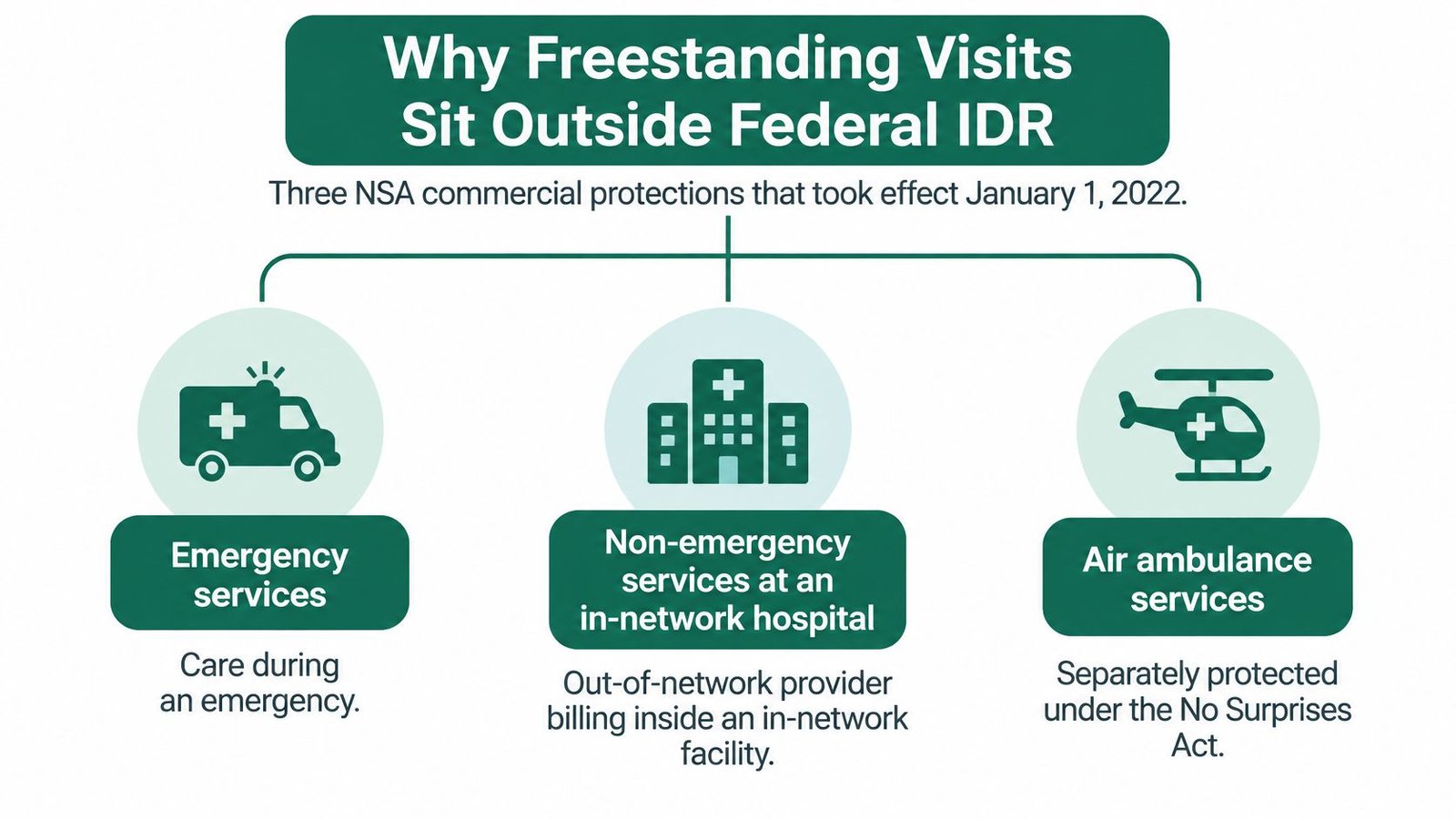
Think of IDR as a facility-and-emergency door, not a specialty door. The CMS overview of No Surprises Act rules and fact sheets states the Act took effect January 1, 2022, and its core commercial protections target emergency services, certain non-emergency services furnished by an out-of-network provider at an in-network hospital, hospital outpatient department, or ambulatory surgical center, and covered out-of-network air-ambulance services.
Plan type decides whether the door exists
Those rules generally reach group health plans, individual-market coverage, and Federal Employees Health Benefits plans. They don't reach Medicare, Medicaid, Veterans Affairs, TRICARE, or Indian Health Service coverage. A routine office visit is scheduled, delivered in a freestanding office rather than a specified in-network facility, and is neither emergency care nor air ambulance, so the statute generally doesn't force the payer to apply in-network cost sharing or pay your billed charge.
The same therapist billing 97110 and 97140 can be inside the NSA analysis during a qualifying hospital outpatient encounter and outside it in a storefront clinic. Place of service 11 is your usual office marker. Places of service 19 or 22 point to off-campus or on-campus hospital settings and require a different analysis. That's location and service context doing the work, not your specialty name on the door.
What the QPA is and isn't
Owners often ask about the qualifying payment amount, or QPA. Inside a qualifying dispute it's a benchmark concept tied to the plan's median contracted rate, with a base anchored to January 31, 2019 and inflation adjustments after that. It is not the amount Cigna owes your POS 11 claim, and citing it in an office appeal doesn't create IDR eligibility that the visit never had.
When a claim is eligible, the path runs through a 30-business-day open negotiation after the initial payment or denial, and only then can either party start IDR, where a certified entity picks one side's offer. Use our federal IDR process for providers guide only after your track check says eligible. Routing an office underpayment into that portal first burns weeks, and your plan appeal deadline doesn't pause while you wait.
Estimates and State Paths That Still Apply
Outside federal IDR doesn't mean outside every rule. Two separate controls still touch your office, and mixing them up costs you money in different directions.
Good Faith Estimates protect the patient bill
For uninsured or self-pay patients, the CMS fact sheet on Good Faith Estimates says providers generally must give an estimate when care is scheduled at least three business days in advance or when the patient requests cost information, and a patient may dispute a bill that is at least $400 above the estimate. CMS specifically recognizes separately scheduled physical therapy as an item or service that may require its own estimate.
For a recurring plan of care, issue the estimate for services you reasonably expect, then update it when visit frequency, duration, or clinicians materially change. Keep the scheduling and delivery record with the estimate. Our Good Faith Estimate requirements and template for medical practices walks through that paperwork in operational detail.
In our experience, calling that estimate an insurer guarantee creates patient disputes without moving a Cigna or Horizon underpayment by a dollar. The estimate lists expected charges from one provider or facility. It doesn't reprice an insured claim, and it doesn't bind a commercial plan that was never part of the self-pay transaction.
State and plan paths for insured office claims
For insured visits, your live options are the plan's claims procedure, ERISA appeal rights on self-funded plans, and state insurance complaints on fully insured plans. In New Jersey and New York, treat state surprise-billing rules as a screen, not a default. Some emergency and facility fact patterns belong with DOBI in New Jersey or DFS in New York, while a routine OON office visit often remains a plan appeal plus a commercial repricing dispute.
A GFE dispute argues about what the patient owes you. A repricing dispute argues about what the plan owes you. Filing one when you need the other leaves both balances untouched.
Balance billing on a non-qualifying office claim follows the plan's out-of-network cost share and any applicable state limit. It isn't banned the way balance billing is for a qualifying NSA service. Before your team picks DOBI, DFS, or the payer portal, log the plan's funding status on the claim, then follow the steps in how to appeal a denied insurance claim for the plan-level fight. Guessing the forum is how a winnable appeal becomes a timely-filing denial.
Two Underpayment Patterns on Real Visits
A paid claim can still leave a substantial balance unexplained. The examples below are hypothetical illustrations of how the same CPTs can produce different payment results. Place of service, plan type, and whether the visit occurred at an in-network facility determine the claim's legal track.
A $540 visit repriced to $60
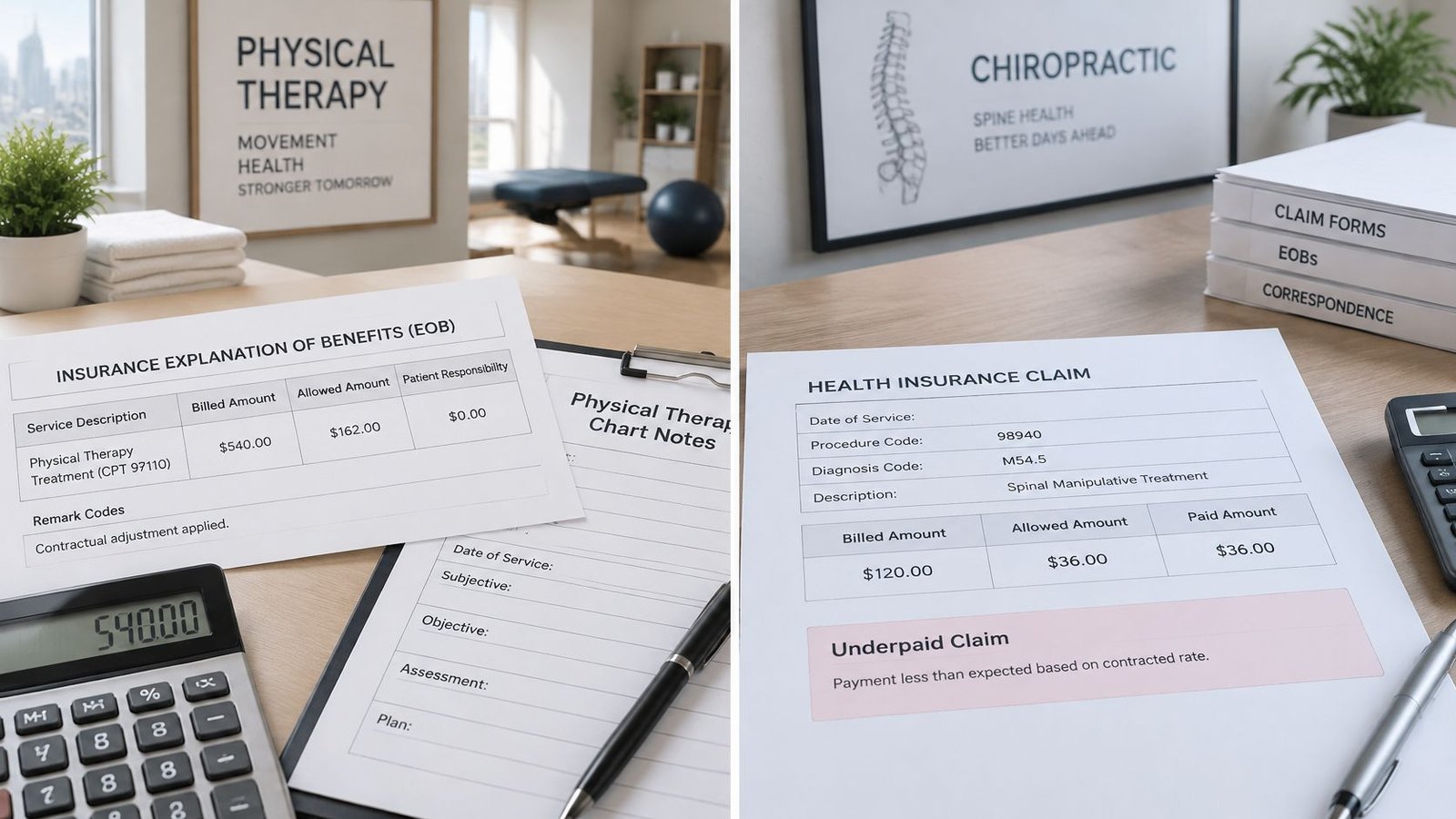
Consider a hypothetical Manhattan office visit billed at $540, with 97140 x2 and 97110 x2. If Cigna pays $60 after Data iSight repricing, compare that payment with the practice's own prior payments for similar visits. If those had been $300 to $400, the difference is $240 to $340 per visit.
That gap is a repricing dispute, not automatically a coding denial. The claim may have processed correctly according to the payer's system while still leaving the practice with a disputed allowance.
Claims near $300 repriced to about $100
In a second hypothetical, Cigna or Horizon reprices a New Jersey sports medicine claim from near $300 to about $100. The roughly $200 difference per visit adds up across a batch of claims, even though each EOB shows a payment.
For your own claims, check four fields before choosing the next step:
- Repricer name: Data iSight, MultiPlan, Zelis, or Naviguard may appear on the remittance.
- Allowed amount: Compare it with the billed charge and the practice's prior payments for similar services.
- Place of service: POS 11 identifies an office setting, but the plan type and facility circumstances still matter.
- Remark code: A repricing or network reduction calls for a payment dispute; a corrected claim alone may not address it.
Payer benchmark language can shape the allowed amount. Reviewing usual and customary rates for out-of-network providers can help frame the gap, but the right claim track still depends on the visit's specific facts. For a freestanding office visit, federal IDR is generally the wrong file.
How We Recover Underpaid OON Office Claims
A low allowed amount is not automatically an IDR case. Recovery starts by identifying the claim's track, the payer's reason for the payment, and the dispute route still available.
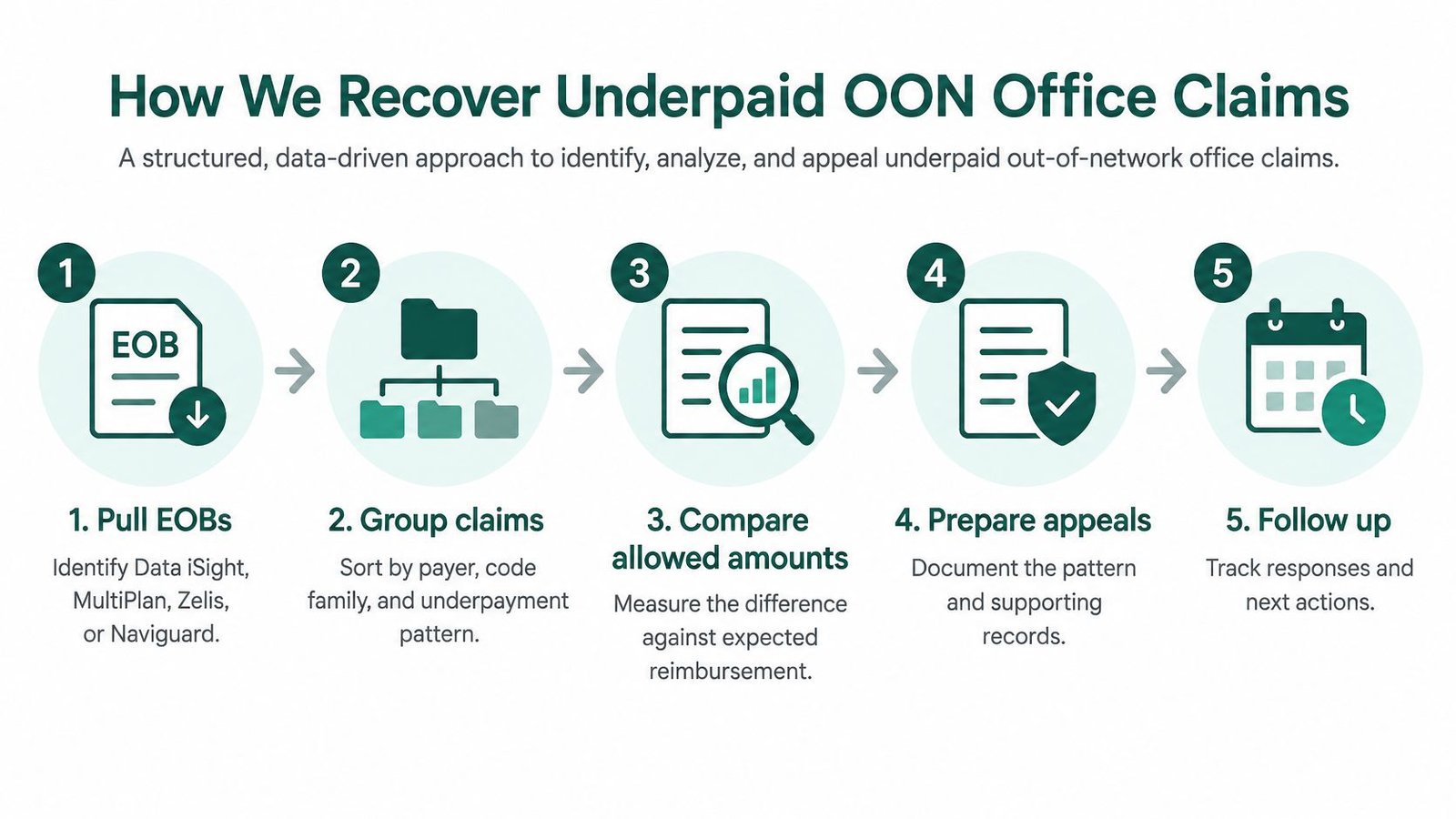
- Pull the EOBs and remittances. Flag claims naming Data iSight, MultiPlan, Zelis, or Naviguard, then sort by payer, code family, place of service, and payment pattern. Coverage questions such as hyperbaric oxygen therapy insurance coverage follow different benefit rules, so keep unrelated claim types out of the same review.
- Group claims with the same issue. A single low payment can be difficult to distinguish from a one-off adjudication. Grouping similar claims makes the recurring repricer reduction and total dollars at stake easier to document.
- Set a supportable payment request. Compare the plan's allowed amount with the billed charge, the applicable contract or plan terms, and relevant regional benchmarks. State the requested amount and show the calculation; do not present a percentile as a guaranteed settlement point.
- Check the dispute deadline before sending anything. Use the date and appeal instructions on the EOB or remittance, and confirm the applicable plan process. A new EOB does not necessarily restart a deadline.
- Send the dispute with the supporting record. Include the clinical documentation and charge support, and explain why the payment does not reflect the services billed. For practical guidance on the claim lifecycle, see how to bill out-of-network insurance.
- Escalate only through an available route. Depending on the claim, that may mean a formal appeal, a provider dispute, or another process allowed by the plan and applicable law. Federal IDR is available only when the claim meets its eligibility requirements.
For qualifying services, CMS explains the federal IDR process: the parties complete a 30-business-day open negotiation after the initial payment or denial before either may initiate IDR. Each side submits an offer, and the certified entity selects one as binding. That process does not turn a freestanding office visit into an eligible IDR claim.
Happy Billing audits historical claims to identify and recover under-reimbursed amounts. Its denial and appeals team investigates rejected claims, identifies the cause, and appeals with clinical evidence when a claim is unfairly denied. The physical therapy underpayment recovery guide outlines the broader recovery workflow.
Appeal Packet and Sample Dispute Language
Assemble the same packet for every file before the first letter goes out. A payer case manager who has to ask you for the note is a case manager who can close your dispute for missing documentation.
The packet checklist
- Original EOB and remittance advice: Include the remark or reason code exactly as the plan printed it.
- Repricer name and allowed amount: Name Data iSight, MultiPlan, Zelis, or Naviguard and the number it produced.
- Signed visit note with timed units: Every 97110 and 97140 line needs time support the reviewer can verify.
- Modifiers and place of service as billed: Don't let the reviewer guess what you submitted.
- Written request for payment rationale: Ask for the fee schedule applied, in the letter itself.
- FAIR Health printout: Same code family, same region, printed before you send anything.
- Assignment of benefits: Include it if one exists, so standing is never the issue.
- Appeal deadline date: Put the calendar date on the file cover, not in someone's memory.
Our out-of-network appeal package checklist and template turns that list into a fillable working document your team can reuse.
Language your team can adapt
We request reconsideration of claim [number] for date of service [date], billed at $540 for CPT 97110 x2 and 97140 x2. The allowed amount of $60 reflects a repricing reduction that is not supported by the plan's published fee schedule or the benchmark enclosed. Please provide the payment rationale and the fee schedule applied, and process this as a formal dispute under the plan's claims procedure.
Keep the letter to one page. Reference only the dates and amounts on the file, and never mention a federal portal unless eligibility is already confirmed. Log every submission date, fax confirmation, and portal receipt so the timeline stays auditable when the payer later claims it never received your dispute. That log is cheap to keep and expensive to reconstruct.
Coding Controls That Stop the Next Leak
A repricer can only cut what survives your own claim scrub. Coding mistakes hand the payer a clean reason to pay nothing at all, and those dollars never even reach the negotiation table.
97110 therapeutic exercise and 97140 manual therapy are the units inside that $540 visit. A missing GP therapy modifier, a wrong place of service, or units the note doesn't support gives the payer a defensible zero while your team argues about a repricing cut on a different claim. Tight unit discipline under the 8-minute rule for therapy billing is what keeps timed codes payable in the first place.
Place of service 11 keeps the claim on the commercial office track where it belongs. Flipping a claim to 19 or 22 to chase IDR eligibility isn't a revenue strategy. It's a compliance problem that can cost you far more than one underpaid visit.
The Medicare chiropractic line
The CMS Medicare billing guidance for chiropractic services states that when a Doctor of Chiropractic orders or performs services, Medicare coverage is limited to manual manipulation of the spine to treat a spinal subluxation, and office visits and physiotherapy are excluded. That's a coverage rule, not a coding preference.
Billing 98940 through 98942 for manipulation is a different coverage question from billing therapy codes to Medicare under a chiropractor's number. Mixing them creates predictable noncovered denials that age in A/R while staff appeal claims that were never payable. Commercial plans aren't Medicare, so your first screen is always payer type, then rendering provider, then the exact service billed.
Put three controls in place this month. Confirm plan funding, network status, and self-pay versus insured status before treatment starts. Scrub units against the timed note before submission, not after the denial. And stop staff from filing every low allowance as an NSA dispute, because that habit alone can cost you the appeal window.
Happy Billing runs end-to-end billing and recovers underpaid out-of-network claims, which is the combination owners are pricing when they compare in-house follow-up against what outsourced billing actually costs. If your team can't work these files at volume, that comparison tells you what handing them off involves.
Book a free 30-minute call
US practices only.
Pricing stays contingency-only, based on claim age and volume, with a clear number given after that call. No fee is quoted here and no recovery is guaranteed.
Questions Practice Owners Ask Next
What if my appeal window already closed
A claim's appeal deadline does not automatically restart because the payer reopens it or issues another EOB. Confirm the applicable deadline and reopening procedure with the plan, and keep the original filing window in view while you ask about any available review.
Should I balance-bill the patient for the repricing cut
Treat the payer dispute and the patient's cost share as separate questions. For a non-NSA office claim, the patient may owe the out-of-network cost share, but state rules, the assignment of benefits, and the EOB determine whether any additional balance can be collected. Check those terms before billing the patient.
Do I need the patient involved if an assignment of benefits is on file
An assignment of benefits may let the practice pursue payment from the plan, but it does not by itself settle every appeal or patient-billing question. Use the EOB, signed note, and relevant benchmark support to document the payer dispute, then confirm who has appeal rights under the plan's procedure.
What does recovery cost and when do I get a number
Send recent EOBs to Happy Billing for review. The team handles end-to-end billing and recovers underpaid out-of-network claims; appeal deadlines should still be confirmed against the plan's own procedure.
For a freestanding PT, chiropractic, OT, or acupuncture practice posting repriced payments as final, Happy Billing can review recent EOBs to help identify which underpaid claims may have a recovery path. The same CPT can follow different rules depending on place of service, plan type, and whether the service was connected to an in-network facility, so the claim track matters before choosing a dispute route.