Expert Guide: How to Appeal a Denied Insurance Claim

To appeal a denied insurance claim, your practice needs a disciplined process: identify the exact denial reason from the ERA or EOB, match it to the clinical and coding record, build a targeted evidence file, and submit a payer-specific appeal within the stated deadline. Practices that do this consistently recover revenue that many competitors write off.
The biggest missed opportunity is that fewer than 1% of denied claims are ever appealed, even though Medicare Advantage data shows that 57% of initial denials are overturned on appeal and prior authorization appeals reached an 83.2% overturn rate in 2022 (Counterforce Health denial statistics). For physician owners and practice managers, that gap is not an administrative footnote. It's avoidable revenue leakage.
Need the letter itself? Our guide on how to write a medical claim denial appeal letter includes a template you can adapt for each payer.
Why Most Denied Claims Are Winnable but Go Unchallenged
Denied claims usually fail for operational reasons that a practice can fix. The payer may be applying an edit that was triggered by modifier misuse, missing documentation, an authorization mismatch, or a policy requirement that was never addressed in the original submission. In revenue cycle terms, that means many denials are recoverable if the team treats them as a technical dispute tied to claim data, not as a final answer.
The core issue is abandonment.
A denied $75 office visit and a denied $4,500 cardiology study often land in the same work queue, touched by the same staff, with the same vague note: "appeal?" That is how collectible dollars age out. I have seen specialty groups write off claims that should have been overturned with a clean operative note, the correct modifier, and a payer policy citation. The loss is not only the denied charge. It includes staff time, filing deadline risk, and a higher downstream write-off rate because no one made a decision fast enough.
Practices usually leave appeal revenue on the table for four specific reasons:
- No financial triage: Teams work denials in date order instead of ranking by allowed amount, filing limit, and probability of overturn.
- No code-level root cause review: Staff reads the plain-language denial but never checks the CARC, RARC, CPT or HCPCS line, modifier combination, NCCI edit, or LCD and payer policy behind it.
- No evidence standard: Appeals are submitted with broad chart notes instead of the exact records that answer the payer's stated reason for denial.
- No owner and no clock: No one is responsible for first appeal, second appeal, peer-to-peer, or external review deadlines, so recoverable claims expire in A/R.
That breakdown hits high-acuity specialties hardest. Orthopedics loses money on global surgery package disputes and modifier 59 or XS line edits. Anesthesia sees denials tied to medical direction rules, concurrency documentation, and time reporting. Behavioral health gets pushed into authorization and time-based note scrutiny. Cardiology gets hit on medical necessity edits for imaging and diagnostic testing, where a missing symptom detail or prior conservative treatment history can decide the outcome.
Generic consumer advice does not solve those problems. An appeal that overturns a CO-50 medical necessity denial looks different from a response to CO-16 missing information or a bundling dispute tied to NCCI procedure-to-procedure edits. One needs policy language and clinical support. Another may need a corrected claim. Another may require the operative report and a modifier defense built line by line.
A useful rule in denial management is simple: if the biller or denial specialist cannot explain the denial in one sentence using the payer code, billed code, and adjudication logic, the claim is not ready for appeal.
Strong teams also treat overturned denials as process failures that need to be closed at the source. If a payer keeps denying 93000, 71260, or prolonged services because documentation does not support the diagnosis or modifier set submitted, the fix belongs upstream in charge capture, coding review, or prior authorization workflow. That is why disciplined groups build a formal medical billing denial management workflow instead of relying on ad hoc follow-up.
An appeal program should recover cash and expose the exact front-end habits that keep creating denials. Practices that do both protect margin. Practices that do not end up funding payer friction with their own write-offs.
Decoding Denial Reasons and Prioritizing Your Appeals
You don't win appeals by arguing harder. You win by classifying the denial correctly before anyone drafts a letter.
Across all plan types in 2024, initial denial rates averaged approximately 11.81%, and research suggests that 90% of medical claim denials are preventable through improved documentation and coding accuracy (Advisement claim denial statistics). That tells you two things. First, denials are common enough to require a system. Second, most start upstream.
Read the ERA like an auditor
The ERA or EOB gives you the first workable version of the truth. Start with the adjustment code, the remark code, the billed line, and the payer's adjudication note.
A few common examples illustrate the difference between an appealable denial and a corrected-claim issue:
| Denial Reason (CARC/RARC) | Common Cause & Example | Required Action for Appeal |
|---|---|---|
| CO-16 | Missing or invalid information. Example: absent documentation, invalid modifier, incomplete rendering detail. | Check the original CMS-1500 or electronic claim, attach missing records or corrected data, and determine whether payer wants a corrected claim or formal appeal. |
| CO-50 | Medical necessity denial. Example: imaging, injections, or therapy denied as not medically necessary. | Pull policy criteria, physician note, test results, prior conservative treatment history, and a Letter of Medical Necessity tied to diagnosis and payer policy. |
| CO-97 | Included in another service. Example: separate procedure denied as bundled. | Review NCCI edits, operative note, anatomic site, encounter timing, and modifier support such as 59, XS, 25, or other appropriate subset modifier. |
| CO-197 | Authorization or precertification issue. Example: no auth on behavioral health or advanced imaging. | Verify whether auth existed, whether the payer processed under the wrong number, and whether records support retrospective review. |
| CO-119 | Benefit maximum reached or benefits exhausted. Example: therapy or visit limit issue. | Confirm benefit accumulation, policy year, and payer application of prior claims. Some are appealable, others require benefit verification correction. |
Not every denial should move straight to appeal. Some should go back as corrected claims. Others need a policy-level challenge.
If your team sees repeated CO-119 activity, it's worth tightening your benefit verification and denial categorization process. This breakdown of the CO-119 denial code is useful because teams often misclassify exhausted-benefit denials as documentation problems.
Sort denials by recoverability, not emotion
Staff naturally wants to work the loudest denial first. That's a mistake. Work the denials with the clearest path to payment.
A practical hierarchy looks like this:
Correctable claim defects
Missing NPI, invalid modifier, wrong place of service, date mismatch, demographic error.Bundling and modifier denials
Claims involving Modifier 59, Modifier 25, or specialty-specific coding logic. These often turn on note detail and coding support.Medical necessity disputes
Higher effort, but often worth it on expensive procedures, imaging, and specialty interventions.Authorization denials
Pursue aggressively when the auth existed, the payer misapplied it, or records support retrospective review.True non-covered services
These require benefit review before anyone burns labor on appeals.
The best denial teams don't ask, "Can we send an appeal?" They ask, "What would make a reviewer reverse this denial?"
Match denial type to specialty risk
High-stakes specialties generate predictable denial patterns.
- Anesthesiology: medical direction, concurrency, base units, time units, and modifier accuracy such as QK, QX, AA, AD.
- Orthopedics: global period disputes, postoperative E/M edits, procedure bundling, and operative note support for distinct services.
- Cardiology: imaging medical necessity, device and procedural coding, and line-level edits.
- Mental health: time-based CPT disputes, authorization denials, and place-of-service mismatches.
When a denial sits in one of those categories, don't hand it to a generalist who only knows "submit records." Hand it to someone who understands the code set and the payer rule behind the denial.
Assembling the Evidence for Your Appeal
A winning appeal package is selective. It doesn't overwhelm the payer with paper. It answers the denial point-by-point with the smallest set of records that proves the payer got the adjudication wrong.
A step-by-step appeals methodology shows that 25% of denials stem from incorrect CPT/HCPCS codes, such as a missing Modifier 59, and incomplete documentation leads to 50% of appeal failures (AHIMA denial resolution approach). That is why evidence assembly matters more than polished writing.
Build the file from the denial backward
Start with the denied line, not the chart. Ask what the payer said was wrong, then gather only the documents that rebut that point.
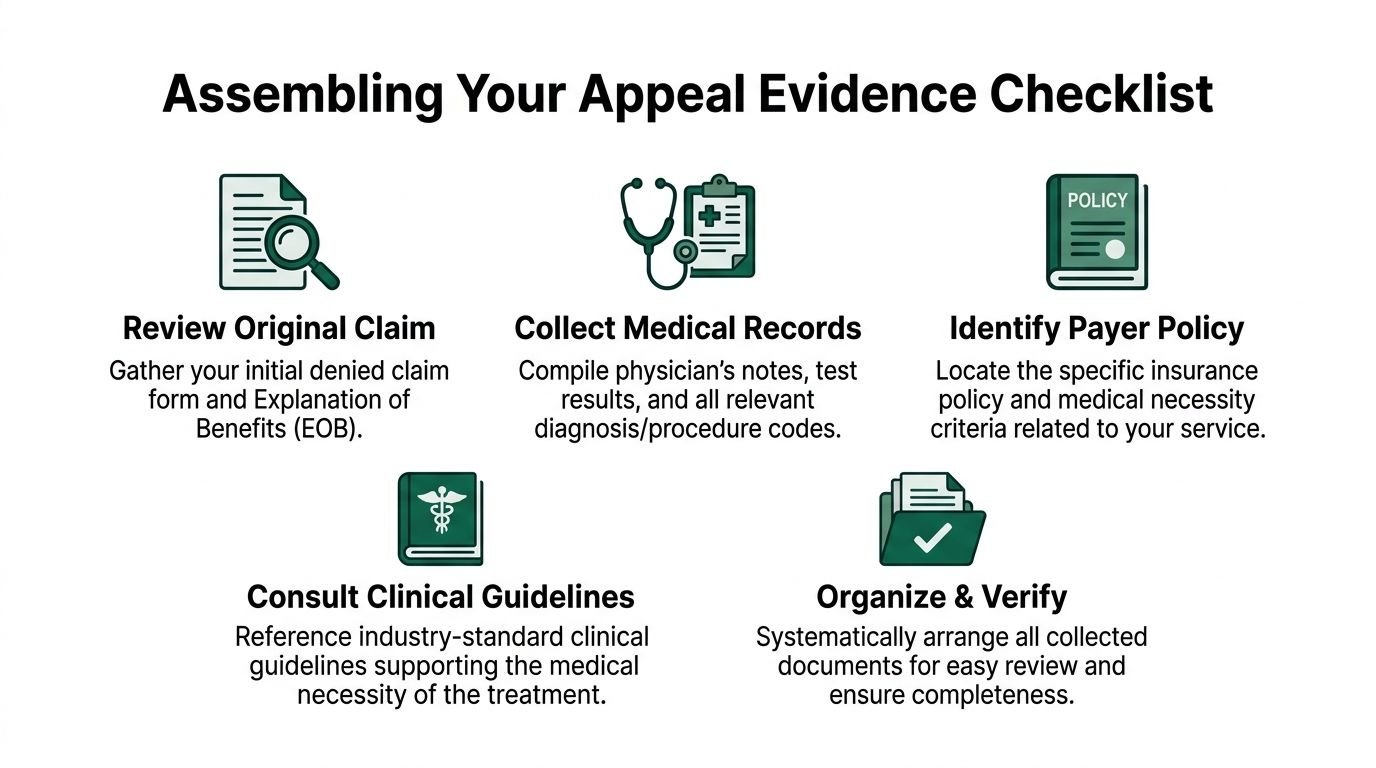
For most practice appeals, the evidence bundle should include:
- Original claim detail: The billed CPT or HCPCS code set, diagnosis links, modifiers, rendering provider, dates of service, and payer claim number.
- ERA or EOB: The denial reason, line-level adjudication, and any CARC or RARC language.
- Relevant chart excerpts: Not the whole chart. Use the history, assessment, plan, procedure note, test result, or start-stop times that directly address the denial.
- Payer policy excerpt: The exact coverage rule, billing rule, or medical necessity requirement applied to the denied service.
- Provider statement: A concise letter or signed note from the physician when clinical judgment, procedural detail, or medical necessity is under dispute.
If you're auditing whether the original submission itself caused the denial, reviewing a clean example of a completed CMS-1500 form is often useful. Many appeal failures start with a claim that was malformed before the medical record ever mattered.
What to include for common denial types
Different denials require different proof. One appeal packet format won't work across specialties.
Coding and modifier denials
Take an orthopedic claim where CPT 29881 is billed with 29877 and the payer bundles one line into the other. If the procedure note supports distinct work, the appeal should include:
- the operative report,
- the exact anatomical detail,
- the procedural sequence,
- the rationale for Modifier 59 or the appropriate X modifier,
- and any payer policy language that recognizes separate reimbursement when documentation supports distinction.
For office-based claims, Modifier 25 disputes often come down to whether the E/M note shows significant, separately identifiable work beyond the procedure. If the physician note is thin, the appeal is weak no matter how upset the front office is.
Medical necessity denials
For CO-50 denials, strong packets usually include:
- diagnosis history,
- failed conservative treatment when relevant,
- test or imaging findings,
- prior treatment response,
- and a physician-authored Letter of Medical Necessity that cites the payer's own criteria or accepted clinical guidelines.
The key is alignment. If the payer policy requires symptom duration, failed first-line treatment, and objective findings, the packet should make those items easy to verify in a minute or less.
Time-based and specialty documentation disputes
A behavioral health appeal for CPT 90837 should not rely on broad statements like "session was clinically appropriate." It should point the reviewer to start time, stop time, total face-to-face time, and the intensity of the intervention documented for that visit.
An anesthesiology appeal involving QK or QX should include the anesthesia record, time documentation, provider involvement details, and any supervision or medical direction elements needed under the payer's rule set.
Send the reviewer to the page, paragraph, and sentence that proves your case. If they have to hunt, you've lowered your own odds.
Organize the packet for speed
Appeals reviewers work quickly. Your packet should let them approve it without reconstructing the claim.
Use this order:
- Appeal letter
- Denial notice or EOB
- Claim form or claim summary
- Payer policy excerpt
- Letter of Medical Necessity or provider statement
- Supporting records in chronological order
- Any corrected coding summary
Label every attachment. If the operative note supports Modifier 59, say that in the index. If the psychotherapy note supports 90837 time requirements, label the page accordingly.
The goal isn't to show how much documentation you have. It's to remove ambiguity.
Writing a Compelling Payer-Specific Appeal Letter
The appeal letter is your argument in final form. It should read like a billing and clinical rebuttal, not like a customer service complaint.
Specialty-specific nuances in modifiers, base units, and global periods drive 30% to 40% of denials in high-stakes fields, yet provider-led strategies focused on those details can achieve 60% to 80% reversal rates (NAIC-focused specialty denial discussion). That happens when the letter is precise.

What every strong appeal letter includes
A payer-specific letter should contain these elements in this order:
- Patient and claim identifiers: patient name, member ID, claim number, date of service, rendering provider, tax ID.
- Denied service detail: each denied CPT or HCPCS code, modifier, and billed diagnosis pairing.
- Reason for denial: use the payer's own wording from the EOB or denial letter.
- Your rebuttal: one short paragraph per denial point.
- Attachment map: list each enclosed document by name.
- Clear request: ask for reprocessing and payment based on corrected coding, documentation, and policy support.
Keep the tone factual. Use sentences a medical director or appeals analyst can verify.
A simple framework works well:
We are appealing the denial of CPT [code] billed with Modifier [modifier] for date of service [date]. The denial states [payer reason]. Based on the enclosed documentation and the applicable billing policy, the denial should be reversed and the claim reprocessed for payment.
Use code-level language, not general objections
The weakest appeal letters say the service was medically necessary and ask for reconsideration. That language wastes space.
The stronger version identifies the exact defect in the payer's adjudication. For example:
Orthopedics bundling appeal
If the payer denied 29877 as included with 29881, don't argue broadly that "both procedures were performed." Instead say:
- the services were documented in the operative report,
- they involved distinct work as supported by the note,
- Modifier 59 was appended to identify a distinct procedural service,
- and the claim should be reprocessed according to payer policy and the operative documentation.
Mental health time-based appeal
For a denial of 90837, don't say "the patient needed a full session." Say the clinical record documents start time, stop time, therapeutic interventions, and medical necessity for the reported service duration. Direct the reviewer to the exact note section.
Anesthesiology medical direction appeal
If Modifier QK is denied, the letter should reference the anesthesia record, physician involvement, timing, and concurrency documentation. The reviewer needs to see that the record supports the reported medical direction relationship and that the billed modifier matches the service configuration.
For specialty practices that deal with these issues routinely, the most useful reference point is practical code-level guidance by field. That's why practice owners often compare workflows by specialty at Happy Billing's specialty pages, especially for anesthesiology, mental health, cardiology, and orthopedics.
A practical letter structure that works
Use short sections. Reviewers don't want long narratives.
Opening statement
State the denied claim, the denied code, and the requested action.
Denial rebuttal
Address each reason separately. If there are two denied lines, give each its own paragraph.
Documentation support
List the enclosed records by function, not just by file name.
- Operative report: supports distinct procedural work for Modifier 59
- Office note: supports significant, separately identifiable E/M for Modifier 25
- Anesthesia record: supports billed provider role and time reporting
- Psychotherapy note: supports duration and intensity of 90837
Policy support
If the payer has a published rule, quote or paraphrase the relevant requirement accurately and tie it back to your documents.
Avoid the mistakes that sink otherwise valid appeals
Three errors show up repeatedly:
- Generic templates: If the same appeal letter goes to every payer, the staff is doing clerical work, not appeals work.
- No line-item analysis: Multi-line denials need line-specific rebuttals.
- Poor modifier support: A claim with Modifier 25 or 59 lives or dies on the note, not on the modifier itself.
Reviewing modifier logic before the letter goes out benefits teams. A focused reference on CPT Modifier 25 is especially useful because many practices either overuse it or fail to support it in the note.
The payer doesn't need your frustration. The payer needs a clean reason to reverse the denial without asking for more information.
Advanced Appeals and Escalation Pathways
When the first appeal fails, the claim is not dead. It has moved into a different level of review, and that level often requires a different strategy.
Post-internal appeal escalation can be highly effective. Recent Illinois data shows that mandated transparency in AI-driven denials can boost overturns in external reviews by as much as 20% (Illinois external review guidance). That matters because more denials now originate from automated review logic that misses clinical nuance.

Know which escalation path fits the denial
Not every second-step action is the same.
Second-level internal appeal
Use this when the payer upheld the first denial but failed to address a clear coding or documentation argument. This is common when the first review was superficial.
A second-level appeal should do two things differently:
- tighten the rebuttal to the payer's first response,
- and add any missing policy language or provider statement.
If the payer ignored your operative note, quote the relevant operative language in the body of the appeal.
Peer-to-peer review
This works best for medical necessity disputes. It is not the right tool for basic registration errors or obvious coding edits.
A good peer-to-peer review requires the physician to prepare before the call. The physician should know:
- the payer's denial rationale,
- the clinical standard used in treatment selection,
- the patient's failed prior management if relevant,
- and exactly where the chart supports the requested service.
For imaging, interventional cardiology, pain procedures, and behavioral health authorization denials, a vague physician call rarely works. A focused clinical defense does.
If the physician enters peer-to-peer without the payer policy and chart in front of them, the practice is gambling with collectible revenue.
External review is a real revenue path
Many practices stop after internal appeal denial because external review sounds burdensome. In reality, external review is often the first time an independent reviewer sees the file without payer bias or flawed automation.
External review is especially worth pursuing when:
- the denial turns on medical necessity,
- the payer misapplied its own published criteria,
- an internal reviewer ignored submitted documentation,
- or the case value justifies the staff and physician time.
The packet should be cleaner at this stage than it was for internal review. Remove duplicate pages. Keep the best evidence. Highlight policy conflict.
Escalation discipline matters more than volume
Advanced appeals fail when teams lose control of dates and versions.
A workable escalation protocol includes:
- One owner per claim: Someone must track submission, acknowledgment, follow-up, and reviewer response.
- A denial chronology: Keep one running log of every call, portal upload, fax, and written response.
- Physician prep before peer-to-peer: Never schedule the call and hope the doctor can wing it.
- State and payer rule review: External review processes vary, and the filing requirements matter.
What works is deliberate escalation. What doesn't work is recycling the same generic first-level appeal and hoping a different reviewer reacts differently.
Shifting from Reactive Appeals to Proactive Prevention
The best denial appeal program eventually makes itself less necessary.
You still need a strong appeal engine. But if your team keeps overturning the same denials month after month, the practice isn't learning. It's just cleaning up after itself.
Use appeal outcomes as root-cause evidence
Every overturned claim tells you where the original workflow failed.
Across plan types in 2024, initial denial rates averaged approximately 11.81%, and research suggests that 90% of medical claim denials are preventable through better documentation and coding accuracy. That should push every practice to close the loop operationally. The clean-claim mindset matters more than the heroic-appeal mindset.
The most useful questions after an overturn are simple:
- Did front-end eligibility or authorization fail?
- Did coding miss a modifier, diagnosis link, or payer-specific rule?
- Did the provider note fail to support the billed service on first submission?
- Did the billing team submit a claim that should have been scrubbed out?
A practice that reviews those questions monthly gets better. A practice that celebrates recovered cash but doesn't change the workflow stays stuck.
Build denial intelligence into pre-claim work
High-performing billing offices push appeal lessons upstream.
That means:
- Updating scrubber rules: Flag recurring edits tied to modifiers like 25 and 59, authorization fields, or place-of-service mismatches.
- Training by specialty: Orthopedics needs global period discipline. Anesthesiology needs concurrency accuracy. Behavioral health needs airtight time and auth documentation.
- Reviewing payer patterns: If one payer repeatedly denies a code family, audit that payer before claims go out.
- Auditing note sufficiency: The chart should support the CPT code before the bill drops, not after a denial arrives.
Practices that focus on pre-bill quality usually perform better than practices that rely on post-denial recovery. A practical benchmark for that mindset is understanding what qualifies as a clean claim in medical billing, then building edits around that standard.
Appeals recover revenue. Prevention protects margin.
Frequently Asked Questions
How should a practice appeal a Modifier 59 denial on a surgical claim
Start with the operative note. The appeal should show distinct procedural work, not just that two CPT codes were billed on the same date.
If the payer bundled 29877 into 29881, point the reviewer to the specific operative language that supports a separate service. Include the denied line, the original modifier usage, and any payer policy that recognizes separate reimbursement when documentation supports distinction.
What's the best way to appeal a denial of CPT 90837
Use the psychotherapy note, not a generic medical necessity statement. The record should clearly show start time, stop time, service duration, and the clinical content that supports the reported code.
If the denial also involved authorization, include the authorization record or any proof that the payer had prior notice and processed the claim incorrectly.
When should a physician get involved directly in an appeal
Bring the physician in when the denial turns on clinical judgment, medical necessity, anesthesia medical direction, or another issue that only the treating physician can explain credibly.
For peer-to-peer review, the physician should have the denial letter, payer criteria, and chart excerpts ready before the call. An unprepared peer-to-peer rarely changes the outcome.
Is it better to submit a corrected claim or a formal appeal
It depends on the denial. If the issue is clerical or formatting, such as missing information, wrong modifier use, or a claim data error, a corrected claim may be faster.
If the payer denied based on medical necessity, bundling logic, benefit interpretation, or authorization findings you dispute, submit a formal appeal with a structured evidence packet. Misclassifying that choice costs time and often causes timely filing problems.
Happy Billing helps high-stakes practices turn denial management into a disciplined revenue recovery system. If your group needs sharper modifier compliance, specialty-specific appeal workflows, or stronger first-pass performance in anesthesiology, mental health, cardiology, orthopedics, or multi-specialty billing, see how Happy Billing approaches full-cycle RCM with AI-assisted review and expert human auditors.