Fixing the CO 119 Denial Code for Practice Growth

The CO 119 denial code means the patient’s benefits for the service are exhausted, forcing your practice to absorb the cost as a contractual write-off. While it appears to be a patient benefit issue, this denial is frequently triggered by preventable internal errors like duplicate billing, incorrect CPT codes, or missing modifiers that falsely indicate a benefit limit has been reached. A disciplined billing process can prevent and overturn these costly denials.
But here’s the inside scoop: while CO 119 looks like a patient benefit issue, a huge number of these denials aren’t caused by true over-utilization. They’re triggered by preventable administrative errors that you can—and should—fix.

Decoding the CO 119 Denial Code
Think of a patient’s insurance plan as a pre-loaded debit card, but with separate buckets of money for different services—like physical therapy, mental health sessions, or chiropractic visits. The CO 119 denial code is the payer's alert that the funds in one of those buckets have just run out.
Once that limit is hit, the payer stops paying. Under your contract, you’re usually required to absorb the loss. This is especially painful for specialties with recurring appointments, where limits are tracked by visit counts, dollar amounts, or service frequency over the plan year.
It's a common myth that a CO 119 denial is always the patient’s fault for using too many services. In reality, a big chunk of these denials are a direct result of internal billing mistakes—like submitting duplicate claims, using the wrong CPT codes, or failing to add a necessary modifier—which trick the payer into thinking a benefit limit has been exhausted.
Common Payer Limits That Trigger CO 119
Knowing the caps is the first step to avoiding them. Payers like Medicare, UnitedHealthcare, and Anthem have firm limits that, if you aren't tracking them, will almost guarantee a denial.
For example, per CMS guidelines, Medicare’s annual therapy threshold for 2026 is $2,480 for physical therapy and speech-language pathology combined. Any claim that pushes a patient over this amount will get an automatic CO 119 denial unless it includes a KX modifier attesting to its medical necessity.
It's the same story with commercial plans. Many impose visit-based limits that can catch even the most diligent billing teams off guard. A classic example is a plan that only covers 20 sessions of psychotherapy (CPT 90837) per year. If your front desk isn’t tracking this from visit one, that 21st session is going to get denied. This is why proactive benefit verification isn’t just a nice-to-have; it's a non-negotiable part of protecting your cash flow.
It’s important to distinguish this from other claim issues. CO 119 is about hitting a benefit limit, whereas other codes flag different problems. To see how it differs, check out our guide on the CO 236 denial code, which deals with procedure and diagnosis mismatches.
Typical Payer Limits Triggering CO 119 Denials in 2026
Tracking benefit maximums is a constant battle, especially across different payers and specialties. This table shows some of the common annual limits that frequently lead to CO 119 denials if they aren't monitored closely from the start of the patient's benefit year.
| Specialty | Service Type | Typical Payer Limit Example (2026) | Relevant CPT Codes |
|---|---|---|---|
| Mental Health | Outpatient Psychotherapy | 20-30 sessions per year | 90834, 90837 |
| Cardiology | Cardiac Rehabilitation | 36 sessions per benefit period | 93797, 93798 |
| Orthopedics | Physical Therapy | $2,480 threshold (Medicare Part B) | 97110, 97140, 97530 |
| Anesthesia | Chronic Pain Injections | 4 epidural steroid injections per year | 62321, 62323 |
Remember, these are just examples. The real limits are buried in each patient’s specific plan. Without a system to verify and track these numbers for every single patient, you're essentially flying blind and leaving your revenue exposed to predictable, and preventable, denials.
How Payers Describe CO 119 Denials on EOBs
The official denial code might be CO 119, but you'll almost never see that clean, simple code on an EOB. That would be too easy.
Instead, payers have a dozen different ways of saying the same thing, and this confusing language is often where the trail goes cold for an inexperienced billing team. They use a variety of phrases that mask the real reason for the denial: the patient's benefits for that specific service have run out.
Think of it like this: Aetna, Humana, and Anthem are all telling you the patient’s plan won't pay, but they're each speaking a slightly different dialect. The key isn't to memorize every single phrase, but to train your team to spot the pattern and translate it back to the core issue.
Here's the bottom line: The language on the EOB is just a symptom. Whether it says "visit limit met" or "benefit maximum has been reached," the underlying problem is the same. The payer believes a contractual service cap has been hit. Your job is to find out if they’re right.
Common EOB Phrases for CO 119
When a denial comes in, stop looking for the CO 119 code. Instead, scan the remark codes and descriptions for any language that points to benefit exhaustion. These are dead giveaways that you're dealing with a benefit limit denial.
Watch for phrases like:
- Services have been exhausted for this benefit period.
- Annual visit limit met.
- The maximum benefit has been paid for this service.
- Benefit maximum for this time period has been reached.
For a cardiology practice, this might look like a "Benefit maximum reached" denial after a patient’s 37th cardiac rehab session (CPT 93798) when their plan only covers 36. A mental health provider will see the same thing, just worded differently: an EOB stating "Annual visit limit met" for a psychotherapy session (CPT 90837) that was the 21st visit in a plan year that caps at 20.
Learning to read this language is the first step in turning denials around. It allows your team to stop scratching their heads and start pulling the patient’s utilization records to see if the payer’s count is correct. Building this skill is a cornerstone of effective medical billing denial management. Once you recognize the patterns, you can immediately shift from confusion to a clear plan for getting that claim paid.
Finding the True Root Cause of CO 119 Denials
It’s a common story: a CO 119 denial code lands on your desk, and the immediate assumption is that the patient simply ran out of benefits. But more often than not, the real culprit isn’t the patient—it’s a preventable slip-up in your own billing workflow.
These denials are a quiet tax on your practice’s revenue. They look like legitimate write-offs, but many are just simple administrative mistakes in disguise, turning recoverable cash into a permanent loss. Things like duplicate claims or billing a service under the wrong CPT code make it look like the patient has hit their limit when, in reality, they haven't.
Think of the payer’s system as a simple calculator. If you accidentally punch in the same charge twice or use the wrong number entirely, the total will be wrong. That’s exactly what happens with these billing errors—they lead the payer's system to a false conclusion, triggering a CO 119 denial.
Administrative Gaps and Authorization Failures
Some of the most common—and avoidable—root causes happen right at the front desk. These are breakdowns in basic processes, like failing to get prior authorization or forgetting to re-verify a patient's benefits when their plan renews mid-year.
For example, a commercial plan might cover 20 mental health sessions (CPT 90837) per year. If your front office isn't tracking visit counts and schedules a 21st session without confirming if extended care is approved, that CO 119 denial is all but guaranteed.
These gaps are the low-hanging fruit for improving your practice's financial health. Tightening up these front-end processes is a crucial first step when evaluating your revenue cycle performance metrics.
Critical Coding and Modifier Mistakes
On the back end, coding mistakes can be just as costly. CO-119 denials don’t just happen when benefits are truly exhausted; they get amplified by billing errors that create a false story of overutilization.
A classic example is forgetting to append the KX modifier on Medicare claims for medically necessary therapy that goes beyond the $2,480 threshold for 2026. Without it, the claim is automatically rejected. This and other common denial code triggers on sprypt.com can be easily avoided.
These simple mistakes create the illusion that benefits are maxed out. They usually fall into one of these categories:
- Missing Modifiers: Forgetting the KX modifier tells Medicare a service isn't medically necessary past the cap, even when it is.
- Unbundling Procedures: Billing services separately when they should be bundled makes it seem like more services were rendered than actually were.
- Duplicate Submissions: A simple clerical error, like sending the same claim twice, will instantly double-count services against the patient’s limit.
Fixing these internal errors is the key. It shifts your team's focus from reactively fighting a CO 119 denial code to proactively protecting your revenue before a claim ever leaves your system.
A Step-by-Step Plan to Appeal CO 119 Denials
When a CO 119 denial lands on your desk, it’s easy to feel like you’ve hit a dead end. The payer is simply saying, "benefits exhausted." But writing that claim off as a loss is a cash flow leak you can't afford. A disciplined workflow is your best defense, turning these denials into recovered revenue.
The first move is always to verify the payer's claim. Before you even think about an appeal, your team needs to get into the payer portal and pull the patient’s utilization history. Is the benefit limit really maxed out, or did a simple clerical error trigger the denial?
This initial check is where you’ll find the low-hanging fruit. More often than not, the problem isn't with the patient's benefits but with an internal mistake.
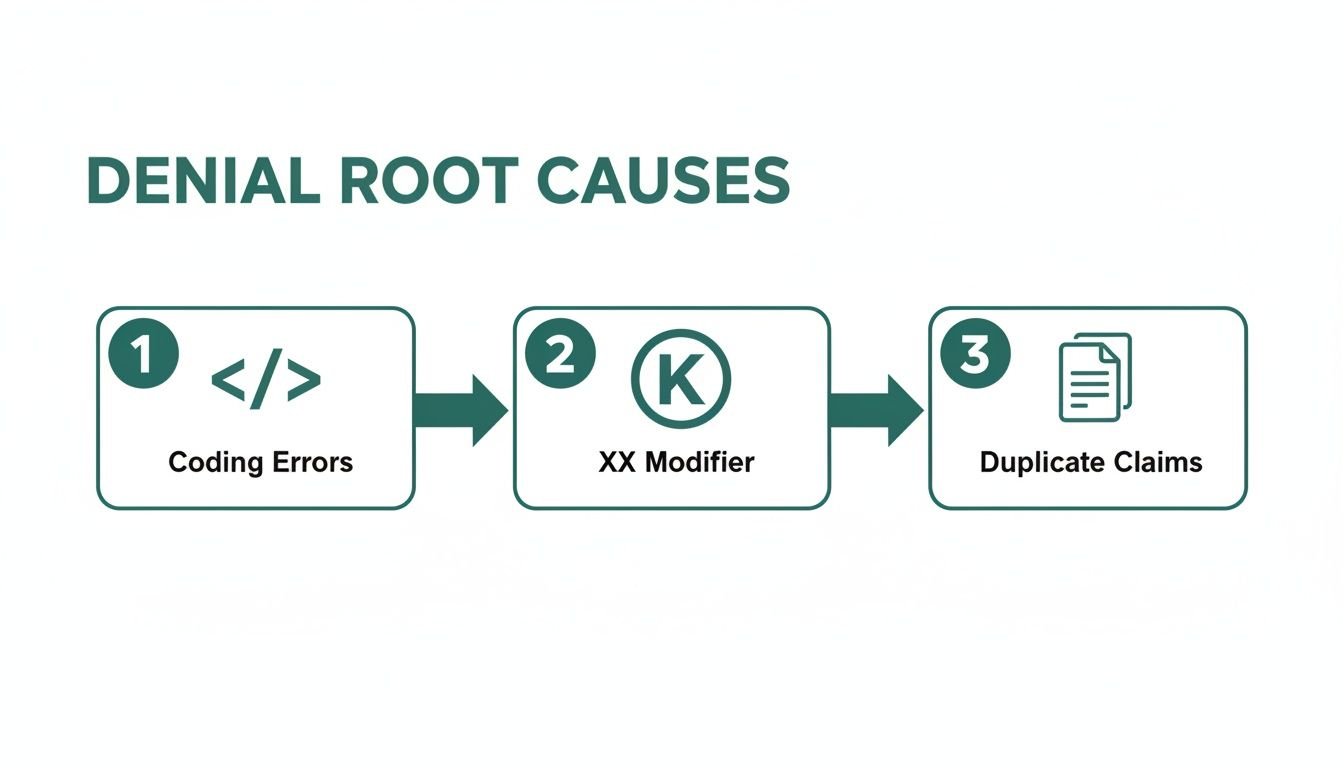
As you can see, the root cause is frequently a controllable billing mistake. If your audit uncovers something simple, like a duplicate charge that was submitted twice, the fix is easy. Just void the bad claim and resubmit a corrected one.
Building an Appeal for Medical Necessity
What if your audit confirms the standard benefits are exhausted, but your physician insists the care must continue? Now, you pivot from a simple correction to a formal appeal based on medical necessity. This is your chance to argue that stopping treatment would harm the patient, justifying payment beyond the standard cap.
A strong appeal is built on rock-solid evidence, not just a resubmitted claim. You need to tell a compelling clinical story backed by documentation.
An appeal for a CO 119 denial is not a request; it's an argument. You are presenting a case that the patient's clinical needs override the payer's standard contractual limits. The strength of your documentation is the only thing that will win this argument.
For example, say Medicare denies a physical therapy claim (like CPT 97110) because it surpassed the $2,480 therapy threshold for 2026. Your appeal must include the KX modifier and a physician-signed letter explaining medical necessity. That letter should point to specific progress notes showing measurable improvements and detailing the functional goals the patient has yet to reach. For practices needing help with these nuances, our anesthesiology billing services team regularly builds these types of evidence-based appeals.
Your Appeal Submission Workflow
Once you’ve gathered your documentation, you need a clear, repeatable process for submission and follow-up. A simple checklist ensures no step gets missed and no appeal falls through the cracks. This is the exact kind of workflow our RCM teams at Happy Billing use to systematize denial management for our clients.
Below is a checklist your practice manager can use to create a standardized response to every CO 119 denial.
CO 119 Denial Response Checklist
| Step | Action Item | Key Objective | Responsible Party |
|---|---|---|---|
| 1. Triage | Log into the payer portal and review the patient’s utilization history against the EOB. | Confirm if benefits are truly exhausted or if it’s a clerical error (e.g., duplicate claim). | Billing Specialist |
| 2. Correct or Appeal? | If a clerical error is found, submit a corrected claim. If benefits are exhausted, proceed to build the appeal. | Choose the fastest path to resolution. Avoid unnecessary appeals. | Billing Manager |
| 3. Compile Evidence | Gather the physician’s letter of medical necessity, progress notes, and diagnostic reports. | Create an evidence package that proves continued care is essential. | Clinical Staff / Biller |
| 4. Draft Appeal | Write a formal appeal letter referencing the patient's history, progress, and remaining deficits. Attach all supporting documents. | Present a clear, compelling argument for overriding the benefit limit. | Billing Specialist / Physician |
| 5. Cite Policy | If available, reference the payer’s own medical policy or CMS guidelines that support an exception. | Use the payer’s own rules to strengthen your case. | Denial Specialist |
| 6. Submit & Track | Submit the appeal package via the payer's preferred method (portal, certified mail) and log the submission date in your system. | Ensure proof of timely filing and create a tracking record. | Billing Specialist |
| 7. Follow-Up | Set a calendar reminder to follow up on the appeal status in 30 days. | Prevent the appeal from getting lost and ensure a timely decision from the payer. | Denial Specialist |
Following a structured checklist like this takes the guesswork out of the appeal process. It creates accountability and ensures that every denial is handled consistently, maximizing your chances of getting paid for the critical care your physicians provide.
Specialty-Specific Strategies to Prevent CO 119
Preventing the CO 119 denial code isn’t a one-size-fits-all game. If you’re using generic advice to handle it, you’re losing money. The real-world prevention tactics that work for a mental health practice are completely different from those needed in an orthopedic group, because the billing patterns, CPT codes, and payer rules are worlds apart.
This is especially true in specialties heavy on therapy, where visit caps are a constant threat. In the high-stakes world of medical billing, CO-119 is a major revenue killer. It's the payer's way of saying, "the benefit maximum for this time period or occurrence has been reached." This denial hits hardest in fields like physical therapy, mental health, and chiropractic care, where many commercial plans enforce strict annual visit caps—often just 20 to 60 sessions for a whole year.
Mental Health Best Practices
For mental health practices, the fight against CO 119 is won or lost by meticulously tracking session counts. It’s no secret that payers love to limit outpatient psychotherapy sessions. This makes proactive management of common codes like 90837 (60-minute therapy) and 90847 (family therapy) absolutely essential.
- Build a Session Counter: Your EHR or practice management software must have a clear, visible counter for each patient’s authorized sessions. Set it up to flag any account that gets within two visits of their limit.
- Re-Verify, Always: Never assume benefits roll over unchanged from one year to the next. We see it all the time: a patient’s plan suddenly drops its annual session limit from 30 down to 20, and the practice gets caught completely off guard mid-treatment.
Orthopedics and Global Periods
Orthopedic practices get hit with CO 119 denials all the time for post-operative care that gets billed incorrectly outside the global period. A classic mistake is billing for a standard E/M visit within the 90-day global period of a major procedure, like a total knee arthroplasty (CPT 27447).
Think of a global period as an all-inclusive resort package. The payment for the main surgery already covers typical follow-up care. Billing for a simple post-op visit separately is like trying to charge for the buffet after you've already paid for the all-inclusive wristband. Payers see it as double-dipping, and it triggers a swift denial.
To get around this, your billers have to append the right modifier. If the visit is for a truly separate issue, use modifier 24 (Unrelated E/M service by the same physician during a post-op period). Otherwise, the visit is considered part of the package, and the claim will be denied.
Cardiology Follow-Up Management
Cardiology practices need to be incredibly careful with visit frequencies, especially for follow-ups after major interventions. For example, after a percutaneous coronary intervention (like a stent placement, CPT 92928), a health plan may have very specific limits on how many follow-up office visits or diagnostic tests it will cover within a certain timeframe.
Systematically tracking these follow-ups against payer-specific frequency rules is the key to getting paid. If a plan only covers one routine follow-up per 90-day period after the procedure, scheduling a second one without rock-solid medical necessity is just asking for a CO 119 denial. Building a robust process to manage these details is critical, and we offer more expert guidance in our article on managing cardiology billing denials.
How a Proactive RCM Partner Eliminates CO 119 Denials
Trying to manually track every patient’s benefit limits across hundreds of payer plans is a recipe for disaster. This administrative overload is a direct cause of CO 119 denial code rejections, turning predictable income into painful, unnecessary write-offs.
A true RCM partner doesn’t just clean up denial messes; they stop them from happening in the first place. We build a denial prevention engine right into your practice's workflow.

The process starts with smart technology integrated directly with your EHR. Our system flags patients approaching their benefit caps before they even come in for their appointment. This simple alert creates a critical opportunity to have clear financial conversations upfront.
Fusing Technology with Human Expertise
But technology alone is never the whole answer. Software can flag a risk, but it takes an expert to secure the revenue. Our dedicated auditors act as an extension of your team, providing a layer of human oversight that algorithms simply can’t match.
Before any claim leaves the building, our team runs it through a rigorous pre-submission audit. This isn't just a simple check for typos. We dig deeper.
- Verifying Modifier Accuracy: We make sure vital modifiers, like the KX modifier needed for Medicare therapy claims that exceed the annual cap, are applied correctly to justify medical necessity.
- Eliminating Duplicate Charges: Our systems and auditors catch duplicate billing mistakes that can incorrectly max out a patient’s benefits.
- Confirming Authorization: We double-check that every required prior authorization is on file and properly linked to the exact CPT codes being billed.
This combination of smart technology and hands-on expert review is how we hit a 98%+ first-pass clean claim rate. We turn the CO 119 denial from a major source of revenue loss into what it should be: a rare, fixable exception.
When you outsource your billing, you aren't just handing off tasks. You’re embedding a denial prevention engine directly into your operations. It’s the difference between chasing old debt and building a financially resilient practice.
Understanding how this integrated approach works is fundamental to your practice's long-term financial health. You can see how this model drives results in our complete guide to outsourced revenue cycle management. By letting experts manage the complexities of benefit tracking and claim submission, your team can get back to focusing on patient care and strategic growth.
Can I Bill the Patient After a CO 119 Denial?
Almost always, no. If your practice is in-network, your payer contract almost certainly obligates you to write off the balance. Trying to bill the patient for this amount is a fast way to violate your agreement and risk serious penalties. The only way around this is to be proactive. This means verifying benefits before the service, seeing that a treatment will hit the patient’s plan limits, and getting a signed financial waiver. For Medicare, that’s the Advance Beneficiary Notice (ABN); commercial payers have similar forms. Without that signed waiver, dated before the service, you have no grounds to bill the patient.
What Is the Difference Between a CO 119 and a CO 29 Denial?
This is a critical distinction that every billing team must master. A CO 119 denial is about the patient’s insurance plan limits, whereas a CO 29 denial indicates your practice failed to submit the claim on time. According to AAPC standards, one is a utilization issue while the other is a critical operational failure. CO 119 (Benefit Maximum Reached) means the patient exhausted covered visits or the dollar limit for that service. CO 29 (Time Limit for Filing Expired) means your team missed the payer’s filing deadline, which can be as short as 90 days. Knowing the difference is the first step toward fixing the correct root cause. Our approach to cardiology billing services shows just how differently we tackle these distinct challenges.
How Can I Justify Medical Necessity to Overturn a CO 119 Denial?
Winning a CO 119 denial appeal comes down to building an undeniable case with clinical proof. You can't just resubmit the claim; you must prove that stopping care is medically harmful. Your appeal must be built around a detailed Letter of Medical Necessity from the treating physician that explains precisely why stopping treatment would be detrimental to the patient’s health and recovery. Use progress notes to show quantifiable improvements (e.g., increased range of motion by 20 degrees) and outline the specific functional goals that remain, directly linking continued treatment to achieving them. Strengthen your argument by referencing the payer's own medical policies or CMS guidelines that define exceptions to increase your odds of getting the denial overturned.
At Happy Billing, we turn denial management from a reactive chore into a proactive strategy. Our blend of AI-driven insights and expert human audits helps prevent CO 119 denials before they ever hit your books, protecting your revenue so your team can focus on patients. Stop writing off recoverable money. See how our tailored RCM solutions can protect your bottom line by visiting us at happybilling.co.