Out-of-network Assistant Surgeons and Orthopedic Surgeons: Recovering Underpaid Claims Under the No Surprises Act
An assistant-surgeon claim may be paid, but the allowance can still fall short of the work documented in the operative report. For eligible out-of-network underpayments, the recovery route depends on the service setting, payer jurisdiction, and filing deadlines. A protected assistant-surgeon shortfall belongs in a payer dispute, not on a patient statement.
Writing off the balance without review hides revenue leakage. Leaving it in a general appeals queue can also cost time while a deadline for a stronger recovery route approaches.
Happy Billing is headquartered in Texas and recovers underpaid out-of-network claims for practices in New Jersey and New York, including orthopedic practices.
Which Assistant Surgeon Claims the NSA Covers
An assistant surgeon's network status must be evaluated separately from the primary surgeon's. Under the CMS No Surprises Act fact sheet, out-of-network assistant surgeons providing protected ancillary services at an in-network hospital, hospital outpatient department, or ambulatory surgical center generally cannot balance-bill beyond applicable in-network cost sharing or use notice-and-consent to waive those protections.
That distinction matters for independent orthopedic, spine, and assistant-surgeon groups. A primary surgeon's consent paperwork doesn't automatically remove the assistant's protection, and the primary surgeon isn't classified as ancillary merely because the assistant is.
Where each underpaid assistant or orthopedic claim goes
| Situation | Patient balance | Recovery path | Do not |
|---|---|---|---|
| OON assistant at an in-network hospital, HOPD, or ASC, emergency or nonemergency | In-network cost share only for protected services | Open negotiation, then federal IDR where federal jurisdiction applies | Balance-bill or use notice-and-consent for the assistant |
| Scheduled case with valid consent for an OON primary surgeon | Consent may waive protection for the consented provider | Re-check the assistant separately; assistants generally remain ancillary | Assume the whole case left the NSA |
| Office or elective care outside a qualifying facility | Applicable plan terms, patient agreement, and law | Commercial OON repricing review and payer dispute | File federal IDR solely because payment is low |
| Medicare or Medicaid | Program cost sharing | Medicare assistant rules or applicable Medicaid appeals | Use federal commercial IDR |
The Department of Labor's surprise-billing guidance distinguishes protected services from situations where a patient may validly consent to an out-of-network provider. For an owner, the operational lesson is to classify each professional claim, rather than assign the entire surgical encounter a single billing status.
Preserve the receivable before deciding its destination
Freeze the discretionary write-off while someone verifies eligibility. Keep the remittance, record when it arrived, and preserve the facility and professional network-status evidence for the date of service.
Your review should establish:
- Setting: Was the service furnished at a qualifying facility or in an ordinary physician office?
- Jurisdiction: Does federal IDR apply, or does a state payment-dispute process govern?
- Provider role: Was this the primary surgeon, physician assistant surgeon, or nonphysician assistant?
- Documentation: Can the practice connect the billed service to the operative report and payment determination?
The distinction between physician-office services and NSA-covered encounters prevents wasted filings. For groups combining complex surgery with office care, spine and neurosurgery billing workflows should keep those receivables on separate recovery tracks.
Book a free 30-minute call with a billing specialist to review which recovery track fits your underpaid claims.
US practices only.
What Modifiers 80 81 82 and AS Are Worth
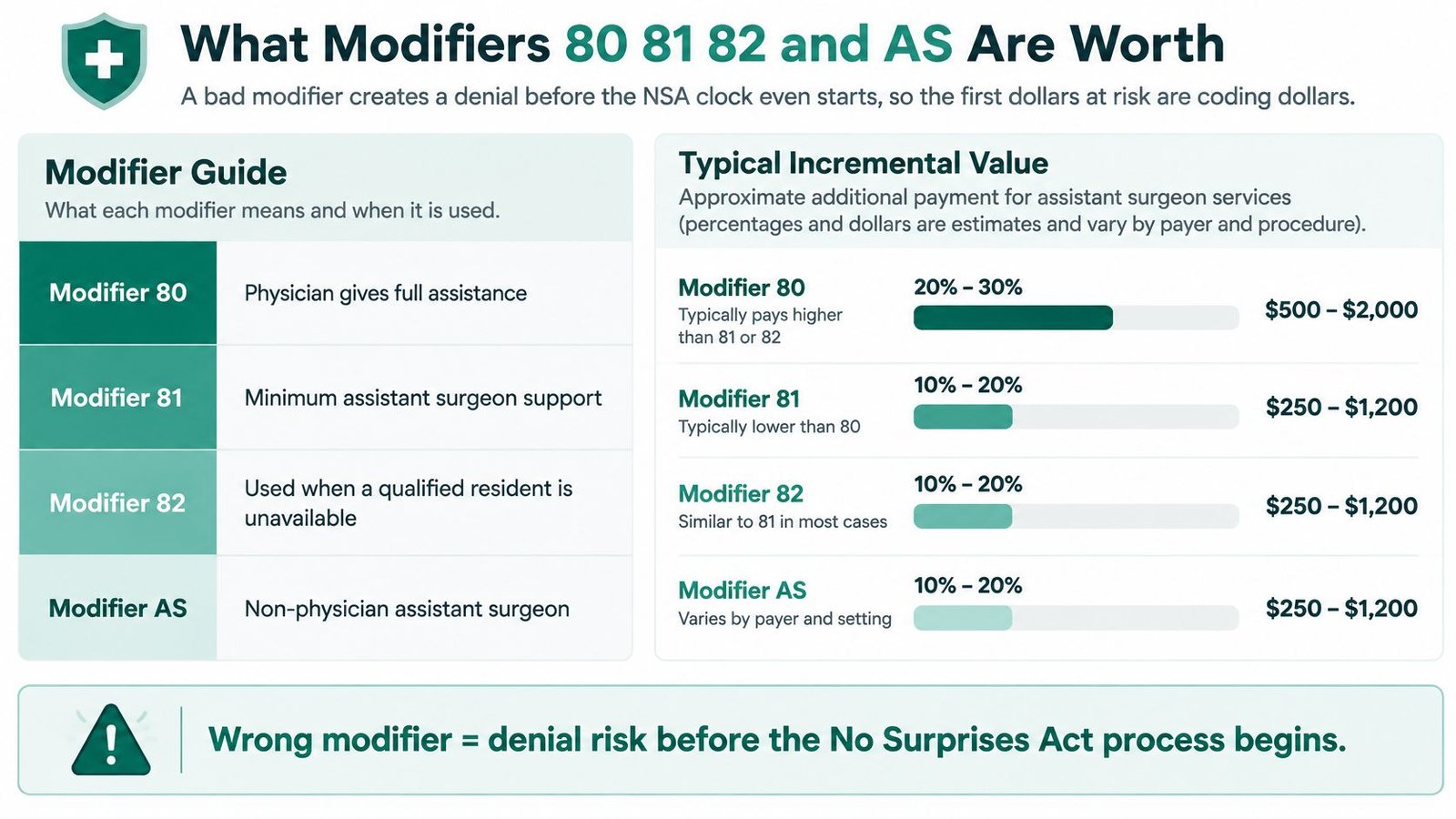
A claim can carry the right assistant modifier and still pay incorrectly. The allowance depends on the procedure's payment indicator, the assistant's credentials, the documented role, and the payer's rules. For an assistant at an in-network facility, the NSA bars notice-and-consent; underpayment is a payer-recovery issue, and the applicable clocks still matter.
Match the assistant to the payable service
The CMS assistant-at-surgery transmittal identifies modifier 80 for full physician assistance, 81 for minimal physician assistance, and 82 for physician assistance when a qualified resident is unavailable, with supporting documentation. For nonphysician assistants, the transmittal calls for AS with the appropriate assistant modifier, rather than AS alone.
“Physician assistant surgeon” means a physician serving as the assistant surgeon. A physician assistant, or PA, follows nonphysician payment rules. Apply each commercial payer's claim instructions separately; Medicare reporting rules do not establish a universal commercial allowance.
Assistant-at-surgery modifiers and what they pay
Use the Medicare contractor's assistant-at-surgery payment guidance to check Medicare payment indicators and allowances. These figures are Medicare comparisons, not commercial rates or an NSA award formula.
| Modifier or indicator | Who | Claim rule | Allowance to test |
|---|---|---|---|
| 80 | Physician, full assist | Assistant line with documented operative role | Medicare 16% of MPFS; about $160 on a $1,000 allowance |
| 81 | Physician, minimal assist | Document the minimal role | Same 16% Medicare base if payable, subject to applicable adjustments |
| 82 | Physician when no qualified resident is available | Document resident unavailability | Physician assistant-at-surgery percentage if the procedure permits payment |
| AS plus 80, 81, or 82 under the cited Medicare instructions | PA, NP, or CNS | AS alone is returned under those instructions | Medicare 13.6% of MPFS; about $136 on a $1,000 allowance |
| Indicator 0 | Either assistant type | Assistant-at-surgery payment is not permitted | No assistant payment under this Medicare indicator |
| Indicator 1 | Either assistant type | Assistant-at-surgery payment may be made if documentation supports medical necessity | Check the record against the applicable documentation requirements |
| Indicator 2 | Either assistant type | Payment restriction applies to specified assistant types | Check the indicator definition and assistant type before billing |
The Medicare percentages help check a Medicare allowance; they do not set what a commercial payer must pay. Office and elective cases remain on a separate commercial repricing path, where the governing plan policy and contract determine the payment basis.
Happy Billing's AAPC-certified coders provide final oversight of claims. Check that the operative note, credentials, CPT-specific payment indicator, and modifier agree before disputing the rate. Keep assistant-payment reductions separate from orthopedic global-period billing rules, since a disagreement over whether a service is separately payable differs from a rate dispute.
If the EOB's benchmark does not match the assistant service, review the qualifying payment amount and how providers challenge it. A disclosed QPA is a benchmark to evaluate, not proof that the payment is correct.
How to Run Open Negotiation and Federal IDR
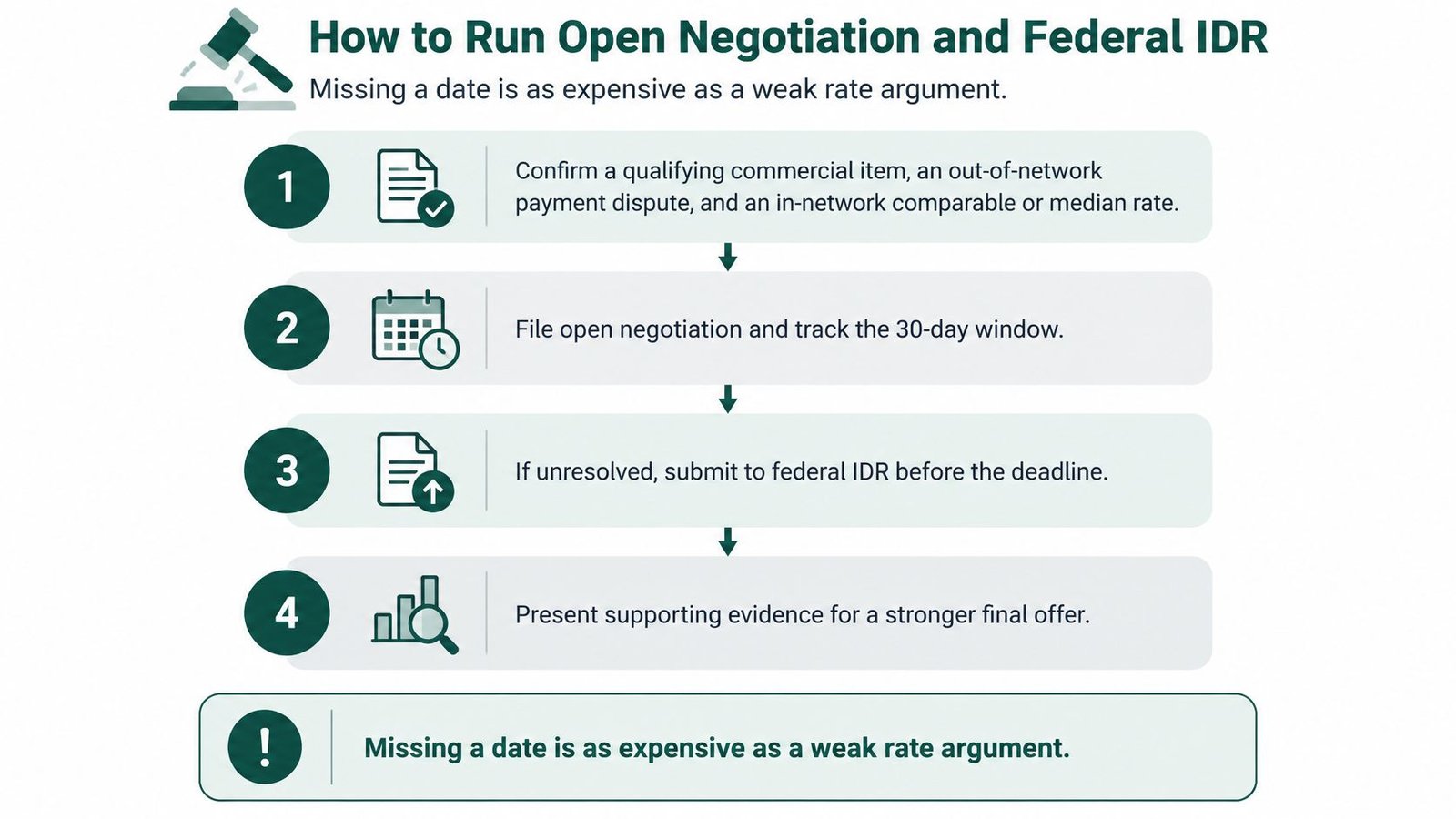
Missing a date can be as expensive as submitting a weak rate argument. Assign the claim to a deadline-controlled recovery queue as soon as the initial payment or denial arrives, even if coding review and requests for missing information are still underway.
A payer may frame its initial payment around the qualifying payment amount. Your response should explain the assistant's actual service, rather than merely assert that the primary surgeon received more or that the billed charge was higher.
Put the dates and evidence in the same workflow
The CMS federal IDR overview sets the sequence: generally initiate open negotiation within 30 business days after receiving the initial payment or denial, complete the 30-business-day negotiation period, and, if unresolved, initiate federal IDR within the following 4 business days; the selected payment amount is due within 30 calendar days of the determination.
Confirm eligibility and jurisdiction. Verify the commercial coverage, protected item or service, facility facts, and whether federal or state dispute rules govern. An out-of-network payment alone isn't enough.
Reconcile the professional claim. Match the surgeon, assistant, CPT code, modifiers, place of service, and operative report. Describe the assistant's distinct work without presenting the primary surgeon's entire procedure as the assistant's contribution.
Preserve the financial record. Save the remittance or denial, receipt-date evidence, payer correspondence, and applicable patient cost sharing. Calculate the total payment position, not just the insurer's check.
Send the formal notice. Use the proper recipient and delivery method, with proof of transmission. The open-negotiation notice guide helps distinguish a qualifying notice from an ordinary appeal letter.
Negotiate with a complete file. Request missing disclosures promptly. Don't invent a claim number, substitute an unrelated benchmark, or assume a request for information extends the filing period.
Initiate eligible federal IDR on time. Follow the filing sequence in the federal IDR step-by-step guide, including party identification, required attachments, and the offer-supporting evidence.
The IDR entity selects a party's offer rather than constructing a compromise midpoint. That makes a defensible final offer more useful than an inflated opening demand with no clinical explanation.
Seeing this on your own EOBs? Bring a few recent out-of-network EOBs to a call. We will tell you which claims look underpaid and which are worth appealing.
Make the assistant's evidence specific
Explain procedure complexity, patient acuity, specialty expertise, and the scope of assistance where relevant and supported. Tie every assertion to the record. A generic statement that spine surgery is difficult won't distinguish this claim.
The CMS guidance for disputing parties identifies submission problems involving missing claim numbers, EOBs, QPAs, and opposing-party contact information. Build those fields into the intake checklist rather than chasing them during filing.
Practical rule: Keep the deadline visible while you investigate the payment. Better evidence won't restore an expired filing opportunity.
Use daily aging and receipt-date proof. Batch eligible lines only after checking current CMS batching requirements; an internal payer worklist isn't automatically an allowable federal filing.
For context, providers, facilities, and air ambulances prevailed in 88% of determinations in the first half of 2025, according to Becker's Payer reporting on CMS data. That's program-level context, not a prediction for your claims or a collection guarantee.
An NSA IDR recovery workflow must also track payment after a determination. A favorable decision and deposited cash are separate milestones.
How We Approach Claims the NSA Does Not Cover
An office visit or elective service outside a qualifying facility doesn't become a federal IDR case because the payer's allowance is low. Ordinary commercial repricing requires a different argument, a different escalation route, and careful attention to the payer's own dispute terms.
For these claims, start by identifying who reduced the allowance. MultiPlan, Zelis, and Data iSight or Claritev can appear in the payment trail, but the name alone doesn't establish which remedy applies. Read the EOB, repricing explanation, benefit terms, and any agreement before choosing the dispute.
Separate the repricing problem from the surgical payment problem
Consider an anonymized Manhattan physical therapy example involving Cigna and Data iSight. The owner's concern is a sharp reduction from prior collections on comparable visits, not an assistant-surgery benchmark. A multi-location New Jersey sports medicine example involving Cigna and Horizon raises a different operational concern: the same reduction appearing across locations suggests a payer-level pattern worth grouping for review.
Neither pattern proves an orthopedic claim qualifies for federal IDR. They illustrate why owners should compare current allowed amounts with the actual payment history and identify the mechanism behind the reduction.
Assistant-surgeon disputes also deserve their own benchmark analysis. A Health Affairs Scholar analysis of planned-procedure disputes examined 2,355 assistant-surgeon claim lines and found providers prevailed in 88.9% of those disputes. That defined NSA sample supports careful assistant-specific review, not the use of federal arbitration for unrelated office claims.
How we approach commercial underpayments
- Group a meaningful payer pattern. Organize claims by payer, repricer, service, location, and disputed methodology. The purpose is to present a coherent financial issue to a case manager, not merely send a larger stack of unrelated claims.
- Build the negotiation position. Compare the applicable benefit or payment terms with relevant FAIR Health benchmarks and the documented service. Treat a chosen percentile as a negotiating reference, not a legally required allowance or promised settlement.
- Repair reviewability where permitted. If a payer's commercial process permits reconsideration or corrected submission, follow it and retain the resulting EOB. Don't submit duplicate or inaccurate claims merely to generate a new document.
- Escalate through the correct channel. Use the formal payer dispute or available one-time provider dispute. Move to state or federal IDR only when the claim independently satisfies that process's eligibility requirements.
The out-of-network repricing tools guide can help identify where an allowance changed. The accompanying out-of-network insurance billing workflow should preserve the original claim and every subsequent payer action.
A fresh EOB isn't an automatic reset of a statutory deadline. Confirm what the payer has actually reopened before treating a claim as newly disputable.
With a valid assignment of benefits and any required authorization on file, payer-facing recovery can generally proceed without contacting the patient. Check representation requirements first, and keep protected patient balances out of collection activity while the payer dispute is reviewed.
Mistakes That Strand Assistant Surgeon Revenue
The mistake I would address first is routing every low payment into an ordinary appeal queue. That queue may produce correspondence without preserving the correct payment-dispute route. The practice owner sees activity, but nobody can identify the next enforceable deadline.
Administrative congestion makes incomplete submissions especially costly. The Government Accountability Office's review found nearly 490,000 disputes were submitted from April 2022 through June 2023, with approximately 61% unresolved at the time of its review.
Operational Misses and What They Cost
| Mistake | Money effect | Owner fix |
|---|---|---|
| Treating an NSA underpayment as a routine appeal | The negotiation window may close, eliminating the ordinary federal filing route | Track receipt dates and assign a separate NSA deadline owner |
| Missing claim number, EOB, QPA, or opposing-party contact | Incomplete submissions delay review or jeopardize eligibility | Build and validate the dispute file before filing |
| AS submitted without the additional modifier required by the governing policy | The assistant line may be returned before rate review | Apply payer-specific modifier edits |
| Indicator-restricted service without required medical-necessity support | The practice spends dispute effort on an unsupported payment position | Confirm documentation and payability before escalation |
| Batching without checking applicable eligibility rules | Rejected grouping wastes preparation time | Validate current batching requirements, not just shared payer identity |
| Assistant balances aging without an escalation owner | Collectible claims become harder to resolve and forecast | Review aging daily and assign the next action |
The table isn't an argument for filing every claim. Some low payments reflect a valid policy limitation, and some disputed balances won't justify the administrative expense. The owner needs a documented decision, not an unexplained adjustment code.
Measure cash movement rather than touches
A useful recovery report shows the disputed balance, recovery route, evidence gaps, next deadline, responsible person, and cash posted. A count of calls or appeal letters doesn't show whether the practice preserved a valid remedy.
For claims outside the NSA, use the insurance-claim appeal guide to structure the payer challenge. A separate denial-management workflow should identify recurring submission defects so the same preventable denial doesn't return next month.
Require reasons for closing claims. “Payer upheld” isn't enough if nobody checked whether the dispute belonged in negotiation, state review, or a contractual appeal.
Procedural completeness can decide assistant-surgeon dollars just as surely as the reimbursement argument.
Related guides for other surgical specialties: spine and neurosurgery, hand and nerve surgery and plastic and reconstructive surgery.
When to Hand Recovery to an RCM Partner
An assistant-surgeon claim can be underpaid even when the primary surgeon's claim pays correctly. If adjustments go unexplained, repricer reductions go unchecked, or no one owns the next filing deadline, the practice needs a recovery process with clear accountability.
Keep recovery in-house when a staff member has protected time, specialty knowledge, and backup coverage. Hand it to a partner when those responsibilities compete with scheduling emergencies and routine payer calls. The trade-off is control versus capacity: outsourcing can provide dedicated follow-through, but the practice still needs to supply operative records, accurate provider information, and agreements that support representation.
Use ownership and visibility as the decision criteria
Compare in-house and outsourced out-of-network recovery by asking who will perform each step and document the outcome:
- Who determines the applicable route? Federal IDR and state dispute processes are not interchangeable.
- Who checks the expected allowance? Assistant-surgeon policy, global periods, and multiple-procedure reductions require separate review.
- Who follows payment through? Reconcile the negotiated or determined amount against the remittance and deposit.
- Who explains a closure? Each write-off needs a reviewable reason.
Happy Billing runs end-to-end billing and recovers underpaid out-of-network claims. Its orthopedics billing covers global periods and multiple-procedure reductions, and its denial and appeals team is trained on NY DFS IDR filing requirements, documentation standards, and aggregation strategies. Review the medical billing outsourcing cost guide when comparing staffing, software, and the work left undone by an overloaded team.
Contact Happy Billing to discuss assistant-surgeon underpayments, receipt-date controls, and commercial repricing inventory.
Can my practice bill the patient for the assistant-surgeon shortfall?
Not when the assistant service is protected ancillary care. Collect the applicable in-network cost share and pursue the remaining payment dispute against the plan through the appropriate route. The primary surgeon's consent does not automatically change the assistant's status.
Do the assistant modifiers really change what we should collect?
Yes. Modifiers identify the assistant's provider category and role, which affect the allowance being tested and the documentation needed to support it. Calculate expected payment using the governing payer policy rather than applying one percentage to every assistant.
Can we reopen a claim after the dispute window closes?
Sometimes a payer offers reconsideration, corrected-claim review, or a formal commercial dispute option. Resubmission alone does not restart federal NSA deadlines. Check the procedural history and any applicable exception before spending time on a filing that may be untimely.
How long should I budget for recovery, and will you need to contact patients?
Timing depends on the recovery route, the payer's response, evidence gaps, and whether a determination still needs to be collected. A commercial negotiation estimate is not a federal IDR payment promise. With an adequate assignment of benefits and required authorization on file, payer-facing recovery generally does not require patient contact.
Happy Billing helps practices separate eligible NSA disputes from ordinary commercial underpayments and pursue each through the appropriate billing and recovery process. Visit Happy Billing to discuss assistant-surgeon receivables, payer reductions, and controls for keeping recoverable balances from becoming unexplained write-offs.
Want someone to run these disputes for you? Happy Billing handles No Surprises Act open negotiation and IDR for facility-based groups, from claim triage to collecting the award.