Texas Out-of-network Arbitration (SB 1264) vs Federal IDR: Which Applies to Your Claim

State-regulated fully insured plans, the Employees Retirement System of Texas, and the Teacher Retirement System of Texas generally use Texas SB 1264, while ERISA self-funded plans generally use federal IDR unless they've opted into Texas. Medicare, Medicaid, CHIP, and TRICARE sit outside both ordinary routes. Getting that routing call wrong doesn't just slow a claim, it can burn the filing clock, push A/R days out, and leave a recoverable underpayment sitting uncollected while your staff rebuilds the file in the other forum.
Which Forum Controls Your Texas Claim
The plan and service category decide which payment-dispute route applies; a Texas address alone does not. Qualifying emergency or facility-based out-of-network claims for services received on or after January 1, 2020 under a fully insured Texas plan, the Employees Retirement System of Texas, or the Teacher Retirement System of Texas generally go through SB 1264. A self-funded ERISA plan generally uses federal Independent Dispute Resolution unless it has lawfully opted into a Texas process. For the employer-plan distinction, see ERISA compliance basics for 2026.
The distinction matters particularly for facility-based groups. Anesthesia, radiology, emergency medicine, pathology, and assistant surgeons may not choose the patient, facility, or network status, yet an underpayment can leave their practices carrying the unpaid balance. Filing in the wrong forum can consume time while the claim waits, increase A/R, and risk losing the chance to dispute the payment if the correct filing window closes.
What to check before filing
Start with the plan documents and the service on the claim. A Texas mailing address or payer logo does not establish which forum controls: BCBS TX products, for example, can include fully insured coverage and self-funded employer plans administered by the same carrier. Check the plan's funding status and confirm that the service qualifies before building the dispute file.
Texas arbitration volume also makes operational triage important. Segment claims by plan type, service category, dollars at stake, and strength of the evidence. Batch eligible claims only when the applicable rules permit it, and track each claim's deadline rather than treating a group as one filing. A high win rate does not justify spending staff time on every low-dollar dispute.
For specialty context, review anesthesia and facility-based billing specialties and use the No Surprises Act compliance checklist for practice owners to organize supporting records. The No Surprises Act in Texas and how it interacts with state law explains the Texas-specific overlay.
Routing rule: If the file does not identify the plan type and service category, it is not ready for filing.
Screen out voluntary out-of-network care and government program claims before staff assemble a dispute package. For thresholds or fees that may change, check the current TDI or CMS requirements instead of relying on a memorized figure.
Happy Billing is a medical billing company headquartered in Texas that serves medical practices in Texas, Florida, and other states. Its coders and compliance team are trained on both SB 1264 and the federal No Surprises Act, and its workflows route claims through the appropriate pathway when payment disputes arise. If underpaid facility-based claims are accumulating, book a 30-minute call with a billing specialist to review your claim mix.
SB 1264 and Federal IDR Side by Side
Texas arbitration and federal IDR use different rules, timelines, and fee structures. Treat them as separate recovery paths, not as higher- and lower-paying versions of the same process. In Texas, segment claims by plan type, service category, amount in dispute, and evidence strength. A busy queue, batching limits, and filing clocks can make a technically eligible low-dollar claim a poor use of staff time.
Texas versus federal IDR at a glance
| Criterion | Texas SB 1264 | Federal NSA IDR |
|---|---|---|
| Plans generally covered | Fully insured Texas plans, ERS, TRS | ERISA self-funded plans that have not opted into a state process |
| Qualifying services | Emergency care, OON care at an in-network facility, related lab or imaging | Federally protected OON services when no state method controls the payment |
| Forum by party | Arbitration for providers, mediation for facilities and laboratories | Certified IDR entity for a qualifying payment dispute |
| Pre-decision period | 30-day informal settlement after a timely request | 30-business-day open negotiation before IDR |
| Filing clock | Generally 20 to 90 days after the provider receives the first payment | Initiate within 4 business days after open negotiation ends unresolved |
| How the amount is set | Arbitrator or mediator under the state process | Entity selects one party's offer, not a split rate |
| Decision and payment | The state guide does not give one general decision or payment deadline for every dispute | Determination generally within 30 business days after entity selection, payment generally within 30 calendar days |
| Batching | Same OON provider and same health plan, total in controversy capped at $5,000 | Batch only as current CMS rules allow, the Texas cap doesn't apply |
| Fees | Arbitration fees depend on the dispute and the applicable TDI fee schedule | Check the current CMS administrative fee schedule before filing |
| Ordinary exclusions | Medicare, Medicaid, CHIP, TRICARE, many self-funded plans, voluntary OON choice | Medicare, Medicaid, CHIP, TRICARE, and disputes a specified state law already governs |
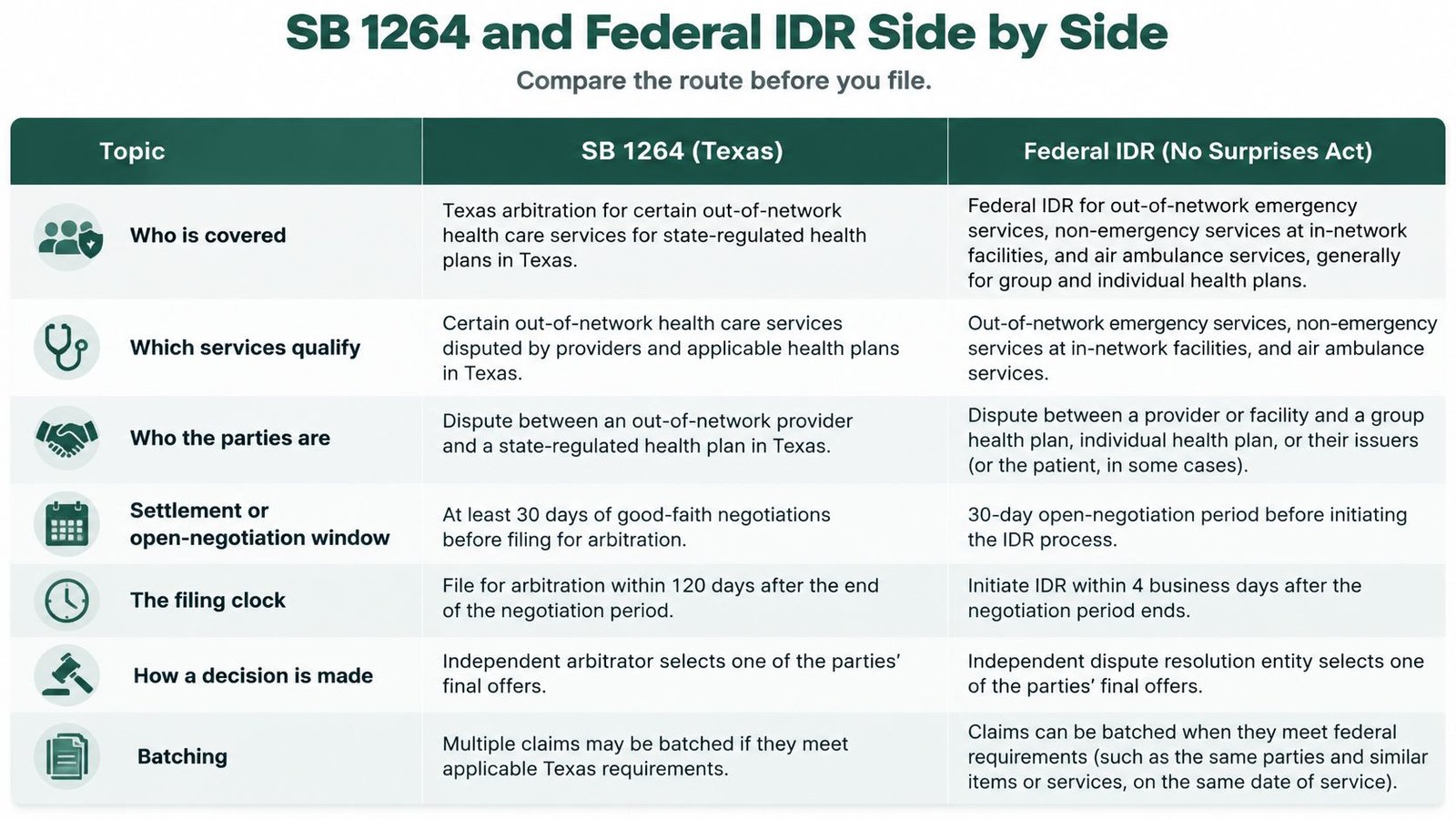
The Texas Department of Insurance surprise billing IDR guide describes the state structure, enacted in 2019 and applicable to medical services received on or after January 1, 2020. It provides arbitration for disputes between out-of-network physicians or other providers and health plans, and mediation for disputes involving facilities and laboratories. A request may start 20 days after the provider receives the first claim payment and generally must be filed within 90 days, followed by a 30-day informal settlement period. Check the current TDI fee schedule when assessing whether the amount in dispute justifies filing. Plan type, service location, and provider-versus-facility status determine whether this is the right forum.
Federal IDR is a fallback when no specified state law sets the out-of-network payment method. The CMS overview of the federal independent dispute resolution process sets out a 30-business-day open-negotiation period and a deadline to initiate IDR within 4 business days if negotiations end without resolution. A certified IDR entity selects one party's offer rather than calculating a midpoint. It generally issues its determination within 30 business days after entity selection, with payment due within 30 calendar days afterward.
Federal IDR doesn't apply when a specified state law already provides the method for determining the final out-of-network payment amount.
A covered fully insured Texas plan generally points to the state process; a private employer self-funded plan generally points to the federal process unless it opted into Texas where permitted. For help identifying the applicable route, use this guide to whether your claim is eligible for federal IDR based on plan type. Decide whether to pursue a claim by weighing its dollar amount and evidence against filing effort, fees, and the risk of missing a deadline.
How to Tell the Plan From the Card
The Texas Department of Insurance medical billing FAQ identifies relevant plans through an insurance card marked "DOI" or "TDI," meaning the plan is state-regulated rather than federally regulated, and it notes SB 1264 covers emergency care or services by a facility-based provider at an in-network facility, such as an anesthesiologist assigned to an in-network surgery or a radiologist interpreting imaging at an in-network hospital. It also warns that misclassifying a state-regulated claim as a federal IDR case can waste filing time, delay payment, and increase A/R days. That card check is your first operational checkpoint, not an afterthought at filing time.
The five checks, in order
- Read the card for DOI or TDI: That mark signals a state-regulated plan and points you toward SB 1264 if the service also qualifies.
- Separate ERISA self-funded coverage: An employer self-funded plan stays federal unless the plan opted into Texas where permitted, even if a familiar carrier name is printed on the card as administrator.
- Confirm the service category: Emergency care and facility-based care at an in-network facility qualify, including anesthesia for surgery, a radiologist reading imaging, pathology, emergency medicine, and assistant surgeon services.
- Stop the state path for voluntary choice: If the patient voluntarily chose an out-of-network doctor or facility, SB 1264 generally doesn't apply.
- Hold government programs out: Medicare, Medicaid, CHIP, and TRICARE don't belong on either ordinary dispute track.
Don't shortcut step two by trusting the logo. Confirm card designs and opt-in status against the current TDI guidance or the plan document itself, since card layouts change and administrators rebrand. For front desk staff who verify coverage at intake, the My Policy Quote coverage verification guide walks through basic coverage confirmation steps that pair well with recording plan type in the chart at registration.
The financial miss from guessing is concrete. Filing a state-regulated claim in federal IDR burns the open-negotiation sequence on a case the federal system won't own, and filing a self-funded claim in Texas burns days off the state clock you never had. Either way staff rebuild the file, the balance ages, and your denial and underpayment queues grow.
Service documentation can kill an otherwise valid state claim. A missing or wrong place-of-service distinction, facility versus office, can make a protected facility-based claim read like voluntary out-of-network care the state process won't take. For anesthesia, that means the record should clearly show the in-network facility, the surgical case you were assigned to, and the time-based units billed, because a sloppy facility indicator costs you the forum before anyone debates the allowed amount.
Deadlines Batches and the Proof File
Outer dates decide whether a route survives at all. Miss the Texas filing deadline and arbitration is gone, not delayed. Miss the federal initiation window after open negotiation ends and IDR is gone the same way. Owners who treat these clocks as billing trivia lose recoverable dollars that no negotiation skill can bring back.
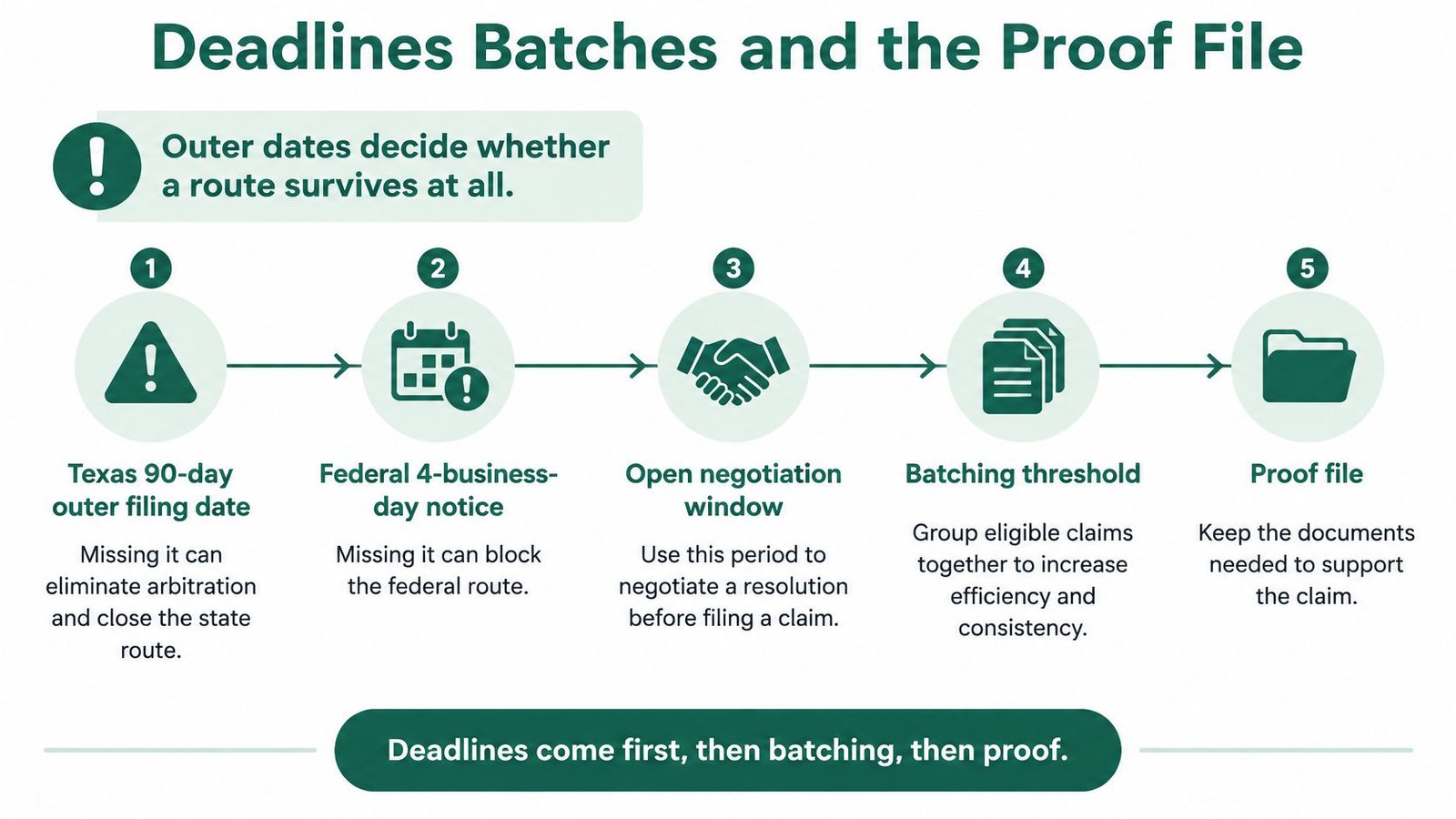
The Texas Insurance Code arbitration statute states a request generally must be filed between 20 and 90 days after the provider receives the initial claim payment, and that Texas permits multiple claims in one submission only when they involve the same out-of-network provider and the same health plan, with the total amount in controversy capped at $5,000. Use the comparison table as your working calendar for both routes, and build ticklers off the initial payment date, not the date someone noticed the underpayment.
What the batching cap means in practice
Say your emergency group has a month of underpaid claims with one fully insured plan totaling roughly $12,000 in controversy. That's not one Texas filing. The cap forces several submissions, each with the same provider and plan pairing, and each needing its own tracking. Properly grouped claims still reduce repetitive administrative work and arbitrator expense compared with filing everything one by one, but only if someone segments the cluster by provider and plan before the first submission goes out.
The proof file every dispute needs
- Qualifying-service proof: Records showing emergency care or facility-based care at an in-network facility.
- Initial payment or denial notice: The EOB that starts your clock and shows what the plan allowed.
- Unpaid amount calculation: The billed amount remaining after copayments, coinsurance, and deductibles where the patient can't be balance billed.
- Offer rationale: Why your number is right, supported by benchmarks and case specifics.
- Negotiation correspondence: Letters and notices proving the required steps happened on time.
If you're heading down the federal path, our guide to starting the No Surprises Act open negotiation clock with the right notice covers the correspondence piece in detail. Don't file federal IDR without that record intact.
Deadlines come first, then batching, then proof. A perfect evidence file filed late recovers nothing.
Catch coding leaks before any dispute starts. For anesthesia, a missed 15-minute time unit or a QK concurrency error is dollars lost at initial adjudication, and no arbitrator fixes units you never billed. Avoid the compliance traps that end claims early, filing in the wrong forum, missing a window, batching above the cap, and billing the patient for amounts the plan must cover. Federal administrative fees and Texas arbitrator costs change, so check the current CMS or TDI schedule rather than memorizing a number.
Which Claims Are Worth Escalating
Federal IDR is not a higher-paying version of Texas arbitration. A practice should screen each claim by plan type, service category, dollar value, and evidence strength before committing staff time. Federal disputes carry administrative costs and deadline risk, and open negotiation must happen first. Texas arbitration is not a catch-all either: the plan and claim category determine whether that route applies.

The volume supports careful screening, not filing by default. The Congressional Research Service report on federal IDR states that more than 1.46 million federal IDR disputes were initiated in 2024, more than double the 679,156 disputes initiated in 2023, and that 262,441 closed disputes, approximately 19%, were found ineligible. That ineligibility rate makes plan and claim review a practical cost control, not paperwork for its own sake.
Texas practices also face substantial federal IDR volume. The CMS federal IDR supplemental tables for 2025 Q4 report 213,585 federal disputes initiated in July 2025, up 4% from June, and 278,244 federal IDR disputes in Texas in the 2025 fourth-quarter supplemental data, more than any other listed state. That volume can create queue, batching, and documentation pressure. A high volume of potential disputes is not a reason to submit every low-dollar claim; it raises the importance of sorting claims before they enter a process with deadlines and staff demands.
What underpayment actually looks like
Repricers can reset an allowed amount well below the billed charge, leaving a practice with a payment shortfall even when the coding is supported. The amount alone does not establish whether a claim is worth escalating. Compare the potential recovery with the filing effort, labor, evidence available, and route that governs the claim.
Segment claims by plan type, service category, dollar value, and evidence strength. A group of similar, well-supported underpayments may justify review as a cluster, while a small claim with weak documentation may not justify the same investment. Texas volume makes disciplined batching useful, but a cluster still needs to fit the applicable process and deadlines.
The physical therapy underpayment recovery guide for practice owners and this review of out-of-network medical bill repricing tools and how repricers cut allowed amounts explain how repricers affect allowed amounts. If a plan's offer relies on the QPA, use this guide to the qualifying payment amount and how providers can challenge it to assess the evidence behind that dispute. For high-volume cardiology, emergency, and anesthesia practices, cluster detection can help identify patterns, but a person still needs to confirm plan classification and whether the claim is provider or facility based.
Route the Claim Before You File
Choose the forum before building the dispute file. Federal IDR is not a higher-paying version of Texas arbitration. A Texas practice should sort claims by plan type, service category, amount at stake, and evidence strength, then account for the queue, batching limits, and filing clocks that come with each route.
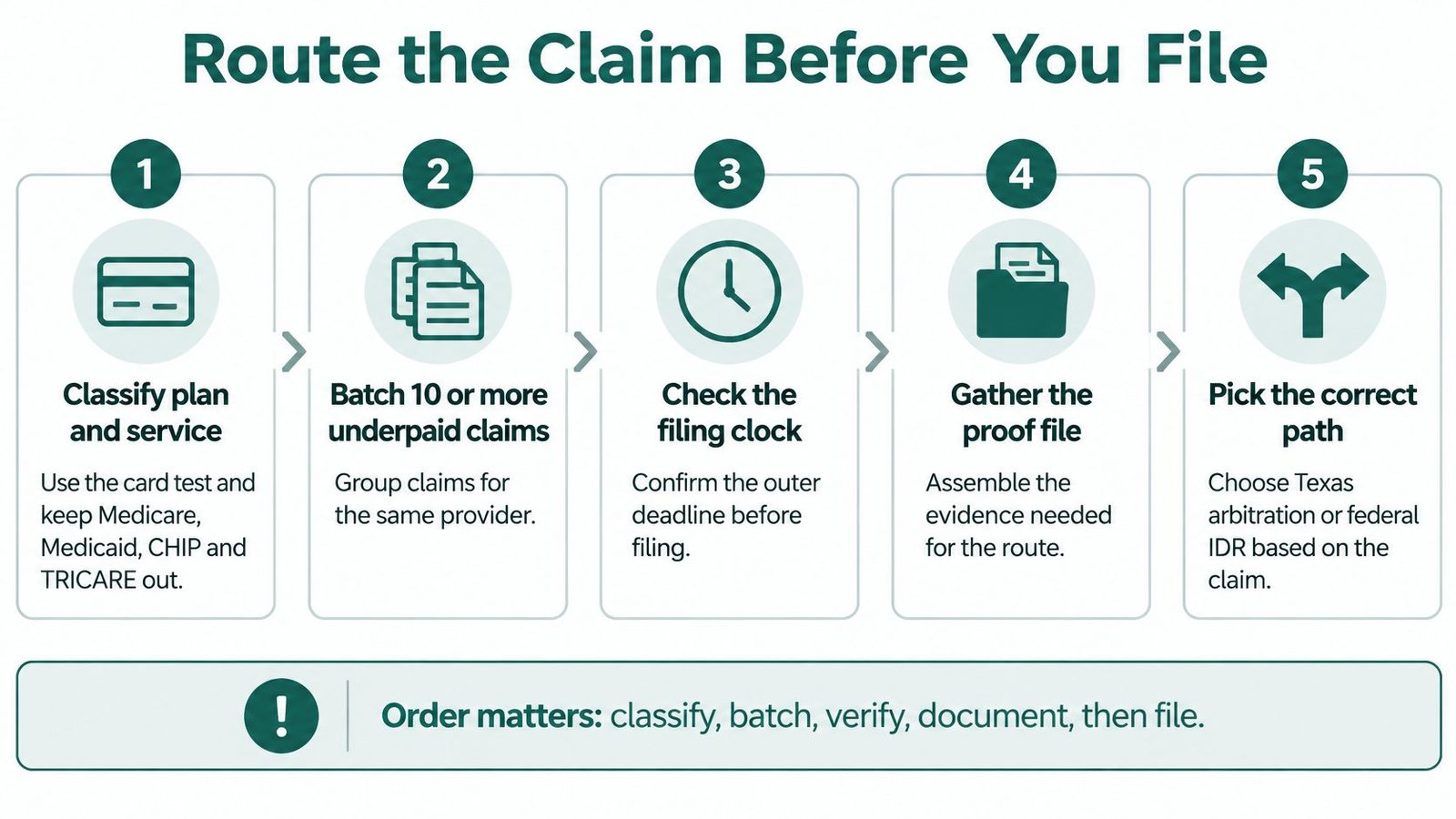
Classify the plan and service. Check the insurance card and plan documents, confirm whether the service and provider setting qualify, and keep Medicare, Medicaid, CHIP, and TRICARE out of these routes. A Texas address alone does not determine the forum. Happy Billing's compliance workflows route each claim through the applicable pathway, including IDR when payment disputes arise.
Batch eligible Texas claims within the cap. Group claims only when the rules allow it, including the same out-of-network provider and health plan, and keep the amount in controversy within the Texas $5,000 cap. Split a larger eligible cluster into separate filings where required. Batching can reduce repetitive work, but it also adds coordination and deadline risk in a high-volume practice. Do not let a large queue obscure the filing window for an individual claim.
Negotiate with a supported amount. Assemble the payment explanation, contract or plan information, coding record, and documentation that supports the service and requested payment. Use a defensible benchmark and explain why the plan's payment does not reflect the claim's circumstances. Billed charges alone do not establish the appropriate payment. Strong evidence gives the negotiation a basis; it does not guarantee a particular result.
Protect the original deadline. Do not resubmit a claim to try to restart a dispute clock or replace a missed filing window. Track the relevant notice and response dates from the original payment decision, and confirm the applicable deadline before taking action. If a deadline may have passed, check the governing process and claim record before choosing a next step. A fresh explanation of benefits is not a safe substitute for filing on time.
Escalate only if eligible. Use the payer's applicable dispute process, Texas arbitration or mediation, or federal IDR only when the plan, service, and claim meet that forum's requirements. For federal cases, follow the step-by-step federal IDR process for providers. An ineligible filing can consume staff time without resolving the payment dispute.
Underpayments and denials require different responses. For a denial, identify the reason and address it with the relevant records, using medical billing denial management that fixes root causes and guidance on how to appeal a denied insurance claim. Happy Billing handles end-to-end billing and underpaid out-of-network claims, and its denial management team investigates rejected claims, identifies root causes, and appeals them.
For example, an anesthesia claim may have defensible base units, time units, and a relevant modifier, yet still be underpaid because the plan's allowed amount does not account for the documented circumstances. The next step is to check the payment rationale and evidence, not automatically recode or file in a forum that may not apply.
Escalation should follow the economics of the claim. A strong case can still be a poor filing if the likely recovery does not justify the staff time and process costs. Book a free 30-minute call to discuss how Happy Billing handles billing and claim recovery.
Questions Practice Owners Ask Before Filing
Does a Texas address put every claim into SB 1264?
No. The plan type and service category determine the route. Self-funded ERISA claims generally remain in the federal process unless the plan has opted into Texas. Check the card for a DOI or TDI mark before choosing the state forum.
Can we batch a month of emergency or anesthesia claims into one Texas case?
Only when claims involve the same out-of-network provider and health plan, and meet the applicable batching requirements. Check the amount-in-controversy rules before grouping claims. If a cluster cannot be filed together, segment it into eligible submissions and account for the added staff time. Texas volume can create queue and deadline risks, so batching needs to fit the rules as well as the team's capacity.
What if a payer or repricer already cut our allowed amount?
Treat the dispute as an underpayment first. Use FAIR Health benchmarks to support negotiation, but do not treat a benchmark as a guaranteed settlement amount. Escalate to Texas arbitration or federal IDR only when the claim qualifies for that forum. A strong evidence file matters, and an ineligible filing can cost time needed to pursue the correct route.
What does it cost to have Happy Billing run this?
Happy Billing is headquartered in Texas and handles end-to-end billing, including recovery of underpaid out-of-network claims. Ask the team for pricing based on the work your claim mix requires.
For anesthesia, radiology, emergency, or pathology claims, sort the backlog by plan type, service category, claim value, and evidence strength before filing. Happy Billing can route eligible payment disputes through the appropriate pathway as part of A/R recovery. Visit Happy Billing to book a call about your claim mix.