Naviguard Underpayment: What Out-of-network Providers Can Do When Unitedhealthcare Reprices a Claim
You're looking at a repriced out-of-network claim and wondering whether UnitedHealthcare just underpaid you or whether you need to move fast to protect revenue. The answer is simple, act like it's a recoverable underpayment until you classify it correctly, preserve every deadline, and push it through the right dispute lane before the account ages into avoidable A/R.
Happy Billing is a medical billing company headquartered in Houston, Texas. We recover out-of-network underpayments for physical therapy, chiropractic, sports medicine and behavioral health practices, including practices in New Jersey and New York.
What Happens When UnitedHealthcare Routes an Out-of-Network Claim to Naviguard
When a payer takes a clean out-of-network charge and cuts it down to a number that looks detached from your fee schedule, your practice loses twice. You lose cash now, and you lose time later if the account sits in limbo while staff treats it like a routine remittance issue instead of a real underpayment problem.
Naviguard is UnitedHealthcare's out-of-network bill-resolution service offered through participating health plans. UnitedHealthcare says it uses analytics, reference-based pricing, provider-network knowledge, and direct negotiation to review potentially excessive out-of-network charges, and its published performance data reported a 78% resolution success rate for member-choice, member-initiated claims negotiated for less than billed charges, based on cases from January 1, 2021, through July 31, 2023. That number matters, but only as context. It is not a promise, and it does not replace payer-side appeal rights. The same materials say the program has helped tens of thousands of people, while warning that the rate is not a guarantee of future results. UnitedHealthcare's Naviguard overview slides
Practical rule: if the remittance looks repriced, don't assume the patient-side negotiation track solved your reimbursement problem. It didn't.
For providers, the distinction is not academic. Naviguard may reduce a patient balance bill, but it does not establish your correct reimbursement and it does not replace formal reconsideration or appeal rights. We have seen too many practices let these accounts drift because someone assumed “the payer handled it.” That mistake pushes denial rate up and collection velocity down at the same time. If you want a specialty-specific view of where repricing pressure tends to hit hardest, start with the physical therapy underpayment recovery guide for practice owners and compare it with a roundup of the best out-of-network medical bill repricing tools.
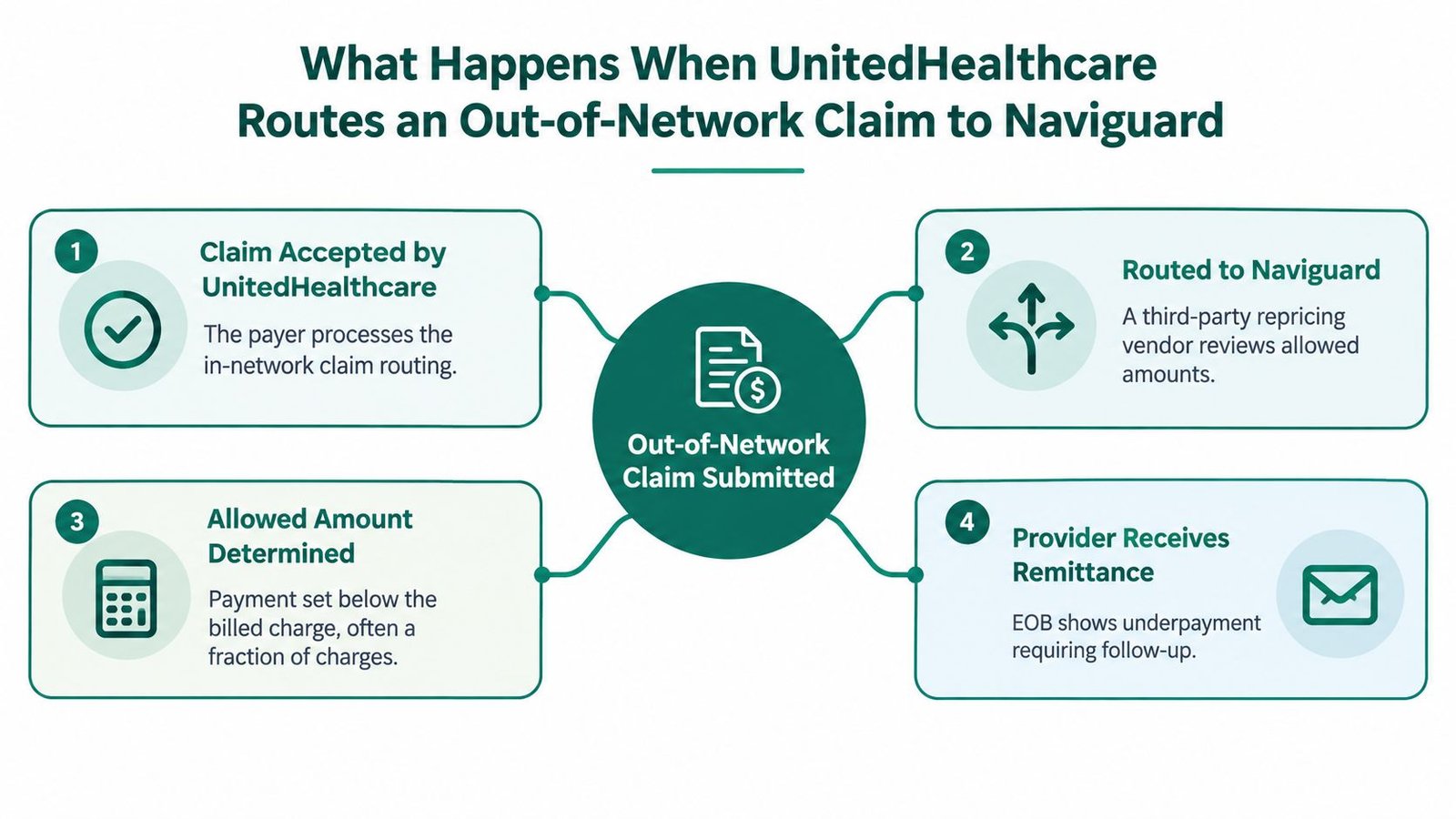
UnitedHealthcare's own provider guidance says to submit reconsideration through the Provider Portal and check status through the claims tool. That is the payer-side workflow you need to separate from the Naviguard negotiation track. If you want the payer-specific walkthrough, keep the UnitedHealthcare out-of-network underpayment appeal guide for providers handy while you review the remittance.
How to Recognize a Naviguard Repricing on Your Explanation of Benefits
The first clue is usually not the vendor name itself. It's the pattern. The paid amount is compressed, the allowed amount looks disconnected from your usual out-of-network reimbursement, and the EOB or correspondence points you toward a negotiation or reconsideration path instead of a normal adjudication trail.
Read the remittance like an owner, not a clerk
Look for the combination of paid amount, allowed amount, and payer notes. If the account was routed through a repricing workflow, the balance often gets pushed below what your practice expected based on historical commercial payments, and the remittance may show language that signals a review rather than a straightforward denial. Preserve the original claim, explanation of benefits, repricing notice, remittance advice, and any portal confirmation immediately.
The portal guidance matters because UnitedHealthcare says providers should submit reconsideration through the Provider Portal. That means you need a clean record of the submission date, the submission contents, and the status check trail. If your team can't prove when the account was touched, you lose ground later when you need to show timely action or escalate the file. How to read an explanation of benefits is worth reviewing if your team still treats EOBs like static PDFs instead of workflow triggers.
Separate the vendor track from the payer track
Naviguard's member-facing process is not the same thing as a provider appeal. Its FAQ says formal appeals must be handled directly with UnitedHealthcare, even when a Naviguard liaison can provide case-status information. That distinction is what keeps practices from wasting weeks on the wrong phone call. Medical billing denial management is where your staff should go when the next step is to protect the account, not just to chase a status update.
Don't let a “case in progress” note trick your team into pausing everything else. Deadlines don't wait for a vendor call-back.
The most useful habit is simple. Classify the account the day the remittance lands, tag it as repricing, denial, or contractual underpayment, and lock the file. That one habit does more to protect A/R days than a month of casual follow-up.
Classifying the Claim Before You Escalate
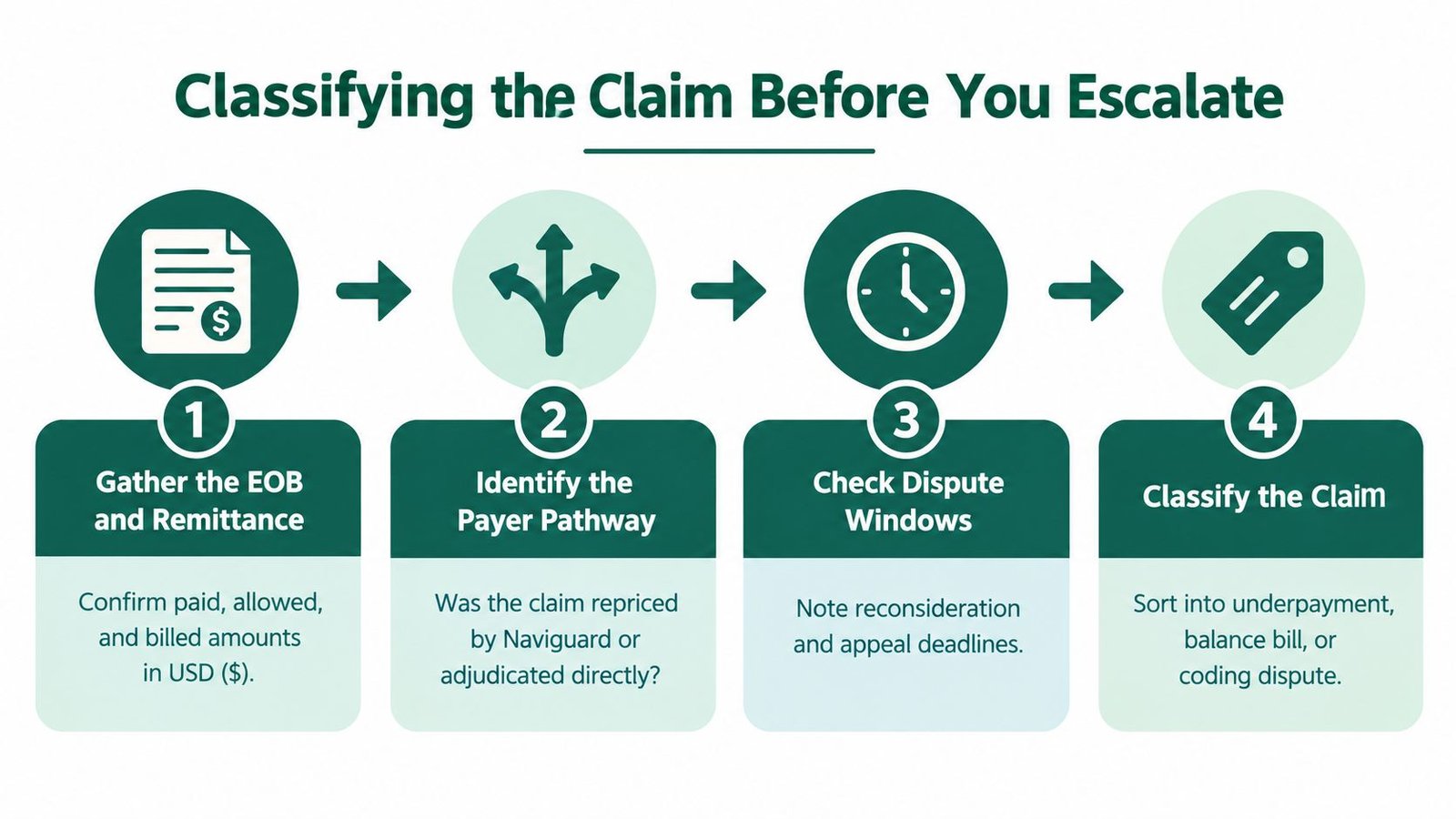
Before you send a single rebuttal, decide whether the account belongs in a federal surprise-billing track, a state-controlled track, or a standard payer dispute. If you skip that classification step, you can spend time and staff effort on the wrong remedy while the claim window keeps closing in the background.
Start with the service setting and payer rule
The federal No Surprises Act generally applies to emergency services, certain post-stabilization services, and non-emergency services delivered by an out-of-network provider at an in-network facility. For covered claims, the patient's financial responsibility is limited to the applicable in-network deductible, copayment, or coinsurance, so the practice should not try to collect the disputed balance from the patient. The payment dispute belongs between the plan and the provider. CMS's No Surprises Act rights overview is the right reference when you need to confirm whether a service belongs in that lane.
If a state all-payer model or specified state law controls payment, that rule may supersede the federal pathway. That's why anesthesia, emergency, radiology, and facility-based specialists need extra discipline around location, modifiers, units, and consent status. One misread service location can move the claim from one dispute path to another and burn days you don't get back.
Preserve the file like it may be audited
Keep the original claim, EOB, repricing notice, contract or rate exhibit, medical records supporting acuity and complexity, claim-line edits, and comparable contracted or historical rates. Also keep the coding support that shows why the billed service was billed as it was. For a practice owner, this is not paperwork for paperwork's sake. This is the evidence set that protects cash when the payer says the amount is final.
The other mistake is comparing apples to guesses. Compare the billed charges against the plan's allowed amount, then compare the allowed amount against your contracted or historically reasonable benchmark. If the gap is real, treat it as a revenue event, not a clerical nuisance. For recurring pattern recognition, use the signals that out-of-network claims are being systematically underpaid as an internal quality check.
Building a Batcher-Oriented Negotiation Strategy
Single-claim follow-up is where good claims go to die. Staff chase one underpaid line, get a polite answer, and move on before the next round of accounts ever gets grouped into a case with enough weight to matter.
Batch the work or stay stuck in low-priority territory
When we work these files, we batch similar underpaid claims, and we do it fast. Ten or more underpaid accounts with the same payer pattern tend to get more attention than one lonely call about one lonely adjustment. That's not theory. It's how case management works when a payer sees that the same repricing pattern is hitting multiple visits, multiple dates of service, or multiple practitioners.
The right negotiating posture is document-first and benchmark-driven. FAIR Health data should frame the discussion, and the 90th percentile should be treated as the ceiling while the 80th percentile is a realistic settlement reference point. Those benchmarks give you a better offer strategy than repeating your billed charge and hoping someone sympathizes. They also help you avoid the common owner mistake of accepting the first number that sounds “reasonable” because staff is tired of the file.
Use the math, not hope
A Manhattan physical therapy practice may bill a visit that includes 97140 and 97110, only to watch repricing cut the payment to a fraction of the charge after the claim has already been paid far below the practice's usual range. A multi-location New Jersey sports medicine group can see the same thing across commercial payers, with claims that used to land in a meaningful reimbursement band getting repriced much lower. Those are the kinds of patterns that justify an outbound negotiation package, not casual note-chasing.
Negotiations generally take 30–45 days, and that window should not be confused with a filing deadline. If the account is older or the dispute is already procedural, move it into the payer's formal dispute lane instead of letting it age in a voicemail loop. Medical bill negotiation services is the right operational frame if you're deciding whether to keep these files in-house or hand them off.
Owner-level rule: if the claim value is low and the evidence is thin, don't spend senior staff time pretending it's strategic. Route it, standardize it, or close it.
Patient contact is usually unnecessary when an assignment-of-benefits form is already on file. That matters because it keeps the team focused on payer recovery instead of generating extra administrative noise.
Navigating UnitedHealthcare Reconsideration and the Federal IDR Pathway
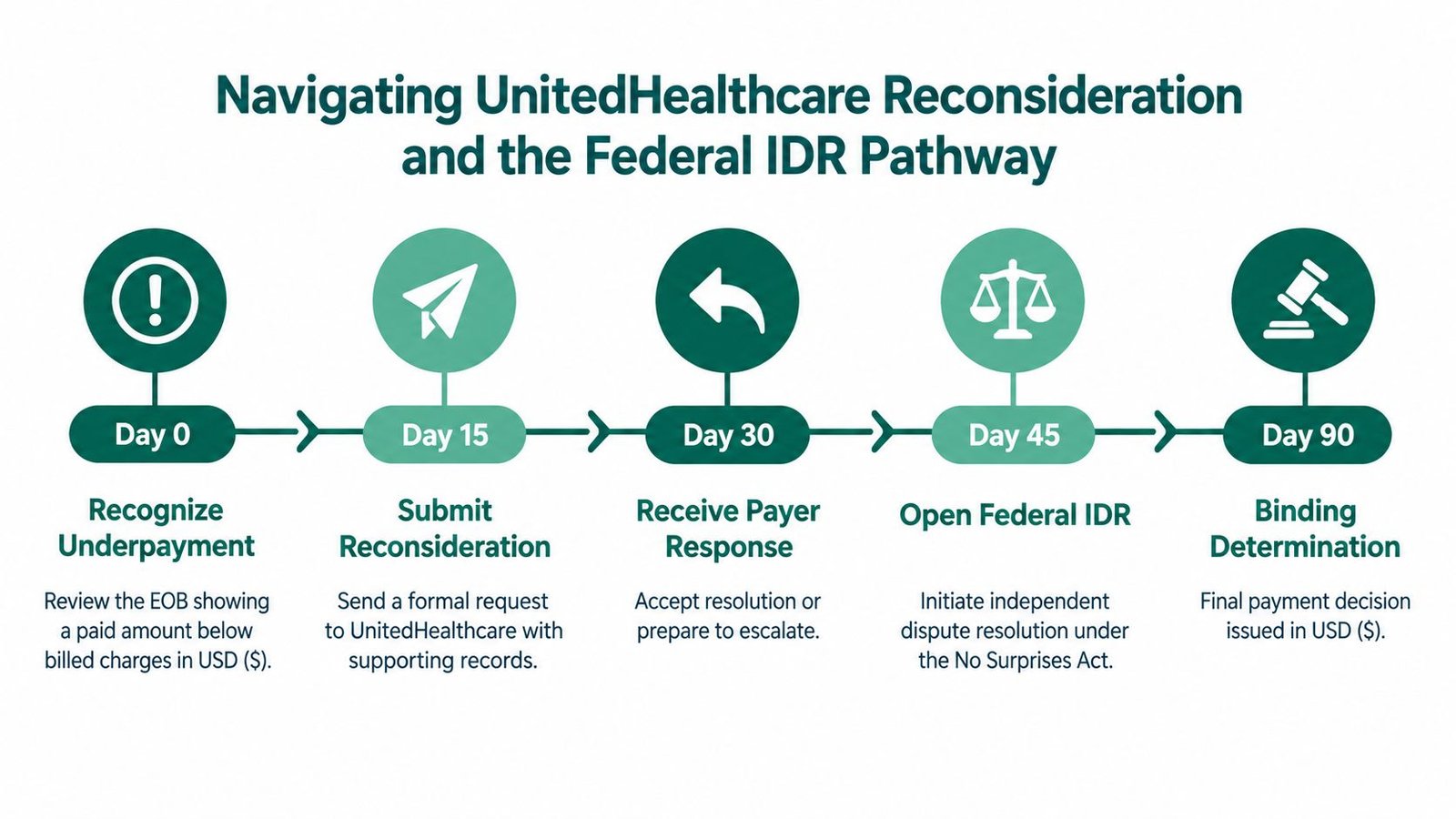
UnitedHealthcare's reconsideration process and the federal IDR pathway are not interchangeable. One is a payer-specific reconsideration track. The other is a statutory dispute mechanism with deadlines you can miss if nobody owns the calendar.
Keep the reconsideration and IDR clocks separate
CMS says eligible claims first go through a 30-business-day open-negotiation period. If no agreement is reached, either party has only 4 business days after that period ends to initiate Federal IDR. That deadline is the kind of thing that kills revenue without anyone noticing when no one owns it. CMS's Independent Dispute Resolution overview should be in your workflow folder, not buried in a compliance binder.
UnitedHealthcare also instructs providers to submit reconsideration through the Provider Portal. That means your internal workflow should track the portal submission separately from any federal process. The claim should have one auditable timeline, not three scattered email threads and a staff note that says “follow up later.”
IDR is offer-based, so submit like a professional
If the dispute qualifies for federal IDR, both parties submit offers and supporting information after a certified IDR entity is selected. The entity then chooses one party's final offer. It does not calculate a fresh fee from scratch. CMS says the process removes the patient from the payment dispute, and the parties have to support their offers with documentation. The federal surprise-billing rules and IDR framework make the point plainly enough.
That means a defensible offer needs service-specific evidence, not just frustration. Use CPT and modifier accuracy, anesthesia units when applicable, case acuity, geographic practice cost, training, outcomes, prior contracting history, and comparable commercial rates. The strongest submissions are the ones that read like a business case, not a complaint letter. If you need a structured walkthrough, the federal IDR process for providers step by step is the right companion reference.
Whether to Pursue IDR or Resolve the Underpayment Through Standard Channels
Not every underpaid Naviguard account deserves the same level of fight. That's the hard truth a lot of owners avoid because “appeal everything” feels safer than making a costed decision.
Use expected recovery, not outrage, as the filter
The right test is straightforward. Estimate the likely incremental payment, multiply it by the probability of success, then subtract filing costs, labor, and the cash-flow cost of delay. If the number is weak, stop pretending the case is strategic. If the number is strong and the documentation is clean, escalate.
Public reporting on 2025 determinations found providers won about 85% of cases, and federal data showed providers initiated roughly 1.2 million IDR cases in the first half of 2025, nearly 40% more than in the prior six-month period, while approximately 20% of submissions were ineligible. Those numbers show a market under pressure, but they also show why blind escalation is wasteful. Healthcare Dive's reporting on 2025 IDR volume and outcomes is the clearest way to see both the upside and the noise.
Separate payment disputes from coding disputes
Many files never belonged in IDR to begin with. Some involve bundling issues. Others involve modifier issues. Some are medical necessity questions. Some are patient responsibility problems. Do not lump all of that into one bucket and label it “underpayment.” That is how practices waste administrative time and overstate what the payer owes.
The smarter triage is simple. Route high-value claims with strong rate evidence into formal escalation, and resolve low-value claims through corrected claims, counters, or payer reconsideration. That approach acknowledges that IDR growth can reflect both genuine payment inadequacy and systematic over-submission. It's a revenue-cycle decision, not a moral stance.
RCM Process Changes to Prevent Recurring Naviguard Underpayments
If the same repricing pattern keeps showing up, the problem is not just the payer. It's your workflow. Owners who fix that early stop leaking cash on claims they should have caught at first pass.
Build the triage into the workflow
Set up automated rules that flag potentially repriced out-of-network encounters the moment the remittance hits. Standardize a file template that captures the EOB, repricing notice, service details, submission dates, and rate comparison in one place. Then give your team one instruction, don't let an underpaid account sit unclassified.
You also need an auditable deadline tracker. Negotiation, reconsideration, and IDR timelines are different clocks. When those clocks live in different spreadsheets or different inboxes, the practice loses ground and the account ages into a write-off candidate. If you want broader context on how process redesign changes revenue behavior, modernizing healthcare revenue workflows is a useful outside reference to pair with your internal cleanup.
Make escalation a rule, not a debate
High-value claims with strong rate evidence should go straight to formal escalation. Low-value claims should move through a lower-cost channel. That is how you protect staff time and keep senior attention for the accounts that can move cash.
For owners comparing service lines, the best next step is usually a specialty review. If you're in a specialty that gets hit hard by repricing, the out-of-network underpayment recovery pages for specialty practices can help you see which accounts deserve a deeper review. If you're also deciding whether the current billing team can handle this volume, the cost to outsource medical billing gives you a practical benchmark for that conversation.
The fastest way to reduce leakage is not to chase every line item. It's to identify the repeat pattern, document it once, and force every similar account through the same disciplined path. If your team can't do that consistently, you need a cleaner process before you need more people.
Frequently Asked Questions for Practice Owners
Should I accept a Naviguard settlement offer without countering it
Not by default. If the number is below your expected reimbursement and you have benchmark support, counter it. Accepting the first offer is usually the fastest way to normalize underpayment in your own books.
How do I know whether state law overrides the federal process
Check the service setting, payer arrangement, and whether a state all-payer model or specific state law controls payment. If it does, that rule may supersede the federal route, so don't assume every out-of-network dispute belongs in the same lane.
Can I balance-bill the patient after a Naviguard repricing
If the claim is covered by the federal No Surprises Act, no. The patient's share is limited to applicable in-network cost-sharing, and the payment dispute is between the plan and the provider.
What should I verify before I start IDR
Confirm eligibility, the open-negotiation timeline, and the current CMS IDR instructions before you file. If the deadline passed or the claim is ineligible, filing late just burns time and staff effort.
If Naviguard repricing is cutting into your out-of-network revenue, stop guessing and get the account classified correctly. Visit Happy Billing to get help tightening your underpayment workflow, protecting deadlines, and recovering the money your practice is owed.