Occupational Therapy Out-of-network Underpayment Recovery Guide for Practice Owners

An occupational therapy practice recovers out-of-network underpayments by comparing each remittance line with the patient's actual benefit methodology, correcting OT-specific coding issues, and appealing only variances that the contract or plan supports. The fastest financial gains usually come from line-level auditing, accurate unit calculation, complete medical-necessity documentation, and compliance checks before any patient balance is pursued.
When those controls are missing, the practice can post substantial charge volume while collections remain flat, denial rates rise, and A/R days expand. Medicare data provide a useful historical benchmark: from 2009 through 2021, OT-specific payments increased 50%, while payment per OT claim line increased only 9%, well below cumulative medical inflation, according to the American Occupational Therapy Association's Medicare spending analysis. Commercial out-of-network claims require a different methodology, but the underlying lesson is the same. Total collections don't prove that every service was paid correctly.
Happy Billing is a medical billing company headquartered in Houston, Texas. We recover out-of-network underpayments for physical therapy, chiropractic, sports medicine and behavioral health practices, including practices in New Jersey and New York.
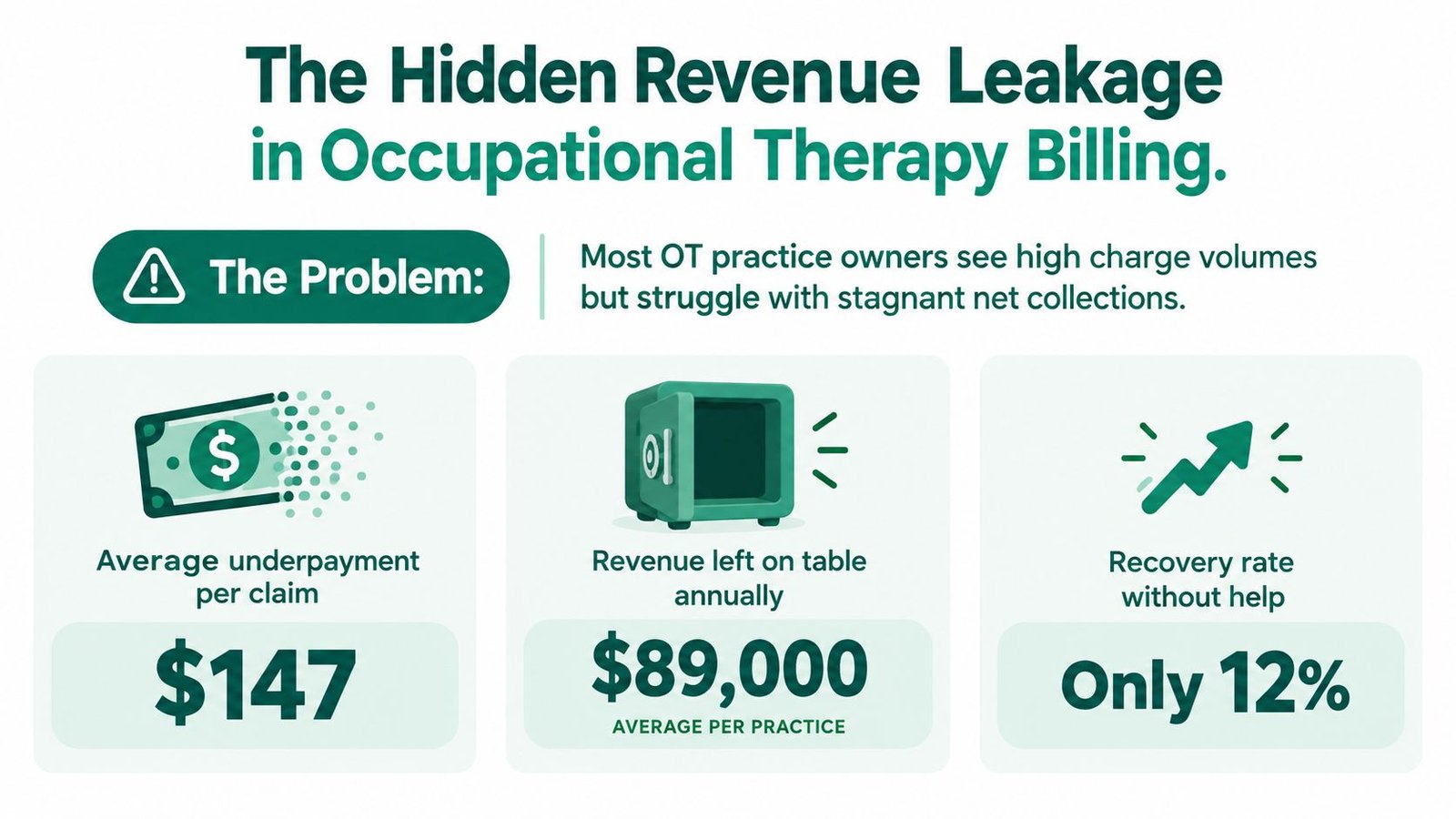
The Hidden Revenue Leakage in Occupational Therapy Billing
A typical OT audit doesn't begin with a dramatic denial. It begins with a ledger full of apparently ordinary payments. A payer allowed one timed treatment line below the expected benefit calculation, reduced another through bundling, and processed an evaluation under the wrong network methodology. Each variance looks too small to justify immediate attention, so the practice posts the payment and moves on.
That approach hides the effect on collection yield and A/R days. Repeated short payments on 97110, 97530, 97535, or 97140 can create a persistent gap between the amount the practice earned clinically and the amount it ultimately collected. The leakage is especially difficult to see when deposits are reviewed in aggregate rather than matched to the 835 ERA at the service-line level.
The practice owner's first question should be whether the payment matches the member's out-of-network benefit, not whether it matches the posted charge. An out-of-network plan may calculate the allowance through a percentage of CMS rates, a relative-value-scale formula, a payer fee schedule, or another published benchmark. Billed charges can be relevant evidence, but they aren't automatically the amount the payer owes.
Why OT claims need a separate recovery lens
OT can receive more aggressive payment treatment than higher-priority specialties because payers often apply strict edits to rehabilitation services, timed units, multiple-procedure reductions, and authorization requirements. A practice may also face a practitioner-status adjustment. For Medicare, services delivered by occupational therapy assistants became subject to a 15% payment reduction beginning in 2022, as noted in the AOTA analysis linked above.
That adjustment isn't the same as a commercial underpayment, but it demonstrates why a recovery review must identify who performed the service, which fee schedule applied, and whether the submitted practitioner status was correctly reflected. A payment that appears short may be contractually correct, while another claim with the same CPT code may contain a genuine payer error.
Owner-level rule: Never judge OT reimbursement by total deposits alone. Compare the expected allowed amount, actual payment, adjustment codes, units, modifiers, and patient responsibility on every material claim line.
Medical necessity is another financial control. A vague note can turn a potentially recoverable payment dispute into a documentation failure. Practices improving their clinical records may benefit from resources such as improve clinical documentation with Documind, provided the resulting records remain clinically accurate and are reviewed by the treating professional.
A useful audit file should show the payer, plan, date of service, CPT code, units, modifier, expected allowed amount, paid amount, CARC and RARC codes, authorization status, and appeal deadline. The medical billing audit checklist for practice owners can help organize those fields, but the owner still needs to decide whether each variance reflects a payer error, a contractual adjustment, or a practice-side mistake.
The most important distinction is between a true underpayment and an amount the plan never promised to pay. Deductibles, coinsurance, copayments, bundling, multiple-procedure reductions, visit caps, nonparticipating-provider penalties, and incorrect coding can all explain a lower payment. Recovery work starts only after those explanations have been tested.
Forensic Auditing OT Claims for OON Underpayments
A forensic OT audit follows the claim line from the clinical service to the payer's calculation. Start with the patient's actual out-of-network benefit and reimbursement methodology. Then map the claim to the applicable CPT code, modifier, units, ICD-10 diagnosis, place of service, practitioner status, and authorization requirement.
The expected payment should come from the plan language, payer fee schedule, contract, or documented methodology. It shouldn't be created by multiplying the billed charge by an assumed percentage.
Review the OT code before challenging the payment
The evaluation range, 97165 through 97167, deserves separate attention. An evaluation is generally reported once per encounter, so a reduction on one of these codes may represent a fee-schedule variance, a level-selection issue, or a claim-construction problem. The record should support the complexity level and explain why the service required skilled occupational therapy.
Treatment codes require a different review. 97110 represents therapeutic exercises, 97530 represents therapeutic activities, 97535 represents self-care or home-management training, and 97140 represents manual therapy, a code also used in physical therapy. A payer may bundle services, reduce multiple procedures, reject unsupported units, or apply a practitioner-specific rule.
Medicare claims must identify the OT discipline with modifier GO. If the modifier is missing, the payer may fail to classify the service correctly, causing a denial or delayed payment rather than a simple rate underpayment. CMS coverage guidance also ties payment to skilled service, medical necessity, and a physician-certified plan of care, so the appeal packet must support both the service and the amount requested through the CMS occupational therapy coverage guidance.
| Service Category | CPT Codes | Key Modifier Requirement | Common Underpayment Error |
|---|---|---|---|
| OT evaluations | 97165–97167 | Use the applicable discipline and payer requirements, including GO for Medicare | Wrong evaluation level, missing discipline identification, or payment at an incorrect methodology |
| Therapeutic exercise | 97110 | Apply payer-required modifiers and document timed service | Units reduced because total timed minutes don't support the billed units |
| Therapeutic activities | 97530 | Check distinct-service rules when billed with other timed procedures | Bundling or multiple-procedure reduction without a clear clinical distinction |
| Self-care and home management | 97535 | Match authorization, diagnosis, and documented functional training | Payer treats the service as duplicative or unsupported by the note |
| Manual therapy | 97140 | Test payer policy and modifier 59 requirements | Bundled payment where the record doesn't establish a separate intervention |
| Discipline identification | Applicable OT lines | Modifier GO for Medicare claims | Claim misclassified or delayed because the discipline isn't identified |
Apply the 8-minute rule to the payment calculation
The 8-minute rule applies to timed OT services and affects whether the total documented treatment time supports the number of units submitted. The audit must add the qualifying timed minutes across the applicable services, then compare that total with the payer's unit calculation. Don't evaluate 97110, 97530, 97535, and 97140 in isolation when the payer uses total timed treatment minutes.
The rule has two financial consequences. Underreporting supported units leaves collectible revenue unbilled or unpaid. Overreporting units can create denials, recoupments, or compliance exposure, particularly when the clinical note doesn't show the time and intervention needed to support the claim.
The record should distinguish each intervention, show the relevant time, connect the service to the functional problem, and avoid duplicative descriptions. When 97140 and 97530 appear together, for example, the note should explain what the manual intervention accomplished and how the therapeutic activity was clinically distinct.
59 can support separate payment when services that are normally bundled are distinct. It isn't a general-purpose appeal modifier. The AOTA modifier guidance emphasizes that payer policy determines which code combinations require or permit the modifier, and the documentation must support separate reporting.
Reconcile the ERA and rank the exceptions
Pull the 835 ERA and compare its allowed amount, paid amount, patient responsibility, contractual adjustment, CARC codes, and RARC codes with the expected calculation. A candidate underpayment exists only when the variance isn't explained by benefit design, cost sharing, bundling, authorization, units, modifiers, or a provider error.
A practical starting tolerance is at least $5 or more than 5% below the expected payment, adjusted for appeal labor and payer behavior, as described in the underpayment detection guidance for medical practices. That threshold is a routing rule, not proof that the payer owes the amount.
Rank cases by recoverable dollars, filing-window risk, clarity of the error, and recurrence. Repeated short payments on the same CPT code and payer point toward a systemic correction. An isolated claim with a missing GO modifier or unsupported unit should be corrected rather than sent through a rate appeal.
Payers and repricing vendors may use allowed-amount reductions that aren't obvious from the headline EOB. When Data iSight or another repricing pathway appears in the payment record, the appeal should identify the methodology, plan provision, and service-line calculation instead of arguing only that the billed charge was higher. The Data iSight underpayment appeal guide for out-of-network providers offers a related framework for separating repricing issues from ordinary adjudication errors.
State escalation belongs after the practice has built a clean record. For unresolved commercial disputes, review the applicable state Department of Banking and Insurance, Department of Financial Services, or Department of Insurance process. New Jersey practices may review DOBI procedures, while New York practices may need to consider DFS requirements. State authority varies, and a regulator complaint won't cure missing authorization or unsupported documentation.
Navigating the No Surprises Act and Patient Compliance
An underpaid out-of-network claim isn't automatically a patient-balance opportunity. That assumption can expose the practice to compliance problems, refunds, complaints, and reputational damage.
The No Surprises Act generally restricts balance billing for emergency services and certain out-of-network services delivered at in-network facilities. It also established a federal Independent Dispute Resolution process for eligible provider-insurer payment disagreements. The law took effect on January 1, 2022, and the Kaiser Family Foundation analysis of out-of-network hospital charges illustrates why network-status and reimbursement mismatches require careful documentation.
Classify the patient and setting first
Before a statement goes out, identify four facts:
- Insurance status: Determine whether the patient is insured, uninsured, or self-pay.
- Care setting: Separate office-based OT from services delivered at an in-network hospital or other facility.
- Service circumstance: Check whether the service was emergency care or another protected service under applicable federal or state rules.
- Payment obligation: Determine whether the remaining amount is a contractual adjustment, a permitted cost share, an unresolved payer obligation, or an amount the practice must write off.
For uninsured or self-pay patients, CMS Good Faith Estimate requirements may apply when the patient requests or schedules care in advance. CMS states that a patient may dispute a bill at least $400 above the estimate, so an internal recovery process must preserve the estimate and compare it with the final charge. Practices can use this Good Faith Estimate requirements and template resource to structure the operational file.
An insured patient who voluntarily chooses out-of-network OT isn't automatically protected in the same way as a patient receiving emergency care or certain facility-based services. Even so, the practice shouldn't shift a disputed payer balance to the patient until it confirms the plan rules, state protections, consent requirements, and network circumstances.
Build a compliance checkpoint into recovery
The appeal team and patient-statement team should not operate independently. If the payer's EOB shows a protected service, a disputed network classification, or a payment method affected by the No Surprises Act, suspend balance-billing activity while the claim is reviewed.
A payer's low payment may create a recovery claim against the insurer, not a collection claim against the patient.
The packet should preserve eligibility evidence, authorization records, network status, service location, consent documentation where applicable, the EOB, the ERA, and all patient communications. If the claim qualifies for federal IDR, the practice must follow negotiation and filing requirements rather than using patient collections as bargaining power. The federal IDR process for providers provides a related process framework.
The financial trade-off is straightforward. Aggressive statements may produce short-term receipts on some accounts, but an improper balance can require refunds and create regulatory exposure. A payer appeal may take longer, yet it protects the practice from treating a prohibited patient balance as revenue.
Building an Effective Internal Appeal and Documentation System
A strong OT appeal makes the payer's error easy to identify. It doesn't send a large clinical record without direction. The first page should state the claim number, date of service, service-line identifiers, expected allowed amount, actual payment, variance, applicable methodology, and requested correction.
Calculate the amount the plan should have allowed
Use the member's benefit language and the payer's applicable methodology. Possible calculations include a percentage of CMS rates, an RVS-based formula, a fee schedule, or another published benchmark. The practice's billed charge can be included as context, but it shouldn't replace the plan-specific calculation.
For each line, document:
- CPT code and units
- Modifier and place of service
- ICD-10 diagnosis linkage
- Practitioner status
- Authorization number and approved services
- Expected allowed amount
- Actual allowed and paid amounts
- Patient responsibility
- CARC and RARC codes
- Contractual or plan language supporting the request
A numeric example shows why aggregation matters. If the practice identifies a $40 short payment on 100 claims, the exposure is $4,000 before considering recurring future errors or secondary effects, as illustrated in the Medicare appeal guidance from CMS's claims processing manual. The same calculation should be performed by payer, CPT code, clinician, and date range.
Make medical necessity do financial work
For OT, medical necessity isn't decorative support. It explains why the evaluation required skilled expertise, why the timed intervention was appropriate, and why separate services weren't duplicative. Include the evaluation findings, functional limitations, plan of care, progress toward goals, intervention details, patient response, and relevant physician certification.
A payer reviewing 97530 and 97535 needs to understand the difference between therapeutic activity and self-care training. A payer reviewing 97140 with another timed service needs documentation showing that the interventions were distinct. A missing or generic note can make a valid payment dispute look like a provider-side coding failure.
The appeal packet should usually contain the ERA, claim form or 837 data, clinical documentation, authorization evidence, benefit language, fee schedule or contract provision, and correspondence showing the payer's position. Keep the packet indexed and searchable. The out-of-network appeal package checklist and template for providers can help standardize the evidence.
Track deadlines and choose the right route
Record the 835 receipt date and payment date, then apply the payer's specific appeal deadline. Industry guidance indicates that many contractual appeal windows fall within 30 to 90 days, so automated aging is operationally necessary. Medicare redetermination requests generally must be filed within 120 days of receipt of the Medicare Summary Notice or remittance advice, according to the CMS manual linked above.
Use a corrected claim for a wrong modifier, bad NPI, incorrect units, or other provider-side error. Use an internal appeal for an incorrect allowed amount, network misclassification, unsupported repricing, or failure to apply the plan methodology. Escalate to the appropriate state DOI, DOBI, DFS, or federal process only after assembling the claim-level record and confirming jurisdiction.
Internal recovery works best when one accountable person owns the inventory and the practice has reliable ERA data. Outsourcing becomes more attractive when staff post payments but don't reconcile service lines, when deadlines are missed, or when recurring errors aren't reported back to the payer-contracting function.
Evaluating When to Outsource Your OT Revenue Cycle
A practice can submit every claim on time and still lose revenue when no one compares the expected allowed amount with the actual payment. In daily OT claim audits, the same pattern appears repeatedly: a payer applies an aggressive repricing edit, the ERA posts a contractual adjustment, and the balance is closed without testing whether the adjustment was valid. If staff then bill the patient for the difference, the practice may create a No Surprises Act or state balance-billing problem while trying to recover money.
Outsourcing should be evaluated against three questions: can the practice identify collectible variances before appeal deadlines close, can it keep prohibited patient balances out of statements, and can it correct recurring coding or payer errors?
An internal team may work well when claim volume is manageable, the payer mix is stable, and one person understands OT coding, benefit calculations, ERA adjustment codes, authorization records, and escalation rules. The trade-off is staff capacity. Reconstructing repricing methodology takes time away from staffing, clinical operations, and payer strategy.
Review the signs your practice is ready to outsource medical billing before deciding whether recovery should remain in-house. An RCM partner may add value through payer-specific fee schedule loading, variance detection, appeal drafting, deadline tracking, and repeat-error reporting. The owner should retain control of clinical documentation, compliance decisions, and payer relationship strategy.
Use operational signals, not frustration
Review these measures by payer and CPT code:
- Days in A/R: Are unresolved OT balances aging because no one owns the appeal?
- First-pass clean claim performance: Do missing modifiers, unit errors, or authorization mismatches keep recurring?
- Repeated coding denials: Are 97110, 97530, 97535, or 97140 repeatedly affected by the same edit?
- Appeal overturn rate: Do written appeals produce corrections, or does the team submit unsupported challenges?
- Variance cause: Are losses caused by payer behavior, provider errors, or incorrect patient responsibility?
- Repeat-error frequency: Does the same payer short-pay the same service line after an appeal?
A capable reviewer should show the expected allowed amount, actual payment, recoverable balance, filing deadline, and evidence status for each candidate. “Work the A/R” is not a recovery method.
The Medicare boundary also matters. For Medicare-covered beneficiaries, an OT provider generally must bill CMS for medically necessary skilled therapy, and an ABN may be required when coverage is expected to be denied. Commercial out-of-network tactics cannot be transferred directly to Medicare.
Compare internal labor costs with revenue at risk, without relying on a promised recovery percentage or invented return estimate. Ask a prospective partner to demonstrate how it separates a contractual adjustment from an underpayment, handles GO and modifier 59, validates the 8-minute rule, and blocks prohibited balances from reaching patients.
The right arrangement improves net collections, denial control, and A/R velocity together. Recovering one payment while violating balance-billing requirements is not a successful revenue-cycle outcome.
Frequently Asked Questions
Can an OT practice appeal a low 97110 payment?
Yes, if the payment doesn't match the applicable plan methodology after units, timed minutes, authorization, modifier requirements, bundling, and cost sharing have been checked. The appeal should include the ERA, treatment note, expected calculation, and relevant benefit or fee-schedule language.
Does Medicare allow an OT practice to remain out of network?
For Medicare-covered beneficiaries, an OT provider generally can't treat Medicare billing like a commercial out-of-network arrangement. The practice should bill CMS for medically necessary skilled therapy and assess whether an ABN is required when coverage is uncertain.
Can the practice bill the patient while an OON appeal is pending?
Not automatically. Review insured versus self-pay status, office versus facility setting, emergency or protected-service status, federal and state requirements, consent rules, and the plan's patient-responsibility calculation before sending a disputed balance.
What proves that an internal audit is working?
Track recovery yield per appealed dollar, appeal overturn rate, days from ERA receipt to filing, payer-versus-provider error share, repeat-error frequency, denial rate, and A/R days. A rising appeal count without fewer repeat errors may indicate activity rather than improvement.
Happy Billing can audit OT claim lines, reconstruct out-of-network payment methodology, identify coding and documentation-driven leakage, and organize compliant appeals without treating every balance as collectible from the patient. Visit Happy Billing to evaluate your occupational therapy revenue cycle and determine which underpayments are recoverable.