Mental Health Therapist Out-of-Network Underpayment Recovery Guide

Behavioral health claims generate measurable recovery friction. A 2024 Virginia government report found that only 40.6% of mental health claims were paid, while 30.5% involved out-of-network provider payments and 13.3% involved provider payment issues. That makes out-of-network underpayment a revenue problem, not an administrative nuisance. Virginia's 2024 mental health claims report
The answer is to audit network status before appealing the allowed amount. If the payer loaded your LCSW, LMFT, PhD, PsyD, or psychiatrist incorrectly, a corrected network record can recover more than a standard EOB appeal. If the status is accurate, build a focused appeal around the plan's allowed amount, parity requirements, documentation, and the payer's repricing methodology.
For practice owners, the objective is simple: reduce denial rate, shorten A/R days, and recover every collectible dollar without sending repetitive claims into a black hole. This mental health therapist out-of-network underpayment recovery guide lays out that process.
The 90837 Underpayment Most Therapists Don't Know About
A 90837 session in NYC or Metro NJ can clear at an in-network contracted rate of $135 to $165, while a Cigna Ivy-repriced out-of-network remittance may land near $62 to $78 after the patient's cost share. Those figures are the operating example for this guide, not a universal fee schedule. The practical exposure is an $80 to $95 per-session gap that repeats across a caseload.
The mistake is treating the EOB as proof that the payer correctly processed the claim. An EOB can show an out-of-network adjudication without explaining whether the provider was nonparticipating on the date of service. A stale credentialing file, incorrect effective date, wrong service location, taxonomy mismatch, or product-loading error can push a participating clinician into an out-of-network repricing pathway.
Start with network status, not the dollar amount
We call this silent underpayment. The payer adjudicates the claim as out of network, applies a vendor percentile or recognized-charge methodology, and never tells the practice that the network classification itself may be wrong.
Before writing an appeal, pull the contract, participation confirmation, roster record, directory history, credentialing correspondence, and claim-level network indicator. Compare the treating clinician's NPI, group NPI, taxonomy, location, product, and effective date with the payer's records. Your first question is not, “Why is the allowed amount low?” It's, “Was this claim eligible for out-of-network repricing at all?”
Operator rule: Prove the payer assigned the correct network status on the date of service before arguing that the assigned rate is inadequate.
The gap on one session
| Payer Scenario | Allowed Amount | Paid to Therapist | Patient Responsibility | Net Recovery Gap |
|---|---|---|---|---|
| In-network contracted example | $135 to $165 | Contract-dependent | Contract-dependent | Baseline |
| Cigna Ivy out-of-network example | Repriced amount | $62 to $78 after cost share | Plan-dependent | $80 to $95 versus the in-network example |
The claim must also be clinically and administratively clean. For a practical comparison of the two core psychotherapy codes, use this 90837 versus 90834 billing reference, then reconcile the actual payment against the member's benefit plan and the payer's EOB.
A 2024 national analysis found that out-of-network service use for mental health was six times more common than for other services. It also found annual out-of-network cost-sharing payments were $341 higher for people with mental health conditions than for people with diabetes, $1,242 higher for people with drug-use disorders, and $1,138 higher for people with alcohol-use disorders. Center for American Progress analysis
That pattern explains why a practice can post every payment correctly and still lose substantial revenue. The loss sits in the allowed amount, network classification, and patient balance workflow.
Are your out-of-network therapy claims being repriced?
We will compare a sample of your out-of-network claims against a fair benchmark and show you what is recoverable, claim by claim. Get a free underpayment analysis →
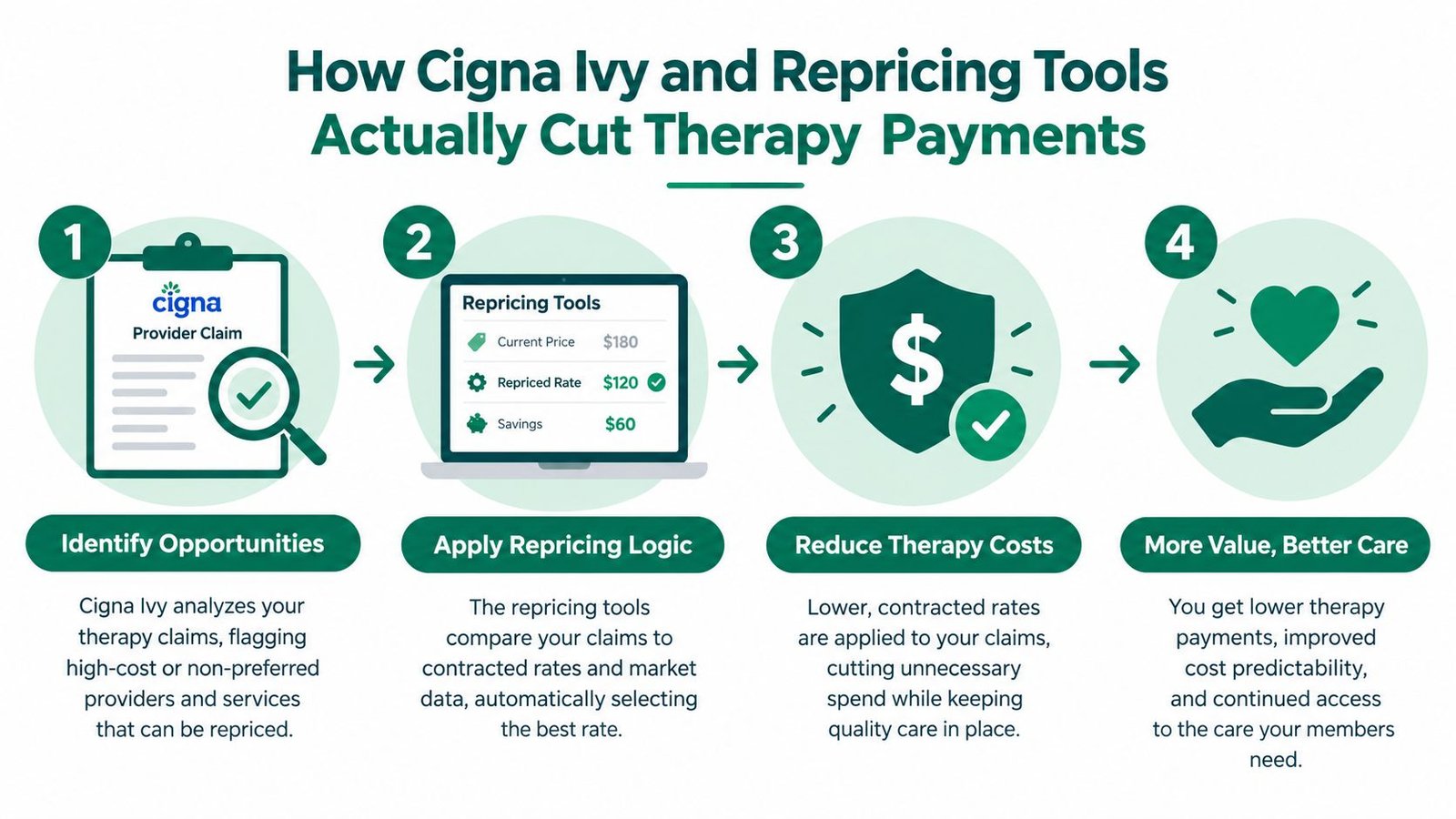
How Cigna Ivy and Repricing Tools Actually Cut Therapy Payments
Cigna Ivy and similar repricing arrangements turn a claim into a geographic pricing exercise. The tool typically evaluates the billed charge, the CPT code, and the ZIP-based market or regional data pool, then returns an allowed amount that may bear little relationship to the therapist's negotiated economics.
Cigna isn't the only payer using outside pricing logic. United, Aetna, and smaller commercial carriers may use vendors or repricing arrangements associated with companies such as MultiPlan, Zelis, and Data iSight. The vendor name can appear in the EOB, remittance remarks, provider portal, or correspondence, but not always in a way that makes the methodology obvious.
Why psychotherapy is vulnerable
Outpatient psychotherapy has a different cost structure from facility-based care and physical medicine. A solo LCSW or LMFT may submit a high-value professional claim from a small office, while a blended pricing database may contain materially different provider settings, specialties, and billing arrangements.
That creates a structural question for every low payment: does the vendor's comparison set represent the service delivered? A 90837 billed by a PhD psychologist in Manhattan isn't economically interchangeable with a facility-based therapy service or a physical-medicine claim from another market.
Cigna Ivy's stated percentile methodology also deserves scrutiny. A payer may describe an amount as a 75th-percentile repricing, but the label doesn't establish which providers, locations, specialties, products, or charges formed the database. If a broader pool was used for a highly localized psychotherapy service, the practice can challenge the data selection rather than merely complain about the result.
The parity argument
Federal parity rules require plans that cover mental health benefits to evaluate parity across six classifications, including inpatient and outpatient out-of-network coverage. The Department of Labor's mental health benefit guidance explains the framework and the escalation path from internal appeal to external review in many plans.
Parity doesn't automatically create a specific fee for 90837. It does create a basis for asking whether the plan applies financial requirements and treatment limits more restrictively to behavioral health than to comparable medical or surgical benefits. A repricing model can be appealable when its data, geographic pooling, or network treatment creates a less favorable behavioral-health result without a defensible comparative analysis.
Use a focused out-of-network medical bill repricing tools analysis to identify what the vendor is doing, but don't accept the vendor's output as self-validating. Request the methodology letter, the geographic definition, the percentile calculation, the provider specialty composition, and the plan provision authorizing the reduction.
The Therapy Superbill That Survives an Audit
Therapy claims don't need a surgical chart packet to withstand an out-of-network review. They need a complete, internally consistent professional claim record that proves who provided the service, what service occurred, where it occurred, why it was medically necessary, and how the charge was calculated.
A strong superbill or claim attachment should include:
- Practice identity: Group Type 2 NPI, billing address, tax identification details, and treating clinician NPI.
- Credential information: Clinician license, credential type, and taxonomy, especially when the payer distinguishes LCSW, LMFT, psychologist, and psychiatrist reimbursement.
- Service details: Date of service, place of service 11 for an office session, CPT 90834 or 90837, and units of 1.
- Diagnosis: The most specific supported ICD-10 diagnosis, linked to the service.
- Financial fields: Billed charge, patient payment, claim submission date, and any prior payer response.
- Clinical narrative: One or two sentences connecting duration, modality, medical necessity, intervention, and patient response.
Modifiers are financial controls
Modifier 95 belongs on synchronous audio-video telehealth claims when the payer requires it. Some payers may still request GT, so the practice must follow the applicable payer policy rather than blindly adding both. A standard in-office 60-minute session generally has no telehealth modifier.
The narrative shouldn't copy the diagnosis description. It should state the session duration, treatment modality, problem addressed, intervention used, and patient response. For a 90837, the record must support the code's time requirement and distinguish clinical service time from administrative work.
A generic blog may recommend a twelve-element surgical superbill. That approach bloats a therapy claim and can confuse an out-of-network processor. The better model is lean, specific, and consistent across the 837P claim, superbill, clinical note, EOB, and appeal packet.
Keep the packet coherent
Use the same clinician name, NPI, taxonomy, group identity, date, CPT, diagnosis, and location everywhere. The superbill fundamentals guide is useful for the basic structure, but a recovery packet must go further by explaining the payment dispute and the network-status evidence.
The payer should be able to answer three questions without requesting a second packet:
- Was this clinician eligible to provide the service?
- Did the documented service support the billed code?
- Did the payer apply the correct network and pricing rule?
If the answer to any question is unclear, the practice has created avoidable appeal friction.
Using Fair Health as Your Appeal Benchmark
Fair Health is useful when the payer relies on a proprietary repricing result and refuses to explain the comparison set. Start at consumer.fairhealth.org, select the actual geographic region, choose the exact CPT code, and preserve the resulting benchmark document as a PDF.
Don't use a broad metro average if the payer cites a narrower ZIP pool. The appeal should compare like with like. For CPT 90837, pull the 80th and 90th percentile values for the relevant area, then identify the provider type and service geography used by the benchmark.
Build the evidence stack
Your packet should contain:
- The EOB and electronic remittance.
- The claim form or 837P data.
- The payer's repricing or methodology explanation.
- The Fair Health benchmark for the correct region and CPT.
- The provider's credentialing and network-status evidence.
- The plan language governing out-of-network benefits.
- A parity analysis focused on the relevant out-of-network classification.
A payer may argue that its repricing amount reflects the 75th percentile of a blended dataset. That argument weakens when a geographically specific benchmark places the comparable service materially higher. The practice isn't asking the insurer to pay an arbitrary charge. It's asking the insurer to explain why its database, geography, specialty grouping, and percentile are appropriate.
Choosing the right benchmark
Fair Health is strongest when the dispute concerns geographic usual, customary, and reasonable pricing. Medicare RBRVS can help establish a professional-service reference point, but Medicare isn't automatically the correct commercial out-of-network payment standard. A carrier's own UCR report can be valuable if the payer relies on it, particularly when the report identifies the provider specialty and region.
Don't overstate the legal effect of any benchmark. The benchmark supports the appeal. It doesn't replace the plan document, contract record, or parity analysis.
Appeal language: “The enclosed geographic benchmark for CPT 90837 does not support the repriced amount applied to this claim. Please identify the provider specialty, geographic pool, data period, and percentile calculation used, and explain how the methodology complies with the plan's outpatient mental health parity obligations.”
| Metro ZIP | FH 50th % | FH 80th % | FH 90th % | Typical Ivy Reprice | Gap vs 90th % |
|---|---|---|---|---|---|
| Manhattan example | Not stated in verified data | Not stated in verified data | Roughly $210 | Not stated in verified data | Not calculable from verified data |
| Metro NJ suburban example | Not stated in verified data | Not stated in verified data | Near $175 | Not stated in verified data | Not calculable from verified data |
The cited Fair Health examples above are the only verified benchmark values available for these metro areas. Don't fill the missing columns with estimates. A credible appeal is stronger when it distinguishes documented facts from calculations that still require payer disclosure.
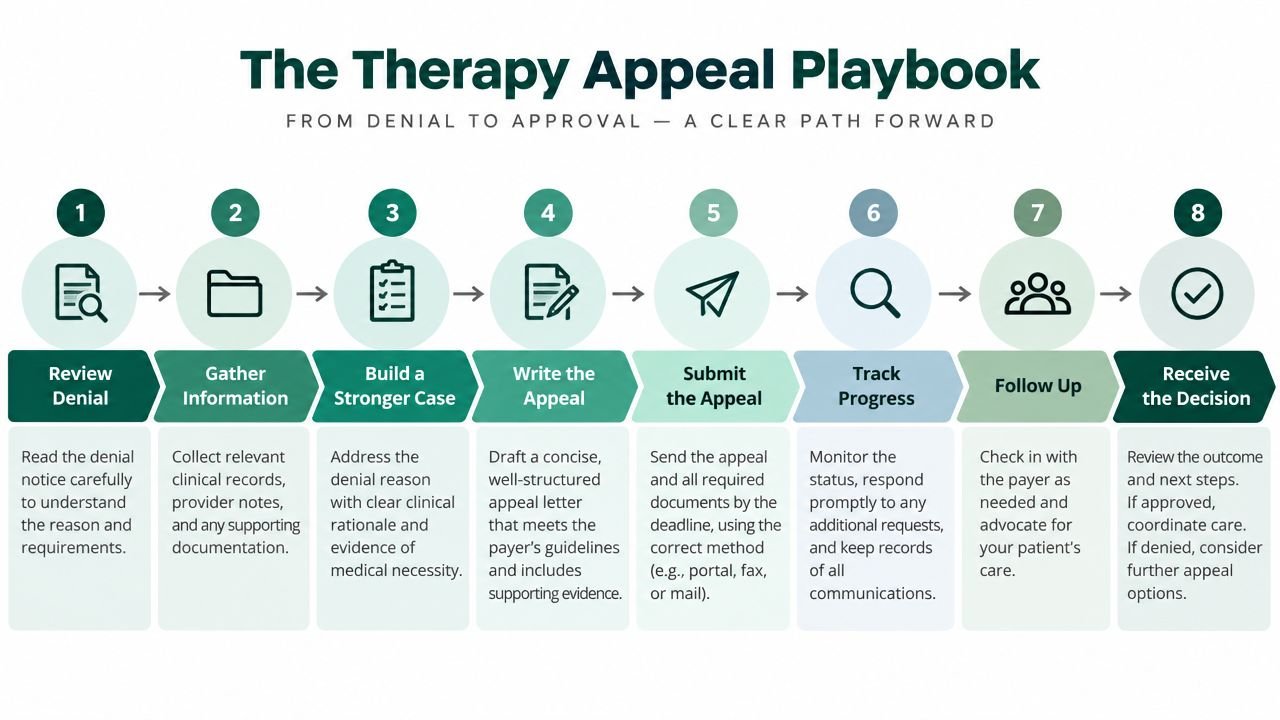
The Therapy Appeal Playbook in the Right Order
An effective appeal separates clerical correction, coverage disagreement, network misclassification, and regulatory escalation. Sending the same claim repeatedly is not a strategy. It creates duplicate records and can make the payer treat a substantive dispute as administrative noise.
First, classify the failure
Use the EOB reason and claim record to choose the route:
- Corrected resubmission: Use this for a wrong NPI, missing modifier, incorrect demographic field, bad diagnosis pointer, or other clerical error. Follow the payer's actual timely-filing rule. A provider guide identifies missed filing deadlines as the most common reason a valid out-of-network claim fails. Out-of-network therapy reimbursement workflow
- First-level written appeal: Use this for an allowed-amount dispute, incorrect network status, unsupported repricing, or coverage interpretation. Attach the Fair Health benchmark, EOB, plan language, and network evidence.
- Second-level appeal: Request review by a named medical director or qualified clinical reviewer when the first response repeats the original conclusion without addressing the methodology.
- External review or DOI complaint: Use this after internal remedies fail, or sooner when the payer refuses to provide a meaningful response to a material parity or network-loading issue.
Submit through the payer's designated appeal channel, not an unverified email address. Put the claim number, member ID, date of service, CPT code, and appeal level in the subject line or first page. Use a searchable PDF with a clear attachment index.
Use a disciplined clock
A realistic recovery cycle can run 90 to 120 days, depending on the payer's review process and the completeness of the packet. The practice should calendar every submission, acknowledgment, response deadline, and escalation date.
Request peer-to-peer review when the dispute involves medical necessity, code interpretation, or a behavioral-health comparison that a clinical reviewer should evaluate. For a pure network-loading or repricing methodology issue, keep the demand administrative and contractual rather than allowing the payer to redirect the case into a clinical-review lane.
The denied claim appeal workflow can support the general process, but the mental-health packet should explicitly identify whether the dispute is a network error, a pricing error, or a parity concern.
Escalation rule: After the second appeal, stop sending corrected claims. Every later submission should be a formal written appeal, an external review request, an IDR filing where available, or a regulatory complaint.
For protected emergency behavioral-health services and certain services at in-network facilities, the No Surprises Act may change the remedy. Federal guidance describes protections for emergency services, including emergency mental health services, and CMS explains that certain provider-payment disputes can proceed to independent dispute resolution after open negotiation fails. CMS No Surprises Act resources
When to Walk Away From a Payer and When to Escalate to the DOI
Don't leave a payer panel because one EOB is disappointing. Leave when the recurring economics, administrative burden, and recovery probability no longer justify the relationship. For a practice owner, the decision belongs in a payer profitability file that tracks CPT 90834, 90837, and 90791 by clinician, plan, allowed amount, and collectible balance.
A cumulative annual underpayment near $15,000 can be used as an internal decision threshold in the operating model described here, but that figure isn't verified source data and shouldn't be presented as a universal rule. Calculate the actual exposure from your own claims before terminating a panel.
Three routes produce three different outcomes
- Voluntary termination: Best when the payer repeatedly underpays, the panel brings limited strategic value, and the practice can replace referrals.
- Silent attrition: Stop accepting new authorizations while honoring existing clinical commitments and communicating a compliant transition plan.
- DOI escalation: Best when the payer refuses to correct a documented network-loading error, ignores a parity argument, or applies a methodology it won't explain.
State insurance departments generally want the EOB, appeal correspondence, plan information, claim history, and a concise statement of the requested remedy. Don't submit a narrative dump. Identify the exact claim, the disputed network status or payment rule, the evidence, and the action requested.
Parity rules require plans that cover mental health benefits to evaluate out-of-network classifications alongside the other required benefit classifications. The KFF discussion of parity highlights why a practice should frame a systemic behavioral-health pricing issue as more than a fee disagreement. KFF mental health parity analysis
| Annual Underpayment | Recommended Action | Filing Route | Realistic Recovery |
|---|---|---|---|
| Isolated or low exposure | Correct the claim or appeal the specific EOB | Payer portal or written appeal | Claim-specific recovery if the error is clerical |
| Recurring exposure with clear network evidence | Escalate after internal review | Formal appeal, then DOI or external review | Potential correction of affected claims |
| Material recurring exposure with weak payer response | Evaluate panel exit and regulatory action | DOI complaint, contract review, transition plan | Recovery depends on documentation and state process |
| Protected emergency or qualifying surprise-billing claim | Don't treat it as a standard patient-balance dispute | Complaint channel, negotiation, or IDR where applicable | Payment under the protected dispute framework |
Walk away from a payer when the practice can't price the relationship, can't predict payment, and can't recover documented errors. Escalate first when the record shows the payer misclassified your status or applied a behavioral-health process that deserves parity review.
What This Costs Your Practice and How to Audit It
A practice billing 90837 out of network needs a payment-level audit, not a general billing review. Pull the claim ID, payer, allowed amount, paid amount, repricing vendor, billed date, date of service, patient ID, clinician NPI, group NPI, CPT code, place of service, modifiers, EOB reason, and appeal status.
Filter the report by 90837, 90834, 90791, and telehealth variants such as 90837-95. Then group the results by payer and vendor. A low allowed amount appearing only under one repricing vendor is a different problem from a low amount appearing across every plan.
Build a network and repricing exception report
Look for:
- Network mismatch: The same clinician is in network for one product or date range and out of network for another.
- Location mismatch: The payer recognizes the clinician at one address but reprices claims from another.
- Credential mismatch: The group is loaded, but the treating provider's taxonomy or license record is stale.
- Vendor concentration: The low payments cluster under Ivy, MultiPlan, Zelis, or another repricing pathway.
- Remark-code pattern: Codes such as PR-204, CO-45, and N130 may appear in the remittance context, but the practice must verify the actual code definitions and payer usage before assigning a recovery theory.
- Patient-balance exposure: The EOB shifts too much responsibility to the patient because the allowed amount is artificially low or the recognized-charge rule is unclear.
The medical billing audit checklist for practice owners can organize the source fields, but the recovery analysis must connect each exception to a contract, plan provision, network record, or repricing explanation.
Annualize only what your data supports
The requested example assumes 25 weekly 90837 sessions, a $45 average gap, and a full operating year. That produces a claimed annual exposure of $58,500 for one clinician and $175,500 for three clinicians, but those figures are scenario math, not verified industry data. Use them as a model, then replace every input with your actual weekly volume, collection history, and working calendar.
| Weekly OON 90837 Sessions | Avg Underpayment Gap | Annual Revenue Loss, 1 Clinician | Annual Revenue Loss, 3 Clinicians |
|---|---|---|---|
| 25, scenario only | $45, scenario only | $58,500, scenario math | $175,500, scenario math |
The first audit should identify recoverable dollars per practitioner before the practice changes vendors, terminates contracts, or alters patient billing. A dedicated RCM partner should be able to review the exposure in a short working session, explain which claims are actionable, and avoid forcing the practice into a software migration or setup commitment before the economics are clear.
Happy Billing reviews mental health out-of-network claims for network-loading errors, repricing patterns, parity issues, and recoverable underpayments. Visit Happy Billing to request a practice-focused revenue exposure review and determine which dollars belong in corrected claims, formal appeals, regulatory filings, or A/R recovery.
Can a low out-of-network payment be a credentialing error?
Yes. Compare the clinician's NPI, taxonomy, service location, product, participation status, and effective date with the payer's records before appealing the rate. A loading error should go to contracting or network management, not directly into a clinical appeal.
What should a 90837 appeal include?
Include the EOB, claim data, plan language, network-status evidence, repricing explanation, geographic benchmark, clinical support, and a precise requested correction. Keep the argument focused on the actual failure, whether it's clerical, network-related, pricing-related, or a parity concern.
When should a practice use the No Surprises Act process?
Review the claim when it involves emergency mental health services or another protected setting covered by the applicable rules. CMS describes negotiation and IDR pathways for certain out-of-network payment disputes, so don't automatically treat a protected claim as ordinary out-of-network billing.
Should we outsource this recovery work?
Outsource when your team can't reconcile EOBs to network records, misses appeal deadlines, or lacks a payer-specific A/R report. Require the RCM partner to quantify exposure by clinician and CPT code before committing to a broad engagement.
Are your out-of-network therapy claims being repriced?
Send us a sample of your out-of-network claims. We compare each allowed amount against a fair benchmark, flag which claims are still appealable, and estimate what is recoverable. BAA signed before we see any data. Get a free underpayment analysis →