How to File a New York Department of Financial Services Complaint for Out-of-network Underpayment
The fastest answer is to file with the New York Department of Financial Services Consumer Assistance Unit, not to keep sending the same appeal to a payer that has already rejected it. For a surprise-bill dispute, New York DFS directs the provider into its Independent Dispute Resolution process, and its guidance says an out-of-network provider generally can't pursue the insured patient for more than applicable in-network cost sharing. See the New York DFS health insurance guidance.
For a New York practice, this is a revenue-recovery decision, not a paperwork exercise. A poorly documented out-of-network claim keeps cash trapped in A/R, increases avoidable denials, and forces physicians to subsidize payer repricing. The right complaint gives DFS a clean record, a clear payment delta, and a reason to make the insurer answer.
For when New York’s surprise-billing law applies instead of the federal No Surprises Act, see the No Surprises Act in New York: what practice owners must know.
What a NY DFS Complaint Is Really Worth to Your Practice
The value of a DFS complaint isn't that it creates another appeal number. Its value is that it moves a documented commercial-insurance dispute outside the payer's ordinary claims queue and places it before a state regulator with an established complaint and IDR workflow.
New York DFS has two relevant routes. The Consumer Assistance Unit complaint process is appropriate when a commercial insurer mishandles reimbursement, applies cost sharing incorrectly, or dismisses a provider's documented payment dispute. The surprise-bill IDR process is the more formal route for qualifying surprise-bill disputes and can produce a binding payment determination under New York's framework. DFS says providers can challenge a health plan's payment through IDR rather than pursue the patient for amounts beyond in-network cost sharing. Its public complaint record also says DFS and its predecessor have received at least 10,000 insurance reimbursement complaints since 2008. That volume tells you this isn't an exotic remedy. It's a functioning dispute channel. See the DFS surprise-bill dispute workflow.
Practical rule: File when the payer's behavior looks systemic, not merely irritating.
The math makes sense when the underpayment is large enough to justify executive attention, when a written level-2 appeal has failed, or when one claim could establish a position across a dominant payer's network. A practice owner should also consider filing when the same repricing logic appears across multiple claims. In that situation, the complaint becomes evidence of a recurring revenue leak rather than a request to reconsider one remittance.
A strong internal recovery policy should distinguish a CAU complaint from IDR. The CAU route seeks regulatory intervention with the insurer. IDR addresses a qualifying surprise-bill dispute through a structured process. Don't send every ordinary coding disagreement to DFS, and don't mistake a patient-protection rule for a general guarantee that every out-of-network charge will be paid at the billed amount. Your out-of-network reimbursement strategy should identify the correct route before anyone submits a complaint.
| Pathway | Avg. Decision Time | Binding? | Realistic Recovery |
|---|---|---|---|
| DFS Consumer Assistance Unit complaint | DFS does not promise one universal decision period; insurer response timing should be tracked | A complaint response isn't the same as an IDR award | Reversal, corrected processing, or a written explanation |
| NY surprise-bill IDR | Structured state workflow; timing depends on intake and case processing | A qualifying IDR determination is binding | Payment determination for the disputed surprise bill |
| Ordinary payer appeal | Controlled by the plan's appeal rules | Usually not a DFS determination | Reprocessing only if the payer accepts the appeal |
Not sure which underpaid claims are worth a DFS complaint?
We will compare a sample of your out-of-network claims against a fair benchmark and show you what is recoverable, claim by claim. Get a free underpayment analysis →
When Filing a NY DFS Complaint Actually Pays Off
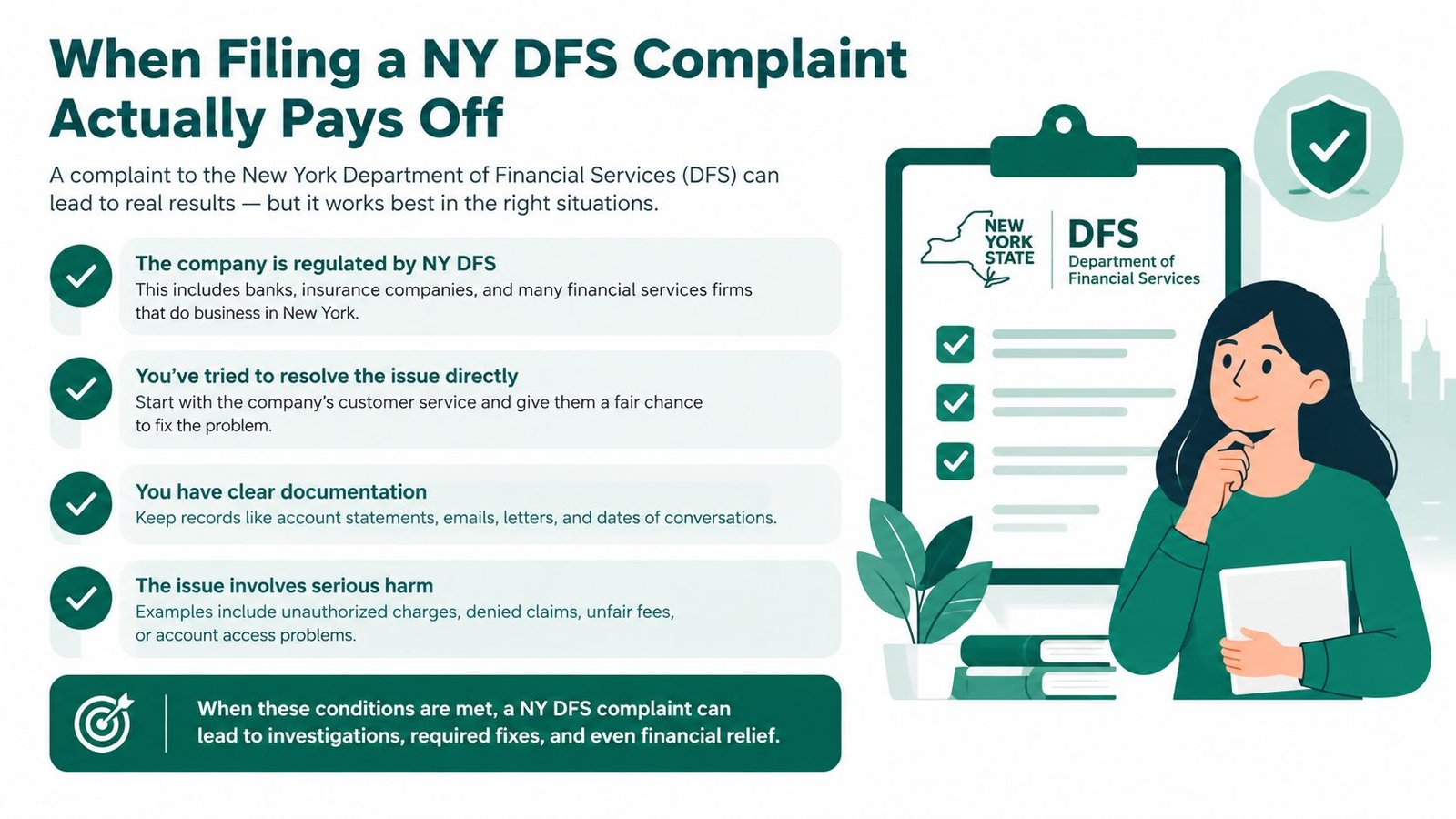
DFS isn't a substitute for a payer appeal. File after the plan has had a fair opportunity to correct the claim and has either denied the appeal or ignored the evidence. The strongest complaints present a payment conduct problem, not a request for DFS to perform clinical coding review.
Three scenarios deserve immediate review:
- Data iSight or Zelis repricing: The payer or repricing vendor reduces the allowed amount through an out-of-network methodology that the practice can't reconcile to the plan's stated basis for payment. Document the original charge, the repriced amount, the vendor name shown on the remittance, and the appeal response.
- Timely-filing denial after resubmission: The practice submitted a clean claim, corrected or resubmitted it within the applicable process, and the payer later denied it for timely filing. The claim history must prove receipt and each subsequent submission.
- IME-style downcoding without documented physician review: The insurer reduces the service level or procedure value but doesn't provide a meaningful clinical rationale or identify the reviewing physician. A DFS complaint can highlight an unsupported payment adjustment, but it won't decide a genuine medical-necessity dispute.
Use a claim-level decision test
Before filing, ask three questions:
- Is the underpayment more than 25% of billed charges?
- Has the practice received a written denial of its level-2 appeal?
- Is the carrier NY-domiciled or writing New York policies?
If two answers are yes, file. That rule keeps your team from spending senior time on immaterial claims while still capturing disputes that can affect the practice's payer economics.
DFS generally isn't the right forum for a pure coding disagreement, a medical-necessity denial based on clinical judgment, or a patient-side balance-billing complaint governed by the federal No Surprises Act. Those cases need a different remedy. A provider should also separate a commercial insurer's reimbursement conduct from the patient's financial responsibility. Confusing the two can make an otherwise credible complaint look like an attempt to collect from the patient improperly.
Review the payer's identity carefully. Empire BCBS, Cigna, Aetna, and Oxford may appear in New York provider disputes, but the relevant question is whether the plan or insurer falls within DFS's authority and whether the claim involves New York-regulated business. If it doesn't, DFS may redirect the matter or decline to adjudicate it.
Building the Documentation Package Carriers Cannot Dismiss
A DFS reviewer can't recover money from a narrative that says, “The payer underpaid us.” The reviewer needs a claim record that shows what you billed, what the insurer allowed, what it paid, what you appealed, and why the remaining balance is wrong.
Start with the remittance advice, whether paper EOB or electronic ERA. Mark the disputed line, allowed amount, patient responsibility, adjustment reason, payment amount, and any reference to Data iSight, Zelis, MultiPlan, or another repricing process. If the payment explanation is opaque, include the payer's accompanying pricing notice or correspondence.
Then assemble the claim itself. Include the submitted CMS-1500 or UB-04, depending on the claim type, along with proof of submission and receipt. For physician claims, identify the disputed CPT code, modifier, units, place of service, date of service, and provider NPI. Don't add codes that aren't part of the dispute. A reviewer should be able to match each line on the complaint to a line on the remittance.
Build the file in the order a reviewer reads it
Include these documents in one chronological package:
- Payment evidence: EOB or ERA, payment trace, adjustment codes, and the payer's repricing explanation.
- Claim evidence: Clean CMS-1500 or UB-04, clearinghouse acceptance, corrected-claim history, and payer receipt records.
- Clinical support: The relevant medical-record excerpt establishing the service and medical necessity. Don't upload an unfiltered chart when a focused excerpt answers the issue.
- Standing evidence: Executed assignment of benefits, patient financial agreement, or other document naming the provider as the claimant where applicable.
- Appeal evidence: Initial appeal, supporting exhibits, payer response, and the final level-2 adverse determination.
- Calculation sheet: Billed amount, payer payment, contractual or legally applicable benchmark, disputed delta, and the action requested.
The assignment of benefits matters because it prevents the carrier from arguing that the provider lacks standing to pursue the reimbursement issue. The final appeal letter matters because it demonstrates exhaustion of the plan's internal process. Without it, the complaint may be sent back to the insurer before DFS considers the substance.
Use a short cover page with the claim number, date of service, carrier, patient identifier, CPT line, disputed amount, and requested resolution. A complete package makes the reviewer work from evidence. An EOB alone makes the reviewer work from assumptions.
For a practical guide to reading every adjustment and responsibility field, use this explanation of benefits guide. Your practice should also retain the original files, because a merged PDF is a submission format, not a replacement for the underlying audit trail.
Submitting Through the DFS Consumer Assistance Unit and IDR Portal
Use the DFS Consumer Assistance Unit complaint portal and treat the submission like a formal regulatory file. Don't paste a long emotional explanation into the narrative box. DFS needs a concise chronology and a specific payment request.
Complete the complaint fields with claim-level precision
Select the insurance category and the out-of-network billing dispute sub-issue when that option appears. Describe the claim using the identifiers DFS and the insurer can verify:
- Patient's IDR Notice ID, if one exists
- Carrier name and NAIC number
- Claim number
- Date of service
- Provider NPI
- Disputed CPT code or codes
- Amount charged
- Amount paid
- Exact payment delta
- Date and result of the final appeal
Keep the narrative under 500 words. Lead with the requested action, then explain the facts in sequence. A useful structure is: “The insurer paid [amount] on [CPT code] after applying [repricing or denial reason]. The provider appealed on [date] with [evidence]. The insurer upheld the decision on [date]. The requested resolution is corrected processing and payment of the documented disputed amount.”
Don't write “the carrier always underpays us” unless you attach claim-level evidence showing a pattern. Instead, identify the repeated issue and list representative claim numbers. A regulator can act on a precise pattern. It can't act on an accusation without a file.
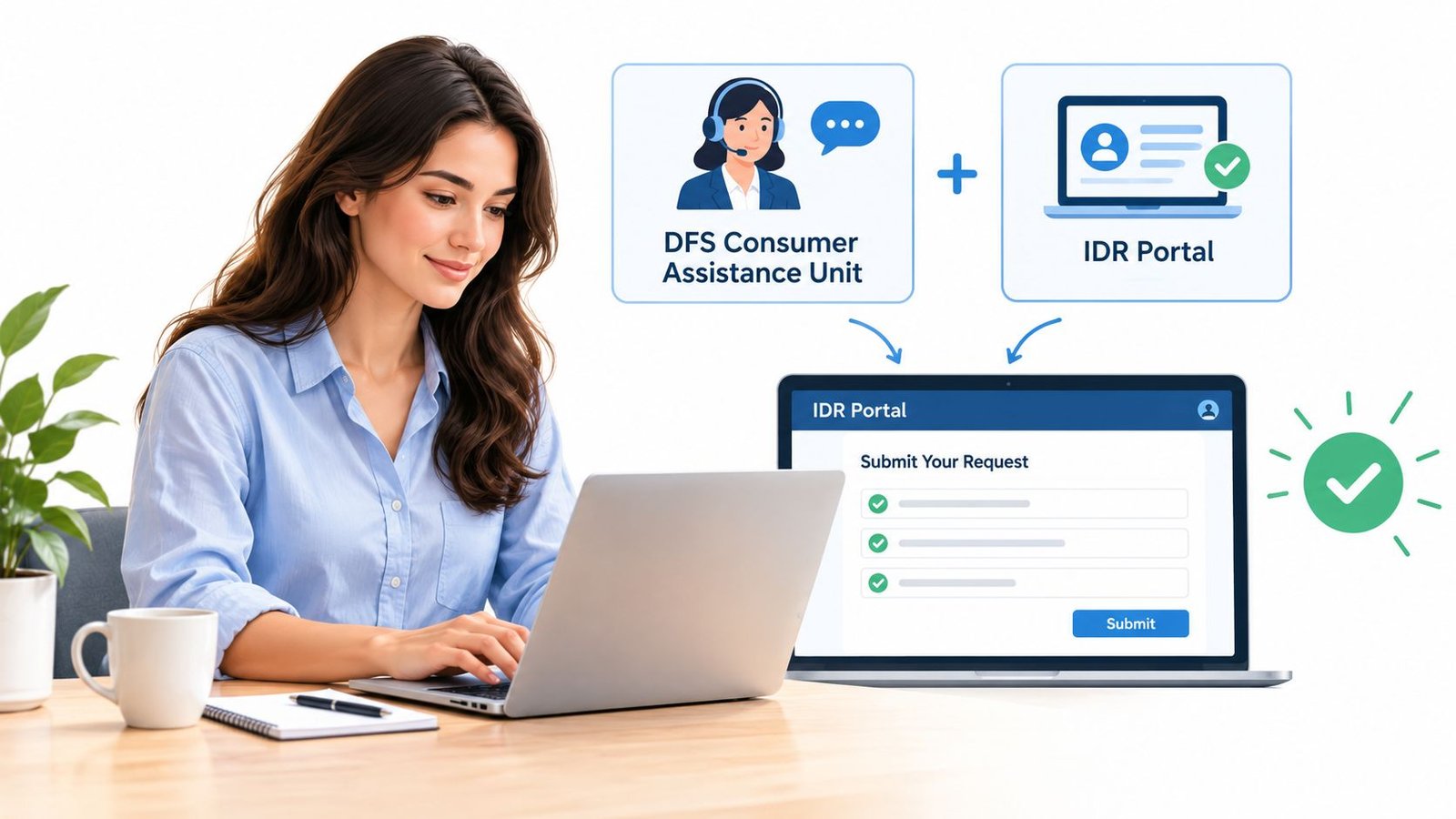
Attach one controlled evidence file
Merge the EOB or ERA, claim copy, medical-record excerpt, assignment of benefits, appeal responses, and final adverse determination into one readable PDF. Label it with the patient MRN and carrier name, while following the portal's privacy and file-format requirements. Keep PHI limited to what the complaint requires.
For a qualifying surprise-bill matter, DFS's workflow calls for the applicable Surprise Medical Bill Certification Form, copies of the disputed bill, and submission through its IDR process. DFS also directs parties to its IDR materials, including the provider and insurer application after the patient-side filing. Review the provider guide to the federal IDR process separately, because federal and New York processes aren't interchangeable.
After a patient-side IDR submission, use the portal tracking number and complete the IDR Provider and Insurer Application when the case requires it. Cross-reference the CAU complaint number where the portal provides that field. Confirm provider access and credentials through the DFS IDR credentialing process before submitting. Save every confirmation screen, tracking number, uploaded file name, and correspondence in the claim's regulatory folder.
Timelines, Carrier Responses, and How DFS Follows Up
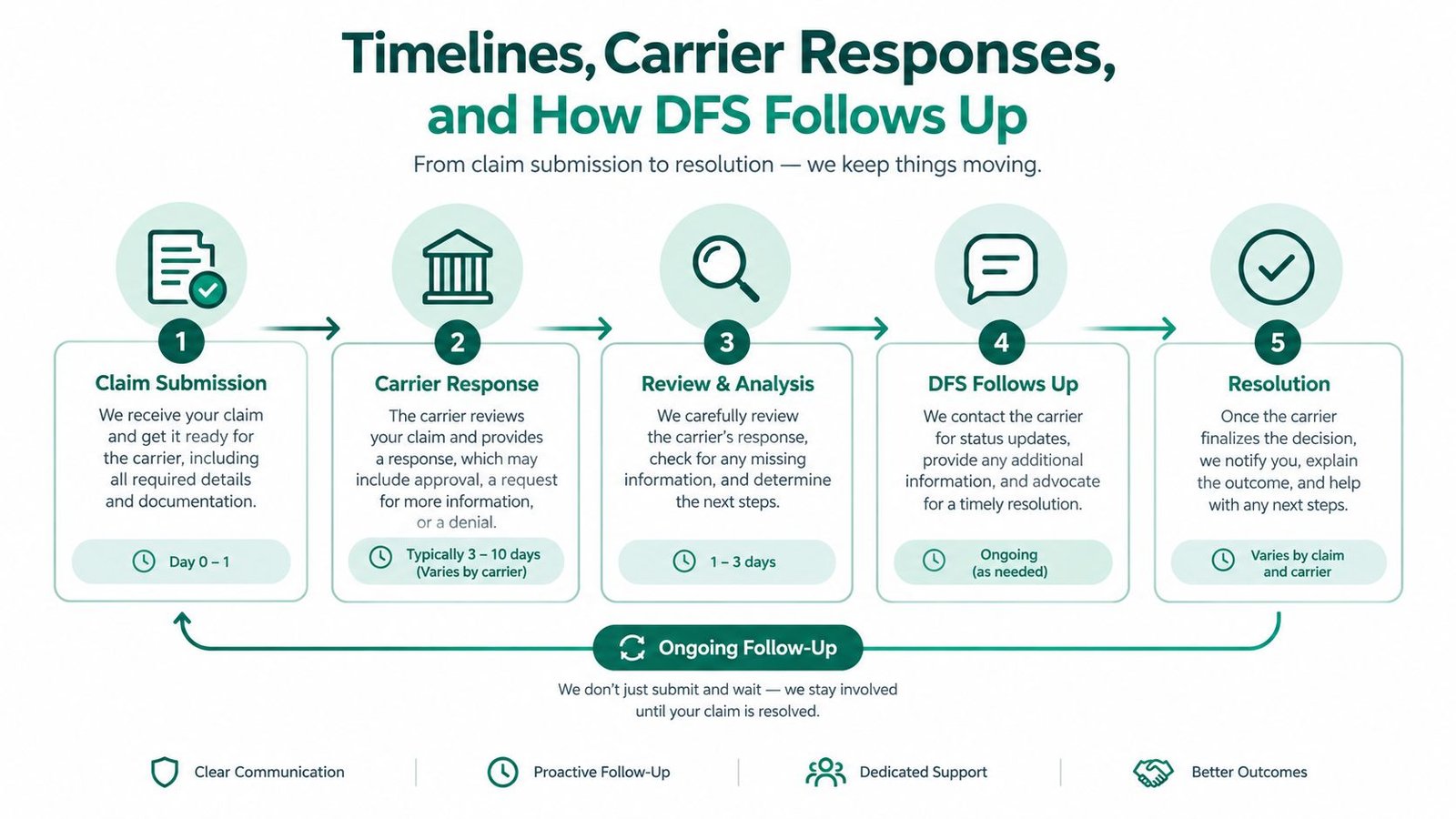
Set the practice's expectation at 30 to 60 days for the insurer response and related DFS handling, rather than assuming the complaint will resolve immediately. DFS's published workflow supports a structured response process, but the exact handling depends on the complaint type, the insurer, the documentation, and whether the dispute belongs in IDR.
The first operational milestone is the complaint number. Record it in the practice management system, not in one employee's inbox. Assign an owner, a follow-up date, and a financial status such as pending response, insurer response received, supplemental evidence requested, or closed.
What to do while the complaint is open
The insurer may contact the practice directly. Route every call to one designated person and require a written response. If the payer offers reprocessing, obtain the claim number, adjustment action, expected payment, and effective date in writing. Don't close the internal task when a representative says, “It has been escalated.”
When DFS asks for clarification, answer the question it asked and attach only the supporting evidence. A supplemental packet should identify the new document and explain what fact it proves. Avoid changing the theory of the complaint halfway through the process. A moving target gives the insurer an easy procedural objection.
The federal No Surprises Act IDR process is a separate path with its own eligibility rules, initiation requirements, and administrative structure. DFS is more useful when the dispute fits New York's regulated insurance or surprise-bill framework and the practice needs a state complaint record. Federal IDR is more appropriate when the claim falls within federal requirements and the parties must obtain a binding payment determination through that route.
DFS may close a complaint without ordering the result you wanted. Treat the closure letter as evidence. Preserve the insurer's explanation, identify any factual contradiction, and decide whether the next filing should go to the New York Attorney General, a federal IDR process, or another regulatory channel.
Escalating to the NY Attorney General or Federal No Surprises Act IDR
Escalation should follow the defect in the payer's conduct. If DFS resolves the individual claim but the same repricing or denial pattern continues, stop treating each claim as an isolated event. Build a pattern file with remittances, appeal outcomes, dates, payer explanations, and the aggregate effect on practice A/R.
The New York Attorney General's Health Care Bureau offers a separate complaint channel for suspected surprise billing and improper cost-sharing treatment. Consumers can file online or call the Health Care Helpline at 1-800-428-9071, according to the Attorney General's surprise-billing guidance. For practice owners, the important distinction is framing. The AG route is stronger when the evidence suggests repeated improper balance billing, recurring cost-sharing treatment, or a broader consumer-protection concern rather than one unresolved remittance.
For qualifying larger out-of-network disputes, consider federal No Surprises Act IDR after confirming eligibility and the applicable federal process. The federal IDR process for providers requires disciplined preparation, and a practice shouldn't assume that a DFS complaint automatically preserves or satisfies federal deadlines.
| Escalation Path | Best Claim Size | Filing Timeline | Primary Leverage | Best Use When |
|---|---|---|---|---|
| NY Attorney General Health Care Bureau | Repeated or consumer-impacting disputes | After evidence of a broader problem is assembled | Consumer-protection and enforcement attention | The payer's conduct affects patients or shows a recurring pattern |
| Federal No Surprises Act IDR | Claims that meet federal eligibility requirements | Within the applicable federal initiation window | Binding arbitration | The dispute is federally governed and payment leverage matters |
| DFS market-conduct complaint | Repeated conduct by a New York-regulated commercial plan | After claim and complaint evidence show a pattern | Regulatory oversight | The same insurer behavior appears across the practice's book of business |
| DFS CAU or state IDR | Qualifying New York disputes | After internal appeal and required documentation | State complaint review or binding IDR determination | The matter fits New York's regulated workflow |
Empire BCBS, Oxford, and other commercial plans should be evaluated by regulatory status and claim facts, not by brand recognition alone. A market-conduct escalation carries more weight when the practice can demonstrate repeated conduct across dates of service, providers, or locations. One large claim may justify attention, but a clean pattern file gives the regulator a reason to examine the insurer's process.
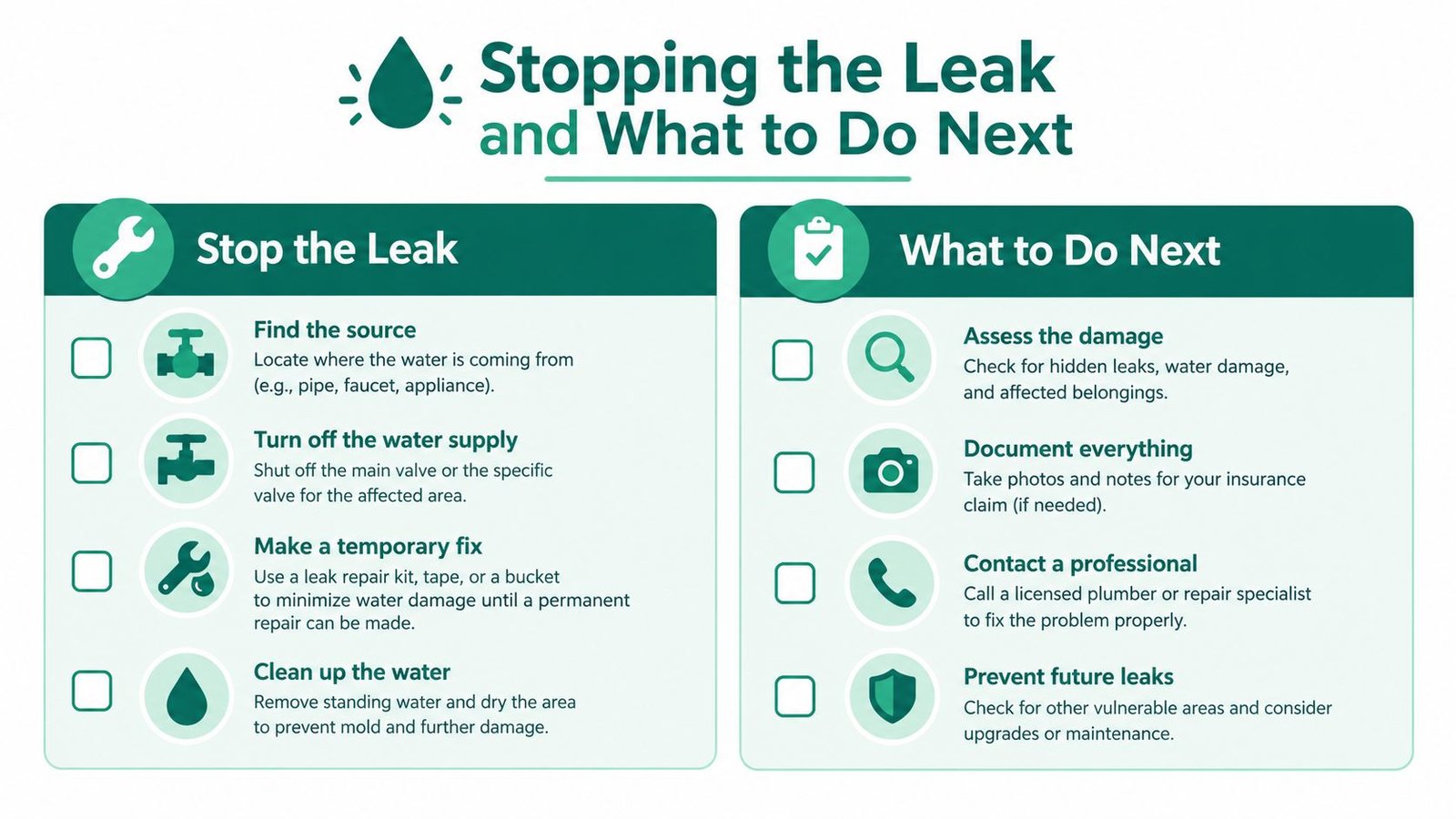
Stopping the Leak and What to Do Next
A DFS complaint recovers money after the payer has created the problem. The better system prevents the same problem from reaching final A/R. Practice owners should review out-of-network remittances monthly, compare the payment logic to the applicable plan terms, and isolate repricing vendors before the balance ages.
Use this operating checklist:
- Assignment of benefits: Confirm the provider's standing documents are complete and retrievable.
- Timely-filing control: Track initial submissions, corrected claims, reconsiderations, and payer receipt dates.
- Appeal evidence: Maintain a level-1 and level-2 appeal template matched to the denial reason.
- Repricing log: Record Data iSight, Zelis, MultiPlan, or other repricing references on each affected remittance.
- CPT review: Check the disputed CPT code, modifier, units, place of service, and provider NPI against the submitted claim.
- Medical-record excerpt: Prepare a focused clinical support packet for downcoding or medical-necessity disputes.
- IDR folder: Store the certification form, claim, remittance, appeal record, and portal confirmations together.
- DFS tracker: Record every complaint number, response date, contact, and requested follow-up.
- Carrier scorecard: Review payer-specific underpayment patterns by service line and denial reason.
- Credentialing audit: Confirm the provider's network and enrollment status so avoidable out-of-network billing doesn't continue.
Keep the prevention work connected to your broader out-of-network billing process. A recurring underpayment should trigger a contract review, credentialing check, fee-schedule validation, and claim-submission audit, not just another appeal.
The right first step is a focused OON underpayment audit. It should identify the claims worth escalating, separate DFS-eligible disputes from coding or clinical disputes, and show whether the problem is isolated to one payer or embedded across the practice's A/R.
Happy Billing audits out-of-network underpayments, prepares the documentation needed for payer and DFS escalation, and builds denial-prevention workflows around the patterns found in your claims. Visit Happy Billing to request a free audit and identify the recovery opportunities your current RCM process is leaving behind.
How long does a New York DFS complaint take?
Plan around a 30 to 60 day insurer-response and follow-up window, while recognizing that the exact handling depends on the complaint type and documentation. Track the complaint number internally and follow up against a specific date.
Can a provider file a DFS complaint after a payer appeal?
Yes, when the dispute fits DFS authority and the practice has a written appeal outcome or a documented failure to correct the claim. Include the complete appeal chain, especially the final adverse determination, with the complaint.
Does DFS handle every out-of-network underpayment?
No. DFS isn't the right forum for every coding dispute, medical-necessity determination, or federal No Surprises Act matter. Confirm whether the issue is a New York-regulated insurance complaint, a state surprise-bill IDR case, or a federal dispute before filing.
When should a practice contact the New York Attorney General?
Use the Attorney General's Health Care Bureau when the evidence shows a broader pattern of improper surprise billing, cost-sharing treatment, or consumer-impacting conduct. A well-organized pattern file is more persuasive than an unsupported allegation about one claim.
Not sure which underpaid claims are worth a DFS complaint?
Send us a sample of your out-of-network claims. We compare each allowed amount against a fair benchmark, flag which claims are still appealable, and estimate what is recoverable. BAA signed before we see any data. Get a free underpayment analysis →