ERISA Appeal Rights for Out-of-Network Healthcare Providers
Out-of-network providers with a valid assignment of benefits can appeal directly to self-funded ERISA plans and, when needed, sue in federal court under §502(a)(1)(B). For a practice owner, that is not a technicality, it's the difference between collecting a denied balance and writing it off after days in A/R keep climbing.
The counterintuitive part is that many billing teams still treat these denials like ordinary payer disputes, then waste weeks on state-level complaints that self-funded plans can ignore. The better path is federal, because the appeal record you build inside ERISA is often what gets the claim paid or positions you for litigation if the plan won't move.
The Federal Advantage Most Billing Companies Ignore
ERISA appeal rights for out-of-network healthcare providers are a revenue tool, not a paperwork chore. If your billing team pushes denied self-funded claims into the same workflow as a routine commercial appeal, cash keeps slipping out of the practice on balances that should be tested under federal rules.
We see the same pattern in specialty practices, especially when the denied claim is high-value and staff defaults to state DOI complaints, peer-to-peer calls, or a generic reconsideration letter. That approach misses the point of ERISA preemption. Self-funded plans answer to federal rules, not state insurance departments, and that changes the pressure point and the timeline.
Practical rule: if the plan is self-funded and you have a valid assignment, the internal appeal is part of your collection strategy, not a courtesy step.
The appeal packet also becomes the record you may need in federal court under §502(a)(1)(B). Operationally, that matters because each unpursued denial adds friction to A/R, while the plan's own process can be used to force a clearer explanation for the denial.
Practices that handle this well treat denial management as evidence preservation. They track plan language, denial reasons, and the exact date the appeal clock started, while keeping an eye on healthcare data compliance strategies that protect PHI while the team moves fast.
For a specialty group that wants a more aggressive recovery posture, the key question is whether the billing operation knows how to use ERISA before the claim gets buried.
If your out-of-network balances keep aging, start with a free out-of-network underpayment analysis to see where federal appeal rights are being missed.
Identifying Self-Funded ERISA Plans on the EOB
Self-funded plans are the first filter. If you misclassify the plan, you'll waste time in the wrong forum and miss the only appeal path that matters.
The practical difference is simple. Fully insured plans are subject to state insurance regulation, while self-funded employer plans run under federal ERISA rules, which is why state DOI pressure often goes nowhere on those claims. For practice owners, the EOB is usually the fastest clue, but it's not enough to guess, you need to verify funding status before spending staff time on a full appeal.
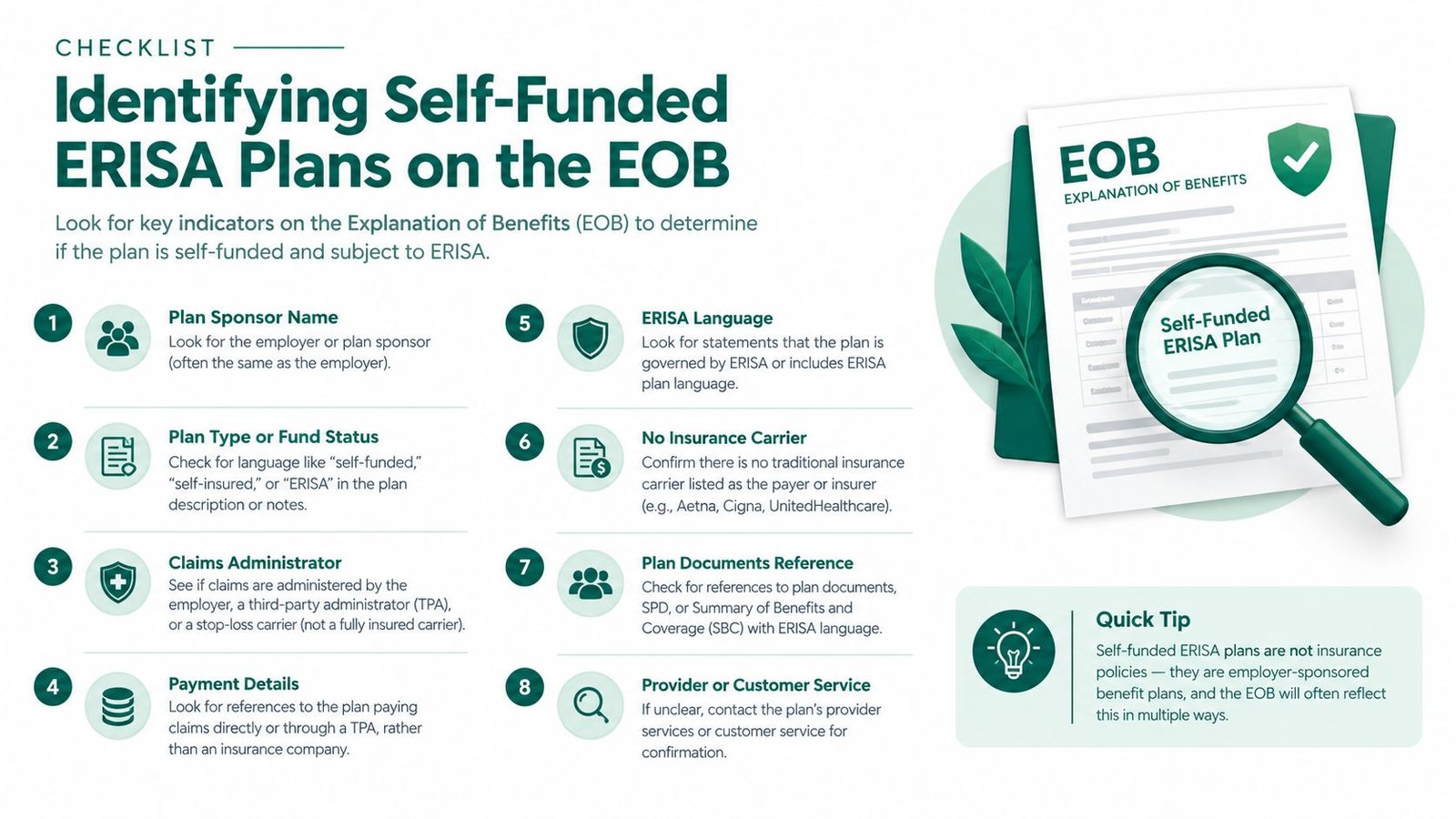
What to look for on the EOB
A few documents usually tell the story. The EOB, the plan brochure, and the Summary Plan Description often reveal whether the employer is funding claims directly or buying a fully insured product from a carrier.
- Plan administrator language: Look for references to an employer plan sponsor or third-party administrator, which can signal self-funding.
- Claims payment routing: If the EOB points to plan administration separate from insurance underwriting, that's a red flag for ERISA handling.
- SPD request language: Ask for the Summary Plan Description when the funding status is unclear, because the SPD can confirm whether state-law remedies are a dead end.
- Appeals address and process: Self-funded plans often route appeals through plan documents rather than a state DOI complaint path.
The operational payoff is straightforward. Once you know the claim sits inside ERISA, you stop burning staff hours on complaints that won't change the outcome and start building a record that can move money.
For a practical walkthrough of the EOB itself, use this guide on how to read an explanation of benefits and then confirm the funding source before any appeal filing.
Operational shortcut: if the payer's form language points you back to the plan document, not a state mandate, assume you're dealing with an ERISA workflow until the SPD proves otherwise.
Securing Standing Through Assignment of Benefits
A provider can't sue a self-funded plan just because the bill is unpaid. The provider has to stand in the patient's place through a valid assignment of benefits, and that assignment has to be broad enough to support the actual recovery strategy.
Federal appellate courts have repeatedly narrowed when out-of-network providers can invoke ERISA rights, making the presence of a valid assignment decisive, as ERISA Section 502 authorizes suits by participants or beneficiaries and not by providers without that assignment. That means the intake form isn't boilerplate. It's the gatekeeper for whether the claim can ever reach federal court. Miller Chevalier's ERISA litigation guidance makes the same point plainly, valid assignment is the line between standing and no standing.
What the assignment must actually transfer
A weak assignment often transfers only the right to receive payment. That's not enough if the plan fights the claim or if you need to appeal directly and preserve suit rights.
The stronger version should transfer the right to appeal, pursue plan benefits, and receive payment on the patient's behalf. If your intake packet doesn't capture that language, your team is gambling with federal authority before the first letter even goes out.
Best practice: preserve the assignment language in the appeal file exactly as signed, because later disputes often turn on the wording, not the medical facts.
How anti-assignment clauses change the risk
Some plans hide anti-assignment clauses in the SPD or claims documents. If the clause is clear and enforceable, it can block the provider from stepping into the patient's shoes even when the care was medically necessary and the balance is large.
That's why the first legal audit isn't the denial letter, it's the assignment language and the plan document together. If the plan prohibits assignment, the practice needs to know that early, because it changes whether the case belongs in ERISA litigation, in a rate-of-payment dispute, or in a different recovery lane altogether.
For a deeper workflow view, compare your intake and claims setup against how to bill out-of-network insurance so the assignment issue is addressed before the appeal clock starts running.
Right to Payment Versus Rate of Payment Disputes
Not every underpayment belongs in the same bucket. The legal theory changes depending on whether the plan denied the claim outright or paid something and lowballed the allowed amount.
Courts have drawn a key distinction between disputes over the right to payment and the rate of payment. Claims attacking a denial are often treated as ERISA benefit disputes, while claims where payment was approved but allegedly underpaid may sometimes be pursued outside ERISA in state court. ACEP's ERISA FAQ reflects that split, and for a practice owner the split matters because it changes both strategy and negotiating position.
Why the difference affects cash recovery
A right-to-payment dispute usually belongs inside the ERISA appeal lane first. If the plan says the service wasn't covered or wasn't medically necessary, the internal appeal becomes the path to later federal review.
A rate-of-payment dispute is different. If the plan acknowledged the claim but applied a repricer or an artificially low out-of-network rate, the case may sometimes fit a state-law posture instead of being trapped entirely inside ERISA. That matters when your team is deciding whether a denial is really a denial, or whether the payer is just shaving the allowed amount.
For practices seeing systematic repricer activity, the issue often shows up alongside vendor pricing logic rather than a classic medical necessity denial. That's where a focused recovery review, such as this guide to Data iSight underpayment appeals for out-of-network providers, can help separate ERISA benefit disputes from reimbursement-rate fights.
What billing teams get wrong
They send the same template appeal to every case. That's inefficient and risky, because a denial needs a benefits-focused record, while a low allowed amount may require a different legal theory and a different commercial posture.
- Denial cases: build the ERISA file and preserve suit rights.
- Underpayment cases: determine whether the issue is plan benefits or payment rate.
- Mixed cases: split the file and decide which facts belong in which lane.
The revenue takeaway is blunt. If your team can't tell the difference, you'll either over-litigate a small balance or under-challenge a claim that had real recovery value.
Executing the 180-Day Administrative Appeal Workflow
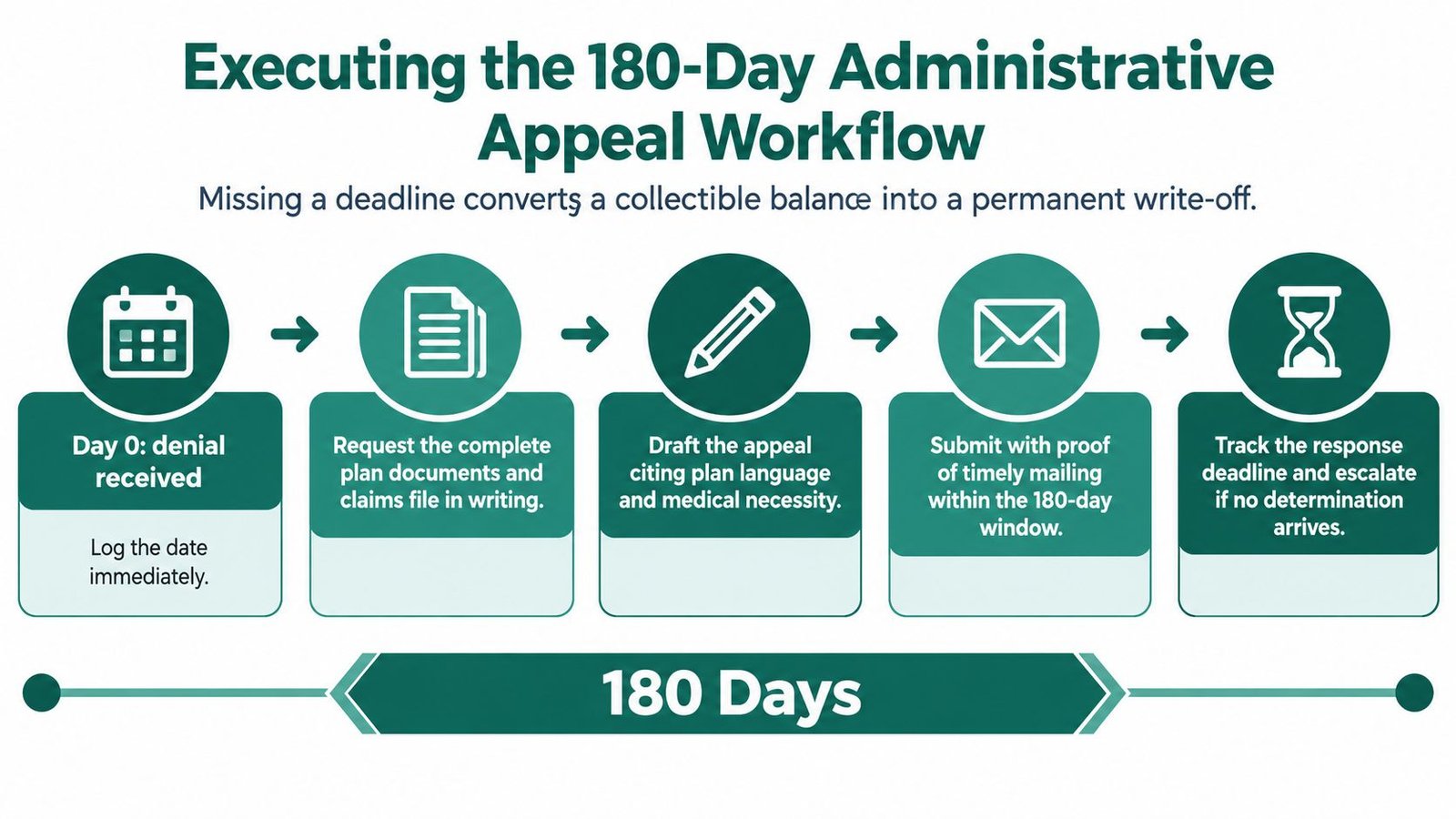
The appeal clock is unforgiving. For ERISA group health claims, participants must be allowed at least 180 days to appeal adverse benefit determinations, and missing that window can turn a collectible balance into a write-off on a high-dollar out-of-network case. The Department of Labor's claims-and-appeals guidance is the rulebook here, not a suggestion.
Build the file like you expect federal review
The administrative appeal is where many practices either gain influence or lose it. The goal isn't just to ask for reconsideration, it's to build a record that shows exactly why the denial was wrong and what the plan failed to disclose.
A strong package should include the clinical records, coding rationale, and medical-necessity evidence, along with a written request for the full claim file and any internal guidelines used in the decision. If the denial notice failed to cite the specific plan provisions relied on, that omission should be documented immediately, because procedural defects matter later.
Track the plan's process, not just your own deadline
ERISA denial notices must explain the specific reasons for denial, cite the plan provisions, describe what additional information is needed, and explain the appeal process. The claimant also has to be allowed to submit comments and relevant records, access relevant documents on request, and receive a fresh review by a different decision-maker, with medically based denials reviewed by a qualified health care professional in the relevant field. The Department of Labor's procedural guidance lays out those protections in detail. The DOL claims-and-appeals framework is worth keeping close when your team is preparing the file.
- Day 0: log the denial date the moment it arrives.
- Document request: ask for the plan file and internal guidelines in writing.
- Appeal narrative: tie the clinical facts to the plan language, not just general fairness.
- Proof of mailing: keep date-stamped proof for the submission.
- Decision tracking: monitor the response deadline and escalate if the plan stalls.
For teams that want a clean operational process, a structured denied insurance claim appeal workflow keeps the file tight and preserves the record for later federal review.
Escalating to Federal Court and Leveraging Case Law
Once the internal appeal is exhausted, the question becomes whether the denial is worth federal litigation. For the right file, the answer is yes, because the administrative record can force the plan to defend its own reasoning under a microscope.
That is where §502(a)(1)(B) matters. A provider with a valid assignment can pursue the plan in federal court for benefits due under the plan, and in practice that threat often changes settlement behavior long before trial. Federal discovery also pressures the plan to produce internal documents, which is why a well-built appeal record is so valuable.
When smaller balances still justify action
Not every case needs a full-blown legal campaign. Smaller balances can still be pursued through targeted federal action when the denial pattern is clean and the facts are strong, especially if the same plan keeps applying the same reasoning across multiple claims.
For a practice owner, the bigger question is whether the denial reflects isolated medical-necessity friction or a recurring payer policy that's draining margin across the out-of-network book. If it's the latter, the case may justify broader coordination with ERISA counsel because the legal pressure can extend beyond one claim.
Why recent provider-friendly outcomes matter
Courts continue to narrow provider standing unless the assignment is solid, but provider-side recovery is still possible when the case is built correctly. The practical lesson from the case law is not that ERISA is impossible, it's that sloppy documentation fails and precise documentation survives.
A related pressure point is the distinction between single-claim litigation and pattern conduct. When the same denial logic appears across many claims, counsel can evaluate whether the facts support a coordinated strategy rather than isolated one-off appeals. That shifts the conversation from “Can we chase this claim?” to “Can we change the payer's behavior?”
Federal court is not a backup plan. It is the enforcement mechanism that makes a disciplined appeal meaningful.
Navigating Exceptions to ERISA Preemption
ERISA is broad, but it doesn't wipe out every possible state-law theory. One of the most practical exceptions involves misleading benefit-verification calls, especially when the provider relied on a payer representative's answer before delivering expensive out-of-network care.
The Ninth Circuit held in 2026 that ERISA did not preempt a negligent-misrepresentation claim by an out-of-network provider based on a benefits-verification call, aligning with the Fifth, Eighth, and Eleventh Circuits on similar misrepresentation theories. That appellate development matters because it creates a parallel recovery theory in some jurisdictions when the payer said one thing on the phone and did another on the EOB.
Why practice owners should care
A verification call can shape the entire financial decision to treat. If the plan or its administrator gives a misleading answer about coverage or allowed amounts, the practice may have a separate misrepresentation problem even when ERISA blocks the ordinary benefits path.
That doesn't replace the appeal. It gives you another lane when the facts support it, especially in high-dollar specialty cases where a small misstatement changes the expected reimbursement materially.
How to preserve the issue
The front office should document the caller, date, reference number, and exact substance of the verification conversation. If the payer's answer influences the decision to provide care, that record can matter later in ways a standard appeal file won't capture.
For practices dealing with self-funded plans and No Surprises Act friction, the verification process also has to be handled carefully. A useful reference point is this No Surprises Act compliance resource, especially where the billing team needs to separate plan verification from balance-billing risk.
Strategic ERISA Questions for Practice Owners
Should we appeal every self-funded denial?
Yes, when the balance is meaningful and the assignment is valid. Unappealed denials are often just silent margin loss, and once the internal deadline passes, the claim is much harder to recover.
What if the plan has an anti-assignment clause?
Then the case needs a document-level review before you invest more time. Some clauses are enforceable, and some aren't, but you need to know which bucket you're in before treating the denial like a standard collectible.
Do we balance bill while the ERISA appeal is pending?
That depends on the plan type, the patient's protections, and the service at issue. For self-funded plans, the appeal and the patient-billing decision have to be aligned carefully so you don't create a compliance problem while trying to protect revenue.
Is outsourcing ERISA appeals worth it?
If your team is missing deadlines, using generic denial templates, or failing to distinguish right-to-payment from rate-of-payment claims, yes. The cost of a good process is usually lower than the cost of repeated write-offs and preventable A/R aging.
If your practice is sitting on self-funded out-of-network denials, Happy Billing can help you isolate the ERISA advantage, rebuild the appeal file, and identify where recoverable balances are getting lost. Start with a free out-of-network underpayment analysis, then visit Happy Billing to see how a focused RCM review can turn denied claims into a cleaner recovery path.