Multiplan Underpayment Appeal Guide for Out-of-Network Providers Explained
MultiPlan repricing is appealable through its portal-based negotiation, and it's typically more workable than Data iSight or Zelis, although providers still report payments 40% to 60% below UCR. It's worth pursuing when the claim has meaningful recovery value, strong documentation, and enough deadline discipline to support the appeal.
You're probably seeing the problem in a familiar form. A Cigna claim comes back as paid, the EOB references a repriced amount, and the allowed figure looks too low to justify the clinical work, overhead, and risk involved. Your team posts the payment because the claim isn't technically denied, while the practice absorbs another underpayment and your A/R report hides the loss inside “paid” claims.
That's why the right question isn't whether MultiPlan is difficult. The question is whether the expected recovery exceeds the cost of pursuing it. A disciplined appeal program can increase net revenue per encounter, prevent avoidable write-offs, and keep underpaid claims from aging into unproductive A/R. The accounts receivable guidance for medical billing is relevant here because MultiPlan claims often create A/R leakage without appearing in the denial rate.
In our experience, the most accurate practitioner summary is simple: “MultiPlan is manageable, but we still lose money on every claim.” Manageable doesn't mean acceptable. It means you can identify the repricing path, submit a focused counteroffer, track the response, and decide rationally when escalation makes financial sense.
This guide is part of our out-of-network underpayment series. If you run a therapy or rehab practice, start with the physical therapy underpayment recovery guide for practice owners; the companion guides cover Data iSight and Zelis.
Already deposited a MultiPlan-repriced payment? You can still contest it. See how to reopen a deposited underpaid claim for the reopening paths that avoid duplicate-claim denials.
Why MultiPlan Underpayments Drain Revenue for Out-of-Network Practices
A claim can close operationally while remaining financially unresolved. The payer issues an EOB, the payment posts, and the account appears settled. Yet the allowed amount may reflect a repricing methodology rather than the reimbursement supported by the patient's out-of-network benefits or the service's usual and customary value.
For a physician owner, that gap affects three operating metrics:
- Net revenue per encounter: A lower allowed amount reduces the contribution from each affected service.
- Denial rate: Repriced claims may be marked paid, allowing the denial dashboard to understate the loss.
- Days in A/R: Delayed identification leaves less time to meet appeal deadlines and recover funds.
Federal dispute activity shows why payment integrity deserves its own workflow. Providers initiated nearly all disputes in the No Surprises Act independent dispute resolution system from its launch through 2024, with more than 2.3 million disputes initiated overall. Providers initiated 679,156 disputes in 2023, and the total rose to over 1.46 million in 2024, according to the Congressional Research Service analysis of the No Surprises Act dispute system.
That volume does not place every MultiPlan claim in federal arbitration. MultiPlan's portal negotiation track and the federal No Surprises Act IDR process are separate routes. Staff must identify which process applies before choosing an escalation strategy. The accounts receivable guidance for medical billing also applies here, because underpaid claims can create A/R leakage without appearing as denials.
The underpayment is hidden inside a paid claim
MultiPlan repricing often produces payment instead of denial. The claim therefore looks clean in adjudication reports even when the billed charge, allowed amount, and practice benchmark are far apart. Post the payment, preserve the EOB and repricing notice, then calculate the disputed balance before accepting the result as final.
CPT selection and modifiers can change the amount at risk. CPT 20610 represents a major joint aspiration or injection. Modifiers such as -25 or -59 may affect whether related services are separately recognized under payer policy. Review each service line, modifier, adjustment reason, and repricing amount. A discount should not conceal a coding or processing error.
CPT 97530 provides a practical decision test. If the payer allows $30 on a $100 charge, the initial gap is $70. If a separate CPT 20610 line carries a $150 charge and receives a $60 allowed amount, another $90 is at issue. The combined gap is $160 before staff time, documentation review, and escalation costs. Accept a low offer only when the expected recovery does not justify that work. Appeal when the balance is material and the record supports a counteroffer.
Treat every repricing as a financial decision
Rank claims by recoverable dollars, documentation quality, payer behavior, and deadline position. Preserve the original EOB, remittance, portal messages, clinical records, coding support, fee benchmark, and every submission timestamp. That evidence supports the portal appeal and protects the practice if a state Department of Insurance complaint becomes necessary.
Do not let staff decide informally. Use a written accept-or-appeal rule, assign one owner, track each deadline, and record the final rationale. This produces consistent appeals, exposes payer patterns, and keeps legitimate underpayments from disappearing inside “paid” A/R.
Seeing MultiPlan reductions on your remits?
We will compare a sample of your out-of-network claims against a fair benchmark and show you what is recoverable, claim by claim. Get a free underpayment analysis →
How MultiPlan Data iSight and Zelis Repricing Really Compare
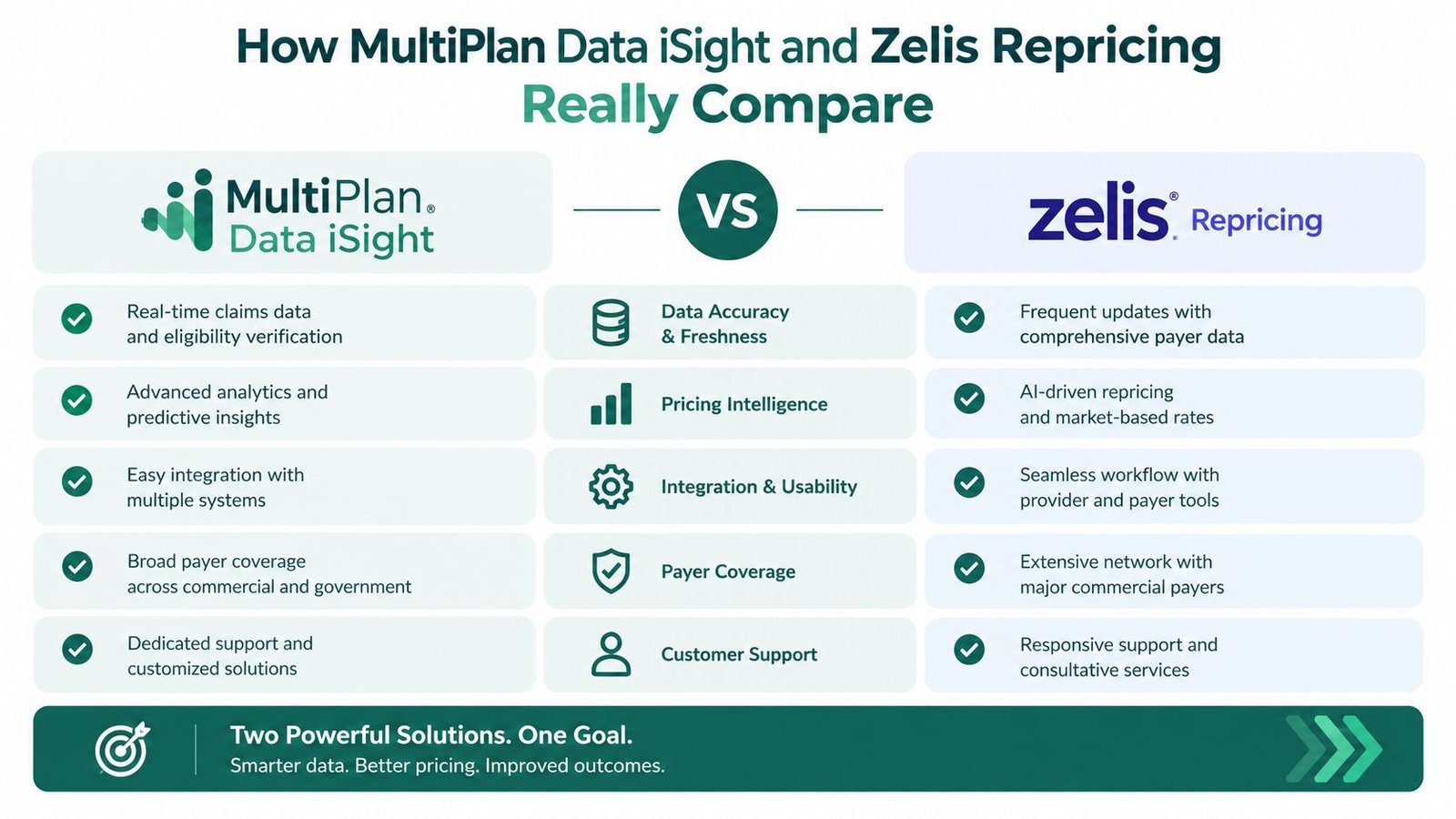
MultiPlan, Data iSight, and Zelis shouldn't be treated as interchangeable labels. They can all appear in out-of-network payment workflows, but the practical recovery path depends on which entity or product appears on the EOB, remittance, portal instructions, and correspondence.
Practitioners generally view MultiPlan as the more negotiable repricer. Its portal-based process gives the provider a channel to review or counter a repriced offer. That doesn't make the offer fair. MultiPlan repricing is still commonly described as landing 40% to 60% below UCR, but the negotiation ceiling is often higher than what practices encounter through Data iSight or Zelis.
MultiPlan gives you a negotiation track
When a payer such as Cigna routes an out-of-network claim through MultiPlan, the EOB or related notice may direct the provider to a portal-based negotiation process. The portal commonly presents the repriced amount, provides a response function, and creates a record of the provider's counterposition.
Your staff should treat that activity as a formal financial dispute, not a casual message exchange. Save the original offer, upload the supporting records, state the requested amount clearly, and preserve confirmation that the submission was received.
The guide to out-of-network repricing tools can help owners evaluate how different repricing arrangements affect claim review and recovery priorities. The important operational point is that a MultiPlan portal offer has a defined workflow, while other repricers may require a payer-specific dispute or a different vendor channel.
Data iSight usually demands a harder economic decision
Data iSight claims often present a lower target price with less practical room for movement. If the offered amount is close to your minimum acceptable reimbursement and the documentation is thin, accepting may be rational. If the gap is large and the service carries meaningful professional cost, appeal viability improves, especially when you can show the submitted service, clinical complexity, authorization history, and relevant out-of-network benefit language.
Don't assume that a claim is unappealable because the first offer is low. Do assume that staff time has a cost. A claim-ranking model should account for the amount at stake, not just the emotional reaction to the discount.
Zelis requires separate handling
Zelis claims may follow their own repricing, negotiation, or payer-directed review rules. The practice shouldn't copy a MultiPlan submission into a Zelis workflow without first confirming the entity named in the correspondence and the required channel.
Use this decision filter:
- Identify the repricer: Confirm whether the EOB, remittance, or notice names MultiPlan, Data iSight, Zelis, or only the payer.
- Measure the gap: Compare billed charges, allowed amount, payment, patient responsibility, and your defensible benchmark.
- Check the CPT economics: Prioritize higher-value services such as CPT 20610 when the variance is material and the documentation is complete.
- Review the history: A payer or repricer that repeatedly improves after a counteroffer deserves a higher appeal priority.
- Apply a floor: Establish the lowest acceptable recovery before staff enters negotiation, then require owner approval for offers below that floor.
What a Real MultiPlan Underpayment Looks Like in Dollars
Consider an illustrative Cigna out-of-network claim for CPT 20610 that routes through MultiPlan. The practice bills $1,200, while its internal UCR benchmark is $1,000. MultiPlan returns an allowed amount of $500, and Cigna pays that amount after adjudication.
The payment isn't a denial. It's cash. But compared with the practice's UCR benchmark, the claim leaves $500 unrecovered before considering staff time, supplies, facility-related costs, and the clinical resources required to perform the injection or aspiration.
Because the verified data doesn't establish a universal Cigna rate, a universal MultiPlan rate, or a standard value for CPT 20610, this example is a decision model rather than a market statistic. Replace the figures with your own EOB, contract, payer policy, and defensible UCR documentation.
Sample MultiPlan Repricing Shortfall for CPT 20610 via Cigna
| Line Item | Amount | Notes |
|---|---|---|
| Billed charge | $1,200 | Amount submitted by the practice |
| MultiPlan allowed amount | $500 | Repriced amount shown in the example EOB |
| Practice UCR benchmark | $1,000 | Internal benchmark requiring supporting documentation |
| Shortfall versus UCR | $500 | Potential recovery target before costs |
| Paid amount | $500 | Amount posted from the example claim |
| Unrecovered benchmark value | $500 | Difference between benchmark and payment |
The appeal case becomes stronger when the record supports the service and the pricing argument. Include the operative or procedure note, the relevant diagnosis, authorization or referral documentation, the EOB, and the out-of-network benefit language. If a modifier such as -25 or -59 appears on the claim, verify that the payer's adjudication did not use the modifier as a reason to suppress a separately payable service.
Translate one claim into an operating decision
The owner should ask three questions:
- What amount is realistically recoverable? The requested amount must be supported, not merely asserted.
- What will the appeal cost in labor and delay? Staff time, portal work, follow-up, and escalation all affect return.
- What does the pattern show? One isolated variance may be a payment error. Repeated underpayment across the same payer or service may justify a broader audit.
A practice can also evaluate the claim against its own minimum acceptable amount. If the payment is below that floor and the evidence is ready, appeal. If the offer is close to the floor and the appeal process is burdensome, accept only after documenting the rationale. That creates a repeatable policy instead of letting individual staff members make inconsistent write-off decisions.
Building and Submitting a Winning MultiPlan Appeal Package
A MultiPlan appeal succeeds when the reviewer can verify the claim, the payment, and the requested correction without searching through disconnected records. State the issue precisely. Identify what was billed, what was paid, which benefit or benchmark supports the request, and why the repricing should be reconsidered. A general complaint about unfair reimbursement rarely produces a usable response.
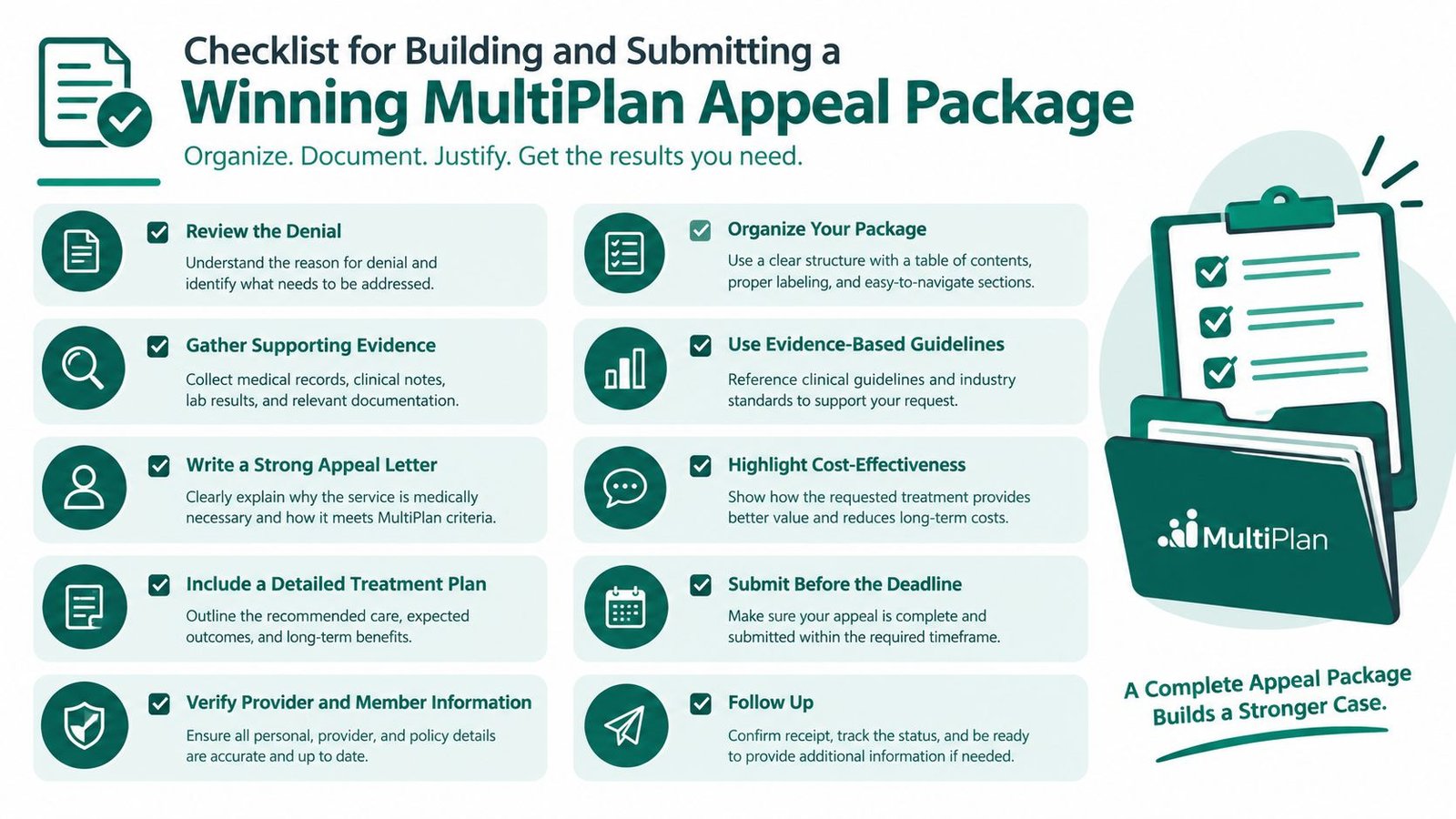
Build the package around one claim. Collect the EOB, UB-04 or itemized statement, out-of-network benefit language, authorization or referral records, and a dated communication log. Submit a formal written appeal through the channel named in the notice, then preserve proof of transmission. You can use this guide on how to appeal a denied insurance claim to build the checklist, alongside this out-of-network denial appeal guide.
Assemble the record before entering the portal
Create one claim-specific file. The reviewer should see the complete argument in a logical order, not reconstruct it from separate folders and email chains.
- EOB and remittance: Include every page, adjustment code, remark, payment date, claim number, and repricing reference.
- UB-04 or itemized statement: Use the form appropriate to the claim and display each service line clearly.
- Policy language: Mark the patient's out-of-network benefits, reimbursement provisions, appeal rights, and authorization requirements.
- Authorization and referral records: Add approval numbers, referral documents, scheduling records, and payer communications.
- Clinical support: Include the procedure note and documentation establishing that the billed service was provided and medically supported.
- CPT and modifier comparison: Explain the code and modifiers in financial terms. For CPT 20610, show the billed line, payment, adjustment, and requested correction. For CPT 97530, identify the timed units and any payer rule affecting unit recognition. If -25 or -59 appears, check whether adjudication used the modifier to suppress a separately payable service.
- UCR or market support: Explain how the documented benchmark was established. Do not present an unsupported figure as a legal entitlement.
- Communication log: Record the date, representative, reference number, offer, response, and next action.
- Deadline tracker: Record the payment receipt date and every stated appeal or challenge deadline.
- Transmission proof: Save the portal confirmation, uploaded file list, timestamp, screenshots, and follow-up reference number.
Write the appeal so the reviewer can resolve it
Label the submission “Formal MultiPlan Underpayment Appeal.” Put the requested action first, then support it with claim facts and exhibits.
Use this structure:
- Claim identification: Include the patient account number, claim number, date of service, payer, repricing reference, and provider tax or billing identifiers.
- Payment dispute: State the billed amount, allowed amount, paid amount, and exact variance.
- Basis for reconsideration: Cite the applicable out-of-network benefit language, payer policy, authorization record, or documented benchmark.
- Service explanation: Explain the CPT code, units, modifiers, complexity, and circumstances supporting the requested reimbursement.
- Requested resolution: State the corrected amount. If the methodology remains unclear, request a written explanation identifying the policy and calculation used.
- Attachments: Number each exhibit and cite it in the letter.
- Response instruction: Request a written determination and preserve the right to seek the next available review or regulatory remedy.
Use neutral, specific language. The goal is a clean administrative record that supports reconsideration, escalation, and regulatory review if the payment does not change.
Submit through the specified channel
Use the portal or payer-directed channel named in the notice. Sending the appeal to an unrelated payer address can leave the practice believing the dispute is active while the applicable deadline continues.
MultiPlan's professional network handbook states that complaint investigations typically take 30 to 60 days for an initial determination, and participating professionals may challenge payment within 180 days of receiving payment by giving written notice to MultiPlan and the client, as described in the MultiPlan professional handbook. Track both dates from payment receipt, not from the day staff identify the underpayment.
The portal negotiation track is separate from No Surprises Act IDR. A MultiPlan repricing challenge follows the notice and handbook requirements. IDR applies only when the claim qualifies under that federal process. Do not label a routine MultiPlan underpayment as an IDR case or assume an IDR filing preserves a portal appeal deadline.
Before submitting, check the failure points that most often weaken otherwise supportable files:
- Missed notice window: The challenge arrives after the applicable period.
- Wrong recipient: The dispute goes to the insurer but not the entity named in the repricing instructions.
- Incomplete EOB: The file omits the page showing the repricing adjustment or payment calculation.
- Unsupported benchmark: The practice demands UCR without explaining how it established that amount.
- No proof of submission: Staff cannot show when the portal received the appeal.
- Unclear request: The letter describes the problem but does not state the correction or amount requested.
Preserve the original EOB, portal record, correspondence, and appeal exhibits in read-only form. If the payer denies the challenge, use the written rationale to decide whether to escalate through the available review process or a state Department of Insurance complaint. That record matters when the dispute involves repeated repricing, unclear network authority, or conduct requiring regulatory attention.
Timelines Escalation and Tracking That Protect Your A/R
A MultiPlan portal challenge and No Surprises Act IDR are separate recovery tracks. Treating them as interchangeable can cost the practice a filing deadline, an eligible IDR opportunity, or both.
For a standard MultiPlan repricing dispute, follow the notice and handbook requirements, preserve the written challenge, and track the 180-day payment challenge window and 30 to 60 day initial determination period described above. Start the clock from the payment or notice date required by the applicable instructions, not from the day staff discover the variance.
A No Surprises Act claim follows a different sequence. The payer must issue an initial payment or denial within 30 calendar days of receiving the bill. The parties then have a 30-business-day open negotiation window, and either party can initiate federal IDR within 4 business days after open negotiation ends. Review the No Surprises Act IDR process and timeline before assigning the file to that route.
The federal IDR entity has 30 business days to choose between the two offers. That additional processing time can extend recovery and increase physician-practice A/R days, as explained in this independent dispute resolution overview.
Choose the right escalation path
Use a state Department of Insurance complaint when the dispute involves payer conduct subject to state oversight, an unexplained repricing practice, failure to follow applicable appeal rules, or a suspected unauthorized network arrangement. A DOI complaint does not replace the claim-level appeal. Submit the administrative dispute first, then attach the complete record to the complaint.
Use federal IDR only when the claim meets No Surprises Act eligibility requirements. Federal IDR is not a general remedy for every out-of-network underpayment. The CMS No Surprises Act framework outlines the federal process, while payer instructions and applicable state rules determine whether a particular claim belongs in the federal or state pathway.
Eligibility screening should happen before staff spend time preparing an IDR file. Check the service, payer, state, facility setting, emergency status, and statutory criteria. One industry analysis reported that insurers considered 39% of submitted disputes ineligible, as described in this analysis of insurance claim disputes. Use that finding as a warning to verify eligibility rather than assuming every repriced claim qualifies.
Build a tracking system owners can read
Your tracker should show the financial result and the next deadline, not merely “open” or “closed.” Include:
- Claim number and date of service
- Payer and repricing entity
- CPT codes, units, and modifiers
- Billed amount, allowed amount, paid amount, and requested amount
- Payment receipt date
- MultiPlan challenge deadline
- Portal submission date and confirmation
- Determination date and result
- Recovery dollars
- Staff time and escalation cost
- A/R days before and after resolution
- Reason for acceptance, appeal, or closure
Review the dashboard by payer, repricer, CPT family, specialty, and aging. A low denial rate can conceal repeated underpayments on a small group of high-value procedures. Compare recovered dollars with staff time and escalation cost before setting an acceptance threshold for future offers.
Owner's rule: Measure appeals by recovered dollars, recovery rate, cost per recovery, and the change in A/R days. Activity alone is not performance.
Preserve evidence as litigation and regulatory scrutiny continue
The broader repricing model remains under antitrust scrutiny. Reporting on the litigation describes allegations involving MultiPlan's repricing model and claimed underpayments of roughly $19 billion in 2020, $22.9 billion in 2023, and $6.4 billion in the third quarter of 2024, as reported by Fierce Healthcare.
Separately, 2026 coverage describes the Massachusetts Zelis case moving forward, an Arizona attorney general action involving MultiPlan and major insurers, and additional deposition and document-production activity in the MultiPlan antitrust MDL, according to WCHSB's discussion of the repricing litigation. These developments do not turn every underpaid claim into a legal claim. They do make disciplined evidence preservation sensible.
Keep original EOBs, portal offers, counteroffers, payment files, contracts, fee schedules, correspondence, and claim-level variance reports. Preserve each version in read-only form, and do not overwrite historical payment data when a payer changes its methodology. If counsel advises preservation or litigation participation, the claim archive should be ready.
Seeing MultiPlan reductions on your remits?
Send us a sample of your out-of-network claims. We compare each allowed amount against a fair benchmark, flag which claims are still appealable, and estimate what is recoverable. BAA signed before we see any data. Get a free underpayment analysis →
Frequently Asked Questions From Practice Owners
Should we outsource MultiPlan appeals or keep them internal?
Keep routine screening and document collection inside the practice if your team has the capacity. Outsource when portal work, deadline tracking, payer follow-up, and contract analysis are consuming physician-owner time or producing inconsistent results. The decision should be based on recovered dollars and A/R improvement, not on whether the practice can technically upload a document.
Will appealing underpayments reduce our denial rate?
Not necessarily. Many repriced claims are paid rather than denied, so the denial rate may remain unchanged while net collections improve. Track underpayment recovery separately, then measure whether corrected payments reduce outstanding A/R and prevent repeat leakage.
What should we do when MultiPlan says the offer is final?
Save the final offer and the complete correspondence, then verify whether the notice identifies another appeal, complaint, or payer-level review. Don't send the case into No Surprises Act IDR automatically. Screen eligibility first, preserve the deadline, and consider a state DOI complaint when the issue involves regulated payer conduct.
How should we handle Cigna claims routed through MultiPlan?
Treat Cigna as the payer and MultiPlan as the repricing channel unless the EOB or plan documents establish a different arrangement. Review the out-of-network benefit language, identify the CPT and modifier impact, compare the allowed amount with your documented benchmark, and submit through the channel named in the notice. Practices that routinely receive out-of-network revenue should use a specialty-specific review process, such as the one described in out-of-network billing guidance.
Happy Billing can audit MultiPlan repricing patterns, organize claim-level evidence, manage portal appeals, and recover underpayments without forcing your practice to replace its existing EHR workflow. Visit the Happy Billing free audit page to identify missed recovery opportunities and determine whether your current RCM process is protecting revenue, denial performance, and A/R days.