Data iSight Underpayment Appeal Guide for Out-of-Network Providers
Data iSight underpayment appeals are worth pursuing, and the first move is simple, resubmit the claim to reset the negotiation clock, attach Fair Health 80th-percentile proof plus one comparable payer payment, and escalate to NJ DOBI if the payer sticks to its reduction. In the right file, providers can recover a meaningful share of the haircut because the dispute process is now a real payment channel, not a courtesy letter.
Quick answer: 1) resubmit to generate a fresh EOB and reset the 14-day window, 2) attach Fair Health 80th-percentile support for the ZIP plus one comparable payer EOB and medical necessity notes, 3) escalate to NJ DOBI if the payer holds its recommendation. That sequence is what moves money on repriced out-of-network claims.
For practice owners, this is not an academic issue. A repriced out-of-network claim hits revenue, drags A/R days, and lowers the visible net collection rate even when patient volume stays flat. The federal surprise-billing dispute system has become a high-volume national channel, with more than 1.37 million disputes closed in 2024 and provider wins still running high in decided cases, which tells you the market has moved from isolated fights to an operational revenue line item (Congressional Research Service report, HFMA summary of IDR outcomes).
If you run PT, chiropractic, OT, mental health, or sports medicine visits out of network, the math gets ugly fast. A single repriced CPT can look modest on paper and still leak serious cash over a month of visits. The only sane response is to stop treating Data iSight as a black box and start treating it like a recoverable pricing decision.
What Data iSight Is Costing Your Practice
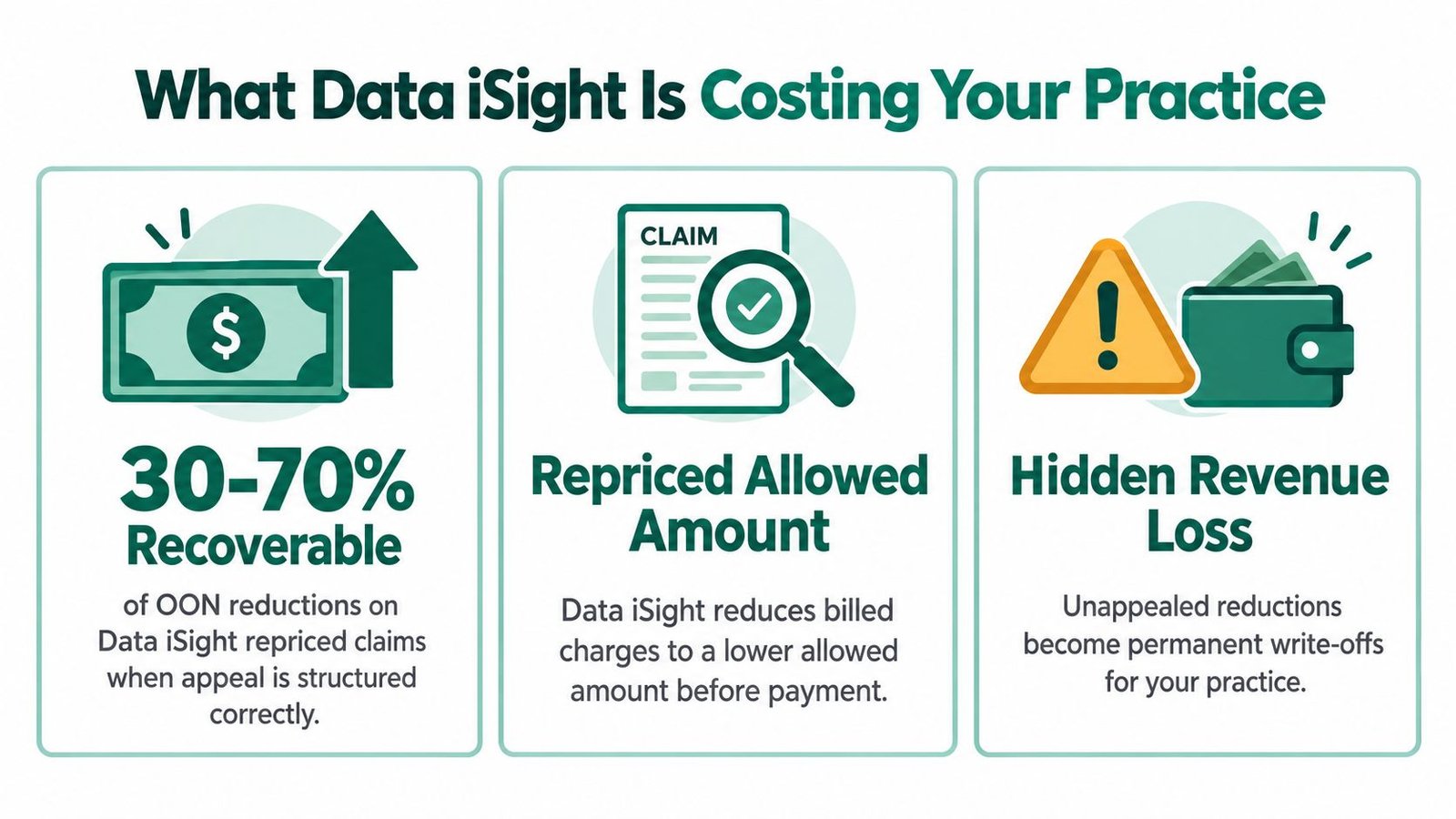
A structured appeal can recover part of the reduction on Data iSight repriced claims. In our illustrative Paramus benchmark, the right appeal aims at roughly 30 to 70 percent of the cut, especially when you challenge the payer's pricing logic with the same kind of evidence it used against you.
A clean example is CPT 97140 in Paramus, New Jersey 07652. Illustrative scenario, a $185 charge comes back repriced near $70 on the first pass, which leaves about $115 per visit unpaid before you count the administrative drag. At 40 out-of-network visits a week, that leakage turns into a serious annual cash problem, and it gets worse because the underpayment sits in A/R while staff keeps working it instead of posting cash.
Where the money disappears
Data iSight is commonly used by payers and health plans to price claims for providers outside the payer's network, which means the claim is being repriced, not denied in the usual fee-schedule sense (Data iSight overview). Claritev says the platform is applied to billed but unpaid out-of-network claims and can end with the payer holding its recommendation, negotiating after appeal, or reversing if settlement fails (Claritev explanation of Data iSight appeals).
That matters for practice economics because repricing changes the denominator on your net collection rate and pushes more of your work into write-off pressure if you let it sit. Owners who focus on volume while the underpayment layer grows are usually the ones who see payroll, rent, and growth plans squeezed first. If you care about cash flow, you care about every repriced line.
Practical rule: if the repriced amount is below a reasonable local benchmark, appeal it as a pricing dispute, not as a generic complaint.
For practices that already have denial management in place, the appeal path belongs in the same operational bucket as contract underpayment recovery. If you want a broader framework for how those recoveries fit inside your billing stack, use the out-of-network reimbursement resources page as a reference point for your team.
How Claritev's Repricing Engine Works
Claritev's Data iSight is a repricing engine. It takes an out-of-network claim and pushes down the allowed amount before payment, so the dispute is about method and money at the same time. Once a payer runs a claim through that engine, the billed charge stops being the anchor.
Why the benchmark matters more than the charge
The problem is opacity. The payer often does not show the exact percentile or internal benchmark it used, so the remittance lands as a reduced figure with no clear roadmap back to the math. That is why the appeal has to be technical. Do not argue that the claim should have paid more. Attack the repricing with ZIP-level benchmark data, comparable payer payment evidence, and a specific medical-necessity story.
For CPT 97140 in 07652 Paramus, the benchmark points are clear. Fair Health 80th percentile is $153, 90th percentile is $158, and providers commonly see about $150 paid on a $160 charge when the claim is supported and the payer stays within a familiar commercial range. A Data iSight outcome can sit much lower without appeal, sometimes in the $30 to $100 range on the same kind of out-of-network claim. That spread is the margin you recover.
| CPT 97140 OON Repricing Example, Paramus, NJ 07652 | Amount | Source |
|---|---|---|
| Billed charge | $160 | Provider example in brief |
| Fair Health 80th percentile | $153 | Fair Health benchmark reference |
| Fair Health 90th percentile | $158 | Fair Health benchmark reference |
| Typical paid amount without heavy repricing | $150 | Provider example in brief |
| Data iSight repriced range without appeal | $30 to $100 | Repricing tools guide |
The lesson is direct. Once the repriced amount sits well below a defensible local benchmark, you have a pricing rebuttal, not a plea. That changes the tone of the file and improves the chance of getting the payer to move.
For teams comparing workflow tools and reimbursement recovery tactics, the out-of-network medical bill repricing tools guide is a useful internal benchmark for how these systems are being used in practice.
Resetting the 14-Day Negotiation Window Trap
The mistake is waiting. Once the reduced payment posts, the clock starts, and delay hands the payer control. CMS surprise-billing rules give you a defined open negotiation period for eligible disputes, and if you let that window close, the appeal gets harder fast. The CMS fact sheet sets the baseline, but the practical move is to act as soon as the repriced EOB lands.
How to reset the file
Reset the file with a clean correction, then file a fresh dispute package that explicitly asks for open negotiation. If the claim has any billing error you can fix without creating a new problem, resubmit it correctly. If the billing is clean, keep the original denial path in front of the payer and force a new review tied to the reduced EOB.
Use the packet as a unit. Do not send fragments.
- EOB showing the Data iSight reduction, because that is the payment you are challenging.
- Fair Health benchmark PDF for the correct ZIP, because local pricing is the anchor.
- One comparable payer EOB for the same CPT, because it shows the market did not price this service as low as the repricer did.
- A dated one-page dispute letter with member ID, date of service, CPT, and original billed amount, because the reviewer should not have to hunt for basics.
- Medical necessity support, because a thin file invites delay even when the price argument is strong.
For a clean federal-process reference, keep the No Surprises Act IDR process guide with the appeal file. It helps staff stay consistent when the dispute moves past informal back-and-forth.
The point of the reset is simple. It turns a passive underpayment into a documented negotiation and stops staff from improvising every time the same payer reprices the same service. In a market like Paramus, a CPT 97140 benchmark against the local zip code is more persuasive than general complaints about low reimbursement. Use the filing window, document the gap, and force the payer to answer the number.
Building the Appeal Package That Wins
Lead with the facts and keep the packet tight. The appeal letter should open with the patient identifier, date of service, CPT code, and billed amount. Then anchor the request to the Fair Health 80th-percentile benchmark for the correct ZIP, followed by one comparable payer EOB showing what another commercial payer paid for the same service.
The appeal packet I recommend sending
A packet that wins is short, disciplined, and easy to review.
- CMS-1500 and itemized notes, so the payer sees the claim exactly as billed.
- EOB with the Data iSight reduction, because that is the payment you are challenging.
- Fair Health printout for the right ZIP, not a nearby market.
- Comparable EOB from another payer, for the same CPT and similar service context.
- Medical necessity notes, especially progress notes, frequency of treatment, and the provider's credentials.
- A concise dispute letter, one page if you can keep it there.
Use direct language in the letter: “This claim was repriced below the local benchmark. The billed service is supported by the record. Another payer reimbursed at a materially higher level for the same CPT in the same market. Please re-evaluate payment and issue the higher allowed amount.”
For CPT 97140 in Paramus 07652, the working target is straightforward. In this Illustrative Paramus example, if the charge is $185, Data iSight posts $72, and Fair Health benchmark PDF for the correct ZIP shows $153 at the 80th percentile, an ask around $148 is defensible. It stays tied to the local market and still leaves room to negotiate.
| Appeal Package Components and Acceptance Criteria | What It Proves | Rejection Trigger to Avoid |
|---|---|---|
| Fair Health ZIP benchmark | Local pricing context | Wrong ZIP or old printout |
| Comparable payer EOB | Market reimbursement reality | Different CPT or unrelated service |
| Medical necessity record | Service was justified | Narrative that only repeats the diagnosis |
| CMS-1500 and itemized notes | Claim accuracy | Missing dates, modifiers, or line items |
| Provider CV or credentials | Clinical legitimacy | No evidence of treating provider expertise |
The rejection pattern is predictable. Missing comparable payment proof, the wrong geographic ZIP, or a medical narrative that only repeats the diagnosis will sink the appeal. For a practical starting point on denial language, keep the how to appeal a denied insurance claim resource in the file and use it to keep staff consistent.
Inbound vs Outbound Negotiation and the KPIs That Matter
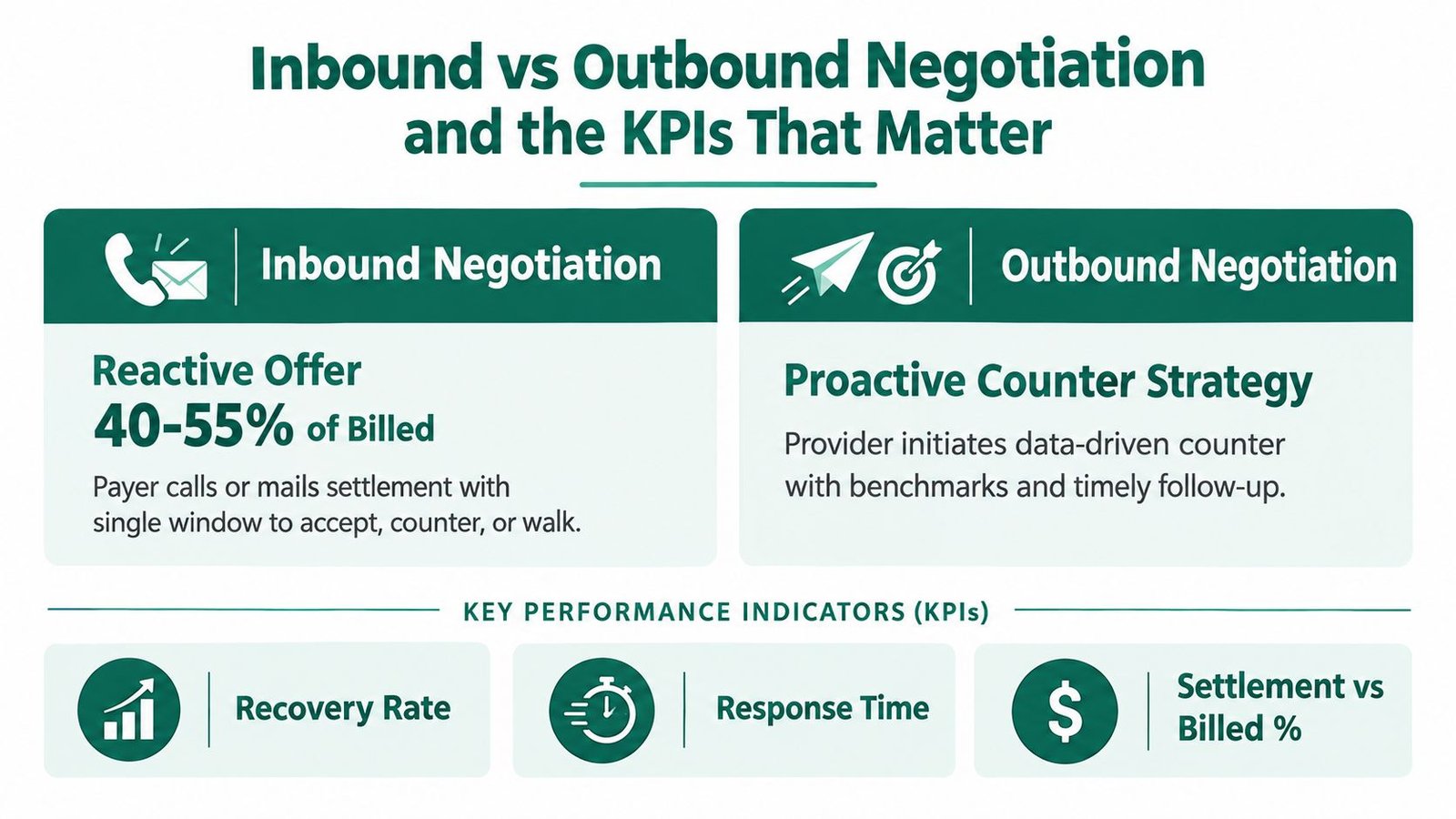
Inbound negotiation is reactive. The payer sends an offer, usually in the middle of the range, and your team decides whether to accept, counter, or walk. Outbound negotiation is proactive. You open the file with evidence and force the payer to deal with a number grounded in comparable payments and local benchmarks.
Which approach fits which payer
Inbound tends to work better when the initial offer is already usable, especially with payers that don't instantly bury the claim at the bottom of the repricing ladder. Outbound is the stronger move when Data iSight has pushed the number so low that a passive response just codifies the loss. That is usually where we see the best recovery behavior on persistent out-of-network portfolios.
A practical way to think about it is this. If the payer's first number looks close enough to negotiate from, answer it. If the number is obviously off-market, initiate the counter yourself and attach the evidence immediately. One is faster, the other is stronger.
For owners running their offices like a business, the dashboard matters more than the anecdote. Keep these four KPIs visible every month:
- Denial rate, because you want it low enough to show the workflow is under control.
- Days in A/R, because unresolved repricing pushes cash farther out.
- Net collection rate, because underpayment leakage hits this number first.
- Appeal overturn rate, because it tells you whether the team is changing payer behavior.
Operational rule: if your team can't show a monthly pattern, the payer will keep treating each underpayment as an isolated event.
If you want a useful workflow analogy, the call center workflow guide is a decent reference for understanding why reactive and proactive processes are managed differently. The same logic applies here, your team either waits for the payer to move or starts the conversation with proof.
I've seen the best settlement outcomes when the cover letter stays tight and the comparable-EOB proof is impossible to ignore. That's the difference between asking for reconsideration and asking to be taken seriously.
Escalation Playbook From State Complaint to Federal IDR
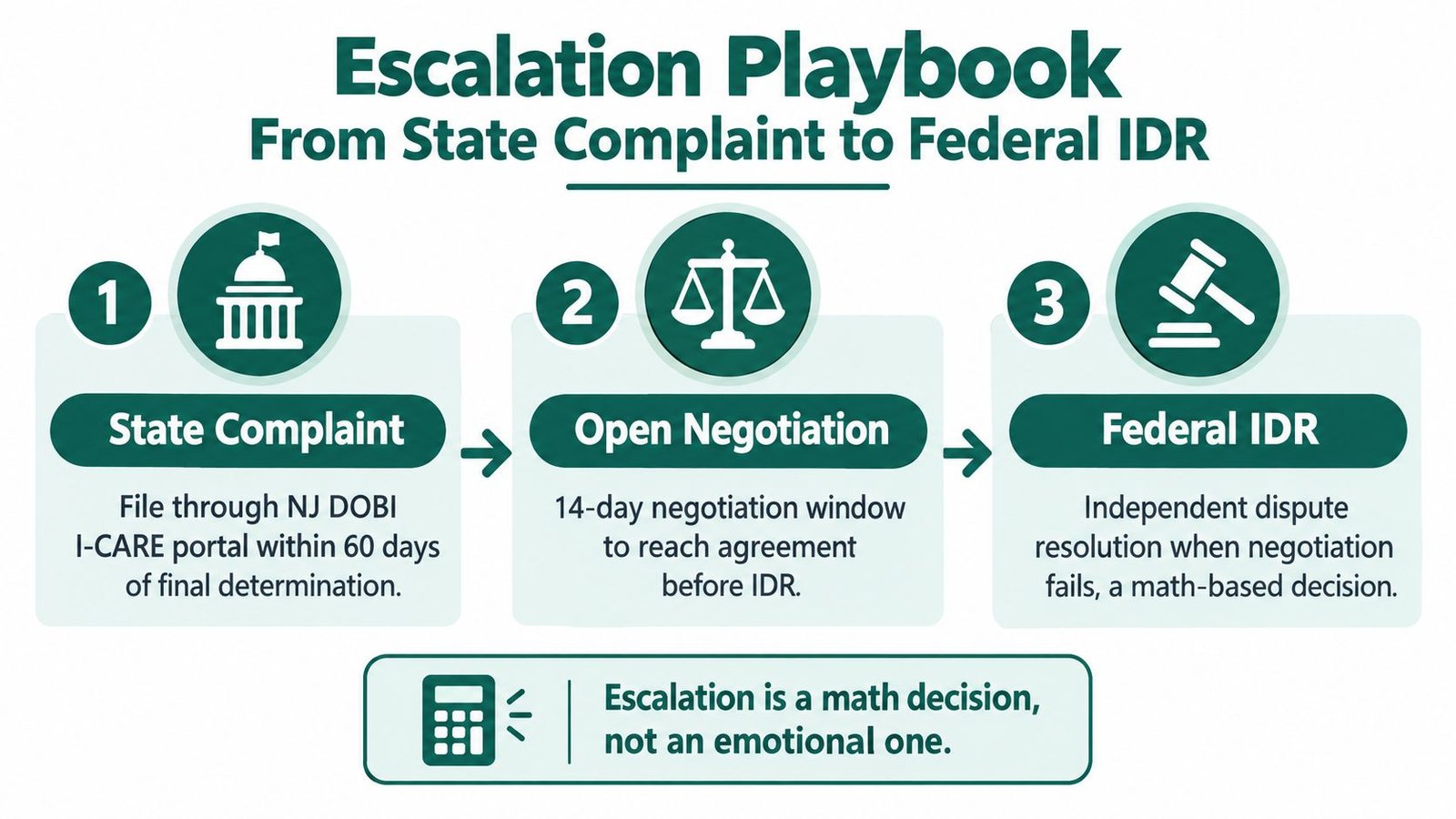
Escalation is a cash decision. Once a clean appeal stalls, move to state complaint first, then federal dispute resolution when the claim qualifies. That sequence keeps your team from burning hours on payer correspondence that will never pay.
How I'd choose the next move
For New Jersey providers, NJ DOBI is the state lever that matters. If the final payment still looks wrong after your documented appeal, file the complaint and force a review of the repricing logic. The filing does not guarantee reversal, but it brings regulator pressure into the file, and that often changes whether the payer reopens it.
Federal IDR is the next step for eligible surprise-billing disputes. CMS says either side can enter a 30-business-day open negotiation period, and if no agreement is reached, either side may initiate federal independent dispute resolution (CMS fact sheet). For the federal rules that govern those disputes, use the CRS report; for provider-side results, the HFMA summary shows why many practices keep pressing when the paper trail is strong.
Use a clean cutoff rule. If the likely recovery is too small after appeal labor and filing friction, move staff to stronger claims or contract work. The goal is not to win every file. The goal is to win the files that change cash flow.
For patient-collection limits, see our balance-billing guide. For a workflow-minded view of how issues should move through escalations, the severity-based workflow design article gives a solid triage model. That same discipline applies when you decide whether to press a repriced claim or stop spending payroll on it.
Simple filter: if the claim cannot justify the labor, do not romanticize the appeal.
Practice Owner FAQs and When to Walk Away
How long does a Data iSight appeal take end to end?
If the file is clean, the first response usually starts with resubmission and open negotiation. Once the payer engages, timing depends on whether you settle it inside the payer channel or push it into state or federal escalation. Treat it as a cash recovery project, not a same-week fix.
What is the expected CPT 97140 recovery range?
In the Paramus benchmark, the appeal target sits between the repriced amount and the local benchmark. If the claim drops from $185 to about $72, and the local Fair Health 80th percentile is $153, the practical recovery range is the gap you can prove with your documents, not the full charge.
When should we stop appealing and accept Claritev's rate?
Stop when the expected recovery does not justify the labor. My line is simple, if expected recovery divided by appeal hours falls below $150 per hour, move staff to stronger work like contract renegotiation or higher-yield underpayment recovery.
Does NJ DOBI move the needle on out-of-network underpayments?
Yes, when the file is documented and the payer cannot easily defend the reduction. A state complaint works best after the payer has already seen your benchmark evidence and still refuses to move. At that point, regulatory pressure starts to matter.
Can we bill the patient for the difference after winning?
No, not as a default strategy. Once surprise-billing protections or state limits apply, balance-billing rules can restrict what you collect from the patient, so the payer-side recovery matters more than trying to shift the gap to the member. If you are unsure, read the billing rules before you send another statement.
What is the exact dollar threshold where federal IDR costs more than it returns?
There is no universal public dollar line in the materials that matters here. The practical threshold is whether the claim's likely upside can absorb the administrative effort and the federal filing friction, especially when the case is batchable or can be grouped cleanly. If the net return is weak, do not force it.
If your practice is living with repeated Data iSight underpayments, Happy Billing can review the repricing pattern, build the appeal packet, and help you decide which claims deserve escalation versus write-off. Visit Happy Billing and request a free audit if you want a second set of eyes on the claims that keep landing too low.