Family Practice Billing Services That Protect Revenue
Family practice billing services matter because claim denials are running about 11.8% in 2024, and in family practice the difference between average performance and strong performance is often the gap between 5% to 8% denials and under 5%. If you're running an independent practice, that gap isn't academic. It hits cash flow, stretches A/R, and forces your staff to spend time reworking claims instead of keeping the schedule full and the front desk clean.
In our experience, owners get into trouble when they treat family medicine billing like generic physician billing. It isn't. Family practice lives on high-volume E/M, preventive care, same-day problem visits, recurring payer edits, and front-end workflow discipline. When those pieces break, revenue leaks in predictable ways. The good news is that most of those leaks can be fixed with better revenue cycle control, not more luck.
What Family Practice Billing Services Actually Do for Your Revenue
Family practice billing services are full-cycle RCM built for family medicine. Done right, they handle eligibility, charge entry, coding review, claim scrubbing, submission, payment posting, denial follow-up, and A/R recovery with one goal: get more of your claims paid correctly the first time and shorten the time between the visit and the deposit.
That matters because family practice operates in a denial-heavy environment. Industry summaries report initial claim denial rates have climbed to about 11.8% by 2024, while 41% of providers say at least 1 in 10 claims is denied. In family practice, benchmark denial rates often land around 5% to 8%, and stronger operations target under 5% (claim denial benchmarks and trend data).
Revenue protection starts before the claim goes out
Owners usually notice the problem at the back end. Cash slows down. A/R gets older. Staff says payers are denying more. But the failure often happened earlier.
A patient wasn't verified correctly. A referral wasn't in place. A same-day preventive and sick visit wasn't documented cleanly. A modifier was used loosely. A claim left the office with avoidable defects, then your team touched it again and again after denial.
Practical rule: If a denial could have been prevented before submission, it should be treated as an operations problem, not a payer problem.
That's why family practice billing services shouldn't be viewed as clerical support. They're financial control systems. A good partner builds payer-specific edits around the way your physicians practice. If you want a plain-language breakdown of the operational role, this overview of what medical billers do is a useful baseline.
What owners should expect from the function
At minimum, the billing function in family medicine should:
- Protect first-pass acceptance: Fewer bad claims means less rework and faster payment.
- Reduce preventable denials: The target isn't perfection. It's getting avoidable leakage under control.
- Create accountability: You should know where denials come from and which workflow is causing them.
- Translate coding rules into dollars: If a modifier error or eligibility miss costs payment, that issue belongs on a management dashboard.
We've seen practices improve fastest when they stop asking, “Who posted this denial?” and start asking, “What process created it?”
How Full Cycle RCM Works in Family Medicine
Family medicine RCM works like an assembly line, but the expensive breakdowns usually happen before the claim ever goes out. We see the same pattern over and over. A same-day preventive and problem visit is scheduled loosely, eligibility is checked incompletely, the chart is routed without clear coding support, and the back end gets stuck cleaning up what the front end created.
That is not random denial activity. It is predictable revenue leakage.
A full-cycle process should run inside your current EHR and practice workflow with tighter handoffs, payer edits that match how your clinicians document, and clear ownership at each step. If you want the broader operating model, this guide to RCM for physician practices gives the big picture.
The front end sets the claim up to pay or fail
In family medicine, patient access is not clerical work. It is revenue control. Insurance verification, demographics, coordination of benefits, referral status, copay collection, and visit-type accuracy all affect whether the claim pays cleanly.
Same-day visit complexity raises the stakes. If the appointment is booked as preventive only, but the provider also manages an acute complaint or adjusts chronic medications, your team needs the right intake, the right chart prompts, and the right routing before checkout. Otherwise, modifier -25 gets missed, overused, or documented poorly. Then the claim either underbills on the front end or denies on the back end.
That is why I tell owners to stop treating registration and coding as separate functions. In family practice, they are connected financially.
Mid-cycle work is where family practices either protect margin or give it away
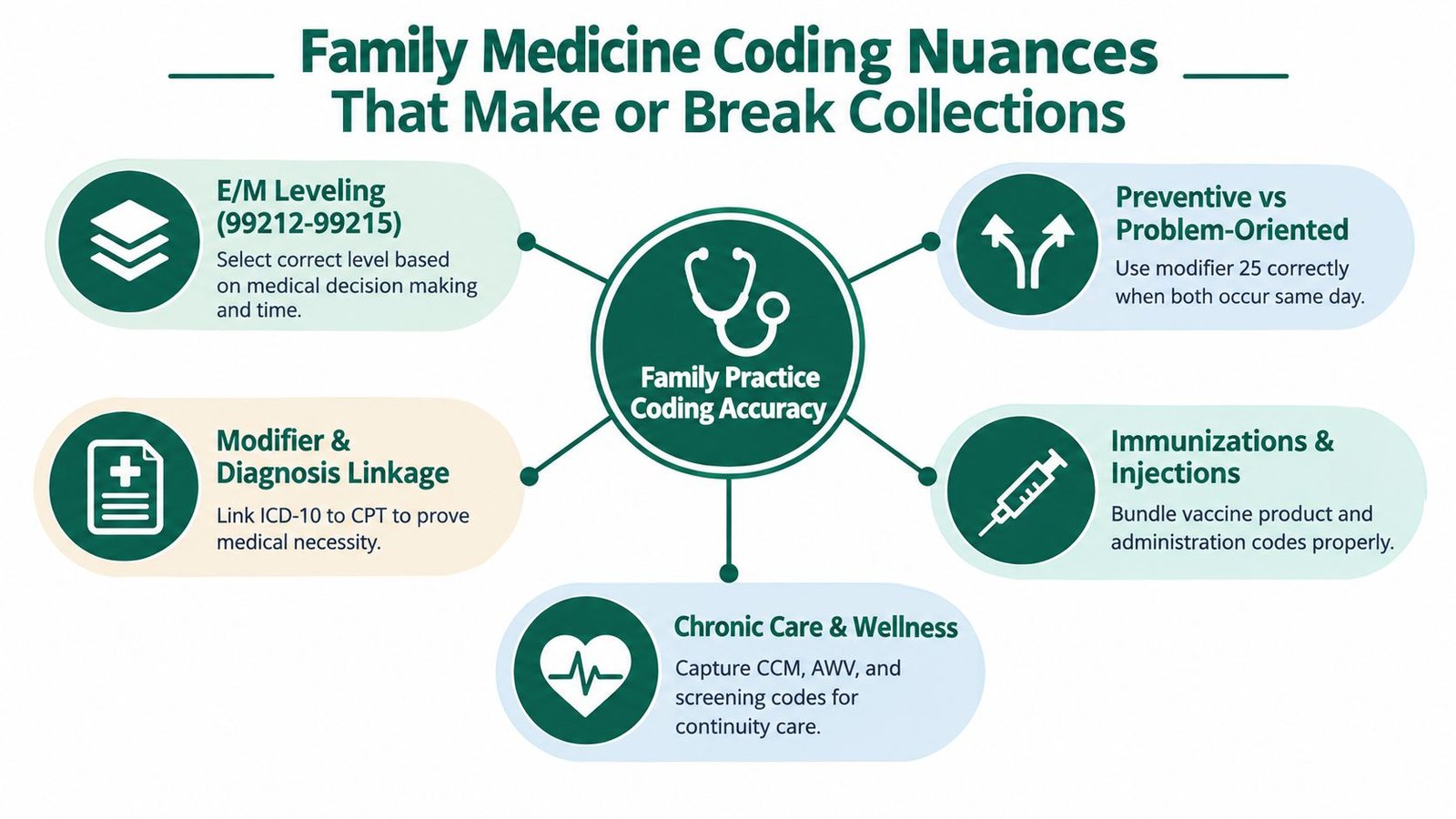
After the visit, charge capture and coding need structure. Family medicine produces high-volume, mixed-complexity encounters. Preventive services, E/M visits, injections, screenings, care management, G2211, incident-to services, and split or shared documentation rules can collide in one day of scheduling.
A strong process does not ask billers to guess after the fact. It uses decision trees. Was there a preventive service plus significant problem-oriented work? Was documentation separate enough to support modifier -25? Was G2211 appropriate with the base E/M and payer policy? Did an APP visit meet incident-to requirements, or should it bill under the rendering clinician involved? Those are front-loaded revenue decisions, not cleanup tasks.
Here is the daily sequence I recommend:
- Verify eligibility and referral or authorization requirements before the visit
- Confirm the visit type matches the reason for service
- Prompt for same-day preventive plus problem-oriented documentation when applicable
- Capture charges at checkout with rendering-provider accuracy
- Scrub claims against payer edits before submission
- Post payments fast and route denials by root cause, not by who has free time
If any one of those steps breaks, rework costs go up fast. Staff touch the account again. Payment slows down. Small documentation misses turn into write-offs.
Clean claims come from rules, not heroics
Owners often focus too much on denial follow-up and not enough on claim prevention. I would rather see a practice fix a scheduling script, a registration checklist, or a same-day visit template than hire another person to chase denials 30 days later.
As noted earlier, clean-claim performance separates efficient groups from practices buried in rework. In family medicine, that result depends heavily on payer-specific edits tied to common failure points. Modifier -25 combinations. G2211 use. Incident-to compliance. APP attribution. Preventive and problem visit pairing. Those are repeatable patterns, which means they are manageable.
Clean claims speed up cash because the claim is correct before it leaves the office, not because someone worked harder after it came back.
What a stable process looks like in the real world
A stable full-cycle RCM process feels boring. That is a good sign. Front desk staff know which visits need extra intake. Providers get short, useful prompts at the point of care instead of long coding emails two weeks later. Billers spend less time repairing bad claims and more time handling true exceptions.
Owners should expect reporting that ties workflow mistakes to dollars. Which payers reject same-day preventive plus E/M most often. How many claims need manual correction for rendering provider issues. How much A/R comes from preventable front-end failures versus true payer underpayment.
That is how you manage family medicine RCM correctly. You treat same-day visit complexity and workflow breakdowns as fixed operational leaks, then you close them.
Family Medicine Coding Nuances That Make or Break Collections
Family medicine loses money in the gray areas. Not because the specialty is sloppy, but because same-day visits, preventive care, APP collaboration, and Medicare rules create small decision points with real financial consequences.
Research summaries show about 33.9% of family practice claims were coded incorrectly and 12.3% had improper payments. More broadly, coding issues appear in roughly 32% of first-submission denials, and first-submission denials in the wider market often run near 30% overall (medical billing accuracy and denial statistics).
Same-day visits are where family practice leaks revenue
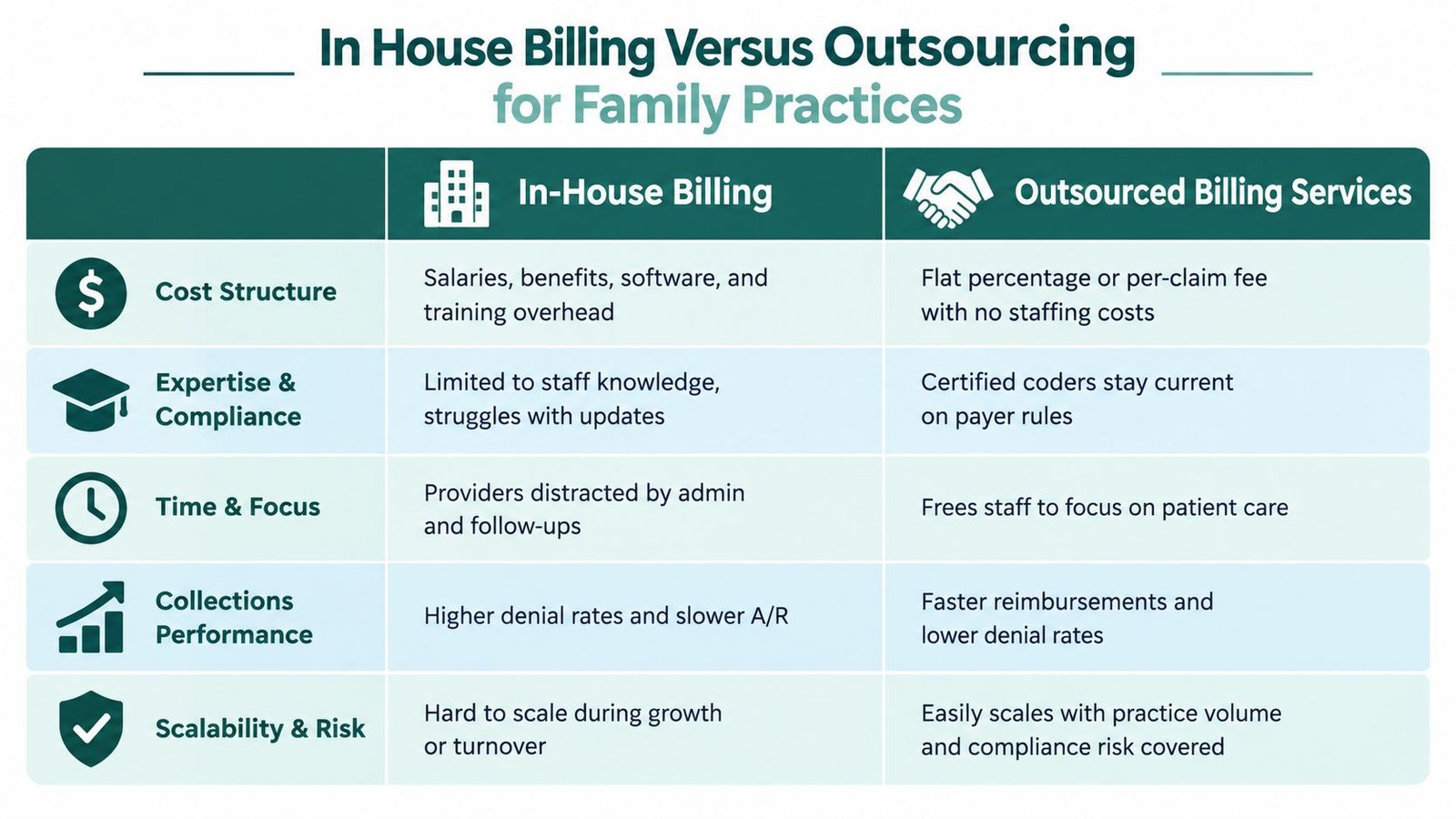
A routine family medicine schedule creates a common billing question. The patient comes in for preventive care, then also discusses a new complaint or a flare of a chronic problem. If the problem-oriented work is significant and separately documented, the practice may bill the preventive service plus the appropriate office E/M with modifier -25.
If that documentation is weak, one of two things usually happens. The second service gets denied, or the practice never bills it because staff doesn't trust the chart.
Recent family practice denial coverage points to repeated denials tied to modifier -25 mistakes and misuse of G2211. That same guidance notes G2211 is generally not payable when the base office or outpatient E/M is billed with modifier -25, except in limited preventive or AWV situations (family practice denial patterns involving modifier -25 and G2211).
A practical decision tree for common office visit combinations
Owners don't need to memorize every coding edge case. They do need a workflow their team can follow.
- Preventive only: Bill the preventive code if that's all that was done.
- Preventive plus significant problem work: Bill the preventive service and the problem-oriented E/M, typically with modifier -25 when supported.
- Problem-oriented E/M with complexity add-on question: Check whether G2211 is allowed with that claim pattern before submission.
- Annual wellness visit plus other work: Build payer edits that distinguish Medicare wellness rules from commercial preventive rules.
A helpful operational reference is this explainer on modifier 25 in physician billing. The point isn't education for its own sake. It's preserving revenue on high-frequency visit types.
If your same-day visit rules live in one senior biller's head, your revenue is one resignation away from trouble.
APP billing rules can change payment or trigger denials
Practices that use nurse practitioners or physician assistants need disciplined rules around incident-to and split/shared billing.
For incident-to, Medicare allows billing under the physician only when the service is an integral part of the physician's professional service, the physician performed the initial service and stays actively involved, and the service is furnished under direct supervision in a physician office or other noninstitutional setting (CMS incident-to requirements). AAFP guidance adds another owner-level takeaway: incident-to requires an established patient with an existing condition, not a new patient or new problem, and the supervision and employment or contractual relationships must be in place for full physician-fee-schedule payment (AAFP incident-to billing guidance).
For split/shared E/M, CMS defines it as a facility-setting service performed by both a physician and nonphysician practitioner in the same group. Since January 1, 2024, the claim is billed by the practitioner who performs more than half of the total time or a substantive part of the MDM, and CMS instructs use of modifier FS (CMS split/shared E/M rules).
One more nuance matters for office-based groups. AAFP notes Medicare shared-visit billing at full physician payment applies in inpatient, outpatient hospital, or emergency department settings, not the typical office setting (AAFP shared visit setting limits).
Why owners should care
These aren't coding trivia points. They determine whether the practice gets paid correctly, gets paid less, or gets denied and forced into rework. In family medicine, repeated same-day visit mistakes can drag down collections month after month.
In House Billing Versus Outsourcing for Family Practices
This decision isn't about ideology. It's about whether your current setup can control denials, keep claims moving, and survive staff turnover without stalling collections.
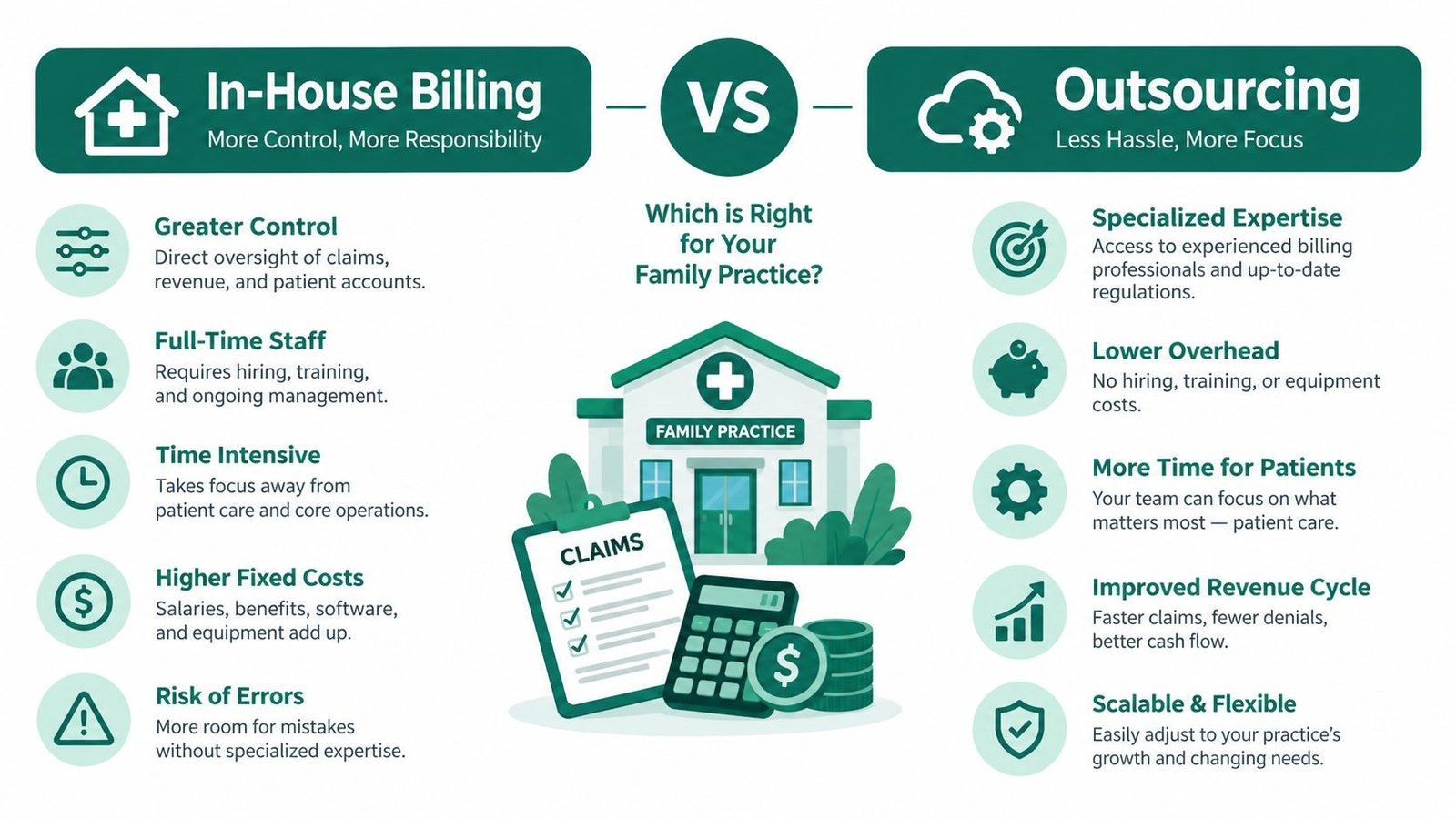
Many owners keep billing in-house because it feels like control. Sometimes that works. If you have stable staff, strong management, payer-specific workflows, and someone who understands family medicine visit logic, in-house can be fine.
The problem is that family practice billing breaks most often at the edges. The same-day preventive plus sick visit. The APP office workflow. The eligibility miss that becomes a write-off weeks later. Those aren't random one-off errors. They're the kind of repetitive leakage that specialized teams are built to catch.
Where in-house teams usually struggle
Internal teams often know the practice well. That's the upside. The downside is concentration risk.
- One-person dependency: If your billing lead leaves, knowledge leaves with them.
- Training lag: Payer policy changes hit faster than most offices can retrain.
- Limited denial engineering: Staff works denials, but often doesn't redesign the upstream process creating them.
- Provider distraction: Physicians get pulled into coding cleanup instead of clinical throughput.
Where outsourcing tends to win
A good outsourced model brings process depth, not just labor. It should operate inside your current systems, enforce claim edits consistently, and separate root-cause analysis from daily task noise.
In our experience, outsourced billing works best when the partner gives the practice visibility, not mystery. Owners should see reports, denial categories, and action items. If you're evaluating models, this comparison of in-house vs outsourced medical billing gives a practical framework.
For specialty context beyond family medicine, practices can also review Happy Billing's specialty billing pages to see how RCM workflows differ by service line.
Outsourcing only works if it increases accountability. If it hides the problem behind a monthly report, it isn't helping.
My recommendation
If your denials keep clustering around front-end errors, same-day E/M decisions, or APP billing rules, I wouldn't keep trying to patch it with overtime. I'd either rebuild the internal workflow with strict ownership or move the function to a billing partner that can enforce discipline every day.
How to Evaluate a Billing Partner and Measure ROI
A small shift in denial rate can change owner income fast. In family medicine, the bigger problem is usually not random payer behavior. It is repeatable leakage from same day E/M decisions, modifier -25 use, G2211 eligibility, incident-to setup, and split/shared confusion that no one owns end to end.
I tell owners to stop buying billing pitches and start buying process control. If a partner cannot explain how they prevent predictable family practice errors before the claim drops, they are selling labor, not revenue improvement.
What I would test in the first meeting
Ask for their operating rules, not their sales deck.
How do they decide when a same-day problem visit supports modifier -25? How do they flag G2211 opportunities without creating compliance risk? How do they keep APP claims from missing incident-to requirements? Who reviews payer edits before submission, and who fixes the front-desk workflow when eligibility or referral data is wrong? If the answers are generic, keep looking.
Use this checklist when you compare finalists:
- EHR workflow fit: They should work inside your current system and show exactly where charges, edits, and follow-up happen.
- Same-day visit controls: They should have written decision trees for modifier -25, G2211, incident-to, and split/shared rules that your physicians and APPs can use.
- Pre-submission edits: Ask what payer-specific edits they run for coding conflicts, enrollment mismatches, and documentation gaps.
- Denial ownership: You want root-cause reporting by category, provider, and payer. A list of appeals filed is not enough.
- Credentialing and enrollment alignment: Rendering, supervising, and group enrollment details need to match claim logic, or clean visits still deny.
- Compliance structure: Review their privacy, access controls, audit process, and core compliance program components before giving them access to PHI.
- Reporting transparency: They should show what changed, why it changed, and what it was worth in dollars.
For interview prep, use this list of questions to ask a medical billing company before hiring. It covers the right pressure points.
Family Practice RCM KPI Targets and What They Mean for Cash Flow
| KPI | Practical Target | Revenue Impact If Missed |
|---|---|---|
| Denial rate | Under 5%, with lower rates indicating tighter front-end control, based on AAFP financial management guidance | More rework, slower cash conversion, and repeat leakage from registration, coding, and enrollment errors |
| Clean claim rate | At or above 95% for a well-run operation | More claims enter A/R with defects, staff touches increase, and cash lands later than it should |
How I calculate ROI
Do not judge a billing partner on fee percentage alone. Judge them on recovered cash, fewer touches per claim, faster payment speed, and fewer preventable write-offs.
I start with four numbers. Current denial rate. Current days in A/R. Claims that require rework. Old A/R that has gone cold. Then I tie each one to labor cost and collection delay.
Here is the simple owner math. If your team keeps touching the same family practice claim two or three times because the same modifier or enrollment issue keeps coming back, you are paying for the error at least twice. Once in payroll. Again in delayed collections. If a partner can reduce those repeat touches and tighten claim acceptance, the return shows up in cash flow before it shows up in a glossy monthly report.
Ask finalists for one thing: a 90-day plan with baseline metrics, target metrics, and named owners. If they cannot tell you how they will reduce leakage around same-day visits and front-end failures, they are not ready to manage family medicine revenue.
One practical option in the market is Happy Billing, which works inside the existing EHR, supports full-cycle RCM, denial management, credentialing, A/R recovery, and front-end claim control for physician practices. That is the level of operational scope I would expect from any serious partner.
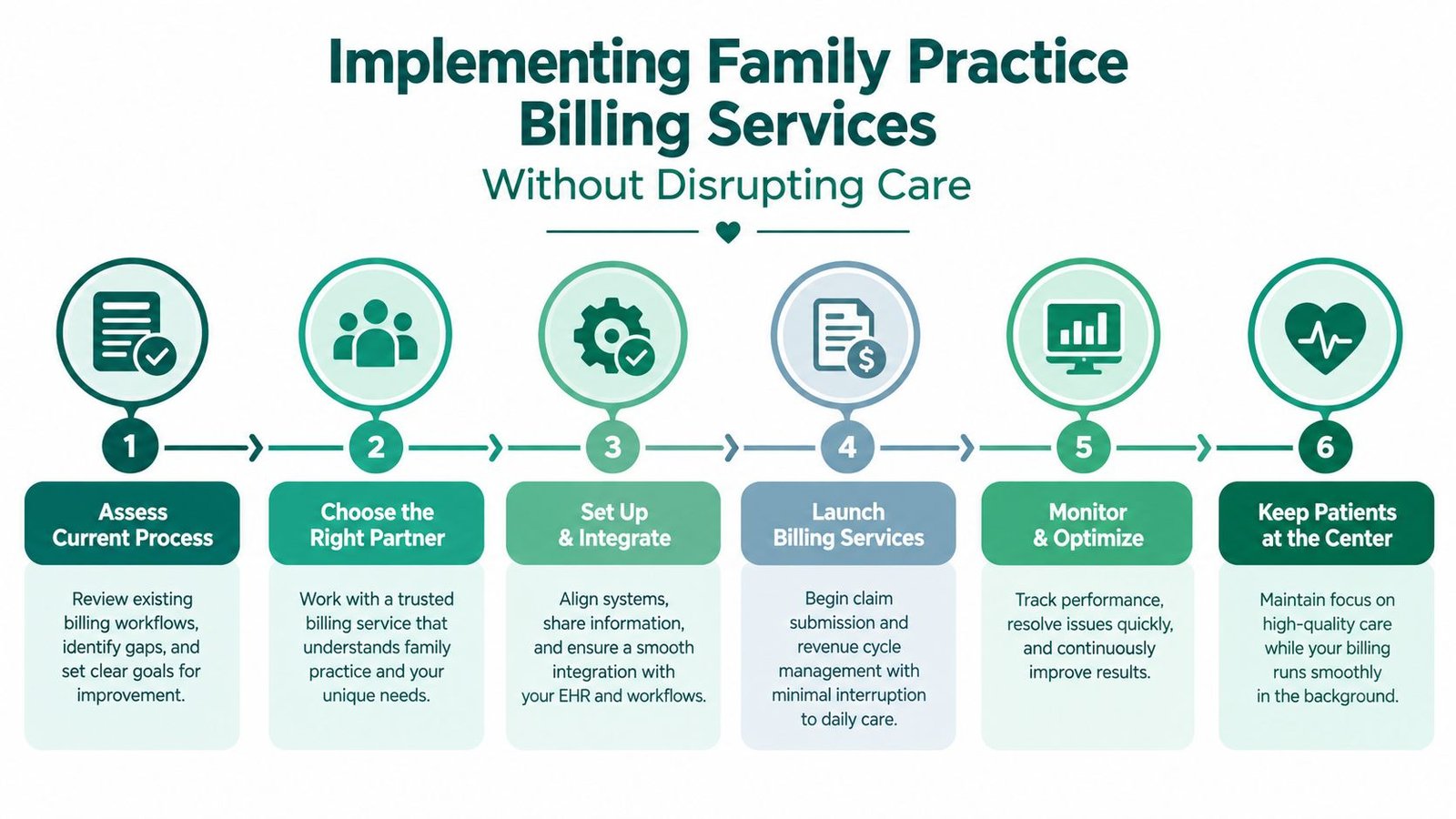
Implementing Family Practice Billing Services Without Disrupting Care
A billing transition shouldn't blow up clinic operations. If it does, the implementation was badly designed.
The cleanest transitions start with an audit, not a software pitch. We review current denial patterns, payer mix, front-desk workflows, APP billing habits, charge lag, and old A/R. That tells you where the leaks are before anyone changes process.
What the rollout should look like
The practical rollout usually follows a controlled sequence:
Discovery and audit
Pull denial categories, review same-day visit patterns, and identify payer-specific breakpoints.Workflow mapping inside the current EHR
The billing partner should adapt to the office workflow, not force a platform migration.Enrollment and credentialing alignment
Claims fail when payer enrollment, supervising provider setup, or rendering logic is off.Front-end training
Staff needs crisp rules for eligibility, referrals, authorizations, and intake accuracy.Parallel monitoring after go-live
Watch accepted claims, edits, denials, and payment posting closely in the first stretch.Tight feedback loops with providers
Keep documentation fixes short, specific, and tied to actual revenue risk.
Front-end redesign matters more than owners think
A lot of family practices focus on claim submission and ignore the work upstream. That's a mistake.
One industry guide reported in 2026 that electronic prior authorization adoption reached only 40%, leaving 60% tied to manual portals and faxes. The same guide reported average manual prior auth cost at $11.44 per request versus $3.82 electronically (prior authorization workflow data and denial pressure commentary). Even if prior auth isn't the core issue in your office, the broader lesson is clear: front-end administrative friction becomes downstream revenue friction.
The claim doesn't start in billing. It starts at scheduling, registration, and chart prep.
What a good implementation feels like to the practice
Providers should feel less interruption, not more. Front-desk staff should know exactly what they own. Billing questions should get sharper and shorter because the workflow is cleaner.
If the transition is handled correctly, you don't get a dramatic grand opening. You get fewer preventable denials, steadier payment flow, and a practice that's easier to manage.
Frequently Asked Questions From Practice Owners
Can we bill a wellness visit and a sick visit on the same day without asking for denials
Yes, sometimes. The issue is whether the problem-oriented E/M work was significant and separately documented from the preventive service. In family practice, we've seen owners lose revenue both ways. Some underbill because they're too cautious, and others overreach with modifier -25 and trigger predictable denials. The fix is a written same-day decision tree tied to payer edits.
When should we use incident-to billing for nurse practitioners or physician assistants
Only when the Medicare conditions are fully met. CMS requires the service to be part of the physician's professional service, with the physician having performed the initial service and remaining actively involved, and the service must be furnished under direct supervision in the office setting. AAFP also makes clear it must involve an established patient and existing problem, not a new patient or new condition. If those elements aren't present, billing under the physician creates risk.
Does split shared billing apply to our regular office visits
Usually no for the typical independent family practice office. CMS split/shared E/M rules apply in facility settings, and AAFP notes shared-visit physician billing rules are for inpatient, outpatient hospital, or emergency department settings, not the standard office setting. If your group spans office and facility work, your billing team needs separate workflows.
How quickly can a billing change improve our A/R and denials
Usually faster at the front end than owners expect. Eligibility controls, same-day visit edits, and APP billing rules can change quickly once someone owns them. Older A/R takes longer because every payer bucket behaves differently, but cleaner new claims should improve before legacy balances are fully worked.
If your family practice is losing money on same-day visit logic, front-end misses, or APP billing rules, Happy Billing offers full-cycle RCM, denial management, credentialing, A/R recovery, and EHR-integrated workflows built to fix those exact leaks. We help independent practices tighten claim quality before submission, reduce rework, and turn billing into a revenue control function instead of a constant cleanup project.