How to Bill Out of Network Insurance

If you're billing out-of-network insurance, submit the claim only after you've confirmed the patient's benefits, the service's legal status, the payer's submission rules, and the documentation supporting your charge. A disciplined workflow produces cleaner first-pass claims, fewer avoidable denials, and faster cash collection. A loosely configured process creates patient disputes, underpayments, and A/R that your practice eventually writes off.
The biggest mistake physician owners make is treating OON billing as a claim-formatting exercise. Revenue leaks before the claim is created, when staff misread benefits, skip authorization, fail to capture consent, or use an EHR configuration designed for contracted rates. The back end then inherits a problem that should have been prevented at scheduling.
Once claims are going out correctly, the next problem is being paid correctly. Out-of-network claims for therapy codes are routinely repriced 30–50% below billed charges through Data iSight, MultiPlan and Zelis. If you run a PT, chiropractic or OT practice, the physical therapy underpayment recovery guide shows how to identify short-paid claims, reopen them inside the 14-day negotiation window and escalate to the state insurance department when appeals stall.
Build an OON Revenue Workflow That Protects Cash Flow
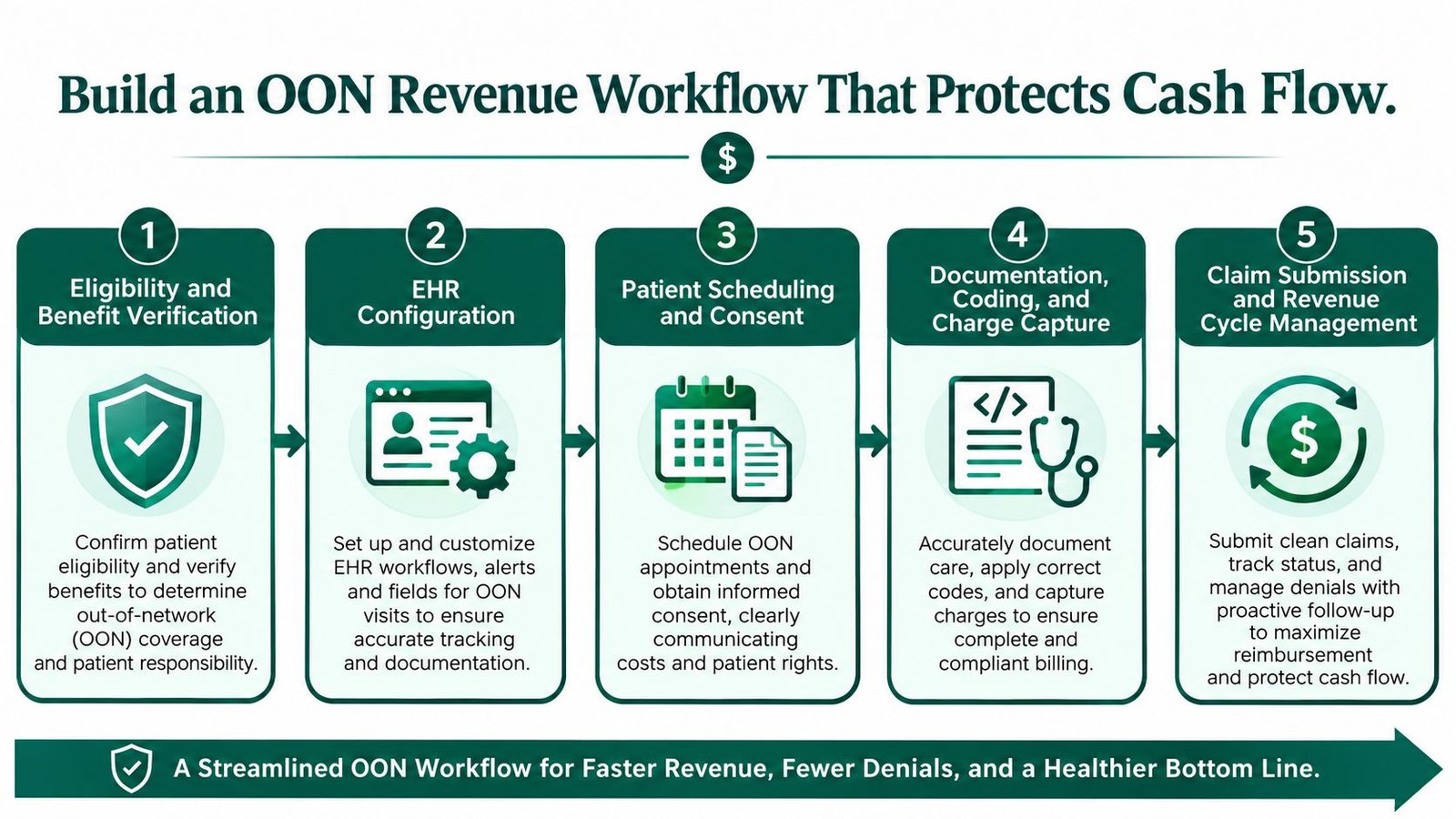
Out-of-network billing works best as a controlled pipeline with a financial owner at every stage. The five stages are eligibility and benefit verification, EHR configuration, patient scheduling and consent, documentation and coding, and claim submission with revenue-cycle follow-up. Each stage should have a work queue, a completion standard, and an escalation rule.
Tie every stage to a financial outcome
At the front end, eligibility verification protects against avoidable patient-balance disputes and non-covered services. EHR configuration protects first-pass claim quality by ensuring the payer, provider, place of service, and OON settings are correct before charge entry. Documentation and coding support medical necessity and reduce technical denials. Claim submission and remittance posting control days in A/R. Denial and dispute management determine whether underpayments become recoverable revenue or permanent write-offs.
We recommend maintaining one approved source of truth for OON fee schedules, payer rules, authorization requirements, and consent forms. Don't let the front desk keep one spreadsheet, the EHR contain another rate table, and the billing vendor rely on a third version. Assign a named owner to each stage and prioritize the daily queue by dollars at risk, not merely by claim count.
Practical rule: If nobody owns a step, the practice owns the loss.
The federal No Surprises Act became effective on January 1, 2022, and changed how out-of-network billing operates for emergency services, air ambulance services, and certain ancillary services such as radiology and anesthesiology. For covered situations, patient cost-sharing is generally capped at in-network levels and balance billing is generally prohibited. The HHS and ASPE No Surprises Act brief explains the shift toward payer negotiation and formal dispute processes, including the 30-day open negotiation period and independent dispute resolution.
For operational context, review this guide to out-of-network reimbursement. The correct objective isn't submitting more claims. It's making sound front-end decisions so claims leave the EHR complete, legally supportable, and financially understood.
Losing money to out-of-network repricing?
We will compare a sample of your out-of-network claims against a fair benchmark and show you what is recoverable, claim by claim. Get a free underpayment analysis →
Confirm Coverage and Patient Financial Exposure
Not every OON service can be balance billed. That assumption is one of the fastest ways to create compliance exposure while also damaging collections.
Before scheduling or rendering care, classify the encounter into one of three categories:
Protected services. The No Surprises Act bars balance billing for most emergency services and certain non-emergency services delivered by out-of-network providers at in-network facilities. Patients generally can be charged only in-network cost-sharing for protected services. CMS guidance on patient rights also explains that consent is required only in limited waiver situations.
Waiver-eligible situations. Some services may proceed under a valid notice and consent process when the law permits it. The form must be completed in the required timeframe, identify the provider and service, disclose the estimated charge, and make clear that the patient is choosing out-of-network care where applicable. A casual financial acknowledgment isn't a substitute for a compliant waiver.
Ordinary OON services. For services outside protected categories, the patient's deductible, coinsurance, out-of-pocket accumulators, plan limits, and the carrier's allowed amount determine the expected responsibility. Your estimate should distinguish the practice's charge from the amount the plan may recognize.
Read the eligibility response as a contract-risk document
Your verification team should capture the network status for the provider and facility, OON deductible status, remaining accumulators, coinsurance, authorization requirements, referral rules, visit limits, claim submission address, and whether payment is assigned to the provider or the patient. Record the representative's reference number and the date of verification. If the response is incomplete, escalate before service rather than treating uncertainty as permission to collect.
The handoff matters. Verification should give the front desk a written financial instruction, not a vague statement that “OON benefits are active.” The front desk then presents the estimate and obtains the right acknowledgment or consent. That prevents under-collection, improper collection, and later disputes over what the patient was told. This explanation of reading an explanation of benefits helps standardize the interpretation of deductible, coinsurance, allowed amount, and payment fields.
| Category | Balance-Bill Allowed? | Consent Required | Patient Pay Source |
|---|---|---|---|
| Protected emergency or covered ancillary service | Generally no | Only in limited waiver situations | In-network cost-sharing |
| Permitted waiver situation | Potentially, if legally valid | Yes, where required | Disclosed patient responsibility under the permitted process |
| Ordinary OON service | Depends on applicable law and plan rules | Document financial terms and any required consent | Deductible, coinsurance, non-covered amounts, or permitted balance |
The financial lesson is simple. Eligibility verification isn't an administrative courtesy. It determines what revenue can legally come from the patient, the payer, or neither.
Configure the EHR for Out-of-Network Claims
A clean OON claim starts in the EHR, not at the clearinghouse. If the system defaults to contracted allowables, in-network payer mapping, or the wrong payment destination, your staff may submit technically valid claims that still produce inaccurate patient balances and weak reimbursement positioning.
Set the configuration before the first encounter
Create a dedicated OON payer profile or claim pathway. Confirm the payer's electronic payer ID, paper submission requirements, claim type, place-of-service defaults, rendering provider NPI, billing NPI, taxonomy, and payment routing. Keep billed charges separate from contracted allowable amounts. An OON fee schedule should reflect the practice's approved charge policy, not a copied in-network rate table.
Then configure the fields that affect adjudication and collections:
- Assignment of benefits: Record whether the patient assigns benefits to the practice or expects payment directly from the plan.
- Relationship fields: Validate the patient relationship and insured relationship codes against the eligibility response.
- Provider data: Match the rendering provider, billing entity, taxonomy, and service location across the claim and payer record.
- Authorization controls: Require authorization or referral information when the plan demands it, and stop charge release when the required data is missing.
- OON indicators: Use payer-specific fields, condition codes, and claim notes only when the payer requires them and the record supports them.
- Edit logic: Build diagnosis-to-procedure edits, duplicate-service checks, place-of-service edits, and modifier prompts before the claim reaches the clearinghouse.
A practice should also test the payment destination. Some plans route reimbursement to the provider when assignment is accepted. Others send it to the patient. If the EHR posts every OON payment as practice cash, your A/R reports become unreliable and your follow-up team may chase money the payer already issued to the patient.
Treat payer rules as configuration requirements
CMS describes the major provider-payment mechanism under the No Surprises Act as the independent dispute resolution process, used when providers or facilities and health plans can't agree on an out-of-network payment amount. CMS's No Surprises Act resources should sit alongside your payer-specific build documents, not replace them. Commercial carriers may impose different electronic submission, attachment, authorization, and reconsideration requirements.
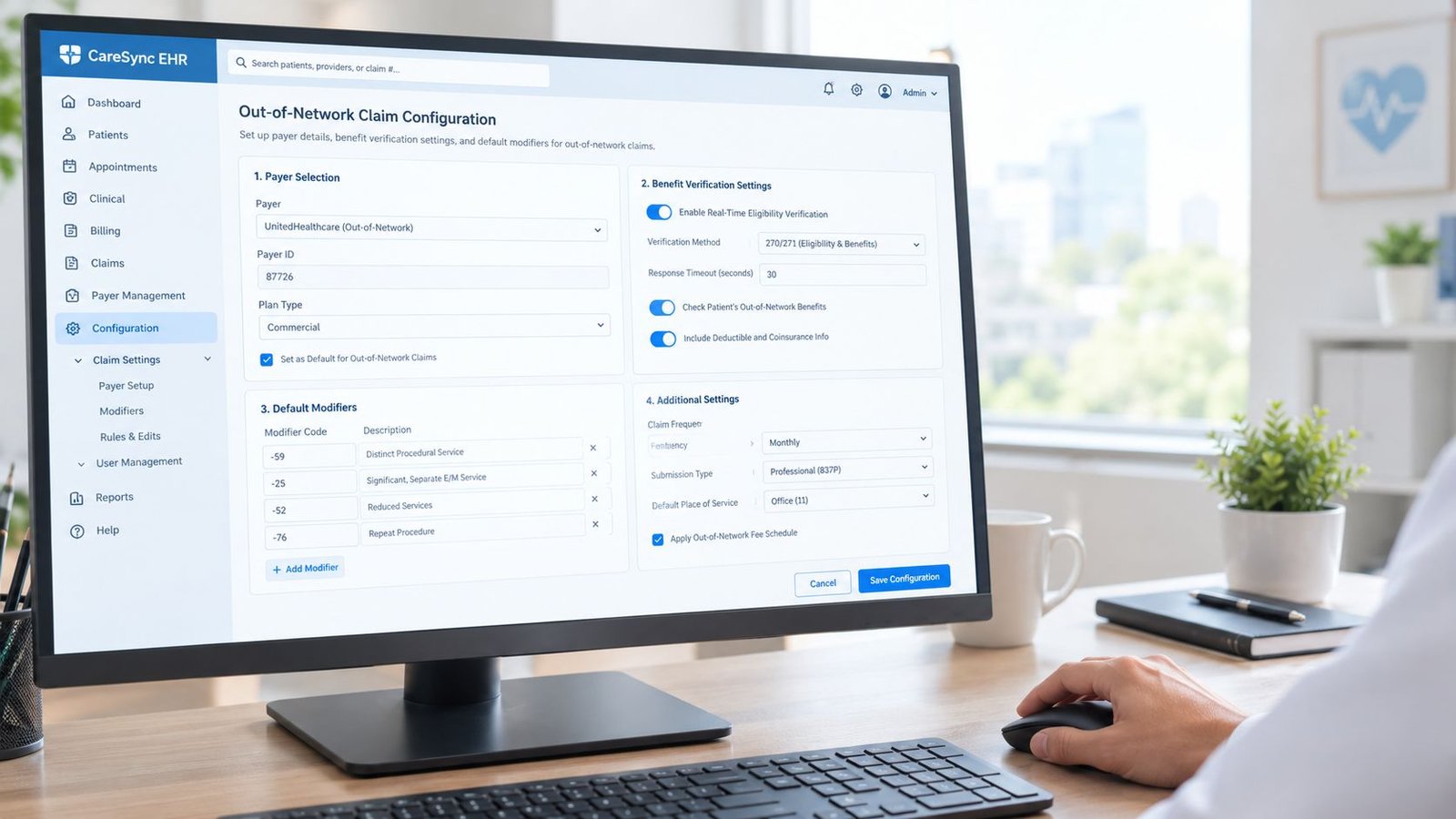
Before go-live, submit test claims and verify that the clearinghouse accepts the configuration, the payer acknowledges the claim, the ERA maps correctly, and the patient statement reflects the approved responsibility. Use this medical claim form resource to align the electronic workflow with the fields required on a paper claim.
Manage Documentation Coding and Consent
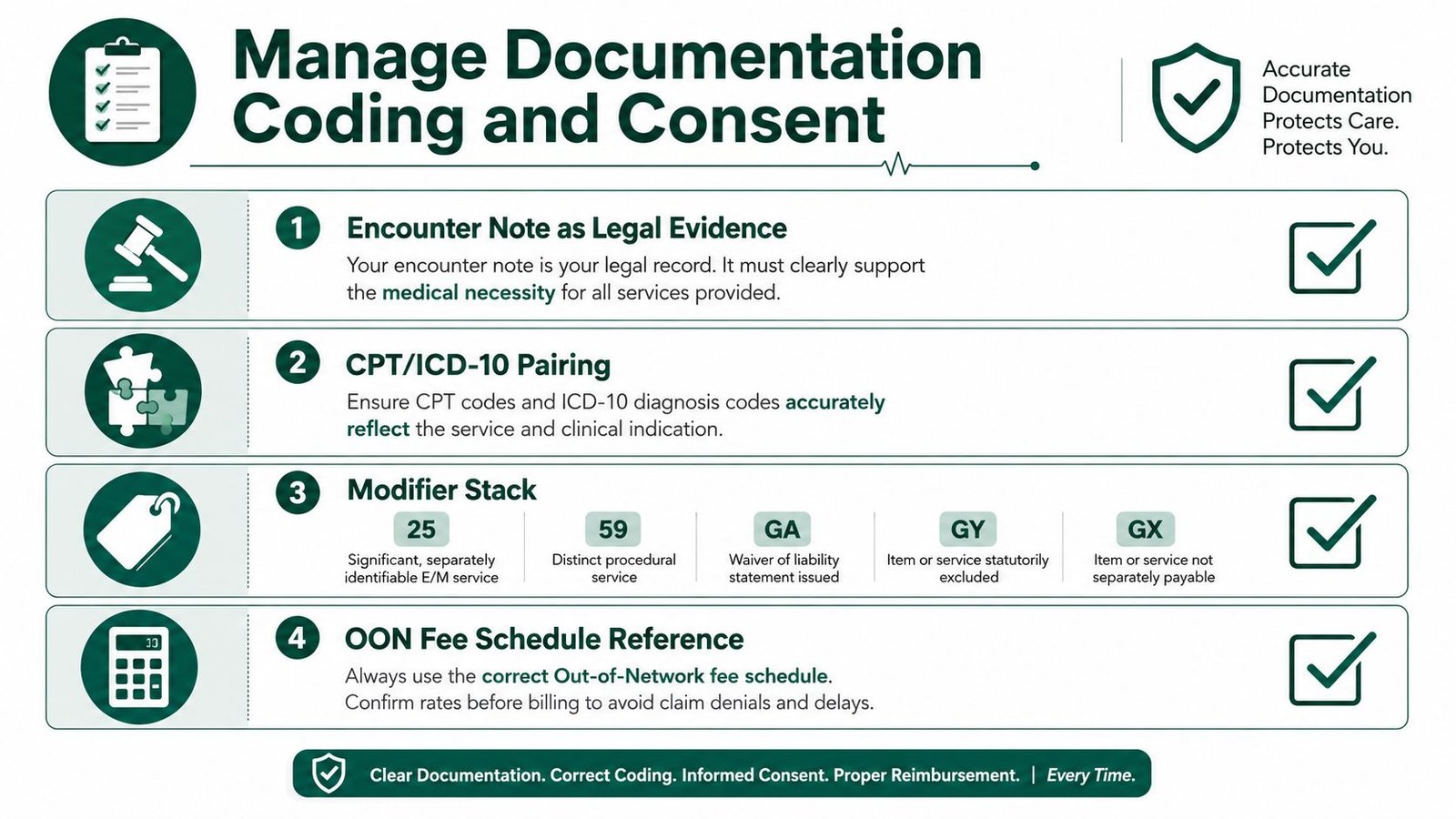
The encounter note is your strongest evidence when an OON claim is denied, underpaid, audited, or challenged by the patient. It must support medical necessity, the CPT and ICD-10 relationship, the billed charge, the provider identity, and any modifier or consent decision.
Compare the exposure by specialty
Anesthesia practices often need tight control over base units, time documentation, concurrency, and applicable modifiers. Radiology depends on the interpretation, technical or professional component distinction, place of service, and clear linkage between the imaging service and diagnosis. Pathology claims can lose revenue when specimen documentation, technical components, or payer-specific requirements don't align.
Orthopedic and pain-management practices face a different exposure. Global-period edits, multiple procedures, injections, imaging, and E/M services can create separate-procedure disputes. A practice that reports an additional E/M service must support it independently rather than assuming OON status makes the service payable.
For same-day procedural billing, CMS states that modifier 25 applies when a physician performs a significant, separately identifiable E/M service on the same day as a procedure. CMS guidance also distinguishes modifier 59 from the X{EPSU} modifiers, including XE, XS, XP, and XU, for separate and distinct services. CMS modifier guidance should inform your edit rules. Incorrect modifier use can turn a defensible claim into a denial or recoupment.
A higher charge doesn't compensate for a note that fails to prove what happened.
Use templates that force the clinician to connect diagnosis to procedure, identify the referring provider when relevant, document the service components, and indicate whether the service falls into a protected category. Anesthesia, radiology, pathology, orthopedic, and pain-management templates shouldn't share identical prompts because their revenue risks differ.
Pair the note with the patient record
The chart should contain a signed acknowledgment describing estimated charges, assignment of benefits, payment routing, and the practice's balance-billing posture. For a permitted waiver situation, retain the required notice and consent documentation with the encounter. Don't rely on a scanned form stored in an unrelated folder.
Review the GY modifier meaning before adding modifiers associated with statutory exclusions or non-covered services. Modifiers must reflect the actual service and payer rule. They aren't tools for forcing payment or disguising a protected claim as an ordinary OON encounter.
Submit Claims and Control Patient Balances
OON claims need a dedicated work queue with clear ownership. The claim should move from edit review to clearinghouse acceptance, payer adjudication, remittance posting, and patient follow-up without disappearing between departments or vendors.
Assign the work, then measure the handoffs
The claim owner checks provider NPI and taxonomy, OON indicators, place of service, authorization, timely-filing requirements, and required attachments. The posting owner reconciles the ERA or paper remittance against the expected adjudication. The patient-balance owner follows the written statement sequence only after the payer response has been reviewed.
Reconcile remittances within 48 hours so underpayments and patient-responsibility errors don't age unnoticed. Segment balances by aging bucket and dollar value. Apply a documented sequence of statement, call, final notice, and agency referral where appropriate. Never send a protected balance to collections because the payer processed it as patient responsibility. Investigate the legal classification first.
The target should be to keep OON A/R under 45 days, while recognizing that payer timing, appeals, and patient payment behavior can affect the result. The point of the threshold is management visibility. A/R beyond the target needs a reason code, an owner, and a next action.
| Workqueue Stage | Named Owner | Target Cycle Time | KPI Threshold |
|---|---|---|---|
| Eligibility and benefit verification | Verification lead | Before scheduling or service | Complete benefit and network record |
| Claim edit and submission | Claim specialist | Same operating cycle after charge release | No preventable rejection |
| Clearinghouse rejection correction | Revenue-cycle lead | Daily | No unworked rejection queue |
| ERA or paper remittance posting | Posting specialist | Within 48 hours | Payment and adjustment fully reconciled |
| Patient balance follow-up | Patient accounts owner | Based on aging policy | No unassigned aging balance |
| Underpayment and denial escalation | Appeals owner | Before payer deadline | Documented next action on every case |
A practice also needs a written policy for when a balance is placed on hold. Use holds for pending payer review, possible No Surprises Act protection, missing authorization documentation, or an unresolved payment-routing issue. This resource on balance billing can help owners evaluate whether their current patient-balance policy matches the service and regulatory context.
Resolve Denials Negotiations and IDR Cases
Denials shouldn't sit in a generic mailbox waiting for someone to “look into them.” They belong in a prioritized revenue queue, ranked by dollars, deadline, eligibility, and probability of recovery.
Triage the cause before drafting an appeal
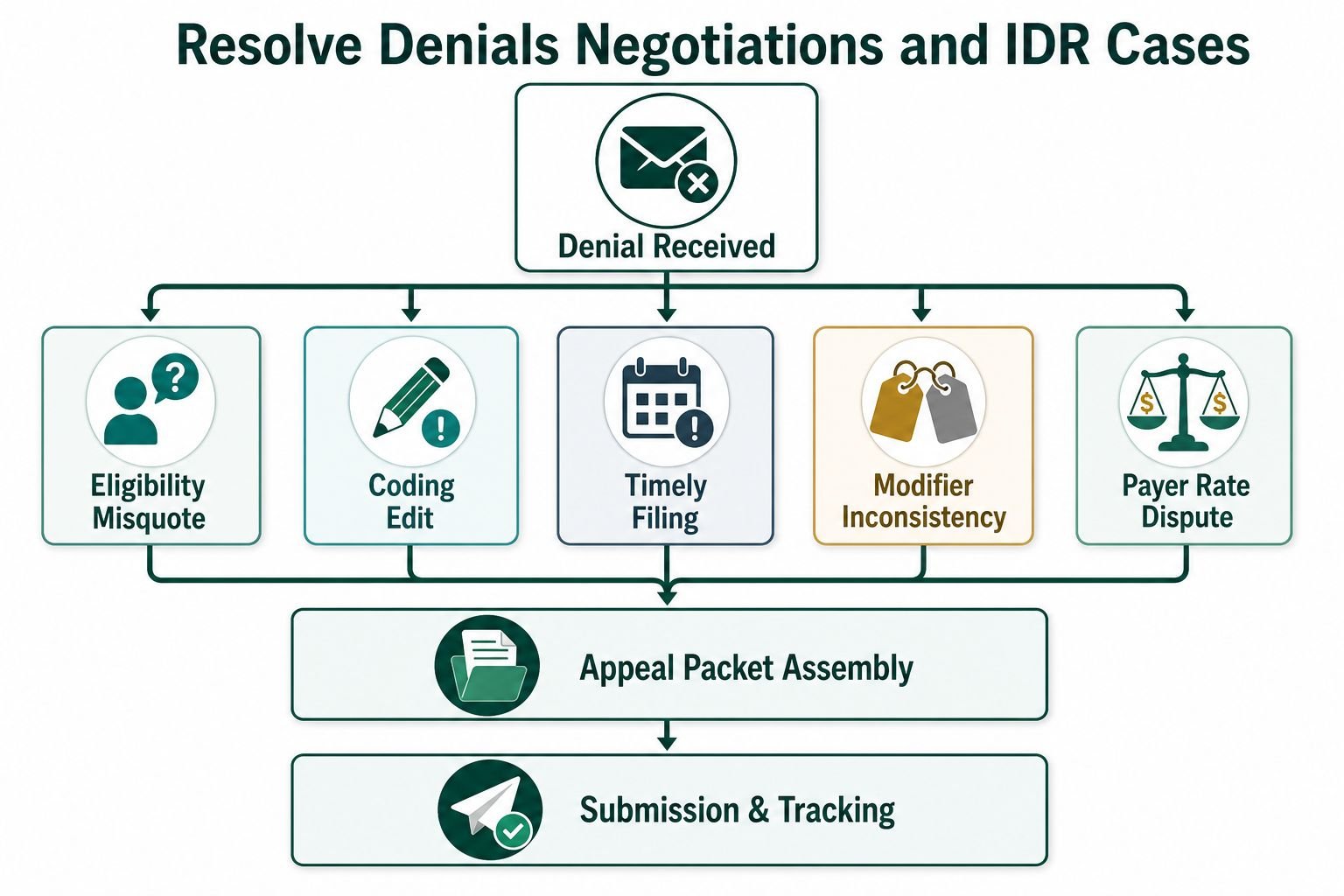
Separate eligibility misquotes from coding edits, timely-filing failures, modifier inconsistencies, and payer rate disputes. Each category needs different evidence:
- Eligibility misquote: Include the verification response, call reference, date, and the plan language that supports coverage.
- Coding edit: Include the medical record excerpt, corrected claim logic, and the applicable CPT or modifier guidance.
- Timely filing: Prove original submission, acceptance, payer routing, and any corrected-claim history.
- Modifier inconsistency: Compare the note, procedure sequence, and modifier rationale. Remove unsupported modifiers rather than defending them automatically.
- Payer rate dispute: Assemble the rendered fee schedule, contract-specific evidence, service complexity, specialty context, and market-specific support.
The appeal packet should be concise and complete. Include the verification of benefits, charge or fee-schedule justification, relevant medical-record excerpt, remittance, and a direct citation to the plan document or applicable rule. Track denial overturn rate, time to appeal, dollars recovered per FTE, and recurring root causes. Those metrics tell you whether the team is recovering revenue or merely moving files.
Use IDR only when the claim qualifies
The No Surprises Act changed the economics of many protected OON claims. HHS/ASPE reported that, compared with 2021, the prevalence of OON bills in 2022 declined 15% for emergency services and 11% for non-emergency services at in-network facilities. Compared with 2019, the reported declines were 24% for emergency services at any facility and 17% for non-emergency services at in-network facilities. The HHS and ASPE follow-up report provides the underlying measures.
The key operational question is eligibility. In 2024, about 1.23 million disputes were submitted to federal arbitration, and an insurer trade-group analysis reported roughly 39% were ineligible, including 45% of non-emergency service disputes. The dispute-volume analysis highlights why classification and documentation must precede filing.
For qualifying cases, document the protected service, verify the payer's QPA, complete the open negotiation process, and submit a provider offer supported by specialty, complexity, geography, and contract evidence. The QPA is the median in-network rate for the same service in the relevant geographic market. The Congressional Research Service reports that, by the last six months of 2025, the winning offer was above QPA in about 87% of federal IDR decisions. The CRS overview of the IDR framework also reinforces the importance of evidence beyond billed charges.
Texas outcomes show why charge-based pricing alone is weak evidence. The final allowed amount averaged $635, close to the $634 median in-network allowed amount and well below the $1,944 80th-percentile charge benchmark. The USC Schaeffer Institute analysis of Texas dispute resolution supports a practical conclusion: local contracted-rate evidence and service-specific facts matter more than an inflated charge.
Audit Performance and Decide When to Get Support
Quarterly, review OON performance as an owner, not just as a billing report. Pull the first-pass resolution rate, appeal overturn percentage, average OON A/R days, patient-balance collection rate, and write-off ratio tied to OON contracts or payer behavior.
| KPI | Target Benchmark | Action Trigger |
|---|---|---|
| OON first-pass resolution | Consistently high and improving | Repeated rejection or correction categories |
| Appeal overturn rate | Demonstrates recoverable revenue | Appeals close without payment or explanation |
| OON A/R days | Under 45 days | Aging exceeds the operating threshold |
| Patient-balance collection rate | Stable against approved policy | Balances age without documented follow-up |
| OON write-off ratio | Limited to approved, explained causes | Write-offs rise without a root-cause plan |
Use the results to make a staffing decision
Repair the internal workflow when the issue is a small number of identifiable edits, missing ownership, or an EHR configuration error. Seek outside RCM support when network-specific denials persist, IDR volume exceeds internal capacity, revenue leakage remains unexplained, or the practice expands into an OON-heavy specialty such as anesthesiology, radiology, pathology, orthopedics, or pain management.
Vendor evaluation should include access to claim-level evidence, transparent work queues, payer-specific reporting, HIPAA controls, escalation ownership, and a transition plan that doesn't strand open A/R. A useful adjacent reference is audit preparation for SaaS support teams, particularly for thinking through evidence ownership, access controls, and repeatable audit trails.
The owner's checklist is straightforward:
- Verify classification: Confirm whether the service is ordinary OON, waiver-eligible, or protected.
- Control configuration: Test payer mapping, payment routing, provider data, and claim edits.
- Protect evidence: Keep the verification, consent, note, coding rationale, remittance, and appeal packet together.
- Manage by dollars: Prioritize denials, underpayments, and aging balances by financial risk.
- Escalate selectively: Use negotiation or IDR only after eligibility and documentation pass review.
How much internal staffing does OON billing require?
That depends on claim volume, specialty complexity, payer mix, and how much authorization and dispute work the practice handles. The right question isn't whether one person can submit claims. It's whether every stage has coverage, deadlines, backup ownership, and measurable recovery accountability.
What should I ask an RCM vendor before outsourcing?
Ask who owns eligibility, claim edits, posting, patient balances, denials, and IDR cases. Require payer-specific reporting, claim-level notes, documented escalation rules, security controls, and proof that the vendor can work inside your current EHR without creating a second disconnected workflow.
How do I reduce transition risk?
Start with an inventory of open claims, aging balances, payer rules, authorizations, pending appeals, and active IDR matters. Define who owns each account during the handoff, preserve access to historical documentation, and require weekly reconciliation until payment posting and A/R reporting stabilize.
When should a practice stop trying to fix OON billing internally?
Stop treating it as an internal-only project when the same denial categories recur after corrective training, high-value disputes miss deadlines, staff can't complete evidence packets, or owners can't explain OON write-offs. At that point, the cost is no longer just staffing. It's unrecovered revenue and distorted A/R visibility.
Happy Billing provides full-cycle OON revenue-cycle support, denial management, A/R recovery, and specialty-specific billing controls designed to prevent leakage before claims reach the payer. If your practice is losing money through eligibility errors, underpayments, patient-balance confusion, or stalled IDR cases, visit Happy Billing to evaluate a more controlled workflow.
Losing money to out-of-network repricing?
Send us a sample of your out-of-network claims. We compare each allowed amount against a fair benchmark, flag which claims are still appealable, and estimate what is recoverable. BAA signed before we see any data. Get a free underpayment analysis →