Federal IDR Process for Providers: Step-by-Step Guide
CMS reported 1,433,289 federal IDR disputes initiated in the first five months of 2026, while IDR entities closed 1,103,487 payment determinations and 222,599 ineligible disputes during that same period. CMS-linked reporting makes the point clearly: federal IDR is no longer a one-off escalation for unusual claims. For independent practices, it's a high-volume revenue recovery channel that can reduce preventable write-offs, denial leakage, and aging A/R.
The process is rigid. You must complete open negotiation, file through the federal portal within the required window, submit a defensible offer, and manage every deadline. Providers won 85% of 1.15 million disputes that received determinations during a six-month period in 2025, according to HFMA's analysis of federal IDR data. The opportunity is substantial, but only practices with disciplined intake, documentation, and follow-up will turn favorable decisions into collected cash.
Not every underpaid out-of-network claim belongs in federal IDR. New York practices should first read how the No Surprises Act applies in New York, and for state-regulated plans a regulator complaint can be faster: see our guides to New York DFS complaints and New Jersey DOBI complaints.
Why the Federal IDR Process Matters to Your Practice
A federal IDR program win can recover money that would otherwise sit in underpaid claims, payer appeals, or aged A/R. That matters directly to a physician-owner because unresolved out-of-network balances increase days in A/R, consume staff time, and make net collections look weaker than the practice's clinical performance warrants.
Federal IDR is a regulated payment dispute process under the No Surprises Act, not a general complaint channel. It applies to qualifying commercial-plan disputes involving protected emergency services, certain post-stabilization and ancillary services, and air ambulance services. The process gives the provider or facility and the health plan a formal route to submit competing payment offers to a certified IDR entity.
The scale changes how you should manage it. CMS reported that more than 2.3 million disputes were initiated from the program's operational start on April 15, 2022 through 2024. In the first half of 2025, 1,186,812 disputes were initiated, followed by 1,372,563 in the second half, a 16% increase in the latter period, according to CMS supplemental federal IDR data. That volume creates administrative pressure, but it also confirms that practices need a repeatable recovery workflow.
Owner's rule: Don't ask whether one claim is worth filing. Ask whether your practice can identify, prepare, submit, and collect every eligible claim without allowing deadlines to expire.
Federal IDR differs from other pathways:
| Pathway | Legal Authority | Typical Timeline | Best Use Case |
|---|---|---|---|
| Federal IDR | No Surprises Act and federal rules | Statutory business-day and calendar-day deadlines | Qualifying commercial-plan disputes governed by federal law |
| State IDR | Applicable state surprise billing law | Depends on the state process | Fully insured claims where state law controls |
| ERISA self-funded plan process | Federal plan rules and the No Surprises Act framework | Depends on the dispute and applicable federal procedure | Claims not displaced by an applicable state pathway |
| Commercial arbitration | Contract or payer agreement | Contract-specific | Disputes governed by negotiated arbitration terms |
Before filing, confirm the plan type, service setting, state jurisdiction, and whether patient notice and consent affect eligibility. Practices that need a plain-language overview can review navigating the No Surprises Act IDR and the CMS surprise billing resources for practices.
The rest of this guide focuses on execution. Operational discipline drives IDR results more reliably than luck, especially when a practice files at scale.
Not sure which underpaid claims qualify for IDR?
We will compare a sample of your out-of-network claims against a fair benchmark and show you what is recoverable, claim by claim. Get a free underpayment analysis →
Eligibility and the Pre-IDR Open Negotiation Period
Federal IDR is a revenue recovery channel only when your team confirms eligibility before work accumulates. Qualifying disputes generally involve out-of-network emergency services, protected post-stabilization care, certain ancillary services at an in-network facility, and air ambulance services covered by the No Surprises Act. Ancillary services may include anesthesiology, radiology, pathology, laboratory services, neonatology, and assistant surgeon services when the patient could not reasonably choose the provider.
Do not route every out-of-network balance into the federal process. Confirm whether state law controls, whether the plan falls under federal IDR, whether the service fits a protected category, and whether valid notice and consent remove the claim from the pathway. Medicare, Medicaid, TRICARE, Veterans Affairs programs, and workers' compensation plans follow different rules and are not federal IDR candidates under this framework.
The first clock starts before IDR
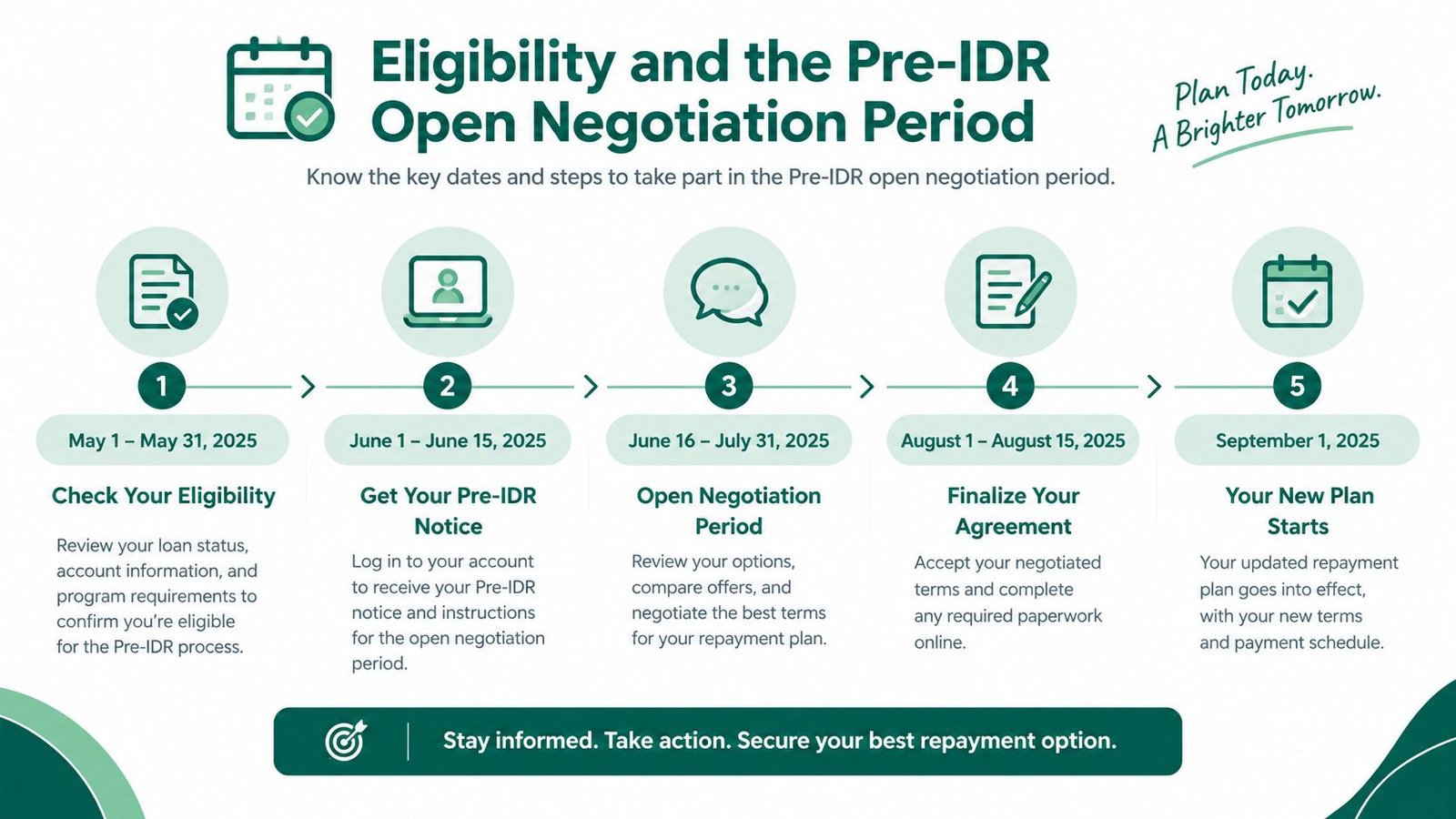
Federal IDR requires a 30-business-day open negotiation period before formal submission. The 30-business-day period begins the day after the practice receives the initial payment or the notice of denial, so the receipt date on the remittance, not the payer's issue date, starts the clock. The initiating party must send an open negotiation notice that identifies the disputed items and services and states the proposed out-of-network rate.
After the negotiation period closes, the provider, facility, or health plan has 4 business days to initiate federal IDR. The CMS federal IDR guidance requires the initiating party to send the Notice of IDR Initiation through the Federal IDR portal to the other party and the Departments within that window.
Run the clock at the claim level, not from a monthly spreadsheet. If the payer denies CPT 99284, an emergency department visit, record the remittance receipt date and calculate the negotiation period from that date. Apply the same control to CPT 73721, an MRI of a lower extremity joint, and CPT 99291, critical care. The code does not establish eligibility by itself. Clinical setting, network status, plan type, notice and consent history, and the payment or denial record determine whether the claim belongs in federal IDR.
Protect the filing window
A missed negotiation deadline can stop an otherwise valid claim from reaching IDR. Configure your workflow to capture:
- Initial payment or denial date: Save the remittance and payer correspondence.
- Open negotiation start date: Calculate business days from the applicable receipt date.
- Open negotiation end date: Confirm the closing date, excluding weekends and applicable federal holidays.
- IDR initiation deadline: Reserve the 4-business-day window immediately after negotiations end.
- Portal evidence: Save the submitted notice and confirmation number.
Do not allow informal negotiation to run past the filing window. Send the notice promptly, document every exchange, and preserve escalation rights. Keep patient-estimate compliance separate from IDR tracking, using these good faith estimate requirements and template for medical practices as a separate workflow reference.
Building the Evidence Pack That Wins Disputes
The arbitrator sees the record you submit, not the work your staff performed behind the scenes. A persuasive evidence pack connects the service, the claim, the payment shortfall, the applicable QPA information, and the provider's offer in a logical sequence.
Build one standardized packet for every dispute, then tailor the argument. At minimum, include:
- Initial claim: Submit the complete claim showing the relevant service codes, modifiers, units, provider identity, facility, date of service, and claim number.
- Remittance or denial: Include the payer's payment, denial reason, patient cost-sharing information, and QPA disclosure where provided.
- Open negotiation notice: Attach the notice, delivery evidence, negotiation dates, and the final unresolved position.
- Eligibility file: Document the emergency, ancillary, post-stabilization, or air ambulance basis, along with network and plan information.
- Consent review: Include relevant notice and consent records, or state clearly why those records don't remove the dispute from federal IDR.
- Payment offer: State one final offer and explain how the evidence supports it.
- Provider context: Describe training, experience, acuity, complexity, case mix, teaching status, scope of services, and good-faith network efforts when relevant.
Batch only when the rules support it
Batching can improve throughput, but careless batching creates eligibility problems. CMS materials allow disputed items and services to be batched when they meet specific conditions, including services furnished to a single patient during a single encounter and billed on the same claim form, services billed under the same service code or comparable code, and certain anesthesiology, radiology, pathology, and laboratory services billed under codes within the same Category I CPT code range. Review the CMS batching guidance summarized by Holland & Hart before combining claims.
Use a batch worksheet with these fields:
| Field | What to verify |
|---|---|
| Provider identity | Same practice, NPI, or applicable billing entity |
| Payer and plan | Same health plan and governing pathway |
| Service family | Same or comparable service code or permitted CPT range |
| Patient and encounter | Single patient and encounter where required |
| Timing | Dates fall within the applicable batching window |
| Documentation | Every item has a matching claim and remittance |
Don't treat the QPA as a number to accept blindly or dismiss casually. Compare the payer's QPA disclosure with the service code, geographic area, plan type, and applicable year. If the data appears inconsistent, stale, or incomplete, identify the specific mismatch and explain why it weakens the payer's offer. Arbitrators need a documented challenge, not a general assertion that the rate is unfair.
Make the packet easy to audit
Use consistent file names such as Payer_Plan_CPT_Date_ClaimID_DocumentType. Keep a master index at the front and use page references in the offer narrative. The most damaging omissions are usually procedural, including missing proof of open negotiation, an unexplained eligibility basis, incomplete remittance data, or a provider offer that doesn't connect to the submitted evidence.
A practice owner evaluating broader leakage should pair IDR review with a medical billing audit checklist for practice owners. IDR recovers eligible underpayments, but an audit can reveal why those underpayments were never routed into the process.
Initiating the IDR Submission and the Clock That Follows
File through the Federal IDR portal, not by email, an internal payer portal, or a verbal agreement with a plan representative. The initiating party sends the Notice of IDR Initiation to the other party and the Departments, identifies the disputed items, provides the required information, and selects or helps select a certified IDR entity. Use the CMS's federal IDR process overview as the operating reference for the submission path.
Before opening a dispute, make the file submission-ready:
- State the eligibility basis in one sentence at the top of the offer narrative.
- Attach the record showing open negotiation ended without resolution.
- Record the filing deadline and assign one owner to submit before it expires.
- Label every item consistently so the portal entry matches the evidence pack.
- Finalize the provider's payment offer and confirm the amount in every required field.
- Upload supporting documents, attestations, and any required selection information.
- Save the portal confirmation, submitted offer, and payment records in the case folder.
The certified IDR entity must be properly certified and free of conflicts. Treat entity selection as a tracked workflow, not an administrative afterthought. If the parties cannot agree, use the federal selection mechanism and preserve the related record.
Manage the actual deadlines
After the entity is selected, both parties submit payment offers within 10 business days. The entity then has 30 business days to decide. The losing party must pay within 30 calendar days after the determination.
Track those deadlines separately. A portal confirmation proves submission, not completion. A favorable decision establishes the result, not receipt of funds. Assign owners for offer submission, decision review, payment follow-up, and reconciliation so cases do not disappear into a queue.
CMS administrative fees and certified IDR entity fees determine whether a dispute makes economic sense, particularly for low-value claims. Build batches around clean documentation and repeatable workflows, then review expected recovery, staff time, and fee exposure before filing. Throughput matters, but a weak batch can reduce provider-favorable results and consume capacity needed for stronger cases.
How Arbitrators Pick a Winner and Why Providers Are Winning
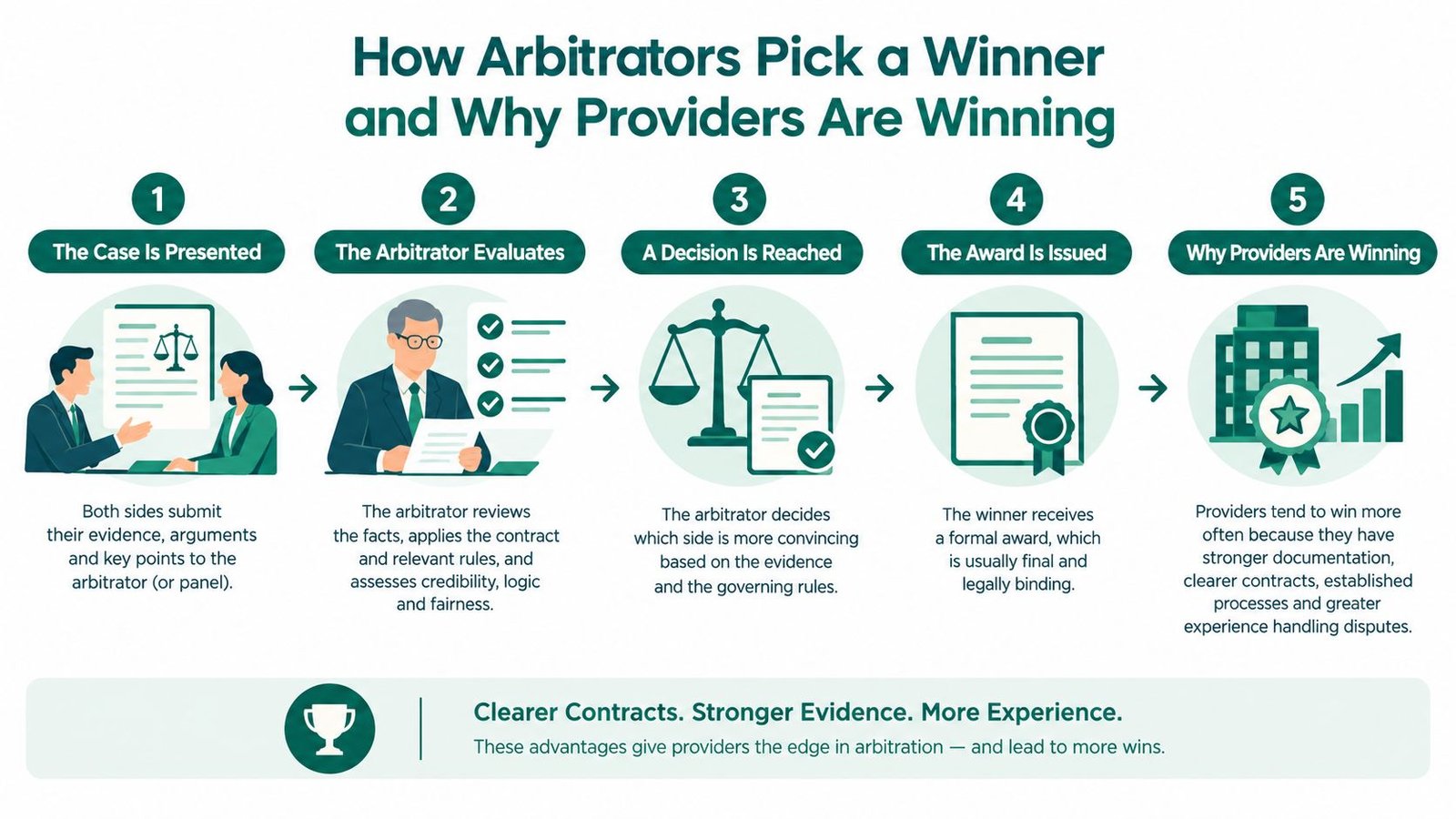
Federal IDR is a final-offer process. The certified IDR entity does not split the difference or create a compromise. It selects either the provider's offer or the payer's offer after reviewing eligibility, the QPA, and permitted additional information.
The qualifying payment amount, or QPA, generally represents the plan's median in-network rate for the same or similar item or service in the applicable geographic area and market. Treat it as the starting benchmark, not the entire case. Your offer needs to explain why the actual service supports the amount requested and how the evidence relates to the statutory factors.
Build around permitted factors
Give the arbitrator a concise reason to choose your offer:
- Provider qualifications: Document specialized training, certification, experience, and relevant quality or outcomes information.
- Service complexity: Describe unusual clinical complexity, intensity, acuity, or risk.
- Facility context: Include teaching status, case mix, and scope of services when they affect the dispute.
- Market conditions: Address provider or plan market share when reliable evidence is available.
- Network conduct: Show good-faith efforts to negotiate a network agreement and include relevant prior contracted rates where permitted.
Do not build the case around billed charges, usual and customary charges, or public program rates. Those figures do not replace the QPA analysis. The comparison must connect the two final offers to the service and support each meaningful adjustment with admissible evidence.
Why provider submissions are prevailing
Provider-favorable determinations reflect a structural tilt toward well-documented offers, which means preparation quality, not luck, drives outcomes. The result is operationally important for physician groups treating federal IDR as a recurring recovery channel. A clean case file gives the arbitrator a direct path from the service facts to the selected offer.
Backlog and rising administrative pressure make throughput part of the strategy. Batch claims with consistent fact patterns, standardize the evidence narrative, and reserve manual review for cases where the permitted factors materially strengthen the provider's position. Filing volume alone will not improve recovery. A weak batch can consume staff capacity and reduce the quality of stronger submissions.
Arbitrators choose an offer. They do not award a compromise because both parties made an effort.
Set the provider offer accordingly. Be assertive, then support every departure from the QPA with evidence tied to the actual service. Use a short, case-specific narrative instead of a broad clinical history. Before submitting a batch, confirm that each file contains the same core fields, a defensible offer, and documentation an independent reviewer can understand without reconstructing the dispute.
For patient-balance compliance, review balance billing guidance for medical practices. Keep the issues separate. Federal IDR addresses the provider-plan payment dispute, while balance billing rules determine what the patient may or may not be charged.
Post-Decision Steps, Cooling-Off Periods, and Fee Allocation
Treat the determination date as day zero. Post the expected amount, set a 30-calendar-day follow-up task, and reconcile the remittance against the selected offer, the original payment, patient cost sharing, and applicable interest. A favorable determination becomes recovered revenue only after your team verifies the payment and clears the balance.
Assign one owner when the determination is issued. Record the payment due date, require proof of posting, and track the result through final reconciliation. If the payer sends the wrong amount, submit a focused package with the determination, payment record, claim details, and calculation of the remaining balance. Address the payment shortfall directly. Do not reopen the clinical argument when the problem is failure to follow the determination.
The cooling-off period changes your queue
After a determination, the parties face a 90-day cooling-off period before bringing the same or a similar dispute against the same party again. Keep the rule in your scheduling controls and confirm the current requirements before filing repeat cases. Filing overlapping items too early can waste preparation time, create eligibility questions, and disrupt a later batch.
Use the cooling-off period to improve throughput and protect recovery performance:
- Payer pattern: Identify repeated underpayments by service family or plan.
- Claim grouping: Separate claims suitable for batching from claims requiring individual review.
- Documentation gap: Record missing QPA disclosures, remittances, or plan details.
- Contract strategy: Decide whether repeated disputes justify a network discussion or broader reimbursement review.
A cooling-off calendar should sit beside the case deadline calendar. That prevents staff from treating a closed dispute as immediately reusable inventory and helps the team prepare the next eligible batch without contaminating it with restricted claims.
Understand the financial exposure
The parties pay the applicable administrative and certified IDR entity fees under the federal rules. The losing party generally carries the IDR entity fee, but verify the allocation shown in the case record and current CMS guidance. Do not build a recovery forecast around an assumed fee amount when the portal or governing rules provide the controlling figure.
Federal IDR determinations are final and binding. An ordinary appeal does not provide a second opportunity to argue for a different payment amount. Narrow judicial review may apply to procedural or legal defects, so escalate when the payer fails to follow the determination, withholds required information, or shows repeated bad-faith conduct. Preserve every notice, portal record, remittance, and communication before involving counsel or regulators.
Operational Tactics to Turn IDR Into a Recovery Engine
A practice should manage federal IDR like a revenue work queue, not an occasional legal project. The winning model combines eligibility screening, batch discipline, evidence templates, deadline controls, and payment reconciliation. If one physician's claims generate recurring NSA-eligible underpayments, filing one dispute at a time through an unstructured inbox guarantees leakage.
Build a dedicated operating lane
Assign an IDR coordinator, even if that person shares responsibilities with denial management. The coordinator should own the case from eligibility review through payment posting. Clinical leadership only needs to become involved when provider qualifications, acuity, complexity, or network strategy strengthens the offer.
Use a shared dashboard with these fields:
- Case identity: Payer, plan, claim number, patient encounter, service family, and provider.
- Eligibility status: Federal, state, pending documentation, or ineligible.
- Clock control: Open negotiation dates, filing deadline, offer deadline, decision deadline, payment due date, and cooling-off end date.
- Financial view: Initial payment, provider offer, payer offer, selected offer, fees, and collected amount.
- Outcome: Won, lost, withdrawn, ineligible, paid, or escalated.
Templated cover letters and standardized file names reduce variation. Portal uploads should follow a checklist, and every submission should have a saved confirmation. Automation can prepare documents and reminders, but a trained reviewer should approve eligibility and the final offer before submission.
Prioritize the right disputes
Don't rank cases only by billed charge. Rank them by recoverable value, eligibility confidence, documentation strength, payer pattern, and the practice's historical results by service family. A recurring underpayment pattern in anesthesiology may require different evidence from a radiology dispute, even when the payer is the same.
Batch eligible services carefully. CMS permits batching in defined circumstances, including same-patient, same-encounter services billed on the same claim form and permitted same-code or comparable-code groupings. Review the best platforms for out-of-network billing compliance when comparing technology for intake, document control, and payer-specific workflows.
Recovery principle: Throughput matters only when eligibility and evidence quality stay intact.
Track the economics by provider and payer. Useful KPIs include IDR win rate, days from determination to disbursement, collected dollars per submitted case, ineligible-dispute rate, staff time per case, and IDR-derived revenue per physician FTE. Pair those metrics with total net collections and A/R days. A high win rate with slow payment posting still leaves cash trapped. A large filing volume with frequent ineligible cases signals poor screening, not operational success.
The right outsourcing decision depends on whether your current RCM team can manage the federal portal, business-day deadlines, evidence preparation, payer follow-up, and reconciliation without pulling physician leadership into administrative work. Happy Billing can manage full-cycle RCM, denial management, and A/R recovery inside an existing EHR, with IDR workflows incorporated into the broader revenue process. Evaluate the partner by documented controls, specialty knowledge, reporting, and collected results, not by promises about filing volume.
Happy Billing can help your practice identify eligible federal IDR claims, prepare evidence packs, manage portal deadlines, and reconcile awarded payments into your existing RCM workflow. If underpayments are increasing A/R days or forcing physicians to accept avoidable write-offs, visit Happy Billing to request a focused review of your recovery process.
How quickly must a provider file federal IDR?
After the 30-business-day open negotiation period ends, either party can initiate federal IDR within 4 business days. The initiating party must submit the Notice of IDR Initiation through the Federal IDR portal and furnish it to the other party and the Departments.
Can every out-of-network claim enter federal IDR?
No. The claim must involve a qualifying No Surprises Act service, a covered commercial plan, the correct federal jurisdiction, and completion of the required negotiation and filing steps. State law, patient consent, plan type, and service setting can make a claim ineligible.
Does the arbitrator split the difference between offers?
No. The certified IDR entity selects one of the two final offers. Your evidence should explain why your offer is supported by the QPA analysis and permitted factors such as complexity, acuity, provider qualifications, and good-faith network efforts.
What should a practice owner measure?
Track IDR win rate, ineligible-dispute rate, days to payment, collected amount per case, staff time per case, and IDR-derived revenue per physician FTE. Review those measures alongside net collections and A/R days to determine whether IDR is improving the practice's actual cash performance.
Not sure which underpaid claims qualify for IDR?
Send us a sample of your out-of-network claims. We compare each allowed amount against a fair benchmark, flag which claims are still appealable, and estimate what is recoverable. BAA signed before we see any data. Get a free underpayment analysis →