Medical Billing Audit Checklist for Practice Owners

Medical billing audit checklist for practice owners starts with front-end capture, coding, claims, denials, A/R, payer contracts, compliance, and specialty-specific risk, then ranks every finding by financial impact and urgency. If your initial denial rate is 11.8% and many providers are already seeing 10% or higher, you do not have a billing housekeeping problem, you have a revenue control problem that hits cash flow and A/R days fast (denial-rate benchmark).
That is why we treat the audit as an owner-level triage system, not a coder-only review. The best practices sample claims, compare source documentation with payer rules, quantify exposure, assign priority scores, and document evidence so the team can fix the highest-dollar leaks first. In our work with physician owners, the fastest gains usually come from stopping preventable denials before submission, then tightening follow-up on the claims already stuck in the pipeline.
A good audit also has to speak the language of actual revenue operations. That means checking Modifier 25, Modifier 59, global period rules, authorization limits, and specialty-specific payer behavior, while also watching denial rate, clean claim rate, days in A/R, and net collection rate as a connected system. CMS enforcement history under HIPAA, the 2013 HHS Omnibus Rule, and payer scrutiny around modifiers all matter because they can turn a sloppy workflow into recoupment exposure later (HIPAA enforcement context, Modifier 25 guidance).
If you run orthopedics, cardiology, anesthesia, behavioral health, or a multi-specialty group, start by using a specialty lens. We've seen that a general checklist misses significant revenue, while a specialty-aware one catches the exact bottlenecks that hit reimbursement. If you want a deeper specialty-specific reference, start with Happy Billing's specialty resources, and if you want a pressure test on your current workflow, use a free billing audit review.
1. Claim Scrubbing for Modifier Compliance and Accuracy
An orthopedic office bills 99213 with 20610 on the same date of service. If the documentation supports a separately identifiable E/M service, the claim needs the right modifier logic, or the payer will bundle the work and the practice absorbs the loss. That is the core job of claim scrubbing, catch modifier failures before they hit denial rate, days in A/R, and compliance exposure.
Use the scrubber as an owner-level triage tool. Start with Modifier 25, Modifier 59, -76, specialty modifiers like -QX and -QY, and payer-specific bundling rules. If your team needs a focused refresher, review our guide to CPT Modifier 59 and anchor the rule in your own policy.
In anesthesia, the risk shifts to supervision and concurrency. A case billed with -QX or -QY has to match payer rules exactly, or the denial lands on a high-dollar service line. Cardiology and imaging create a different leak. When technical and professional components are mixed up, missing -26 or -TC can turn a clean encounter into avoidable underpayment.
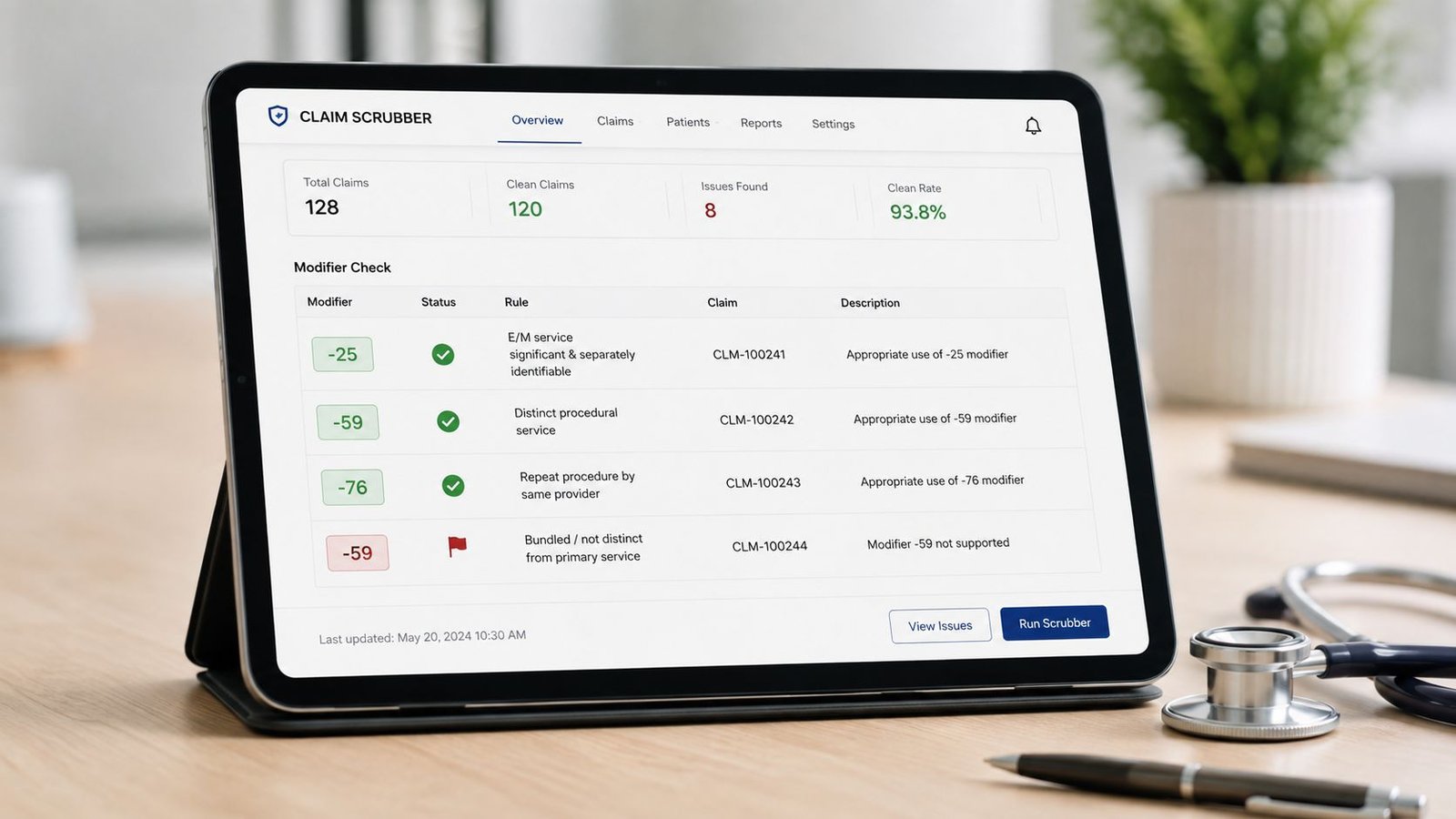
Practical rule: If the claim needs a human to catch the modifier after submission, your front end is too weak.
Build the scrubber into the billing system and keep a written modifier policy by specialty. Cross-check it against CMS NCCI edits every month. The pattern that loses the most money is usually the one the team keeps repeating without seeing the denial trend.
- Automate the scrubber: Manual coder review alone misses too many modifier errors.
- Match specialty rules: Orthopedics, anesthesia, and cardiology need different modifier logic.
- Review the last 30 days: Look for repeated modifier errors in submitted claims.
- Train charge entry staff: Front-desk and charge capture teams need enough modifier literacy to flag mismatches early.
- Use scrubber output: High-risk CPT combinations should trigger template or charge master edits, not just note-level corrections.
2. Authorization Verification and Denial Prevention
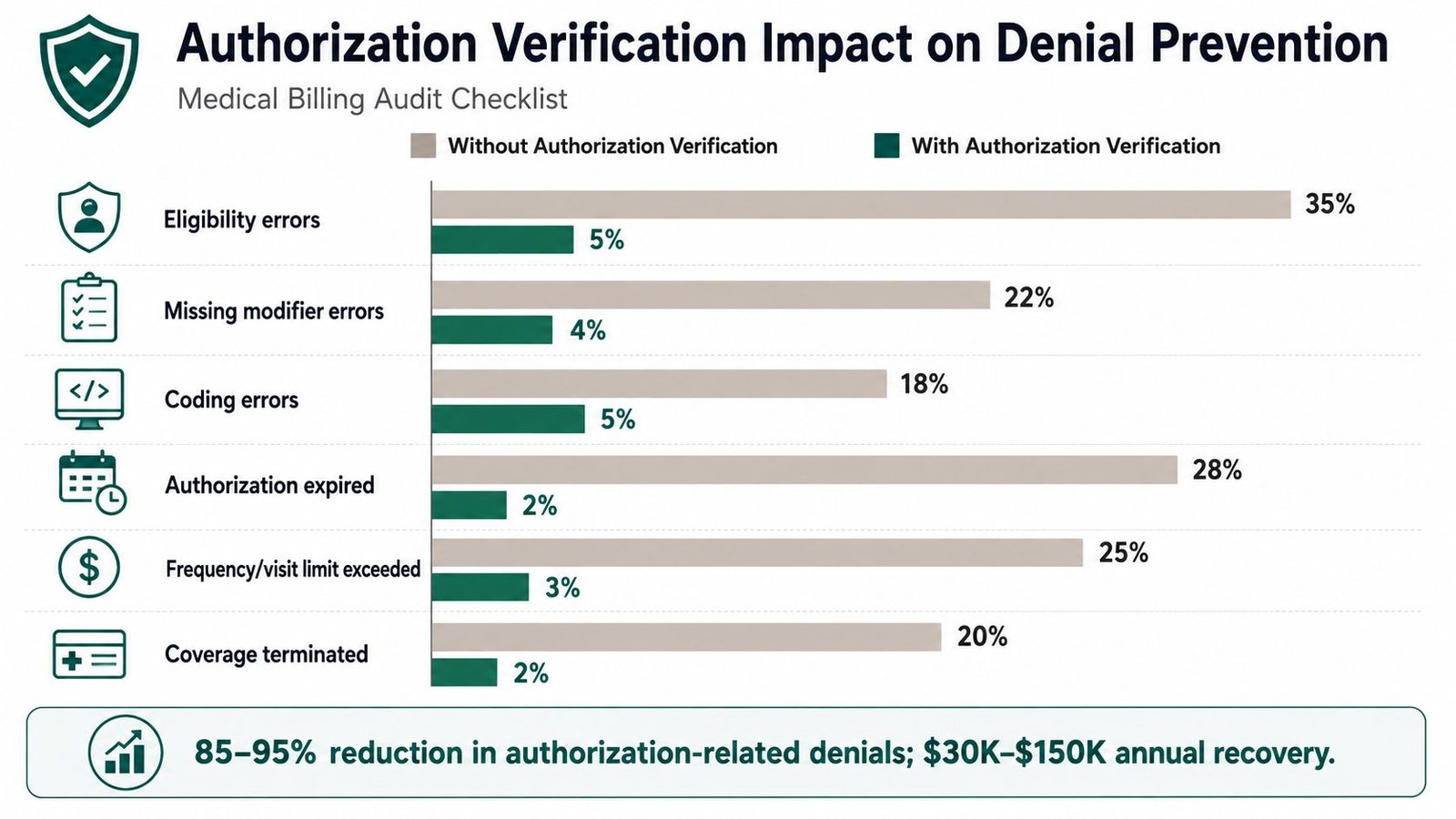
A mental health practice billing 90837 near its visit limit has a different risk profile from primary care, and the fix belongs at the front desk, not in the denial queue. If the payer allows only a set number of visits, staff should stop the claim before submission until the renewal is confirmed. The same pressure shows up with 90834 in behavioral health, where an expired prior auth turns a payable visit into a write-off. Pediatric practices billing autism-related services under 99213 or similar visit patterns face the same leak when authorization is missing.
Before building scrubber rules from denial patterns, compare data scrubbing tools to see what fits your existing stack. Then build a pre-visit verification workflow that lives in the schedule and the billing dashboard. The team needs the authorization number, validity dates, service scope, and visit limits before the patient is seen. Keep a concise staff guide aligned with prior authorization guidance for medical billing teams.
Keep one person accountable for daily authorization renewals. If everyone owns it, nobody owns it.
Owners should treat authorization leakage as a revenue triage problem. Track denial rate, A/R days, and compliance exposure for each payer and service line, then assign a priority score to the worst patterns. If the score stays high after front-end fixes, the issue is bigger than staff reminders. It points to payer complexity, weak workflow controls, or a billing process that needs outside RCM support.
Monthly denial review should isolate authorization failures by CARC 50 and N3, then compare those denials by payer and service type. That gives you a clear read on whether the problem sits in intake discipline, payer rule complexity, or a workflow that needs to be outsourced.
- Verify at scheduling and check-in: Capture the authorization number, validity dates, and visit limits early.
- Build a live dashboard: Real-time status reduces same-day claim holds.
- Track renewal deadlines: High-volume authorizations need advance monitoring.
- Audit top payers quarterly: Payer rules change, and the front desk needs a current cheat sheet.
- Trend denial reasons: Report authorization-related denials monthly and act on the recurring pattern.
3. Denial Rate Trending and Root Cause Analysis
Weekly denial trending should turn the log into a fix list. Sort denials by payer, CPT, diagnosis, and CARC/RARC code, then rank the top patterns by dollar impact and by the effect on A/R days and compliance exposure.
A practice owner should treat denial trending as revenue triage. Benchmarks from benchmark data show denial pressure is not a fringe problem, and the claims index summary points to a longer-running rise in payer scrutiny. One internal audit I reviewed found a repeated denial cluster on 99214 visits with one commercial payer, while another site kept seeing CARC 50 hits tied to missing authorization checks. Those patterns do not call for more denial chasing. They call for upstream correction.
A good report starts with a clean export. Group denials by reason code, then pull 10 to 15 recent claims from each repeat pattern and compare the documentation, eligibility file, and intake notes. If a specific CPT-payer pair keeps failing, fix the workflow before staff spend more time reworking the same claim. That is where our denial management workflow earns its keep.
optimize claims intake steps only after you know which denial types are driving the loss. Otherwise you just speed up the same errors.
- Trend weekly, not quarterly: Recurring denials need fast review before they pile up.
- Separate rejections from denials: The fix is different, so the report should be too.
- Review payer concentration: One payer with strict rules can distort collections fast.
- Share the report with providers: Coding and documentation fixes need clinical buy-in.
- Feed patterns into scrubbing rules: If a denial repeats, block it before submission.
4. E/M Coding Accuracy and Compliance Review
A review of 50 encounters per provider found visits billed at 99213 when documentation supported 99214. That gap is the revenue leak this section helps you find, and it also tells you where compliance risk is hiding. If your team bills below the documented level, you are leaving money in the account. If it bills above the chart, you are creating audit exposure you do not need.
Start with a focused chart sample, then compare the billed E/M level against the note, the MDM elements, and the EHR template prompts. Use CPT 99202–99215 as the review range and look for patterns, not one-off mistakes. A single miss is a training issue. Repeated drift points to a workflow problem. When audit documentation includes PHI, confirm your tracking tools meet tracked link privacy practices before sharing findings externally.
Owners should treat this as a revenue triage step. A low-billed dermatology follow-up reduces margin. A pediatric template that skips preventive care elements can hold down reimbursement even when the provider did the work. A coding pattern that keeps pushing visits to the same level usually means the note structure is doing the damage. That is where internal correction stops being enough. If the provider education, template cleanup, and spot checks do not change the chart pattern, an RCM partner should review the specialty logic and payer mix.
Use a one-page provider scorecard tied to your EHR rules. Track undercoding, overcoding, and documentation mismatch side by side, then rank the highest-risk patterns by denial rate, A/R drag, and compliance exposure. For smaller groups that need tighter operational support, medical billing support for small practices can help keep E/M review consistent without building a full internal audit function.
Audit the note, not the memory of the visit. The payer reads the chart.
- Baseline each provider: Use the same sample size so comparisons stay fair.
- Compare billed level to documentation: Catch undercoding and overcoding in the same review.
- Standardize template prompts: The EHR should support accurate leveling.
- Train for compliance: Medical decision-making has to match what the note shows.
- Repeat quarterly: E/M drift shows up slowly, then hits revenue hard.
5. Eligibility Verification and Insurance Coverage Accuracy
Eligibility errors are front-end errors with back-end consequences. When coverage changes and nobody catches it, the claim goes to the wrong payer, the patient gets the wrong estimate, and your A/R ages while staff untangles a problem that could've been prevented at check-in.
A primary care practice might find that a commercial plan terminated three days earlier, while an orthopedic surgery center could miss a deductible change that should've triggered a different pre-collection conversation. In pediatrics, the money can be in the secondary plan. If the front desk doesn't verify coordination of benefits correctly, the first claim may go to the wrong payer and sit unpaid while the team reworks the file. That's why eligibility is not just an administrative courtesy, it's a cash-flow control.
The process should run twice. First at scheduling, then again at check-in. The team should confirm active coverage, plan type, copay, deductible status, and whether a secondary insurance policy needs to be billed first. If your staff still does this manually, the audit should tell you whether the volume justifies automation. If you want a tighter operational reference, coordination of benefits in medical billing belongs in your training packet.
A monthly eligibility audit should compare submitted claims against active coverage on the date of service. If the claim went out on the wrong policy, the fix is not just a corrected claim. It's a workflow change at registration.
- Verify twice: Scheduling and check-in both need active coverage confirmation.
- Capture secondary coverage: COB mistakes often hide the largest avoidable delays.
- Train staff on churn: Insurance changes need immediate EHR updates.
- Use monthly sampling: Compare claims to eligibility responses on the submission date.
- Escalate high-churn populations: Weekly re-verification can pay off in practices with frequent insurance changes.
6. Global Period Compliance and Post-Operative Billing
Global period mistakes are easy to miss and hard to recover. Surgery claims don't just live in the moment of the procedure, they carry a billing window that can block or allow later visits depending on whether the code is still in its global period.
Orthopedics is where many owners first feel this pain. If 29881 has a 90-day global and the patient comes back for an unrelated problem, the post-op E/M must carry the correct modifier and documentation must support that the issue is unrelated. If the note doesn't clearly show that, the payer can deny the visit or bundle it into the surgery. General surgery and cardiology bring their own version of the same problem, especially where wound care, ancillary services, or staged procedures are involved. When the team misses -24, -76, -77, -78, -79, or -59, the payer gets an easy denial reason.
This is a place where the audit has to be very specific. Build a quick-reference chart for your top surgical codes, note the global period, and align it with the modifier rules your clinical staff uses. We've seen practices lose easy follow-up revenue because the post-op date logic was not built into the EHR.
If the note doesn't show an unrelated diagnosis, staged procedure, or separate anatomic site, don't expect the payer to infer it.
Quarterly audits should sample post-op claims and confirm that the documentation, dates, and modifiers all line up with the global rules. That's the difference between clean reimbursement and repeated bundling denials.
- Map top surgical codes: Include the global period and the allowed exceptions.
- Use auto-calculated post-op dates: Human memory is not a billing control.
- Train clinical staff: Providers need to know when an unrelated visit really is separate.
- Check modifier support: The note must justify the unbundling exception.
- Audit quarterly: Post-op billing drift can hide in plain sight.
7. Anesthesia Unit and Modifier Billing Accuracy
Anesthesia billing is not forgiving. If the base units, time units, or concurrency rules are off, the denial can be large and the correction can be labor-intensive. That is why anesthesia audits need a different standard than general outpatient billing.
The base-unit problem is the first place to look. One payer may contract around a different base-unit value than the CMS Anesthesia Value File, and the billing system has to reflect that payer-specific rule exactly. The modifier logic matters just as much. -QX, -QY, -QK, -G8, and -G9 all carry supervision and medical direction implications, so the claim has to match the actual care model. If a physician directed too many concurrent cases, or the record doesn't support the supervision structure, the payer can deny the service at a meaningful dollar value.
We've seen audits catch missed add-on units such as 99100, which means the practice was doing the work but not capturing the revenue. That's the kind of leak owners care about because it's invisible until someone audits the case level. If your anesthesia group handles payer addenda, keep a payer-specific reference for base units, concurrency limits, and add-on policies in the billing system, not in a binder.
The cleanest workflow is electronic time tracking tied to the anesthesia record, then automated time-to-unit conversion with payer edits layered on top. Manual conversion is fine for exceptions, not for the main process.
- Keep the CMS file current: Base units need regular validation.
- Build payer-specific references: Contract addenda can override default assumptions.
- Track time electronically: Unit calculations should not depend on memory.
- Audit quarterly: Sample anesthesia cases and compare the billed units to the record.
- Flag concurrency automatically: Supervision thresholds should trigger review before claim submission.
8. Charge Capture and Front-End Collections Optimization
Missed charges are a front-end problem that show up as a revenue problem later. If the order never becomes a charge, or the visit ends before the claim is created, the practice loses money without ever seeing a denial.
Same-day charge entry is the first control I'd put in place. When clinics reconcile charges against the schedule and operative logs daily, missed revenue falls because the team catches gaps while the visit is still fresh. A monthly missed-charge report is even more important in specialties with complex encounters or multiple ancillary services, where one uncaptured item can sit buried in the workflow. If your practice uses front-end collections, pre-visit estimates and clear patient financial conversations also reduce balance disputes later, because patients are less likely to argue a bill they understood up front.
Charge capture and collections are tightly linked. Better eligibility verification gives the front desk more accurate estimates, and better estimates improve collection at check-in. That money matters because it lowers the balance that has to be chased later in A/R. For owners deciding whether to keep this in-house, the question isn't whether the team is trying hard enough, it's whether the process is detailed enough to catch every billable event.
A practical audit should compare the order set, the schedule, the encounter note, and the posted charge. If one of those doesn't line up, the owner should know why.
- Require same-day charge entry: Delay is where misses multiply.
- Reconcile with schedules daily: Visit logs should match posted charges.
- Pull a missed-charge report monthly: Find orders that never became claims.
- Train front desk on patient collections: The script matters as much as the estimate.
- Tie estimates to eligibility: Financial conversations should reflect active coverage.
8-Point Medical Billing Audit Comparison
| Service / Audit Type | Implementation complexity | Resource requirements | Expected outcomes | Ideal use cases | Key advantages | Key limitations |
|---|---|---|---|---|---|---|
| Claim Scrubbing for Modifier Compliance and Accuracy | Medium, payer-specific rules + periodic updates | Billing-system integration, rules config, quarterly maintenance | 8–12% denial reduction; 10–15% better clean claim rate; A/R −5–8 days | All specialties; highest impact: orthopedics, anesthesia, cardiology | Prevents modifier denials, reduces rework, improves compliance | Ongoing updates needed; cannot fix documentation gaps; potential submission slow-down if not automated |
| Authorization Verification and Denial Prevention | Medium–High, payer mapping + EHR integration | Payer system integrations, staff for manual verifications, dashboarding | 85–95% reduction in auth-related denials; A/R −8–15 days; $30K–$150K annual recovery | Mental/behavioral health, pediatrics, any high‑auth specialty | Prevents surprise denials, improves patient experience, frees appeals staff | Some payers lack real-time checks; manual work and workflow changes required |
| Denial Rate Trending and Root Cause Analysis | Medium, data integration + analytics setup | Claims/remit integration, analyst time, BI/dashboard tools | Identifies high‑impact drivers; $50K–$250K potential recovery; improves cash flow per 1% denial reduction | Practices needing systemic denial reduction; all specialties | Prioritizes remediation, supports provider coaching, reduces appeals | Time‑intensive analysis; requires clean data; payer reasons often vague |
| E/M Coding Accuracy and Compliance Review | Medium, chart audits and template updates | Experienced coders/auditors, provider training, chart review time | Typical 3–6% net revenue improvement; $30K–$100K impact from miscoding | Primary care, internal medicine, family med, pediatrics, dermatology | Increases defensible coding, reduces audit risk, improves documentation | Subjective guidelines; provider resistance; requires significant review time |
| Eligibility Verification and Insurance Coverage Accuracy | Low–Medium, vendor integration + workflows | Eligibility vendor, EHR integration, front‑desk verification practices | Eliminates 80–90% eligibility denials; reduces patient disputes 40–60%; $50K–$100K recovery | All specialties; critical for Medicaid, high‑churn populations | Ensures correct payer submission, accurate cost estimates, fewer disputes | Vendor cost; payer data gaps; staff must verify each visit |
| Global Period Compliance and Post-Operative Billing | High, specialty rules + modifier logic | Surgical coding expertise, system mapping, provider documentation coordination | 90–95% reduction in global‑period denials; 2–4% revenue uplift from valid unbundling | Orthopedics, general surgery, cardiology, surgical specialties | Prevents costly surgical denials, captures legitimate unbundling revenue | Complex specialty rules; modifier use can be subjective; needs strong documentation |
| Anesthesia Unit and Modifier Billing Accuracy | High, complex time/unit and concurrency rules | Anesthesia coding experts, CMS value file maintenance, time-tracking integration | 15–25% improved clean claims for anesthesia; large-dollar recovery potential ($50K–$300K) | Anesthesia groups and facilities with anesthesia volume | Accurate base/time units, reduces high-value denials, audit defense | Requires specialized expertise, precise time records, frequent updates |
| Charge Capture and Front-End Collections Optimization | Low–Medium, workflow & training focus | Front‑desk training, EHR/order‑to‑bill integration, estimation tools | Fewer missed charges and write‑offs; improved collections and patient satisfaction | All specialties; high‑volume clinics aiming to reduce leakage | Prevents revenue loss at point of care, improves patient communications | Cultural/workflow change required; integration and training costs; rollout burden |
Turn Audit Findings Into a Cash-Flow Plan
An audit only helps if it becomes a cash-flow plan with owners, dates, and re-checks. Start by consolidating sample evidence into one file set, encounter notes, superbills, claim forms, remittance advice, denial logs, eligibility responses, authorization records, payer contracts, fee schedules, charge masters, A/R aging, and HIPAA access or disclosure logs. Then score each finding by financial exposure, frequency, compliance risk, and fixability, because not every error deserves the same response.
Practice owners can separate busywork from effective action. If the problem is a small documentation gap in one provider's note, internal retraining may be enough. If the issue is recurring denials tied to payer rules, specialty complexity, underpayment patterns, or aging A/R that keeps stretching beyond normal bounds, the practice is past the point of casual cleanup. The benchmark guidance puts A/R at 30 to 40 days for most outpatient practices, with under 35 days described as best-in-class, and some owners use under 40 as the warning line (A/R benchmark, practice KPI guidance). If your numbers are drifting beyond that, the cash is already sitting too long.
Use the audit output to assign one owner per finding, one deadline per owner, and one re-audit date per fix. Then rerun the same sample and compare the new result to the last cycle. That re-test is what tells you whether the fix worked or whether the problem just moved.
For high-stakes specialties, we usually see the tipping point when the internal team knows what's wrong, but not how to sustain the fix across payer behavior, modifier rules, and denial follow-up. That's when a specialized partner becomes practical, especially for orthopedics, cardiology, anesthesia, or behavioral health. If you want a clean starting point, take advantage of a free billing audit review with Happy Billing and compare the findings to your current workflow.
How should I prioritize audit findings if everything looks urgent?
Start with the issues that hit revenue first, then compliance, then workflow friction. A denial pattern that repeats across high-volume claims gets fixed before a one-off documentation miss.
When is internal cleanup enough?
Internal cleanup works when the error is isolated, the fix is clear, and the team can prove it improved on the next sample. If the same denial or underpayment keeps returning, internal correction isn't enough.
What metrics should I watch after the audit?
Watch denial rate, clean claim rate, days in A/R, net collection rate, and coding accuracy together. Looking at one metric alone hides the full revenue story.
Which practices usually need outside RCM support?
Practices with specialty-heavy billing, persistent denials, payer complexity, or A/R that keeps drifting past normal benchmarks usually need help. That's especially true in anesthesia, behavioral health, cardiology, and orthopedics.
If you want a billing partner that works inside your existing EHR, focuses on denial prevention, and treats your audit findings like revenue recovery tasks, visit Happy Billing. We help physician owners tighten modifier compliance, authorization control, and denial follow-up so cash moves faster and the same problems stop repeating.