Out-of-network Appeal Package Checklist and Template for Providers

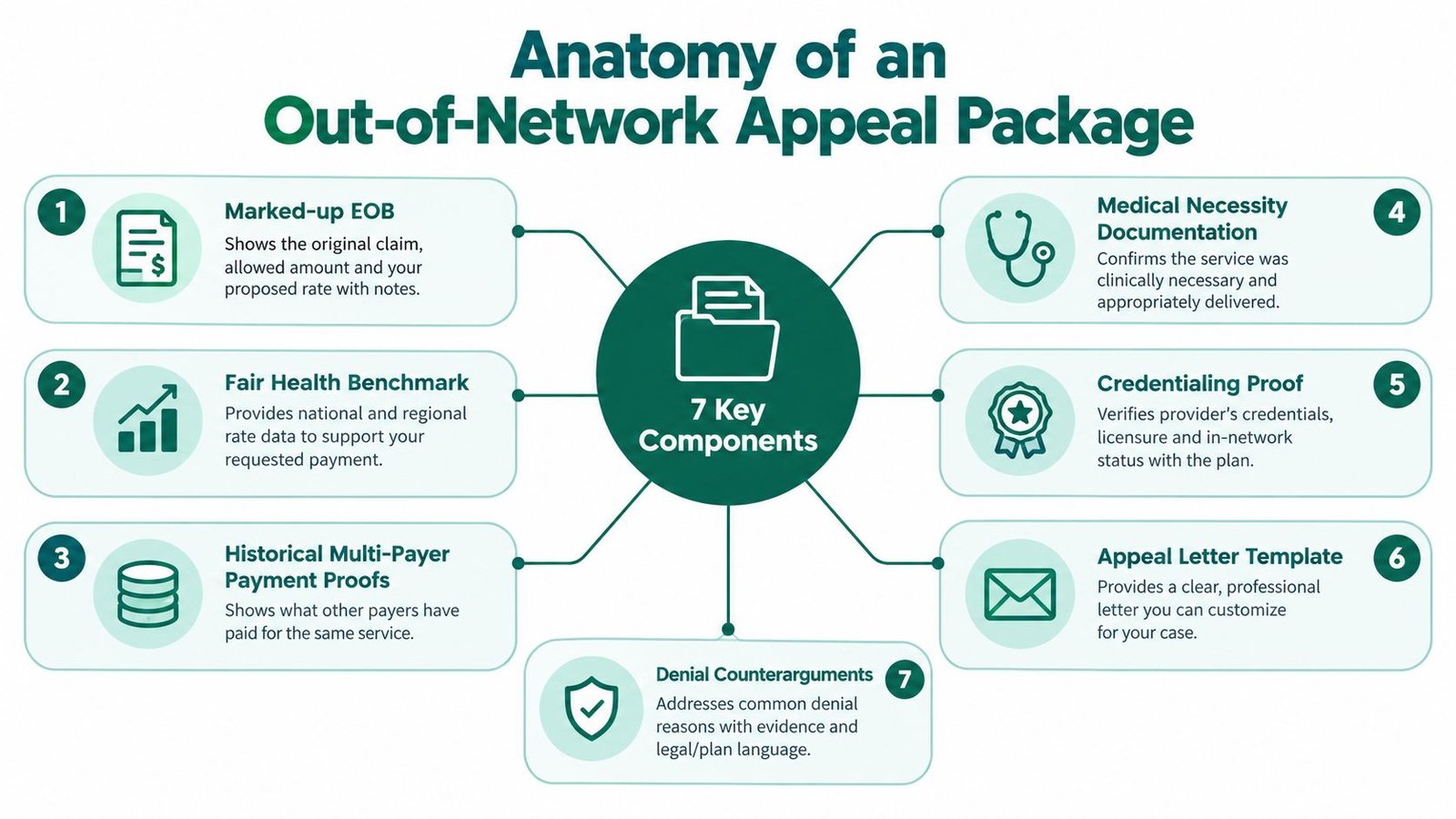
A winning out-of-network appeal package contains seven components: a marked-up EOB, Fair Health benchmark data, aggregated payment proofs from other payers, medical necessity chart notes, credentialing evidence, an appeal letter with a specific reimbursement demand, and defined escalation triggers. That file stack is often the difference between writing off an underpayment and recovering the amount your practice earned.
For a practice owner, an OON appeal isn't just a documentation exercise. Every unresolved payment affects revenue, denial rate, and A/R days. The strongest out-of-network appeal package checklist and template for providers turns a vague objection into a claim-specific financial argument that a payer must address.
What an OON Appeal Package Is and Why It Protects Revenue
The winning file stack starts with the marked-up EOB, then adds the Fair Health benchmark, historical multi-payer payment proofs, medical necessity documentation, provider credentialing and licensure evidence, the appeal letter with a specific dollar demand, and escalation triggers. Each item answers a different payer objection. The EOB identifies what was reduced, benchmark data supports the requested rate, comparable payments show that the demand isn't arbitrary, and clinical and credentialing records establish that the service and rendering provider were appropriate.
A major payer's Medicare Advantage policy requires an out-of-network provider appeal within 60 calendar days of the denial notice and calls for the waiver of liability, denial notice, original claim, claim number, member and patient identifiers, and supporting documentation. See the payer's Medicare Advantage out-of-network appeal requirements before finalizing the packet.
The file stack is a revenue control
A generic appeal letter usually fails because it asks the payer to reconsider without proving what should change. A claim-specific packet gives the reviewer a clean path from the adjustment code to the requested additional payment. It also preserves an audit trail if the practice later contacts a provider liaison, regulator, external review organization, or the appropriate No Surprises Act pathway.
Practical rule: Treat every underpayment as a recoverable account until the payer has answered the evidence, not merely repeated the original adjustment.
We have seen practices accept low OON payments because compiling support felt slower than closing the account. That trade-off can quietly inflate write-offs and extend A/R. A reusable Word letter template, paired with a disciplined exhibit stack, makes the work repeatable and gives physicians a referral-worthy asset to share with peers.
Component 1, Marking Up the EOB and Identifying the Denial
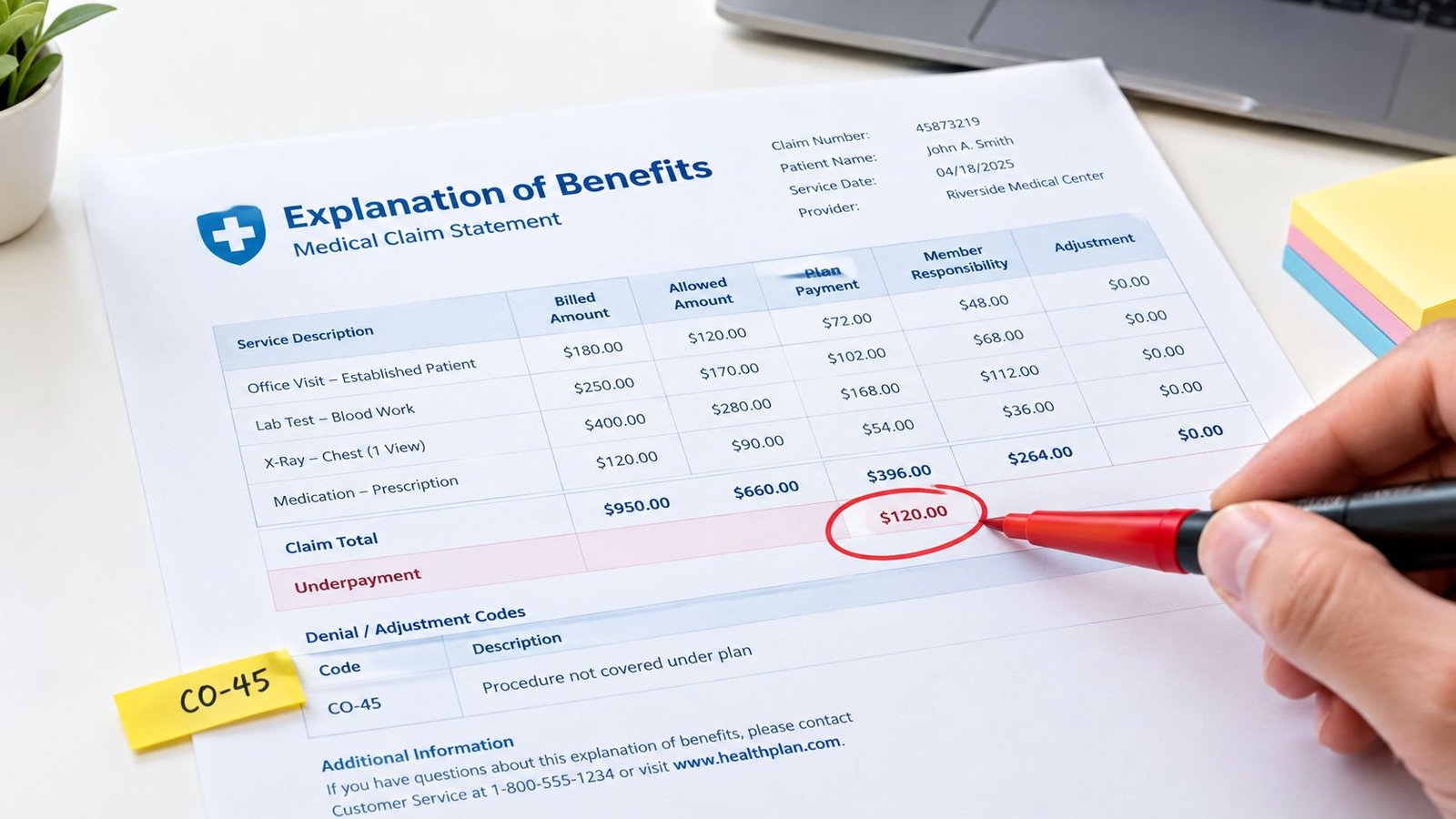
The EOB or remittance advice is the first file in the packet because it defines the dispute. Highlight the claim number, date of service, CPT code, billed amount, allowed amount, paid amount, patient responsibility, adjustment amount, claim status, and every denial or remark code. Don't write “the payer underpaid.” State exactly what the payer did and why the payment is disputed.
Common codes point toward different strategies:
- CO-45: The charge exceeds the fee schedule or maximum allowable amount. Support the requested amount with geographic benchmark evidence and comparable payer payments.
- PR-1: The payer assigned the amount to the deductible. Confirm the benefit application before demanding additional payer reimbursement, because a patient-responsibility dispute isn't the same as an allowed-amount dispute.
- CO-29: The payer says the filing limit expired. Assemble proof of the original submission, payer receipt, corrected claim history, and any documented exception before treating the issue as a rate appeal.
A useful guide to reading an explanation of benefits helps your team distinguish payment, adjustment, and responsibility fields before drafting the demand. The appeal letter should mirror the EOB's language, then explain why the adjustment doesn't resolve the claim.
Protect the deadline before researching the rate
For Medicare fee-for-service, the redetermination deadline is 120 days from receipt of the Medicare Summary Notice or Remittance Advice, as stated in the CMS Medicare Claims Processing Manual. That clock changes the work order. Identify the deadline first, then gather evidence in parallel rather than waiting for a perfect narrative.
The final marked-up EOB should be labeled as Exhibit A. Add a one-page claim summary showing the original charge, payer calculation, amount received, and additional amount requested. That summary lets a physician decision-maker see the financial issue without reading the entire clinical record.
Component 2, Fair Health Benchmarks and Historical Multi-Payer Payment Proofs
An OON reimbursement demand needs an objective financial spine. Pull the Fair Health fee schedule benchmark for the exact CPT code and service ZIP code, save the results as a PDF, and label the search parameters clearly. The evidence is stronger when the reviewer can see the code, geography, and benchmark context without reconstructing the search.
Then add historical payment proofs for the same CPT from three to six payers, aggregated into a concise exhibit. Don't present one favorable remittance as if it establishes the market. A payer can dismiss an isolated payment as an exception. A consistent range across multiple payers gives the reviewer a more credible comparison.
Build the payment exhibit without overstating the evidence
Use de-identified EOBs or remittance records and show the payer's allowed amount, paid amount, and relationship to the billed charge. The table below is a structure, not invented payment data. Replace the placeholders with actual records from your practice.
| Payer | Allowed Amount | Paid Amount | % of Billed |
|---|---|---|---|
| Payer A | [insert actual amount] | [insert actual amount] | [calculate from actual billed amount] |
| Payer B | [insert actual amount] | [insert actual amount] | [calculate from actual billed amount] |
| Payer C | [insert actual amount] | [insert actual amount] | [calculate from actual billed amount] |
The appeal should explain why the requested amount is supported by both the geographic benchmark and the practice's payment history. If the payer used a repricer such as MultiPlan, Zelis, or Data iSight, now Claritev, identify that methodology in the EOB or correspondence and challenge the allowed amount with the evidence you can document. The physical therapy underpayment recovery guide and out-of-network repricing tools comparison provide useful context for practices investigating these reductions.
CMS managed-care guidance says plans must process 95% of clean claims from out-of-network providers within 30 days, with all other claims due within 60 days, according to the CMS managed-care appeals flow chart. A complete packet matters commercially because missing exhibits can keep an otherwise payable claim in extended A/R.
For additional reimbursement context, review this resource on out-of-network reimbursement. Keep the exhibit focused. The goal isn't to overwhelm the payer with every remittance in your system. It's to show a defensible, claim-specific pattern.
Components 3 and 4, Medical Necessity Documentation and Provider Credentialing
Clinical records should make the service understandable to a reviewer who wasn't in the exam room. Include the dated encounter note, order or referral, relevant imaging or test results, treatment plan, and a physician-authored explanation connecting the service to the patient's condition. The explanation should address what was treated, why the service was appropriate, and why the documented intensity or complexity was necessary.
A short medical necessity statement can be more effective than a large unindexed chart dump. Point the reviewer to the exact note and page where the condition, findings, treatment decision, and response appear. If your practice uses voice capture or structured documentation tools, a clinical documentation software guide can help your clinicians produce clearer records without turning the appeal into a separate administrative project.
Credentialing evidence forms the second half of this clinical credibility layer. Depending on the dispute, include the rendering provider's state license, board certification or board eligibility, relevant hospital privileges, and DEA evidence where applicable. Only attach records that support the denial issue and protect sensitive information through appropriate redaction.
New York's network-adequacy framework gives a specific example. An attending physician can submit a written statement that in-network providers lack the appropriate training and experience, name an OON provider with the needed specialty, and support the provider's qualifications. The physician must be licensed and board certified or board eligible under the New York network adequacy FAQ.
That credentialing evidence should sit immediately behind the physician statement, not in an unrelated master file. Practices that need help aligning payer enrollment, licenses, and appeal support can review medical billing and credentialing services.
Component 5, The Appeal Letter Template With Specific Reimbursement Demand
The letter should be brief enough to review quickly and detailed enough to stand on its own. Build it around the money at issue, the payer's stated reason, and the evidence that answers that reason.
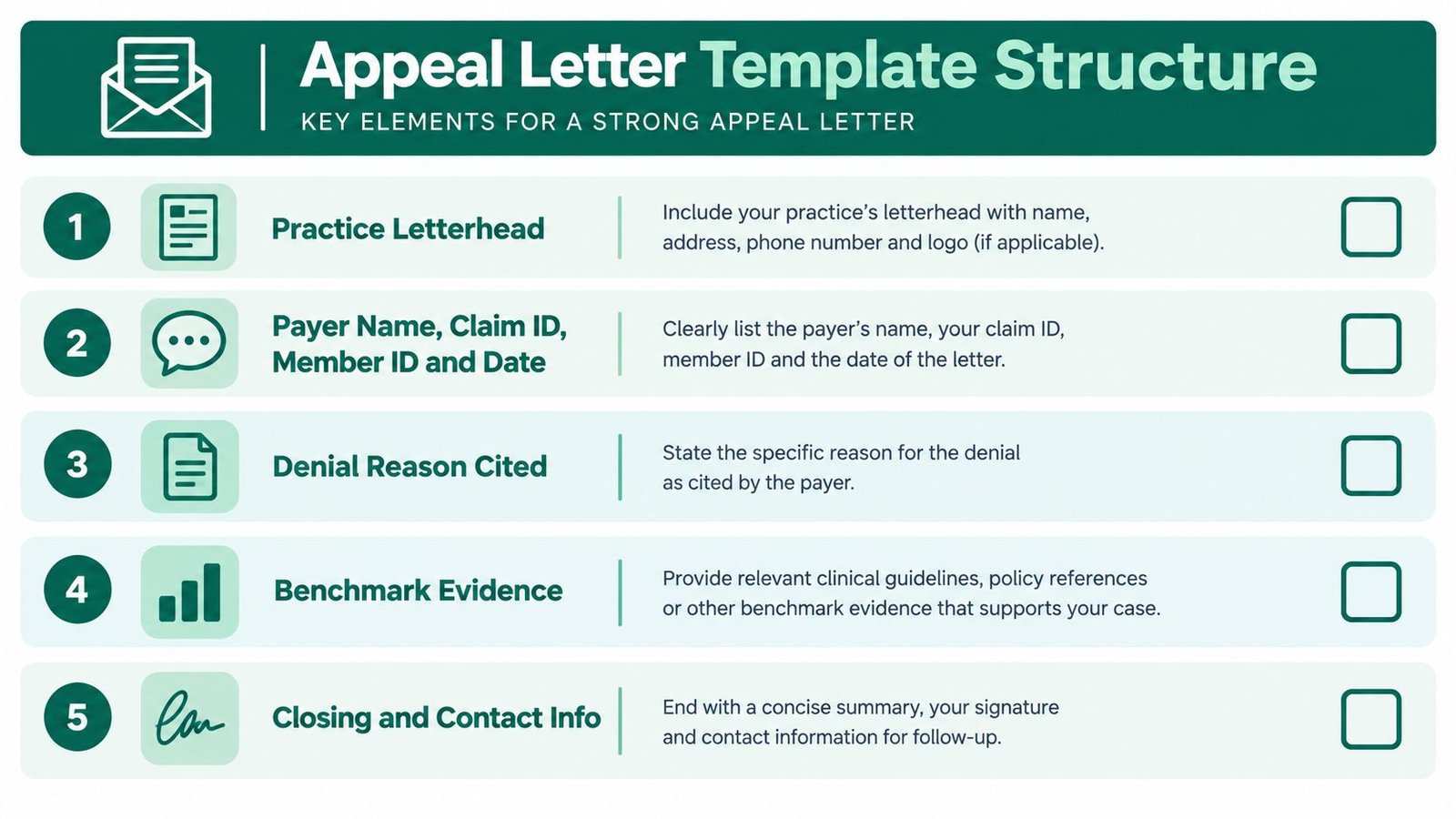
Copy and adapt this letter structure
[Practice letterhead]
Date: [insert date]
To: [payer appeals department]
Re: Formal appeal of out-of-network payment
Patient: [member name and patient name]
Member ID: [insert ID]
Claim number: [insert claim number]
Date of service: [insert date]
CPT code: [insert CPT]
Request and amount at issue
We request reconsideration of the out-of-network payment for the service identified above. The EOB allowed [insert allowed amount] and paid [insert paid amount] against billed charges of [insert billed amount]. We request an additional payment of [insert specific dollar amount], bringing total reimbursement to [insert requested total].
Denial and payment evidence
The EOB cites [insert adjustment and remark code or payer rationale]. That calculation does not reflect the documented Fair Health benchmark for CPT [insert CPT] in ZIP code [insert ZIP], attached as Exhibit B. Exhibits C through [insert exhibit] show historical allowed and paid amounts for the same CPT across [insert actual number of payers] payers. Together, these records support the requested reimbursement and show why the current payment is not a reasonable resolution of the claim.
Clinical justification
The service was medically necessary because [physician explanation]. The chart documents [condition, findings, treatment decision, and outcome]. The rendering provider's license and specialty qualifications are attached as Exhibit [insert exhibit]. The original claim and relevant clinical records are included for review.
No Surprises Act review, when applicable
[Insert only when applicable: “This claim involves [emergency care, post-stabilization care, or covered non-emergency services at an in-network facility]. Please route the payment dispute through the applicable No Surprises Act process and identify the required open-negotiation or IDR steps.”]
Demand and response request
Please reprocess the claim and issue the additional [insert dollar amount] requested above. If the payer declines, provide a written explanation identifying the methodology, policy language, and evidence used to support the allowed amount. Please respond through the designated appeal channel and reference claim [insert claim number] in all correspondence.
Authorized representative or provider signature
[Name, title, credentials, phone, secure email, fax, and mailing address]
The package must remain claim-specific. The published provider appeal form illustrates the need for one appeal form per claim, the denial or EOB, the original CMS-1500 or UB claim form, and documentation specific to the dispute. No Surprises Act open-negotiation and filing-limit issues require different supporting sets, so don't recycle a medical necessity packet for every pathway.
A formatted downloadable Word version of this letter is available through the free audit engagement. It turns the structure above into a reusable practice asset while leaving the financial fields claim-specific. For NSA cases, consult the federal IDR process guide and No Surprises Act compliance checklist before selecting the route.
Component 6, Payer Submission Channels and Tracking Workflow
Choose the submission channel that gives your practice the best combination of acceptance proof and retrieval speed. A payer provider portal is usually efficient when the appeal function is clearly labeled. A clearinghouse or designated appeal email can work when the payer provides a transaction or case number. Certified mail remains useful when electronic routing is unavailable or when the practice needs a formal delivery record.
| Channel | Best use | Evidence to retain |
|---|---|---|
| Provider portal | Payer-specific electronic appeals | Confirmation number, timestamp, uploaded-file list, screenshot |
| Clearinghouse or appeal email | Designated electronic workflows | Transmission record, payer acknowledgment, attachments |
| Certified mail | No reliable electronic route or formal delivery need | Mailing receipt, tracking record, complete submitted copy |
Some major payers require out-of-network professionals to submit pre-service and post-service appeals electronically, so confirm the payer's current provider policy before mailing a packet. For internal appeals, Healthcare.gov states that the deadline is generally 180 days from the denial notice and advises keeping copies of claim records while sending the original appeal request, as described in its internal appeals guidance.
Use one tracker for every disputed claim
Your tracker should include:
- Claim identity: Patient or member identifier, claim number, CPT, date of service, and payer.
- Financial fields: Billed, allowed, paid, patient responsibility, disputed amount, and requested amount.
- Submission record: Channel, submission date, confirmation number, and file version.
- Follow-up record: Representative name, call date, reference number, response, and next action.
- Escalation status: Internal level, external review eligibility, IDR screening, regulator complaint, or closure.
A denied insurance claim appeal guide can supplement the workflow, but the tracker is what preserves advantage. Save the original packet as a locked PDF and store later correspondence as separate dated entries. Never overwrite the version that established the filing record.
Component 7, Denial-Reason Counterarguments and Escalation Triggers
Match the rebuttal to the payer's reason. A broad letter that argues every possible issue makes the practice look uncertain and gives the reviewer no clear correction path.
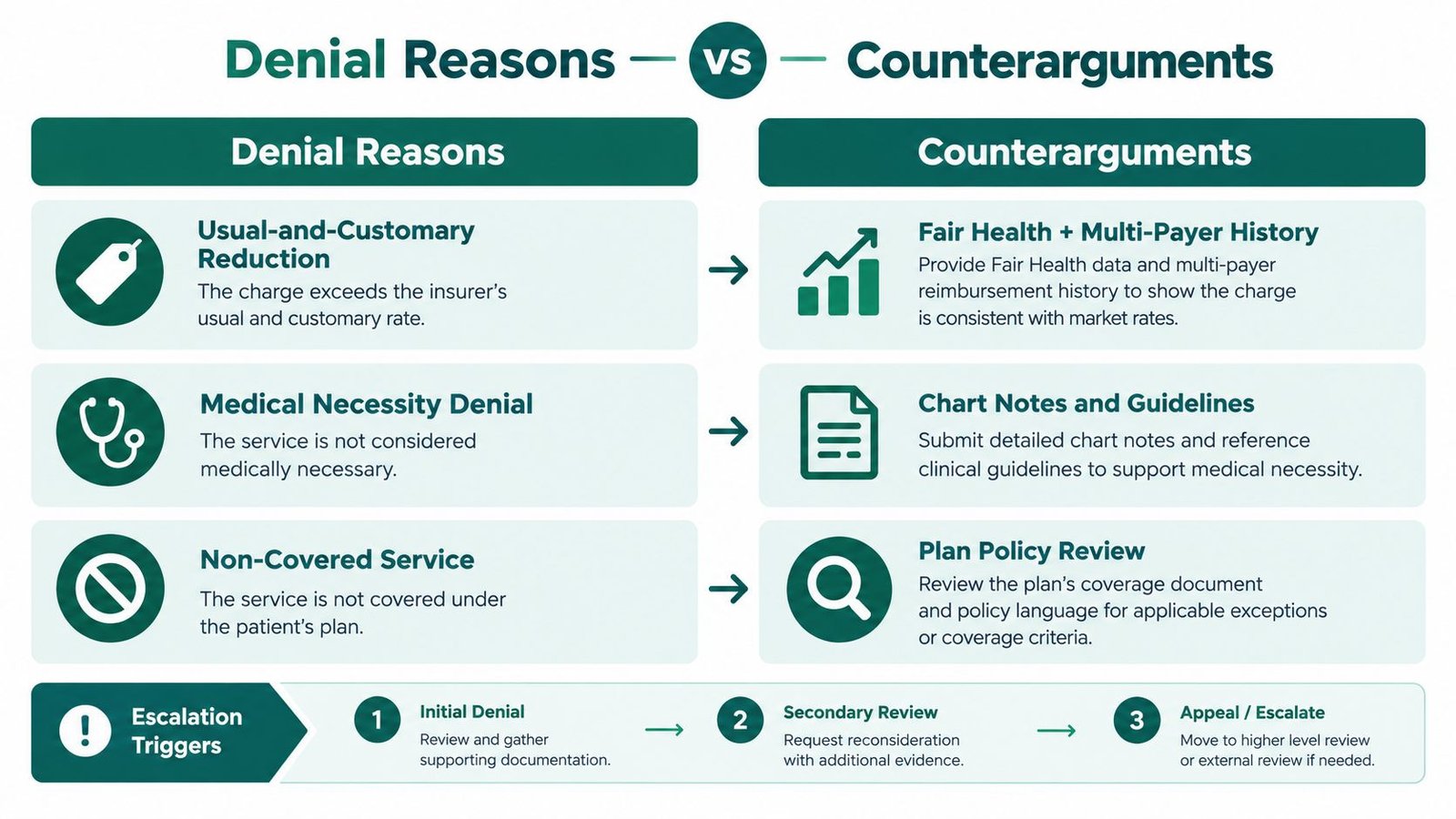
- Usual-and-customary reduction: Attach the Fair Health result, the marked EOB, and aggregated historical payments. Demand the additional amount supported by those exhibits, not an unexplained percentage of billed charges.
- Medical necessity denial: Lead with the chart note, physician attestation, treatment rationale, relevant test results, and applicable clinical guidance. Ask the payer to identify the exact record or policy criterion it believes is missing.
- Network-adequacy denial: Add date-stamped directory checks, failed referral attempts, appointment wait-time evidence, and the search trail showing that the needed provider type or specialty wasn't reasonably available. Government and state guidance specifically points providers toward network search and appeal documentation.
- No Surprises Act dispute: Don't force the claim through a standard underpayment appeal. First determine whether the plan and service fall within the federal pathway. CMS's No Surprises Act decision tree separates internal appeals from NSA processes and starts with plan-type eligibility.
Escalate when the payer stops answering the evidence
Set triggers before the first appeal is sent. A missing response within the payer's stated window, a partial payment without a rationale, or repeated denials for the same CPT should move the account to a defined next step. That may be a payer provider liaison, state insurance department complaint, external review, or federal IDR, depending on the plan and dispute.
New York provides a concrete external timing model. Its framework allows applications within 4 months of the final adverse determination, while providers appealing on their own behalf must file within 60 days, according to the New York external appeal framework. Don't assume those deadlines apply universally. Confirm the plan type, state rules, and provider filing rights for the claim.
For denial patterns that extend beyond one account, use a structured medical billing denial management process. A repeated CPT issue is no longer just an appeal queue. It's a payer-specific revenue problem that needs root-cause review.
Specialty-Specific Adjustments for High-Stakes Practices
A generic OON packet becomes more persuasive when it anticipates the specialty's payment logic. The supporting exhibit should explain not only that the code was correct, but why the payer's reduction changes the economics of the service.
Anesthesiology
Add the ASA crosswalk, base-unit and time-unit calculation, and relevant medical direction modifiers such as QK, QX, and QY. Explain concurrency and the documented start and stop times so the payer can't reduce the payment by ignoring the service model.
Mental health
Include authorization logs, treatment-plan summaries, progress notes, and the correct place of service and telehealth modifier. The packet should connect the authorized service to the billed encounter and address any mismatch directly.
Cardiology
Attach the diagnostic or interventional rationale, supporting test results, and prior authorization reference numbers. For imaging or procedures, index the clinical record so the reviewer can locate the medical decision without searching the full chart.
Orthopedics and pain management
Address global-period edits, multiple-procedure reductions, and the relevant modifier -59 or -X{EPSU} when documentation supports distinct services. Explain separate encounters, anatomical sites, or procedural circumstances with the chart evidence that proves the distinction.
Pediatrics and multispecialty groups
Use age-appropriate clinical documentation and include applicable vaccine or immunization administration codes. A practice should also document network searches, directory screenshots, appointment wait times, or lack of the required specialty when access drove the OON service, consistent with government and state guidance.
For NSA disputes involving eligible services, use a dedicated IDR process for providers rather than attaching a standard medical necessity argument to the wrong track. The same revenue principle applies across specialties. Code detail earns attention only when it connects to a documented payment difference.
Tracking, Timeline, and Revenue Outcomes
A complete packet gives the practice three operational benefits: it protects filing rights, reduces avoidable back-and-forth, and creates a record for escalation. That can preserve A/R and reduce write-offs because the team knows which account is waiting, which payer owes a response, and what evidence has already been submitted.
Use a day-count tracker with the actual payer deadline as the controlling field:
| Milestone | Action |
|---|---|
| Day 0 | Record denial notice, EOB, claim identifiers, and applicable pathway |
| Day 30 | Send the first documented follow-up |
| Day 45 | Escalate to the payer provider liaison when the response is inadequate |
| Day 60 | Evaluate external appeal or IDR eligibility, and protect any applicable payer deadline |
| Day 120 | Evaluate a state department of insurance complaint or Medicare FFS redetermination status |
CMS requires providers to distinguish internal appeals from No Surprises Act pathways. Its decision tree first asks whether the plan is subject to the NSA, then considers emergency care, post-stabilization care, non-emergency services at in-network facilities, and state-law protections. Make that decision before drafting the letter, not after a standard appeal has consumed the available time.
If your team is deciding whether to keep this work in-house, compare the operational burden against the cost of outsourcing medical billing and review specialty-specific workflows on the medical specialties page. A free out-of-network underpayment analysis can identify whether the leakage is isolated or systemic and provide access to the downloadable Word template.
Frequently Asked Questions From Practice Owners
How long does a complete OON appeal take to resolve?
There isn't one universal resolution period. The practical objective is to submit before the controlling deadline, document every payer response, and escalate when the payer fails to address the evidence. That protects recoverable dollars and prevents an account from aging into an avoidable write-off.
What should we do if the payer ignores the first appeal?
Use the submission receipt and tracker to contact the payer's provider liaison. If the plan still doesn't respond or repeats the same unsupported decision, evaluate external review, a state insurance department complaint, or IDR based on the plan and service.
Should we batch underpaid claims into one letter?
Keep the appeal package claim-specific, with one form and evidence set per claim. You can identify a recurring CPT pattern in a cover summary, but batching unrelated claims can make deadlines, exhibits, and requested amounts unclear.
When should we use federal IDR or a state complaint?
Use the NSA decision tree first. Payment disputes that fall within the federal pathway may belong in open negotiation and IDR, while other disputes may require internal appeal, external review, or a state regulator route. A free out-of-network underpayment analysis can help separate those pathways and prioritize the accounts with the clearest recovery case.
Happy Billing helps practices organize OON underpayment evidence, build claim-specific appeal packets, track deadlines, and pursue the appropriate escalation path. Visit Happy Billing to request a free review of your underpayments and obtain the downloadable Word appeal-letter template.