Good Faith Estimate Requirements and Template for Medical Practices

Federal Good Faith Estimate rules apply to uninsured and self-pay patients scheduled on or after January 1, 2022, and the estimate has to arrive in 1 business day or 3 business days depending on how far out the visit is booked. If your GFE is sloppy, the patient can push a dispute when the billed amount is more than $400 above the estimate, and that is where real revenue leakage starts.
Most practices think of GFEs as patient paperwork. I think of them as a cash protection workflow. Miss the deadline, omit a co-provider charge, or use a generic template that doesn't match your specialty, and you've built the kind of paper trail that turns a clean self-pay balance into an A/R fight.
What the No Surprises Act GFE Actually Requires
The federal rule is blunt. For uninsured and self-pay patients, a Good Faith Estimate is required for scheduled or requested care, and the clock starts the moment the appointment is booked or the patient asks for pricing. CMS says the estimate is due within 1 business day when the service is scheduled 3 to 9 business days out, within 3 business days when it's scheduled at least 10 business days out, and within 3 business days of a patient request for pricing. CMS key protections guide
That timing matters because the estimate is not just a courtesy. It anchors what your practice can credibly collect, and if your team misses the window, you've handed the patient a compliance complaint and a billing dispute at the same time. CMS also makes clear that the GFE has to include expected charges for the primary item or service plus any reasonably expected co-provider or co-facility charges. CMS medical bill rights resource
Practical rule: if your front desk can book the visit, your practice can start the GFE workflow that same day. Waiting until the day before the appointment is how teams miss the federal clock.
The biggest mistake I see is treating the GFE as a single number. CMS's model is itemized, and that reflects the law's scope across providers, facilities, and air ambulance services under Section 2799B-6 of the Public Health Service Act. The sample format is built to capture the service, provider and facility details, diagnosis or service description, and an estimated total, not just a price line. CMS GFE and PPDR slides
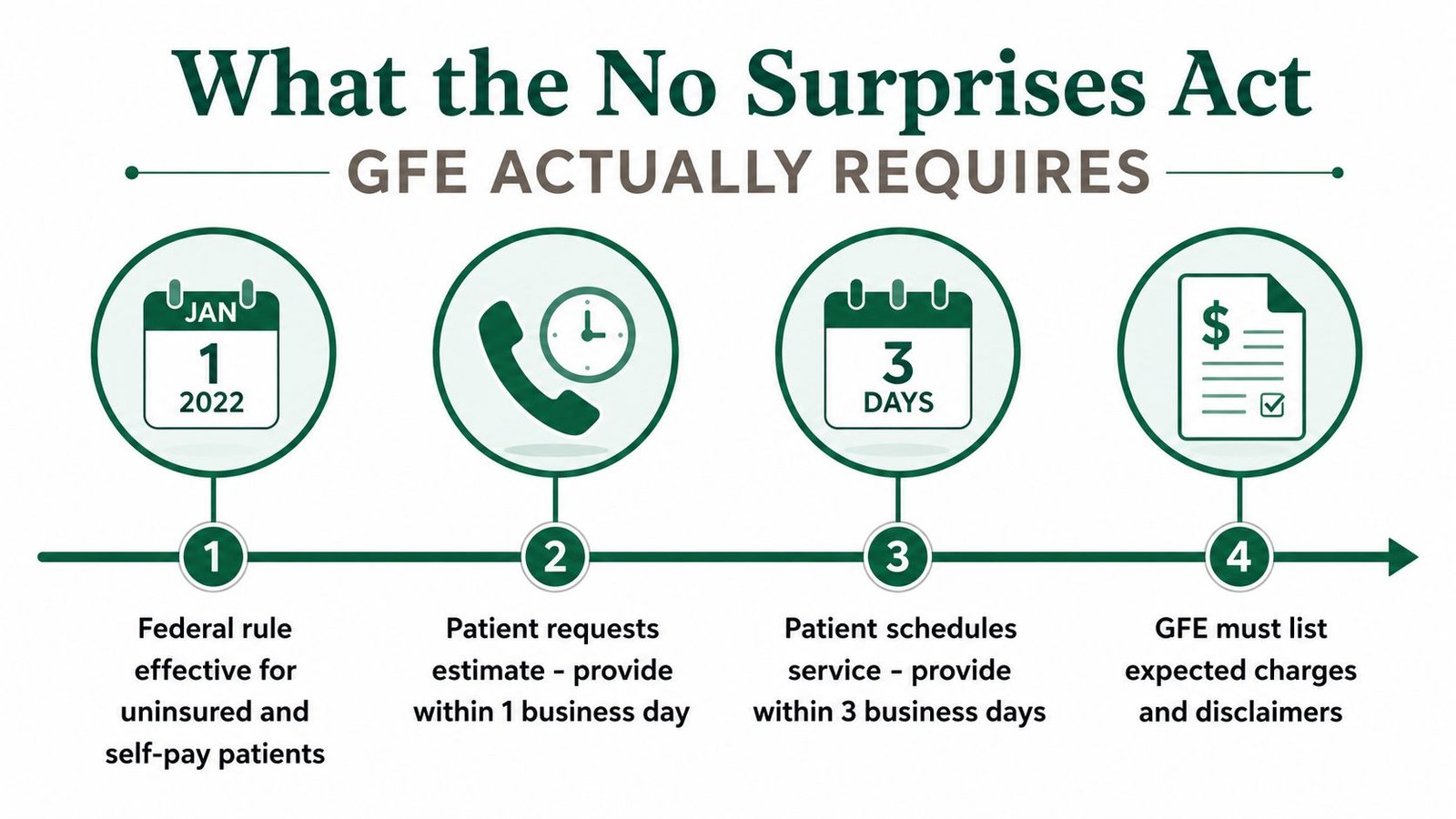
For practice owners, the financial point is simple. A late or incomplete GFE creates the kind of documentation gap that helps a patient contest the bill, slows payment, and forces your staff to spend time defending what should've been collected cleanly up front. The estimate is front-end revenue control, not back-office decoration.
Review your practice's No Surprises Act workflow before the next uninsured case lands on the schedule.
Required Fields on a Compliant GFE Template
A compliant template has to do more than look official. It needs to identify the patient, identify every expected billing party, describe the service clearly, and leave enough traceability that your team can defend the estimate later if the final bill changes. CMS's required elements are specific, and the sample form isn't forgiving if your staff leaves out key identifiers.
Build the template field by field
Start with the patient's identifying data. CMS materials call for the patient's name, date of birth, and address information, along with the date the estimate was issued. Then add the provider and facility details, including name, NPI, and TIN for each provider or facility listed. APTA summary of CMS template elements
Next, list the primary CPT or HCPCS code with a plain-language description, then itemize each expected charge with the corresponding service code. If the treatment plan has a clear diagnosis, include the relevant ICD-10 diagnosis code and any expected volume or frequency when that matters for the estimate. CMS also expects the list of reasonably expected additional services, grouped by provider or facility, so your anesthesiologist, pathologist, radiologist, ASC, or hospital outpatient department don't disappear into a single blended line.
A blank NPI isn't a small clerical miss. It breaks audit traceability, weakens your explanation if the bill changes, and makes it harder to prove who actually owned the charge.
The disclaimer block matters too. The template should state that the actual billed amount may differ from the estimate, and the notice of availability has to be present somewhere in the patient-facing workflow. CMS guidance ties GFEs to uninsured and self-pay populations and says providers and facilities generally must furnish notice that GFEs are available, so this is a front-end disclosure, not a back-office afterthought. CMS notice requirement
| Required GFE Fields and Compliance Risk if Missing | ||
|---|---|---|
| Required Field | Purpose on the GFE | Risk if Missing |
| Patient name and date of birth | Ties the estimate to the correct encounter | Wrong-patient confusion and weak proof of delivery |
| Provider and facility name, NPI, TIN | Identifies who is billing and who owns the charge | Audit traceability breaks down |
| Primary CPT or HCPCS code | Defines the main service | Under-scoping the estimate |
| ICD-10 diagnosis code | Supports the reason for care | Harder to justify scope and frequency |
| Itemized additional services | Captures ancillary and co-provider charges | Surprise variance and dispute risk |
| Date issued | Proves the estimate was timely | Deadline failure becomes visible |
| Disclaimer of possible variance | Sets expectations about final billing | Patients treat the estimate like a promise |
| Notice of availability statement | Shows the patient was informed | Front-end compliance gap |
For practices evaluating outside help, the issue isn't whether a vendor can type up a form. It's whether the workflow can survive real-world billing variance and still hold up under review. If you're comparing systems and service partners, start with a practical out-of-network billing compliance resource and judge them on template discipline, not marketing language.
Specialty-Specific GFE Scenarios in Real Practices
A single template won't survive specialty care without customization. The estimate has to reflect how the service gets billed, because the patient sees one number while your practice may be dealing with several charges from several clinicians. That's where sloppy GFEs turn into silent margin loss.
Anesthesiology and orthopedics need line-item discipline
In anesthesiology, the estimate has to show the base anesthesia service, the related surgical CPT that triggers it, and the separate CRNA or anesthesiologist NPI. If your team folds that into one line, patients will challenge the bill the moment they see a higher final number. That's especially true around bundled OR cases, where the estimate needs to reflect who is billing the patient, not just the procedure that started the episode.
Orthopedics has the same problem, just with more moving pieces. A surgical bundle estimate should show the surgeon, assistant surgeon, anesthesiologist, implant costs, and the ASC or hospital facility fee on separate lines. Patients don't care that your internal charge file is neat if the final bill shows a stack of charges that never appeared in the estimate.
If the service touches the operating room, assume the patient will compare the estimate line by line with the final statement.
Behavioral health and cardiology need treatment-scope control
Mental health is where templates fail. Recurring-session estimates need a clear end date or session cap, and medication management has to be excluded unless it's listed. If the practice offers group and individual therapy, the estimate should disclose the rate difference, because that's where the variance usually shows up first.
Cardiology demands different structure. A stress echo estimate should split the professional component, technical component, radiologist overread, and tracer drug cost. Three billers, one patient-facing number, and one vague template is a dispute waiting to happen. In my experience, that's how practices create unnecessary write-downs on imaging-heavy self-pay cases.
Cardiology revenue cycle management guidance is worth reviewing if your estimates routinely wrap imaging, interpretation, and facility charges into one patient quote.
The takeaway is blunt. Specialty-specific templates protect collections because they force the team to think like the billing system thinks. If the estimate reflects the true charge structure, you keep more of the bill inside the acceptable range and you avoid having your staff renegotiate care after it's already delivered.
Building the GFE Into Your Front-Office Workflow
The GFE process starts before the appointment is locked. If scheduling cannot spot uninsured, self-pay, or out-of-network-electing patients at intake, the practice is already behind. That delay turns a compliance task into avoidable A/R exposure.
Give ownership to one person
Front desk staff should flag the encounter at scheduling and route it to one named GFE owner, usually a billing coordinator or RCM analyst with fee-schedule access. That person pulls the expected CPT codes from the order or referral, adds co-provider charges like anesthesia or pathology, layers in co-facility fees, and includes DME or infusion drugs when those are reasonably expected. For services booked close in, the team has to work inside the federal deadline, not according to whatever the schedule allows.
Log delivery like a receivable
The estimate should go out in person, by mail, or electronically with documented patient consent for email. Timestamp, recipient, and delivery method belong in the PM system, and the encounter record should keep a copy so the final claim can be compared against it at charge entry. That comparison protects A/R when the variance stays within range and gives the team a clean file if someone later questions the bill.
Operational rule: if it isn't logged, it didn't happen. A polished estimate with no delivery proof will not help when the patient disputes the charge.
If you want to automate the repetitive parts without losing control, the Loopfour healthcare automation resources are useful background reading for workflow design. The goal is not software for its own sake, it is removing the human bottleneck between scheduling and delivery.
Understand the biller's role in the workflow before you hand this to a vendor or a front-office lead. The biller should own the estimate logic, not clean it up after the fact.
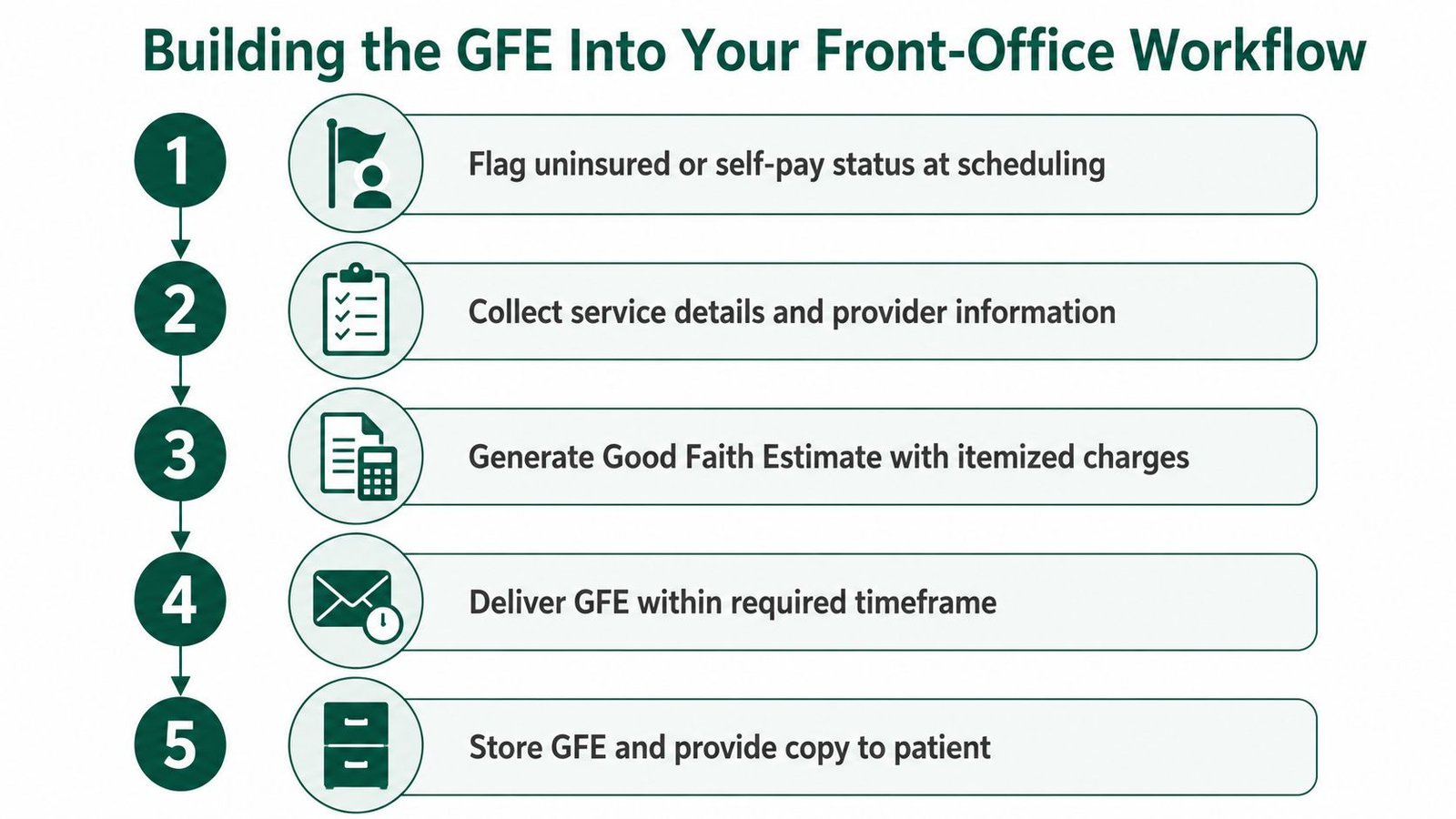
Every missed handoff stretches days in A/R because the patient gets a bill they did not understand, then your staff spends days explaining what should have been clear before the visit. A tight workflow prevents that fight from starting.
Estimate Variance and the $400 Dispute Trigger
The form itself isn't the exposure. The gap between the estimate and the final bill is where the money leaks, and that gap becomes dangerous fast when the bill is more than $400 above the GFE. CMS's patient-provider dispute framework can be triggered at that point, and the dispute gets handled through a selected dispute resolution process rather than by your front office. CMS factsheet on the good faith estimate
Use an assumptions log, not a vague disclaimer
A good estimate should spell out the assumptions behind the number. That means diagnosis range, expected units, anesthesia time blocks, implant categories, recurring-session frequency, and explicit exclusions for unanticipated complications. If the care plan changes, the estimate should be updated rather than left to drift into a billing surprise.
Many practices get burned. An anesthesiologist who quotes one number and bills materially more has created an easy dispute path for the patient. A behavioral health practice that under-quotes recurring sessions and then discovers the true treatment length later has the same problem, only stretched over a longer period of care. The answer is not to under-promise and hope the bill sorts itself out, it's to document the assumptions at the outset and revise them when the plan changes.
The disclaimer is not legal wallpaper. It's your proof that the estimate was a reasoned projection based on the scope known at the time.
Keep the final bill inside the corridor
A disciplined assumptions section does two things. It narrows the variance so the final bill stays inside the dispute corridor more often, and it gives your staff a factual basis to push back when someone tries to force an unwarranted dispute. That matters because every dispute pulls staff time away from collection work and turns a self-pay account into a documentation case.
| GFE Variance Scenarios by Specialty | |||
|---|---|---|---|
| Specialty | Typical GFE Item | Common Billed Amount | Variance Risk vs. $400 |
| Anesthesiology | Base anesthesia episode with expected time | Higher final anesthesia total after case extension | Dispute risk rises when time isn't scoped clearly |
| Behavioral health | Recurring therapy episode with session cap | Additional sessions beyond the original assumption | Dispute risk rises when renewal language is weak |
| Cardiology | Stress echo with technical and professional pieces | Extra read or tracer-related charge layered in later | Dispute risk rises when components are merged |
| Orthopedics | Surgical bundle with implant and facility lines | Facility or implant increase not shown in the original quote | Dispute risk rises when the estimate is too compressed |
For practices that need to understand how disputes move once they start, the IDR process resource is the right place to tighten policy language and internal response steps. If your team can't explain the assumptions behind the estimate, you're giving the dispute reviewer the cleanest possible path to side with the patient.
Good Faith Estimate Compliance Checklist for Practices
Give this checklist to your office manager and review it now. If any answer is “no,” your practice is carrying avoidable revenue exposure.
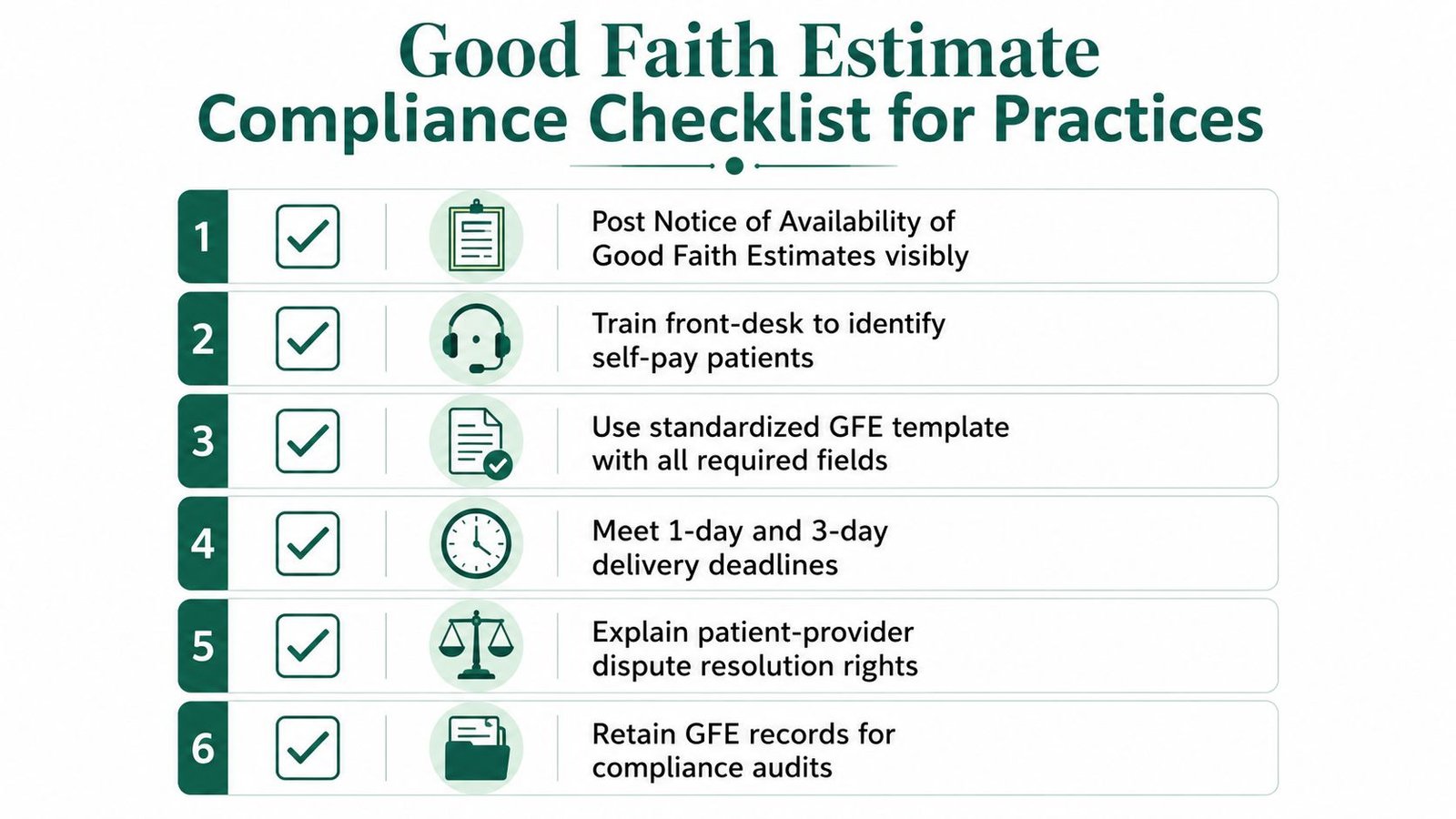
- Post the notice visibly. Place the Notice of Availability of Good Faith Estimates in the waiting room, on the website, and in intake paperwork, in the languages your patients use.
- Train scheduling to ask the right questions. Every new caller should be asked about insurance status, self-pay intent, and out-of-network elections before the visit is confirmed.
- Use one standardized template. The form should capture patient identifiers, provider identifiers, service codes, expected charges, and the disclaimer about variance.
- Meet the delivery window every time. Build the 1-business-day and 3-business-day deadlines into the scheduling handoff, not staff memory.
- Retain the record. Keep the GFE, proof of delivery, and any corrected estimate with the encounter file for audit support.
- Check state overlays. Some states have stricter timing or extra disclosure expectations, including California, Colorado, and New York, so federal minimums may not be enough.
What a medical biller does belongs in your internal SOP if the billing team owns the estimate file. That role has to know when to escalate, when to revise, and when to preserve the paper trail.
Required: a GFE that cannot be found later is functionally the same as not sending one at all.
Questions Practice Owners Ask About GFEs
Can we outsource GFE generation to a billing company
Yes, but the legal duty doesn't move. The provider and practice still own the compliance risk, so the contract has to define turnaround SLAs, escalation rules, and proof of delivery handoff. If the vendor can't return a timestamped record, you're outsourcing the typing and keeping the liability.
Can we batch GFEs weekly instead of per appointment
No. The federal windows are tied to each scheduling event, and batching creates exposure the moment the deadline passes. That's how a practice accidentally turns a routine self-pay visit into a dispute file.
Do recurring mental-health visits need one estimate or many
One estimate can cover the expected scope if the treatment episode is clearly defined, but it has to include renewal language and a realistic session structure. If you leave that vague, you'll end up rebuilding the estimate too often and absorbing the variance when the care plan extends.
What happens when a patient files a dispute
The dispute moves into the formal patient-provider process, and a reviewer compares the billed charges with the estimate and the documentation supporting the care. If the bill is too far above the estimate, the practice can face refund obligations and fee reductions, which is exactly why sloppy GFEs are expensive even when the patient eventually pays.
If you want a tighter GFE workflow, stronger self-pay collections, and a template that fits your specialty, Happy Billing can help you build it into your front-end revenue cycle instead of leaving it to chance. We've seen how fast sloppy estimates turn into disputes, write-offs, and avoidable A/R drag, and we know how to clean that up.