No Surprises Act Florida: Dual Systems Impact Your Billing
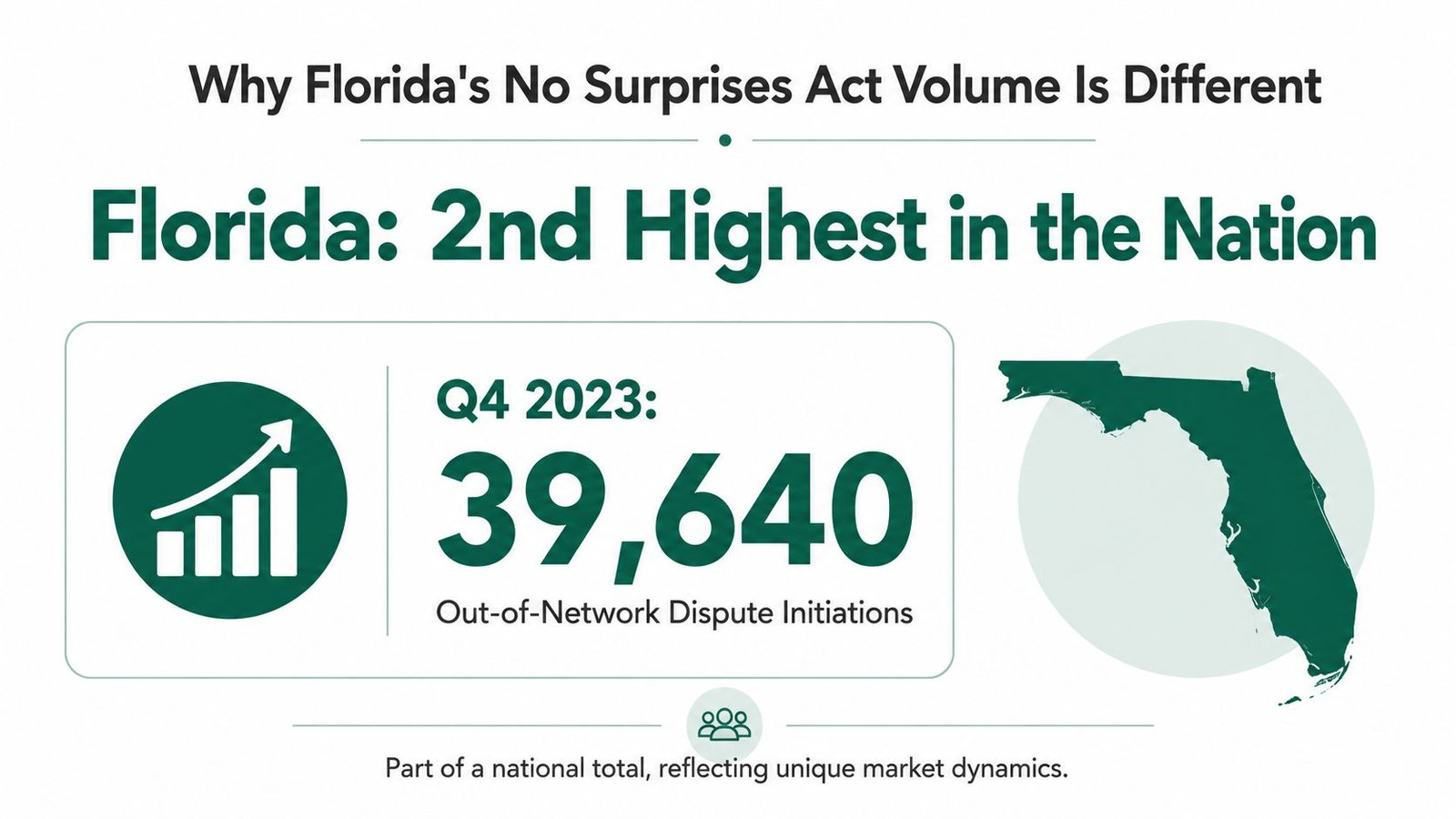
In Q4 2023 alone, Florida had 39,640 out-of-network dispute initiations, making it the second-highest state nationally. That volume exists because the No Surprises Act operates alongside Florida’s separate surprise-billing law, creating a dual system that directly controls how your practice gets paid for out-of-network services.
For an independent practice owner, this isn’t a patient-information issue alone. The wrong dispute pathway can delay reimbursement, increase denials, extend A/R, and force avoidable write-offs. Your team must identify the governing law before it escalates a claim, document open negotiation correctly, and assess whether an IDR award is realistically collectible.
Florida rules sit on top of the federal baseline. For the underlying obligations every physician practice must meet — Good Faith Estimates, notice and consent, public disclosure and the dispute timelines — see our No Surprises Act compliance guide for practice owners.
Quick answer: The federal No Surprises Act protects Florida patients against balance billing on emergency services, out-of-network care at in-network facilities, and air ambulance. Florida also has its own Section 627.64194 F.S. (Patient Balance Billing law), which for state-regulated PPO/HMO plans set an out-of-network reimbursement standard tied to a usual and customary provider charge methodology and gives the Florida Office of Insurance Regulation an administrative resolution path. Which framework governs a specific claim depends on plan type: state-regulated plans use the Florida framework; federally-regulated and self-funded ERISA plans use the federal IDR process. Florida practices still owe Good Faith Estimates to uninsured and self-pay patients and must post the federal public disclosure notice, regardless of network status.
Why Florida’s No Surprises Act Volume Is Different
Florida’s dispute activity is too large to treat as an occasional compliance exception. The Congressional Research Service reported 679,156 federal IDR disputes initiated nationwide in 2023, and Florida was among the seven states that repeatedly dominated quarterly dispute volume. In Q4, Florida recorded 39,640 out-of-network emergency and nonemergency dispute initiations, the second-highest state total for that quarter, as summarized in the Florida No Surprises Act dispute data.
That concentration reflects Florida’s unusual operating environment. Practices aren’t dealing with one clean federal process. They’re working across federal protections, Florida reimbursement statutes, plan structure, service setting, and separate state dispute mechanisms. A claim can look like a routine out-of-network underpayment until someone determines whether the patient’s plan is fully insured, self-funded, an HMO, or tied to an uninsured or self-pay account.
Revenue-cycle implication: The governing forum determines the filing sequence, evidence required, valuation method, and timing of payment. A team that routes every dispute to federal IDR can lose collection time on claims that belong under Florida’s framework.
Why volume changes practice economics
High dispute volume creates administrative pressure, but the financial problem is more specific. Every unresolved claim remains tied up in A/R while staff exchange payer correspondence, verify eligibility, assemble medical records, and monitor procedural deadlines. If the practice starts the wrong process, it may have to restart the dispute or accept a lower settlement to end the delay.
The mistake is treating the No Surprises Act as a passive legal obligation. It’s an RCM decision point that belongs in claim review, denial management, payer escalation, and management reporting. Florida practices that separate these claims early can protect collection velocity. Those that leave the classification to a general follow-up queue often discover the problem only after the claim has aged.
Florida’s complexity also makes comparisons with other states unreliable. A useful explanation of the broader state-by-state differences appears in this guide to No Surprises Act requirements in Texas. The lesson for Florida owners is straightforward: national workflow templates don’t automatically fit state-specific reimbursement rules.
How the Federal IDR Process Works for Out-of-Network Claims
The federal process starts with a covered out-of-network payment dispute, not with arbitration. For eligible emergency services and certain nonemergency services at in-network facilities, the provider or facility first communicates with the payer through an open negotiation period. The parties exchange payment positions and attempt to resolve the difference before either side can initiate federal IDR.
If negotiation fails, an eligible party uses the CMS Federal IDR portal to begin the dispute. CMS describes this process as available to out-of-network providers, facilities, air ambulance providers, and group health plans or issuers seeking a determination of the out-of-network rate after unsuccessful open negotiation. The CMS Federal IDR reports and policy resources explain the federal framework.
The workflow your practice must control
- Classify the claim first. Confirm the service setting, network status, plan type, and whether the federal statute governs the account.
- Complete open negotiation. Preserve the initial payment position, the payer’s response, counteroffers, dates, and any explanation for the unresolved balance. An internal note that says “payer refused” isn’t enough to support a disciplined escalation record.
- File through the CMS portal when eligible. The practice must follow the applicable filing window and submit the required dispute information. The federal process uses a selection model in which the certified IDR entity chooses between the parties’ offers, rather than calculating an unrestricted compromise.
- Support the offer with relevant documentation. Clinical complexity, service circumstances, provider expertise, market information, and prior payment history may affect the presentation, but the record must remain consistent with the claim and applicable rules.
- Track the award and payment separately. An IDR determination is a dispute outcome. It shouldn’t be marked as collected until the remittance is posted and the allowed amount is reconciled.
CMS lists the Federal IDR Help Desk at 1-800-985-3059, available from 8 a.m. to 8 p.m. Eastern Time, seven days a week. Those details appear in the agency’s guidance for disputing parties. A billing operation should use that channel for process clarification, not as a substitute for internal deadline controls. Practices can also review the Federal IDR process overview when building an escalation protocol.
Florida’s 2016 Surprise Billing Law and What It Still Governs
Florida built a surprise-billing framework before the federal law took effect. In 2016, Florida enacted protections for patients who unintentionally receive out-of-network physician services at in-network facilities. Under that framework, the patient owes only the applicable in-network cost-sharing amount for covered services, while the reimbursement dispute moves between the provider and payer under the state’s rules.
The statute also addresses hospital disclosure. Hospitals that use out-of-network physicians must post website statements warning that physicians may bill separately and may not participate in the same insurer networks as the hospital. That distinction matters because a hospital’s network status doesn’t establish that every physician practicing there participates in the same network. The background and disclosure requirements are described in this overview of Florida’s out-of-network surprise-billing law.
The provider-side consequence
For anesthesiology, cardiology, emergency medicine, surgery, and other procedural specialties, mixed-network arrangements create recurring payment questions. A facility can be in network while the physician is out of network. The patient’s cost-sharing obligation may be protected, but the practice still needs to identify the correct reimbursement route and preserve the documentation showing why the claim falls within that route.
Florida’s framework doesn’t duplicate federal baseball arbitration. Florida statutes can direct an out-of-network reimbursement dispute to a court of competent jurisdiction or to a voluntary dispute-resolution program. The operative issue is often whether the service falls under the state reimbursement statute and whether the claim qualifies for the Florida Agency for Health Care Administration process.
That creates a different financial calculation from federal IDR. Under the state path, the practice may need to evaluate court strategy or voluntary resolution. Under federal IDR, the team must complete open negotiation and then use the federal portal if the claim qualifies. Choosing the wrong route can consume staff time without improving the expected recovery.
Practice-owner test: Never ask only whether the patient received a surprise bill. Ask which law controls the provider-payer payment dispute, and whether the plan is subject to Florida’s framework or federal requirements.
CMS guidance confirms that Florida’s state rules remain controlling for many insured plans, while the federal No Surprises Act applies to other categories. Practices evaluating office-based services should also review whether the No Surprises Act applies to physician offices, especially before building a universal workflow around facility-based claims.
Which System Governs Your Claim: The Practical Decision Tree
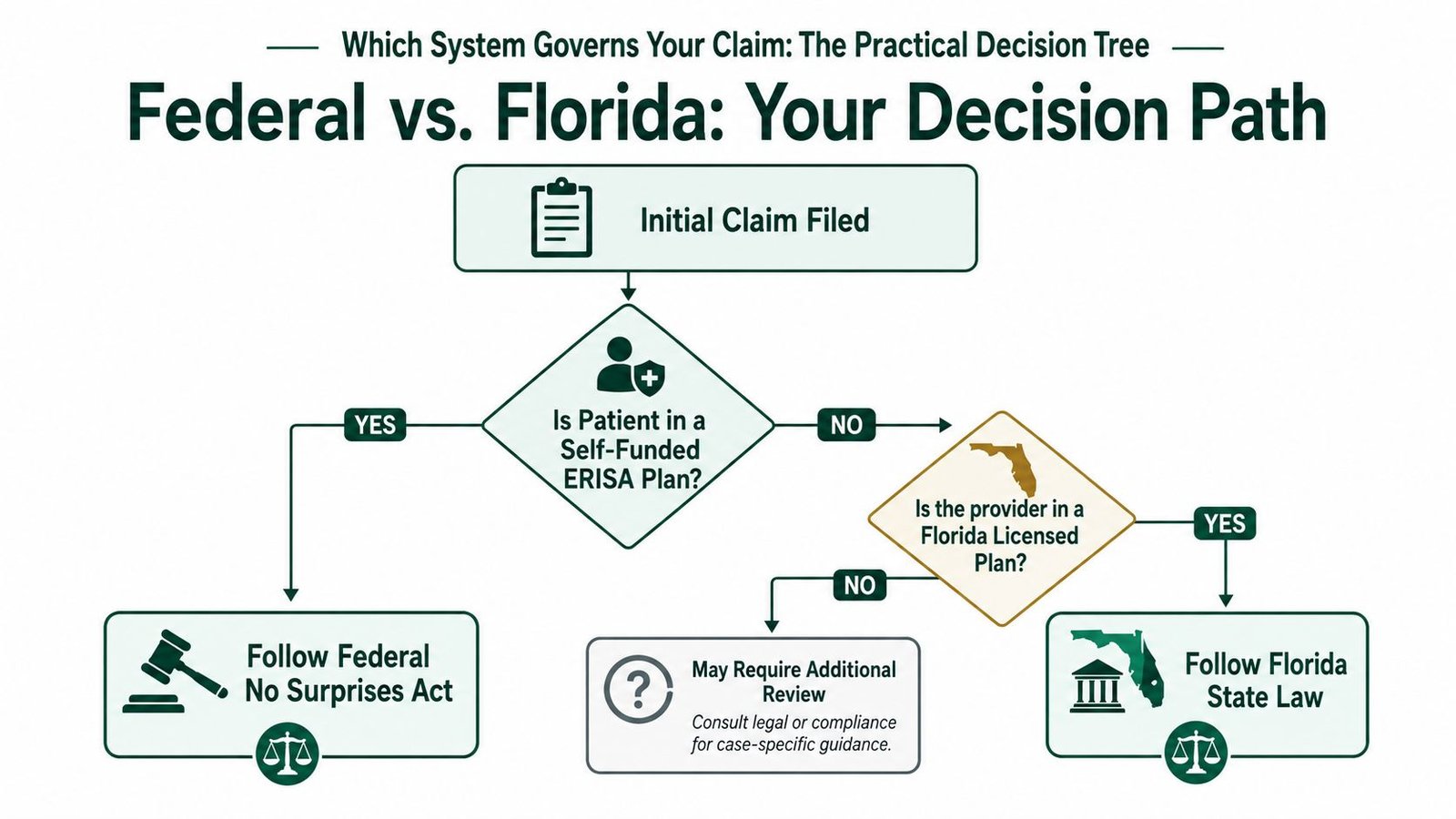
Florida practices cannot choose a dispute forum from the patient’s bill alone. Classify each out-of-network account by coverage, plan funding, service setting, network relationships, and the disclosure record before staff select a pathway. A misclassified claim can create avoidable work, delay reimbursement, and leave the practice with incomplete documentation if the payer challenges the route.
The operational decision tree
Start with the patient’s coverage. CMS states that Florida lacks an applicable statewide patient-provider dispute-resolution process for uninsured or self-pay patients. Where the federal No Surprises Act applies, the federal process may fill that gap. For insured patients, identify whether the plan is fully insured, an HMO, or self-funded under ERISA.
Then confirm the service setting. Emergency services generally raise federal No Surprises Act issues regardless of location. Nonemergency services at an in-network facility may fall under Florida law for qualifying insured plans. Self-funded ERISA plans require separate review because state insurance regulation may not apply to them in the same way as fully insured products.
HMO claims can split again. Florida thresholds and plan rules may determine the state route, while HMO disputes below applicable thresholds may qualify for federal IDR. Do not assume that the facility, physician, and plan share the same network relationship. Verify each relationship in the account record.
Record the classification in the RCM system
The decision tree only protects revenue if the result follows the claim through billing and dispute work. Require fields for plan type, funding status, network status for the facility and clinician, service setting, emergency status, patient coverage category, disclosure history, negotiation dates, and selected dispute pathway. Store the supporting eligibility response and payer correspondence with the account.
Use a controlled pathway value, such as federal IDR, Florida statutory process, voluntary AHCA resolution, court review, or not eligible. Make the field visible to registration, coding, billing, and follow-up teams. A manager can then identify whether a delayed recovery reflects payer conduct, missing documentation, or internal misrouting instead of treating every unpaid balance as the same problem.
Balance-billing exposure remains separate from provider reimbursement. Keep patient billing policies distinct from payer dispute escalation, using this explanation of balance billing and its financial risks as a reference for the financial consequences of billing the patient beyond the permitted amount.
The Enforcement Gap
An IDR win doesn’t automatically equal cash in the bank. A 2025 legal update reported that federal district courts in Florida and New York rejected provider suits seeking to enforce No Surprises Act IDR awards, creating uncertainty around private judicial enforcement. The issue is especially important for practices that have already invested time and legal expense in a disputed claim.
The Florida decision involved an air ambulance provider, while the New York matter involved a plastic surgery center. Those matters shouldn’t be treated as a universal prediction for every Florida physician claim, but they do show why practice owners need a post-award plan. The legal update is discussed in the analysis of Florida and New York IDR enforcement rulings.

What this changes in financial strategy
The emerging litigation concerns whether the NSA creates a private right to enforce an award and how limited Federal Arbitration Act grounds apply to review or vacatur. One Eleventh Circuit-linked case involving Florida providers and a health plan has been described as recognizing limited FAA-style grounds for vacating an award. That leaves the provider with a more complicated question than “Should we file IDR?”
Before escalation, management should estimate:
- Expected recovery: What amount is realistically at issue after correcting coding, eligibility, authorization, and contract errors?
- Documentation strength: Can the practice prove the service circumstances, open negotiation, payment positions, and plan applicability?
- Enforcement exposure: What happens if the payer doesn’t pay and administrative or legal follow-up becomes necessary?
- A/R impact: How long can the practice carry the receivable without distorting cash planning?
A disciplined post-award workflow belongs inside broader revenue cycle tips from Bookkeeping and Accounting, particularly around aging controls, cash forecasting, and reconciliation. Practices should preserve the award, payment request, payer response, regulatory communications, and all follow-up notes in one claim file. The accounts receivable workflow guidance is also relevant when an award remains unpaid.
Compliance Checklist for Florida Practice Owners
Compliance starts with classification, not with a form. A practice that can’t identify its plan mix won’t know which claims belong in Florida’s framework, which require federal handling, and which need legal review before escalation.
Five controls to implement
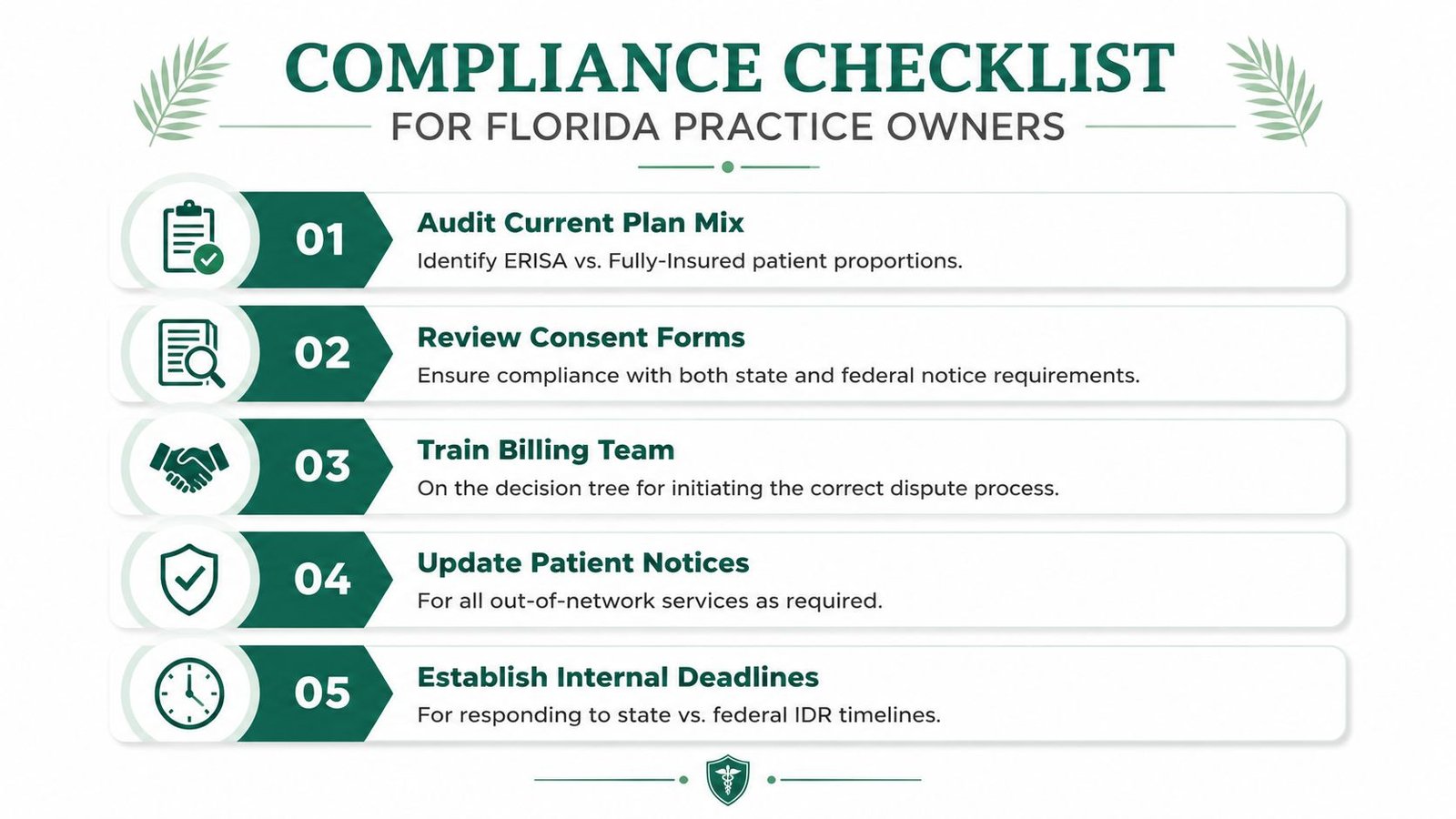
- Audit the current plan mix. Separate fully insured group plans, individual plans, HMOs, self-funded ERISA plans, Medicare, Medicaid, uninsured accounts, and self-pay accounts. The purpose is financial, not academic. Each category can change the dispute route and the expected collection timeline.
- Create an open negotiation file. Store the original claim, payer explanation of payment, initial offer, counteroffer, communication dates, and final unresolved balance. Require a reviewer to confirm that the negotiation occurred before anyone starts a federal IDR filing.
- Record network and disclosure facts. Capture whether the facility was in network, whether the physician was out of network, what notices were available, and whether the service was emergency or nonemergency. Florida’s hospital website disclosure rule can become relevant to the fact pattern, but it doesn’t replace claim-level analysis.
- Route claims through a decision matrix. Build required fields into your work queue. A claim shouldn’t move to an IDR specialist until the system records the plan structure, service setting, patient insurance status, and state or federal pathway.
- Set an escalation threshold. Not every underpayment justifies the same process. Review the expected recovery against staff time, documentation effort, legal exposure, and delayed cash. High-value procedural claims may warrant counsel review, while small or poorly supported claims may need a different resolution strategy.
Management standard: Every disputed out-of-network claim should have an owner, a governing pathway, a next deadline, and a documented recovery rationale.
Your front-end team should verify coverage and network relationships before service whenever possible. Your clinical and coding teams should preserve documentation that explains the service circumstances. Your RCM leadership should monitor disputes separately from ordinary denials so management can see whether the problem is payer underpayment, eligibility, incorrect routing, or missing evidence.
For complex claims, healthcare counsel familiar with both Florida statutes and federal No Surprises Act enforcement can help define the risk profile. Outsourcing can also make sense when the current team lacks the capacity to maintain plan-level rules, negotiation records, and deadline surveillance without allowing ordinary A/R follow-up to deteriorate.
Frequently Asked Questions for Practice Owners
What determines whether an out-of-network claim uses federal IDR or Florida’s state process?
Start with a claim-level classification, not a payer assumption. Record the service type, service setting, patient insurance status, and plan structure, then confirm the applicable pathway before sending a notice or filing a dispute. The same practice may use different systems across claims because plan funding and service circumstances can change the analysis.
For unclear claims, place the account in a pending-pathway queue. Assign an owner, request the plan document or payer confirmation, and document the reason for the selected route. Do not let an uncertain classification consume repeated staff time without a review deadline.
Can my practice still pursue an IDR award if a Florida federal court rejected enforcement of similar awards?
An eligible claim can still be evaluated and pursued, but the award should not be booked as assured cash. Recent Florida and New York federal court decisions have rejected provider suits seeking private enforcement of NSA IDR awards, while related litigation has raised questions about administrative enforcement and limited FAA-style review.
Before escalating, compare the disputed balance with filing effort, expected delay, counsel cost, and the strength of the record. Preserve the award, negotiation history, and payer communications. If the payer refuses payment, counsel can help determine whether administrative action or another remedy is appropriate.
What should our billing team change this quarter?
Add pathway fields to the claim record: insurance type and plan funding, service setting, emergency status, network relationship, disclosure facts, negotiation dates, and filing deadlines. Require staff to attach the actual offers, responses, eligibility checks, and supporting clinical or coding records rather than relying on notes that summarize them.
The documentation gaps that most often weaken an IDR submission are missing negotiation evidence, unclear plan funding, incomplete service-setting details, and no record connecting the billed service to the disputed payment. A supervisor should review those fields before filing.
Set a written escalation threshold based on expected recovery, staff hours, documentation work, legal exposure, and cash delay. High-value claims with a clean record may justify review. Small claims or claims with unresolved pathway facts may need payer follow-up or another resolution route first.
Should we outsource No Surprises Act claim handling?
Outsourcing makes sense when internal staff cannot classify plans, monitor deadlines, retain negotiation records, and reconcile disputed payments without increasing ordinary denial volume or A/R days. Assess the vendor through an audit of sample claims, including its pathway rationale, deadline controls, evidence checklist, and payment reconciliation.
For practices with anesthesia, cardiology, orthopedic, emergency, or other complex out-of-network exposure, specialty knowledge matters. The partner should support billing operations while leaving legal interpretation and escalation decisions with appropriate counsel.
Happy Billing manages claim classification, denial follow-up, documentation controls, and A/R recovery workflows for Florida practices handling overlapping federal and state surprise-billing rules. Visit Happy Billing to discuss your current out-of-network process and identify pathway errors delaying reimbursement.