Does the No Surprises Act Apply to Physician Offices

The No Surprises Act generally does not apply to routine services delivered in a private physician office. It does apply in three narrow situations that can still touch your practice, emergency care, out-of-network clinicians at in-network facilities, and air ambulance services, so the risk is not the office visit itself, it's the workflow around the claim, the notice, and the place of service.
If you own a practice, that distinction matters because one bad classification can turn into denied claims, refund exposure, and A/R days you didn't plan for. We've seen the bigger problem in offices that assume the law is either everywhere or nowhere. It's neither. It's targeted, and that means your billing team has to know exactly when a freestanding office is out of scope, when a facility episode pulls the claim back in, and when the patient-facing estimate rules still apply.
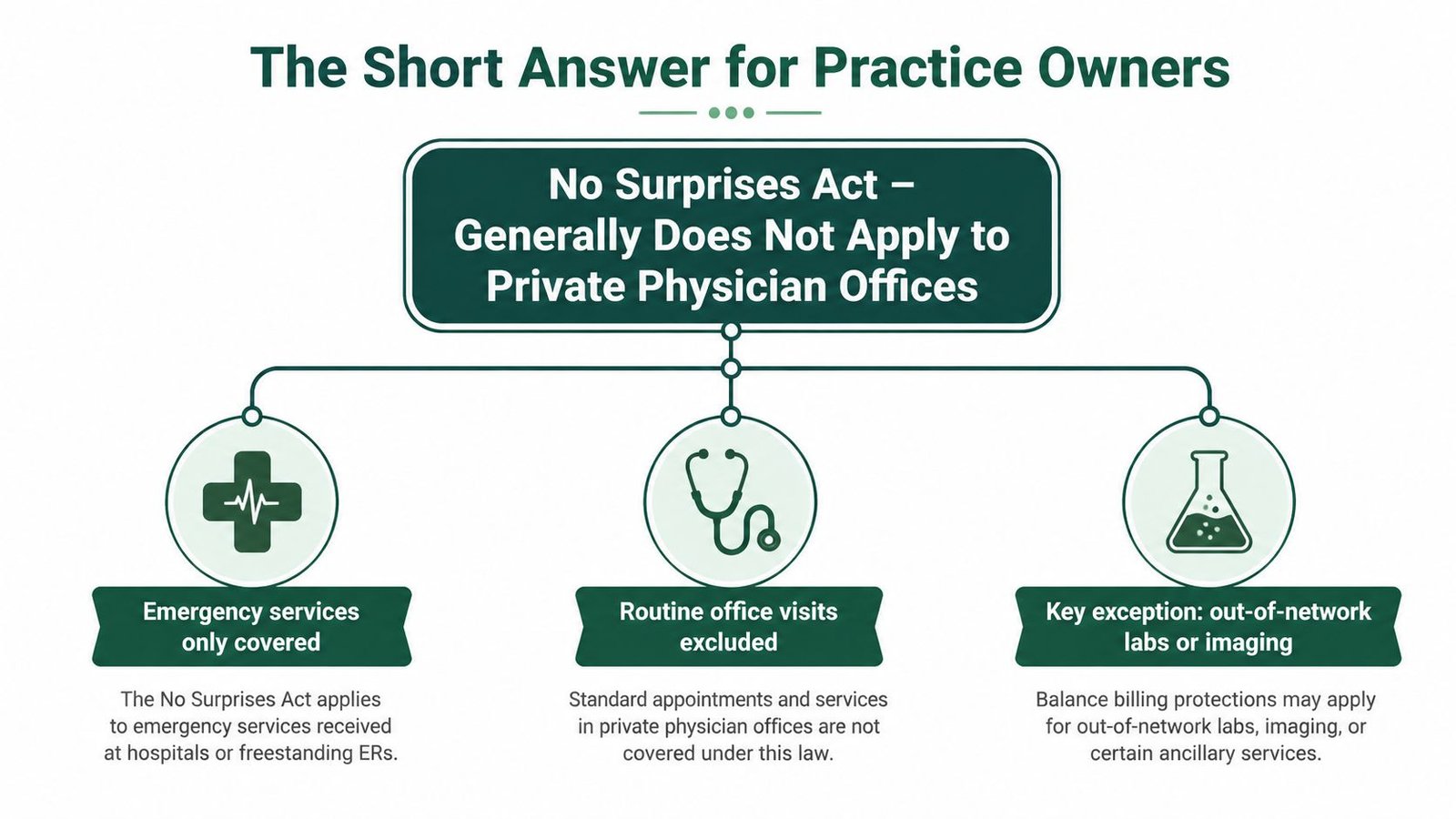
Quick answer: Yes — the federal No Surprises Act applies to almost every physician office in the United States, whether the practice is in-network or out-of-network. Two obligations apply universally: (1) Good Faith Estimates must be issued to any uninsured or self-pay patient who schedules a service or asks for a cost estimate, and (2) the public disclosure notice of patient rights against balance billing must be posted on the practice website and in the office. Balance-billing protections themselves apply when the practice provides emergency services, out-of-network care at an in-network facility, or air ambulance transport. Enforcement is by CMS for most providers, with civil penalties of up to $10,000 per violation. Practices that never see uninsured patients still owe the public-disclosure obligation.
The Short Answer for Practice Owners
The short answer is simple. No, the No Surprises Act generally does not cover routine services delivered in a private physician office, because the law is aimed at emergency services, non-emergency care from out-of-network clinicians at in-network facilities, and air ambulance services. That's the clean operating rule, and it's the one most practice owners should use when they're deciding whether the office visit itself is inside the federal surprise-billing framework. The law took effect on January 1, 2022 after being signed on December 27, 2020. (CMS medical bill rights)
Practical rule: if the encounter is a normal office visit in POS 11, the NSA usually isn't the billing rule you're managing. If the encounter sits inside a covered facility episode, it might be.
The financial issue is that teams often stop at the yes-or-no question and miss the revenue leak. If you misclassify a setting, miss the required notice, or bill the wrong place of service, you can push a clean claim into an avoidable denial path, or create a refund problem after the fact. That is where office revenue gets shaved, not usually in the exam room itself, but in the billing record that follows it.
CMS defines the covered facilities narrowly, hospitals, hospital outpatient departments, critical access hospitals, and ambulatory surgical centers. Private physician offices are not on that list, which is the structural reason the statute does not blanket-apply to office-based care. CMS also says the protections do not apply to urgent care and other non-covered facility types, which is why your intake team needs to know the setting before they guess at the rule set. (CMS provider FAQ)
The easiest way to think about it is by location and billing context, not specialty name. The same anesthesiologist billing the same CPT family can face two different regimes depending on whether the procedure happened in an ASC or in a freestanding pain clinic. In the ASC, the NSA framework can come into play because the facility is covered. In the private office, it usually doesn't. That difference is exactly why specialty practices, especially anesthesiology, pathology, radiology, and behavioral health, need setting-specific billing rules instead of one generic policy.
We've seen office owners lose time trying to apply hospital templates to office claims. Don't do that. Start with the setting, then decide whether the claim touches a covered facility episode, then decide whether the patient-facing notice or good faith estimate workflow turns on. For a specialty-specific review, the anesthesiology billing guidance matters most when your clinicians split time between office and facility sites, and the office rules should also be mapped against your No Surprises Act compliance checklist.
Where a Physician Office Still Gets Caught
The office itself is usually outside the statute, but the same physician can still be pulled into NSA obligations when the claim is tied to a covered encounter. That is where practices get burned. The billing record says “office,” but the episode says “facility,” and payer logic follows the episode.
Three scenarios that still matter
First, office-based ancillary services can get pulled into a covered facility episode. Pathology, radiology, and anesthesiology are the classic examples when they're billed incident-to a procedure at an in-network facility. If your team mislabels the place of service, the claim can land in the wrong payment bucket and invite a denial or underpayment. A wrong POS 11 versus POS 22 decision is not a clerical issue, it can change whether the claim is processed under standard office billing or under a surprise-billing framework.
Second, emergency services do not care that your building looks like an office if the encounter meets the emergency standard. If the patient presents under a prudent layperson emergency scenario, the office cannot treat it like a routine cash visit just because the front desk is not a hospital registration desk. That's where your documentation and triage workflow need to be sharp, especially when a level of service and a modifier 25 evaluation and management service are both in play.
Third, behavioral health and other services where the patient had no meaningful choice of clinician can still create NSA friction when the encounter is connected to a protected facility setting. Owners need to watch their modifier stack, especially QK for medical direction of CRNAs and the correct procedural pairing on the claim. If the office bills as if it were a freestanding encounter, but the service really occurred in a covered setting, the payer may recast the reimbursement and the practice may lose the delta.
The mistake isn't usually the clinical work. It's the claim form. Once the place of service is wrong, everything downstream gets harder.
If your practice does work in radiology, pain management, or anesthesia, check the claim line before it goes out. That is the difference between a routine office collection and a dispute you have to unwind later. If your charting and denials look messy, the balance-billing workflow is the right place to tighten controls, and if you want an operational readout, start with a free billing audit.
Good Faith Estimates and Self-Pay Disclosures
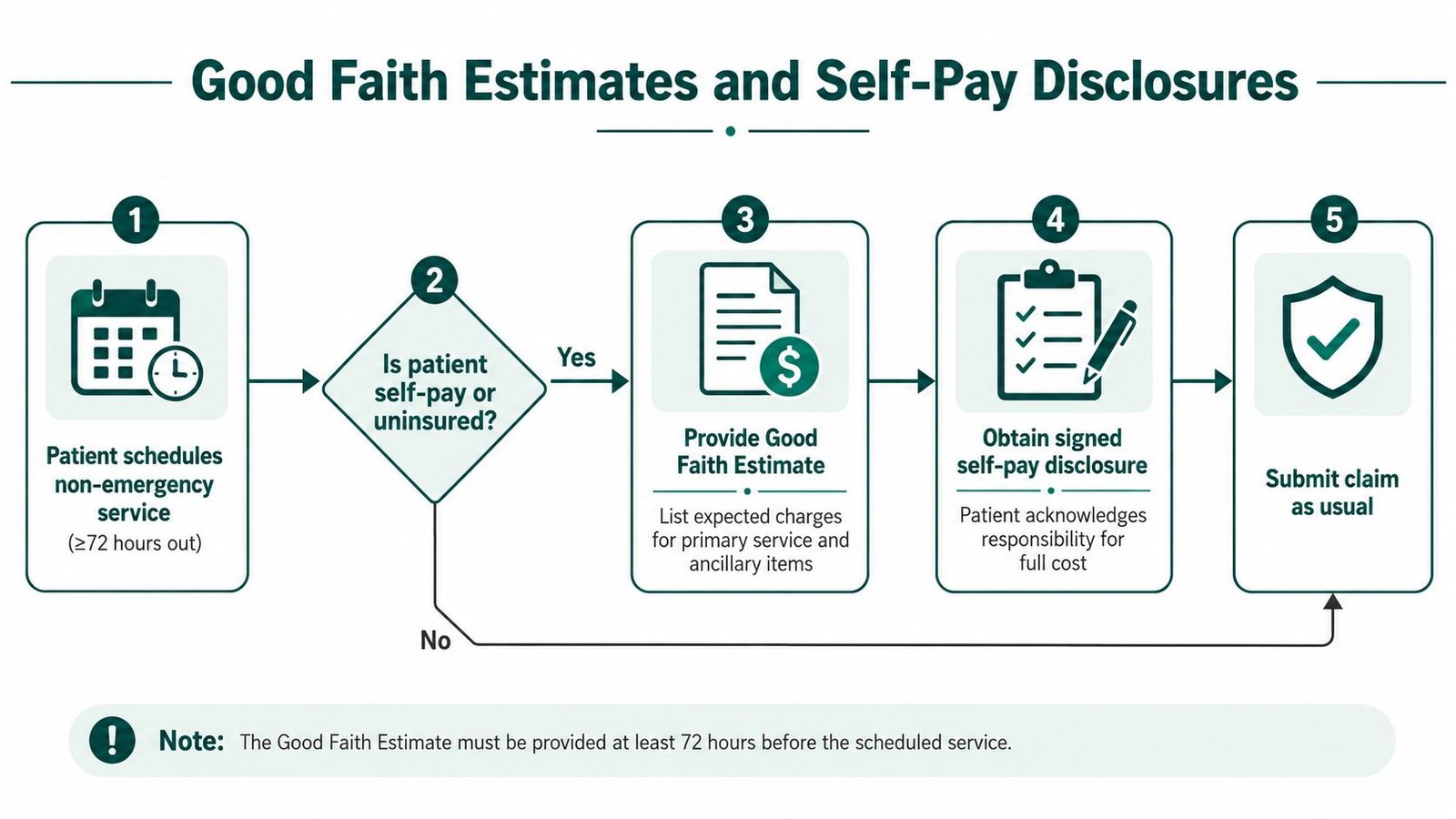
The bigger office workflow change for many practices is not balance billing at all. It's the good faith estimate process for uninsured and self-pay patients. Offices that think the NSA “doesn't apply here” still get caught.
What has to happen before the visit
For scheduled, non-emergency care, the estimate obligation kicks in when the service is scheduled at least 72 hours in advance, or upon request from an uninsured or self-pay patient. ACEP's guidance is clear that the estimate is tied to scheduled care and excludes emergency care, and the Department of Labor points patients toward help for billing disputes when charges go sideways. (DOL surprise healthcare expenses)
Operationally, your front desk should identify self-pay status at scheduling, not after the visit. Then your billing team should produce the estimate within the required timing window, document delivery, and keep the notice in the chart. The estimate should include the primary service and the ancillary items the practice reasonably expects to provide alongside it. That means you don't just list the visit code and move on. You capture the downstream items that are part of the scheduled encounter.
If you miss the estimate, or if the bill ends up more than $400 above the estimate, the patient can challenge it through the federal patient-provider dispute process. That is not a theoretical risk. It turns a billing miss into a formal revenue dispute and can force a refund or compromise settlement. In practice, we advise offices to treat the estimate as a real collection document, not a courtesy quote.
AAPC-style documentation standards matter here because the estimate has to be readable, dated, and tied to the specific service path. Your staff should be able to show what was quoted, when it was sent, and who acknowledged it. If your office also issues super bills for cash-pay patients, keep the workflow consistent with your superbill process, because the patient-facing paperwork should never contradict the estimate.
Independent Dispute Resolution and Office Claims
IDR is where the dollars get real. But let's be clear about the gatekeeping rule. A physician office can use the NSA dispute path only when the underlying service falls inside one of the protected settings. A routine office visit in POS 11 is not an IDR claim just because the payer underpaid it.
The payment math is what makes this worth your attention. One analysis reported providers won 86.4% of disputes and the mean winning offer was 2.65 times the qualifying payment amount, while another found providers won 80.1% of disputes with median and mean settlement awards of $564 and $1,333. Those numbers show why the process matters, but they also show why your claim setup has to be perfect before you file. (HHS No Surprises Act Third Report to Congress)
What decides whether the office can file
The first filter is the setting. POS 21, 22, or 24 can support NSA relevance when the service itself fits a protected category. POS 11 usually does not. The second filter is the modifier stack and whether the claim line belongs to a covered episode. If the claim was built like an office claim when it should have been built like a facility-based professional claim, the IDR door may close before you ever reach the merits.
The third filter is documentation. You need the qualifying payment amount support, the date of service, and the service relationship to the protected setting. If those pieces are thin, the case looks weak even when the clinical work was solid. That is why the smartest offices audit denials before they ever file disputes.
For practices with ancillaries that regularly cross into covered facilities, the economics can be worth the hassle. For pure office-based care, it usually isn't. That is the distinction to keep front and center. If you want a tighter operating process around those edge cases, the IDR process overview is the right operational reference.
| Metric | Value | Source |
|---|---|---|
| Provider win rate in one analysis | 86.4% | HHS No Surprises Act Third Report to Congress |
| Mean winning offer versus QPA | 2.65 times | HHS No Surprises Act Third Report to Congress |
| Provider win rate in another analysis | 80.1% | HHS No Surprises Act Third Report to Congress |
| Median settlement award | $564 | HHS No Surprises Act Third Report to Congress |
| Mean settlement award | $1,333 | HHS No Surprises Act Third Report to Congress |
Facility-Based Versus Office-Based Billing
If you want the cleanest possible operating rule, stop thinking in terms of specialty and start thinking in terms of billing context. The same physician can have one encounter that is squarely inside NSA controls and another that is not, depending on setting and claim structure. That's why place of service has to be checked before submission, not after denial.
| Dimension | Facility-Based | Office-Based |
|---|---|---|
| Typical POS | 21, 22, or 24 | 11 |
| NSA balance-billing exposure | Can apply in protected settings | Usually outside the NSA framework |
| Patient notice and consent | Often required in protected situations | Usually not part of standard office billing, unless self-pay estimate rules apply |
| Good faith estimate | May apply when the patient is uninsured or self-pay and the service is scheduled | Applies to uninsured or self-pay scheduled services |
| Modifier stack to watch | 25, 59, QK and related facility-linked patterns | Still important, but usually not tied to NSA scope by itself |
| Financial consequence of a wrong POS | Can move the claim into or out of surprise-billing rules and payment limits | Can cause underpayment, denial, or improper dispute routing |
The modifier stack is where office teams get lazy and lose money. 25 matters for separately identifiable E/M work, 59 can separate distinct procedures, and QK matters for medical direction of CRNAs. If those modifiers are attached to the wrong POS, the payer may pay a different amount than you expected, or refuse the claim path you wanted to use.
Here's the part practice owners care about. A wrong POS can shift hundreds of dollars per claim in either direction because it changes the payment logic. That is true even before you get to disputes. If your office runs anesthesia, interventional pain, or any ancillary that touches ASC or hospital workflow, your coder and your biller need the same source of truth. The POS 21 guidance is useful because it reminds your team that the setting, not just the CPT, drives the claim outcome.
Common RCM Mistakes We See in Office NSA Audits
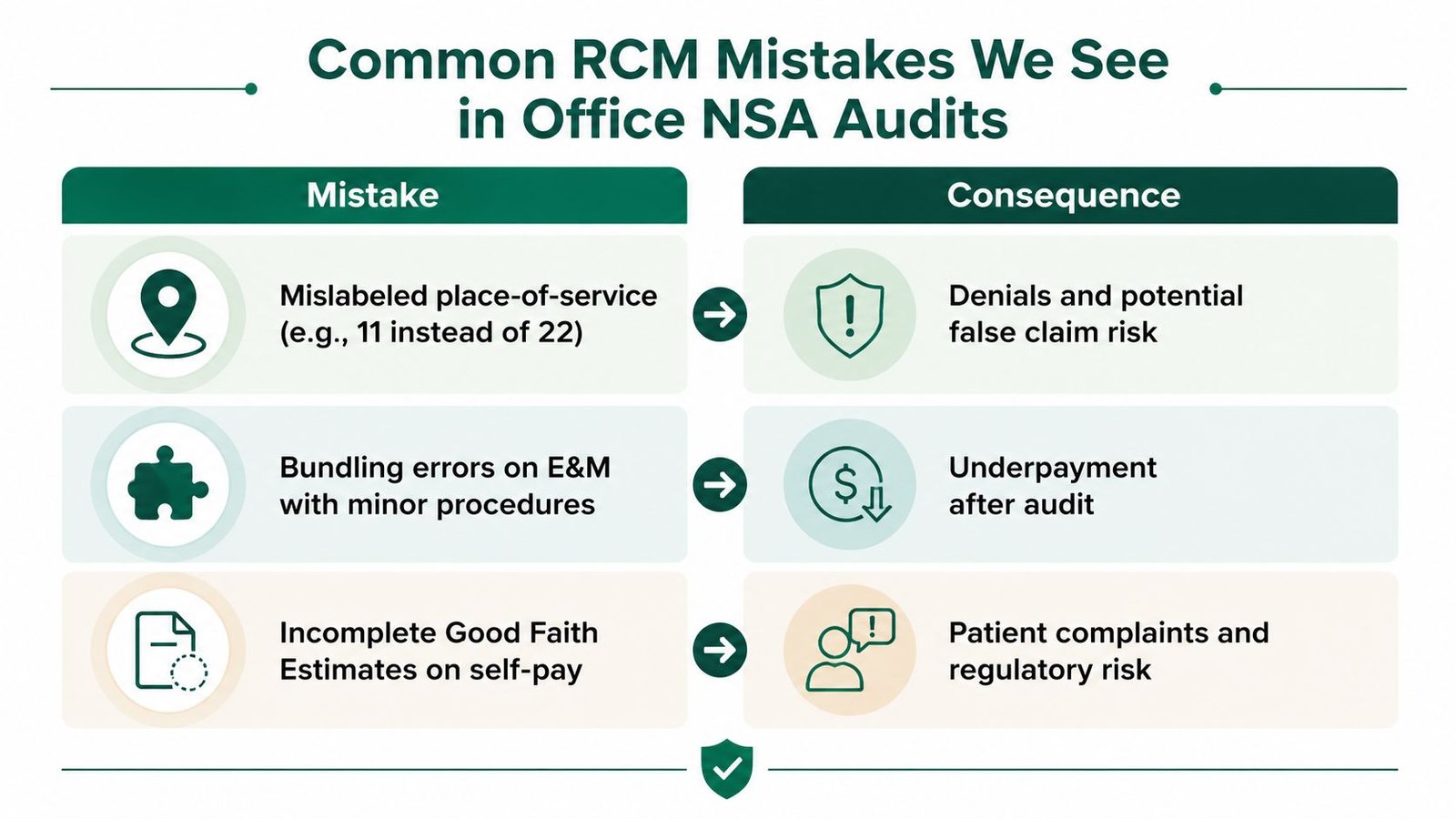
We keep seeing the same problems in office audits, and every one of them has a cash impact. The common thread is simple, teams either label the setting wrong or reuse hospital habits in a private office workflow.
The mistakes that cost the most
One, mislabeled place of service. We have seen claims billed as POS 11 when the episode belonged in a covered setting, and the reverse. That creates denial risk and can also create false claim exposure if the chart and the claim disagree. When the billing team cleans this up, denial rate usually improves because the payer stops pushing the claim into the wrong lane.
Two, bundling errors on E&M with minor procedures. A practice forgets that the E/M has to stand on its own when a modifier 25 is used. The result is underpayment after audit, which drags revenue backward and forces your team to chase adjustments. If your clinic sees frequent minor procedures, this is one of the first places to inspect.
Three, incomplete good faith estimates on self-pay. The office may think the patient is “just paying cash,” so no extra paperwork is needed. That's wrong. Missing the estimate creates patient complaints, refund exposure, and regulatory risk if the bill diverges too far from what was disclosed. In our experience, this also adds A/R days because staff spend time reworking accounts that should have been clean from the start.
If your office uses automation for pre-auth and scheduling, it should be tied to the NSA trigger logic, not bolted on later. A practical resource on insurance pre-auth workflow automation can help your team think through the intake sequence without turning every case into a manual chase.
Audit rule: if the claim file, the patient notice, and the place of service don't tell the same story, expect a denial or a refund question later.
If these issues show up in your charts, a free audit is the fastest way to spot whether the problem is front-end intake, coding, or claim routing.
Process Changes Your Office Should Implement Now
Stop treating this like a legal memo and start treating it like a revenue control problem. The workflow has to be boring, repeatable, and checked every quarter.
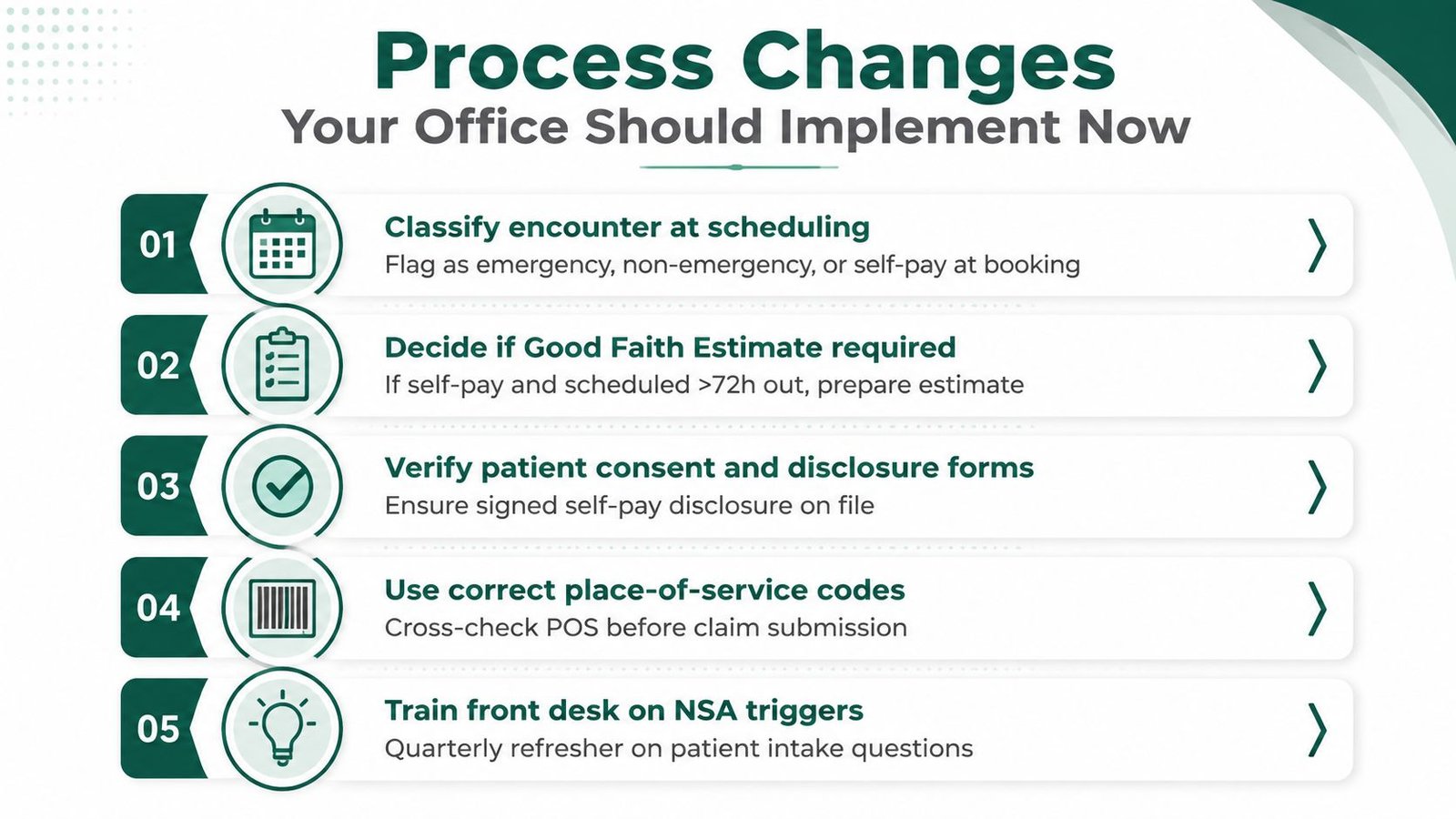
First, classify the encounter at scheduling. Flag it as emergency, non-emergency, or self-pay before the patient arrives. Second, decide whether a good faith estimate is required for scheduled self-pay care. Third, verify consent and disclosure forms so the patient-facing record matches the billing record. Fourth, use the correct place-of-service code before the claim leaves the office. Fifth, train the front desk on the NSA triggers so the same questions get asked every time.
Your KPIs should be boring too. Track denial rate by POS code, A/R days on self-pay balances, and IDR win rate if you file disputes. If those numbers move in the right direction, your workflow is working. If they don't, the issue is usually intake discipline, not payer behavior.
Quarterly internal audits are the right cadence. Pull a sample of office visits, ASC-linked claims, self-pay estimates, and any disputed out-of-network bills. Check whether the chart, the estimate, the modifier stack, and the POS all agree. When they don't, fix the front-end workflow, not just the individual claim.
The owner takeaway is blunt. The NSA does not make routine office billing harder by default, but it does punish sloppy setting logic. Clean that up now, and your denial rate, cash collection, and A/R aging will all be easier to manage.
Frequently Asked Questions From Practice Owners
Does a routine follow-up visit in a private office fall under the No Surprises Act
Usually no. A routine follow-up in a private office is generally outside the NSA because the covered settings are hospitals, hospital outpatient departments, critical access hospitals, and ambulatory surgical centers, not ordinary physician offices. The billing risk comes when the visit is tied to a covered facility episode or when the patient is uninsured or self-pay and the estimate rules apply.
What happens if we never give a self-pay patient a good faith estimate
You put the account at dispute risk. If the final bill exceeds the estimate by more than $400, the patient can use the federal dispute process, which means refunds, rework, and delayed cash. Treat the estimate like a real pre-bill document, not a courtesy form.
Can we still balance bill an out-of-network patient when the NSA doesn't apply
Yes, but only outside the protected NSA settings and subject to any applicable state surprise-billing law. That's why your team should never assume federal inapplicability means free rein. State rules can still control the collection outcome.
How do we know if our ancillaries cross into NSA scope
Verify the place of service on every claim, then audit modifier 25, 59, and QK stacking every month. If your ancillary services regularly happen in ASC or hospital settings, build a separate claim checklist for those episodes. If they stay in POS 11, keep them in the office billing workflow and make sure your estimates are triggered only when the self-pay rules apply.
If you want a billing partner that treats NSA scope, place of service, and self-pay estimate workflow as revenue cycle controls instead of compliance theater, Happy Billing can review your current setup and show you where claims are leaking. We work inside your existing workflow to tighten denials, protect A/R, and clean up the office-to-facility edge cases that are commonly missed.