When to Outsource Medical Billing: Signs Your Practice Is Ready

A practice is ready to evaluate outsourcing when denial rates stay above 5% to 8%, A/R rises beyond 40 days, or authorization, staffing, visibility, and credentialing problems create financial drag greater than the cost and disruption of a specialized partner. The decision becomes urgent when clean claims fall below 95%, because delayed reimbursement is already competing with payroll, growth, and clinical operations.
The surprising part is that many owners wait for collections to collapse before changing their RCM model. A well-managed practice generally targets a clean claim rate above 95%, denial rates below 5%, and A/R under 35 to 40 days according to current RCM benchmark guidance. If your practice consistently misses those thresholds, billing isn't merely an administrative cost. It's a cash-flow risk.
Use the scorecard below to distinguish a fixable process defect from a structural capability gap. An anesthesiology group may need specialty expertise for base units and concurrency, while a mental health clinic may need authorization control. Cardiology, orthopedics, gastroenterology, pediatrics, and multi-specialty groups face different leakage patterns. Happy Billing's specialty-focused medical billing support is designed around those differences, and a free revenue cycle audit can help quantify the problem before you compare vendors. The same disciplined evaluation used when choosing an accounting advisory provider applies here: measure the exposure, test the operator, and price the risk of doing nothing.
1. Denial Rate Exceeding 5% to 8% of Claims Submitted
A denial rate above 5% is a cash-flow warning. A persistent rate near or above 8% warrants an outsourcing evaluation, particularly when claims depend on modifiers, authorization, global-period rules, or procedure-specific documentation.
MGMA-benchmarked physician practices recorded first-submission denial rates of about 7% to 8% over the past four years. AAPC guidance identifies below 5% as a healthier target, as reported in MGMA benchmark data and AAPC practice-management guidance. The exposure includes more than the unpaid claim. Staff must correct, appeal, follow up, and post the account while reimbursement remains delayed.
Measure denials by payer, provider, CPT code, and root cause, then check concentration within each category. Anesthesia claims can fail when base units or concurrency details vary. Orthopedic claims may break down around global periods and multiple-procedure rules. Behavioral health denials often reflect authorization lapses. A tolerable overall rate can still conceal a damaging payer, provider, or high-value procedure pattern.
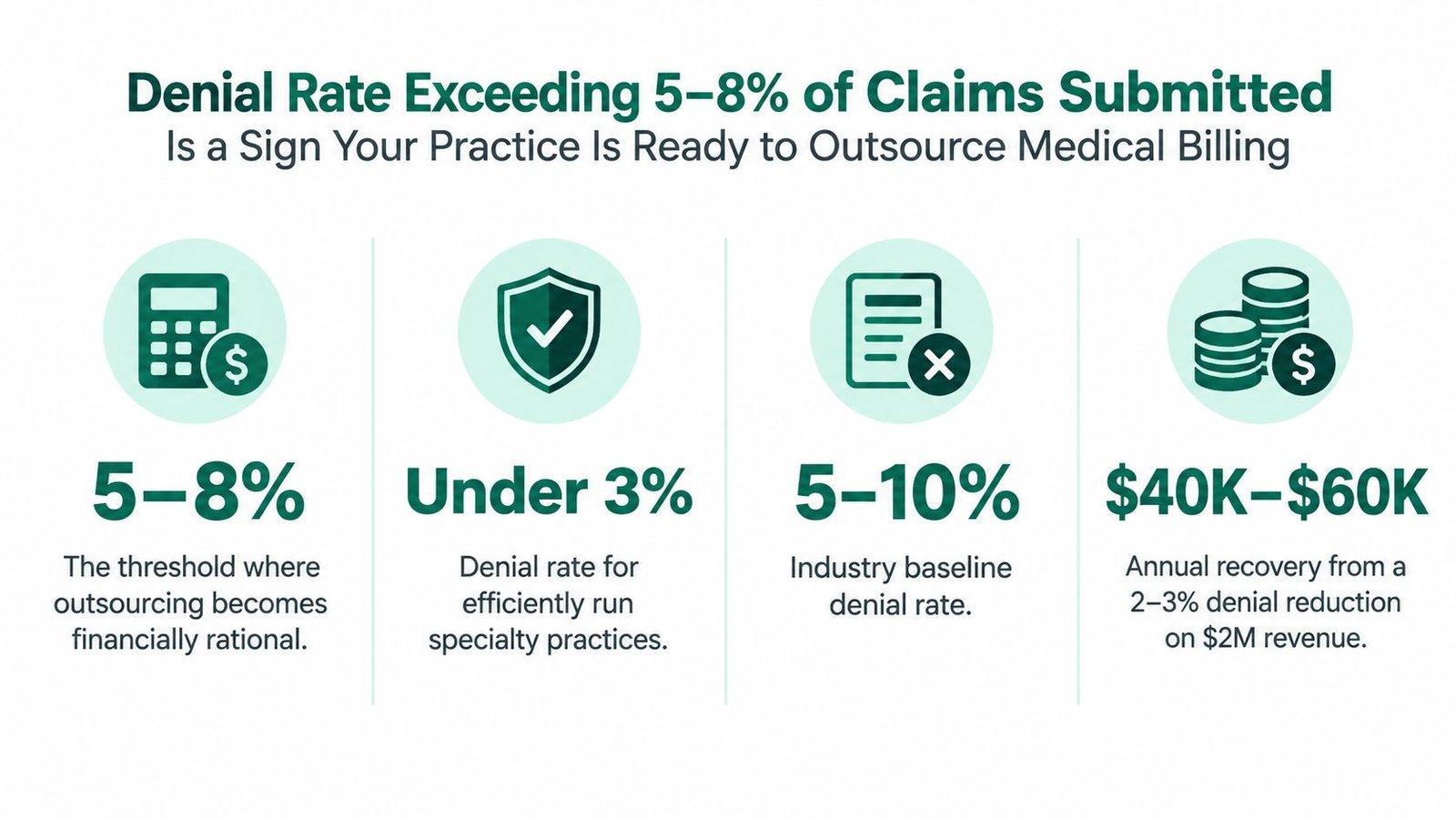
If the team can classify denials but cannot stop recurring causes, the gap is process control rather than workload. Before selecting a vendor, ask how it will assign ownership by root cause, monitor payer-rule changes, measure prevention, and report recovered revenue separately from avoided denials.
Happy Billing's medical billing denial management resource provides a framework for categorizing causes and testing whether current controls prevent repeat failures.
2. Days in Accounts Receivable Exceeding 40 Days
A/R days show how long earned revenue remains outside the practice. Once A/R exceeds 40 days, working capital is tied up in claims that should already be progressing through adjudication or payment.
Well-managed practices often target A/R below 35 to 40 days. Industry references commonly place A/R at 40 to 50 days and identify levels above 45 days as a strong outsourcing signal current RCM benchmark guidance. These thresholds are not a universal outsourcing rule. They are control limits that show when delayed collections may be impairing payroll flexibility, purchasing, or investment in care delivery.
Age the ledger by payer, claim status, provider, and service date. Review the oldest balances separately from the average. A practice can report acceptable overall A/R while a concentrated tail of unpaid claims consumes follow-up capacity and increases write-off risk.

Read the aging pattern, not just the average
Benchmark references place A/R older than 90 days at about 13.5% of total A/R, while best practice keeps that share below 10% medical billing benchmark guidance. An expanding older balance can indicate authorization backlogs, payer disputes, missing records, or accounts without a clear owner.
Every extra day in A/R delays access to money the practice has already earned.
Specialty mix changes the interpretation. Anesthesia groups may face delayed claims tied to operative documentation and payer adjudication. Behavioral health practices may see older balances linked to authorization or visit-limit issues. Orthopedic practices may need separate review of surgical claims, global-period questions, and secondary billing.
Before outsourcing, ask a prospective partner which aged claims it can address immediately and which depend on the payer, EHR, documentation, or contract terms. Require an aging methodology, escalation rules, follow-up cadence, and reporting that separates recovered revenue from existing collections.
Track performance against a defined A/R target and review whether the vendor can explain changes by payer and aging bucket. Happy Billing's days in A/R resource provides terminology for that evaluation.
3. Revenue Leakage from Missed Modifier Application or Bundling Errors
Some practices don't have a denial problem. They have an underbilling problem that never appears in the denial report.
Modifier and bundling errors can suppress reimbursement before a claim becomes visibly actionable. A missing modifier may cause a service to bundle, deny, or pay below the amount the documentation supports. In a high-volume specialty, repeated small errors can become a material annual leakage stream.
Review the top 20 CPT codes by volume over the past 90 days, then compare billed lines with documentation, payer rules, and payment outcomes. The review should include modifier 25 for distinct evaluation and management work, modifier 59 for distinct procedural services, and specialty-specific modifiers used for global periods, multiple procedures, or anesthesia circumstances.
CMS guidance creates a concrete example. Code G2211 can't be paid on the same date of service as certain office or outpatient E/M services when modifier 25 is involved, and CMS manual language governs same-day billing interactions CMS manual guidance. The owner-level issue is straightforward: incorrect handling can suppress legitimate reimbursement or trigger denials, while careless overuse can create compliance exposure.
Match expertise to the specialty
Anesthesiology requires precise attention to base units, time, concurrency, and qualifying circumstances. Orthopedics needs disciplined global-period and multiple-procedure handling. Gastroenterology and cardiology groups may need tighter review of procedure combinations, imaging, and E/M relationships.
A vendor should show how it documents payer-specific rules for your highest-volume codes and how human auditors review automated edits. Technology can flag an inconsistency, but it can't replace a clear escalation process when documentation and payer policy conflict.
Use Happy Billing's CPT modifier 59 guidance to structure a line-item audit. The decision to outsource is stronger when the audit finds recurring leakage, your internal team can't explain its source, and the partner can demonstrate specialty-specific controls rather than generic claim submission.
4. Inability to Meet Authorization or Pre-Certification Deadlines
Authorization failure is often a front-end problem with a back-end financial consequence. The patient may receive care as scheduled, but the practice later absorbs a denial because the authorization was missing, expired, attached to the wrong service, or recorded under the wrong payer conditions.
Prior authorization pressure has become more complex across specialties. Independent market coverage reports that between 2023 and 2025, total prior authorization volume grew 49%, while denials and peer-to-peer cases grew 307% and online denials grew 623% specialty outsourcing coverage. Those figures are particularly relevant to mental health, cardiology imaging, orthopedics, pediatrics, and other services where approval requirements can determine whether a claim is payable.
Audit the last 60 days of denials and isolate authorization-related failures. If the same issue appears repeatedly, the practice needs more than reminders. It needs ownership, payer-specific requirements, expiration tracking, escalation, and documented handoffs between scheduling, clinical staff, and billing.
Treat authorization as a revenue function
A front-desk employee who spends hours calling payer portals is performing revenue-critical work without necessarily having the tools or capacity to manage it consistently. For a mental health clinic, the bottleneck may be recurring visit authorization. For cardiology, it may be imaging or interventional procedures. For pediatrics, several plans may impose different approval workflows.
If an authorization failure can prevent payment for care already delivered, it belongs on the owner's financial dashboard.
Ask vendors to show portal access, authorization status reporting, peer-to-peer escalation, and accountability for expired approvals. Don't accept a broad promise to “handle authorizations.” Require a workflow that identifies the service, payer rule, deadline, responsible person, and final outcome.
Happy Billing's prior authorization resource can help frame the questions. Outsourcing becomes rational when authorization work is consuming clinical or administrative capacity and the practice lacks reliable evidence that deadlines are being met.
5. Inconsistent Claim Submission Quality and Scrubbing Protocols
A claim with preventable errors consumes clinical, administrative, and billing time before payer review. Rejection starts another work cycle, delays adjudication, and forces staff to correct information that should have been identified before submission.
Start with the practice's clean claim performance. A sustained clean claim rate above 95% is a reasonable operating target. If the practice cannot maintain that level after documented process changes, its front-end controls are not working consistently, as noted in RCM best-practice guidance. Clearinghouse acceptance does not establish payment readiness. A claim may pass technical edits and still fail payer-specific coding, authorization, eligibility, or documentation rules.
Test the workflow at the point of entry
Require the billing team to document every pre-submission check. The workflow should address demographics, eligibility, diagnosis and procedure relationships, modifiers, authorization data, provider enrollment, and payer-specific edits. It should also identify which exceptions receive human review instead of entering an unchecked submission queue.
Billing complexity changes the required controls. Anesthesiology needs edits for base-unit and modifier relationships. Gastroenterology needs procedure-specific validation. Orthopedics requires global-period logic. Mental health billing may depend on authorization and plan-specific rules.
A scorecard can connect the warning to the vendor decision:
- High priority: clean claims remain below the target after internal corrections. Request monthly first-pass results, rejection categories, and specialty-specific examples.
- Medium priority: errors concentrate in a payer or service line. Require configurable edits and proof that payer rules are updated.
- Vendor gate: reject providers that show only a generic scrubber dashboard. Require a sample scrub report, human-review workflow, integration limits, and implementation responsibilities.
Happy Billing states that it operates within the existing EHR and combines agentic AI with human auditors. Evaluate that claim through the same evidence standard applied to any vendor.
The financial test is simple: payable claims should increase, avoidable rework should decline, and reporting should clarify cash-flow risk without adding another system burden.
6. High Staff Turnover or Knowledge Gaps in Billing Operations
A billing employee's departure can remove payer knowledge, specialty judgment, workflow history, and informal safeguards in a single day. The practice then pays twice, first through recruiting and training, and again through delayed claims, rising denials, and unresolved A/R while a replacement learns the operation.
The risk is greater when one person controls a critical function. A sole authorization specialist, senior orthopedic biller, or experienced anesthesia reviewer may know exceptions that were never documented. If that person leaves, the practice discovers whether its process is institutionalized or dependent on memory.
Calculate the cost of dependency
Don't limit the comparison to wages. Include recruiting, onboarding, manager time, reduced productivity, claim rework, delayed follow-up, and the revenue effect of knowledge gaps. Then compare that total with the cost of maintaining an outsourced team that has redundancy, documented procedures, specialty training, and coverage during absences.
A practice should map dependencies across:
- Single-person functions: Identify authorization, payment posting, denial appeals, credentialing, and payer escalation tasks that only one employee can perform.
- Undocumented payer rules: Record rules that live in personal notes, email threads, or individual experience rather than a shared operating process.
- Specialty-specific judgment: Test whether the remaining team can correctly explain anesthesia concurrency, orthopedic global periods, behavioral health authorizations, or cardiology procedure relationships.
- Recovery continuity: Confirm who works aged claims when staff are absent, resign, or move to another role.
The decision isn't automatically to outsource every function. A stable internal team with strong documentation may be cheaper and more controllable. But if turnover repeatedly changes denial and A/R performance, the practice is paying for operational fragility.
We have seen owners treat retention as an HR issue when it is an RCM continuity issue. A vendor evaluation should therefore include staffing depth, backup coverage, training practices, named escalation contacts, and the right to review performance if assigned personnel change.
7. Lack of Real-Time Visibility into Claim Status and Payer Performance
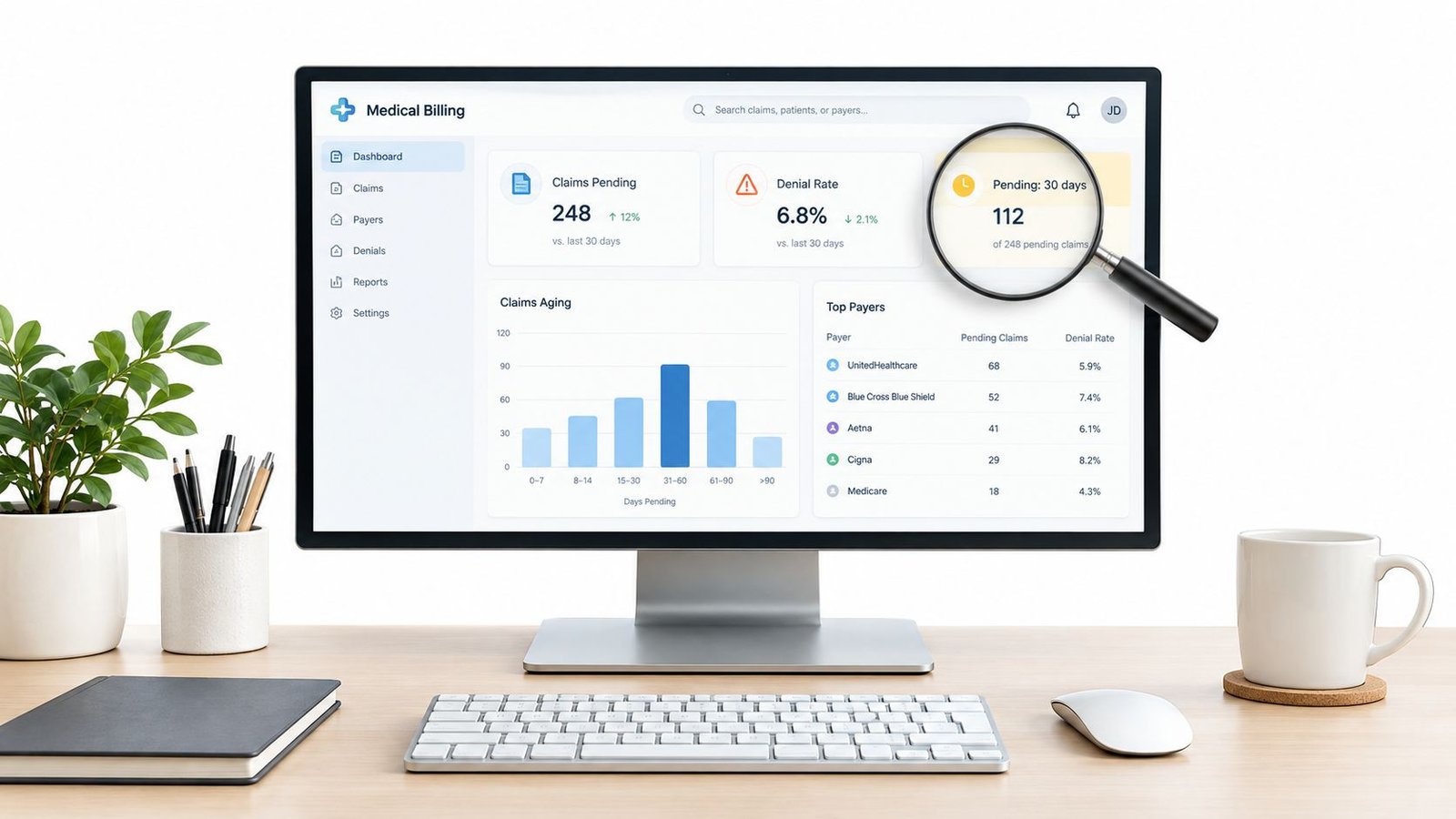
You can't manage cash you can't locate. If the practice doesn't know which claims are pending, rejected, denied, underpaid, or awaiting records, leadership is forced to review collections after the financial damage has already occurred.
Manual portal checks and spreadsheet updates often leave claims untouched for too long. The operational warning sign isn't that reporting looks dated. It's that nobody can answer, without a manual investigation, which payers are delaying payment, which providers generate repeat denials, and which high-value claims need escalation today.
Require evidence, not a dashboard tour
Ask for a 30-day visibility report covering claim status, aging, payer response, denial reason, next action, assigned owner, and escalation date. A colorful dashboard that can't produce a worklist is not operational visibility.
Your reporting should allow the owner to compare:
- Payer performance: Which plans create the longest payment delays or most repeated edits?
- Provider performance: Which clinicians or locations produce unusual rejection or denial patterns?
- Procedure performance: Which CPT codes generate bundling, modifier, authorization, or documentation issues?
- Aging accountability: Which claims have exceeded the practice's escalation threshold, and what has the assigned owner done?
A practice may discover that its headline A/R problem is concentrated in one payer or one workflow. That changes the outsourcing decision. You might need a targeted payer escalation program rather than full-cycle replacement. Conversely, if the current team can't produce reliable status data, a broader partner may be justified because leadership lacks the information required to manage internal performance.
Require access to reports, not just verbal summaries. Confirm who owns follow-up, how often queues are worked, and whether the vendor can integrate with the existing EHR without forcing a migration.
8. Provider Credentialing Lapses or Credential Management Burden
Credentialing errors can stop payment at the provider level. A lapsed enrollment, inaccurate demographic record, missing revalidation, or payer activation problem can cause a series of otherwise clean claims to reject or deny.
That failure is especially expensive because the practice may continue delivering care while the administrative defect remains unresolved. The resulting A/R isn't caused by patient volume or clinical demand. It's caused by a provider file that nobody monitored closely enough.
Credentialing requires lifecycle management, not a one-time application. The practice must maintain documents, track payer deadlines, respond to inquiries, verify enrollment status, and coordinate new providers, locations, and specialties. As the group expands, internal staff may spend increasing time on work that doesn't produce visible revenue until something goes wrong.
Put dates and ownership in one system
Maintain a centralized record of provider data, payer participation, applications, re-verifications, documents, and expiration dates. Verify status well before deadlines and assign one accountable owner for every open item.
A credentialing review should answer:
- Who owns each payer file: Identify the employee or vendor responsible for follow-up.
- What happens before expiration: Confirm the re-verification timeline, documentation checklist, and escalation path.
- How new providers become payable: Map the steps from contract execution to payer activation and claim submission.
- How failures affect claims: Define the hold, correction, appeal, and communication process when enrollment data is wrong.
The decision to outsource is stronger when credentialing consumes substantial staff time, the practice has several providers or payers, or a prior lapse created a denial spike. A vendor should provide documented status reporting rather than promise faster enrollment.
Happy Billing's medical billing and credentialing services reflect the practical connection between enrollment and revenue. Credentialing shouldn't sit in a separate administrative silo if a lapse can interrupt payment.
8 Readiness Indicators for Outsourcing Medical Billing
| Issue | Implementation Complexity | Resource Requirements | Expected Outcomes | Ideal Use Cases | Key Advantages |
|---|---|---|---|---|---|
| Denial Rate Exceeding 5–8% of Claims Submitted | Medium–High: denial audit, appeals workflow and process changes | Specialized denial analytics, appeals staff, payer expertise | Reduce denials 2–5%; recover revenue; ROI ~6–9 months | Practices with >5% denials or specialty-specific denial patterns | Quantifiable ROI; reveals systemic billing failures; specialty expertise |
| Days in Accounts Receivable (A/R) Exceeding 40 Days | Medium: automation of scrubbing and daily follow-up required | Continuous claim scrubbing, daily payer follow-up, cash-flow reporting | Compress A/R to ~30–35 days within ~90 days; free working capital | Practices with A/R >40 days or cash-flow constraints | Faster collections; frees working capital; measurable ROI |
| Revenue Leakage from Missed Modifier Application or Bundling Errors | Low–Medium: line-item audits and payer-specific rule mapping | Modifier audits, specialty coders, real-time scrubbing tools | Recover ~1–4% revenue; rapid fixes often within 90 days | Specialties with frequent modifier use (anesthesia, gastro, ortho) | High ROI; low-cost fixes; rapid revenue recovery |
| Inability to Meet Authorization or Pre-Certification Deadlines | Medium: build auth workflows, portal access and tracking | Dedicated authorization specialists, portal access, automated tracking | Reduce auth-related denials 50–75%; compress A/R and reclaim staff time | Mental/behavioral health, pediatrics, imaging-heavy practices | Eliminates auth-driven denials; reclaims staff hours |
| Inconsistent Claim Submission Quality and Scrubbing Protocols | High: requires automated scrubbing, AI tools and audit discipline | AI-assisted scrubbing, human auditors, credential maintenance | Achieve 98%+ clean claims; reduce rework and A/R by days | Practices with <95% first-pass acceptance or high rework | Fewer rejections; faster cash flow; scalable validation |
| High Staff Turnover or Knowledge Gaps in Billing Operations | Low–Medium: transition to outsourced teams; change management needed | Outsourced redundancy, ongoing training, onboarding effort | Stabilize denials/A/R; eliminate single-person risk | Small teams with high turnover or sole-expert dependencies | Removes key-person risk; reduces recruiting/onboarding costs |
| Lack of Real-Time Visibility into Claim Status and Payer Performance | Medium–High: systems integration and dashboard setup | Claims management software, monitoring staff, payer integrations | Proactive follow-up; recover stuck claims; reduce A/R by ~5–8 days | Practices without daily tracking or unexplained aging | Enables data-driven follow-up; identifies problematic payers |
| Provider Credentialing Lapses or Credential Management Burden | Medium: credential lifecycle setup and ongoing maintenance | Credentialing specialists, document management, automated alerts | Prevent 3–8% denial spikes; free 20–30 staff hours/month | Multi-provider practices or those with recent credential lapses | Prevents denial spikes; proactive re-verification and faster activation |
Turn the Warning Signs Into a Vendor Decision
The eight indicators don't create an automatic outsourcing mandate. They create a financial case that you need to test. Start by quantifying four things: annual denied or underpaid revenue, cash tied up in aged A/R, fully loaded internal billing cost, and implementation risk.
Your internal cost includes salaries, benefits, software, training, management time, turnover disruption, and the cost of unresolved work. Your recoverable revenue should come from an audit of denials, aged claims, underpayments, missed modifiers, authorization failures, and unbilled or delayed charges. Don't count every unpaid claim as recoverable. Separate claims a partner can correct from balances controlled by payer contracts, missing documentation, patient eligibility, or EHR limitations.
Build a break-even model
Compare the vendor's fee and implementation costs with realistic recovery and operating savings. Model a conservative case, a likely case, and a downside case. Include the temporary productivity loss during onboarding, data cleanup, credentialing transfer, interface work, and internal oversight.
Then define success using metrics you already understand:
- Clean claim rate: Set a target above 95%, with specialty-specific exception reporting.
- Denial rate: Require root-cause categories, payer trends, appeal status, and prevention actions.
- A/R days: Track total A/R and aging buckets, not just the average.
- Authorization performance: Measure completed approvals, expiration controls, and authorization-related denials.
- Credentialing status: Require provider-level deadlines, payer activation, and unresolved enrollment issues.
- Cash performance: Review net collections, payment posting timeliness, underpayment identification, and recovered balances.
Test the vendor before signing
Ask for comparable evidence from practices with similar specialties, payer mix, provider count, and EHR. An anesthesia practice should ask about base units, time, concurrency, and modifier handling. A mental health clinic should test authorization workflows. Cardiology groups should examine diagnostic imaging and interventional coding. Orthopedic practices should ask about global periods and multiple-procedure reductions.
Require clear answers about:
- CPT and modifier governance: Who reviews exceptions, and how are payer rules updated?
- Denial ownership: Does the vendor correct, appeal, and prevent denials, or only report them?
- Reporting access: Can owners see claim-level status, aging, payer performance, and assigned actions?
- Security safeguards: What HIPAA controls, access restrictions, encryption, incident response, and third-party assurance are in place?
- EHR integration: Will the partner work inside the existing system, and what data must be exchanged?
- Onboarding: Which staff members own conversion, cleanup, provider enrollment, and open A/R?
- Pricing: Are fees based on collections, claims, services, or a combination, and what additional charges apply?
- Exit terms: Who owns data, how are open claims transferred, and how quickly can the practice leave?
Outsourcing doesn't remove practice oversight. It changes the owner's role from supervising every billing task to governing performance, compliance, access, and financial outcomes. In our experience at Happy Billing, the strongest partnerships give physicians and administrators better visibility, not less control.
Frequently asked questions
Is 40 A/R days enough reason to outsource medical billing?
It's enough reason to evaluate outsourcing, not enough reason to sign a contract automatically. Compare the aging pattern, denial rate, clean claim performance, payer concentration, internal cost, and the causes of delay. A/R above 40 days becomes more persuasive when the practice also misses other benchmarks or can't explain which claims are holding back cash.
How should a practice calculate its outsourcing break-even point?
Add the fully loaded cost of internal billing to the financial effect of denied, delayed, underpaid, and unworked claims. Then compare that exposure with vendor fees, implementation costs, and the realistic portion of revenue the partner can recover. Keep payer-controlled and documentation-controlled balances separate so your model doesn't overstate the opportunity.
What should an owner request during an RCM audit?
Request claim-level samples, denial categories, A/R aging, payer performance, clean claim results, modifier review, authorization failures, payment posting controls, credentialing status, and underpayment findings. Ask the auditor to connect each problem to an owner, corrective action, expected financial effect, and measurement method.
Does outsourcing replace internal practice oversight?
No. The practice remains accountable for financial governance, compliance, provider documentation, patient registration quality, vendor access, and contract performance. A capable partner should reduce operational burden while giving the owner clearer reporting and defined escalation rights.
Happy Billing provides full-cycle RCM, denial management, A/R recovery, authorization support, and credentialing workflows for specialties such as anesthesiology, mental health, cardiology, and orthopedics. Review your warning signs and visit Happy Billing to discuss a revenue audit and an outsourcing decision based on measurable cash-flow risk.