Cigna Data Isight Repricing for Physical Therapy Practices: How to Recover Underpaid Visits
A Manhattan PT visit billed at $540 can come back from Cigna at $60 after Data iSight repricing, even when the same visit used to pay $300 to $400 before the repricer took hold. You can recover those underpaid visits in roughly 45 to 90 days when you batch the right claims, back them with FAIR Health benchmarks, and send a case manager a file that's too clean to ignore.
Happy Billing is a medical billing company headquartered in Houston, Texas. We recover out-of-network underpayments for physical therapy, chiropractic, sports medicine and behavioral health practices, including practices in New Jersey and New York.
The $540 to $60 Reality of a Data iSight Reduction
A Data iSight reduction is where a clean out-of-network claim gets chopped down to a number that looks arbitrary because it is. On one Manhattan visit, CPT 97140 x2 and 97110 x2 produced a billed charge of $540 and then came back at about $60 after repricing. That is not a routine adjustment. It is a payer taking control of a rate the practice never agreed to accept.
The same pattern shows up in New Jersey sports medicine files, where a roughly $300 out-of-network claim gets pushed toward roughly $100. That is the point where owners stop treating this as a billing annoyance and start treating it as lost revenue tied to specific CPT lines. If you are still building patient volume while you pursue recovery, you also need to grow your physio practice affordably so insurer cuts do not force you into defensive cash flow decisions.
The number on the remittance is not the finish line. It is a repriced figure, and if your practice never signed an agreement with Data iSight, the payer still has to justify why that figure should control the visit.
That is why these files are won on authority, not outrage. Cigna usually responds slowly, and it often does so only after the practice sends a file that makes the repricing issue impossible to ignore. A single claim rarely gets attention. A batch of similar underpaid visits, documented cleanly and tied to plan language, gets a reply.
A good recovery packet starts with the contract question. If the EOB names Data iSight, you are dealing with an external pricing layer, not a negotiated fee schedule with your practice. The next step is to show that the repriced amount does not bind the provider on that out-of-network service, then force the payer to answer the only questions that matter, the plan language, the repricing method, and the authority to use it.
That is the line owners miss when they let these reductions sit. Each unchallenged visit becomes a subsidy to the payer.
For the full recovery playbook, use this physical therapy underpayment recovery guide.
If you want the numbers checked claim by claim, request a free out-of-network underpayment analysis.
Reading the Cigna EOB When Data iSight Is Named
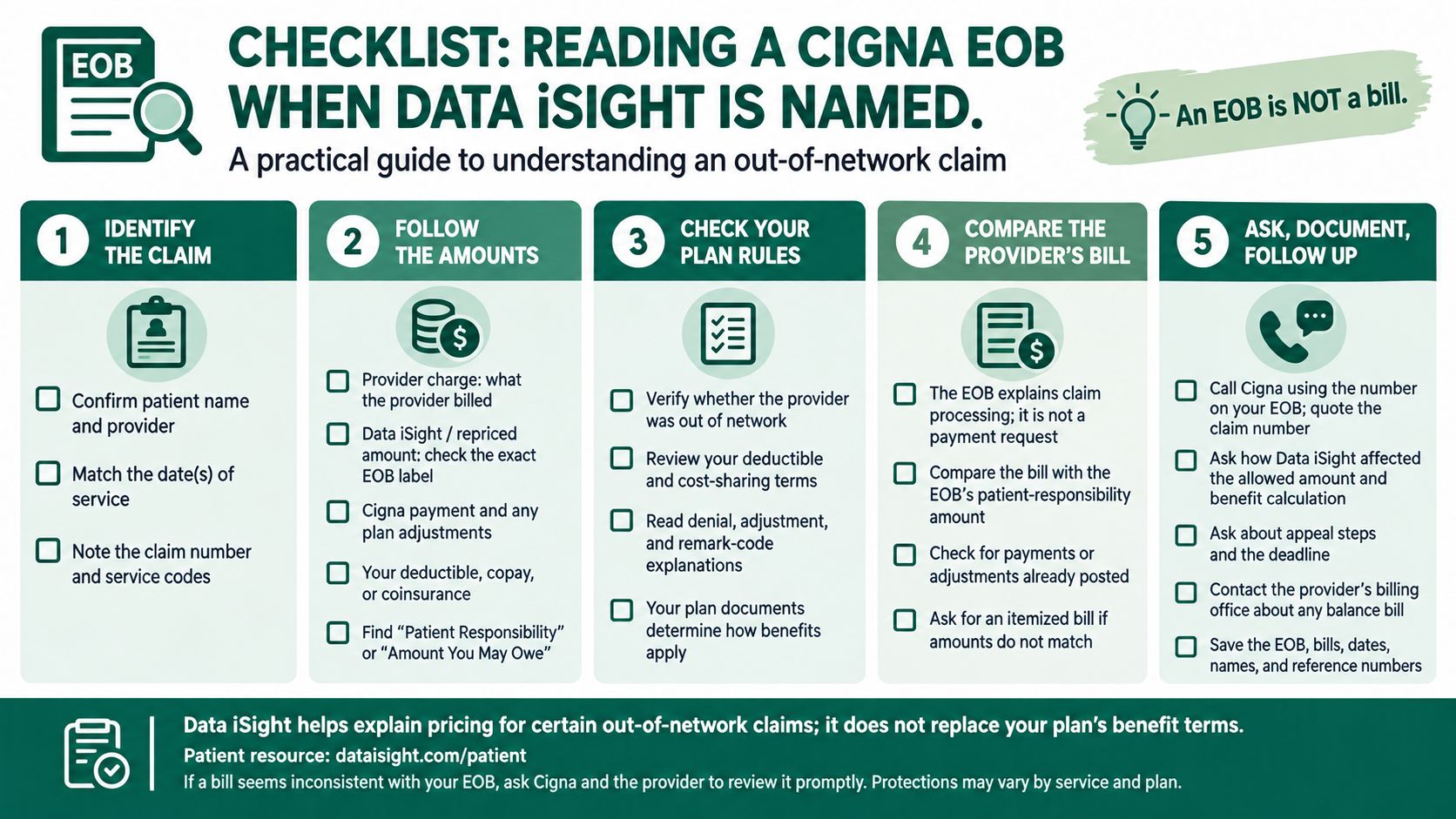
A Data iSight remittance is usually hiding in plain sight. The line that matters is the one naming the repricing entity, because that tells you the claim was not paid low on its own, it was routed through an external pricing layer. The other fields that matter are the billed charge, allowed amount, repricer adjustment, payment, and patient responsibility.
Use the EOB like a forensic document, not a billing receipt. The appeal clock is embedded in the payment date and the dispute instructions, and that matters because a good file is one you can prove was timely. The best practice owners I've worked with do not let the biller “review later.” They export the full claim record immediately and lock down the date of service, submission date, and remittance date while the trail is fresh.
The internal logic is straightforward. If the EOB references Data iSight, MultiPlan, or Claritev, that is your proof that a repricer influenced the allowed amount. You then confirm there is no provider contract with the repricing entity, because APTA has made clear that the therapist generally has no contract with the repricer, which means the repricer cannot unilaterally impose payment terms on you. Cigna's own appeal process can then be used against the payer, line by line, on the specific service dates and units involved. For a clean walkthrough of EOB anatomy, use this explanation of benefits reading guide.
Practical rule: if you can't export the claim record, you can't win the appeal file.
For the recovery packet, export these fields for every underpaid line:
- Patient and plan identifiers, enough to match the claim to the remittance.
- Date of service and submission date, so the deadline is provable.
- CPT/HCPCS line, units, and modifiers, especially on timed therapy codes.
- Billed charge, allowed amount, repricer adjustment, payment, and patient responsibility.
- Remark or adjustment text naming Data iSight or another repricing entity.
- Appeal deadline, case number, and remittance trace information.
- Any plan language or contract language that says why Cigna says the amount is valid.
That's the clean working list. Everything else is noise.
CPT Codes Hit Hardest and What a Fair Allowed Amount Looks Like
The dollars usually concentrate in the same four therapy codes. 97110, 97140, 97530, and 97112 are where a repricing cut does the most damage because they're the backbone of one-hour out-of-network visits and they're often bundled into combinations that look ordinary on paper but are financially meaningful in the remittance.
What actually gets hit
97110 is where exercises get compressed if the note doesn't clearly support the timed units. 97140 gets clipped when manual therapy minutes are thin or poorly segmented. 97530 is vulnerable when the note reads like activity supervision instead of skilled functional work. 97112 gets challenged when neuromuscular re-education is documented with vague language instead of a clear therapeutic rationale.
Cigna's own physical therapy policy says a visit with more than four timed unit services per date of service per provider is treated as more than one hour, so unit patterns matter financially. That statement is not a universal payment cap, but it is a scrutiny trigger. Separate that from the repricing issue, because a coding problem and a repricing problem need different evidence.
Cigna also publishes its multiple-procedure reimbursement policy, which is why you should not confuse therapy repricing with a generic multiple-procedure cut. If the note is weak, fix the note. If the payment was repriced, attack the repricer authority.
Here's the way we frame a fair allowed amount for a representative out-of-network visit. The right benchmark is not the billed charge and it's not the repricer number. It's a local benchmark, usually tied to FAIR Health, with the 90th percentile as the ceiling and the 80th percentile as the practical settlement point when a case manager wants closure.
| Code and units | Billed charge | FAIR Health 80th percentile | FAIR Health 90th percentile | Cigna paid after Data iSight |
|---|---|---|---|---|
| 97140 x2, 97110 x2 | $540 | Qualitatively higher than the repriced amount | Qualitatively higher than the repriced amount | About $60 |
The numbers that matter are relative. A fair allowed amount should look like a negotiated out-of-network resolution, not a token payment. When the gap is around $50 per visit across dozens of weekly visits, the annual leakage becomes impossible to ignore, especially once you layer in A/R drag and staff time spent chasing denials.
Practical rule: don't appeal because the payment is lower than the charge, appeal because the repriced amount is out of line with the market and unsupported by plan authority.
For background on the 8-minute rule and why timed units can swing reimbursement, see this therapy unit billing guide.
Building the Batched Evidence Pack That Gets a Case Manager to Reply
A single claim gets a templated answer. Ten or more underpaid claims get attention. That's the difference between a stalled portal message and a human case manager who can move money.
The batched evidence pack has four parts. First, a claim-level export that lists every repriced Cigna PT visit, with date of service, CPT line, units, billed charge, allowed amount, patient responsibility, repricer adjustment, and payment date. Second, FAIR Health exhibits tied to the ZIP code and specialty, so the case manager sees a market anchor, not just an angry provider. Third, plan language that shows the out-of-network reimbursement methodology, or shows that Cigna has not produced one that binds the practice. Fourth, medical record excerpts that support the units and the level of skilled care.
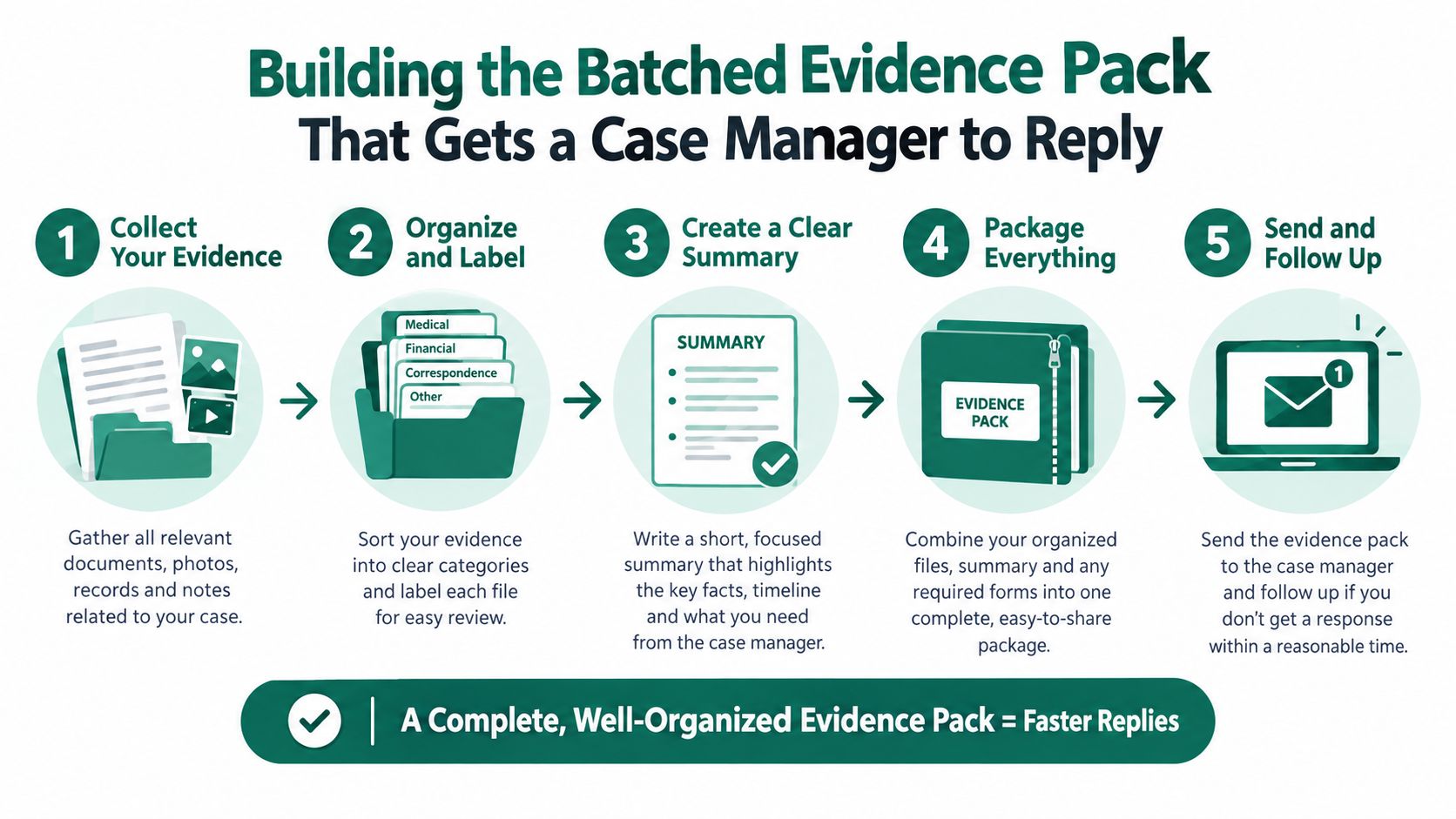
The outbound script should be firm and narrow. Open as a provider dispute, identify the exact Data iSight reduction, attach the benchmark, and ask for claim reprocessing by Cigna. If the claim is still inside the appeal window, use it. If the window closed, resubmit cleanly and request a fresh EOB. If the payer offers a special rate verbally, insist on written terms before you accept anything.
We've seen this work on a multi-location New Jersey sports medicine file where Cigna and Horizon both pushed claims that were around $300 down near $100. The payer stopped treating it like a one-off once the team sent a batched file showing the same pattern across multiple dates and locations. Volume changes the conversation because the case manager has to answer for a trend, not a single line.
Practical rule: the file should be built so the payer can settle it, not just review it.
Security matters too. These packets usually move through multiple hands, so secure handling of remittances, notes, and PDF exhibits is not optional. If your team still shuffles attachments around casually, secure PDF handling for hospitals is a useful reminder of how much exposure sloppy document handling creates.
Realistically, the first meaningful response should arrive inside 45 to 90 days. Inside that window, you want acknowledgment, a case number, a document request if needed, and then a written decision or settlement movement. If nothing happens, the batch was too small or the packet was too thin.
For a practical checklist on assembling the appeal package, see this out-of-network appeal package template for providers.
Escalation Paths When Cigna Refuses to Reprocess
If the first appeal stalls, don't keep mailing the same packet. Escalate with a decision tree, not with hope.
The payer path
Cigna's provider dispute process generally gives 180 calendar days from the initial payment or denial for the first-level dispute, and 60 calendar days from the first-level decision for the second-level review. Those are the windows that matter for most files, and they're easy to miss when the office assumes someone else is tracking them. California is an exception to watch because some disputes there can run on a longer 365 calendar day timeline under state-specific policy.
The federal and state pressure points
Federal Independent Dispute Resolution under the No Surprises Act is only useful when the claim is eligible under NSA rules. That means you don't waste weeks trying to force IDR on a file that isn't in the program. For many out-of-network PT claims, the better pressure point is the provider dispute track first, then the state route if the claim and jurisdiction support it. For a detailed view of when IDR can be used, this federal IDR process guide is the cleanest starting point.
For New York and New Jersey practices, regulator complaints can also move an insurer when the payer has gone quiet. New York tends to be more rule-driven, New Jersey more documentation-driven, but both care about whether the claim was repriced, whether the practice had notice, and whether the payment matched the plan terms. That's why the remittance, plan language, and denial history all need to travel together.
A clean resubmission can also restart the conversation when the original appeal window is dead. Correct the coding if the coding was weak, clarify the network status if the claim was misclassified, and request a fresh EOB. That move doesn't solve every case, but it gives you another procedural door when the first one is closed.
If you want a broader view of denial escalation strategy, this medical billing denial management guide is a useful companion.
What the Recovery Engagement Actually Looks Like
The practice owner signs off on a claim batch, a document request list, and a dispute strategy. The front office doesn't start calling patients, and nobody has to play telephone with the member if an assignment of benefits is already on file and the claim is being pursued as a provider dispute with payer records and remittance support.
That matters because owners usually worry that recovery work creates patient friction. It doesn't have to. The cleanest files stay inside payer and provider channels, with the patient out of the loop unless the plan structure requires a member-level appeal or the AOB is missing. In the files we've seen, the fastest progress comes when the practice owner stops thinking in terms of “one claim at a time” and starts thinking in terms of “recover the whole repricing pattern.”
The economics are simple. Fees are contingency-only, they depend on claim age and volume, and a clear number comes only after a free underpayment analysis. That's the right way to price recovery work because a stale file with a small balance behaves differently from a fresh batch with a broad variance. No serious operator should buy this on blind faith or on a flat guess.
For an owner, the test is whether the engagement improves accounts receivable and lowers the denial rate without dragging staff into more work. If the recovery file is built correctly, the payer spends less time dismissing claims and more time paying them, which is exactly what your practice needs when repricing has been shaving visits for months.
If you're trying to decide whether to outsource this or keep it in-house, look at the leakage first. If your team can't isolate repriced visits quickly, can't build a benchmark exhibit, and can't keep deadlines straight, the issue isn't effort. It's bandwidth and process.
Questions PT Practice Owners Ask Before They Sign Anything
Why is Cigna harder than Aetna on these claims
Cigna usually pushes harder on repricing disputes because the company is more likely to treat the payment as final unless you prove the repricing authority problem with plan language and claim-specific documentation. Aetna often engages more readily after payment when the packet shows a clear gap. The runaround isn't permanent, but it is predictable, and the way out is a batched file with enough financial weight to force a response.
Do we need to call patients before we can recover these claims
No, not if the assignment of benefits is on file and the claim is being handled as a provider dispute with the payer record, remittance, and plan language. If you do need a member-level appeal, that becomes a different path, but that's not the default for a provider-side repricing challenge. Good documentation protects the front office from becoming the messenger.
How many underpaid claims make a batched case worth opening
Ten or more is where the economics start to change. Below that, the case manager can shrug it off as noise. Above that, especially when the same CPTs and the same repricing pattern repeat, the payer has to treat it like a portfolio issue.
When is federal IDR actually an option for a New York or New Jersey PT practice
Only when the claim fits the No Surprises Act eligibility rules. If the out-of-network PT claim doesn't fit NSA coverage for the dispute pathway, IDR is a dead end and you lose time. In those cases, provider dispute, second-level review, state complaint routes, and a clean resubmission usually give you a better shot at payment movement.
If your team wants help using automation without handing over judgment, AI for allied health admin is a useful lens on where software can support the work and where humans still need to own the decision.
If your Cigna out-of-network visits are getting repriced by Data iSight, stop treating them as isolated denials and start treating them as recoverable underpayments tied to contract authority. Happy Billing can review the repricing pattern, quantify the leakage, and help you decide whether the file is worth batching now or letting age kill the upside. Request a free out-of-network underpayment analysis and we'll show you where the money is hiding.