Aetna Out-of-Network Underpayment Appeal Guide for Healthcare Providers
Aetna's initial payment isn't always the final payment. For an out-of-network claim, the practice can often improve its position by identifying the exact product and jurisdiction, proving the pricing variance line by line, and choosing the correct escalation route. A generic reconsideration letter rarely changes revenue, denial rate, or A/R days. A controlled appeal workflow can.
Happy Billing is a medical billing company headquartered in Houston, Texas. We recover out-of-network underpayments for physical therapy, chiropractic, sports medicine and behavioral health practices, including practices in New Jersey and New York.
Why Aetna Out-of-Network Underpayments Hurt Practice Revenue and What to Do First
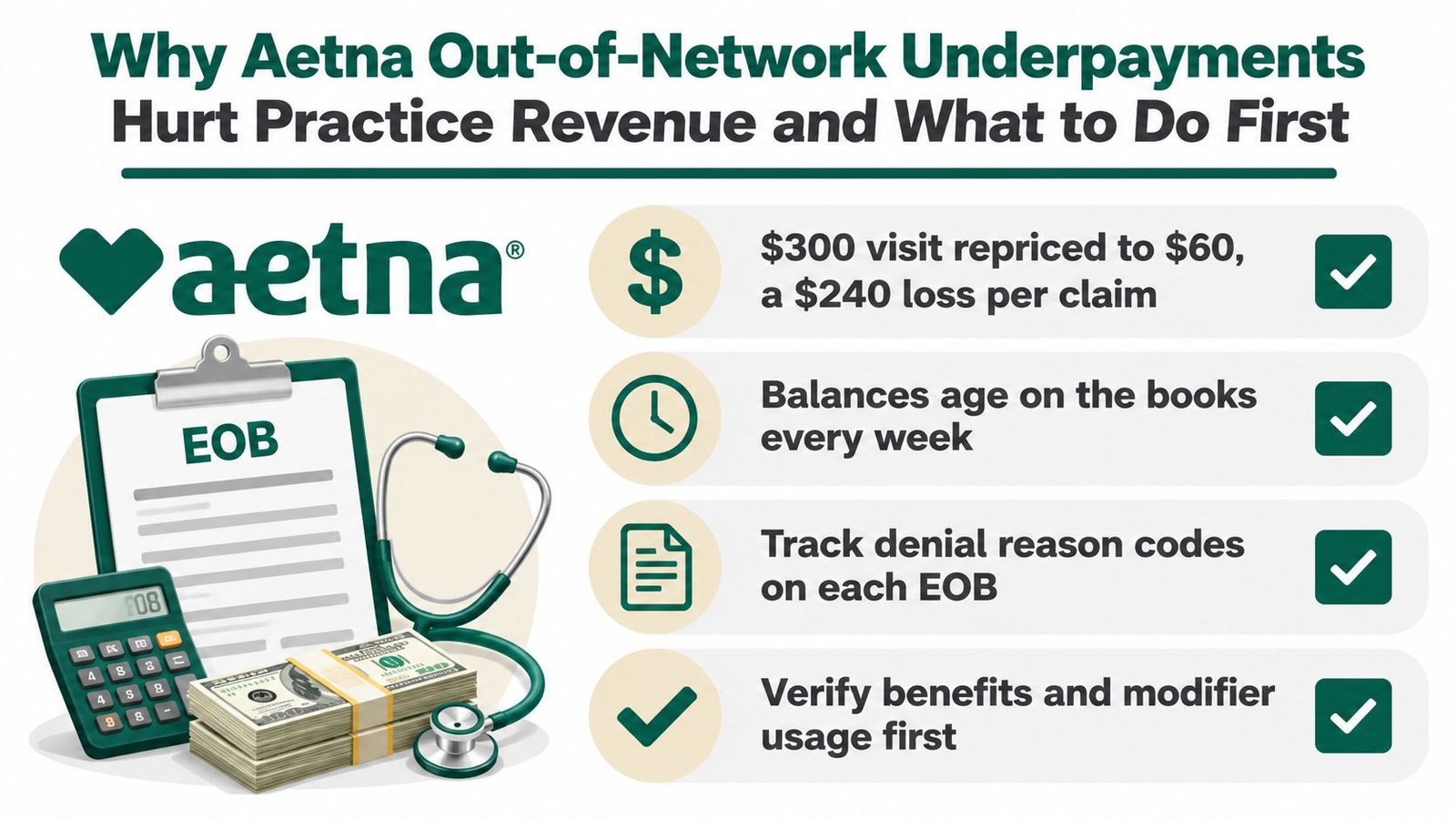
When Aetna pays $60 on a $300 out-of-network visit, the practice loses real revenue every week that balance remains unresolved. Multiply that variance across recurring visits, locations, and clinicians, and your net collection rate falls while A/R days rise. The underpayment may not appear as a denial, which makes the leakage harder to see in a standard denial report.
The first mistake is writing an appeal before confirming that the claim belongs in the appeal queue. We start with production-readiness triage, because the wrong product, missing assignment of benefits, or expired deadline can defeat a strong payment argument.
Confirm the claim can be pursued
Check these items before preparing a letter:
- Assignment of benefits: Confirm that an AOB is on file. When it is, the practice can pursue the payer without asking the patient to participate in the payment dispute.
- Plan identity: Separate commercial, Medicare Advantage, Medicaid, self-funded ASO, and fully insured claims. The Aetna name alone doesn't identify the governing process.
- Jurisdiction: Record the state, plan administrator, and funding status. Fully insured plans may be subject to state insurance oversight, while self-funded plans generally follow federal ERISA procedures.
- Payment trigger: Capture the remittance or EOB date, claim number, date of service, billed amount, payment, adjustment, and patient responsibility.
- Remark codes: Pull the complete EOB or ERA, not a payment-posting summary. The remarks often reveal whether a repricer, network rule, or administrative edit affected the allowed amount.
Practical rule: Never let staff classify every low Aetna payment as the same type of dispute. First identify the product, funding arrangement, jurisdiction, and payment mechanism.
That discipline resembles other insurance workflows where missing evidence creates avoidable exposure. Practices that handle multiple risk categories may also benefit from reviewing why cyber insurance claims fail, because both processes depend on preserving records and meeting procedural requirements.
Use a claim-level work queue, not a shared inbox. A useful starting point is this guide to signs your out-of-network claims are being systematically underpaid. If the same remark code appears across clinicians or locations, you may have a payer methodology problem rather than isolated billing errors.
How Aetna Prices Out-of-Network Claims and How to Read the EOB
Aetna out-of-network pricing usually falls into one of three categories: a plan-defined usual, customary, and reasonable amount, a stated percentage of Medicare, or an outsourced repricing arrangement. The plan document controls the benefit, while the EOB shows how Aetna applied that benefit to the individual claim.
Practices commonly see references to Data iSight, now associated with Claritev, MultiPlan, or Zelis on out-of-network payment documents. The vendor name doesn't prove that the payment is wrong. It tells you where to investigate. Your argument should connect the vendor's allowed amount to the plan language, the relevant benchmark, and the exact line-level variance.
Look for CO-45, which can indicate a contractual obligation adjustment, and N130 or a plan-specific remark that references repricing, discounts, or a network pricing arrangement. Coordination-of-benefits messages can also affect the result. Codes must be read with the full EOB, because the same adjustment code can support different conclusions depending on the payer's remark text and plan structure.
What the payment examples reveal
A Manhattan physical therapy practice billed $540 for one visit using 97140 x2 and 97110 x2. Cigna paid $60 after Data iSight repricing, compared with a prior per-visit range of $300 to $400. This is an anonymized example of the type of payment variance that requires a pricing analysis rather than a coding lecture.
A multi-location New Jersey sports medicine practice saw Cigna and Horizon reprice claims of approximately $300 to approximately $100. Those examples involve other payers, but they illustrate the same operational question for Aetna: did the plan apply a supported out-of-network methodology, or did a repricer produce an amount that conflicts with the plan terms and available market evidence?
| Code | What It Signals | How to Respond |
|---|---|---|
| CO-45 | An adjustment described as a contractual obligation | Compare the adjustment with the plan's out-of-network benefit and identify the pricing basis |
| N130 | A remark requiring additional explanation, sometimes appearing with repricing language | Read the associated payer note and request the methodology used |
| Plan-specific repricing remark | A vendor or network pricing process may have affected the allowed amount | Preserve the EOB, identify the vendor reference, and benchmark the line |
| COB message | Another payer or coordination rule may have affected payment | Verify primary and secondary coverage before arguing the allowed amount |
The operational choice follows the pricing method. Use FAIR Health data to challenge a UCR-based result, use Original Medicare methodology for an eligible Medicare Advantage payment dispute, and consider the state Department of Insurance route when a fully insured plan remains unresponsive. For a practical explanation of the payment document itself, use this guide to read an explanation of benefits.
Building the Documentation Package That Wins Reconsiderations
Aetna reviewers don't need a long story. They need to connect the disputed line to the claim, service, evidence, and requested correction without hunting through an unindexed chart.
Build every package in the same order. That consistency makes recurring underpayments easier to audit across physicians, locations, CPT codes, and plan products.
Assemble the claim file
Start with the EOB or ERA and a line-level variance schedule. Show the CPT code, units, billed amount, allowed amount, payment, adjustment reason, expected amount, and requested correction. Don't argue from total charges alone. Aetna can dismiss a broad demand if the reviewer can't identify the exact payment variance.
Add the original CMS-1500 or UB-04, the 837 transmission trail, claim number, member ID, tax identification number, dates of service, and billing entity. If the issue is a billing error rather than a pricing dispute, decide whether a corrected claim is appropriate. A corrected claim and an appeal are different processing tracks.
Support the service and the benchmark
Include coding and documentation relevant to the disputed line. Examples may include:
- CPT 97110 and 97140: Physical therapy services where units, timed documentation, and modifiers affect the payment review.
- CPT 20550: Injection or tendon-sheath work where the procedure detail and anatomical documentation support the billed service.
- CPT 90837: Behavioral health psychotherapy where the clinician, duration, place of service, authorization, and record must align.
- Modifiers 59 and 25: Attach only when the documentation supports distinct services or a separately identifiable evaluation and management service.
- Modifiers GP, GO, and KX: Reconcile therapy plan-of-care, discipline, and documentation requirements before presenting the line as underpaid.
The clinical record or office note should establish that the service occurred and support the billed coding. It doesn't replace the payment calculation.
Include the applicable contract, plan language, benefit provision, or payment methodology. Then attach a FAIR Health benchmark printout for the same ZIP code and procedure at the 80th and 90th percentiles. The 90th percentile establishes a documented ceiling for negotiation, while the 80th percentile often provides a defensible settlement position.
Aetna's general dispute guidance requires core claim-identification data and permits supporting records through the Availity provider portal, mail, or the address on the denial notice or EOB. Preserve proof of timely filing, including Availity confirmation, fax confirmation, or certified-mail receipt. For administrative support around repetitive evidence collection, a Medical virtual assistant may help organize records, but the financial argument still needs experienced review.
Use this out-of-network appeal package checklist and template for providers to standardize the file. Maintain a deadline tracker keyed to the remittance date, product, jurisdiction, appeal level, submission channel, and response date.
Submitting the Appeal Through the Right Aetna Channel
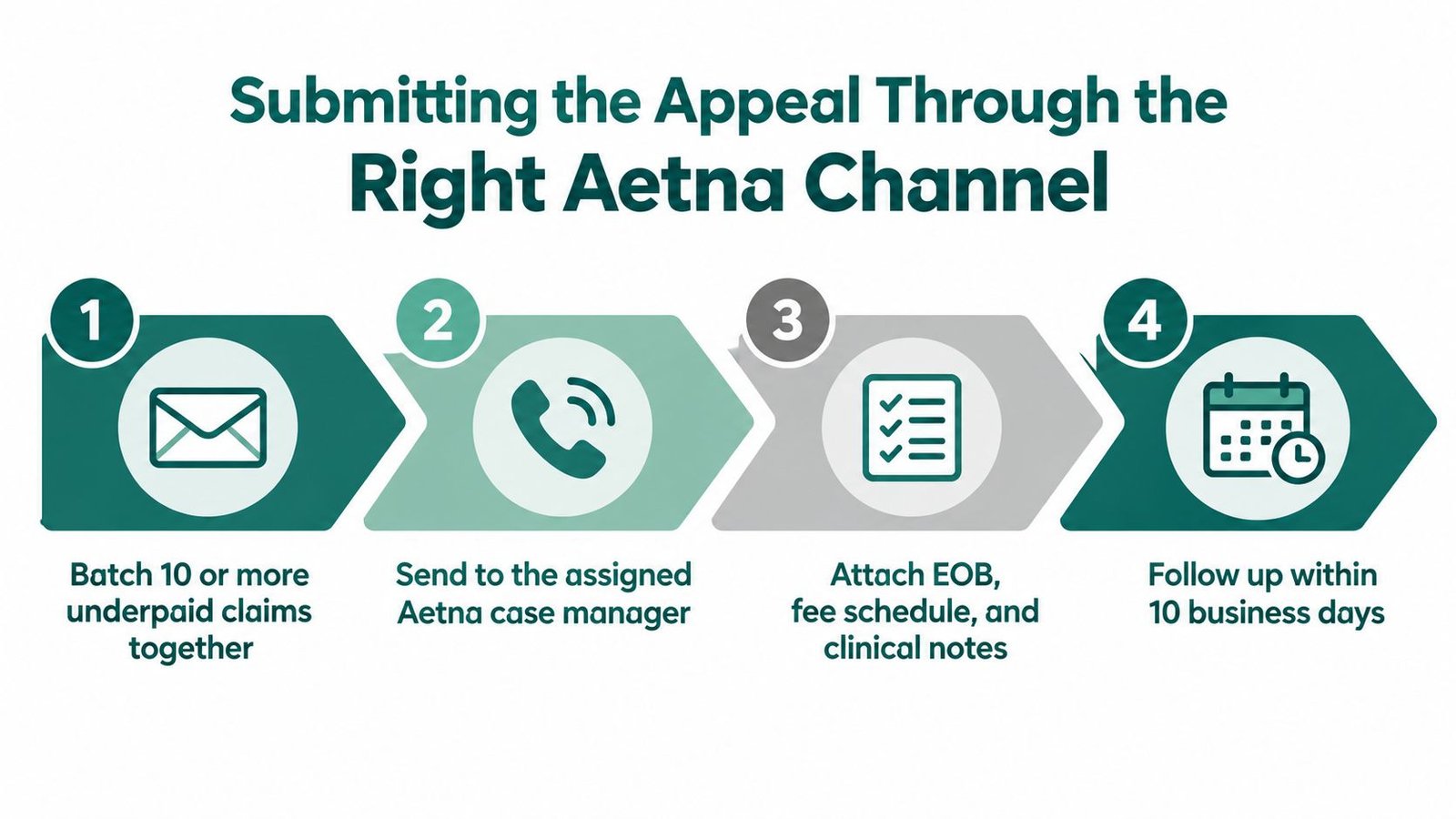
Aetna responds better to a financially meaningful pattern than to isolated complaints. We approach recurring underpayments by batching 10 or more claims with the same pricing issue, product, or repricer reference. The batch should still contain claim-level calculations, because volume gets attention but evidence wins the review.
Start with the Availity provider portal when the applicable Aetna instructions permit electronic submission. Upload a concise cover letter, indexed evidence, EOBs, variance schedule, benchmarks, and supporting records. Use mail or fax when the plan's instructions require them, and send the packet to the address or channel listed on the relevant denial letter, EOB, or product-specific dispute form.
Use the deadline matrix, not a universal Aetna deadline
Aetna's general commercial and Medicare dispute guidance identifies 180 calendar days from the initial claim decision for reconsideration. A general appeal after a reconsideration decision is generally due within 60 days, but the plan, state, contract, or product rule can supersede those defaults. The source for the general process is Aetna's provider disputes and appeals guidance.
For Medicare Advantage, a non-contracted provider generally must submit a written reconsideration within 65 days of the denial notice and include a signed Waiver of Liability stating that the provider won't bill the enrollee regardless of the outcome. The request must identify the beneficiary or enrollee plan ID, health plan, dates of service, and initiator signature. Aetna's published Medicare process is available in its non-contracted provider appeal document.
Aetna Better Health deadlines vary by state and product. Published materials identify examples of 90 calendar days in some Medicaid processes, 60 days in others, and 180 days for Independent Review Entity review in one Illinois Medicare-related process. Aetna's Illinois materials also describe the Medicare Advantage 65-day process. Verify the exact plan and jurisdiction before using any of these periods.
Submitting the right argument through the wrong channel still produces a rejected file.
Record the upload timestamp, confirmation number, fax confirmation, or certified-mail receipt. Follow up with the assigned case manager and ask for a written status. A batch that includes the same EOB language, repricing reference, and variance schedule gives the payer a pattern it can route for substantive review.
Escalation Tracks That Move Aetna After the First Denial
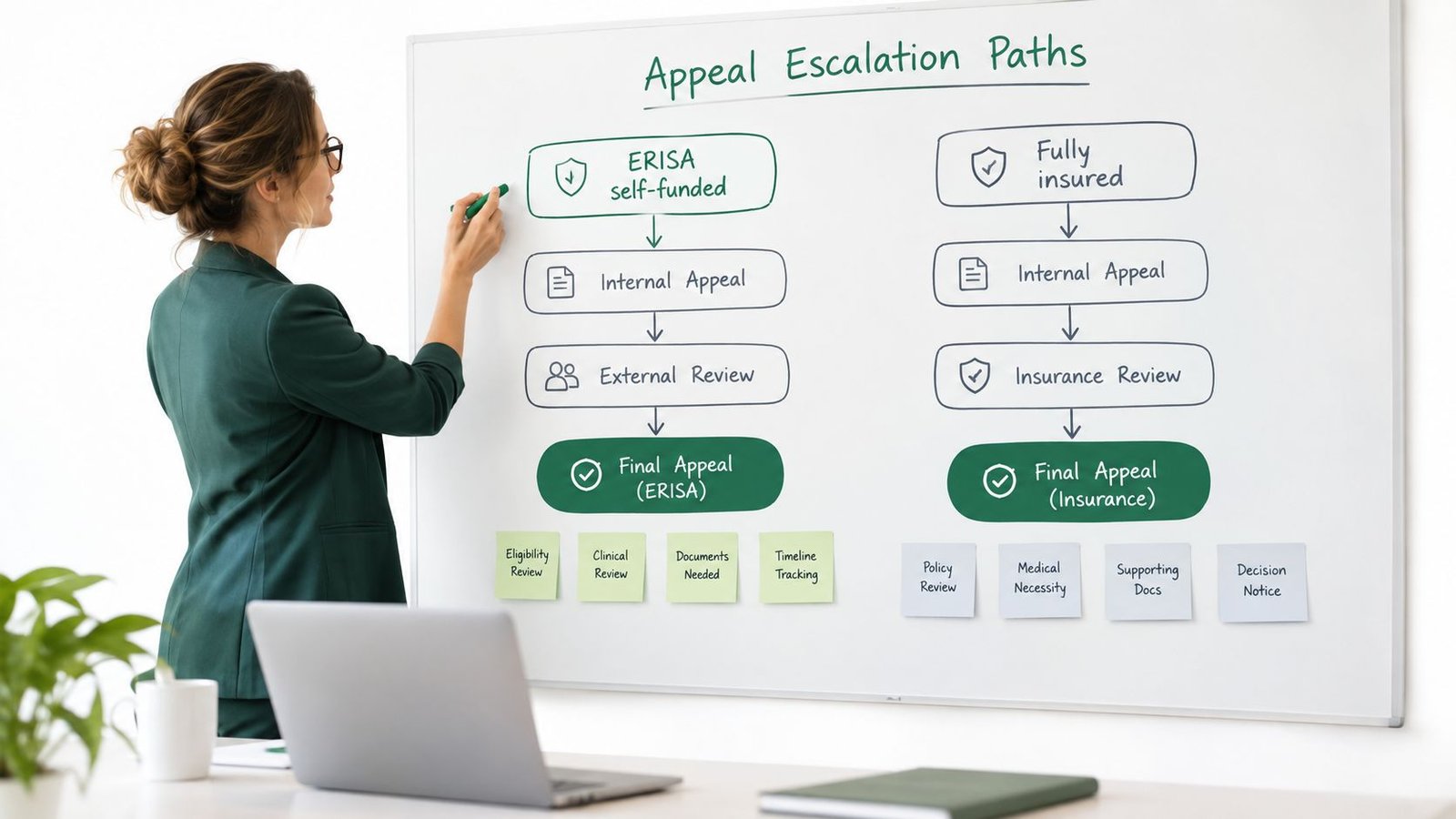
The funding arrangement determines the escalation lane. Treating every Aetna claim as a state-regulated commercial dispute is how practices waste months.
For a self-funded ASO or ERISA plan, the employer plan and its administrator control the governing claims procedure. Aetna may administer the claim, but the practice should obtain the plan document, summary plan description, administrator identity, and formal appeal instructions. Follow the plan's internal process, preserve exhaustion evidence, and identify what the first reviewer failed to address. If the second denial leaves a benefits dispute unresolved, counsel can evaluate the available federal ERISA remedy.
For a fully insured plan, complete the payer's internal dispute process and then consider the applicable state insurance regulator. In New Jersey, that may mean the Department of Banking and Insurance, commonly called DOBI. In New York, the relevant agency is the Department of Financial Services, or DFS. State oversight doesn't guarantee payment, but a well-documented complaint can compel a formal response and clarify the plan's position.
Add clinical and federal escalation selectively
Request a medical director review when the dispute involves medical necessity, clinical documentation, or a clinical interpretation. A peer-to-peer request should name the clinician, summarize the disputed service, identify the unresolved medical issue, and state the requested correction. Don't ask a physician reviewer to resolve a pure arithmetic dispute that belongs with payment operations.
The No Surprises Act can create a separate path for eligible emergency services, certain non-emergency services at participating facilities, and air-ambulance claims. Ordinary Aetna appeal instructions don't establish NSA eligibility. Check the service setting, facility participation, patient consent, QPA disclosure, open-negotiation status, and applicable federal or state pathway first.
For eligible federal IDR disputes, the parties generally have 30 business days for open negotiation, followed by 4 business days to initiate IDR if negotiations fail. The binding decision requires payment within 30 calendar days. CMS describes this sequence in its federal Independent Dispute Resolution guidance.
A clean administrative record matters in every lane. Use this ERISA appeal rights guide for out-of-network healthcare providers to help separate plan-level federal rights from state insurance complaints.
Using FAIR Health Benchmarks to Renegotiate After Payment Posts
The strongest lever is often the one practices never use after posting the EOB: a focused outbound negotiation supported by FAIR Health data. Aetna may be willing to reopen a payment conversation when the request identifies the exact line, demonstrates the variance, and presents a credible local benchmark instead of a demand based only on billed charges.
The Manhattan physical therapy example shows why this matters. The practice billed $540 for one visit, using 97140 x2 and 97110 x2, and received $60 after Data iSight repricing, down from a prior range of $300 to $400 per visit. The New Jersey sports medicine example involved Cigna and Horizon claims of approximately $300 repriced to approximately $100. These are anonymized examples, not guarantees of what Aetna owes on a particular claim.
Build the renegotiation letter around evidence
Use a short cover letter and attach a variance schedule. The letter should state the payment received, the benchmark, the disputed pricing mechanism, and the specific remedy requested.
- 90th percentile: Present this as the documented ceiling for the same procedure and ZIP code. Don't describe it as an automatic entitlement.
- 80th percentile: Use this as a practical settlement reference when the payer wants a negotiated amount.
- Line-level arithmetic: Show units, billed charges, allowed amount, payment, adjustment, benchmark, and requested correction.
- Corrected EOB request: Ask Aetna to reprocess the claim and issue a corrected EOB or written explanation if it declines.
The argument is stronger when it says, “The payment differs from the documented local benchmark and the plan's stated methodology,” rather than, “The payer underpaid us.” That distinction gives a case manager something concrete to investigate.
A payer may negotiate after payment when the documentation exposes a repeatable pricing issue. It may also require a formal dispute, one-time provider dispute, or eligible IDR route. Keep the path aligned with the product and jurisdiction rather than threatening every escalation channel at once.
A realistic working timeline is 45 to 90 days for outbound negotiation and escalation activity, depending on the payer response and the route selected. We don't promise recovery. Fees are contingency-only, depend on claim age and volume, and we give a clear number after a free underpayment audit or analysis.
For broader payment strategy, practices can review this resource on out-of-network reimbursement. The principle is simple: benchmark the claim, document the variance, and ask for a specific correction.
Tracking, Prevention, and Quick Answers for Practice Owners
Aetna underpayment recovery needs an owner-level dashboard, not a spreadsheet that disappears after submission. Track each claim by remittance date, plan type, jurisdiction, deadline, channel, escalation status, and outcome. Add claim number, CPT code, repricer reference, payment received, requested correction, and next action.
Run a monthly audit of out-of-network EOBs against the original claims. Catching a variance while the applicable appeal window remains open gives the practice more options than discovering it after A/R has aged.
Use a prevention checklist
- Verify benefits: Confirm out-of-network benefits and pricing language before the visit.
- Capture the AOB: Preserve the assignment so staff don't need patient involvement for a payer payment dispute.
- Request the QPA: Ask for the qualifying payment amount in writing when the No Surprises Act may apply.
- Benchmark early: Compare high-volume repriced lines with FAIR Health before the EOB arrives when the workflow allows it.
- Separate the issue: Distinguish coding corrections, medical necessity, authorization, network status, and pure payment variance.
Automation can help with exception queues and deadline tracking. Practices evaluating that category can see how TOOLii helps clinics, but no software substitutes for correct plan classification and payer-specific review.
What practice owners ask before escalating
How do I tell a true underpayment from a contractual adjustment?
Compare the EOB with the plan language, network status, repricer reference, and benchmark. A difference between billed charges and payment isn't automatically recoverable. The claim becomes an appeal candidate when the payment conflicts with the applicable methodology, benefit, or documented processing facts.
What should I do when a self-funded ERISA plan refuses to negotiate?
Request the formal plan appeal procedure, plan administrator identity, governing documents, and written explanation of the decision. Follow the exhaustion requirements, preserve every submission record, and obtain legal advice when evaluating federal ERISA remedies.
Is a Waiver of Liability required for every Aetna appeal?
No. The signed waiver is a specific safeguard for non-contracted Medicare Advantage reconsiderations. Confirm the exact Aetna product and jurisdiction before attaching or omitting it.
How long does Aetna underpayment recovery take?
A realistic negotiation and escalation timeline is 45 to 90 days, but the product, deadline, evidence quality, and payer response control the outcome. A complete batch with documented receipt and line-level arithmetic moves faster than repeated generic letters.
Request a free out-of-network underpayment analysis to identify Aetna payment variances, product-specific deadlines, repricer patterns, and the strongest escalation lane. Fees are contingency-only, depend on claim age and volume, and we give a clear number after the analysis.
Happy Billing can audit Aetna out-of-network payments, separate true underpayments from supported plan adjustments, and build the documentation and escalation workflow around your product and jurisdiction. Visit Happy Billing to request a free out-of-network underpayment analysis and see which claims deserve action.