Horizon BCBS New Jersey Out-of-network Appeal Process for Healthcare Providers
Providers must file the DOBI Health Care Provider Application to Appeal a Claims Determination within 90 calendar days of Horizon's determination on fully insured plans, or that revenue is gone. Horizon also gives providers a separate 30-calendar-day response window for a first-level HCAPPA appeal, so the money is often won or lost on calendar management, not clinical merit alone.
About Happy Billing: We are a medical billing company headquartered in Houston, Texas. We recover out-of-network underpayments for physical therapy, chiropractic, sports medicine and behavioral health practices, including practices in New Jersey and New York. We review your remits, find the underpaid claims, and handle the appeals. Get a free underpayment analysis.
That timing gap is the part most practices miss. A claim can still be inside a longer filing period and still be unrecoverable if the appeal deadline slips, which is why the Horizon BCBS New Jersey out-of-network appeal process for healthcare providers has a direct impact on A/R days, denial rate, and net collection rate. In our experience, the practices that treat this as a revenue workflow, not a clerical errand, recover more of what Horizon underpays.
The Hidden Revenue Leak in Horizon BCBS New Jersey OON Claims
Ignoring a Horizon out-of-network underpayment because it looks small is expensive. The write-off is rarely just the single line item, it's the downstream effect of letting a recoverable balance age until it becomes a permanent adjustment.
The problem is operational. Every unresolved Horizon OON claim adds friction to your A/R days, and when the team doesn't have a disciplined appeal path, those balances get buried under new volume. That's where the appeal process becomes a cash-flow tool instead of a compliance chore.
For a specialty-specific walkthrough, see chiropractic out-of-network underpayment recovery in New Jersey.
Why the 90-day filing rule matters more than most owners realize
For fully insured plans, Horizon requires the DOBI Health Care Provider Application to Appeal a Claims Determination within 90 days of the insurer's determination, and first-level HCAPPA appeals get a written response within 30 calendar days of receipt, with submission mailed to the Newark Appeals Department (Horizon claim payment determination appeals). That creates a hard front-end deadline and a measurable back-end wait, which is exactly the kind of process that can easily swell receivables if nobody owns it.
Practical rule: if your staff waits for the claim to age before reviewing Horizon underpayments, you've already cut into recovery odds.
The better approach is to build a payer-specific queue for Horizon claims as soon as the EOB posts. That queue should separate clean reimbursements from underpayments that deserve an appeal, because not every denial is worth the same effort. We've seen practices improve cash recovery by treating Horizon as a priority payer for appeal tracking rather than letting it sit inside a generic denial bucket.
If you're still sorting out whether a recurring Horizon issue belongs in workflow cleanup or outsourcing, start with this out-of-network reimbursement recovery guide. A focused review can show whether the leak is in appeal timing, routing, or documentation.
Why this payer behaves differently from standard commercial plans
Horizon isn't just another commercial carrier with a different fax number. Its provider rules split formal appeals, out-of-network disputes, BlueCard routing, and DOBI escalation into different paths, and each path changes the revenue outcome.
That matters because the same claim can be underpaid for more than one reason. One line may be appealable as a claim payment determination, another may require a different dispute route, and a third may need a complaint-level escalation if the procedural handling was wrong. Practices that assume every Horizon underpayment is a simple denial usually spend more time chasing the wrong remedy.
The strongest revenue play is to stop thinking in terms of “denied or paid” and start thinking in terms of recoverable, appealable, or nonrecoverable. That frame alone helps practice owners and administrators assign the right staff, the right deadline, and the right follow-up.
Navigating Horizon's Unique OON Pricing and BlueCard Routing
Horizon's out-of-network dispute process is tied to New Jersey's Out-of-Network Consumer Protection, Transparency, Cost Containment and Accountability Act. Horizon's provider forms also make clear that inadvertent or involuntary services can fall into this framework, including services delivered by an out-of-network provider at an in-network facility or out-of-network services at an in-network facility without the patient's informed consent or choice (Horizon appeal and dispute forms).
That structure matters because the appeal path changes depending on what kind of claim you're holding. A practice that submits the wrong packet loses time, and time is the one thing Horizon's filing rules do not forgive.
Know which claim bucket you're in before you appeal
A clean internal workflow starts with classification. If the claim involves a standard provider payment determination, the DOBI form and the 90-day appeal clock are central. If the claim involves a BlueCard member or a partially paid out-of-network item, the routing rules can change the paperwork and the mailing path.
Horizon is more procedural than most practices expect. If the claim lands in the wrong queue, the appeal may never reach the reviewer who can actually fix the payment.
For out-of-state members, the BlueCard distinction is especially important. Horizon's guidance says partially paid claims in that context must be appealed by mail using a specific BlueCard Claim Appeal Form, and reimbursement may still not come from the local plan. That means the claim can be right on the merits and still be mishandled if the submission path is wrong.
Horizon BCBSNJ Appeal Routing Matrix
| Claim Type | Member Status | Required Action |
|---|---|---|
| Claim payment determination | Fully insured Horizon member | File the DOBI Health Care Provider Application to Appeal a Claims Determination within 90 days |
| Partially paid BlueCard claim | Out-of-state member | Appeal by mail using the BlueCard Claim Appeal Form |
| Inadvertent or involuntary OON service | Member treated at in-network facility | Use the dispute framework tied to New Jersey OON rules |
| Ancillary-provider inquiry | Provider-specific inquiry | Follow Horizon's inquiry rules and timely filing limits |
When a practice gets this matrix wrong, it often loses the first round before anyone reviews the clinical merits. That's why payer routing should be part of front-end training, not just the appeals team's job.
For practices that serve multi-specialty or cross-border patient flows, the operational setup matters as much as the coding. If your office sees frequent cross-state claims, this New Jersey out-of-network billing services guide helps frame the administrative work behind the claim flow.
Building the Irrefutable Documentation Package
A strong Horizon appeal starts with a clean paper trail, not a persuasive argument. The package has to show the billed service, the payer's determination, and the exact reason the allowed amount is wrong or incomplete.
The documents that usually need to be in the packet
At minimum, the appeal should contain the completed DOBI Health Care Provider Application to Appeal a Claims Determination, the original EOB, and the clinical notes or records that justify the service level and medical necessity. The billing summary should also show the charge amount, the allowed amount, and the shortfall in a way the reviewer can read in one pass.
A practical package often includes:
- Completed appeal form: Use the correct Horizon or DOBI form for the claim type.
- Original EOB: Show the adjudication, denial code, or partial-payment detail.
- Itemized billing summary: Reconcile charge, allowed amount, and balance.
- Clinical records: Support medical necessity and the level of service.
- Any authorization or intake documentation: Proves the claim belongs in the appeal track, not a benefits dispute.
Practical rule: never make the reviewer hunt across multiple attachments to understand the underpayment. If the logic isn't obvious, the appeal is weaker than it should be.
The common mistake is to over-argue and under-document. Horizon does not need a long narrative if the packet already proves the underpayment. What it does need is clean proof that the claim was handled incorrectly under the rules that apply to that member and that service.
How the filing window should shape your workflow
Horizon's provider guidance for treatment-related claims says the appeal must be initiated on the DOBI-required form within 90 calendar days after the insurer's claim determination, while hospitals have no time limit for making an inquiry (Horizon hospital network inquiries, complaints, and appeals). Horizon also gives ancillary-provider inquiries a different structure, with no general time limit except for claim-specific inquiry limits tied to contract or benefits deadlines.
That split tells you something important. Horizon is not applying one universal workflow to every provider type, so your documentation packet has to reflect the right provider category before you send it. If you're handling a time-sensitive OON balance, the packet should be ready to file, not still waiting on internal chart pulls.
For practices building a reusable packet, this out-of-network appeal package checklist and template is a useful operational reference. It's easier to standardize one clean packet than to rebuild the same appeal from scratch every time.
Calculating Your Loss, a Real-World CPT 97140 Example
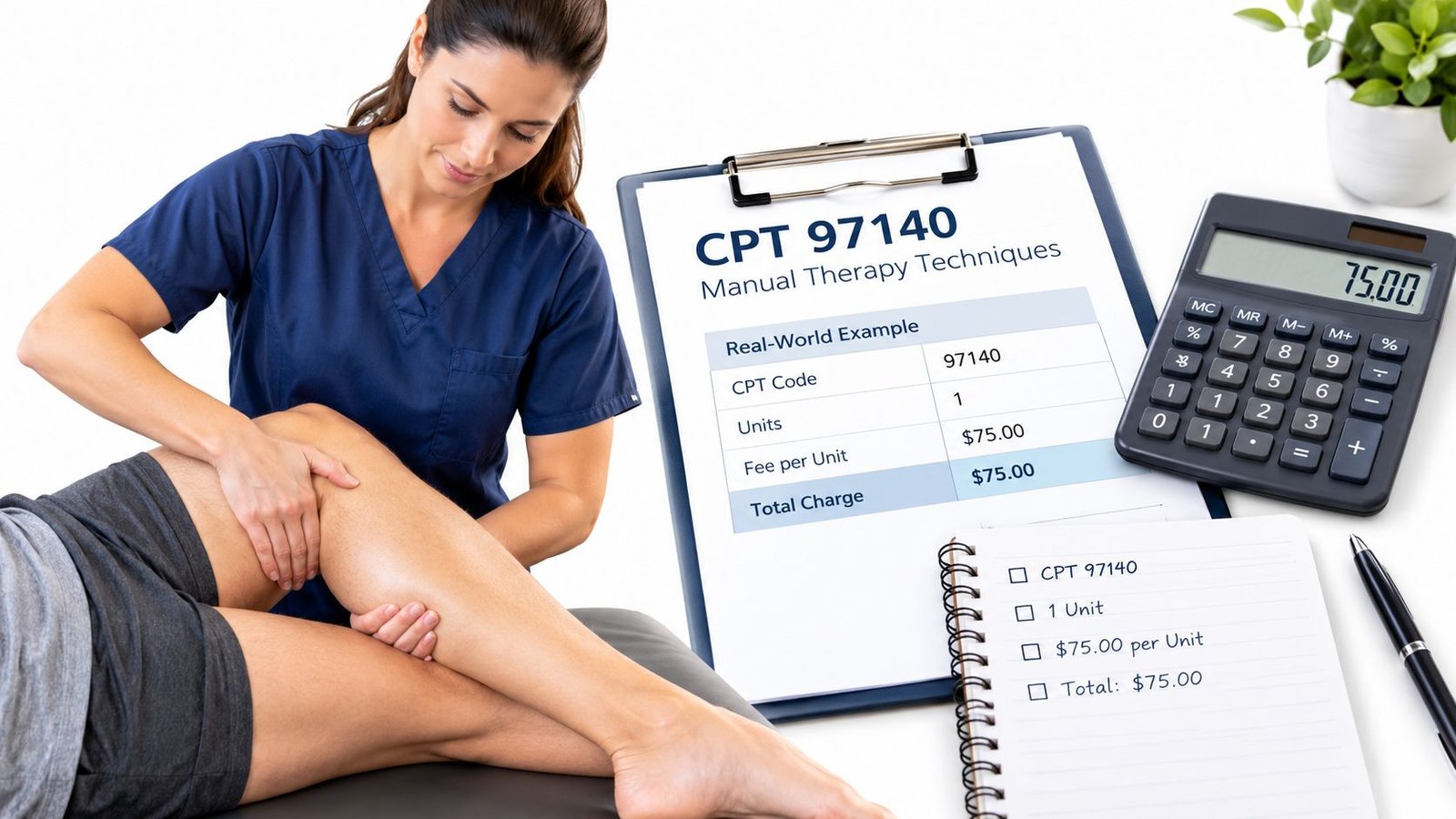
A Paramus practice billing CPT 97140 for manual therapy in 07652 can see the revenue gap immediately when the allowed amount comes back below the usual charge. Even when the exact charge varies by practice, the point is the same, the underpayment is a receivable problem, not just a coding event.
What the math tells the owner
If a Horizon adjudication pays only part of the billed amount, the lost margin sits in A/R until someone appeals it or writes it off. For an out-of-network service, that can happen line by line, which is why one partial payment should never be treated as the whole story.
The claim may also route differently if the member is out of state and the BlueCard process applies. In that case, one line may be recoverable through the appeal form while another still falls into a different handling bucket, and the practice has to track each line item separately.
Why line-level review matters
The biggest mistake is assuming the claim is a single yes-no event. Horizon's BlueCard guidance creates a real risk of partial outcomes, where part of the claim processes and part does not, which means the revenue opportunity is spread across the individual lines rather than the entire encounter.
That's where a disciplined review helps. If the EOB shows a reduction against a procedure like 97140, the appeal should explain why the allowed amount is wrong, why the service was medically necessary, and why the documentation supports the charge. A vague complaint about “underpayment” won't move the file.
For practices that want to pressure-test recurring underpayments against broader repricing behavior, this Data iSight underpayment appeal guide is a useful comparator. It helps owners see whether a low allowed amount is a one-off or part of a systemic pricing pattern.
Where to escalate when the number still looks wrong
If the internal appeal doesn't fix the payment, the next step is not to shrug and post the balance. Horizon's internal appeals department in Newark is one escalation path, but New Jersey's DOBI complaint process is the stronger lever when the payer mishandles the claim or the filing logic.
The value of escalation is influence, not noise. A well-documented complaint tells the payer that the provider has preserved the paper trail and is willing to push the issue through the state process if the internal route fails.
Escalation Pathways, Internal Appeals and DOBI Complaints
When Horizon says no, the file should not stop moving. The smartest practices assign one team member to internal appeal tracking and another to escalation readiness, so the claim never sits in limbo while the filing clock keeps running.
Internal appeal first, then state leverage if needed
Horizon's first-level HCAPPA appeal goes to its Newark Appeals Department, and the insurer's written determination is due within 30 calendar days of receipt if the request qualifies as a first-level appeal (Horizon claim payment determination appeals). That means the first internal pass is structured, time-bound, and worth exhausting before moving outward.
If the appeal is denied or mishandled, the New Jersey DOBI path becomes a separate pressure point. It is not just another version of the same appeal, it's an external complaint channel that can be especially effective when Horizon has applied the wrong rule or ignored the documentation.
Internal appeal asks the payer to reconsider. A DOBI complaint asks the regulator to look at whether the payer followed the rules correctly.
For a clean escalation workflow, it helps to think in terms of escalation criteria. A good resource on sequencing escalation procedures is Resolut's escalation strategies, especially when your team needs a structured trigger for moving a claim from payer follow-up to outside review.
When DOBI is the better lever
DOBI complaints make the most sense when the issue is procedural, not just clinical. That includes Horizon underpayments that appear to ignore the filing timeline, disputes that involve a good-faith estimate problem, and claims that raise No Surprises Act concerns or other regulatory compliance issues.
The complaint route also matters when the claim touches a dispute Horizon should answer directly. In practice, that's often where provider-side complaints become useful, because Horizon's response can clarify whether the issue was a claim edit, a routing error, or a broader processing failure.
For providers dealing with state-level complaints or payer underpayment challenges, this NJ DOBI complaint guide for underpaid out-of-network claims is the right companion reference. The complaint route should be reserved for the files that justify escalation, not used as a substitute for a disciplined first appeal.
The one operational lesson that saves time
The same packet should not be rebuilt from scratch at every level. Use the appeal packet as the source of truth, then add the complaint narrative only where the payer's handling deviated from the rule set.
That saves staff time and preserves consistency. It also makes it easier for ownership to see whether the problem is a one-off claim issue or a repeated Horizon workflow failure.
Frequently Asked Questions for Practice Owners
Is it worth appealing a small Horizon underpayment
If the same denial pattern shows up more than once, yes. Small balances often reveal a larger routing or pricing problem, and the labor to fix the pattern is usually cheaper than repeatedly writing off the same underpayment.
What if the patient partially understood the out-of-network risk
That doesn't automatically make the payer's payment right. If the service falls under the New Jersey out-of-network dispute framework and the claim was handled incorrectly, the documentation and appeal path still matter.
Which claim details does Horizon reject most often
The most common failure point is not the clinical note, it's the mismatch between the claim packet, the correct appeal form, and the correct member-routing path. Partially paid BlueCard claims are especially vulnerable when the wrong mailing route or form is used.
Does the 14-month timely filing window protect me if I miss the 90-day appeal deadline
No, not in the way most owners hope. The timely filing period and the appeal deadline are different rules, and missing the 90-day appeal window can still kill the recovery even if the claim is technically within the longer filing period.
If Horizon underpayments are slipping through your current workflow, Happy Billing can help you isolate whether the problem is routing, documentation, or missed appeal timing. We review the denial pattern, map the appeal path, and show you where revenue is leaking so you can decide whether to fix it in-house or hand it off. Visit Happy Billing to see how we handle provider-side appeal recovery with the same urgency your A/R needs.