United Healthcare Out-of-Network Underpayment Appeal Guide for Providers
The counterintuitive truth is that a UnitedHealthcare out-of-network underpayment often becomes uncollectible because the practice misses an administrative deadline, not because the payment calculation is impossible to challenge. UnitedHealthcare's provider guidance gives providers 12 months for reconsideration and appeal in many circumstances, while other plan documents impose shorter, plan-specific clocks. Missing the applicable deadline can eliminate the practice's right to recover the difference. UnitedHealthcare's appeals guidance
For a physician owner, this is a revenue problem first. Every unresolved underpayment increases A/R, weakens net collection performance, and makes the practice's denial rate look worse than it should. This United Healthcare out-of-network underpayment appeal guide for providers gives you a tiered process for identifying the pricing method, preserving appeal rights, building the record, and escalating intelligently.
Happy Billing is a medical billing company headquartered in Houston, Texas. We recover out-of-network underpayments for physical therapy, chiropractic, sports medicine and behavioral health practices, including practices in New Jersey and New York.
Why UnitedHealthcare Out-of-Network Underpayments Hurt Practice Revenue
UnitedHealthcare may process an out-of-network claim correctly under the plan's terms and still use a reimbursement methodology that produces a payment worth challenging. The insurer says out-of-network payment can depend on the member's benefit plan, reimbursement databases, benchmarks, and other methodologies when the No Surprises Act or a state surprise-billing law doesn't apply. UnitedHealthcare's explanation of out-of-network benefits
That distinction matters. A claim can be adjudicated, paid, and still underpaid. If your team posts the remittance and closes the account without comparing the allowed amount against the plan's applicable benchmark, the practice may write off recoverable revenue while the denial and A/R reports appear artificially clean.
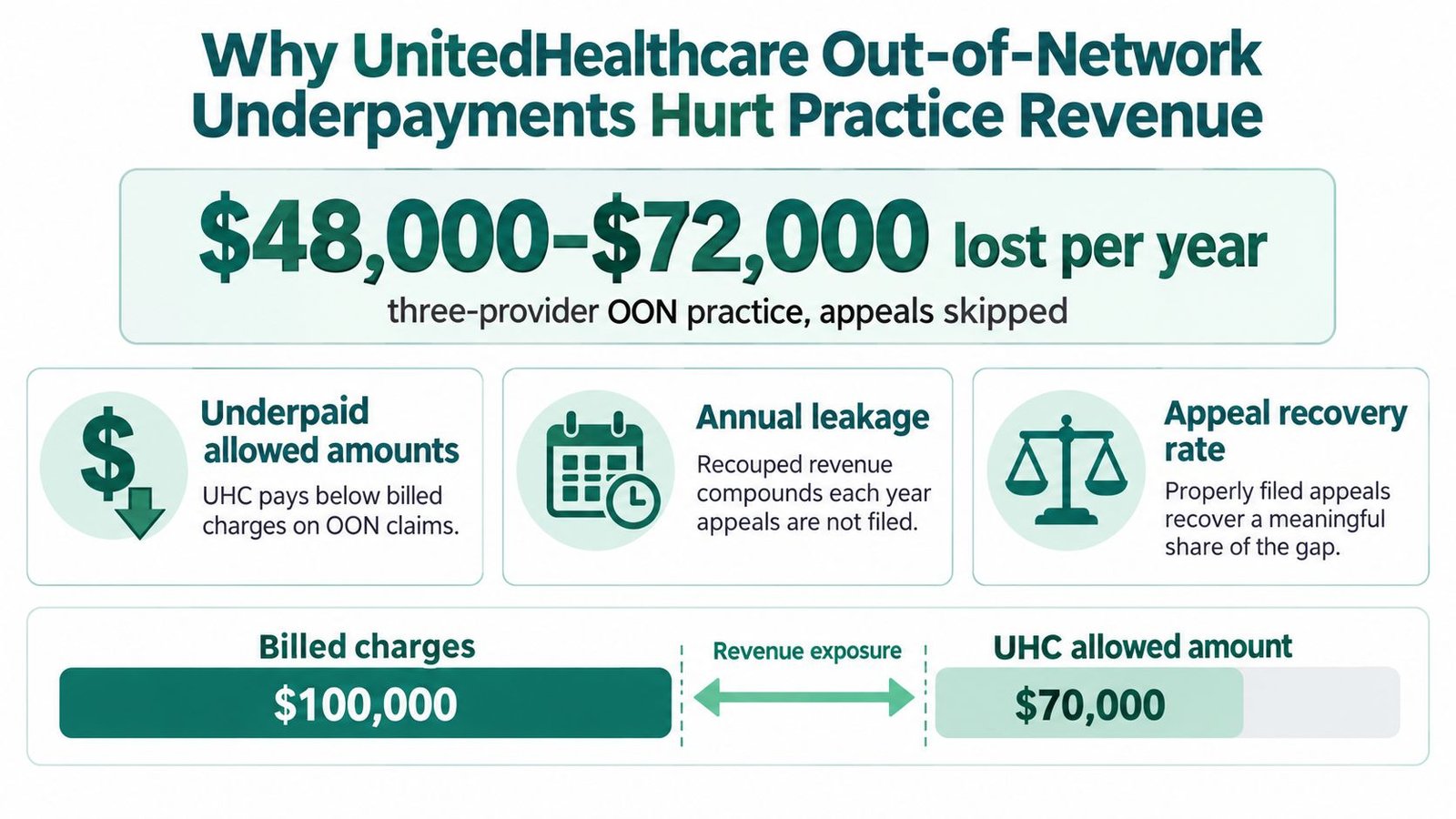
The revenue leak starts with the allowed amount
The relevant numbers are simple:
- Billed charge: What the practice submits for the service.
- Allowed amount: The amount UnitedHealthcare recognizes under the plan's reimbursement methodology.
- Provider payment: The amount remitted after benefit calculations and applicable cost sharing.
- Appealable variance: The difference between the payment supported by the plan and benchmark documentation and the amount paid.
UnitedHealthcare's out-of-network reimbursement FAQ identifies several possible approaches, including a Usual, Customary, and Reasonable standard, the Maximum Non-Network Reimbursement Program, an Extended Non-Network Reimbursement Program where applicable, federal and state requirements, and shared-savings negotiations. UnitedHealthcare's out-of-network reimbursement FAQ
That variety is why underpayments aren't random from a practice perspective. The appeal should identify the methodology, test whether it matches the plan, and show why the resulting allowed amount doesn't support the service, geography, provider type, or applicable legal benchmark.
Practical rule: Never treat an out-of-network payment as final until someone has identified the pricing method and checked the claim against the governing plan language.
The recovery system should run in tiers. First, preserve the deadline and submit a complete reconsideration. Next, pursue the applicable internal appeal. For Medicare Advantage non-contracted providers, compare the payment with what Original Medicare would have paid for the same service, because UnitedHealthcare identifies that comparison as the relevant benchmark for these disputes. If the plan is self-funded, inspect the plan documents and ERISA rights. If internal review fails, evaluate the appropriate external or regulatory route.
How UnitedHealthcare Sets Out-of-Network Allowed Amounts
UnitedHealthcare doesn't use one universal out-of-network formula. The plan document, product type, state requirements, and claim circumstances determine which methodology applies. Your appeal should therefore begin with a pricing audit, not a generic statement that the claim was underpaid.
The pricing levers that matter
Usual, Customary, and Reasonable pricing may rely on reimbursement data associated with a geographic area and service. The weakness is that a narrow or stale data set may not reflect a specialty practice's actual market, especially where a service is performed by relatively few providers.
Medicare-based methodologies can produce a reasonable amount tied to Original Medicare rather than the practice's billed charge. For a non-contracted Medicare Advantage provider, the payment comparison should start with the amount Original Medicare would have paid for the same service, as described in UnitedHealthcare's Medicare Advantage dispute guidance. UnitedHealthcare's Medicare Advantage non-contracted provider dispute rights
Repricing and database labels require careful verification. A remittance or explanation of benefits may reference a repricer, a reimbursement program, a database, or a negotiated reduction. Don't assume that a product name alone proves the methodology was valid. Request the calculation, identify the source used, and compare it with the plan's out-of-network language.
No Surprises Act pricing is a separate issue. Where the federal law or a state surprise-billing law applies, the appeal strategy may involve the qualifying payment amount and the independent dispute resolution process. Where those protections don't apply, the plan's language and UnitedHealthcare's stated reimbursement methodology become more important.
For example, CPT 29881 with the appropriate laterality and documentation could be paid using a methodology that doesn't account adequately for the practice's geography or service setting. The point isn't to assume a particular dollar result. The point is to obtain the actual calculation and test it against the plan, the claim record, and a defensible external benchmark.
| Pricing Method | How It Calculates Allowed | Common Underpayment Pattern | Best Appeal Counter |
|---|---|---|---|
| Usual, Customary, and Reasonable | Uses a customary charge methodology tied to applicable data | Geographic or specialty data may not reflect the service | Provide geographic, specialty, and benchmark evidence |
| Medicare-based methodology | Uses an Original Medicare-related benchmark or formula | Payment may ignore the commercial value of specialized care | Compare the paid amount with the applicable Medicare benchmark and plan terms |
| Maximum or Extended Non-Network Reimbursement Program | Applies a plan-specific reimbursement program | The remittance may not explain the calculation clearly | Request the methodology and show why the plan language was misapplied |
| Shared-savings negotiation | Applies a negotiated reduction to billed charges | The reduction may be treated as if it were the correct allowed amount | Challenge the calculation and document the provider's nonparticipating status |
| NSA or state surprise-billing methodology | Uses legally defined payment and dispute mechanisms | The claim may be routed under the wrong process | Establish whether the service qualifies and use the required dispute path |
Keep the filing clock separate from the pricing analysis. UnitedHealthcare timely filing limits and appeal deadlines should be reviewed against the specific EOB, provider agreement, product type, and state guide before anyone waits for more data.
Building the Appeal Package and Meeting UHC Deadlines
A successful underpayment appeal gives UnitedHealthcare a complete payment case, not a complaint about a low check. The reviewer should be able to verify the claim, identify the pricing method, compare the payment with the applicable plan terms, and approve a specific adjustment without rebuilding the file.
Assemble the record before submission
Start with the original claim and itemized bill. Include revenue codes, CPT or HCPCS codes, diagnosis codes, and valid modifiers such as -QK, -QY, or -SG when they accurately describe the service and setting. Use a modifier only when the clinical and billing record supports it. An unsupported modifier creates another denial issue instead of improving reimbursement.
Include the operative report or treatment record, medical necessity narrative, and relevant clinical documentation. Add the original EOB or ERA, the 835 CARC and RARC codes, remittance date, allowed amount, payment, and patient responsibility. These details establish exactly what UHC processed and where the underpayment occurred.
Build the pricing file around the payment source:
- Plan language: Quote the section governing out-of-network reimbursement and identify the product type.
- Methodology evidence: State whether the remittance or plan materials point to Optum, Data iSight, a reimbursement program, a database, a benchmark, or another calculation.
- Benchmark excerpt: Include relevant FAIR Health, Medicare, or legally applicable benchmark evidence. Explain what the benchmark supports without claiming that it controls when it does not.
- Calculation worksheet: Show the billed amount, allowed amount, payment, expected amount under the plan language, and requested adjustment.
- Timeliness proof: Preserve the EOB date, submission date, portal confirmation, fax confirmation, and follow-up correspondence.
Use this out-of-network appeal package checklist and provider template to keep the documents in a reviewable sequence. A clean packet limits avoidable record requests and makes the requested reprocessing amount easy to approve.
Calendar the correct clock
Do not apply one UHC deadline to every claim. Use the product and state to select the governing filing clock.
| Product or claim type | Deadline to calendar |
|---|---|
| Commercial or fully insured | Reconsideration and appeal generally must be submitted within 12 months from the original claim EOB or PRA, unless applicable law or the provider agreement requires another period. See UnitedHealthcare's provider administrative guide. |
| State-specific product | Check the applicable state guide. For Indiana Community Plan claims, the guidance identifies 365 days to submit an out-of-network claim, 60 calendar days for reconsideration after the original remittance, and 60 calendar days for a formal appeal after the original remittance or benefit determination letter. Community-plan disputes may have review periods of 30 calendar days, with some decisions taking up to 60 days. Review the full state process at UnitedHealthcare's Indiana Community Plan claims guidance. |
| Medicare Advantage, non-contracted provider | Use the 120 calendar day dispute window described in the Medicare Advantage dispute-rights guidance above. A denial or different-level-of-service decision may carry a 60-day payment reconsideration deadline. |
Record the deadline on the account, set an internal submission date before it, and preserve the rule used. The 120-day Medicare Advantage dispute period and the 60-day reconsideration period are separate clocks, not interchangeable alternatives.
Submit through the accepted channel
Use the UnitedHealthcare Provider Portal when the plan permits electronic submission. Upload the appeal letter and attachments, capture the confirmation number, and save the complete packet exactly as submitted. If the portal is unavailable or the plan requires another channel, retain fax confirmation or other delivery evidence.
Before filing, verify:
- Claim match: Member, claim number, date of service, provider, NPI, and TIN match the EOB.
- Code support: CPT, HCPCS, diagnosis codes, and modifiers match the medical record.
- Payment math: The allowed amount and payment reconcile to the remittance.
- Methodology: The appeal identifies the pricing approach being challenged.
- Deadline: The applicable product and state rule is documented.
- Relief: The appeal requests reprocessing at a clearly stated, supported amount.
- Receipt: Portal, fax, or other submission confirmation is stored.
Submit first through the accepted portal or channel, then escalate with a focused second-level appeal when the pricing evidence is ignored. A clear record lets the practice challenge the payment source, not just the final dollar amount.
What Most Practices Miss About UMR and ERISA Self-Funded Plans
UMR often administers employer-sponsored self-funded plans, but the employer's plan controls the benefits and appeal rights. The administrator's logo does not tell you how the claim must be priced or reviewed. Treating every UMR claim like a standard fully insured UnitedHealthcare claim can leave a supported underpayment unchallenged.
Start with the plan, not the logo
Request the Summary Plan Description, the governing plan document when available, the provisions addressing out-of-network reimbursement, and the claim's adverse determination. These records can identify appeal levels, document access rights, review authority, and any external review process.
ERISA can change the state-law analysis. State prompt-pay and insurance remedies that may apply to a fully insured product generally do not apply in the same way to an ERISA plan. The practice must follow the rights created by the plan and the applicable federal procedure, rather than rely on a state remedy that may not fit the product.
Ask precise questions:
- What plan provision controlled the allowed amount?
- What methodology produced the payment?
- Was the claim processed under the correct plan version?
- What documents may the provider inspect or obtain?
- What is the next appeal level if UMR upholds the payment?
- Does the plan provide external review for the disputed issue?
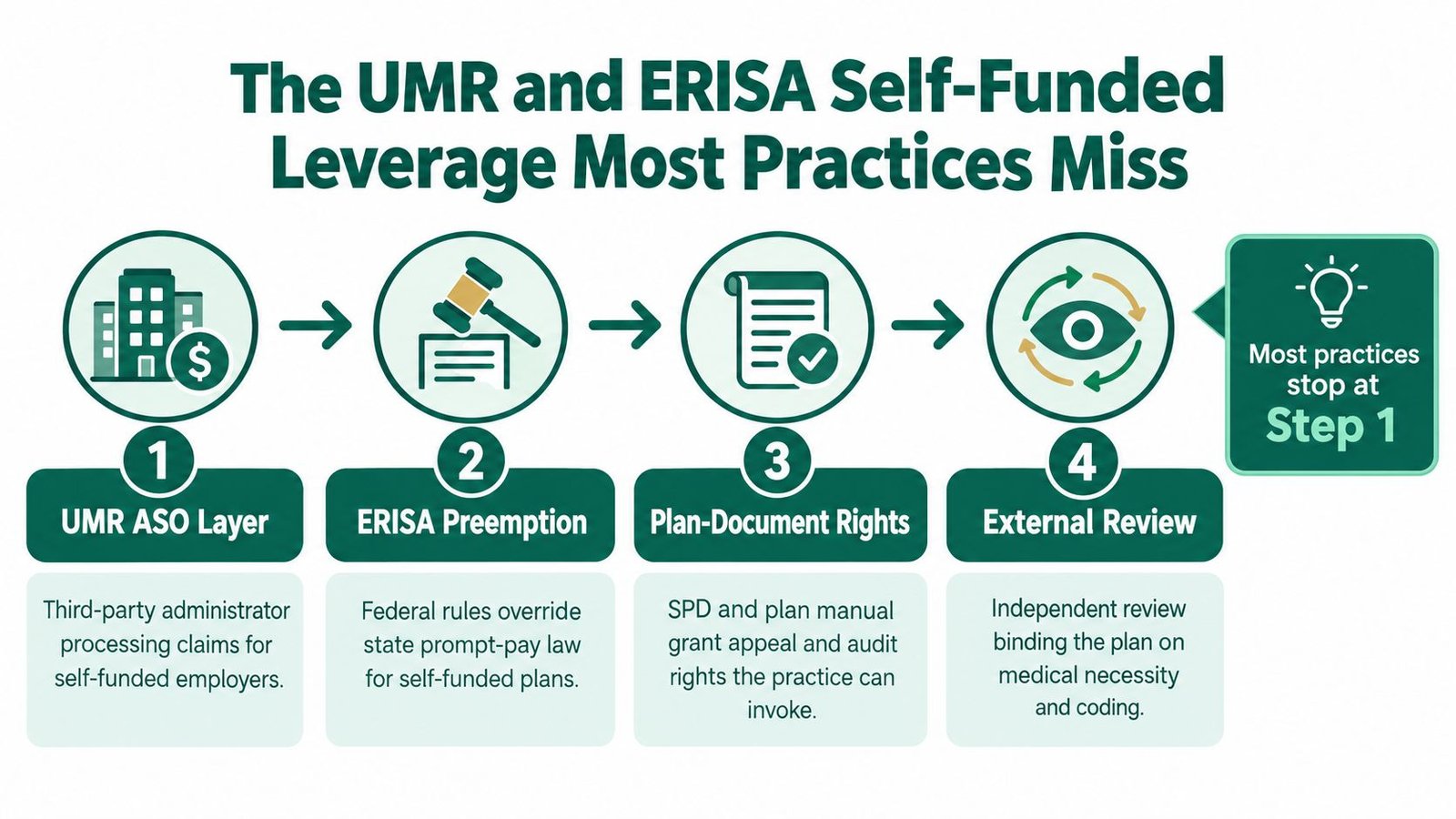
A practice that receives a second remittance showing the same allowed amount often closes the account. The stronger move is to obtain the plan language, identify the fiduciary or formal appeal route, and preserve the record for the next review level.
Separate an administrative processing error from a benefits interpretation dispute. A wrong modifier, duplicate edit, or missing document may be corrected through claim reconsideration. A dispute over the reimbursement formula calls for plan-document analysis and a formal appeal under the plan's ERISA procedure.
Use this ERISA appeal rights guide for out-of-network healthcare providers to organize the federal-plan record. Request clarity about the plan terms, decision-maker, evidence considered, and available review. ERISA does not promise a specific payment. It gives the practice a defined process for challenging how UMR, Optum, or another administrator applied the plan.
A Realistic Numeric Example of an OON Underpayment Recovery
A useful example must show the mechanics without pretending that one claim proves what every UHC claim should pay. Consider a hypothetical orthopedic claim for CPT 27447, with modifier -LT where supported by the record, submitted on a CMS-1500 with the operative report attached.
The practice receives an EOB showing that UnitedHealthcare used an out-of-network allowed amount and paid less than the practice expected under the plan's stated reimbursement language. The practice doesn't appeal merely because the billed charge is higher. It first verifies the plan, identifies the methodology referenced by the remittance, compares the payment with the applicable Medicare or UCR benchmark, and checks whether the service was processed at the correct level.
| Step | Billed | UHC Allowed | Paid to Provider | Variance | Action Taken |
|---|---|---|---|---|---|
| Original claim | Practice charge | Not yet established | Not yet established | Unknown | Submit complete claim and operative documentation |
| Initial remittance | Practice charge | EOB amount | EOB payment | Calculate from EOB | Reconcile allowed amount, benefit calculation, and cost sharing |
| Pricing review | Same billed charge | Compare with plan benchmark | Remittance payment | Identify supported gap | Request methodology and plan-language review |
| First appeal | Same billed charge | Requested corrected amount | Original payment | Document variance | Submit EOB, operative report, plan terms, and benchmark |
| Reprocessed claim | Same billed charge | Revised amount if approved | Revised payment if approved | Confirm adjustment | Post recovery and preserve decision for similar claims |
The claim narrative should be concise and financial. State that the service was billed under the correct CPT and laterality modifier, identify the amount UnitedHealthcare allowed, explain the methodology shown on the remittance, and cite the plan provision supporting the requested recalculation. If the payment was based on a Medicare-related benchmark, show the comparison. If it was based on a UCR or non-network program, request the underlying calculation and explain why the data does not match the applicable plan terms.
Appeal language should answer one question: What specific error caused the allowed amount or payment to be lower than the amount required by the plan?
Track the labor required to prepare the appeal, but don't use labor cost as a reason to abandon high-value claims. Instead, rank claims by recoverable variance, deadline proximity, repeated CPT or modifier pattern, and whether one successful decision can support a broader batch review.
Escalating Through State Regulators When UHC Still Lowballs the Claim
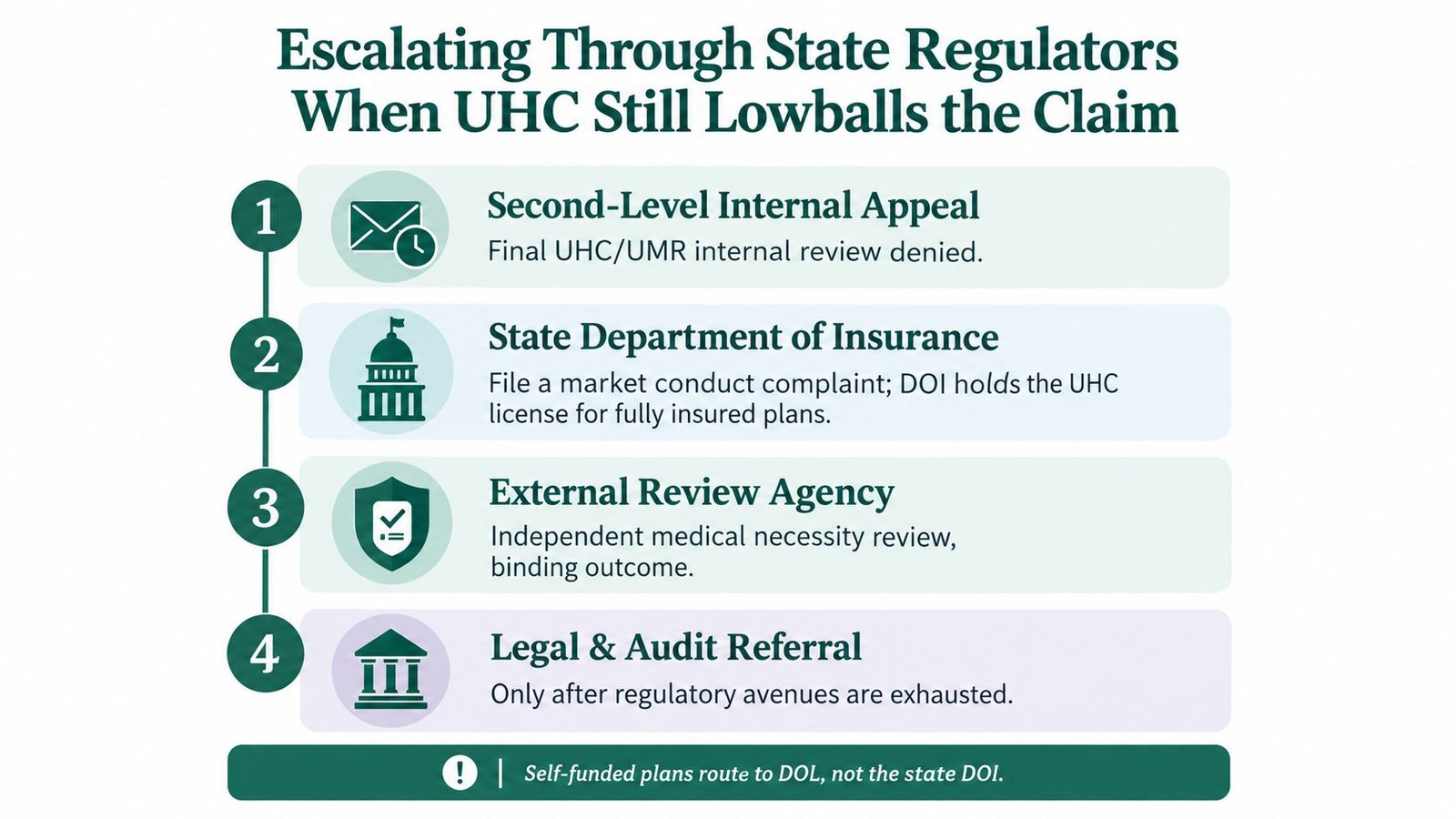
Regulatory escalation is not a substitute for a complete internal appeal. It's a pressure and documentation channel after the practice has established the claim facts, used the available payer process, and determined whether the product is fully insured or self-funded.
For a fully insured plan, the state Department of Insurance may have authority over the licensed insurer and market conduct issues. For a self-funded ERISA plan, the state DOI may not have jurisdiction over the benefit determination in the same way. The employer's plan situs and the applicable federal route matter.
Build the complaint around jurisdiction
The complaint should identify:
- Plan type: Fully insured, self-funded, Medicare Advantage, or Community Plan.
- Claim facts: Member, claim number, date of service, CPT or HCPCS code, billed charge, allowed amount, payment, and variance.
- Internal history: Reconsideration, appeal levels, dates, decisions, and unanswered requests.
- Methodology dispute: The reimbursement approach UnitedHealthcare or UMR used and why it conflicts with the plan or applicable rule.
- Requested remedy: Reprocessing, disclosure of the calculation, correction of the payment, or a written explanation.
A New Jersey practice can evaluate the New Jersey DOBI complaint process for underpaid out-of-network claims. New York practices should review the New York Department of Financial Services process. Texas practices can assess the Texas Department of Insurance route, while California practices must distinguish Department of Managed Health Care products from matters regulated through the insurance department.
Submit a complete regulator file
Attach the denial or underpayment EOB, the relevant plan document or Summary Plan Description when available, every appeal letter, payer responses, proof of submission, and evidence of missed or disputed deadlines. Include a one-page chronology. Regulators respond better to a documented administrative record than to a generalized accusation that the payer underpaid.
For self-funded UMR plans, identify whether the issue belongs with the employer's plan administrator, the Department of Labor, or another applicable federal channel. Don't file a state complaint without first checking jurisdiction. A misdirected complaint costs time and can create another missed deadline.
The regulator's role is to investigate within its authority. It may request a payer response or clarify whether the payer followed the applicable process. It doesn't guarantee that the regulator will order the exact amount the practice requests, so preserve all contractual, plan, and appeal rights while the complaint is pending.
Recovery Metrics, Sample Appeal Language, and Next Steps for Providers
Underpayment recovery belongs on the revenue cycle dashboard, not in a miscellaneous claim-cleanup file. Track each UnitedHealthcare claim from the original allowed amount through appeal, reprocessing, and final payment. This shows which pricing paths produce recoveries and where work is being lost.
Track these fields at claim level:
- Payer and product: UnitedHealthcare commercial, Community Plan, Medicare Advantage, or UMR.
- Network status: Contracted, non-contracted, or disputed.
- CPT and modifier: Include laterality, anesthesia, facility, and assistant modifiers when relevant.
- Pricing method: UCR, Medicare-related, non-network program, shared savings, or unidentified.
- Deadline: EOB date, applicable filing date, submission date, and confirmation number.
- Financial result: Original payment, supported expected amount, recovered amount, and unresolved variance.
- Operational result: Denial rate, A/R days, net collection rate, and appeal turnaround.
| KPI | Baseline | Target | Source |
|---|---|---|---|
| Denial rate | Current UHC denial and underpayment classification | Fewer repeat errors by CPT and reason | Practice claim and remittance data |
| Days in A/R | Current aging by UHC product | Shorter aging through deadline-driven work queues | Practice A/R report |
| Net collection rate | Current collections against collectible charges | Higher posted recovery after validated reprocessing | Practice financial statements |
| Gross recovery per appealed claim | Original payment versus recovered payment | Positive variance after appeal labor | Appeal log and remittance |
| Timely appeal rate | Claims submitted within the applicable window | Complete compliance with product-specific deadlines | Portal and submission confirmations |
Use a focused appeal paragraph
The appeal should identify the claim, explain the disputed calculation, and request a specific correction:
UnitedHealthcare processed the attached claim for CPT [code] with modifier [modifier] and issued an allowed amount of [amount] against billed charges of [amount]. The plan's out-of-network language requires payment under [identified methodology or provision]. The attached benchmark excerpt and claim documentation support an allowed amount consistent with [applicable benchmark], while the remittance does not identify a calculation that supports the amount paid. Please reprocess the claim at the correct allowed amount and issue the resulting additional payment.
Use a FAIR Health percentile or plan percentage only after verifying the exact benchmark and plan language for that claim. An unsupported figure gives the reviewer an easy reason to reject the argument. A documented comparison tied to the EOB, plan terms, and pricing methodology creates a specific payment issue that UHC must address.
Review the pricing path before sending the appeal. A reduction may originate in an Optum workflow, Data iSight repricing, a non-network program, or an employer plan administered by UMR. The remedy depends on that path. Commercial claims may require portal submission and payer reconsideration, while UMR claims often require the self-funded plan's ERISA procedure. If internal appeals fail, preserve the record for an ERISA external review or a state Department of Insurance complaint when that regulator has jurisdiction.
Repeat patterns deserve their own work queue. If one UHC product repeatedly reduces a CPT, applies an unsupported modifier edit, or routes claims through an unexplained repricing method, group those claims by product, code, and reason. Do not treat every variance as a new mystery. This guide to writing a medical claim denial appeal letter can help standardize the narrative and attachment order.
For an independent practice, outsourcing makes sense when the internal team cannot meet deadlines, verify pricing methodology, obtain plan documents, and measure recovered dollars. Require a claim-level inventory rather than a general promise to work denials. The free out-of-network underpayment analysis should identify timely UHC claims, repeated pricing patterns, and variances that appear recoverable.
Frequently asked questions
How long do we have to appeal a UnitedHealthcare out-of-network underpayment?
The deadline depends on the product, plan documents, state guidance, and provider agreement. UnitedHealthcare materials identify a 12-month reconsideration and appeal window in its administrative guide. Other guidance identifies shorter deadlines for certain claim types, including 60 calendar days for some reconsiderations and formal appeals. Verify the EOB, plan, and provider guidance before submitting.
Should we appeal a payment that was processed instead of denied?
Yes, when the allowed amount or payment conflicts with the plan's reimbursement language or an applicable benchmark. Identify the methodology, reconcile the EOB, and document the exact variance. A paid claim can still be an underpayment dispute.
Does UMR follow the same process as UnitedHealthcare?
Not necessarily. UMR may administer claims for a self-funded employer plan, making the governing plan document and ERISA procedure controlling. Obtain the Summary Plan Description, identify the formal appeal route, and confirm whether state insurance regulation applies before escalating.
What should a practice owner do first?
Pull UHC and UMR A/R by payer, CPT, date of service, and EOB date. Prioritize claims approaching their deadline, secure remittances and plan documents, then obtain a claim-level review before writing off the variance.
Happy Billing reviews out-of-network payment variances, denial patterns, appeal deadlines, and supporting documentation for independent practices. Visit Happy Billing to request a review that can include a 90-day A/R snapshot, denial-pattern mapping, and a recoverable-dollar estimate.