Sports Medicine Out-of-Network Billing Services in New Jersey

The right sports medicine out-of-network billing services in New Jersey can recover revenue that routine claim submission leaves behind, but the biggest losses rarely come from obvious denials. They come from repricer reductions, incorrect procedure sequencing, missed arbitration windows, and patient-balance activity that violates New Jersey protections. Those errors increase denial rates, A/R days, and revenue leakage at the same time.
New Jersey's rules and payer practices make sports medicine billing a specialized revenue function, not a back-office formality. A practice treating orthopedic injuries, rehabilitation cases, injections, interventional pain episodes, or surgical patients needs a workflow that connects clinical documentation, CPT selection, payer policy, payment variance review, appeals, and escalation.
The Hidden Revenue Leakage in New Jersey Sports Medicine
New Jersey sports medicine practices can lose substantial reimbursement without seeing a conventional denial. A claim may process, generate an explanation of benefits, and still pay below a defensible out-of-network benchmark because a commercial payer or repricer applies an opaque allowed amount. If the practice posts the payment as complete, the underpayment becomes permanent.
Happy Billing is a medical billing company headquartered in Houston, Texas. We recover out-of-network underpayments for physical therapy, chiropractic, sports medicine and behavioral health practices, including practices in New Jersey and New York.
New Jersey has a mature sports medicine industry, a competitive commercial market, and significant out-of-network activity. That combination creates opportunity for independent practices, but it also gives payers and repricers a strong incentive to reduce allowed amounts. Integrated practices that combine sports medicine with physical therapy, chiropractic, occupational therapy, or interventional pain management face an even more complicated payment environment because each service line can carry different network status, authorization rules, fee schedules, and documentation requirements.
The operational question isn't only whether a claim was paid. It is whether the payment reflects the patient's circumstances, the service performed, the applicable law, and a defensible market benchmark. A practice owner who doesn't ask that question may mistake systematic underpayment for normal payer performance.
Where owners usually find the leakage
The most common pressure points include:
- Repricer reductions: MultiPlan, Zelis, and Data iSight, now associated with Claritev, may present a reduced allowed amount supported by proprietary pricing logic that isn't transparent from the remittance alone.
- Mixed network episodes: An in-network facility can include out-of-network surgeons, anesthesiologists, radiologists, assistant providers, or rehabilitation professionals.
- Coding and sequencing errors: A technically correct clinical service can still produce a poor financial result when modifiers, laterality, units, or primary-procedure sequencing are wrong.
- Uncontrolled patient balances: Protected emergency, urgent, or inadvertent out-of-network claims may be placed into patient A/R even though New Jersey restrictions limit what the patient can owe.
A useful starting point is a structured medical billing audit for sports medicine practices. The audit should compare billed charges, payer adjudication, contractual or statutory protections, expected allowed amounts, and the next recovery action. A charge-submission vendor won't perform that work unless its agreement and reporting specifically require it.
Owner-level test: If your team can tell you what was paid but can't explain why that amount was accepted, your payment-posting process is incomplete.
Sports Medicine CPT Codes and Modifier Vulnerabilities
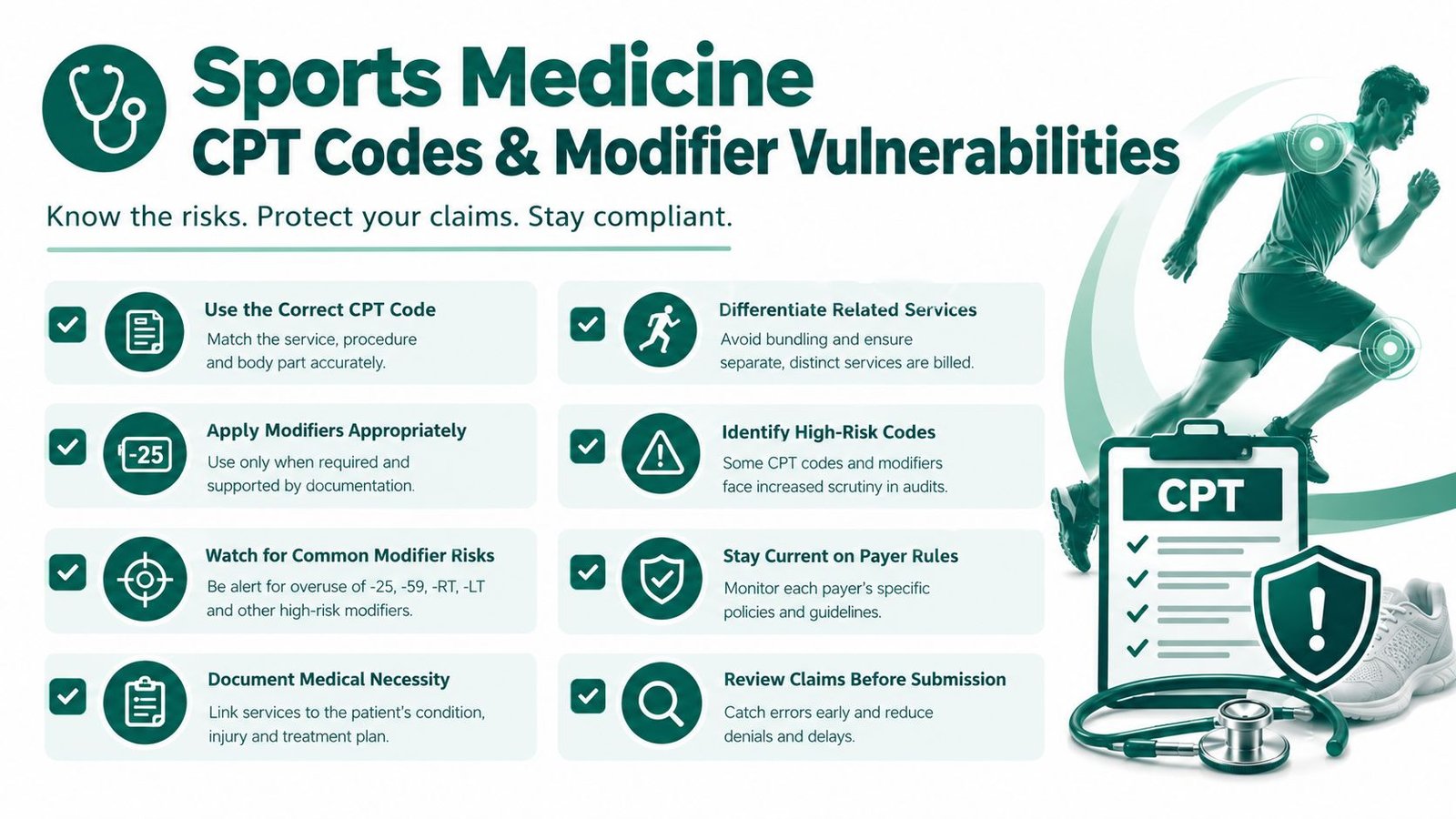
Sports medicine revenue depends on a code mix that looks straightforward until payers apply edits, bundling logic, or repricer reductions. CPT 20610 for a major joint injection, CPT 20550 and 20551 for tendon or ligament sheath and tendon-origin or insertion injections, CPT 97140 and 97530 for rehabilitation services, and CPT 76942 for ultrasound guidance all require the claim to match the clinical record precisely.
The financial risk differs by code. A missed ultrasound-guidance report can reduce payment for a procedure that was clinically performed. A rehabilitation claim with incomplete timed-service documentation can deny or pay below expectation. An injection claim with incorrect laterality, an absent modifier, or inconsistent diagnosis information can enter a payer edit queue rather than producing timely reimbursement.
Build the claim around the episode
For each encounter, the practice should reconcile:
- Procedure details: Confirm the exact service, anatomical site, laterality, units, and whether guidance was separately reportable.
- Clinical support: Match the operative note, injection note, therapy documentation, imaging report, and medical-necessity record to the submitted codes.
- Payer rules: Check whether the plan applies bundling, authorization, global-surgery, or multiple-procedure edits to the service.
- Payment variance: Compare the remittance against the expected allowed amount, not merely against the billed charge.
Fair Health benchmarks for sports medicine codes in the New Jersey metro area can provide useful context for a payment review, but a benchmark isn't a substitute for contract interpretation, statutory analysis, or claim-specific documentation. The practice owner needs a defensible explanation for why the expected amount is reasonable and why the payer's reduction should be challenged.
CMS guidance distinguishes the primary procedure from additional same-day surgical procedures for multiple-procedure reporting. The Medicare Claims Processing Manual states that the more major procedure is reported without modifier -51, while additional surgical procedures performed by the same surgeon on the same day are reported with modifier -51. The CMS multiple-procedure reporting guidance matters to owners because a modifier error can trigger reduced reimbursement, manual review, or a denial across a recurring procedure line.
The primary procedure should be sequenced by relative procedural significance. Additional eligible procedures may require modifier -51, while the more major procedure shouldn't carry it under this rule. Practices should also review whether another modifier, global-surgery rule, or payer-specific edit applies before submission. A repeated sequencing error doesn't stay isolated to one claim. It can inflate A/R days across every operative session using the same charge workflow.
For a deeper procedure-level example, review this guide to knee arthroscopy CPT coding, then ask whether your own operative claims are sequenced and audited before they reach the payer.
Defeating Repricer Underpayment Tactics
A paid claim can still conceal a serious revenue loss. MultiPlan, Zelis, Data iSight, and Claritev may apply proprietary databases or negotiated pricing logic to lower an out-of-network allowed amount. The remittance can make that reduction look routine, even when it conflicts with the service documented, the patient's legal protections, or a reasonable New Jersey market benchmark.
Resubmitting the same charge rarely addresses the cause. A practice needs a payment-variance workflow that identifies the repricer's action, preserves the claim record, interprets the explanation of benefits, and escalates with evidence.
What an effective recovery workflow contains
- Separate the reduction from the denial. Confirm whether the payer denied the claim, applied a repricer, invoked a plan provision, processed the service as in network, or used another reduction method.
- Reconstruct the episode. Gather the claim form, operative or treatment note, diagnosis, laterality, modifiers, authorization records, network disclosures, remittance, and payer correspondence.
- Compare the payment. Review relevant Fair Health information, contract language, New Jersey statutory protections, and comparable claim history to establish the variance.
- Submit a focused appeal. State the service performed, the payment defect, the corrected amount requested, and the evidence supporting it. A generic appeal makes it easier to repeat the original decision.
- Calendar escalation. Track reconsideration, negotiation, complaint, and arbitration deadlines separately from patient-balance activity.
The Data iSight underpayment appeal guide provides a useful framework for examining repricer reductions. The practice remains responsible for claim ownership, documentation, and every deadline.
A free out-of-network underpayment analysis can help identify whether accepted payments are masking recoverable variance, particularly across recurring sports medicine procedures. Review findings against New Jersey requirements before choosing negotiation, appeal, or arbitration.
Navigating New Jersey Arbitration and Balance Billing Laws
New Jersey's out-of-network rules can determine whether a sports medicine practice recovers a legitimate payment or shifts an impermissible balance to the patient. The Out-of-Network Consumer Protection, Transparency, Cost Containment, and Accountability Act took effect on August 30, 2018. It covers protected out-of-network services provided in circumstances such as emergencies, urgent care, and inadvertent treatment at an in-network facility. In those cases, providers generally cannot bill patients for more than the in-network cost-sharing amount, as described in the New Jersey out-of-network consumer guidance.
Sports medicine episodes create added risk because several clinicians may participate under different network statuses. A patient can receive care at an in-network hospital while the orthopedic surgeon, assistant provider, anesthesiologist, radiologist, pain specialist, or rehabilitation team remains out of network. The claim review must separate the patient-protection question from the insurer-payment question.
Arbitration requires deadline control
New Jersey uses final-offer, or baseball-style, arbitration. The arbitrator selects one party's final offer rather than creating a compromise award. A carrier generally has 20 days to pay an out-of-network bill or notify the provider that the amount is excessive. The provider generally has 30 days to dispute the proposed payment and negotiate. For eligible disputes, arbitration may be available when the difference between the insurer's and provider's final offers exceeds $1,000.
| Action | Timeframe | Financial Impact |
|---|---|---|
| Carrier pays or identifies an excessive amount | 20 days | Determines whether the claim enters a payment dispute |
| Provider disputes and negotiates | 30 days | Preserves the opportunity to resolve the variance |
| Arbitration request | After unsuccessful negotiation, subject to eligibility | Places one final offer before the arbitrator |
A reported review of 1,695 arbitration cases found a mean award of $7,222 and a median award of $4,354. Providers won 59% of decisions, compared with 41% for health plans. The review also reported mean and median awards 9.0 and 5.7 times higher, respectively, than the median in-network price for comparable services. These findings appear in New Jersey's out-of-network arbitration information published by NJ DOBI.
Those results do not make arbitration appropriate for every claim. They show why eligible disputes deserve a documented decision rather than an automatic write-off. The provider's final offer should match the procedure performed, clinical complexity, operative or treatment record, coding, market context, and applicable New Jersey rules. A weak offer gives the arbitrator little reason to select it.
Keep patient billing separate from payer recovery
New Jersey's framework limits balance billing in protected circumstances. Emergency, urgent, and inadvertent out-of-network care require accurate classification. Planned, non-emergency care may require network disclosure, a charge estimate at least 72 hours before service, and valid patient consent under applicable requirements.
For hospital-based sports medicine procedures, document whether the service was planned, whether the facility was in network, whether each treating provider was in network, and whether the patient knowingly consented to out-of-network care. Do not use the patient account to compensate for an insurer underpayment while those facts remain unresolved.
If payer escalation is necessary, follow this New Jersey DOBI complaint process for underpaid out-of-network claims. A complaint can support regulatory review, but it does not replace claim ownership, internal deadline tracking, or a separate review of whether the patient balance is legally permitted.
Prior Authorization and Good Faith Estimate Compliance
Urgent clinical presentation doesn't automatically protect every downstream service. A patient can arrive with an urgent sports injury, receive an initial evaluation, and later need an MRI, injection, surgery, rehabilitation episode, or follow-up service that the payer classifies separately. If the practice treats the entire sequence as automatically exempt, authorization leakage can turn into avoidable denials.
UnitedHealthcare Community Plan's New Jersey policy effective July 1, 2025 states that out-of-network physicians, facilities, and other professionals must obtain prior authorization for all procedures and services, while emergency or urgent care is exempt from prior authorization. The UnitedHealthcare Community Plan New Jersey prior authorization policy illustrates the operational distinction, but each payer and plan still requires policy-specific review.
Preserve the clinical timeline
A defensible authorization record should connect:
- Initial presentation: Triage notes, injury timeline, and the reason the episode was urgent or emergent.
- Ordering information: Ordering provider, requested service, diagnosis, laterality, and relevant clinical findings.
- Authorization record: Reference number, approved service, approved dates, units, and payer communications.
- Follow-up classification: Whether the MRI, injection, procedure, or therapy episode was emergency care, urgent care, or planned treatment.
- Network access evidence: Documentation showing whether an accessible in-network specialist with the required expertise was available when relevant.
This separation helps the practice appeal a denial with facts instead of general arguments. It also reduces the chance that staff will apply an emergency exception to an elective follow-up service.
For scheduled self-pay or uninsured services, the No Surprises Act requires a Good Faith Estimate when the patient requests one or schedules care at least 3 business days in advance. For appointments scheduled 3 to 9 business days ahead, the estimate is generally due within 1 business day after scheduling. For appointments scheduled at least 10 business days ahead, it is generally due within 3 business days, and requested estimates are generally due within 3 business days. Emergency care and walk-in appointments are excluded from the advance-estimate timing requirement.
A patient may use the federal dispute process when the billed amount is at least $400 higher than the estimate, according to CMS guidance on medical bill rights and Good Faith Estimates. The estimate should include the primary service and reasonably expected accompanying items, including known services from other providers.
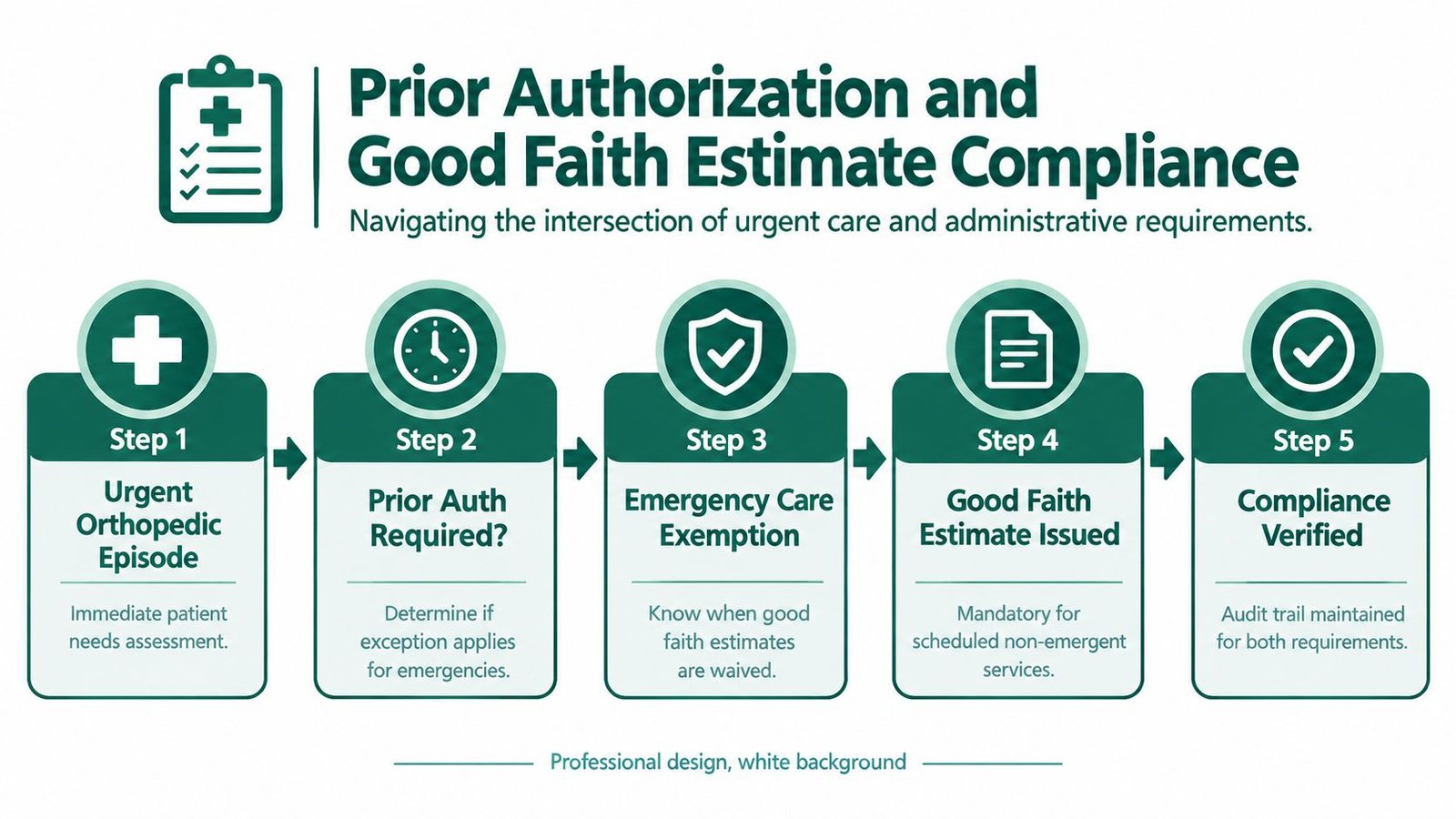
Link scheduling, authorization, coding, and final billing. The record should keep CPT or HCPCS services, diagnosis codes, laterality, modifiers, facility charges, imaging, anesthesia, and ancillary services consistent. A Good Faith Estimate requirements guide and template can support the administrative design, but the practice must still verify that its workflow matches the services scheduled.
Edge Sports Med Revenue Recovery Case Study
Edge Sports Med's case study remains pending. The placeholder will be completed with verified figures at day 60 of the Kim engagement, approximately 60 days after kickoff, pending reconciliation of claims and payment records. No recovery result, percentage, or financial outcome should be published before those records are reconciled.
The completed case study should report three measures:
- A/R days: The change in outstanding-receivable aging after payment-variance review, appeals, and deadline management.
- Net collections: The verified change in collections after separating new activity from recovered historical underpayments.
- Recovered dollars: The total recovered from repricer underpayments and successful New Jersey arbitration cases.
The analysis must separate prevention from recovery. A corrected modifier or authorization workflow can prevent future denials. An arbitration award or repricer appeal recovers money from a claim that has already been adjudicated. Combining these categories may produce a stronger headline, but it gives a practice owner an unreliable view of the engagement's financial effect.
A useful case study shows the claim-level evidence behind each recovered dollar. It also explains changes in A/R days, identifies whether New Jersey arbitration or repricer appeals produced the recovery, and documents which workflow changes should prevent the same leakage from returning. Claims and payment records must be reconciled before any result is presented as verified.
Evaluating Out-of-Network RCM Partners
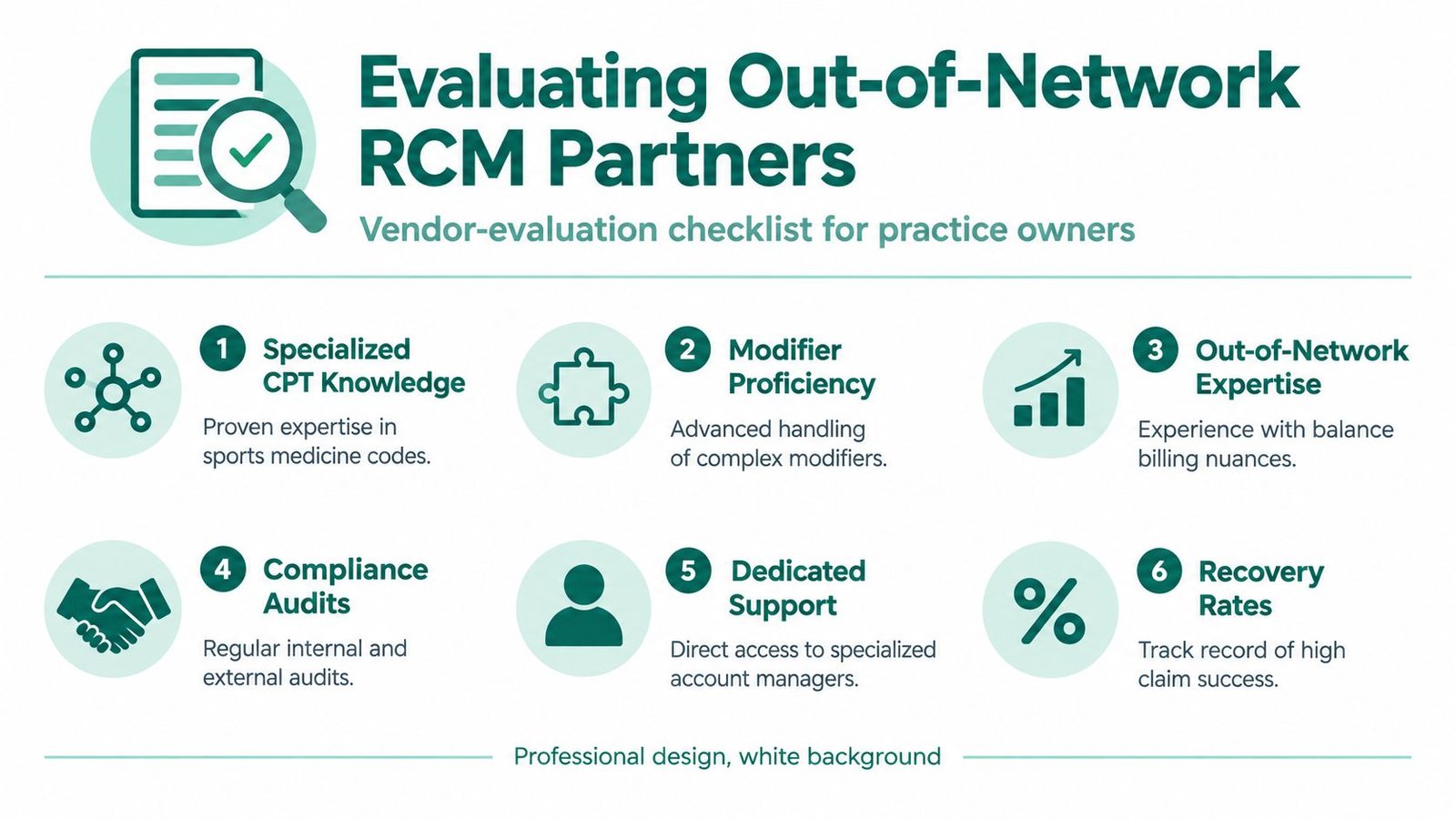
A New Jersey sports medicine billing partner should recover revenue, not merely transmit claims. Evaluate whether the team can connect Department of Banking and Insurance requirements with sports medicine CPT combinations, modifier logic, repricer reductions, authorization rules, protected patient balances, and arbitration deadlines. That combination determines whether silent underpayments are identified before they become accepted losses.
The vendor checklist
- NJ regulatory knowledge: Ask how the team distinguishes emergency, urgent, inadvertent, and knowingly planned out-of-network claims.
- Sports medicine coding depth: Confirm experience with CPT 20610, 20550, 20551, 97140, 97530, and 76942, surgical sequencing, and modifier -51.
- Repricer recovery: Require a documented process for reviewing reductions from MultiPlan, Zelis, and Data iSight or Claritev.
- Appeal ownership: The vendor should identify the denial or underpayment reason, assemble supporting evidence, track payer responses, and escalate when appropriate.
- System compatibility: The partner should work within the existing EHR and practice-management environment instead of forcing a disruptive migration.
- Reporting discipline: Require claim-level reporting for charges, payments, adjustments, open disputes, aging, and the next action.
- Compliance controls: Verify how the vendor protects PHI, limits access, documents patient consent, and suppresses improper patient statements.
The right choice depends on the practice's internal capacity. An employee may understand the EHR and clinical workflow but lack time to analyze repricer reductions or manage arbitration calendars. A general billing company may submit claims efficiently while treating every payment as final. A specialized partner costs more than basic charge entry, so compare the fee with recoverable leakage, denial rework, and aging A/R, not with submission cost alone.
Ask for a claim-level audit based on actual remittances before changing vendors. The baseline should show repricer reductions, missed appeals, and paid claims that warrant review.
Technical integration also affects recovery. Before signing, practice owners should view billing documentation to understand how billing data can be documented and exchanged in a controlled workflow. The technology matters less than preserving claim history, payment records, payer correspondence, and audit trails without duplicate or inconsistent data.
Frequently Asked Questions About NJ OON Billing
When can a New Jersey practice pursue arbitration?
A provider may generally initiate arbitration when the difference between the insurer's and provider's final offers exceeds $1,000, subject to statutory eligibility and exclusions. The practice must also protect the 20-day carrier response period and the provider's 30-day dispute and negotiation period. A missed deadline can eliminate bargaining power before the merits of the claim are considered.
Can an integrated sports medicine practice balance bill PT or chiropractic services?
Not automatically. The practice must determine whether the service was emergency, urgent, inadvertent at an in-network facility, or knowingly planned out of network. Protected services generally limit the patient to applicable in-network cost sharing, so the practice should resolve payer responsibility and consent documentation before sending a balance statement.
What should an owner review before outsourcing OON RCM?
Ask for claim-level evidence of underpayment detection, repricer appeals, authorization follow-up, modifier review, New Jersey compliance controls, and arbitration deadline tracking. The partner should explain how it works in the existing EHR, separates patient A/R from payer disputes, and reports recoveries without inventing results or combining prevention with historical recovery.
Is outsourcing sports medicine out-of-network billing worth the cost?
The answer depends on recoverable leakage, denial workload, internal staffing, and A/R aging. Compare the vendor's cost with documented repricer reductions, missed appeal opportunities, preventable denials, and time that physicians or administrators spend managing payer disputes. A focused audit is a better starting point than choosing a vendor from a generic percentage-of-collections comparison.
Happy Billing provides specialized out-of-network billing, underpayment recovery, denial management, and New Jersey payment-dispute support for sports medicine practices. Visit Happy Billing to evaluate your current claims, identify revenue leakage, and establish a recovery workflow built around the services your practice delivers.