Acupuncture Out-of-Network Billing Services in New Jersey

“Submit a superbill and wait for the plan” is not a reliable out-of-network acupuncture strategy in New Jersey. Covered doesn't mean fully reimbursed, and a low plan allowance or daily maximum can turn a completed visit into uncollected revenue, patient disputes, and longer A/R days. Acupuncture out-of-network billing services in New Jersey should verify the allowance before treatment, submit procedure-level claims accurately, and pursue underpayments without violating balance-billing protections.
Happy Billing is a medical billing company headquartered in Houston, Texas. We recover out-of-network underpayments for physical therapy, chiropractic, sports medicine and behavioral health practices, including practices in New Jersey and New York.
The financial question for an independent practice owner is simple: what will the plan allow, what may the patient legally owe, and which amount can the practice recover? The answers are rarely found in a benefit summary that merely says acupuncture is covered. They're found in the member-specific plan terms, the applicable New Jersey rules, the claim record, and the payer's explanation of benefits.
The Hidden Revenue Trap in New Jersey Acupuncture Billing
The dangerous assumption is that an out-of-network acupuncture benefit pays a predictable percentage of your customary charge. A plan may advertise coverage while applying that percentage to a restricted reasonable-and-customary allowance or a fixed per-visit cap. The result is a large gap between your billed charge and the payer's payment, even when the service is clearly covered.
The New Jersey State Health Benefits Program guide shows how this works. It describes out-of-network acupuncture reimbursement at 80%, 70%, or 60% of the plan's allowance, while some plans impose a fixed limit of $60 per visit. Those percentages do not represent payment on the full fee. They apply only after the plan determines its own allowance, and a visit cap can reduce the payable amount before coinsurance is calculated.
Revenue rule: Forecast collections from the plan allowance, visit cap, deductible, coinsurance, authorization rules, and the amount the practice may legally collect. The benefit percentage alone is not a forecast.
A per-visit cap can silently erase margin. If the team posts the billed charge as expected revenue, management reports overstate collectible A/R. Patient statements then repeat the same shortfall, while write-offs grow and staff spend time explaining balances that should have been identified before treatment.
The practice's clinical revenue must also reconcile with its accounting records. Guidance on financial records for wellness clinics helps connect posted payments, contractual adjustments, patient balances, and write-offs with actual financial reporting. That connection matters when owners assess whether an out-of-network contract is producing acceptable net revenue.
Separate a low allowance from an improper underpayment. A payer may have processed the claim correctly under the member's plan, even if the result is commercially unattractive. Another claim may show an incorrect allowed amount, an unsuitable code policy, or a repricer adjustment without an adequate explanation. Each situation needs a different response. Appeal documented payer errors, but do not treat every unpaid balance as recoverable.
A disciplined out-of-network reimbursement process begins before the appointment. Record the representative, call reference, verified allowance, visit limit, deductible status, and authorization requirements. Tell the patient which amount depends on the billed charge and which depends on the payer's allowed amount. That protects the practice from avoidable collection disputes and gives billing staff a defensible basis for follow-up.
Acupuncture CPT Codes and New Jersey Daily Maximums
The core acupuncture code family includes CPT 97810, 97811, 97813, and 97814. The codes represent distinct acupuncture techniques and service structures, so the record and claim must support the exact service performed. A practice loses revenue when it submits a code that doesn't match the note, but it can also overstate expected revenue when it assumes each code will produce separate additive reimbursement on the same date.
New Jersey's Department of Banking and Insurance has addressed these codes through a daily maximum allowable fee. The relevant order describes a $105 daily maximum for listed physical-medicine-and-rehabilitation codes commonly provided together for the same patient on the same date. The order's text contains a typographical rendering of the final code as “07814,” while the applicable acupuncture code family is 97810, 97811, 97813, and 97814. The New Jersey DOBI order should be reviewed when modeling payment expectations.
Why the daily maximum changes your forecast
Suppose a charge schedule assigns a separate expected collection to each acupuncture code. That schedule may look reasonable at the line-item level and still produce an unrealistic daily forecast. When several listed services occur for one patient on one date, the applicable daily maximum can constrain the total payment.
The practical controls are straightforward:
- Model the date, not only the line: Review the combined code set for the same patient and service date.
- Separate charge from expectation: Keep the provider's billed charge distinct from the applicable fee limitation and payer allowance.
- Check the payer overlay: A state fee limitation doesn't replace the need to review the member's plan, network status, authorization, or benefit policy.
- Audit code combinations: Compare the note, technique, service timing, units, and submitted codes before measuring the claim as collectible.
Timed and untimed service rules also deserve attention. The 8-minute rule billing guidance is not a substitute for the acupuncture code description or payer policy, but it illustrates why time documentation and code selection must align. Unsupported combinations create avoidable denials and can make an otherwise valid out-of-network claim harder to defend.
Navigating the 2018 Out-of-Network Consumer Protection Act
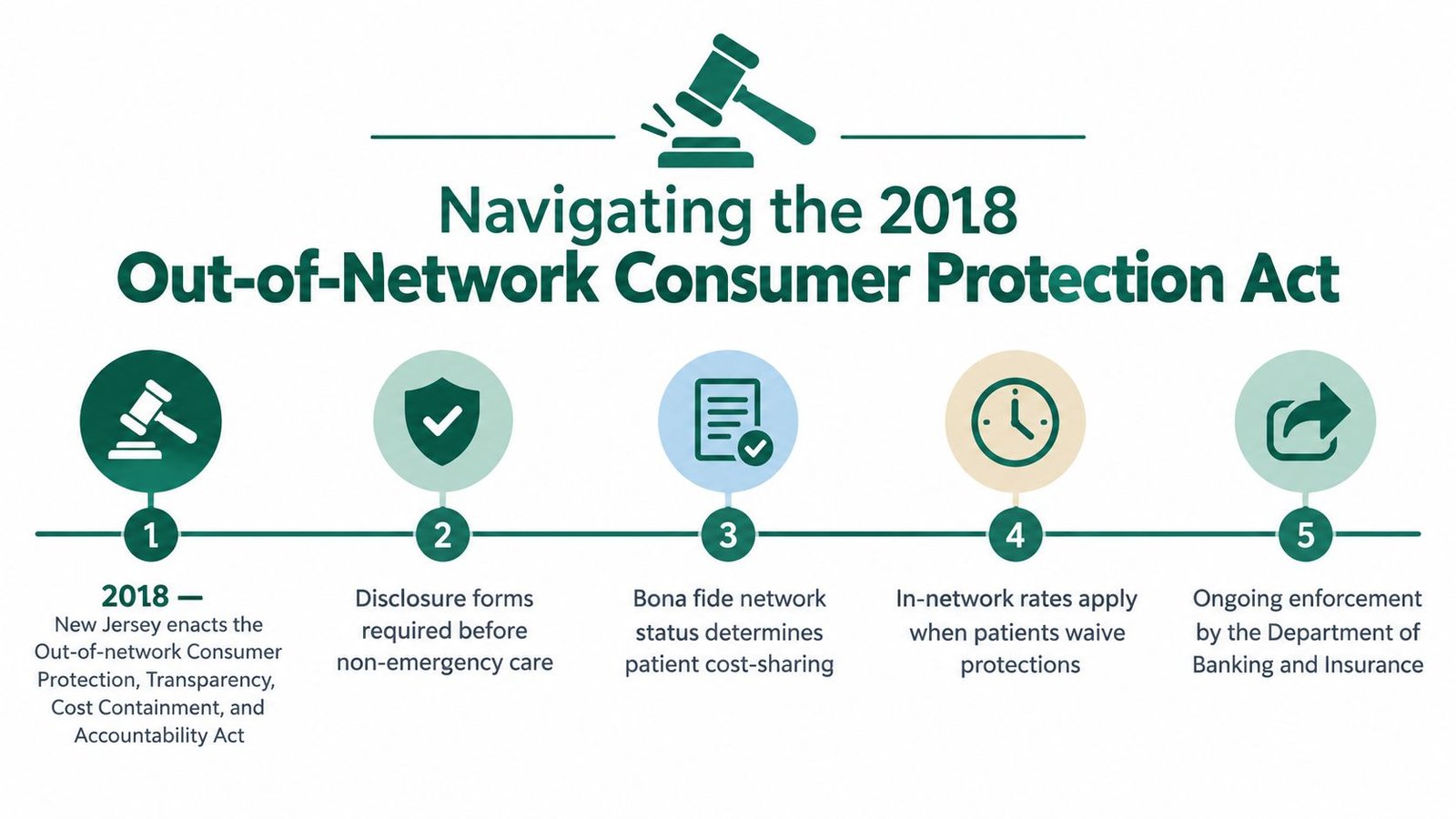
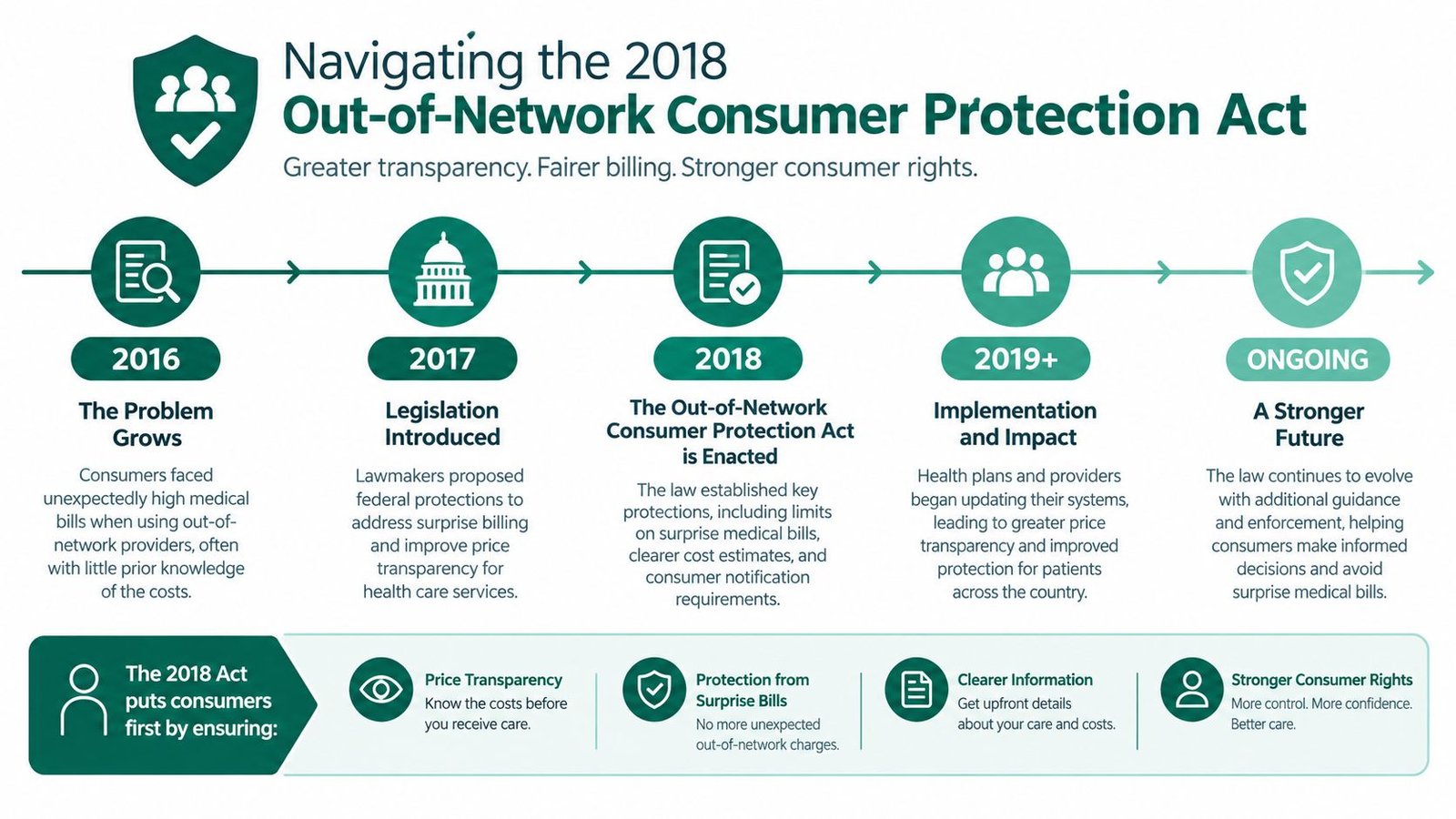
New Jersey enacted the Out-of-network Consumer Protection, Transparency, Cost Containment, and Accountability Act on June 1, 2018, and the law became effective on August 30, 2018, according to the New Jersey Department of Banking and Insurance overview. The law prohibits providers from balance billing covered patients for inadvertent or involuntary out-of-network services above what the patient would have owed for comparable in-network care, including applicable in-network deductibles, copayments, or coinsurance.
For an acupuncture practice, the operational distinction is critical. A patient who knowingly elects an out-of-network provider for elective care isn't in the same position as a patient who receives emergency, urgent, or inadvertent out-of-network services without knowingly selecting that provider. Your intake process needs to document which situation applies.
Controls that protect both revenue and compliance
The law doesn't make every out-of-network acupuncture claim payable at the provider's full charge. Reimbursement still depends on the plan's allowed amount and the applicable payment or dispute rules. It also means a patient balance can't be issued casually when the service falls within a protected circumstance.
Your practice should retain:
- Network status: The provider's network relationship for the specific plan and date of service.
- Patient disclosures: Documentation showing what the patient was told before elective care.
- Referral and authorization records: Evidence of payer requirements and whether they were satisfied.
- Claim and EOB data: The billed charge, allowed amount, payment, adjustment, and patient liability.
- Dispute classification: A clear reason the claim is being handled as an ordinary benefit issue or a protected out-of-network dispute.
For protected claims, the carrier may pay the billed amount or, within 20 days, notify the provider that it considers the charge excessive and remit its initial allowed amount. If the provider rejects that determination, the provider has 30 days to contact the carrier and negotiate a final reimbursement amount. When the parties settle, the carrier must send the additional payment within 30 days. These deadlines are described in the New Jersey surprise-billing update.
The provider can't shift the disputed balance to the patient while using this process. A missed deadline can turn a recoverable underpayment into leakage, while an improper statement can create compliance exposure and patient rework.
The New Jersey DOBI complaint pathway for underpaid out-of-network claims can become relevant when a carrier repeatedly applies an incorrect payment position or fails to resolve a properly documented dispute. A complaint isn't a substitute for a complete claim file. It's stronger when the practice can show the plan language, EOB, correspondence, benefit verification, and appeal history.
The Reality of Plan-Specific Allowances and Visit Caps
“Acupuncture covered” is only the starting point. Before scheduling an out-of-network patient, verify whether the plan covers the diagnosis, limits treatment to specific conditions, requires authorization, applies a deductible, or calculates payment from a percentage rather than a fixed allowance. A covered benefit can still produce a severe per-visit cap that leaves the practice collecting far less than its charge.
The same billed amount can therefore lead to very different results. These examples illustrate common payment structures described in New Jersey public-plan materials. They are planning tools, not guarantees for every commercial plan.
| Plan Structure | Billed Charge | Payer Allowance | Patient Responsibility |
|---|---|---|---|
| Percentage of an out-of-network allowance | Practice's charge | 80%, 70%, or 60% of the plan allowance | Deductible, coinsurance, and any legally collectible amount under the plan |
| Fixed per-visit cap | Practice's charge | As low as $60 per visit | The difference may remain financially significant, subject to plan terms and New Jersey protections |
| Public-plan example | Practice's charge | No more than $60 per visit or 75% of in-network cost per visit, whichever is less | The remaining amount may not be collectible in protected circumstances |
The percentage structures and $60 examples appear in the New Jersey State Health Benefits Program guide and the New Jersey court's description of the public-plan design in Association of New Jersey Chiropractors v. State Health Benefits Commission.
Record the payment terms before the visit
An intake note that says “OON acupuncture covered” gives the billing team little to defend later. Capture the payer's answers and the applicable benefit language in consistent fields:
- Allowance: Record the dollar allowance or the formula used to calculate it.
- Visit limit: Confirm any visit cap, service limit, frequency rule, or diagnosis restriction.
- Cost sharing: Document the remaining deductible, coinsurance, and copayment.
- Authorization: Verify whether prior authorization, a referral, or medical-necessity review applies.
- Patient liability: Ask whether the member may be billed for the difference between the provider charge and allowed amount. Compare that answer with New Jersey protections before sending a balance statement.
Have staff obtain the representative's name, call reference, and verification date. If the payer will not provide a clear allowance, treat the benefit as unresolved rather than assuming the billed charge will be reimbursed.
Fair Health benchmarks may support an appeal when the allowed amount appears inconsistent with local charges. They do not change the plan's benefit design or a New Jersey daily maximum. Use the benchmark as supporting evidence, never as a payment promise.
Clinical Documentation and Coding Discipline for Acupuncture
Coverage and coding are separate decisions. A plan may cover acupuncture in principle, but the claim can still deny because the diagnosis doesn't satisfy the payer policy, the procedure doesn't match the note, the authorization is absent, or the submitted code combination isn't supported.
CMS recognizes CPT 97810, 97811, 97813, 97814, 20560, and 20561 for covered acupuncture services under National Coverage Determination 30.3.3 for chronic low-back-pain coverage effective for dates of service on or after January 21, 2020. The CMS coverage memorandum is specific to that Medicare condition and shouldn't be generalized to commercial New Jersey plans.
Build the note around the claim
For covered acupuncture services, the clinical record should identify the treated condition, medical necessity, treatment sites or technique, session date, practitioner identity and credentials, start and stop time when required, patient response, and plan for continued care. The record should support the exact technique and timed or untimed service represented by the selected code.
For New Jersey out-of-network claims, also confirm:
- Provider identifiers: The rendering and billing provider information must be correct.
- Place of service: Use the place of service that matches the encounter and payer policy.
- Diagnosis linkage: Connect the diagnosis to the procedure in a way the payer can adjudicate.
- Authorization data: Include payer-specific authorization or referral information when required.
- Charge integrity: Submit the billed charge before contractual or plan adjudication, then reconcile it against the EOB.
A practice can lose money in two opposite ways. It can undercode a supported service and collect less than it should, or it can submit unsupported combinations that trigger denials and delay every line on the claim. The superbill guide for medical practices is useful for understanding why a superbill is a structured clinical and financial record, not a substitute for payer-specific claim controls.
Audit paid claims, not only denials
Sample both denied and paid claims. Compare the note to the code, diagnosis, authorization, provider identifiers, payment calculation, and patient liability. Paid claims can still contain underpayments, and a denial-only audit misses money that entered the account at the wrong amount.
Building a Bulletproof Out-of-Network Billing Workflow
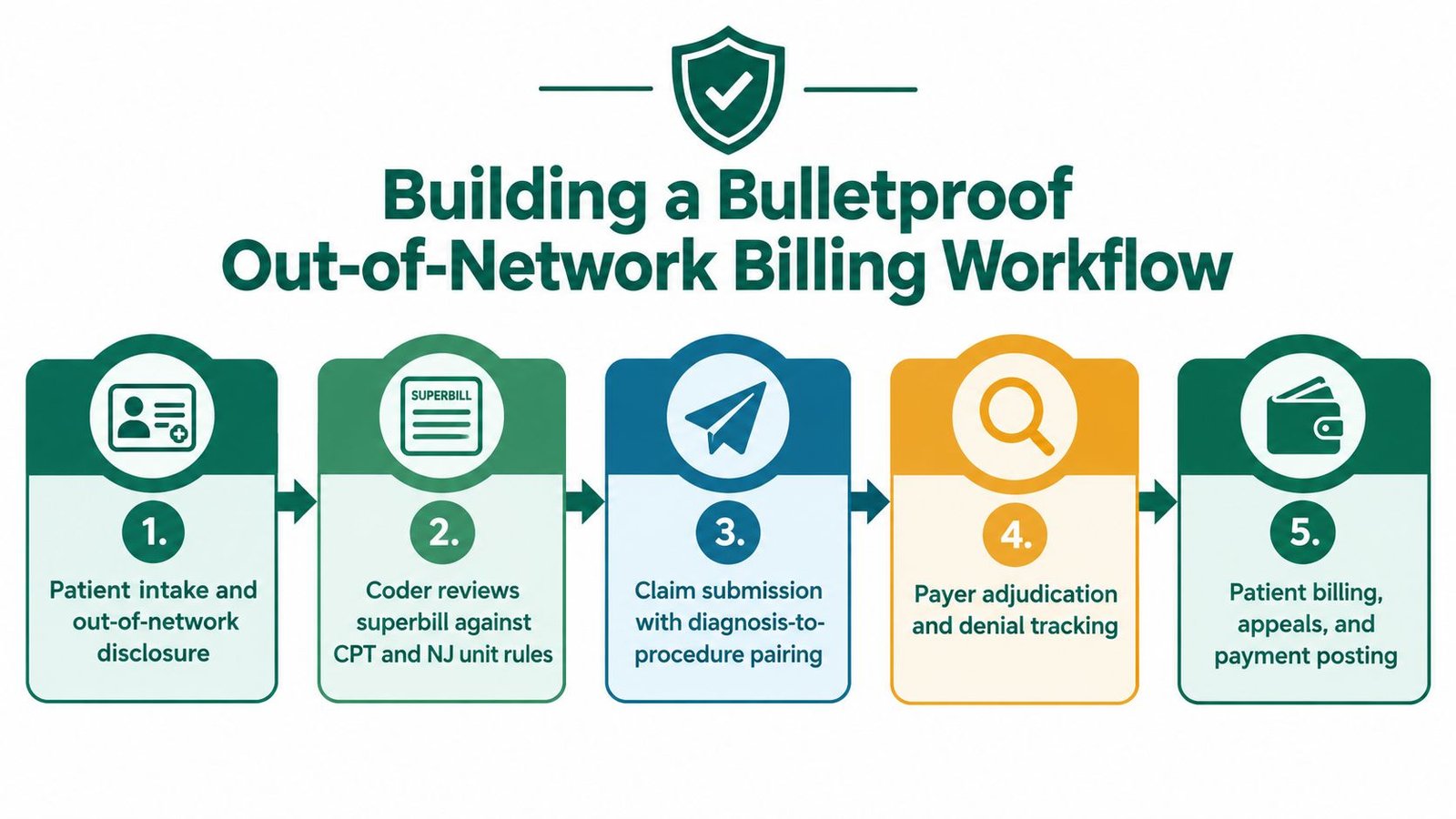
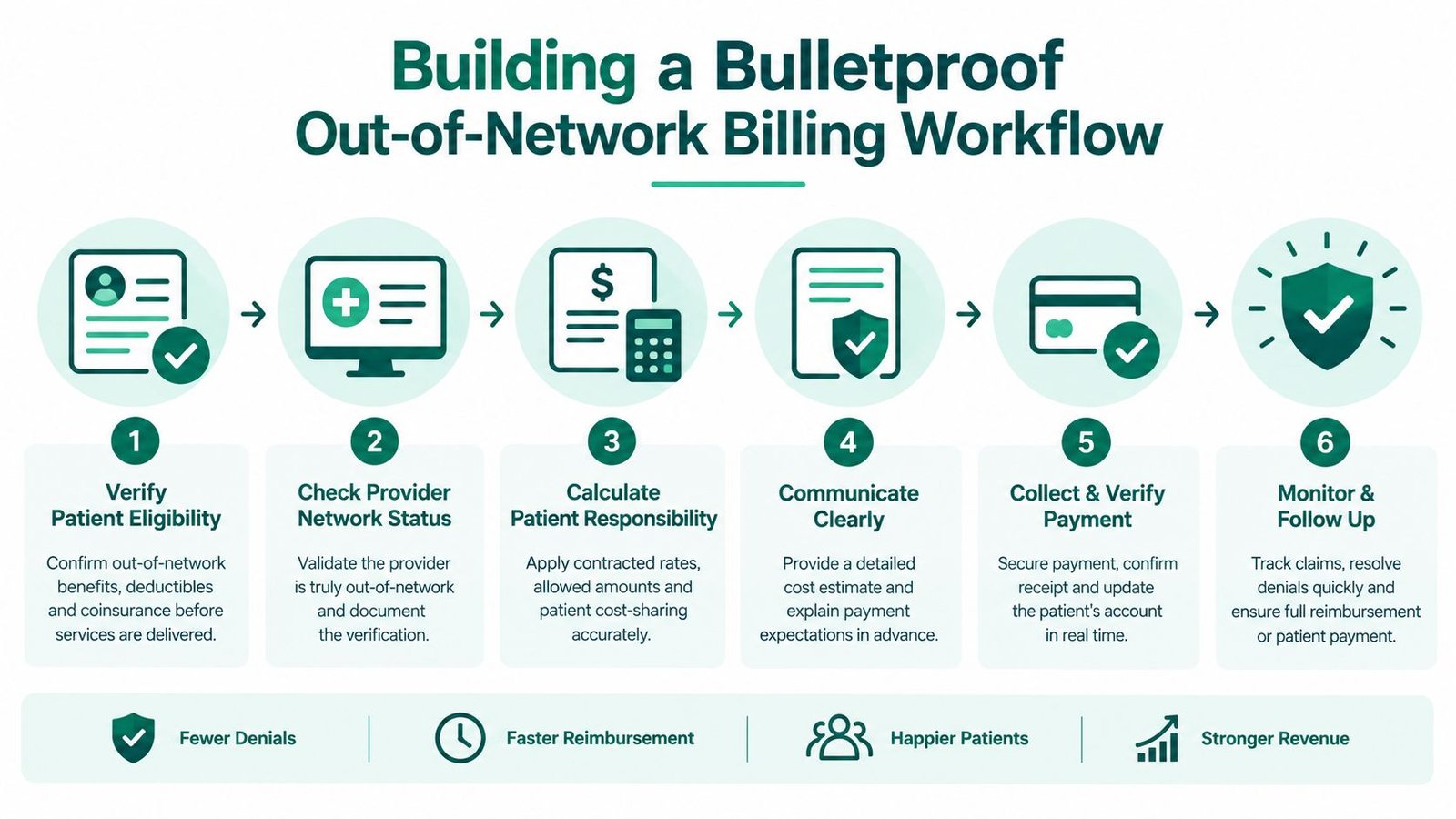
A superbill is only one handoff in the revenue cycle. The practice needs a workflow that starts with financial feasibility and ends with payment integrity.
Before the appointment
Verify the member's active coverage, network status, acupuncture benefit, diagnosis restrictions, authorization rules, visit limits, deductible, coinsurance, and exact allowance. Save the call reference and the representative's name or identifier. If the plan won't disclose a fixed allowance, document that limitation and avoid presenting the percentage as a guaranteed payment.
At intake, provide the required out-of-network disclosures for the patient's circumstances. For elective care, explain the estimated financial responsibility using the verified plan information. Don't promise that the payer will reimburse a percentage of the provider's full charge.
At claim submission
The claim should carry the appropriate CPT code, diagnosis linkage, rendering and billing provider identifiers, place of service, billed charge, and authorization or referral information. A pre-submission edit should flag unsupported code combinations, missing documentation, duplicate units, and dates that exceed the plan's stated limitations.
After adjudication
Post the EOB against the expected allowance, not merely against the charge. Classify the result:
- Correct adjudication: Post the contractual or plan adjustment and apply only permitted patient liability.
- Preventable denial: Correct the documentation, coding, authorization, or claim data issue.
- Potential underpayment: Compare the EOB with the verified benefit, plan language, daily maximum, and any repricer reduction.
- Protected dispute: Hold patient billing while the applicable New Jersey process is active.
For recurring allowed-amount reductions, review the out-of-network underpayment recovery guide and the medical claim repricing tools overview. Tools such as MultiPlan, Zelis, and Data iSight or Claritev may appear in an out-of-network payment workflow, but a repriced amount still needs to be reconciled with the plan and the claim circumstances.
The Federal IDR process may apply in specific situations, but it shouldn't be treated as a universal remedy for ordinary elective acupuncture claims. A practice should first classify the service under the applicable state and federal rules, then use the appropriate appeal, complaint, negotiation, or dispute route.
Evaluating Specialized Acupuncture Billing Partners
A clean claim is not evidence of good billing. In New Jersey, a benefit marked “covered” can still carry a low per-visit allowance or daily maximum that reduces revenue behind the scenes. A partner should understand those limits before the claim reaches the payer, not discover them after the EOB arrives.
Generalist billing teams often stop at submission. Ask a prospective partner to explain how it would handle CPT 97810 and 97811 on the same date, a payment below the verified allowance, and a patient whose liability may be protected under New Jersey rules. The answer should address the financial and compliance consequences, not just claim acceptance.
Request a walkthrough of the partner's actual workflow. It should record the dollar allowance rather than only “covered,” identify payer-specific caps and authorization requirements, and compare payment with the verified benefit. The team should also show how it connects an appeal to the clinical note, diagnosis, code combination, authorization, plan language, and payment calculation.
Look for ownership of the details that practices often miss:
- Benefit verification that documents limits in usable fields.
- Payment variance review that separates a valid adjustment from an underpayment.
- DOBI escalation with an organized complaint file when payer follow-up stalls.
- EHR integration that fits the current clinical workflow.
- Reporting that distinguishes charges, allowed amounts, payments, patient responsibility, denials, and unresolved balances.
Ask who reviews exceptions. Automation can route claims and compare payment fields, but a specialist must interpret conflicting payer explanations, documentation gaps, and protected patient liability. Fair Health benchmarks may support an appeal narrative when they fit the service and market, but they cannot override an exclusion or fixed plan cap.
A New Jersey out-of-network billing service for specialty practices should make those judgments visible through reports and documented follow-up. Choose based on preventable denials, valid underpayment recovery, unresolved A/R, and compliant patient statements, not the lowest fee alone.
Frequently Asked Questions About NJ Acupuncture Billing
Can I bill the patient for the difference between my charge and the payer's payment?
Not automatically. For protected inadvertent or involuntary out-of-network services, New Jersey law limits balance billing above the amount the patient would have owed for comparable in-network care. For elective, knowingly out-of-network acupuncture, the analysis depends on the plan, disclosures, and applicable rules. Your team should classify the service before sending a statement.
Is a superbill enough for an out-of-network acupuncture claim?
No. A superbill can support the claim, but it doesn't verify the member's allowance, authorization, diagnosis restrictions, daily maximum, or patient liability. The claim also needs accurate provider identifiers, place of service, code selection, diagnosis linkage, and payer-specific data.
What should I do when the EOB pays less than the verified benefit?
Compare the EOB with the benefit call, plan language, billed charge, allowance, code combination, and New Jersey payment limits. If the payment is inconsistent, submit a focused appeal with the supporting records. For protected claims, track the carrier's 20-day notice period and your 30-day negotiation window using the applicable denial management process.
Which metrics should an owner monitor?
Track net collections by payer and code family, denial reason, underpayment variance, unresolved A/R, appeal recovery, patient-balance reversals, and the time from EOB receipt to escalation. A practice that watches only total charges can miss a daily maximum, low allowance, or recurring repricer reduction that gradually weakens cash flow.
Happy Billing can review your New Jersey acupuncture claims for allowance reductions, daily maximum issues, preventable denials, and patient-liability risks. Visit Happy Billing to request a free audit and identify which out-of-network balances are recoverable before they become permanent A/R leakage.