Medical Billing Audit Services: 2026 Guide + Free Practice Audit
Expert medical billing audit services are a forensic review of a practice's billing process, designed to find and fix the errors quietly draining your revenue. For a practice owner, this isn't just about compliance—it's about finding precisely where money is leaking from incorrect coding, missed modifiers, or documentation gaps. A proactive audit is a strategic tool to recover cash that is rightfully yours, directly impacting your denial rate and A/R days.
Quick answer: A medical billing audit reviews a random sample of your recent claims and denials to find where revenue is leaking — the four most common findings are undercoding (leaving 5–15% of billable revenue on the table), missed modifier-25 opportunities, denials that were never appealed, and timely-filing losses. A one-off external audit typically costs $1,500–$5,000 for a 100–300 claim sample, or is included free with a switch to a full-service billing partner. Practices should audit at least once a year, and immediately if net collection rate drops below 95%, denial rate exceeds 10%, or a new coder / EHR has been in place for less than 6 months.
→ Book a free billing audit with Happy Billing — 30 minutes, no obligation. We review your recent EOBs and denial patterns and show you exactly where the money is going.
What Is a Medical Billing Audit?
A medical billing audit is an expert financial health checkup for your practice, comparing clinical documentation against submitted claims to ensure accuracy, compliance, and optimal reimbursement. For a practice owner, this process is essential for recovering lost revenue and strengthening the bottom line. Within the first quarter after addressing audit findings, we have seen practices lower their denial rates by several percentage points and shorten their A/R days, leading to a measurable lift in monthly cash flow.

Proactive vs. Reactive Audits
Audits fall into two categories, and the difference is crucial for your practice's financial health:
- Proactive (Internal) Audits: Your practice initiates these audits to find opportunities. The goal is to correct issues like under-coding or missed billing opportunities before payers see the claims. For instance, a cardiology practice might conduct a proactive audit to ensure all components of a nuclear stress test (e.g., CPT codes 78452, 93015-93018) are billed correctly, which you can learn more about on our cardiology billing specialty page. This is about maximizing revenue.
- Reactive (External) Audits: These are initiated by outside entities like CMS or commercial payers because your billing patterns have raised a red flag. A reactive audit is a defensive, stressful necessity that can result in significant take-backs and penalties, directly threatening your practice's financial stability.
By understanding both, you can shift your practice from a reactive, compliance-driven mindset to a proactive, revenue-focused strategy. Let us show you where your hidden revenue is hiding; get a no-obligation analysis of your current billing performance today.
Why Audits Are a Revenue Tool, Not Just a Compliance Check
Most practice owners think of audits defensively—as a necessary evil to fend off payer recoupments. But that’s only half the story. The real power of medical billing audit services is found on offense. A regular, proactive audit is one of the best management tools a practice owner has to actively drive revenue, turning a cost center into a source of serious cash flow.
When you spot coding and billing mistakes before payers do, you take control. You can dramatically improve reimbursement rates and cut down on frustrating denials. We’ve seen practices slash their denial rates by several percentage points after just one quarterly audit. For a mid-sized clinic, that can easily translate to tens of thousands of dollars in recovered revenue every year.

Uncover Hidden Revenue Opportunities
A good audit delivers actionable data on everything from staff performance and common CPT code mistakes to documentation gaps that are quietly killing your bottom line. This isn't just about catching errors; it's about finding the patterns that show you exactly where your practice is leaving money on the table. As Simbie AI explains revenue optimization, a medical billing audit is a critical step in strengthening your financial health.
In our experience, under-coding is a massive source of lost revenue. A cardiology practice we audited was consistently billing Level 3 office visits (CPT 99213) for follow-ups on complex cardiac conditions. Their own documentation, however, supported a Level 4 visit (CPT 99214) in over 40% of cases.
This under-coding, driven by a fear of being audited, was costing the practice over $40 per visit. It was a massive revenue leak that added up to tens of thousands of dollars a year. Fixing that one issue gave their monthly collections a major boost without seeing a single extra patient.
From Compliance Burden to Management Tool
The way smart practices view audits has completely changed. It's no longer just a defensive reaction to compliance fears; it’s a powerful management strategy. The findings from a thorough audit give you clear, data-driven insights into your practice's biggest operational and financial weaknesses.
By analyzing patterns in visit volume, coding accuracy, and denial reasons, you can make informed decisions about everything from staff training and workflow fixes to new technology. For many practices, this data becomes the tipping point for rethinking their entire RCM strategy. If this sounds familiar, you might find our guide on the benefits of outsourcing your medical billing helpful.
Ultimately, this shift in perspective turns the audit from a dreaded chore into a genuine engine for financial growth and operational excellence.
Key Audit Triggers That Put Your Revenue at Risk
Payers aren’t looking at claims one by one anymore. They’re using powerful algorithms to spot billing patterns that scream "audit me," putting your practice's revenue at risk of take-backs. The most common red flags we see are upcoding, unbundling, and billing for services that don't pass medical necessity tests based on payer policies.
Ignoring these patterns is like ignoring a leaky pipe—it’s a financial disaster waiting to happen. A single, persistent error can trigger a targeted review that results in massive recoupments from payers like UnitedHealthcare or Blue Cross Blue Shield.
Specific Coding and Modifier Errors
Certain billing habits are practically guaranteed to draw unwanted attention. For a practice owner, these aren't just administrative headaches; they are direct threats to your cash flow.
For instance, we often see mental health practices that bill CPT 90837 (a 60-minute therapy session) for almost every visit. If the session notes don't clearly document at least 53 minutes of face-to-face time, as per CPT guidelines, a payer audit will almost certainly claw back the difference between that code and a lower-paying one like 90834. That's a direct loss of over $50 per claim with some payers.
It’s the same story in orthopedics. A practice that repeatedly fails to use modifier 59 correctly to show a distinct procedural service will trigger a cascade of automatic denials. This isn't just an administrative hassle—it's lost revenue that costs time and money to fight for. Understanding the nuances behind the top 10 reasons for claim denials is your first line of defense.
Becoming an Outlier in Payer Data
Payers like Medicare use powerful tools like Comparative Billing Reports (CBRs) to see how your practice stacks up against your peers in the same specialty and region.
If your practice is an outlier—for example, billing Level 5 E/M visits (CPT 99215) at a rate far higher than the local average—you are essentially sending up a flare to auditors. This data-driven approach means even unintentional errors can put a target on your back.
These triggers are precisely why proactive medical billing audit services are so critical. By identifying and correcting these red flags before a payer does, you shift from a defensive, reactive position to one of control. You safeguard your revenue and secure your practice’s long-term financial health.
Our Medical Billing Audit Process from Start to Finish
A professional audit is a collaborative effort designed to pinpoint exactly where your revenue is leaking and give you a clear plan to patch the holes. The process begins with a kickoff call where we discuss your biggest concerns—whether it’s a high denial rate or shrinking margins—to ensure our audit focuses on the areas that matter most to your practice's financial health.
Step 1: Defining the Scope and Extracting the Data
First, we establish a clear target. Are you worried about a recent flood of denials for a specific procedure? Or maybe you just want a wide-angle view of your highest-volume services? We'll help you zero in on the right scope.
Common audit scopes we handle for practice owners include:
- A 90-day look-back on all claims for a high-volume CPT code, like 99214 for an internal medicine practice.
- A focused review of claims using tricky modifiers, such as modifier 25, to ensure you’re both compliant and not leaving money on the table.
- A random sample of claims from a new provider to find coaching opportunities before small mistakes become big revenue problems.
Once we agree on the scope, we securely access the data. Our team works directly with your administrator to pull the necessary claim data and matching medical records. This is a fully HIPAA-compliant process, using bank-level encryption to keep your patient data protected every step of the way.
Step 2: From Deep-Dive Analysis to an Actionable Report
With the data in hand, our certified auditors get to work on the meticulous chart-to-claim review. This is where we compare what the clinical documentation says against the codes that were actually billed. We’re hunting for discrepancies that kill your revenue—things like under-coding, missed procedures, or incorrect modifier use.
Next comes the financial impact analysis. We quantify exactly how much revenue has been lost and what you stand to recover by fixing these issues.
The final deliverable is an Actionable Report. This isn't just a generic list of findings. It's a strategic plan with concrete, easy-to-follow recommendations to stop future losses, boost your clean claim rate, and slash your A/R days. If you're looking to get a head start, our revenue cycle management checklist is a great tool for an internal check-up.
A great audit partner delivers more than just a report card; we give you a roadmap for recovery and long-term financial stability. It all starts with discovering the hidden potential in your practice. You can begin that process today by requesting a complimentary analysis of your billing on our free audit page.
Choosing the Right Medical Billing Audit Partner
Choosing a medical billing audit partner is more than just hiring another vendor. You're entrusting a firm with the keys to your revenue cycle. The wrong choice wastes time and money, but the right partner plugs revenue leaks and drives down your denial rate, delivering a clear return on investment.
The market is crowded. With IBISWorld estimating over 1,300 medical billing businesses in the U.S., you have to ask sharp questions to find the true experts who can deliver measurable results. A high-quality partner will follow a structured, transparent process.
The workflow below shows exactly what that professional process looks like.
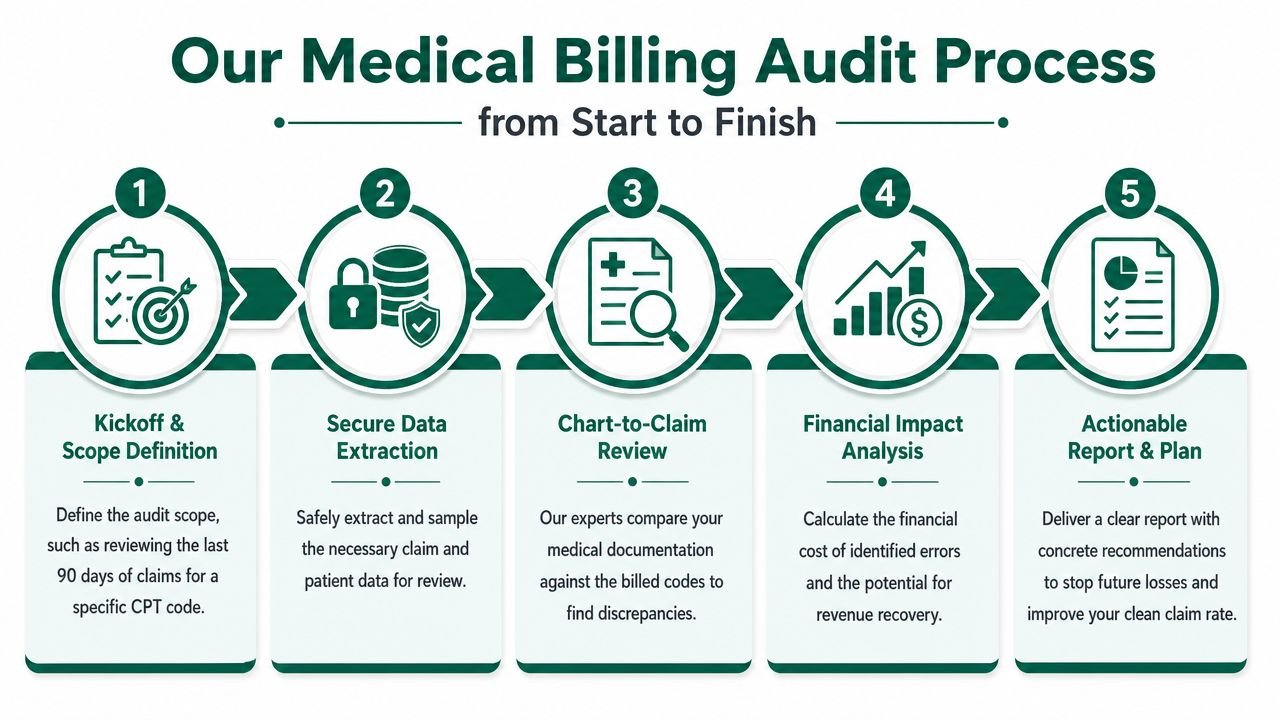
A proper audit isn't a vague review; it's a methodical progression from a defined scope to a report filled with actionable steps that lead directly to financial recovery.
Critical Questions for Any Potential Partner
Before you sign any contract, you need specific, evidence-backed answers. When you choose your medical billing company, these details are what separate a real partner from a simple vendor.
- What is your specific experience with my specialty? This is the most important question you can ask. The billing rules for an anesthesiology group—with its base units and concurrency ratios—are a world away from the authorization-heavy billing of a behavioral health clinic. A generalist simply doesn't have the depth to maximize your revenue.
- Can you provide case studies with measurable improvements? Ask for proof. A serious firm will have no problem showing you anonymized data on how they improved a similar practice’s denial rate, A/R days, or net collection rate.
- What are your HIPAA compliance and data security protocols? Don't accept vague answers. A trustworthy partner should be able to instantly detail their data encryption methods, access controls, and staff training procedures. Hesitation is a major red flag.
The single most important factor is specialty expertise. Choosing a partner unfamiliar with your specific CPT codes and payer rules is like hiring a general family doctor to perform heart surgery—you are guaranteed to leave money on the table that a specialist would have captured.
Don’t settle for a firm that treats your practice like just another account number. For more help in your search, check out these questions to ask a medical billing company before hiring. The right partner will feel like an extension of your own team, completely focused on protecting and growing your revenue.
Calculating the ROI of a Proactive Billing Audit
It's easy for a practice owner to think of a billing audit as just another expense. The reality is, it’s an investment, and a good one should pay for itself many times over. The entire point of medical billing audit services is to find and stop the quiet, consistent revenue leaks that are costing your practice far more than the audit itself.
Think about it this way: a single coding error that shaves $50 off a claim feels minor. But if that same mistake happens just five times a week, you're losing $13,000 a year from that one issue alone. An audit is designed to hunt down these kinds of patterns and turn those hidden losses back into cash.

A Case Study in Financial Recovery
Let's look at a real-world scenario from a mid-sized orthopedic group we recently worked with. We pulled a sample of 100 claims where an E/M service was billed alongside a minor procedure—a common source of revenue loss.
We found a 15% error rate centered on the inconsistent use of modifier 25. Because the team wasn't applying it correctly every time, payers were bundling the E/M service into the procedure payment and denying the office visit portion of the claim.
By creating a clear, repeatable workflow and training the team on proper modifier 25 use per AAPC and CMS guidelines, we put the practice in a position to recover an estimated $75,000 a year. They didn't have to see a single extra patient to find that money; it was already earned, just not captured. This story is incredibly common, and understanding the real cost to outsource medical billing helps put into perspective how quickly these services deliver a return.
The goal here isn't just to find problems—it's to stop the leaks at their source so you can get back to focusing on your patients. The first step is to see what your practice's unique recovery opportunity looks like. A free, no-obligation audit of your billing can quantify your potential ROI, giving you the hard data you need to make the right decision for your practice's financial health.
How often should my practice get a medical billing audit?
For most independent practices, we recommend a proactive audit at least quarterly. This frequency is the sweet spot—it’s often enough to catch and correct negative coding patterns before they balloon into serious financial liabilities or attract unwanted attention from payers. An annual comprehensive audit should be considered the absolute minimum for maintaining a healthy revenue cycle.
Can an audit really find enough money to justify the cost?
Yes, almost every time. In our experience providing medical billing audit services, it's incredibly rare to find a practice with a completely flawless billing process. Small, repetitive errors—like missing modifier 25 on an E/M visit with a procedure or under-coding complex follow-up visits—compound into staggering annual losses. A thorough audit almost always uncovers enough recoverable revenue to deliver a significant positive ROI.
My in-house biller says everything is fine, so why do I need a third-party audit?
An external audit brings a fresh, unbiased perspective that's nearly impossible for an in-house team to replicate. Your biller might be fantastic, but they work inside the same system every day, which can create "process blindness" to recurring—and costly—errors. Payers constantly update their rules, and a specialized partner with deep expertise in specialties like orthopedics lives and breathes these changes. An external audit validates your team's work while spotting hidden opportunities they can’t see, protecting your practice from long-term risk and ensuring you capture every dollar you've earned.