Out of Network Billing: A 2026 Practice Guide
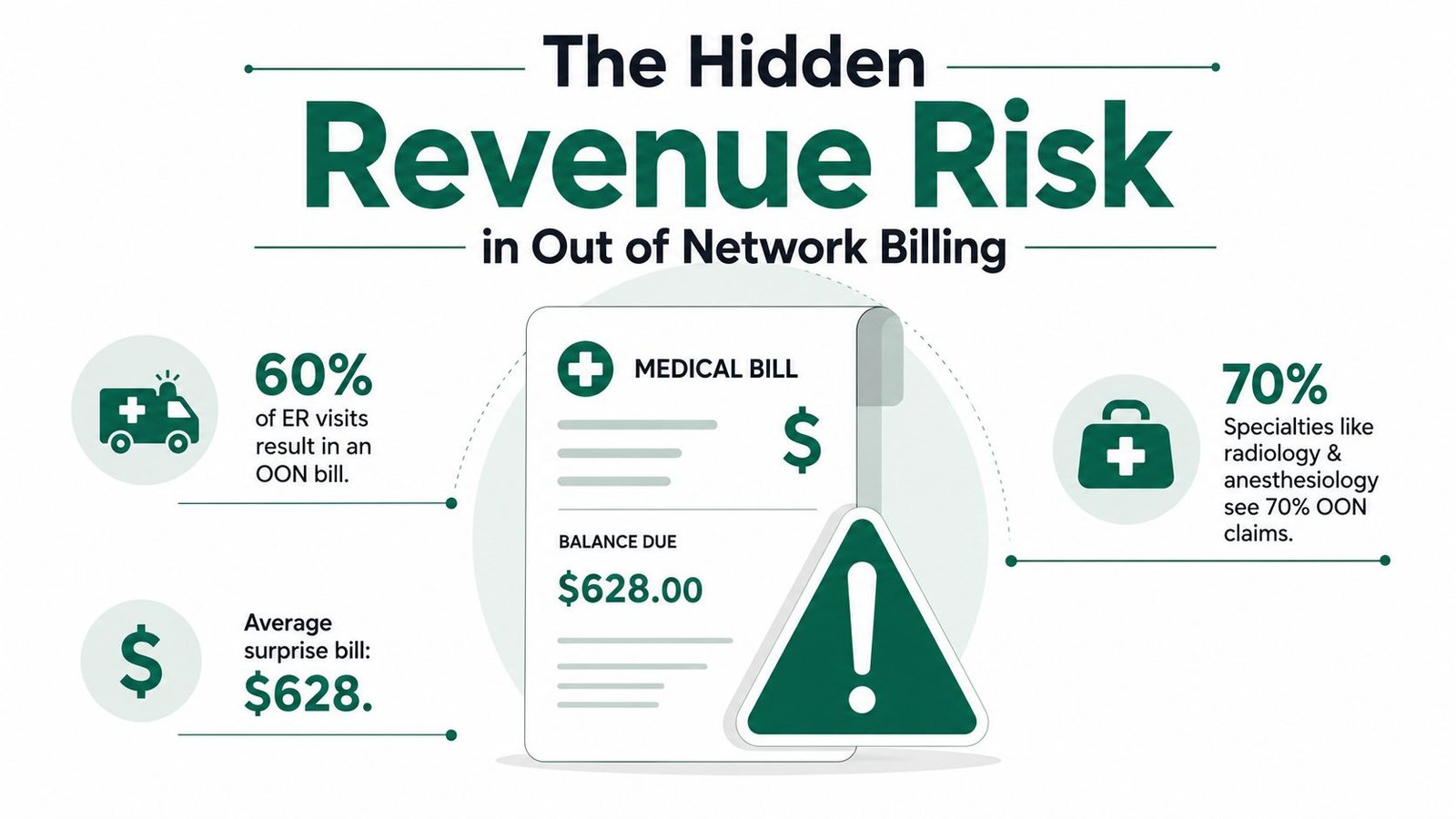
Out of network billing is not a rare edge case, it's a structural revenue problem. In a large U.S. commercial-claims study, 42.8% of emergency department visits and 42.0% of inpatient admissions at in-network hospitals generated an out-of-network bill by 2016, with mean potential liability rising to $628 for emergency department bills and $2,040 for inpatient admissions, all in 2018 dollars (JAMA Internal Medicine study). For a practice owner, that means the risk isn't just patient friction, it's more denials, slower collections, and more time spent cleaning up claims that should have paid cleanly the first time.
That shift hits specialty practices hardest when multiple clinicians touch the same encounter. Anesthesia, pathology, radiology, and assistant surgery can all create hidden leakage inside otherwise in-network facilities, which is why billing teams need to treat out-of-network billing as a contract and workflow issue, not just a patient collections issue. If your team is trying to understand where A/R is leaking, start by mapping how often these claims get stuck, then compare that to your days in A/R benchmarks using this practical A/R guide and a plain-language explainer like demystify coverage with Patient Talker LLC.
Practical rule: if your claim volume is concentrated in hospital-based specialty work, out-of-network exposure is probably already embedded in your revenue cycle, even if no one has labeled it that way yet.
The Hidden Revenue Risk in Out of Network Billing
The biggest mistake I see practices make is treating out of network billing like a patient-service problem instead of a revenue-cycle design problem. In the data, it is clearly structural. A major commercial-claims analysis found out-of-network billing inside in-network hospitals affected 11.8% of anesthesiology care, 12.3% of pathology care, 5.6% of radiology claims, and 11.3% of assistant-surgeon cases in 2015, and the same line of work estimated a 3.4% increase in total employer-sponsored spending, about $40 billion (Health Affairs).
Why this hits collections, not just patient complaints
For a practice owner, those percentages matter because they show where claims can fail. If the payer reads the claim as out of network, the patient's share can't be handled the same way as an ordinary in-network line, and your staff ends up chasing balances that may be contractually restricted. That creates a double hit, slower cash and more recoupment exposure when the documentation doesn't support what was billed.
The more technical problem is that out-of-network billing often hides in routine hospital episodes. A facility can be in network, the surgeon can be in network, and the anesthesiology or pathology component still trips the claim into a dispute. That's why billing teams need to review specialty mix, facility setting, and physician status together instead of assuming one in-network credential solves the encounter.
What a practice owner should look for
If your current reports don't separate facility-based claims by specialty, you're probably blind to the leak. That's especially dangerous for high-acuity services where the contract picture changes from one clinician to the next. I've seen practices improve cash flow by identifying which departments generate the most out-of-network denials, then tightening eligibility checks and contract rules around those encounter types.
Bottom line: out-of-network billing doesn't just create surprise bills, it creates hidden A/R drag in the exact places where practices can least afford it.
The first move is to stop thinking in aggregates and start thinking in claim families. Anesthesia, pathology, radiology, and surgical assistant work should be reviewed differently from straightforward office-based claims, because the financial risk sits inside the episode, not just at the front desk.
The best compliance teams I've worked with don't wait for denials to reveal the problem. They identify the claim patterns that repeatedly trigger out-of-network status, then build edits around those encounters before the bill leaves the system.
Navigating the No Surprises Act and Balance Billing Rules
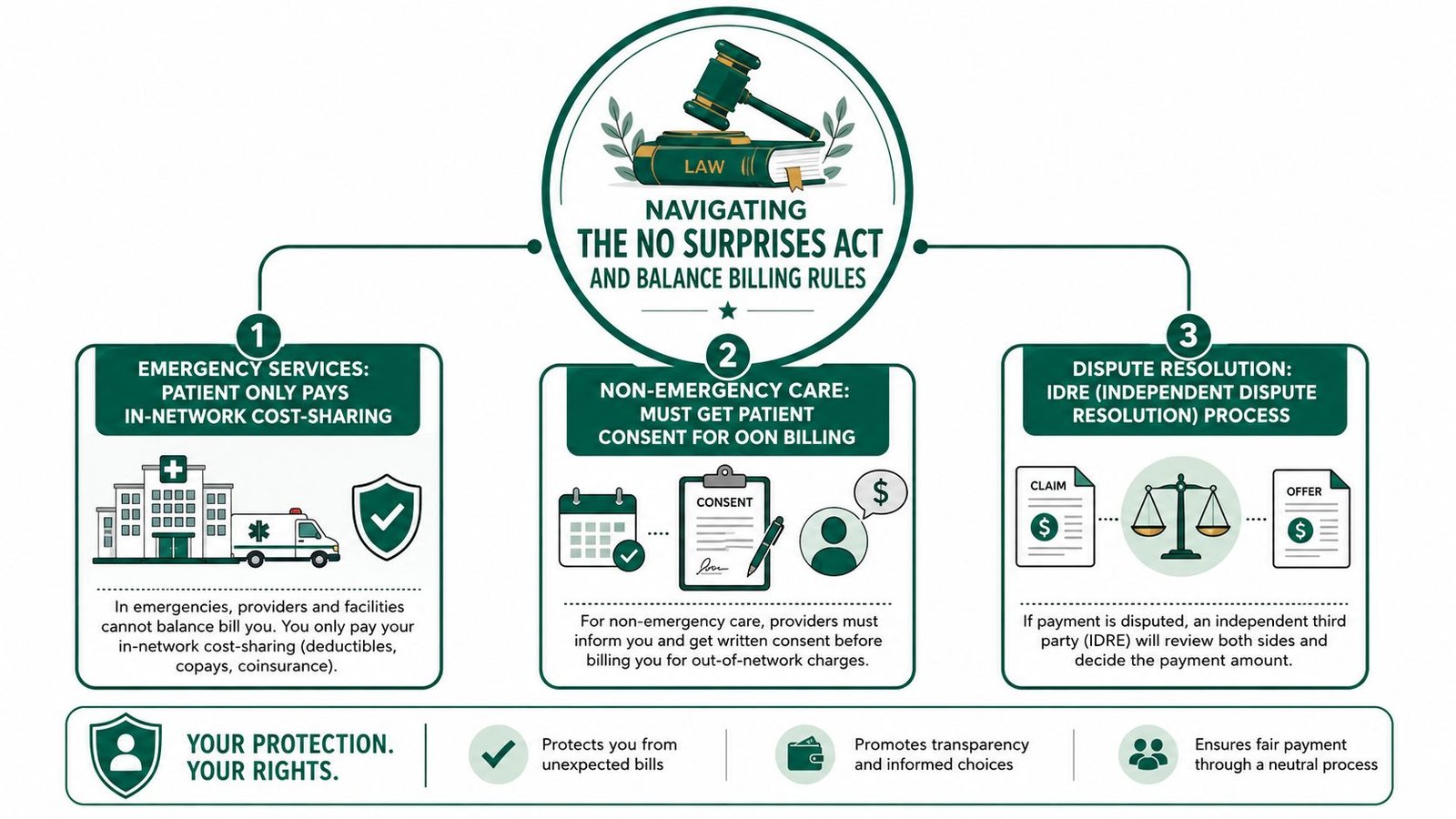
The No Surprises Act changed the economics of out-of-network billing for physician practices, and specialty groups inside in-network facilities feel that pressure first. CMS says providers cannot balance bill for out-of-network emergency services, and they also cannot balance bill for certain non-emergency services at in-network facilities unless the notice-and-consent requirements are satisfied (CMS overview of rules). For a practice owner, that means the old habit of sending the balance to the patient is no longer safe in many hospital-based scenarios.
The hidden revenue loss is not only the missed patient balance. It also shows up as delayed appeals, corrected claims, rework, and staff time spent sorting out which encounters were protected by federal rules.
Where the payment dispute goes now
The law shifts a lot of the fight away from the patient and into regulated payment determination. CMS explains that the patient is protected from balance billing in emergency services and in some non-emergency facility-based care, while the AMA notes that state payment laws control when they specify the total amount payable, and otherwise the QPA becomes a key input in the federal IDR process (CMS provider FAQ, HHS brief, AMA NSA and IDR slides). That matters because your collections strategy now depends on whether you are operating inside the statute's protection zone.
For independent practices, the operational takeaway is plain. If the claim falls under the law, the patient is not the secondary payer for the disputed amount. If staff still bills as though full usual-and-customary collection from the patient is available, the practice invites write-offs, complaints, and recoupments.
The trap for specialty groups is inside in-network facilities, where the clinical work may be routine but the billing exposure is not. Anesthesia, pathology, radiology, and surgical assistant services can all trigger a different payment path than the one your office staff expects, especially when the provider is out of network but the facility is not.
The consent pathway still needs tight documentation
Federal guidance says balance billing in non-emergency situations at in-network facilities is only allowed when the patient has consented after receiving an easy-to-understand notice and a good-faith estimate (HHS brief). That creates a compliance gate, not a casual front-desk script. If the notice is weak or the estimate is handled incorrectly, the practice can lose the ability to collect the expected out-of-network amount.
The gray zone is outpatient office-based care, where the NSA's protections do not cover every service type. Training materials from the AMA also note that some physician-office services sit outside the rule, while some out-of-network surgeons may still use consent-based arrangements in facility settings (AMA NSA and IDR slides). That is where practices get sloppy, because the workflow feels familiar even though the billing consequence is very different.
For a detailed breakdown of the federal requirements, our guide to No Surprises Act compliance offers a step-by-step checklist.
Practical rule: if you want the right to balance bill in a protected scenario, your documentation has to be cleaner than your revenue goals.
A clear internal standard helps more than a last-minute correction. Identify the service category, confirm whether the NSA applies, verify whether consent is allowed, and document the notice path before the claim reaches the payer. That protects revenue better than trying to repair the file after the denial lands.
Learniverse shared health LMS is useful here because staff training is often the missing piece. The rules only work when the front-office workflow applies them consistently on a busy day.
Coding and Claim Submission Strategies for OON Success
Coding doesn't rescue a weak contract position, but it can stop a good claim from being paid like a bad one. For hospital-based specialty billing, the difference between clean payment and a denial often comes down to whether the claim reflects the service, the setting, and the provider role precisely enough for the payer to process it.
The details payers scrutinize first
For anesthesiology, the combination of base units, physical status modifiers, and concurrency-related documentation can determine whether the claim is paid at the expected rate or underpaid. Practices that use modifiers like QK and QX need a strict internal review because one missing modifier can distort the payer's read of who performed the service and how it should be valued. That's not an academic issue, it's the difference between a claim that earns proper reimbursement and one that gets reduced without a meaningful appeal path.
Place-of-service coding matters too, especially when the service straddles a hospital, ambulatory surgery center, or office setting. When the payer sees an out-of-network claim with the wrong POS code, the first-pass denial risk goes up immediately because the claim no longer matches the clinical setting the contract expects. If you're auditing your workflow, start with the claims where the place of service and provider status don't line up cleanly in the EHR.
What a clean submission process actually looks like
A strong team checks three things before submission. First, the claim form must reflect the correct service site and provider role. Second, the documentation must support the billed service and any modifier logic. Third, the billing team should confirm that the claim is being routed through the right payer rules, especially when the service might fall under NSA protections or facility-based consent requirements.
Here's a simple operational filter I recommend:
| Specialty | OON Claim Rate |
|---|---|
| Emergency room visits with emergency-medicine specialist services | 16.5% |
| Lab or pathology visits | 12.9% |
| Anesthesiology visits | 8.3% |
| Behavioral-health visits | 6.7% |
| Radiology visits | 4.2% |
| Surgical visits | 2.1% |
| Cardiovascular visits | 2.0% |
Those figures come from 2017 U.S. claims data and show why specialty-specific submission rules matter (HCCI report). If your team submits all out-of-network claims through the same template, you're probably leaving money behind.
Practical rule: build edits around the service line, not just the payer. That's where the mistakes tend to cluster.
If you need a baseline for how a standard claim should look when it's fully populated, compare your files against this CMS-1500 example. A good billing partner should be able to explain every field that affects the payer's first read, not just push claims faster.
Patient Communication and Consent as Revenue Protection
A clean consent process can protect more revenue than a tighter fee schedule. In out-of-network billing, the leak often shows up after the visit, when the patient says they never understood the financial split and the practice has to absorb the dispute, the write-off pressure, or both.
The consent conversation that protects collections
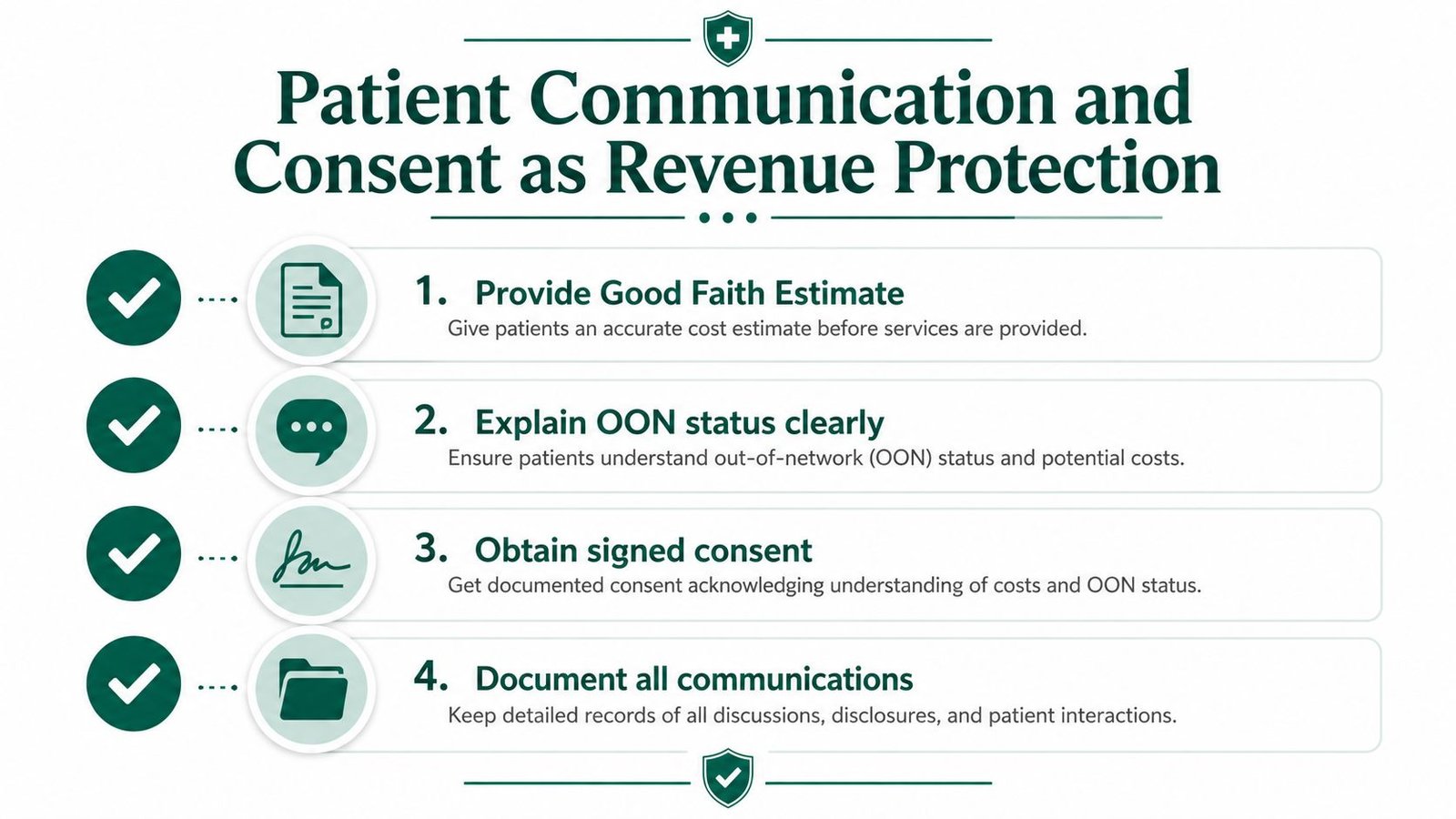
Federal guidance allows balance billing in certain non-emergency facility settings only after the patient receives a clear notice and gives consent. That means the front desk, scheduler, and clinical team need one consistent script, not three different versions of the story. If the patient learns the out-of-network status only after the claim is denied, the practice usually loses ground on the balance.
The estimate should come before the collection call. It should explain, in plain language, why the service is out of network, what the patient may owe, and whether consent is required before the encounter moves forward. Practices that wait until after the visit to explain the financial side usually spend more time chasing balances and answering complaints than they do collecting cleanly.
Where gray zones still create trouble
The rule set does not remove every office-based edge case. Some physician-office services sit outside federal protections, while hospital-adjacent workflows can still create confusion when consent-based billing is used in facility settings. The documentation has to show who explained the charge, when the discussion happened, and which form the patient signed.
Strong teams train front-office staff to record the communication trail in the EHR the same day the conversation happens. They also keep the wording short enough for a patient to understand without legal decoding. If a patient cannot repeat the basic financial terms back in plain English, the script needs revision.
Revenue protection starts before the claim. If the notice is sloppy, the appeal later on is harder, and the patient balance is harder to defend.
Staff education is part of the revenue cycle, not an extra. A solid medical billing denial management workflow should connect the consent script, the signed form, and the handoff to billing so the account does not drift into avoidable disputes.
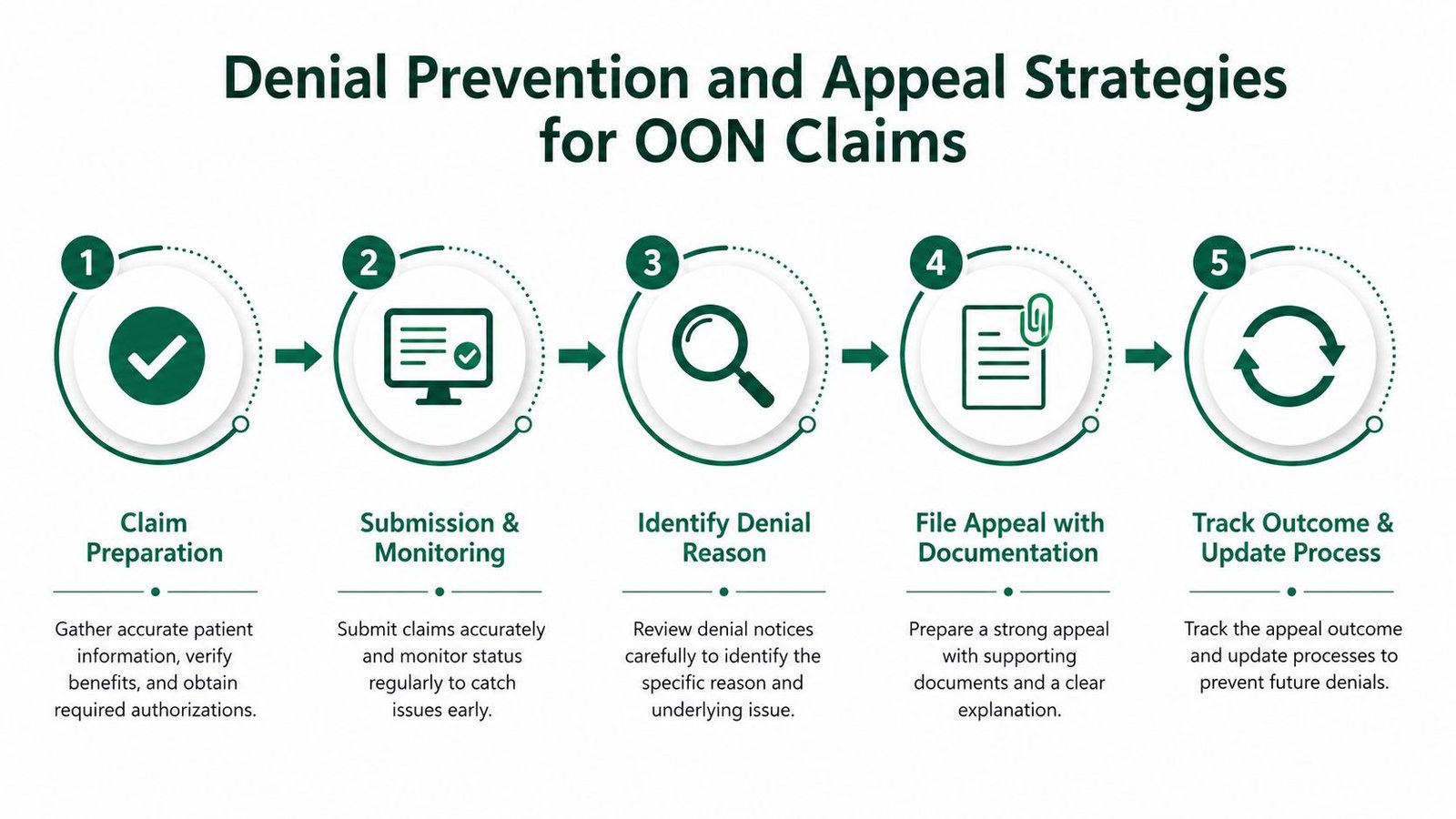
Denial Prevention and Appeal Strategies for OON Claims
Out-of-network denials are expensive because they don't just delay cash, they force your team to prove the claim after the fact. The best denial management programs I've seen treat each rejection as a pattern, not an event. That approach shortens A/R because it prevents the same mistake from being resubmitted over and over.
Where denials usually start
The common failure points are predictable. Missing modifiers, wrong place-of-service codes, weak documentation, and eligibility assumptions create a denial stack long before the appeal letter is written. If the service also falls under NSA protection, a payer may try to deny on the wrong basis, which means your team needs to know whether the claim belongs in a reimbursement dispute, a coding correction, or a compliance review.
That's why I like denial dashboards that separate reasons by payer and service line. If one payer keeps rejecting facility-based specialty claims, the issue is probably contractual or policy-driven, not random staff error. If one specialty is routinely denied for modifier problems, then the fix belongs in the charge capture workflow, not the appeal queue.
How to appeal without wasting cycles
The strongest appeal letters are short, specific, and evidence-based. They should identify the service date, the exact denial reason, the supporting documentation, and the rule that supports the billed amount. If the claim is eligible for the federal dispute process, the team needs to preserve the file for that path instead of assuming a standard reconsideration will solve it.
This is also where Transparency in Coverage files can help, but only if you use them correctly. Under the federal rules, each out-of-network allowed amount and billed charge in the machine-readable file must be tied to a specific NPI, TIN, and place-of-service code, and the allowed amount must reflect the actual dollar amount the plan paid plus the patient's share, with disclosure thresholds noted in the BCBS implementation guide at 20 or more claims in the lookback period (CMS Transparency in Coverage steps). That structure makes benchmarking possible, but it only helps when your billing team can compare apples to apples.
Practical rule: appeal the denial reason you actually received, not the denial reason you expected.
For a structured denial process, a good starting point is this denial management resource. A disciplined team tracks whether the problem came from eligibility, coding, authorization, or payment policy, then fixes the root cause so the same A/R doesn't boomerang back next month.
Building an OON Revenue Cycle Workflow and Pricing Strategy
The cleanest out-of-network billing operations I've seen are built like a chain, not a pile of tasks. Eligibility, consent, coding, submission, denial follow-up, and payer negotiation all feed the same revenue outcome, so weak links show up in cash flow quickly. If your practice doesn't own that chain internally, it needs a billing partner that can.
Pricing has to match the contract reality
Out-of-network pricing isn't just “charge more and hope.” The practice has to know where usual-and-customary expectations are likely to trigger friction, where payer contracts create a negotiating advantage, and where collections should be driven by regulated payment pathways instead of patient billing. When the service falls under NSA protections, the payment process changes, so pricing strategy has to account for dispute resolution rather than patient balance collection.
That's why I'd rather see a practice define pricing by service family and payer behavior than by a blanket markup. Specialty workflows, especially anesthesia, radiology, pathology, and behavioral health, tend to produce different denial patterns and different settlement behavior. If your billing team can't tell you which service lines recover well, the pricing model is too blunt.
What to measure every month
The metrics that matter are operational, not decorative. Track first-pass clean claim rate, days in A/R, denial rate by payer, and the share of claims that move into appeal or dispute. Those numbers tell you whether the team is protecting cash or just processing volume.
A practical evaluation question for an owner is simple. Can the current team explain why one payer pays quickly, why another delays, and which claim types are safest to push through the normal workflow? If the answer is vague, the practice probably needs more specialized RCM support.
outsource medical billing is worth considering when out-of-network complexity starts consuming staff time that should be going to patient access and clinical operations. In our experience, the cost of a specialized team usually shows up in fewer avoidable denials and less time spent repairing claims that were never clean to begin with.
Decision rule: if out-of-network claims are a meaningful part of your revenue mix, your billing partner should be able to manage payer disputes, consent workflows, and specialty-specific coding without slowing A/R.
Frequently Asked Questions About Out of Network Billing
Out-of-network billing in specialty practice is where hidden revenue leakage usually shows up first. The patient-facing bill gets most of the attention, but the bigger risk is often inside the facility relationship, where consent, modifier use, place-of-service rules, and payer-specific edits can turn a payable claim into a denial or a recoupment.
Can I still balance bill for outpatient office services?
Sometimes, but not automatically. If the service falls outside the NSA protections, you still need to check payer rules, state law, and your own consent workflow before billing the patient for the full amount.
The practical risk is not just whether the charge is allowed. It is whether your documentation supports why the service was billed as out of network, whether the patient was properly informed, and whether the claim was submitted in a way that matches the contract you are working under. A weak consent file or a sloppy charge entry can create both compliance exposure and A/R drag.
What if I'm in network with some payers but not others?
Then your team has to stop treating all claims the same. The payer mix matters because the right billing strategy for one insurer can create a denial or recoupment risk with another.
That matters even more in specialty settings inside in-network facilities. A practice may be in network for the facility contract, but still out of network for the professional claim, and that split changes how the team handles authorization, patient notices, modifier logic, and appeal language. If the front end and billing team are not aligned, leakage starts before the claim even leaves the practice.
How do I track IDR outcomes without losing control of A/R?
Track them like any other dispute bucket, by payer, service line, date opened, and final resolution. If the same claim type keeps ending up in dispute, the fix is upstream in contracting, documentation, or pricing.
I also recommend separating disputed claims from ordinary aged A/R in your dashboard. If everything sits in one bucket, leadership cannot see whether cash is delayed because the payer is stalling, the record is incomplete, or the fee schedule is too aggressive for the market. Clear status tracking makes it easier to decide when to appeal, when to rewrite the process, and when to stop sending the same claim pattern through the same broken workflow.
When does it make sense to go fully in network?
When the administrative burden and collection volatility from out-of-network billing outweigh the payment upside. If your team spends more time defending claims than collecting them, the math may already be telling you what to do.
For a specialty practice, the decision often comes down to predictability. If a payer mix creates repeated denials, prolonged disputes, or frequent patient abrasion, in-network contracting may protect A/R even if the allowed amount is lower. The right answer depends on specialty, utilization, and how much staff time the current model consumes.
If out-of-network billing is draining cash, creating denials, or stretching your A/R, Happy Billing can help you tighten the workflow without forcing an EHR migration. Visit Happy Billing to see how a specialty-focused RCM partner can protect collections, reduce leakage, and bring more predictability to your claims.