No Surprises Act Open Negotiation: How to Start the 30-day Clock (with Notice Template)
A claim paid at about $100 against a roughly $300 billed amount leaves a meaningful gap. Treat those figures as a hypothetical example, not a guaranteed result: the practical risk is that a valid underpayment stays in A/R when nobody records the payment or denial date and assigns the notice deadline.
The notice has to be sent within 30 business days after receipt of the initial payment or denial. Business days are Monday through Friday, excluding federal holidays. Once the notice is submitted to both the payer and HHS, the separate 30-business-day negotiation period begins. If the parties do not resolve the dispute, the usual next step is to initiate federal IDR within 4 business days after that period ends. These linked deadlines make the first date especially costly to miss.
Record the ERA or EOB receipt date at payment posting, then calculate and track the notice deadline at the claim level. A payer phone call or an internal follow-up note does not replace the written notice. The CMS guidance for disputing parties explains the federal timing and standard notice requirement.
The notice must identify the disputed service and proposed total out-of-network rate, including applicable patient cost sharing. Use the No Surprises Act compliance checklist to check related workflow requirements. Keep the submitted notice and evidence of delivery with the claim record. A late or undocumented notice can leave an underpayment stuck in A/R even when the dispute is valid.
Happy Billing is headquartered in Texas and supports No Surprises Act compliance, including work with Medicaid Managed Care and Empire BCBS in New York. Its specialty coverage includes anesthesiology, mental health, cardiology and orthopedics. Practices reviewing balance-billing rules and workflows can start with the plan and claim details.
US practices only.
What Actually Starts the 30-Day Clock
A low payment appears on the ERA, and staff flag the claim for follow-up. If they wait until a payer call or internal note before sending the notice, they may miss the deadline. Neither action starts or preserves the federal open negotiation process. The clock begins with receipt of the initial payment or notice of denial for the item or service. Either the out-of-network provider or facility, or the health plan, may initiate negotiation.
The first deadline is business day 30 after receipt of the initial payment or denial. Count business days as Monday through Friday, excluding federal holidays, and submit the notice within that window. The second clock is the 30-business-day negotiation period, which starts when the notice is submitted to both the payer and HHS. If the dispute remains unresolved, the usual IDR filing window is 4 business days after the negotiation period ends. These are three linked deadlines, and missing the first can leave a valid underpayment stuck in A/R.
For a New Jersey sports medicine group, a gap between about $300 billed and about $100 allowed can affect cash flow across multiple locations. If staff do not record the ERA date, each day of delay cuts into the time available to start the process. Set one claim-level deadline that payment posting and A/R follow-up can both see. Don't rely on someone spotting the underpayment later.
Anchor the workflow to the remittance date
Record when the remittance advice or denial was received, calculate the notice deadline, and save proof of submission. CMS provides a standard Federal Open Negotiation Notice for meeting the notice requirement. Treat it as a formal step in the dispute process, not a request for a better payment.
Before placing a claim in a batch, assign an owner to check whether the claim and plan qualify. The intake record should capture the payment or denial, plan details, notice deadline, and person responsible for the next action. Use the federal IDR process for providers to map the handoff from negotiation to filing, so it does not depend on anyone remembering a date. Keep the workflow aligned with your balance-billing rules and processes.
US practices only.
Timeline From Payment Date to IDR Filing
Copy this calendar into the claim workflow and define business day 0 as the date the ERA or EOB shows the initial payment or denial. Don't use the date someone opened the payer portal. The calendar needs to distinguish the deadline for sending the notice from the negotiation period that follows submission.
| Milestone | Clock rule | Evidence to keep |
|---|---|---|
| Business day 0 | ERA or EOB shows the initial payment or denial | Remittance copy with date stamp |
| Business day 30 at the latest | Deadline to submit the open negotiation notice | Transmission confirmation to payer and HHS |
| Negotiation day 5 | First documented payer contact and QPA request | Call log with representative name and reference number |
| Negotiation day 15 | Second contact with the benchmark rationale | Written record of the payer response |
| Negotiation day 25 | Escalation decision | Internal decision memo for each claim |
| Negotiation day 30 | Negotiation period ends | Outcome recorded for every claim |
| Within 4 business days after the period ends | Deadline to initiate federal IDR if unresolved | IDR filing receipt |
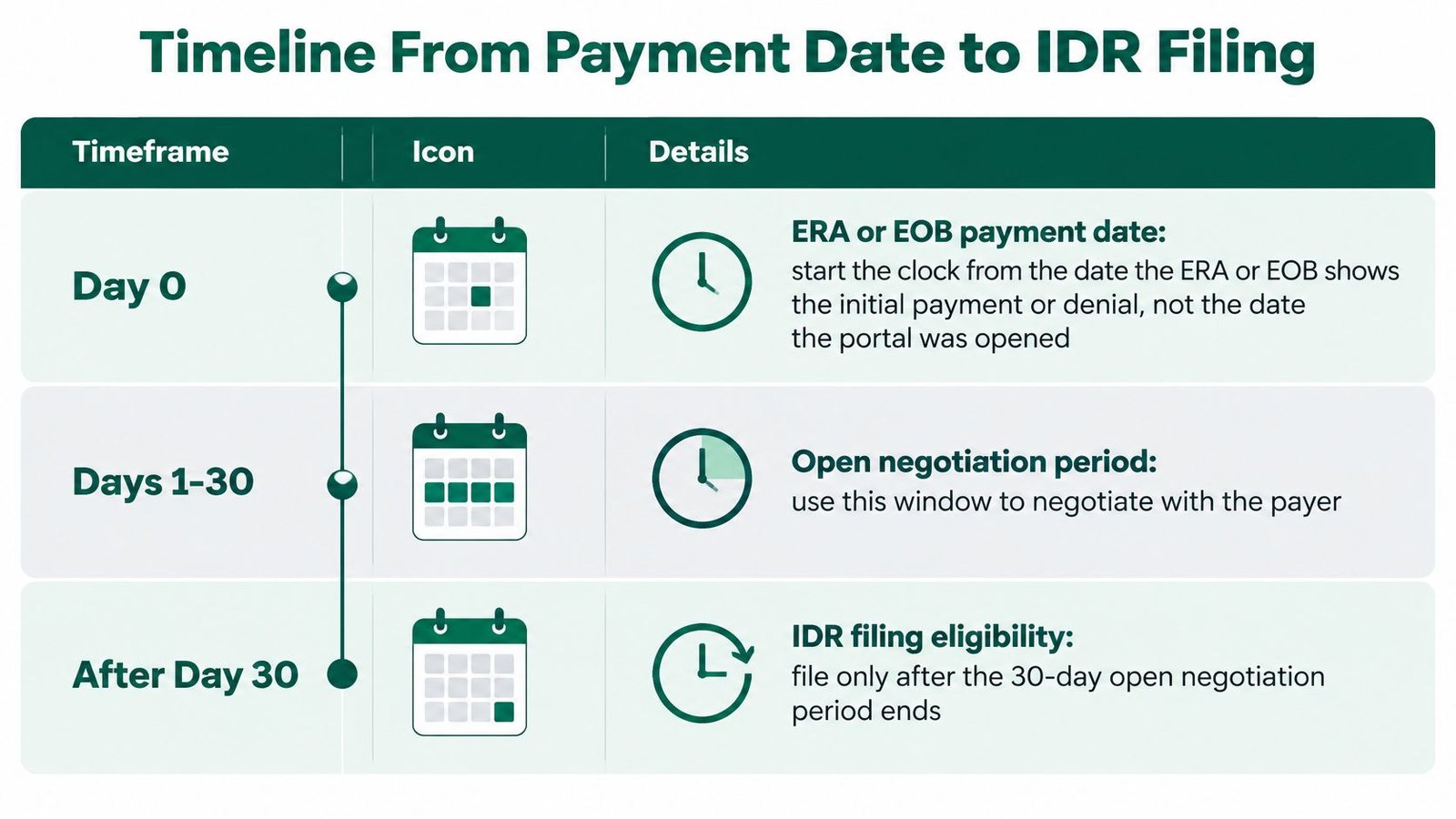
Make the handoff before the window closes
The day 5, 15 and 25 contacts are operational checkpoints, not separate federal filing deadlines. Use them to document the payer's position, provide a supported rate rationale and decide whether the dispute is moving toward agreement or IDR. By negotiation day 25, someone should own the escalation decision and have the claim evidence ready.
The parties must finish the negotiation period before IDR can begin. If there's no agreement, either party generally has only 4 business days after it ends to initiate IDR, as explained in the CMS overview of the independent dispute resolution process. The provider IDR filing guide can help your team prepare the next step while negotiation is still active.
A realistic path from the initial payment to resolution can take 45 to 90 days in our experience. The exact pace depends on payer response and the dispute path, but the calendar should always be driven by the ERA or EOB date. A deadline generated when staff first notice a denial starts too late.
What the Notice Must Contain and How to Fill It
Use this field-by-field check before sending the prescribed federal notice. The plain-language template below is a drafting aid, not a substitute for the standard form. Submit the notice to both the payer or issuer and HHS, with the remittance advice or denial documentation attached.
| Field | What to enter | Why it matters |
|---|---|---|
| Initial payment or denial date | Date on the ERA or EOB | Sets the notice deadline |
| Notice submission date | Date the notice goes to payer and HHS | Starts the 30-business-day negotiation period |
| Claim and service identifiers | Claim number, date of service, CPT codes with units and modifiers | Ties the notice to the exact line items |
| Plan identification | Payer name, plan name, member ID and plan funding type | A wrong plan type can make the claim ineligible |
| Total out-of-network rate | Proposed total rate including patient cost sharing | Federal negotiation addresses the total rate, not only the payer share |
| Remittance attachment | Copy of the ERA or EOB showing the payment or denial | Proves the trigger date |
| Contact and signature | Practice name, contact person, phone and email | Gives the payer a named responder |
Seeing this on your own EOBs? Bring a few recent out-of-network EOBs to a call. We will tell you which claims look underpaid and which are worth appealing.
Plain-language notice template
Copy each bracketed field from the ERA, EOB, claim record or plan documents. Don't estimate a date, code, unit count, modifier or proposed amount. The notice needs to identify the disputed item or service and address the total out-of-network rate, including patient cost sharing.
To [payer name] and the U.S. Department of Health and Human Services: [Practice name] is initiating open negotiation under the No Surprises Act for claim [claim number], date of service [date], CPT [codes with units and modifiers]. We received an initial payment or denial on [date]; the remittance advice is attached. Our proposed total out-of-network rate, including patient cost sharing, is [amount]. Please respond to [contact name, phone, email] and provide the qualifying payment amount on request.
A wrong unit count or missing modifier can point the negotiation at the wrong service line. For example, a $540 physical therapy visit with 97140 x2 and 97110 x2 needs those units represented accurately; otherwise, the proposed rate may not match the billed services. A wrong plan type or omitted remittance attachment can also stall review before the payer evaluates the proposal.
Sending the Notice and Keeping Proof of Delivery
Sending starts the clock; proof defends it. The federal notice and information-collection instructions explain that the notice counts from the date it's sent, not the date the recipient opens it. Mail is permitted. Electronic delivery is permitted only when the sender reasonably believes the method is readily accessible to the recipient and provides a paper copy free upon request.
- Pull the trigger date. Use the ERA or EOB to identify the initial payment or denial date, then enter it on the claim record.
- Complete the prescribed notice. Check the identifying fields and attach the remittance or denial documentation.
- Choose a delivery method. Mail the notice, or use electronic delivery only when the access and free paper-copy conditions are met.
- Submit to both recipients. Send the notice to the payer and HHS. A phone call, internal email or claim-status flag doesn't substitute for submission.
- Save the transmission record. Keep a portal receipt, email delivery record or certified-mail receipt, along with the recipient address.
- Start the negotiation calendar. Log the submission date and set the end of the 30-business-day period.
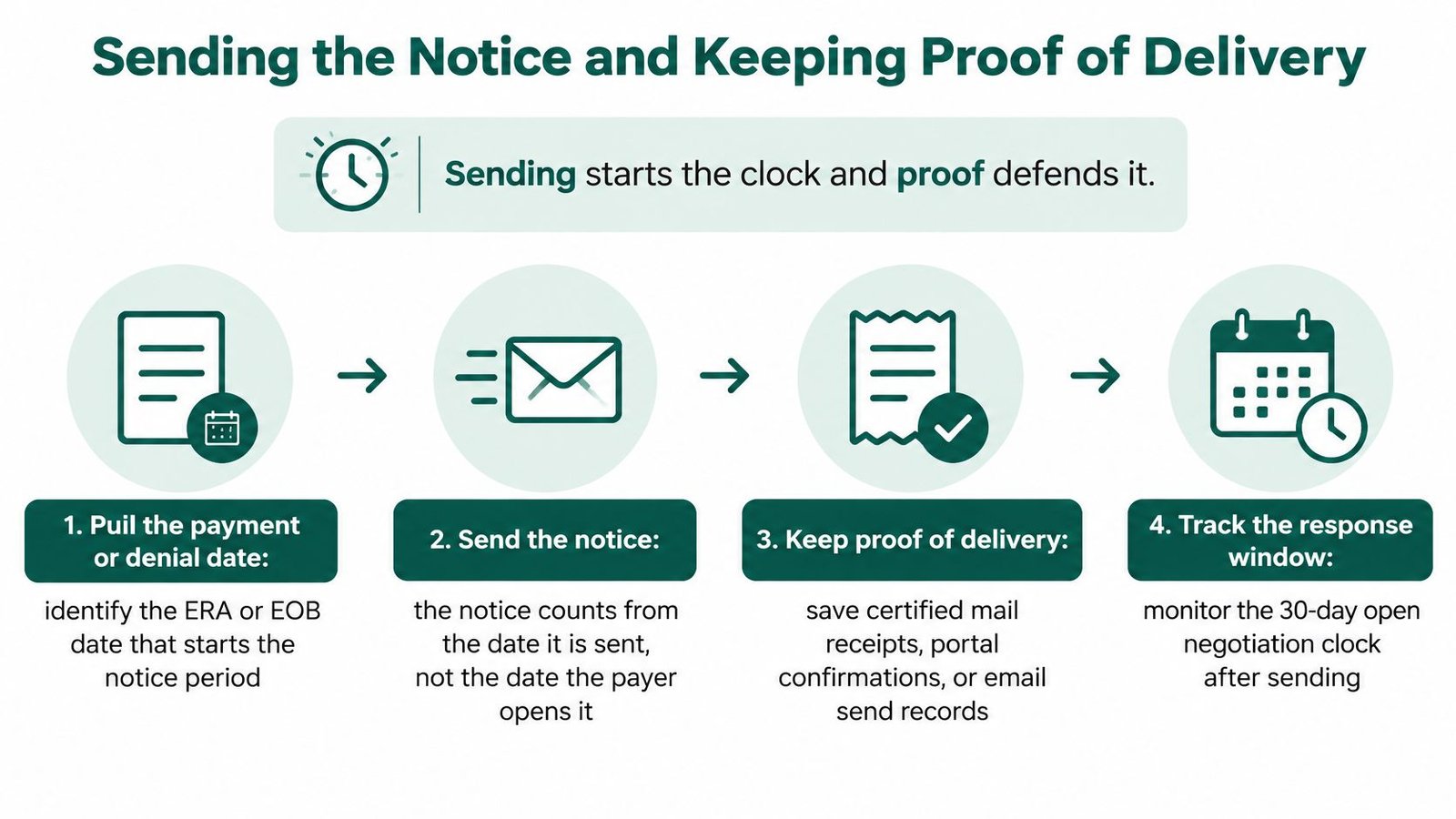
Build one proof file per claim
Keep the completed notice, remittance or denial, transmission confirmation, recipient address and business-day calendar entry together. For anesthesia, radiology and emergency groups, notices may go out in batches, but each claim still needs its own proof file. An undated internal copy doesn't show when the notice was sent or whether it went to both recipients.
Happy Billing's billing team ensures every OON Consumer Protection Act disclosure protocol, notification timeline and documentation requirement is met before claims are submitted. That kind of document control matters because a template alone can't prove timely delivery. The No Surprises Act compliance checklist is a useful reference when reviewing whether the submission workflow captures both the notice and its delivery evidence.
Negotiating Batches With the Payer and Requesting QPA
A batch works best when its claims share a clear rationale, such as a common payer, specialty, code family or payment issue. Grouping related underpayments makes it easier to present the facts consistently, while a mixed file can obscure why each claim warrants a different payment. Use a batching workflow for underpaid out-of-network claims to organize the claims and supporting details.
For each claim, request the qualifying payment amount (QPA) in writing and ask the payer to explain the basis for its payment. Compare the response with relevant benchmark data and document why the practice's proposed rate is reasonable. Benchmarks can inform the discussion, but no specific percentile is a required ceiling or standard settlement point.

Build a defensible negotiation record
Prepare an evidence packet with the remittance or denial, EOB, claim form, code and modifier detail, relevant medical-record or acuity support, network-status evidence and proposed-rate rationale. Contact the payer during the negotiation period and record each response. If an assignment of benefits is on file, the practice and payer can negotiate without patient contact.
The parties must complete the full negotiation period before federal IDR. If they do not reach agreement, either party generally has 4 business days after the period ends to initiate IDR, according to the CMS IDR process overview. Decide whether to escalate before the period closes. If a deadline has passed, consider an appropriate resubmission for a fresh EOB, the payer's formal or one-time provider dispute, or IDR if the claim qualifies.
Track results by eligible notices sent on time, payer responses, agreements and disputes advanced to IDR. Separate outcomes by specialty, code family, payer and denial reason, so different claim types do not distort the comparison. The out-of-network medical bill repricing tools overview can help explain how repricing affects allowed amounts.
Edge Cases, the Go or No-Go Check and Your Next Step
A valid underpayment can still become stranded in A/R if the notice misses the first deadline. The clock is a chain: send notice within 30 business days of the payment or denial, complete the 30-business-day negotiation period, then start IDR within the applicable 4-business-day window. Screen eligibility before a claim enters a batch, and keep the plan type and delivery record with the claim. A QPA may inform the negotiation record. Use this QPA guide for out-of-network providers to understand what to request and review.
| Mistake | Why the claim fails | Fix |
|---|---|---|
| Notice sent after business day 30 | Federal IDR access may be at risk even if the underpayment is valid | Track the deadline from the ERA or EOB date |
| Notice sent to the payer only | The notice must reach both the payer and HHS | Submit to both and save each confirmation |
| Wrong plan type | Self-funded and state-regulated plans may follow different routes | Verify the plan's funding type before sending |
| Electronic delivery without accessibility | Electronic delivery requires a readily accessible method and a free paper copy | Mail the notice or confirm the recipient can readily access it |
| Calendar days counted instead of business days | The deadline arrives sooner than the team expects | Use a business-day calendar that excludes federal holidays |
| Ineligible claim placed in a batch | The claim does not belong in the federal negotiation process | Screen eligibility before batching |
Facility-based groups should confirm which party initiates the dispute and which plan governs the service. Anesthesia, radiology, emergency medicine, pathology, neonatology, assistant surgery and neuromonitoring claims may pass through a facility. Confirm the responsible entity and plan funding type rather than relying on the payer's name alone. Fully insured plans regulated by state law may follow a different route from self-funded plans.
Run the go or no-go check
Before submitting, confirm the ERA or EOB date and calculate the notice deadline in business days. Verify the claim's plan type, required notice content and delivery method. Schedule delivery to both the payer and HHS, then keep the submission confirmations in a proof file. If the claim falls outside the federal path, leave it out of the IDR batch and assess the payer's other dispute route.
For denials outside open negotiation, follow a defined medical billing denial management process. For specialty-specific workflow, see the anesthesiology billing specialty page. Tracking ERA dates helps the team identify edge cases before the notice window closes.
A billing specialist can review your notice and follow-up process on a free 30-minute call.
US practices only.
Frequently Asked Questions
What happens if we miss the notice deadline?
The claim may lose access to federal IDR even when the underpayment is valid. Check the ERA or EOB date immediately, verify whether the claim still qualifies, and fix the workflow that caused the missed deadline.
Do we need patient consent before negotiating?
No patient contact is needed when an assignment of benefits is on file. The negotiation is between the practice and the payer, subject to the claim's eligibility and documentation.
Can we send the notice by email?
Only when you reasonably believe the recipient can readily access the electronic method and you provide a paper copy free on request. Mail is the simplest option for a clear delivery record when your electronic workflow doesn't meet those conditions.
Should we outsource open negotiation or handle it in-house?
Choose based on whether your team can control deadlines, manage batches and keep a complete proof file for each claim. Compare those demands with the cost of outsourcing medical billing; our out-of-network recovery fees are contingency-only, depend on claim age and volume, and we give a clear number after a free 30-minute call with a billing specialist.
Happy Billing helps practices manage out-of-network underpayment workflows, including the notice record, payer negotiation and IDR preparation when a claim is eligible. Visit Happy Billing to book a free 30-minute call with a billing specialist and discuss how your practice can protect the open-negotiation deadlines.
Want someone to run these disputes for you? Happy Billing handles No Surprises Act open negotiation and IDR for facility-based groups, from claim triage to collecting the award.