No Surprises Act IDR for Radiology and Emergency Physician Groups: A Guide
Most out-of-network emergency department services and facility-based radiology reads belong in federal independent dispute resolution. Waived nonemergency care and many state-process claims do not. Treat No Surprises Act IDR for radiology and emergency physician groups as a weekly revenue-cycle function with a break-even test, not as a legal appeal you file when someone has spare time. Groups that skip that test watch A/R days rise while the payer's first allowed amount becomes the collected rate.
Also worth reading: how to start No Surprises Act open negotiation, recovering underpaid assistant-surgeon and orthopedic claims under the No Surprises Act and No Surprises Act IDR for neuromonitoring (IONM) groups.
Who Qualifies for IDR and What It Is Worth
Confirm the forum before the clock starts. Eligible out-of-network emergency visits and facility-based radiology reads can go to federal IDR. A valid patient waiver, or a claim that belongs in a state dispute process, generally cannot.
By 2024, disputing parties had initiated more than 1.46 million federal IDR disputes, according to the Congressional Research Service. About 1.42 million, or 97%, involved out-of-network emergency or nonemergency services, while 44,238, about 3%, involved air ambulance. Emergency department services produced roughly 45% of all 2024 payment determinations and radiology about 20%; together the two specialties accounted for nearly two-thirds of disputes over out-of-network emergency or nonemergency care. The same report shows CMS logged 610,498 disputes in the first half of 2024 and 853,374 in the second half, a 40% increase. At that volume, a missed batch is lost revenue. Groups that file IDR sporadically leave money sitting at the payer's first allowed rate.
Happy Billing is a medical billing company headquartered in Texas, working with physician groups in New York, New Jersey, and other states where federal and state dispute rules overlap. We recover out-of-network underpayments for radiology, emergency medicine, anesthesiology, and cardiology practices. When an IDR dispute is triggered in one of those specialties, our team prepares the documentation package and timeline the OIC arbitration process requires, and our coders and compliance staff train on both SB 1264 and the federal No Surprises Act.
Which claims can actually move cash
| Claim type | Federal IDR eligible? | What it means for your revenue |
|---|---|---|
| Out-of-network ED visits at any facility | Yes | Largest share of determinations; under-coding or missed deadlines leave the payer's first rate in place |
| Out-of-network radiology reads at in-network hospitals | Yes, when facility-based rules apply | Radiology is a recurring share of determinations; a missed read is a missed filing |
| Nonemergency services with a valid patient waiver | No | Revenue depends on the contract and state rules, not federal IDR |
| Claims in states with their own process (for example, New York DFS) | Usually no; the state process applies | Filing in the wrong forum burns the deadline |
| Air ambulance services | Separate federal rules | Rarely relevant to ED or radiology groups |
A wrong forum does not pause the dollar. An under-coded 99284 or 99285 that never enters the right process stays at the initial allowed amount. A professional radiology read dies the same way when staff file a New York claim in the federal portal or send a federal claim to the state regulator. Groups lose money before a case exists: in triage, coding, and the routing decision, weeks before any arbitrator sees the file. Our denial team trains on New York DFS filing requirements, documentation standards, and aggregation strategies precisely so that routing call gets made correctly on the first pass.
Read the rules on whether the No Surprises Act applies to physician offices before you build a batch. Specialty billing for emergency and radiology groups is where that eligibility filter meets charge capture, and we post ERAs and EOBs so recovered amounts reconcile cleanly to the books.
Start with the 120-day payer EOB pull described in the closing section. That pull sizes your recoverable pool and shows which payers underpay most often, which is exactly what a break-even test needs. Talk to Happy Billing about your out-of-network A/R to scope that review.
US practices only.
Triage Claims Before You File Anything
IDR deserves a weekly A/R queue before it deserves a legal file. Filing every underpaid line feels thorough. It is also how independent groups spend margin on preparation, certified-entity fees, and cash that sits idle for months.

CMS reported 1,145,039 payment determinations from July through December 2025, including 52% for emergency department services and 15% for radiology, in its federal IDR supplemental background; the same release lists 2026 certified-entity fees that differ by entity, including examples of $485 for a single determination and $685 for a batched determination, plus an administrative fee reduced from $115 to $15 per party for disputes initiated on or after June 11, 2026.
A lower administrative fee may invite more filings. It does not cover staff time, reduce the certified-entity fee, or make a weak claim economical.
The four inputs that decide a filing
Run four numbers before anyone opens a portal.
- Minimum underpayment: the gap between the payer's initial payment and a defensible offer, after removing lines likely to be dismissed.
- Expected selection rate: a conservative estimate for that payer and CPT family.
- Staff hours: logging, open negotiation, offer support, and payment posting. Two hours on a thin line can erase the recovery even when the dispute succeeds.
- Permitted batch size: only claims that qualify for aggregation. Claims spread across payers require separate economics.
A single ED visit with a $200 underpayment may fail that test after the entity fee and labor. Ten same-payer claims with comparable gaps, such as ED E/M 99283 through 99285 or a run of radiology reads, create a $2,000 pool. That pool can justify the filing work if the claims meet the batching rules.
Same-payer claims usually deserve aggregation when their combined gap covers fees and labor. Single low-dollar lines belong in open negotiation until enough similar claims create a stronger pool.
Practical rule: If the batch can't cover the entity fee, the labor, and still beat the initial payment, don't file it.
A repricing pattern can make batching rational even when one claim does not. When a repricing tool reduced the allowed amount, name it in the negotiation letter and look for other claims affected the same way.
Happy Billing tracks the in-network rating for every facility where a client's physicians practice. When a qualified radiology or emergency medicine dispute clears the break-even test, its team prepares the documentation package and timeline required by the OIC arbitration process.
Confirm the applicable certified-entity and administrative fees on the initiation date. The cost structure from an earlier dispute may not govern the next filing.
Coding and Charge Capture That Protects Your Offer
A claim that is wrong at the charge level is wrong again in the dispute. Specialty-trained coders, working to AAPC-aligned CPT, ICD-10, and modifier review, are how we keep those errors from becoming the offer.
Level 99281 through 99285 against documented medical decision making or time before the claim goes out. 99285 needs high-complexity documentation. If the note supports 99284 and the charge says 99285, the payer's low payment is the easy argument, and your offer inherits the same weakness. That lost level is not a coding quibble. It is the difference between the initial ED payment and the amount you can defend.
What fails the offer before it is written
| Code or modifier | What to verify | What it costs the practice if wrong |
|---|---|---|
| Modifier 25 on ED E/M | Separate, significant service documented on the same day as a procedure | Missing 25 bundles the visit payment into the procedure |
| Radiology professional 70010 to 79999 with modifier 26 | Group bills only the read and does not own the equipment | Global billing without equipment ownership triggers denial and recoupment |
| Modifier TC on technical component | Group owns the equipment and bills from the facility setting | Mismatch triggers review and weakens the offer's credibility |
| Place of service 23 (hospital emergency room) | POS matches the facility where service was rendered | Wrong POS shifts payment to a different rate schedule |
Modifier 25 is the quiet leak on procedure days. If the E/M isn't a separate, significant service, the visit dollars fold into the procedure and never show up as an underpayment you can dispute. On the radiology side, a group that doesn't own the scanner bills the professional component with modifier 26 only. A global claim from a read-only group is a common recoupment. Modifier TC belongs only when you own the equipment and the facility setting is yours. The split is explained in modifier 26 versus TC.
Place of service 23 has to match the hospital emergency room where the physician worked. A clinic POS on an ED chart pushes the line onto a different rate schedule. You then argue from a number the payer can dismiss.
Match charge capture to the EOB before any batch is built. Pull code and modifier mismatches back to charge review. One bad line can taint how a certified entity reads the rest of the submission.
Don't send a global radiology claim into IDR to "see what happens." If you don't own the equipment, the global charge is the problem, not the QPA.
Seeing this on your own EOBs? Bring a few recent out-of-network EOBs to a call. We will tell you which claims look underpaid and which are worth appealing.
Run Open Negotiation and Meet the Filing Deadline
The underpayment isn't the operational problem. The problem is whether your workflow catches the payment notice, starts negotiation, and still has a filing right when negotiation fails.
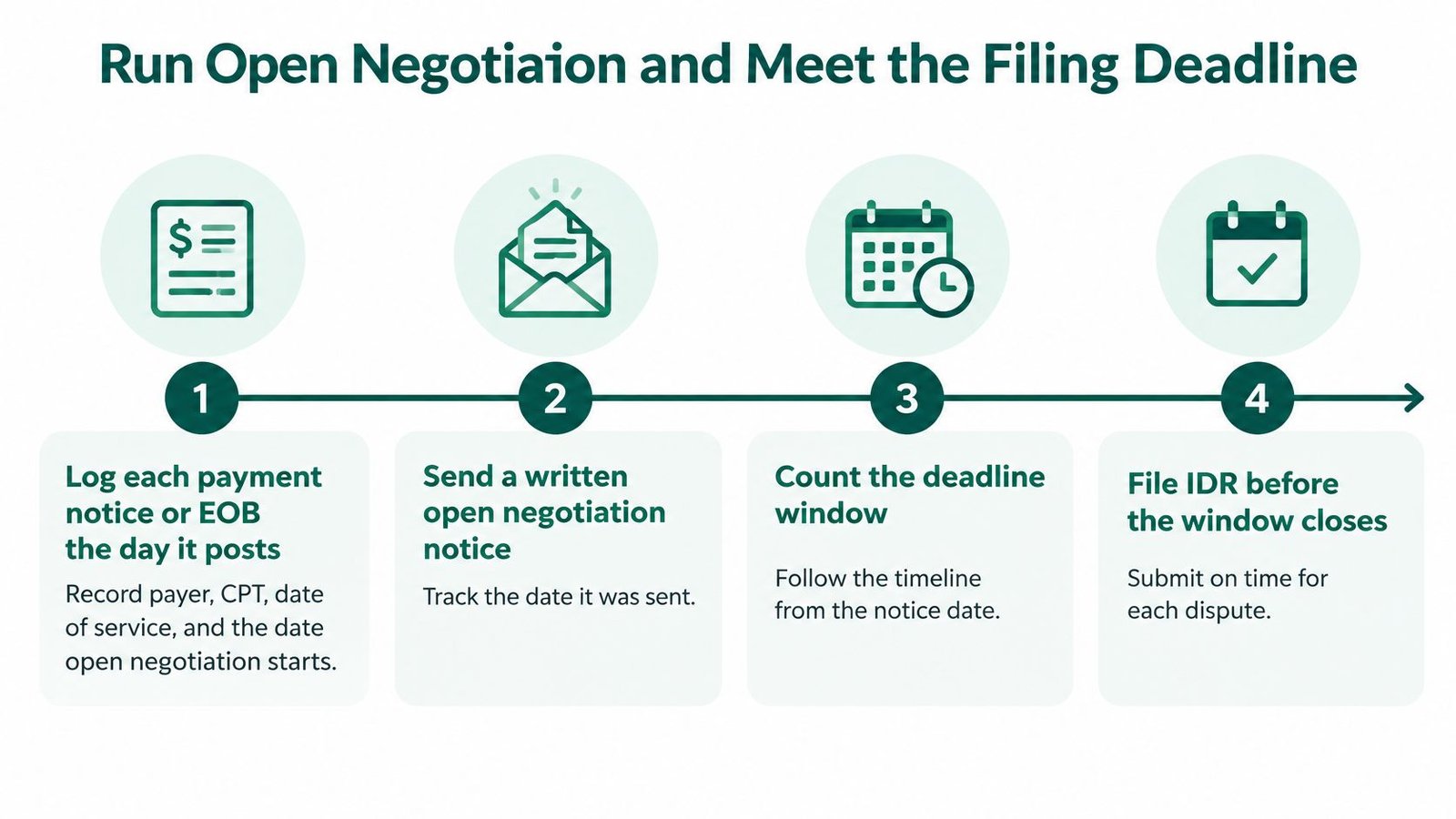
For an eligible out-of-network emergency, radiology, or other physician claim, the parties must first complete a 30-business-day open negotiation period. If there's no agreement, the IDR initiation notice generally must go in within 4 business days after that period ends, per CMS guidance on independent dispute resolution. Miss that window and the group is stuck with the payer's initial rate. A/R days go up, and the unrecovered dollars stay unrecovered. CMS also requires both sides to submit offers and pay the required fees during the process.
Six moves, in order
- Log each payment notice or EOB the day it posts. Capture payer, CPT, date of service, and the date open negotiation starts. If that date isn't in the practice management system, the rest of the calendar is a guess.
- Send a written open-negotiation offer in the first two weeks, with the benchmark behind it. Waiting until week four leaves no time to trade numbers before the period dies.
- Track the 30-business-day period to its last day, by payer. The deadline runs from the open-negotiation period, not from a later internal review date.
- Submit the initiation notice within 4 business days after the period ends. A late notice can end the challenge for that claim.
- Select a certified IDR entity, then submit offers and fees while the process is open. An offer without the fee is not an offer.
- Confirm the award and post the payment to the correct claim. An award that sits in a portal is not cash.
| Milestone | Timing | Risk if missed |
|---|---|---|
| Payment notice or EOB posts | Day zero | The clock for negotiation starts without anyone noticing |
| Open negotiation period | 30 business days | Payer's initial rate becomes the working rate |
| IDR initiation notice | Within 4 business days after the negotiation period ends | Challenge right is lost for that claim |
| Offers and fees submitted | During the IDR process | Dismissal or loss of the award |
| Award and payment posting | Set by the certified IDR entity's determination schedule and the payer's remittance cycle | Unposted awards inflate A/R days |
High-volume ED and radiology groups need payer-specific tracking. One workqueue for "all underpayments" hides which notices are on day 28. Put a deadline field in the practice management system and trigger it from the payment date, not from the day a biller happens to open the file. The full sequence, including what the initiation notice has to contain, is in our federal IDR process step by step.
Posting is where the cycle either closes or stalls. Happy Billing posts ERAs and EOBs to keep practice books balanced, so a determination lands on the correct claim instead of sitting in a portal while A/R ages.
The gap between award and cash belongs in your filing math. Timing runs on the certified IDR entity's schedule and the payer's remittance cycle, not your internal calendar, so underwrite that delay when you decide which claims to file. A favorable determination that takes weeks to post still has to clear the fees and staff time you spent to get it. That is the trade-off that decides whether IDR works as a recurring recovery function or just burns hours on claims that were never worth filing.
Build an Offer That Beats the QPA
The qualifying payment amount is an anchor, not a ceiling. It is generally the median contracted rate for the same or similar service in the same geographic region, calculated from contracts in effect on January 31, 2019 and adjusted for inflation. CMS uses the QPA for cost sharing on covered services, and certified IDR entities must consider it when they pick between the two offers, as explained in the QPA calculation methodology. It is not automatically the final reimbursement. A sloppy comparison still sinks the offer.
Check the QPA at the CPT and location level. A single group-wide average is the mistake that weakens offers. One local median doesn't apply to every code, every hospital, or every county. That error leaks underpayment and leaves the line in A/R while you rebuild the file.
What selection rates do and don't promise
For out-of-network emergency and nonemergency disputes that produced a payment determination, IDR entities selected the provider's offer in about 80% of cases in 2023 and 85% in 2024, according to a Congressional Research Service brief on IDR outcomes. That is a benchmark, not guaranteed reimbursement and not net profit. The same brief cites CMS Q4 2025 supplemental data with median prevailing offers of 334% of QPA for emergency-department CPT 99281 to 99288 items and 398% of QPA for radiology CPT 70010 to 79999 items. Those medians are reference points for a supported offer. They are not a number you type in because someone else received it.
A high initial offer without comparable contracted rates, acuity, complexity, or market access loses credibility. Overreaching is how a winnable line becomes the payer's number.
On negotiation, we treat FAIR Health benchmark data as a range with a job: it sets the supportable band between the QPA floor and the upper end of what the market has paid for that code in that geography. An offer that sits outside what the benchmarks and comparable rates can defend gives the IDR entity no reason to pick it. An offer parked at the QPA leaves the gap you came to recover.
When an IDR dispute is triggered for radiology or emergency medicine, we prepare the documentation package and timeline the arbitration process requires. The rules side of the QPA sits in the No Surprises Act compliance checklist. How to challenge a bad QPA is covered in what the qualifying payment amount is and how out-of-network providers challenge it.
Evidence that belongs in the package:
- Contracted rates: same CPT, same geography, not a national blend.
- ED acuity and time stamps: the note has to support the level you priced.
- Professional and technical split: modifier 26 or TC has to match who owns the equipment.
- Prior payer payments: what this payer paid before the repricing shift.
- EOB reconciled to the QPA: if those two figures don't tie, fix them before you file.
Prevent Denials and Measure Recovery
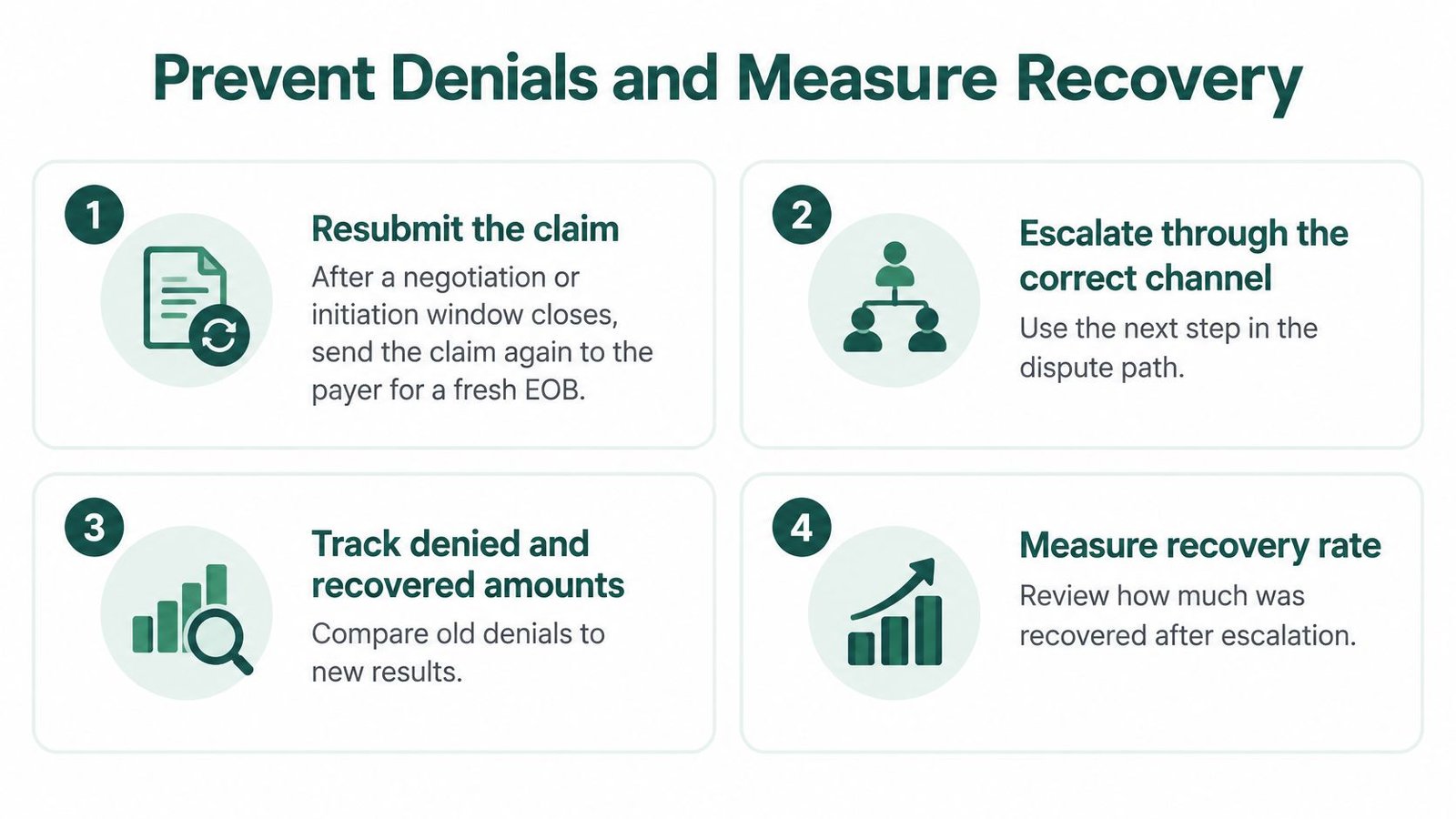
The federal IDR right dies with the initiation window. Recovery on the account does not. Resubmit the claim for a fresh EOB, then escalate through the payer's formal dispute or one-time provider dispute. That resubmitted line cannot go back into federal arbitration, so build the second attempt around what the payer's own appeal path can pay.
What to do when the federal clock has run
Resubmission matters because the new EOB resets what you can show a case manager. Don't resubmit a line you already know is miscoded. Fix the code, then send it. If the fresh EOB still sits far below a supported amount, move to the payer's formal dispute. Keep the two paths on separate workqueues; mixing them on one spreadsheet is how a second deadline gets missed.
Repricing detail belongs in that second look. A payment that lands far below the prior per-service level for the same code and payer is a signal to review contract and allowed-amount logic before you resubmit. On radiology lines, check whether the payer repriced the professional component or applied a facility rate to a freestanding read. On ED lines, check whether the E/M level paid below the acuity the note supports. Cloning the original claim returns the same underpayment with a new date on it.
Lines that were never NSA-eligible still need a denial workflow. Run them through a medical billing denial management workqueue, and use how to appeal a denied insurance claim when the issue is a standard appeal rather than a federal payment determination.
Four numbers that tell you if this is working
Provider-win percentage is the wrong scoreboard. A selected offer that doesn't clear fees, or that posts months later, didn't help the month.
- Net award after fees: entity fee, administrative fee, and labor, subtracted.
- Elapsed days from payment to cash: the A/R effect, not the portal date.
- Dismissal rate: ineligible, duplicate, or mismatched lines you should have kept out.
- Incremental payment above the initial offer: the only dollar the owner can spend.
Review those four monthly. The function pays for itself when incremental payment across a month of batches exceeds the fees plus the labor that went into the packages. Below that line, filing everything is a margin leak. If dismissal rate climbs while incremental payment stays flat, you are filing too wide. If elapsed days climb, the posting step is where the cash is stuck.
Measure the workflow by cash above the initial payment, net of fees. A high selection rate with a high dismissal rate is an expensive hobby.
Confirm Your Open Claims This Week
Decide this week whether the book can be worked in-house. Then work it, or hand off the part your staff can't date-stamp.
- Days 1 and 2. Pull 120 days of payer EOBs for ED and radiology codes. That is the first action.
- Day 3. Sort underpaid claims into same-payer batches of 10 or more. Leave the thin single lines in outbound negotiation.
- Day 4. Mark every open-negotiation end date and every initiation deadline in the practice management system, triggered from the payment date.
- Day 5. Send coding and modifier mismatches back to charge review. They don't belong in a batch.
Most of the money is lost on the calendar, before a case is ever filed. Compare the staff hours spent tracking deadlines each month with the revenue that disappears when one initiation window closes and the payer's rate sticks. If the hours don't cover the calendar, outsourcing the recovery work is the rational choice. The cost frame for that choice is in outsource medical billing cost. A billing specialist can scope your book on a free 30-minute call.
US practices only.
Do we have to contact the patient if an assignment of benefits is on file?
No. With an assignment of benefits on file, negotiation, resubmission, and an eligible dispute run on the practice side. Keep the patient out of the underpayment argument. Balance-billing limits are a separate compliance duty, not a reason to call the patient about the payer's allowed amount.
What if we already missed the 4-business-day initiation window?
That federal filing right is gone for the claim. Resubmit for a fresh EOB, then use the payer's formal dispute or one-time provider dispute. Don't backdate a notice. A late federal filing wastes the fee and can raise your dismissal rate.
Should we batch or file claim by claim?
Batch 10 or more same-payer claims when the rules allow it and the combined gap clears fees and labor. File a single claim only when that one line, standing alone, still clears the same test. Everything else stays in outbound negotiation.
How do we know outsourcing beats fixing this in-house?
Count the hours your team spends on notices, batches, and posting. Set that against one missed window's unrecovered dollars and against A/R that won't move. If the calendar is already slipping, a team that works denials and filings full-time costs less than another quarter of first-rate payments.
Happy Billing handles open negotiation, batching, and federal IDR support for radiology and emergency groups that are tired of leaving facility-based underpayments at the payer's first number. When a dispute is triggered, the team prepares the documentation package and timeline the OIC arbitration process requires, and posts ERAs and EOBs so practice books stay balanced while cases are pending. Visit Happy Billing to put the next 120 days of EOBs in front of a billing specialist.
Want someone to run these disputes for you? Happy Billing handles No Surprises Act open negotiation and IDR for facility-based groups, from claim triage to collecting the award.