Pain Management Out-of-network Underpayments: Procedures, Ascs and the No Surprises Act
An in-network ASC can still involve out-of-network pain physicians or anesthesia groups. Since January 1, 2022, eligible No Surprises Act claims have followed a 30-business-day open negotiation period before federal Independent Dispute Resolution. Treat the NSA as a controlled revenue-cycle workflow: verify eligibility, document the qualifying payment amount, track deadlines, and measure recovery against the dollars at stake on each procedure line.
Happy Billing is a medical billing company headquartered in Texas that recovers out-of-network underpayments for pain, ASC and specialty practices.
The largest risk is a low payment that an RCM partner closes as final. A clean denial rate can hide disputed procedure revenue written off and unresolved balances left in A/R. Underpayments on pain procedures, ASC services and No Surprises Act claims need separate recovery tracks, not one appeals queue. Late in 2025, about 19% of disputes were ineligible, so confirm eligibility before spending time and resources on IDR.
Where Out-of-Network Underpayments Hit in an Independent Pain Practice
An in-network facility doesn't make every professional involved in a procedure in-network. Your physician, anesthesia group, assistant, and facility can have different participation statuses, payment arrangements, and dispute rights.
A JAMA study of ambulatory surgery center billing examined 83,021 privately insured elective procedures and found out-of-network facility bills in 6.7% and out-of-network professional bills in 17.2%; related findings identified full billed-charge payment in only 24% of surprise out-of-network professional cases. These are historical findings, not a forecast of current pain-practice reimbursement, and they predate the NSA.
Inspect the payment, not just the claim status
The owner's question isn't whether the payer processed the claim. It's whether the payer paid the correct amount, whether the remaining balance is legally collectible, and whether a recovery deadline is running.
We approach that review at the procedure-line level:
- Epidurals: Review the physician payment separately from the facility and anesthesia components.
- Facet procedures and ablations: Reconcile the treated levels, laterality, and applicable payment reductions before calling the difference a repricer underpayment.
- Nerve blocks: Determine whether the service was an office procedure or part of a qualifying facility encounter.
- Spinal cord stimulation trials: Separate professional reimbursement from facility, device, and other associated charges.
The billed charge is useful context. It isn't proof that the entire unpaid balance is recoverable. Compare the payment against a defensible benchmark, account for legitimate reductions, and identify the actual disputed amount before escalating.
Owner's rule: A paid claim should leave the underpayment queue only after someone verifies the allowed amount, not merely because an EOB arrived.
Require a visible underpayment queue
Ask your RCM partner to show paid-but-disputed claims alongside denials. The signs of systematically underpaid out-of-network claims are particularly relevant when payments decline but claim acceptance remains stable.
Software selection matters, but jurisdiction matters more. Owners comparing international systems can review Wistec's medical billing software for Australian clinics as a separate market resource, not as guidance for US NSA compliance.
For a US pain practice, insist on claim-level visibility into payment benchmarks, dispute ownership, and aging. A billing platform that can't distinguish these fields won't give you a reliable view of recoverable revenue.
Book a free 30-minute call with a billing specialist to review how your pain and ASC underpayments are being routed.
US practices only.
Mapping Pain Procedures and ASC Services to NSA Eligibility
The CPT code identifies the service. It doesn't establish federal IDR eligibility. The same procedure can require a commercial payment dispute in an office and an NSA review when an out-of-network physician performs it at an in-network ASC.
CMS's medical bill protections guidance covers qualifying non-emergency services at in-network hospitals, hospital outpatient departments, and ASCs, including protected ancillary services such as anesthesiology. In covered circumstances, the professional generally can't balance bill the patient for the difference between the charge and the plan's payment.
Map the encounter before valuing the claim
| Procedure family | Office-based encounter | In-network ASC or hospital encounter |
|---|---|---|
| Epidurals 62321/62323 | Review commercial benefits, pricing, and payer dispute rights | Screen the professional claim for NSA eligibility |
| Facet procedures 64490-64495 and RFA 64633-64636 | Challenge unsupported pricing through the applicable payer route | Verify facility participation, consent status, and each disputed line |
| Nerve blocks 64405/64450 | Don't assume federal protection from the procedure name | Assess the covered facility visit and professional participation |
| Spinal cord stimulation trials | Identify the actual setting and billing entities | Evaluate professional and facility claims independently |
For 64405, an occipital nerve block, and 64450, a peripheral nerve block, the financial distinction is the recovery channel, not merely the code selection. Use the pain management CPT reference, including nerve-block codes to organize the procedure inventory, then attach encounter-specific eligibility evidence.
Notice-and-consent status also needs review. Don't assume that a signed general financial form removes NSA protections, particularly for protected ancillary services.
Keep professional and facility claims separate
An out-of-network physician at an in-network ASC doesn't automatically make the ASC's own claim eligible for federal IDR. Review the billing entity, payer type, facility status, service date, and applicable federal or state pathway independently.
The qualifying payment amount, or QPA, is generally based on the plan's median contracted rate for the same or similar service, rather than your billed charge. The AMA's QPA explanation provides context for why the relevant service, market, insurance type, and rate category matter.
A wrong benchmark can distort both your negotiation demand and your expected net recovery. Your pain-management specialty billing review should therefore connect the procedure inventory to eligibility and valuation, not stop at claim submission.
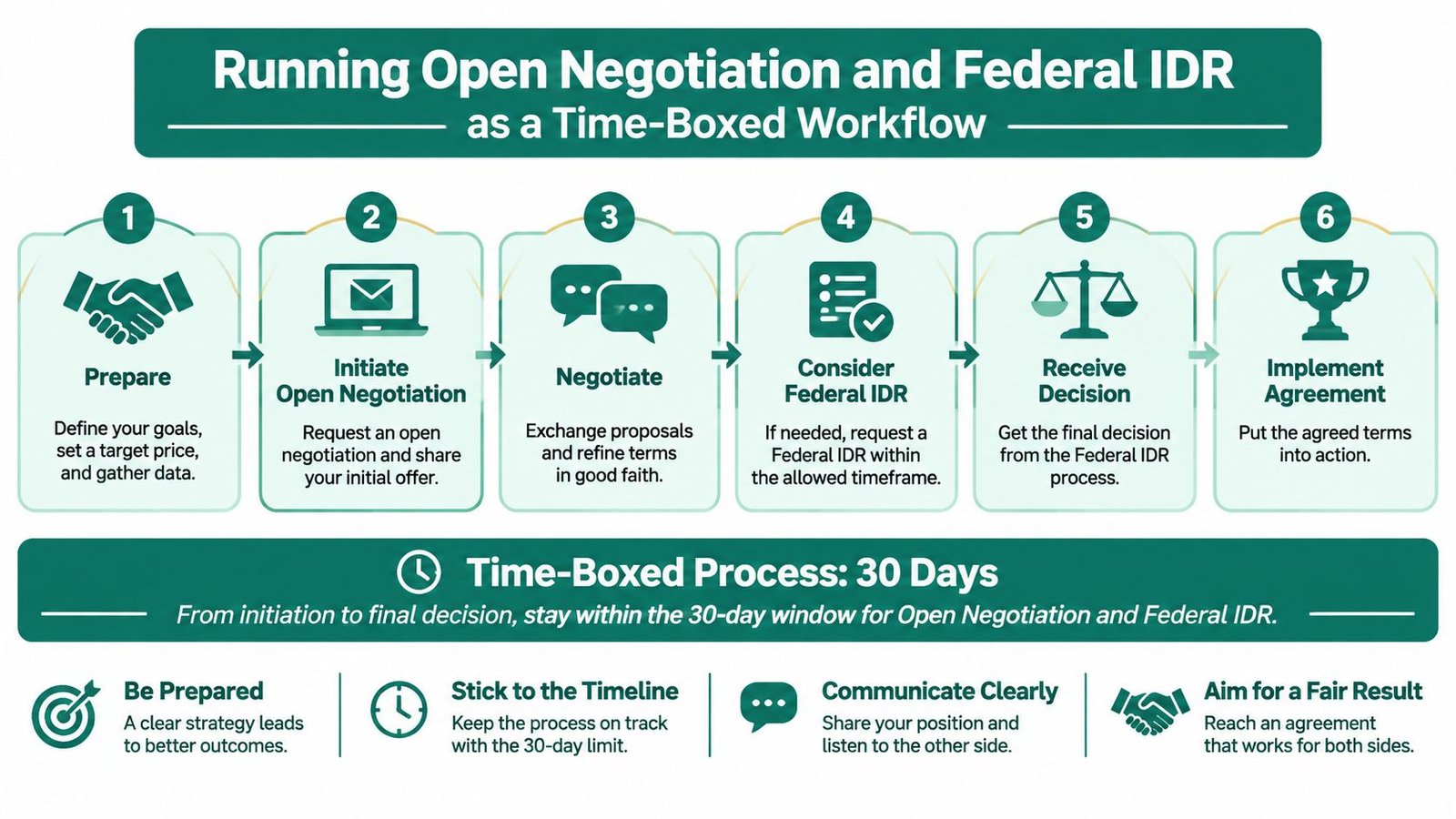
Once a claim qualifies, the dispute follows a defined sequence:
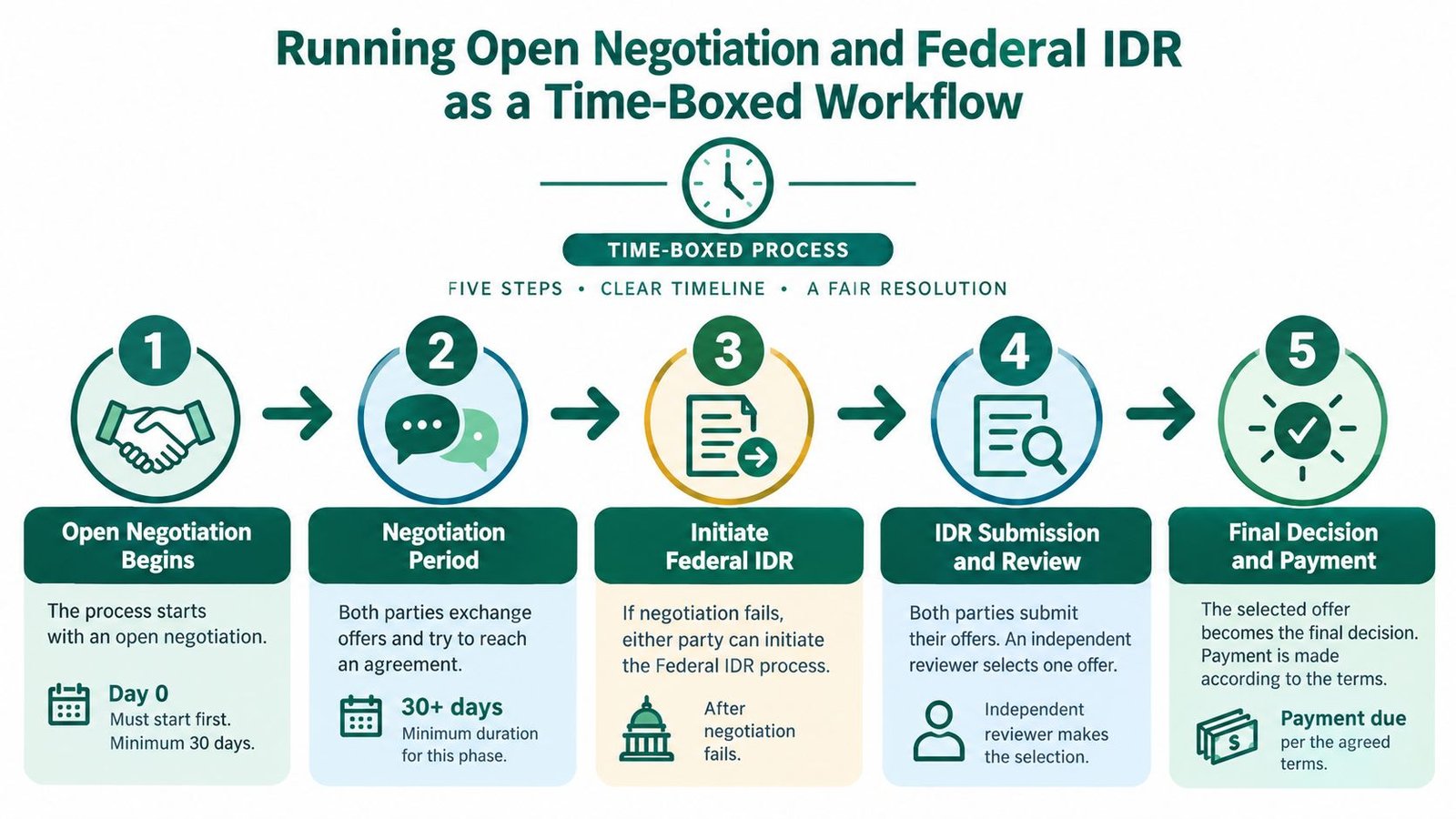
Running Open Negotiation and Federal IDR as a Time-Boxed Workflow
Your administrator should be able to identify the person responsible for every pending negotiation, filing, offer, fee, and payment reconciliation. “We're appealing it” isn't an adequate status.
CMS's federal IDR overview requires unsuccessful open negotiation before federal arbitration and states that payment following the determination must be made within 30 calendar days. Missing an upstream deadline can prevent your practice from reaching that payment stage.
Build the evidence package before escalation
- Confirm the pathway: Establish federal eligibility or identify the controlling state process. Check payer type, facility participation, service setting, and applicable exclusions.
- Preserve the record: Retain the original claim, EOB or remittance, clinical documentation, coding, units, modifiers, and payer correspondence.
- Document the benchmark: Record the QPA and its relationship to the disputed service. Identify discrepancies without substituting billed charges for evidence.
- Control delivery and dates: Keep the negotiation notice, proof of delivery, applicable initiation deadlines, and the dates of every offer.
- Prepare the submission: Include the valuation rationale, required fees, and evidence relevant to the statutory factors.
For implementation detail, use the federal IDR process guide for providers alongside an assigned owner and an auditable deadline log.
Treat eligibility failures as financial losses
CMS IDR reporting identifies 262,441 ineligible closed disputes in 2024, approximately 19%, and describes a framework generally contemplating a determination within 33 business days after IDR-entity selection. That is a procedural target, not a promise of end-to-end recovery speed.
A separate Healthcare Dive review of later eligibility data reported that only about 19% of disputes submitted in the second half of 2025 were found eligible. That isn't the same measure as the earlier ineligibility percentage, and the remainder shouldn't automatically be labeled ineligible.
Paying filing fees before confirming eligibility isn't aggressive recovery. It's avoidable expense.
Use the NSA and IDR process reference to formalize your claim-level checklist. The NSA compliance checklist can support a broader review, but neither replaces encounter-specific screening.
Two Real Pain and Sports Medicine Underpayment Cases
The clearest supplied dollar-level examples come from adjacent physical therapy and sports medicine practices, not interventional pain claims. They're useful for recognizing commercial repricing, but they aren't evidence of an NSA award or a pain-procedure recovery result.
Manhattan physical therapy repricing
An anonymized Manhattan physical therapy practice billed $540 for a visit containing 97140 ×2 and 97110 ×2. Cigna paid $60 after Data iSight repricing, compared with historical payments of $300-$400 per visit.
The financial issue wasn't a rejected claim. The payer processed it and paid substantially less than the practice's previous reimbursement pattern. The difference between the billed charge and payment wasn't automatically recoverable, and historical payments alone didn't establish entitlement to the former rate.
Our recommended review would assemble:
- Original payment evidence: The claim, remittance, repricing explanation, and payer correspondence.
- Comparison records: Earlier payments for comparable services, with differences in benefits and claim composition identified.
- Authority to act: The assignment of benefits and applicable payer dispute requirements.
- Valuation support: Relevant benchmark information tied to the service and market.
The physical therapy underpayment recovery guide provides context for this commercial recovery track.
New Jersey sports medicine repricing
A multi-location New Jersey sports medicine practice saw Cigna and Horizon reprice approximately $300 claims to approximately $100. A practice owner reviewing only claim acceptance would miss the change in reimbursement.
For that pattern, we would group comparable claims by payer and repricing method, rather than argue each payment in isolation. The out-of-network repricing tools guide helps distinguish a repricer's valuation from a final determination of what the payer owes.
Neither example establishes a recovered amount, settlement, or guaranteed result. The lesson for pain owners is narrower and more useful: a clean EOB can still require a payment dispute. Don't transfer these office-based cases into federal IDR without independently establishing eligibility.
Sorting Claims into Repricer Disputes, NSA, or Formal Appeals
A repricer reduction, an NSA payment dispute, and a medical-necessity denial aren't interchangeable. Route the claim according to the reason for the shortfall, not the size of the balance.
How to Route a Pain Practice Underpayment Claim
| Claim Scenario | Best Recovery Channel | Typical Timeline |
|---|---|---|
| Office procedure reduced through MultiPlan, Zelis, Data iSight, or Claritev | Commercial negotiation, then the applicable formal or one-time provider dispute | 45-90 days as a working recovery range, not a guarantee |
| Eligible OON professional service at an in-network facility | Open negotiation, then federal or applicable state IDR | Deadline-controlled; actual completion varies |
| Denial involving authorization, medical necessity, or claim information | Correction or formal appeal addressing the denial reason | Payer-specific |
| In-network ASC claim paid below its contract | Contract reconciliation and payer escalation | Contract- and payer-specific |
How we approach commercial negotiation
We batch 10 or more underpaid claims where they share a coherent payer issue. The purpose is to present enough disputed value for a substantive case-manager review, not to assume the payer has a published minimum threshold.
Our commercial negotiation approach uses FAIR Health benchmarks, treating the 90th percentile as a negotiating ceiling and the 80th percentile as a typical settlement reference. These are negotiating positions, not mandatory payer reimbursement rules or guaranteed settlement amounts.
Build the package using the out-of-network appeal package checklist and template. The payer should be able to identify the affected claims, understand the valuation argument, and respond to a specific request.
When the original payment window has closed, we assess whether a legitimate resubmission can produce a fresh EOB. Don't assume resubmission restarts an appeal deadline or revives federal IDR rights. Verify the payer's rules, avoid duplicate submissions, and escalate through the applicable formal dispute or one-time provider dispute when negotiation stalls.
Federal batching is a different decision
Commercial grouping for negotiation isn't permission to combine unrelated services into federal IDR. Federal submissions must meet the applicable batching requirements and retain line-level evidence.
Congressional Research Service reporting on federal IDR recorded more than 1.46 million initiated disputes and approximately $718 million in fees during 2024. Those figures make an eligibility and economics test essential before filing.
Recovery discipline: Choose the route that can lawfully resolve the payment issue. Don't choose arbitration simply because the initial payment is low.
For ordinary denials, require a response to the denial reason. A benchmark argument won't repair a missing authorization, and a corrected claim won't resolve a disagreement over valuation.
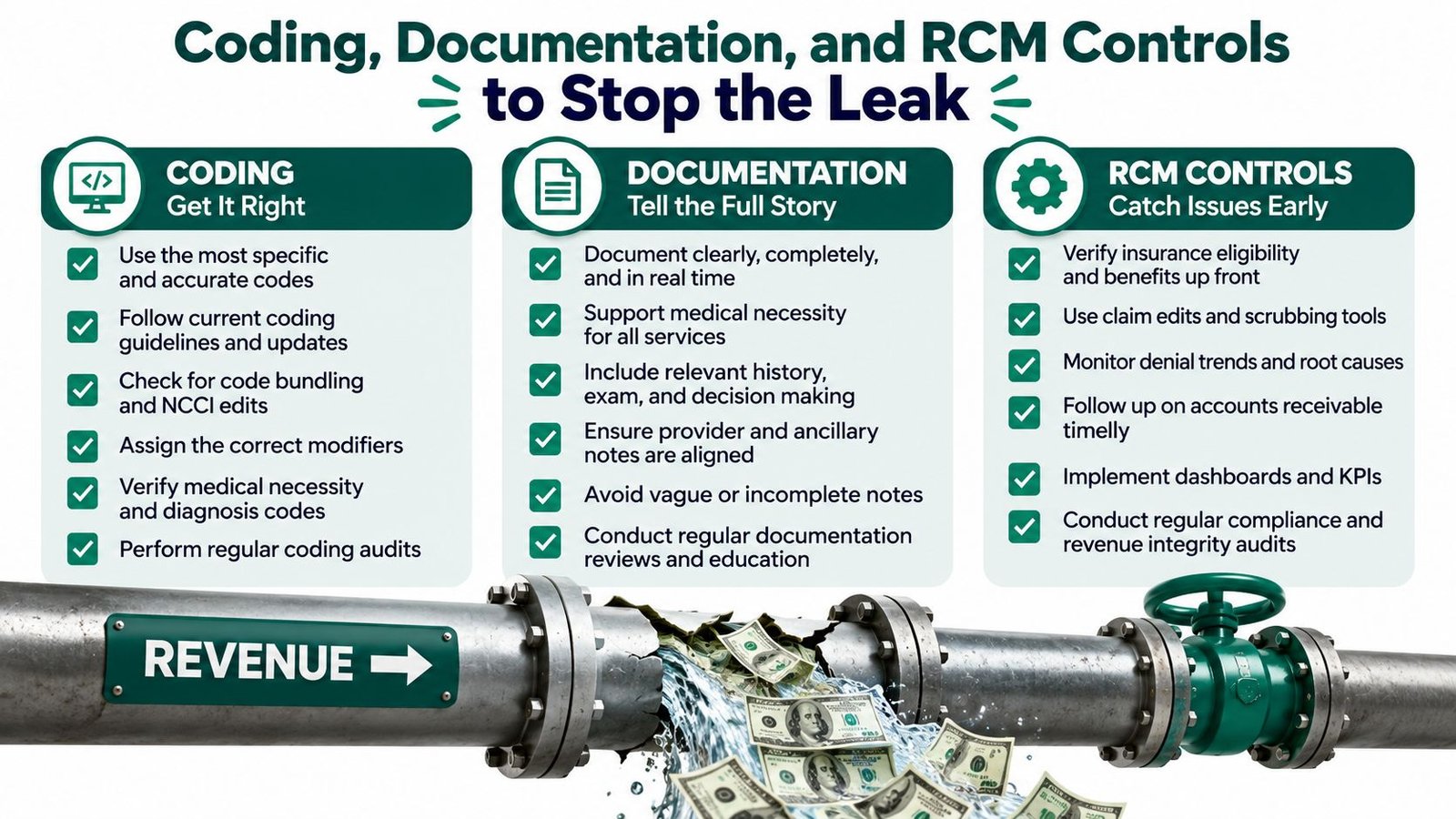
Coding, Documentation, and RCM Controls to Stop the Leak
Don't outsource billing without retaining visibility into the controls that determine payment. Your RCM partner should explain why each disputed line is payable and distinguish coding errors from pricing disagreements.
Set procedure-specific review requirements
- Epidurals 62321/62323: Require documentation supporting the reported procedure, anatomical region, approach, and relevant imaging references.
- Facet services 64490-64495 and RFA 64633-64636: Reconcile levels and laterality across the operative record, claim, and payment.
- Nerve blocks 64405/64450: Confirm that the documented target supports the selected service. Don't treat the codes as interchangeable.
- SCS trials: Connect the professional services, facility setting, and associated device documentation without duplicating charges.
- Modifiers 50 and 59: Apply bilateral and distinct-service reporting only where supported and permitted by the applicable coding and payer rules. A modifier isn't a reimbursement workaround.
Missing laterality, level, or procedure support can turn a valuation discussion into a claim-validity problem. Require your vendor to identify the governing payer rule rather than offer a generic explanation that the insurer “always reduces those codes.”
Measure the actual payment discrepancy
Track denied and underpaid claims separately by payer, CPT family, and site of service. Review multiple-procedure reductions before concluding that a repricer caused the shortfall, and reconcile professional and facility components before calculating disputed value.
A quarterly QPA-versus-payment variance review should distinguish an incorrect benchmark from a legitimate disagreement about the appropriate payment. For owners redesigning reporting, MyOfficeOps' revenue cycle process and metrics explained provides broader operational context.
The medical billing denial-management guide and insurance claim appeal guidance support separate workflows for claim correction and formal escalation.
National provider win rates don't establish the economics of your pain claim. CRS's specialty-specific IDR analysis found providers and facilities prevailed in about 85% of non-default determinations in both 2023 and 2024, but cautions against transferring other specialties' payment benchmarks to pain, anesthesia, or ASC claims.
Your reporting should show net disputed value, expected costs, and the next required action, not merely a count of arbitration wins.
The Recovery Process, Realistic Timeline, and Practice Owner FAQs
Start with the past 6-12 months of out-of-network claims. Prioritize claims with viable deadlines, a documented valuation gap, and a recovery route the law permits. Treat recovery as a controlled revenue-cycle workflow: assign ownership for each deadline, route claims by payer and eligibility, and reconcile additional payments against the EOB and ledger before closing an account. A low payment alone does not make a claim eligible for federal IDR.
Use the usual-and-customary rate explanation for out-of-network providers to assess commercial valuation. Keep that review separate from the QPA analysis required for an NSA dispute.
Set expectations around cash, not awards
Plan around 60-120 days for an NSA dispute, not a guaranteed completion date. Georgetown's review of early-2025 IDR data found two-thirds of determinations exceeded the statutory 30-day target. Track pending determinations separately from cash received, and measure the net recovery on each claim after fees and payment reconciliation.
Fees are contingency-only, based on claim age and volume. After a free call with a billing specialist, require a clear fee figure before authorizing work. There is no upfront payment, and fees apply only when recovery is delivered.
Book a free 30-minute call to review your payer mix, procedure settings, and current underpayment workflow. US practices only.
Do I need to replace my current billing company?
No. Keep your existing billing operation and use a focused underpayment recovery engagement if that fits your needs. Put responsibility in writing so neither team files conflicting disputes or duplicate claims.
Will recovery require contacting my patients?
Payer-directed recovery usually needs no patient contact when an assignment of benefits (AOB) is on file and authorizes the work. The assignment does not override NSA balance-billing protections or satisfy other payer requirements by itself.
How will I know whether an award became cash?
Match the determination to the later remittance, payment received, and ledger adjustment. Do not report an arbitration decision as collected revenue until the payment is verified.
What should I bring to the first discussion?
Bring representative claims, EOBs, payer correspondence, procedure settings, participation information, and your current aging report. Include claims your billing company already adjusted off. Those records can show whether payment review ends before recoverable dollars are identified.
Happy Billing offers payer-directed underpayment review and recovery workflows that separate commercial repricing from eligible NSA disputes. Visit Happy Billing to discuss deadline ownership, claim review, and payment reconciliation for your pain practice.