Pain Management Billing Company: What Independent Practices Should Ask Before Hiring One

A billing partner should show how it will protect revenue and give your practice clear control over reporting, authorization ownership and exit terms. Ask for monthly reporting that tracks claim outcomes and underpayments, and make sure responsibilities are defined before work begins. A headline collection percentage alone cannot show where revenue is leaking.
Pain claims can fail at different points in the process. A facet injection may be denied if the documented level count does not match the note. A missing JZ modifier can put a drug line at risk, while an expired authorization or missing conservative-treatment history can stop a claim after it clears the clearinghouse. Ask who checks these details, how exceptions are flagged, and who follows up when a claim is denied.
Confirm that you can review performance each month and retain access to your data if the relationship ends. The contract should specify who owns authorization follow-up and what happens to open claims at exit.
Happy Billing is headquartered in Houston, Texas and works with independent practices across the United States. It recovers out-of-network underpayments for physical therapy, chiropractic and behavioral health practices, including practices in New Jersey and New York.
When Outsourcing Pays Off for a Pain Practice
Outsourcing pays when a partner can improve the numbers that determine your revenue: initial denial rate, days in A/R and net recovery after fees. Ask for documented results and reporting definitions before you compare proposals. If a vendor cannot show how it will measure performance, keep the work in-house until it can.
Pain practices have a demanding mix of office E/M, injections, ablations, imaging, anesthesia and sometimes facility charges. Each service has its own coding edits, authorization rules and payer requirements. A billing team that handles every claim the same way can miss those differences, leaving avoidable denials and unpaid balances.
A low percentage quote can still cost more if older claims go untouched. Practices that choose the lowest quote may discover months later that nobody is working claims over 90 days. The fee was cheap. The revenue was gone.
The trade-off to accept: a specialist partner may require more of your attention at the start, while you grant workflow access and review a performance baseline. In-house staff may preserve familiar processes, but those processes still need regular checks for missed procedure revenue.
Before comparing proposals, decide what work you want transferred and what you want to retain. Outsourcing can be full or partial, and the right arrangement depends on where claims stall, who owns authorization follow-up and whether reports let you verify progress each month. A headline collection percentage alone cannot show whether old claims are being worked or denials are being appealed.
For practical signs that a practice may be ready, review when to outsource medical billing and the signs your practice is ready.
Questions That Separate Capable Billing Partners
Bring this table to the vendor call and score the answers. Ten rows, four columns, no room for a rehearsed pitch.
| Area | Question to ask | Strong answer | Red flag |
|---|---|---|---|
| Procedure coding | How are facet, nerve block and injection units counted by level and site? | Named edit checks by CPT family and documented modifier rules | Only standard coding with no examples |
| Prior authorization | Who verifies authorization, dates and units before the procedure? | A named owner and a pre-service check log | Authorization handled after the claim is sent |
| Denial tracking | Can you report denial dollars by payer, CPT family and cause? | Monthly report split into preventable and nonpreventable causes | Denial counts only, no dollars |
| Timely filing | How do you keep claims under the 12-month Medicare filing limit? | Aging report with escalation rules before the limit | No aging report or no escalation rule |
| Reporting | Will you provide a monthly KPI pack with claim-level drill-downs? | Written definitions, frequency and drill-down access | A single collection percentage |
| Credentialing | What is your payer-by-payer enrollment plan and effective-date tracking? | Written milestones and CAQH re-attestation duties | Timelines given as it depends |
| Security | Do you sign a business associate agreement, and who are your subcontractors? | Named subcontractors, access logging and a breach-notice clock | Vague answers on access or hosting location |
| Data exit | Can we export all claims, payments and denial data at termination? | Export format and timeline written into the contract | Data held back until a dispute ends |
| EHR fit | Do you work inside our current EHR without a data migration? | Named integrations and a live workflow walkthrough | A new system required before go-live |
| Fee model | How is the fee calculated and what triggers it? | Written model with stated exclusions | Fee terms discussed only verbally |
A capable partner answers the procedure-coding row with specifics. They should be able to tell you how they check a level count against the note before submission, how they decide whether modifier 59 or XS is defensible, and how they handle multiple-procedure reduction under modifier 51. If the answer is "our coders are certified," you've learned nothing.
The EHR row matters more than owners expect. A migration is a six-month project that costs you cash flow while it happens. Ask for named integrations and a live walkthrough of their workflow inside your system.
The fee row deserves a separate conversation. Percentage-of-collections pricing is standard in this specialty, but what sits inside and outside the percentage is where disputes start. Ask what happens with patient payments, self-pay balances, out-of-network recovery and credentialing. Get it all in writing.
How to score it: mark each row as strong, weak or evasive. A vendor that answers "trust us" on three or more rows should be dropped from the list. Every one of the ten rows is a revenue control, not a personality test.
Full Outsourcing, Partial Support or Fixing In-House
One question decides the setup: where does your revenue leak fastest?
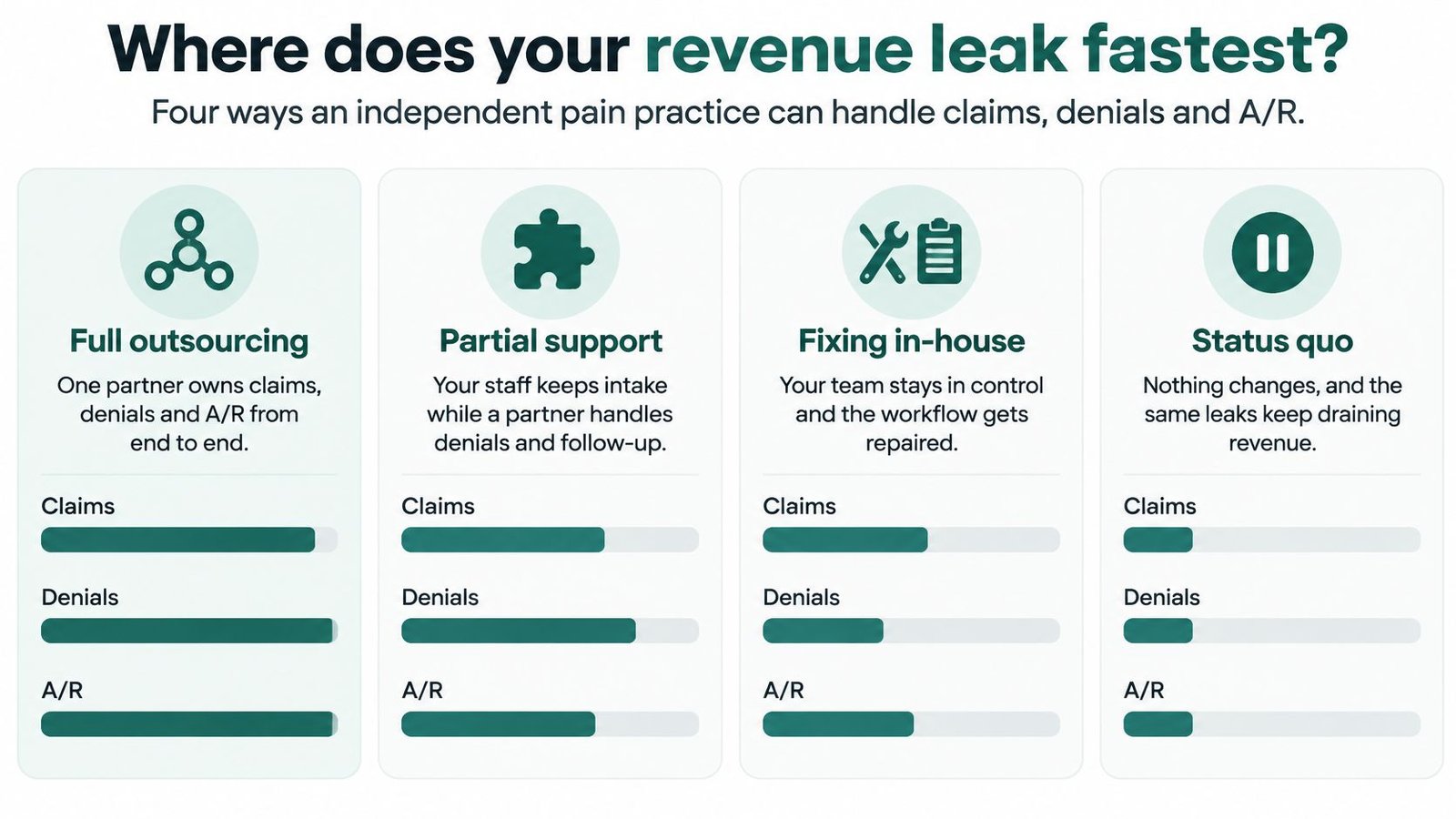
If it's denial follow-up, aged A/R and procedure edits across the board, full outsourcing is the clean answer. If your front desk and payment posting run well and only one area sags, partial support is cheaper and less disruptive. Happy Billing can handle partial outsourcing, full revenue cycle management, or anything in between, including outsourcing billing for one specialty or one location.
| Setup | Best fit | What you keep | Main risk |
|---|---|---|---|
| Full outsourcing | Practices with no billing lead or rising A/R days | Clinical and front-desk work, and your EHR | Vendor dependence and exit terms |
| Partial support | Practices with a strong in-house biller and one weak area | Core staff and control of payments | Hand-off gaps between two teams |
| Specialist add-on | Credentialing gaps or out-of-network underpayments | Your current biller for everything else | Two owners working the same claim |
| Fix in-house | Denial rate under 5 percent and A/R under 40 days | Full control and existing staff | Staffing and tool upkeep stay with you |
Three situations show how the choice falls out.
A three-physician pain group with ASC cases and one overloaded biller. She's doing eligibility, authorizations, charge entry and denial follow-up on 900 claims a month. Full outsourcing makes sense here, provided the vendor can work facility and professional sides separately and understands ASC modifier conventions. The risk is concentration: read the exit clause before you sign.
A single-location practice with a strong biller and a credentialing gap. Don't replace the biller. Credentialing is separate from billing, and your current biller can stay for the parts you want to keep. Add enrollment support as a standalone service and leave claims where they are.
A practice whose out-of-network injections are paid below fair value. Here the missing function isn't billing at all, it's underpayment recovery. You need a partner who identifies repriced or short-paid procedure claims. The workflows for that sit in our pain management billing services overview.
The honest trade-off: every setup trades control for capacity. Full outsourcing buys you time and gives up visibility unless the reporting is contractual. In-house work buys you visibility and keeps the staffing problem.
Injection and Facility Claims Where Revenue Leaks
Injection revenue can be lost before a payer reviews the clinical merits. A mismatch between the procedure note, code levels, modifiers, or billing entity can put payment at risk.
Facet injections are reported by level under CPT 64490 to 64492 for cervical and thoracic procedures and 64493 to 64495 for lumbar procedures. The documented levels must match the claim. If a physician blocks several medial branch nerves to target two joints but the claim reports three levels, the discrepancy can invite audit review and put payment for the reported levels at risk.

Ask how the vendor compares level counts with procedure notes before submission and retains edit history by payer. Request an example of a corrected level count, with any patient information removed. Changes in newer facet joint pain treatments can also make it important to check that documentation reflects the procedure performed.
Modifier use needs the same scrutiny. Modifier 59 or XS is appropriate only when the sites are distinct. Modifier 51 applies to a second procedure under multiple-procedure rules and can reduce payment. Ask how the vendor applies modifier logic across office and facility claims; a blanket rule can trigger denials or reduce reimbursement.
Drug-containing injections create another point of exposure. Medicare expects the JZ modifier when a single-dose container has no discarded drug, and JW reporting when drug is discarded. If JZ is missed, the drug line can be denied.
For ASC cases, establish who bills the facility component and how the applicable facility payment rules are checked before submission. “The same team” is not enough: ask what process it follows for facility claims and how it distinguishes the facility component from the professional claim. Agree in writing on fees for out-of-network recovery before the work begins.
Use a pain management CPT code reference to check whether the vendor can explain the code families relevant to your procedures. A specific answer should connect coding choices to the note, site of service, and claim component, not rely on a headline collection rate.
Prior Authorization and Denial Ownership
A clean claim can still become lost revenue if authorization ownership is unclear. A claim may pass the clearinghouse and later fail because authorization is missing, the conservative-treatment history is thin, or a modifier is misused. Ask who owns each step from scheduling through appeal, and how the practice can verify that work.
Prior-authorization requirements vary by payer, procedure, medication and site of service. Ask the vendor to explain what prior authorization in healthcare requires for your services, and who maintains the payer-specific requirements. The AMA prior-authorization physician survey reports physicians' concerns about the process and insurer reform commitments.
Put these questions to the vendor:
- Authorization scope: Which procedures and medications require authorization by payer and site of service? Where is that list maintained, and who updates it?
- Validity checks: Who verifies authorization status, dates and units before the procedure? Ask to see the pre-service log.
- Peer-to-peer tracking: How are deadlines tracked, and who is responsible for the call?
- Documentation feedback: Does the billing team send clinicians a written summary of recurring documentation defects?
- Denial triage: Is each denial assigned to a named owner and deadline, and classified as a correctable claim, documentation request or appeal?
Ask who reviews medical-necessity denials and whether qualified clinical review is part of the appeal process. The AMA survey on insurer denial review addresses physicians' views on how health plans review these denials. If the vendor cannot explain who evaluates the clinical basis for an appeal, the practice may be left accepting the payer's decision without a clear review path.
Documentation supports both authorization and appeal. Notes should capture the conservative-treatment timeline, functional deficit and relevant imaging findings in the encounter record. Make sure the team can retrieve that evidence when a payer requests it, using HIPAA-ready documentation for modern practices as a reference for documentation workflows.
Require monthly reporting on dollars recovered by denial category, alongside named owners and deadlines for unresolved cases. That makes authorization work and denial recovery verifiable, rather than relying on a headline collection percentage. Happy Billing's Certified RCM Specialists act as practice advocates and challenge claims they consider unfairly denied. For process details, consult the medical billing denial management guide and how to appeal a denied insurance claim.
Reporting Benchmarks to Demand Each Month
A collection percentage cannot show where cash is leaking. Monthly reports should connect claim outcomes to specific services, payers, providers, and follow-up actions so the practice can verify performance rather than rely on a vendor's headline figure.
Require a specialty-specific KPI dashboard with written metric definitions, a consistent reporting schedule, and claim-level drill-downs, as outlined in the MGMA KPI benchmarking white paper. For pain services, separate office E/M, procedures, injections, imaging, facility claims, anesthesia, drug wastage, authorization-related denials, medical-necessity denials, and coding edits. Otherwise, strong performance in one category can conceal losses in another.
Agree on definitions before reviewing results. Clean-claim rate should count claims accepted on first submission, not merely transmitted. Track payer rejections separately from post-adjudication denials, since combining them obscures whether the issue is claim preparation or payer processing. Define net collection rate to account for contractual adjustments, refunds, and bad debt.
| Metric | How to review it | What it tells you |
|---|---|---|
| Clean-claim rate | Track first-pass acceptance over time | Whether claims are prepared accurately |
| Denial rate | Separate by payer, service, and denial reason | Where preventable losses are occurring |
| Denial resolution | Review dollars recovered and time to resolution | Whether follow-up turns denials into payment |
| Overall A/R | Review aging by payer and provider | How quickly receivables are moving |
| A/R over 90 days | Track the balance and recovery actions | Which older claims need escalation |
| Medicare filing limit | Track deadlines from date of service | Whether claims are at risk of becoming uncollectible |
Request monthly aging by payer and provider, denial dollars rather than denial counts, appeal overturn rate, median days from denial to resubmission, and dollars recovered from claims older than 90 and 120 days. Assign an owner to each unresolved category. A report without accountable follow-up records activity, not control.
Run the review the same way every month: when a metric worsens for two consecutive months, require a root-cause review, a named owner, and a written corrective action. Treat the two-month trigger as a prompt to investigate, not as proof that the vendor caused the change.
Use the medical billing KPI tracking guide to organize the measures. If the vendor cannot show the underlying claim detail or explain how it defines each metric, the practice cannot reliably verify whether reported performance reflects recovered revenue or completed tasks.
Contract Terms That Make Promises Enforceable
A verbal promise on security, credentialing or data is worth exactly what the contract makes it worth.
Security comes first. A business associate agreement is the floor, not the differentiator. Go past it: who can access patient data, where systems and backups are hosted, whether subcontractors or offshore staff are involved, how access is logged and revoked, how encryption and multifactor authentication are applied, and how fast incidents get reported.
The breach record explains why this isn't theoretical. The HHS breach report to Congress counted 663 breaches affecting 500 or more individuals in 2024. Business associates filed only 16% of those reports but accounted for 85% of affected individuals, while healthcare providers filed 76% of reports and accounted for 14% of affected individuals. One vendor holds data for many practices at once, so a single incident has an unusually wide blast radius.
Your contract should name breach-notification duties, permitted data uses, cyber-insurance coverage, audit rights and responsibility for subcontractors. HHS also confirms that business associates are directly liable for certain requirements, and that the framework extends to subcontractors.
Credentialing next. Require payer-by-payer milestones: submission date, primary-source verification status, roster acceptance, contract execution and effective date. CAQH re-attestation recurs every 120 days, and a clean payer file can still take roughly 90 to 120 days from submission to effective date, as outlined in this CAQH provider guide. Ask how retroactive effective-date requests and claims submitted before enrollment is active get handled. Roster reconciliation and notice before any enrollment lapse belong in the service level.
Exit last, and negotiate it while you still have options. Require a full export of claims, payments, denials and patient-account data in a usable format, a defined transition period, and return or destruction of protected health information at termination. Confirm the team works inside your current EHR so no migration is needed and the exit path stays short.
Tie the service-level agreement to outcomes, such as out-of-network claims prevented and days from complete application to effective participation, rather than to application submission. The questions to ask an underpayment recovery partner about fees, proof and contract terms applies the same discipline to the recovery side of the relationship.
Choose a Billing Partner Before You Sign
Sign only when a prospective partner can show how it will measure performance and report results. Ask for a baseline built from your claims history, then agree on which measures the partner will report each month, who owns authorization work, and how unresolved denials are escalated. A headline collection percentage cannot show whether claims were coded correctly, worked promptly, or paid at the right rate.
If denials are persistently high or A/R is aging, require the vendor to identify the causes and set measurable improvement targets before the contract begins. A partner that cannot produce a clear baseline or explain how it will track progress is not ready to take responsibility for your revenue.
For a practice with a narrower problem, start with a defined scope rather than committing to full outsourcing. A focused pilot can test support for authorization or injection claims. Set the measures in advance, review them during the pilot, and decide whether to expand based on the results.
The questions to ask SEO agencies use a similar approach to evaluating a vendor: request specific answers and evidence rather than accepting broad promises. For medical billing, make those answers concrete. Ask who handles each task, what the monthly report contains, and how the partner will address missed authorizations, coding errors, or denials.
Happy Billing works with independent practices across the United States and can handle full-cycle billing or work alongside a practice's current biller. The team works inside the practice's existing EHR, with integrations for eClinicalWorks, Athena Health, EPIC, NextGen, ModMed and other systems. For a practical overview of cost considerations, see this guide to outsourcing medical billing costs.
Can a billing company handle injections and ASC claims?
Yes, when its workflows account for the procedures and settings involved. Ask for examples of claim edits by CPT family, documented modifier rules for bilateral and multiple-procedure cases, and a clear explanation of who bills the facility component. Office and ASC claims may require different handling, so a vendor should be able to explain how it prevents those distinctions from turning into denials.
Should I keep my current biller if I outsource?
Often, yes. Partial support may fit when your biller handles front-desk work or payment posting well, but another part of the revenue cycle needs attention. Credentialing is separate from billing, and a current biller can stay responsible for the work the practice wants to retain. Assign ownership for each claim and task at handoff, so the in-house biller and outside team do not duplicate work or leave gaps.
How do I leave a billing company if the relationship fails?
Negotiate the exit terms before signing. Require a usable export of claims, payments, denials, and patient-account data, a defined transition period, and return or destruction of protected health information at termination. Confirm that the vendor works in your existing EHR and clarify how access and outstanding work will be handled during the transition.
How is out-of-network recovery paid?
Ask the partner to put its fee model in writing. The agreement should explain how recovered funds are reconciled against fees, when the practice receives payment, and how disagreements are handled. Do not accept a general promise of recovery without clear accounting for the funds collected and the fees charged.
Pain management billing is a revenue control function. Happy Billing provides medical billing and coding, authorization support, denial management, A/R follow-up, credentialing and payer enrollment, and recovery of out-of-network underpayments and No Surprises Act claims. Its team works in the practice's existing EHR and serves independent practices nationwide, with workflows for pain management and related specialties. A practice evaluating the fit should ask how the proposed scope, reporting, and responsibilities address its specific revenue risks.
Where this fits