Behavioral Health Billing Company: What Practice and IOP Owners Should Ask Before Hiring One
A billing company can submit every claim and still leave your practice with uncollectible revenue. Judge a behavioral health billing company by the revenue it can prove: benefit checks before the visit, clinicians who are billable by each payer, IOP claim mapping, and out-of-network recovery. Submission volume and a headline clean-claim rate do not settle that question.
The stakes are unusually high. A U.S. Government Accountability Office review found that behavioral-health patients used out-of-network outpatient providers at rates 3.0 to 6.1 times higher than patients receiving medical or surgical care between 2013 and 2017. That gap means missed authorizations and weak out-of-network follow-up hit behavioral health harder than most medical specialties.
Every unauthorized session, unresolved enrollment record, and unworked denial can stretch A/R days or cut what you collect. I judge a partner by what the practice keeps.
Happy Billing is a full-service medical billing and revenue cycle management company headquartered in Houston, Texas. We handle medical billing and coding, denial management, credentialing, and recovery of out-of-network underpayments for independent practices.
What a Strong Billing Partner Must Prove
A real partner connects clinical operations to payment. A claim submitter starts with completed encounters. A revenue partner asks whether those encounters were covered, authorized, delivered by an eligible clinician and supported under the applicable payer contract.
For practice owners, this means evaluating more than a headline clean-claim rate. A clearinghouse acceptance doesn't establish coverage, medical necessity or correct reimbursement. Your behavioral health billing partner should explain how it identifies the obstacles between an accepted claim and money deposited.
I want evidence across these areas:
- Network strategy: Which payer contracts support your service mix, and which reimbursement terms deserve review?
- Billable capacity: Which clinicians and programs can bill each payer today?
- Payment performance: Where do denials, underpayments and aging balances concentrate?
- Recovery accountability: Who owns appeals, payer escalation and unresolved contractual variances?
My hiring rule: Don't accept a collections total without the payer-level work behind it.
Request an anonymized reporting demonstration. Have the candidate explain an enrollment delay, an authorization-related denial and an underpayment from initial identification through resolution. Look for named owners, documented actions and a clear explanation of what remains outstanding.
For an IOP, that demonstration must also address authorization validity, recurring services, coordination of benefits and level-of-care documentation. A vendor that can't translate your operating model into payer-specific controls isn't ready to own your revenue cycle.
These are decisions for independent practice owners, physician decision-makers and IOP owners choosing who handles billing, credentialing or recovery. You don't need a coding tutorial. You need evidence that the proposed workflow protects collectible revenue.
Book a free 30-minute call with a billing specialist to discuss where your practice needs support. We only get paid when we deliver, nothing upfront.
US practices only.
Questions That Separate Partners From Submitters
| Question to ask | Answer to accept | Red flag |
|---|---|---|
| Do you verify eligibility and mental health benefit limits before the first visit? | Real-time check with a reference number saved to the chart | Verification only at claim time, after the session |
| Who owns prior authorization, and what happens when one lapses mid-program? | Named owner, expiration tracking and alerts before units run out | Authorization handled informally by the clinical team |
| Which clinicians are active and billable with each payer, and from what date? | Provider-level status with effective dates and payer acceptance proof | A single credentialing-complete statement with no clinician detail |
| How do you handle out-of-network claims and underpayments? | Written process, payer-level variance report and clear decision rules | Acceptance of the payer's payment without a recovery review |
| What do you report each month, by payer? | Clean-claim rate, denial reasons, appeal outcomes and aging by payer | Practice-wide totals only |
| What happens to our data, EHR access and open claims if we leave? | Written return of data, access revocation dates and a transition plan | Access tied to vendor-controlled accounts with no exit clause |
Use this hiring checklist for a behavioral health billing company in every candidate meeting. Require a demonstration, not a verbal assurance. A polished presentation won't tell you whether someone follows up when a payer stops responding.
Score answers as documented, demonstrated or unsupported. A sample dashboard demonstrates reporting capability. A written authorization workflow documents responsibility. A promise to improve collections, without either, remains unsupported.
Compare the actual scope
Make candidates identify what's included, excluded and retained by your staff. Our services include insurance eligibility verification, charge capture and certified coding, clean claim submission, denial management and targeted appeals, A/R recovery, provider credentialing and re-enrollment, and real-time reporting and analytics dashboards.
The distinction matters when you assess denial-management reporting owners should request. A vendor may identify denials without preparing appeals, or submit appeals without tracking the resulting payment. Those are different service scopes.
For the technology side of vendor selection, the provider checklist from Finchum Fixes IT offers a useful parallel: scrutinize accountability, support responsibilities and security rather than accepting a broad service label.
Ask the candidate to show who takes the next action when a claim stops moving. If the answer is your administrator, you haven't outsourced that work.
We can run billing end to end or work alongside an existing biller. The right arrangement assigns each task once, gives each person the access they need and leaves no ambiguity about unresolved claims.
Benefit Checks and Prior Authorization Before the First Session
Active insurance isn't the same as a covered behavioral-health service. Your scheduling workflow must establish the applicable benefit, exclusions and approval requirements before the practice commits resources.
Plans can use separate behavioral-health administrators, service exclusions and visit limits. Don't assume that the medical insurer shown on the card also controls authorization or payment.
Verify coverage at scheduling. Confirm active coverage and the specific mental-health or substance-use benefit. We run instant eligibility checks, but active coverage is the starting point, not a payment guarantee.
Identify the responsible administrator. Establish whether a carve-out manager or separate authorization vendor applies. Record the payer's benefit response, relevant contract provisions and verification reference in the chart.
Check exclusions and request approval. Confirm whether the proposed service, diagnosis category, clinician credential and setting are covered. Where authorization is required, obtain the approved service type, start date, end date and units before the first session.
Reconcile authorization against the schedule. Track completed services and upcoming appointments against the approval. An alert must reach someone who can act before the remaining units or date span are exhausted.
Resolve exceptions before additional services. Flag services outside the approved plan for clinical and administrative review. Obtain required reauthorization before delivery where applicable, without allowing an automated billing hold to replace clinical judgment about necessary care.
Make Medicaid managed care plan-specific
Require a separate workflow for each Medicaid managed care plan you serve. Confirm whether an authorization number must be obtained before the visit, which entity issues it and how continued-stay requests are handled. Don't let the vendor substitute a general Medicaid checklist for the plan's actual requirements.
A session delivered without required authorization can become an appeal or write-off rather than cash. Our mental-health billing work emphasizes authorization management because preventing that gap is more useful than discovering it on a remittance.
Use this mental-health billing workflow guide to evaluate the handoffs between scheduling, the clinical team and billing. Ask candidates to demonstrate an expiring authorization and show exactly who receives the alert.
IOP Claim Requirements Every Billing Partner Must Map
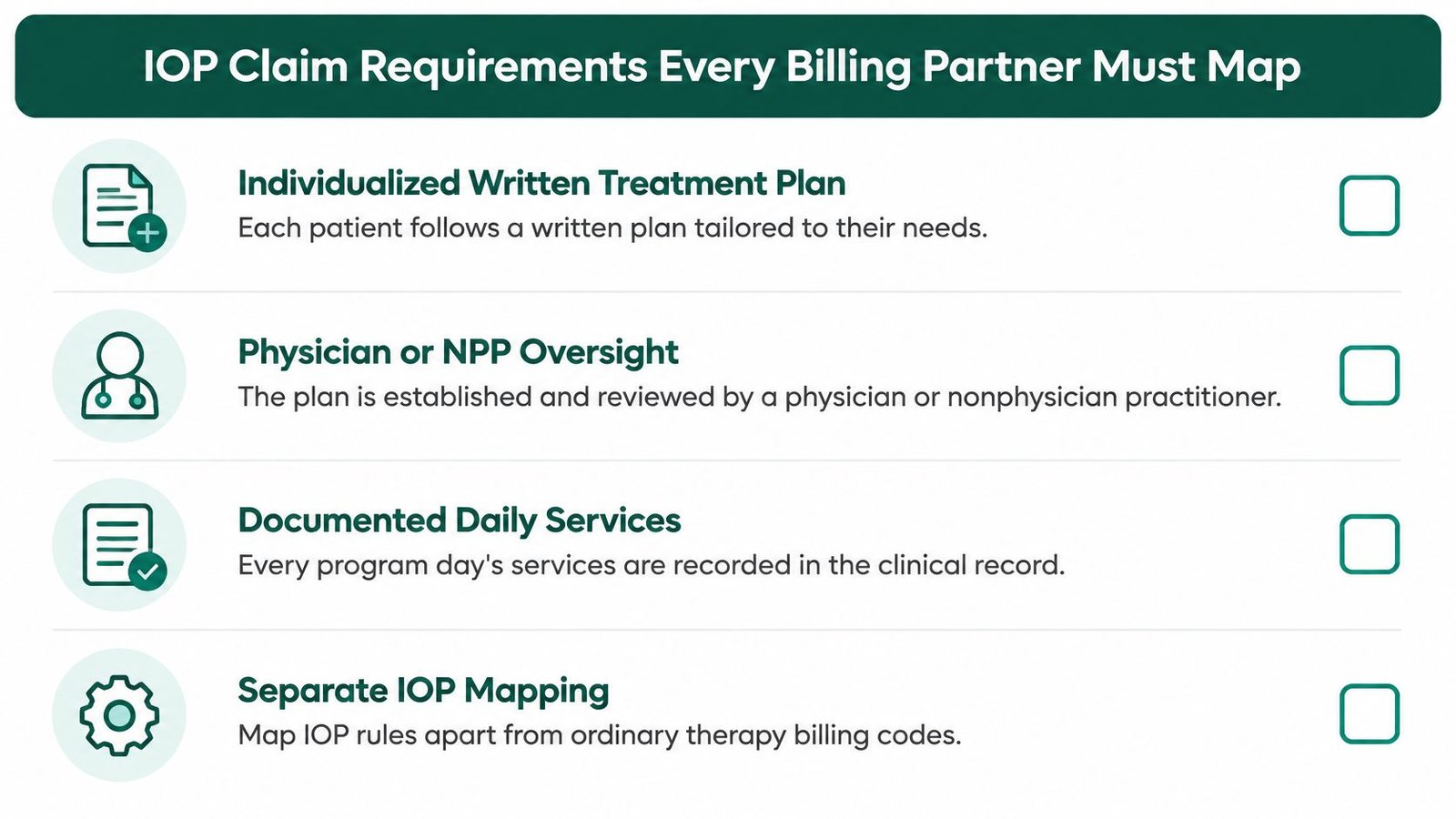
IOP billing isn't ordinary therapy billing with more appointments. The vendor must understand the program structure, the treatment plan and the payer's payment methodology before it builds the billing workflow.
Take the Medicare FQHC requirements. In CMS's billing guidance for intensive outpatient program services, the individualized written treatment plan must be established and periodically reviewed by a physician with appropriate participating staff, specify diagnosis, type, amount, frequency, duration and goals, and include physician certification of a need for at least 9 hours weekly of therapeutic services. The guidance also identifies revenue code 0905 for these IOP claims.
These aren't details an owner should personally code. They're controls your billing partner must verify within the applicable setting. Missing certification, unsupported program documentation or incorrect claim identification can prevent payment for services your team already delivered. One mislabeled claim rarely stops at one claim. It repeats across every IOP day until someone catches it, which is why the mapping work below matters more than any submission-volume promise.
Test the vendor against your actual program
Give the candidate a de-identified program schedule. Ask it to explain how rendering providers, place of service, group services, authorizations, units and daily documentation map to each target payer's rules. A strong answer walks through one week of your schedule line by line. A weak answer recites a general IOP definition.
The answer should distinguish Medicare requirements from commercial and Medicaid plan requirements, never applying one payer's model everywhere. For the Medicare requirements described above, insist on physician involvement rather than accepting a generic oversight label. If the vendor cannot say who signs the treatment plan, how often it gets reviewed and what happens when a patient drops below the certified service intensity, it has never billed this program type for real.
Your owner-level review of mental-health billing codes should focus on payment exposure and documentation responsibility, not memorizing code lists. Then press the candidate on edge cases. What happens when attendance changes midweek, a clinician is absent or a payer revises its policy? Each answer should name a person, a step and a timeline.
Require these deliverables before go-live:
- Payer-by-payer matrix: Program participation, covered services, approval requirements and payment logic for every plan you bill.
- Sample claim audit: Evidence that delivered services and the applicable requirements align, using one of your own recent weeks.
- Denial taxonomy: Separate categories for authorization, enrollment, documentation and payment problems, because each demands a different fix and a different owner.
- Responsibility split: Written ownership for the physician, clinical team, program administrator and billing company.
- Policy-change process: A named owner who updates and retests the mapping when a payer revises its rules.
If a candidate hesitates on any of these five, keep looking. The vendor that can prove this mapping before go-live is the one that protects revenue after it.
Credentialing and Medicaid Managed Care Enrollment Gaps
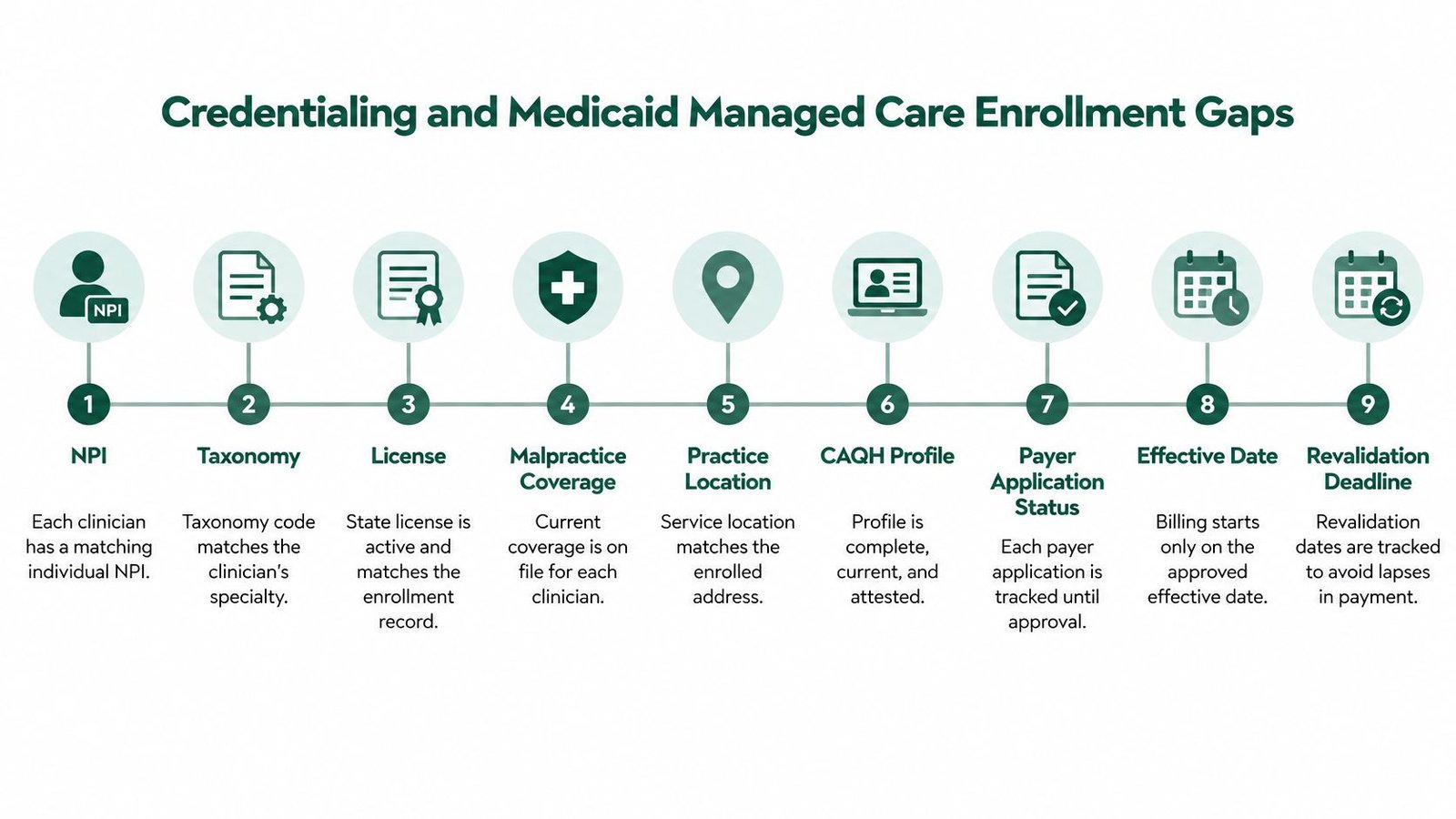
An application submission isn't permission to bill. Treat enrollment as a progression from complete provider information to payer acceptance, an effective date and confirmed roster status.
The CAQH Provider Data Portal guide explains the provider-data foundation; your vendor's control system should track NPI, taxonomy, license, malpractice coverage, practice location, CAQH profile, application status, effective date and revalidation deadline. Incorrect locations, stale attestations and missing documents can delay enrollment and create downstream denials.
| Status reported | Billable for that payer? | Owner action |
|---|---|---|
| Application submitted | Submission alone doesn't establish payable status | Ask for the payer receipt date and expected effective date |
| Pending payer review | Not on the strength of a pending application | Require a written payer follow-up schedule |
| Active with effective date | Eligible services from the effective date, subject to other payment requirements | Confirm the roster record and effective date in writing |
| Retroactive effective date requested | Requires payer approval | Request the date in writing and manage held claims against filing deadlines |
| Revalidation due | Continued billing requires timely compliance with payer requirements | Track the deadline on a shared calendar |
For Medicaid managed care, verify each plan's enrollment and roster process. Require a dashboard separating submitted applications from active and billable clinicians, plus elapsed time to effective date and claims held for unresolved enrollment.
IOPs also need facility participation, program contracts, rendering-versus-billing relationships and authorization prerequisites validated. This IOP payer credentialing and contracting guide helps owners assess those separate gates.
We maintain active credentialing relationships with Amerigroup, CareSource, Peach State, WellCare and Cenpatico Behavioral Health. That doesn't replace confirmation for your particular entity, location and clinician.
Our stand-alone credentialing services can support a practice without replacing its current biller. Assign CAQH attestations, revalidations, payer correspondence and retroactive-effective-date requests explicitly in the agreement.
Claim Tracking Reports Your EHR Billing Tools Often Hide
| Metric | What owners should see | Usual gap in default reports |
|---|---|---|
| Clean-claim rate | First-pass acceptance by payer, with a defined denominator | Practice-wide total only |
| Denial rate and reason | Denials grouped by payer, reason and resolution status | Ungrouped reasons and separate resolution tracking |
| Aging by payer | A/R by payer and age bucket | Aging without a payer split |
| Appeal overturn rate | Appeal outcomes by payer, reconciled to payment | Appeals buried in notes |
| In-network and out-of-network collections | Separate collections and payer-level underpayment variance | One collections total |
| Clinician billable status | Status and effective date for each clinician and payer | Enrollment absent from the billing module |
An EHR billing module may support these views, but don't assume its default dashboard provides them. Require the candidate to demonstrate the reports in your system or explain how it produces and reconciles supplemental reporting.
The most expensive gap is often an unresolved balance without an accountable next action. A claim marked submitted, pending or appealed tells you little unless you can see when someone last worked it and what happens next.
Reporting test: Select a payer balance and ask the vendor to trace it from encounter to submission, adjudication, follow-up and deposit.
Verify integration beyond the logo
We integrate with eClinicalWorks, Athena Health, EPIC, NextGen, ModMed and other EHR systems. We also post ERAs and EOBs to keep practice books balanced. During evaluation, establish which transactions post automatically, which require review and who resolves unmatched payments.
Integration also includes the documents that support payment. FaxZen's explanation of connecting fax and EHR systems is useful context for discussing how referral, authorization and payer documents reach the right record. A document arriving electronically doesn't establish that someone reviewed or acted on it.
Our real-time reporting and analytics dashboards support owner oversight. Require that visibility to include data freshness, claim status and payer-level aging, not just a refreshed collections graphic.
For a broader operating framework, use this mental-health revenue cycle management guide. Your objective is straightforward: identify where cash is stalled, who owns the work and whether the action taken produced payment.
Out-of-Network Underpayments and IDR Deadlines to Track
A paid claim can still require recovery work. If your team closes the account when any payment arrives, it may never evaluate whether the amount is supportable under the applicable contract or dispute framework. That is where out-of-network revenue disappears, especially on IOP group days where a single recurring underpayment multiplies across dozens of claims.
Require an expected-versus-paid review, with written criteria for escalation. The underpayment recovery process illustrates that discipline, while the out-of-network repricing tools guide helps owners understand repricer-related variance. Your vendor should be able to show you the threshold where it stops writing off small differences and starts disputing them.

For qualifying services, CMS's federal independent dispute resolution guidance describes a 30-business-day open-negotiation period before IDR can proceed and explains that the certified entity selects one party's offer rather than averaging the offers. That negotiation window is separate from the initiation and filing deadlines, and missing any one of them forfeits the dispute entirely.
Eligibility deserves equal attention. CMS's IDR reports show that large volumes of disputes are initiated each reporting period and that a substantial share are found ineligible, which means a vendor that files without screening eligibility first is burning time and money.
Not every out-of-network behavioral-health claim qualifies for federal IDR. Ask for documented eligibility screening, deadline ownership and reporting that separates payment determinations from ordinary denial appeals. Use the federal IDR walkthrough for providers to assess the proposed process against what the vendor commits to in writing.
Finally, get the recovery fee structure in the contract rather than accepting a verbal estimate. The number matters less than knowing which claims it applies to and when you pay it.
Confirm Contract, Security and Exit Terms Before You Sign
Start with a signed Business Associate Agreement, documented subcontractor oversight, role-based access, encryption, multifactor authentication, workforce training and incident reporting. Security is operational due diligence, not a checkbox attached to the proposal.
HHS's breach report to Congress lists 663 breaches affecting 500 or more individuals in 2024. Ask for evidence of risk assessments, access reviews, tested recovery procedures and cyber-liability coverage rather than accepting a generic HIPAA assurance.
Under HHS business-associate guidance, a business associate must notify the covered entity of a breach of unsecured PHI without unreasonable delay and no later than 60 days after discovery. Negotiate a shorter contractual notification target so your practice can investigate and respond promptly.
Protect your ability to leave
For IOP records involving substance-use treatment, have counsel assess applicable confidentiality obligations and the vendor's record-sharing controls. Generic security language may not address the actual workflow.
Your agreement should identify:
- Account ownership: Practice control of EHR and clearinghouse accounts and administrative access.
- Data return: Export format, delivery responsibilities, retention and destruction terms.
- Open A/R transition: Claim histories, appeal documents, deadline logs and unresolved payer correspondence.
- Access termination: Who revokes vendor and subcontractor access, and when.
- Exit obligations: Notice periods, transition support and responsibility for work already underway.
The Washington business contract guidance from By Design Law Firm & Legal Consultancy, PLLC provides useful context for seeking professional contract review. Your counsel should evaluate your actual agreement and jurisdiction.
My recommendation: Outsource end to end when the internal team can't sustain the payer workload. Keep the current biller when the gap is narrow, and add credentialing or recovery support around that gap.
Book a free 30-minute call with a billing specialist. Bring your payer mix, aging summary and current division of responsibilities so we can discuss an appropriate scope.
US practices only.
Should I keep my current biller?
Yes, if that person handles the retained responsibilities well. Compare the full workload using this guide to outsourcing versus in-house billing costs, then assign only the work that needs outside support.
What if a vendor won't share payer-level metrics?
Don't hire it to own your revenue cycle. You need auditable reporting and access to the underlying claim history, not a practice-wide collections summary.
Who should own our EHR access after we leave?
Your practice should retain control of its accounts and records. The contract should preserve administrator access and define vendor access revocation and data-transfer responsibilities.
How do I compare options before receiving a quote?
Compare identical service scopes, retained staff workload, reporting access and responsibility for unresolved claims. Then review commercial terms during the call rather than comparing proposals that cover different work.
How can I tell whether a company really understands IOP billing?
Require a payer-specific demonstration using a de-identified program schedule. If the candidate can't explain program participation, authorization, documentation ownership and payment logic, it hasn't demonstrated IOP readiness.
We help practices manage billing end to end or add credentialing, denial follow-up and underpayment recovery alongside an existing team. Visit Happy Billing to discuss the payer and workflow gaps you need to close before choosing your next billing partner.
Where this fits