Master Billing Codes for Mental Health in 2026

The most common billing codes for mental health are the time-based psychotherapy CPT codes 90832 (16-37 minutes), 90834 (38-52 minutes), and 90837 (53+ minutes), alongside the initial psychiatric diagnostic evaluation code, 90791. Correctly applying these codes, along with relevant modifiers like 95 for telehealth, is the only way to secure full reimbursement and prevent claim denials. For the two most-confused codes, see our breakdown of CPT 90837 vs 90834.
Coding correctly is half the job. If your out-of-network therapy claims are paid at a fraction of billed charges, read our out-of-network underpayment recovery guide for mental health therapists.
Your Definitive Guide To Mental Health Billing Codes

This guide is built for practice owners and managers who need a clear path through the maze of behavioral health billing. We’re cutting through the complexity to give you a definitive reference—from standard therapy codes to murky telehealth rules and payer-specific headaches. Our goal is simple: boost your clean claim rate, shorten your revenue cycle, and get you paid fully for the valuable work you do.
Quick Reference for Core Mental Health CPT Codes (2026)
This table summarizes the most frequently used CPT codes in mental health practices. It provides a quick lookup for the code, its description, the typical session time it represents, and the 2026 national average reimbursement rate from CMS as a baseline.
| CPT Code | Description | Typical Session Time | 2026 National Average Rate |
|---|---|---|---|
| 90791 | Psychiatric Diagnostic Evaluation | 60-90 minutes | $174.59 |
| 90832 | Psychotherapy, 30 minutes | 16-37 minutes | $77.81 |
| 90834 | Psychotherapy, 45 minutes | 38-52 minutes | $108.97 |
| 90837 | Psychotherapy, 60 minutes | 53+ minutes | $155.69 |
| 90847 | Family/Couples Psychotherapy, with patient | 50 minutes | $116.75 |
| 90839 | Psychotherapy for Crisis, first 60 minutes | 60 minutes | $181.76 |
Remember, these CMS rates are national averages. Your actual reimbursement will vary based on your geographic location, your specific contract with a payer, and any applicable modifiers.
The real challenge isn't just picking a code from a list; it's making sure that code aligns perfectly with the ICD-10 diagnosis, any required modifiers, and the specific rules of the patient's insurance plan. When those pieces don't match, payers reject claims. That leads directly to lost revenue, wasted administrative time, and a ton of frustration.
For a deeper look at how specialized RCM can elevate your practice's financial performance, explore our expert insights on mental health revenue cycle management. For direct partnership, discover our dedicated mental health billing services.
Decoding Psychiatric Diagnostic Evaluation Codes 90791 and 90792
The entire financial and clinical trajectory of a new patient case hinges on getting the initial intake right. This starts with CPT code 90791 for diagnostic evaluations without medical services, or 90792 for evaluations that include them. Think of it as the foundational claim for each new treatment episode.
Getting this choice correct is critical. You’ll use 90791 for evaluations performed by therapists, counselors, and other non-prescribing clinicians. The code 90792 is reserved for prescribers—psychiatrists, psychiatric nurse practitioners—because it accounts for the medical assessment component of their evaluation.
These codes are your first and best chance to establish clear medical necessity. When a practice gets them right, claim denials plummet. We've seen firsthand how clearer CMS guidelines helped slash initial denials from 22% down to just 14% between 2019 and 2023. For more deep-dive data on behavioral health billing, you can explore detailed reports on HealthArc.io.
To stay compliant, your documentation has to be rock-solid. Every 90791 or 90792 claim must be backed by notes that include a complete patient history, a formal mental status exam, and a detailed initial treatment plan. Payers like Medicare are notoriously strict here; for example, their Local Coverage Determination (LCD A57480) flat-out prohibits billing a psychotherapy session on the same day as the diagnostic evaluation. Trying to do so is an automatic denial.
Getting Psychotherapy Time Codes Right
Time-based psychotherapy codes are the bread and butter of any mental health practice, covering the vast majority of your ongoing patient sessions. Getting them right is non-negotiable for healthy cash flow. These are the codes you'll use day in and day out: 90832 (16-37 minutes), 90834 (38-52 minutes), and 90837 (53+ minutes).
The key isn't just picking the right code; it's the documentation. Payers demand precise start and stop times for the substantive therapeutic work to justify payment. Sloppy notes on timing are one of the fastest ways to get a claim kicked back.
CPT code 90837, which covers the standard "hour-long" session (53+ minutes), is the most frequently billed code in the entire mental health specialty. With a 2026 national average reimbursement rate of around $155.69, it's a critical driver of your practice's revenue. In fact, these three psychotherapy codes account for over 70% of all mental health claims.
The problem? They also have one of the highest error rates. Misdocumenting the time or using the wrong code for the minutes spent can lead to denial rates as high as 15-20%. That’s a massive, and entirely preventable, leak in your revenue. SimplePractice.com offers great data on how these codes dominate billing patterns.
Think of the billing process as part of the overall client journey. It doesn't just start with the first therapy session; it begins with the initial intake.
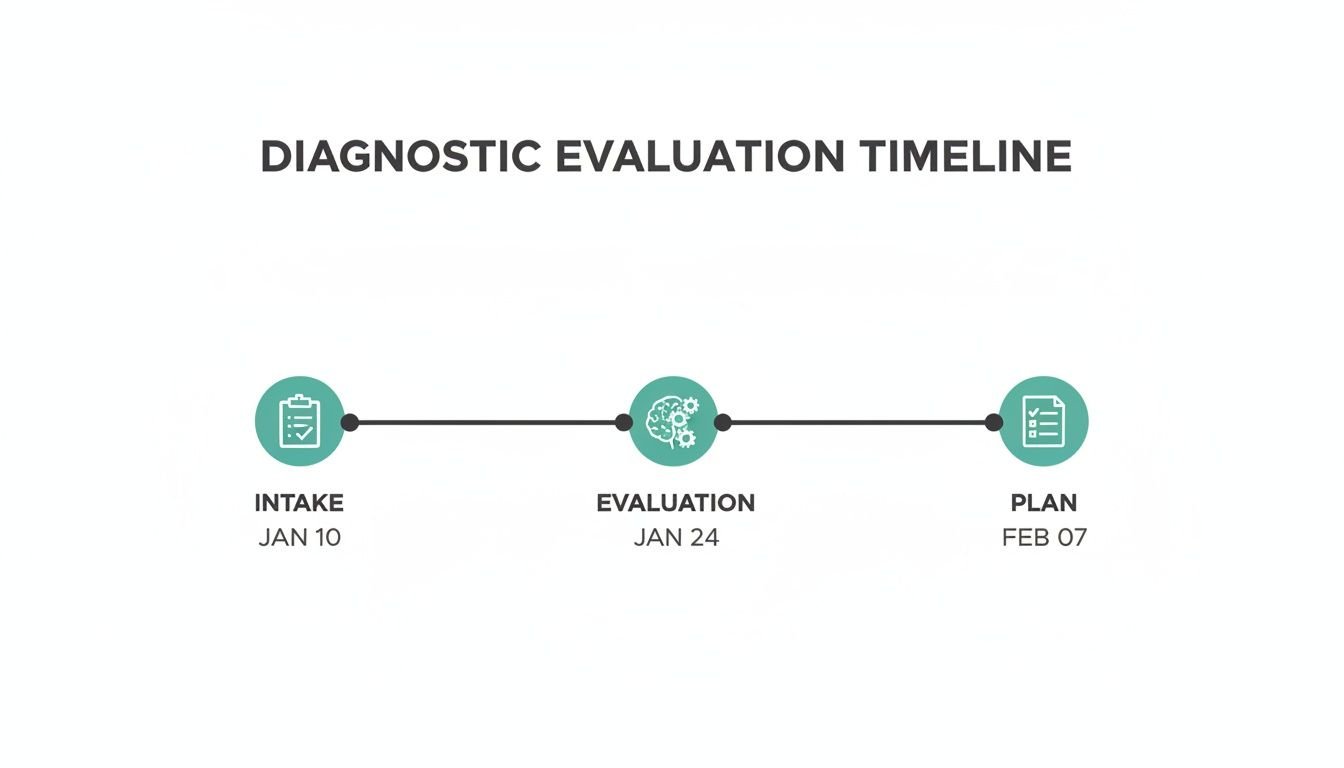
This timeline highlights why your documentation for each step—from the initial intake to the diagnostic evaluation and the final treatment plan—must be rock-solid. Each phase uses different codes and has different requirements. Lumping them together or having weak documentation for any single step puts the entire claim at risk.
Navigating Group, Family, and Crisis Therapy Codes
Billing for group, family, and crisis therapy is where many practices see denials pile up. Unlike standard individual therapy, these services are governed by stricter documentation requirements and distinct CPT codes that payers scrutinize closely. Get the details wrong, and you risk downcoding or outright rejection.
The codes themselves are straightforward: 90853 for group therapy, 90846/90847 for family, and 90839/+90840 for crisis intervention. But the real challenge lies in proving medical necessity for each.
Family and Crisis Coding: The Devil is in the Details
For family therapy, the distinction between CPT 90846 (patient not present) and CPT 90847 (patient present) is critical. Your documentation must always tie back to the primary patient’s treatment plan, justifying why the family session is medically necessary for their care—even when they aren't in the room.
Crisis therapy codes demand even more rigor. Payers expect to see clear documentation of an urgent, acute, or life-threatening situation.
- Use 90839 for the first 60 minutes of crisis psychotherapy.
- Use the add-on code +90840 for each additional 30-minute block of time.
Failing to vividly detail the crisis in your notes is the fastest way to get a claim downcoded to a routine psychotherapy code, or denied entirely. For a deeper dive into managing these specialty-specific billing challenges, see our guide to mental health billing services.
Getting Paid: Applying Essential Modifiers to Mental Health Claims
Getting modifiers wrong is one of the fastest ways to get a claim denied, yet so many practices make simple, costly errors. Modifiers give payers the extra detail they need to process your claim correctly, and mastering them means you get paid the full amount for the services you actually provided. Think of them as the grammar of your claim—without them, the whole sentence is wrong.
This quick reference covers the modifiers that cause the most confusion and revenue loss in mental health billing.
Key Modifiers in Behavioral Health Billing
We’ll start with the most common scenarios. Telehealth modifiers like 95 (Synchronous Telemedicine Service) and GT are a great example. Payer preferences for these have been shifting constantly, and for 2026, many are standardizing on 95, but you can't assume. You have to know which your top payers require.
Then there’s the classic challenge: billing an E/M service on the same day as psychotherapy. This requires Modifier 25 to signal a significant, separately identifiable service. It’s a magnet for denials if not used perfectly. For a complete breakdown, check out our guide on how to use CPT Modifier 25. Similarly, Modifier 59 is crucial for showing a distinct procedural service was performed separately from another non-E/M service on the same day.
The table below breaks down the correct usage and common pitfalls for these critical modifiers.
| Modifier | Description | Correct Use Case Example | Common Payer Denial Reason |
|---|---|---|---|
| 95 | Synchronous Telemedicine Service | A 45-minute psychotherapy session (90834) conducted via a real-time, two-way audio/video platform. | Using it for an audio-only call when the payer requires video, or billing for a location not approved for telehealth. |
| GT | Via Interactive Audio and Video Telecommunication Systems | Similar to 95, but often preferred by specific Medicaid or commercial payers. A psychiatrist provides a diagnostic evaluation (90792) via video call. | The payer has officially switched its policy to exclusively accept modifier 95, making GT obsolete for that plan. |
| 25 | Significant, Separately Identifiable E/M Service | A patient has a scheduled 45-minute therapy session (90834), but also presents with new symptoms requiring a separate E/M workup (e.g., 99213) for medication management. | Documentation fails to clearly separate the work of the E/M service from the psychotherapy portion of the visit. |
| 59 | Distinct Procedural Service | A patient receives psychological testing (e.g., 96130) and later in the day has a crisis psychotherapy session (90839) due to an acute issue. | The services are not considered truly separate; for example, billing two therapy codes that payers bundle by default on the same day. |
Ultimately, modifier accuracy isn't just about compliance—it's about protecting your revenue. Consistently applying the right modifier for the right situation ensures you stop seeing avoidable denials and start seeing faster, more accurate payments.
Linking ICD-10 Codes To Medical Necessity
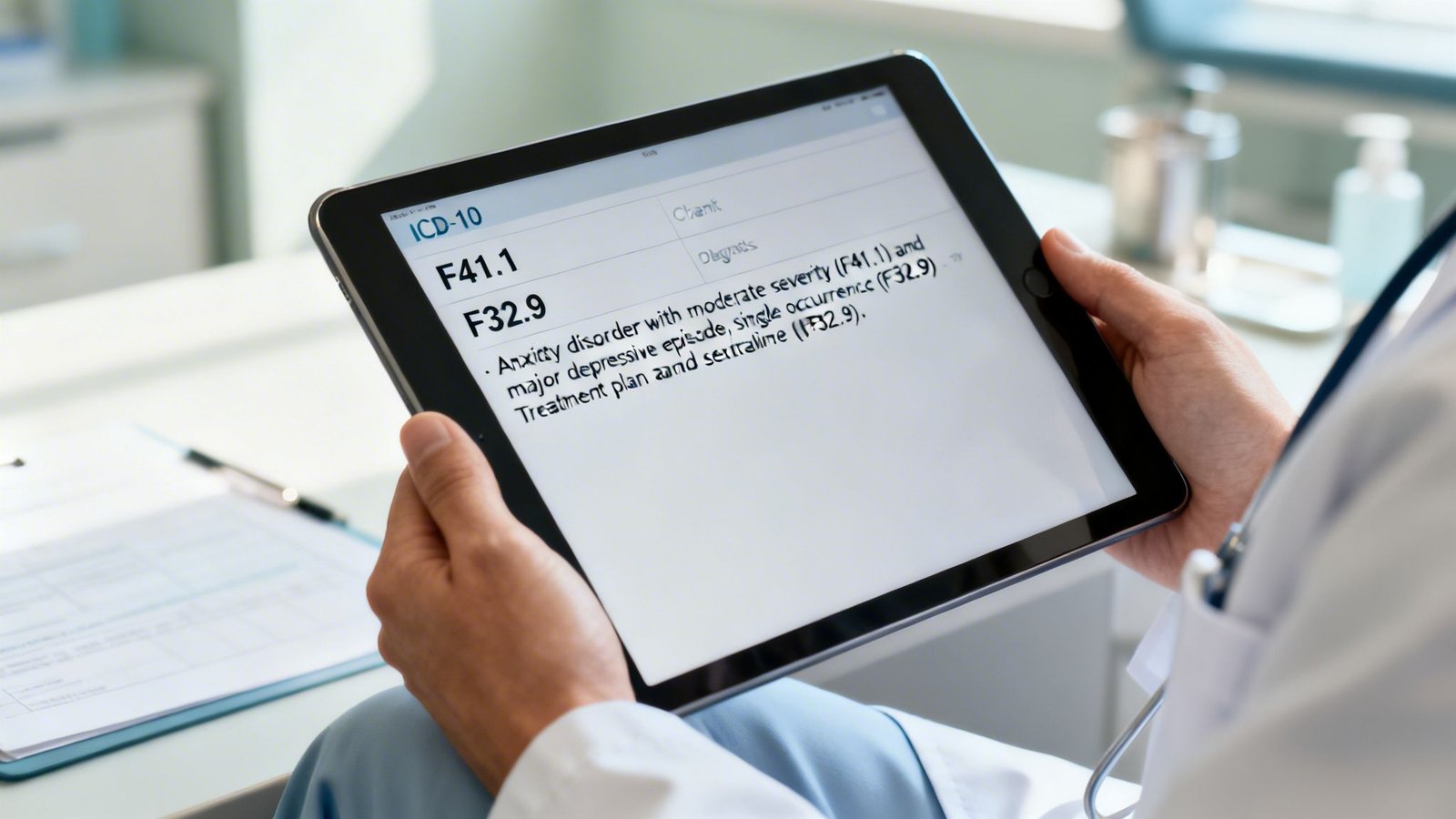
Think of the ICD-10 code as the "why" and the CPT code as the "what." For a payer to cover a service, the "why" must justify the "what." This connection—linking the diagnosis to the treatment to prove medical necessity—is the single most common point of failure on mental health claims.
Get this wrong, and you'll see denials for "non-covered diagnosis" or "lack of medical necessity" stack up fast.
Specificity is your best defense. Moving from a generic code like F41.9 (Anxiety disorder, unspecified) to a precise one like F41.1 (Generalized anxiety disorder) immediately strengthens your claim. It tells the payer you've done the diagnostic work and aren't just guessing.
Your patient's clinical record must tell the same story. The notes need a clear "diagnostic narrative" that supports the chosen ICD-10 code and logically leads to the treatment you provided. If your CPT code is for psychotherapy, the diagnosis must clearly state what condition that therapy is treating. You can see a great example of how diagnosis drives billing in our guide on using the ICD-10 code for weight loss.
How Do I Bill For a Session That Runs Longer Than 60 Minutes?
For a standard, non-crisis psychotherapy session that runs over 60 minutes, you still use CPT code 90837 (for 53+ minutes). There is no incremental code for an extended routine session. If the extra time was required to manage a patient crisis, you must use the crisis CPT codes: 90839 for the first 60 minutes and add-on code +90840 for each additional 30 minutes. Documentation must clearly detail the crisis to justify these codes.
Can I Bill An E/M Code And a Psychotherapy Code On The Same Day?
Yes, but only when billing for two distinct services. A qualified prescriber can bill for an Evaluation and Management (E/M) service (e.g., 99213 for medication management) and psychotherapy on the same day by using psychotherapy add-on codes (like +90833, +90836, +90838). The E/M service must be significant and separately identifiable from the therapy, indicated by attaching Modifier 25 to the E/M code. Your documentation must clearly delineate the work for each service to satisfy payer scrutiny.
What Is The Most Common Reason For Mental Health Claim Denials?
The most frequent denials stem from front-end administrative errors, primarily patient eligibility and prior authorization issues. These stop a claim before a payer even reviews the clinical details. The second most common cause is coding errors, such as a mismatch between the CPT service code and the ICD-10 diagnosis code, which fails to establish medical necessity. A robust intake and verification process is the best defense against these preventable denials. For a deeper dive, learn how to overhaul your medical billing denial management.
What is the difference between CPT 90791 and 90792?
CPT 90791 is the psychiatric diagnostic evaluation code used by non-prescribing clinicians like psychologists, counselors, and therapists. CPT 90792 is used for the same initial evaluation but is reserved for prescribing clinicians, such as psychiatrists or psychiatric nurse practitioners, as it includes medical services and assessment. Choosing the correct code based on the provider's credentials is a fundamental compliance requirement.