Cardiology Billing Company: What Practice Owners Should Ask Before Hiring One

Don't hire a cardiology billing company based on its clean-claim percentage alone. Ask who owns prior authorizations, how the vendor categorizes denials, what each report measures, and which files you receive if you leave.
A strong headline metric can hide aging accounts receivable and high-value denials that go unappealed. The practical test is whether the vendor can show how its processes address those revenue leaks, rather than shifting the rework to a new inbox. Practices that later want out may have overlooked these questions and agreed to a blended rate.
The Questions That Separate Strong Cardiology Billing Companies
Price comes last. Every weak answer below turns into money the practice never collects: balances nobody works, denials nobody appeals, and underpayments nobody even lists.
Score each bidder on the same seven rows. A strong answer is specific. A red flag should end the conversation before you compare cost.
| Question to ask | Strong answer includes | Red flag |
|---|---|---|
| Can you show cardiology denial and authorization rates? | Rates by payer and service line, with definitions | Only a blended clean-claim percentage |
| Who owns prior authorization and peer-to-peer requests? | Named owner, turnaround target and escalation before expiry | Authorizations left with the practice's staff |
| How do you define a clean claim? | Payer acceptance date, with numerator and denominator | Clean claims measured at internal release |
| How are imaging and interventional claims reviewed? | Pre-submission edits and documented review for echo, stress, cath and EP cases | We code everything the same way |
| What does the monthly report contain? | A/R aging buckets, denial reasons and underpayment variance by payer | A summary with no claim-level detail |
| What do we receive if we leave? | Full billing history in a usable format, with return timing | No written exit clause |
| Can you work alongside our current biller? | A scoped handoff by function, such as credentialing only | All-or-nothing transfer required |
How to read a weak row
Blended rates hide the leak. A single clean-claim number treats a corrected office visit the same as a denied cath or nuclear study. Ask which payer and which service line produced the misses.
Ownership has to be a name. If authorizations stay with your front desk, you didn't outsource the step that creates the denial. You rented claim submission.
Exit is part of the hire. No written return of history means the next partner starts blind, and collectible balances age while files sit in someone else's system.
Practical rule: If two of the seven rows come back as "we'll customize that," don't negotiate the fee. You're still buying a promise.
Put the seven scores side by side, then talk price only with the bidders who cleared every red flag.
US practices only.
Where Cardiology Billing Complexity Costs You Money
Cardiology revenue doesn't fail in one place. It fails in the service family you bill most, and the miss often isn't a denial you can see on a dashboard.
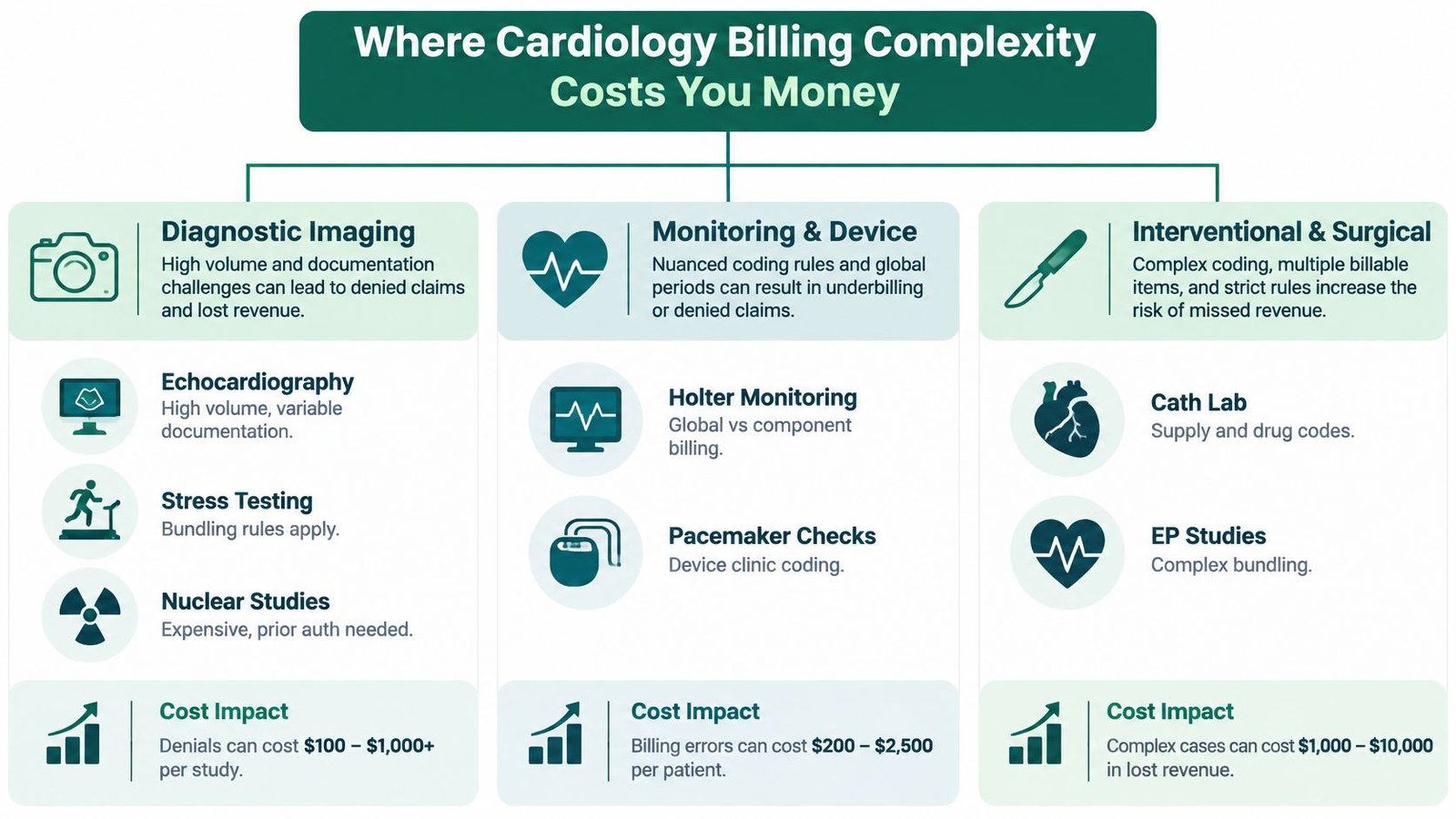
| Service family | Why it is hard to bill | What a missed step costs |
|---|---|---|
| Diagnostic imaging (echo, stress, nuclear) | Medical-necessity documentation and repeat-study rules | High-value denials that erase margin on the visit |
| Monitoring and device services | Frequency limits, device-specific coverage and remote-data documentation | Partial payments and recoupments found months later |
| Interventional and EP procedures | Physician versus facility split, assistant and co-surgeon rules, global periods | Underpayments that never show as denials |
| Cardiac rehabilitation and office visits | Visit-level documentation, supervision and session counts | Steady small losses across high volume |
Imaging is a margin problem. Echo, stress testing, and nuclear studies live or die on medical-necessity notes and payer rules for repeat studies. One denied high-value study can wipe out the margin on the whole visit, and the schedule still looks full.
Device work pays late and then claws back. Holter, remote checks, and pacemaker interrogations run into frequency limits and missing remote-data notes. You often see a partial payment first, then a recoupment months later, long after the month looked closed.
Procedures are underpaid without notice. Cath and electrophysiology claims split between physician and facility, and they trip on assistant, co-surgeon, and global-period rules. A bad split is frequently paid short, not denied, so it never lands on a denial report. Our cardiology billing work includes expert coding for diagnostic imaging and interventional procedures, with that split checked before the claim goes out. Patterns we see on these claims are laid out in our guide to cardiology billing denials.
Rehab and office visits are the high-volume tail. Session counts, supervision, and visit documentation don't look dramatic one at a time. Repeated short pays across a full schedule do.
Rank families by collected revenue, not by how complex they sound. Ask each bidder to walk a sample claim from your top two, including what was expected, what paid, and who would have caught a short pay.
Prior Authorization and Denial Metrics That Show Real Control
In 2024, Medicare Advantage insurers processed 52.8 million prior-authorization determinations and fully or partially denied 4.1 million, 7.7% of requests, up from 6.4% in 2023, according to KFF's review of Medicare Advantage prior authorization.
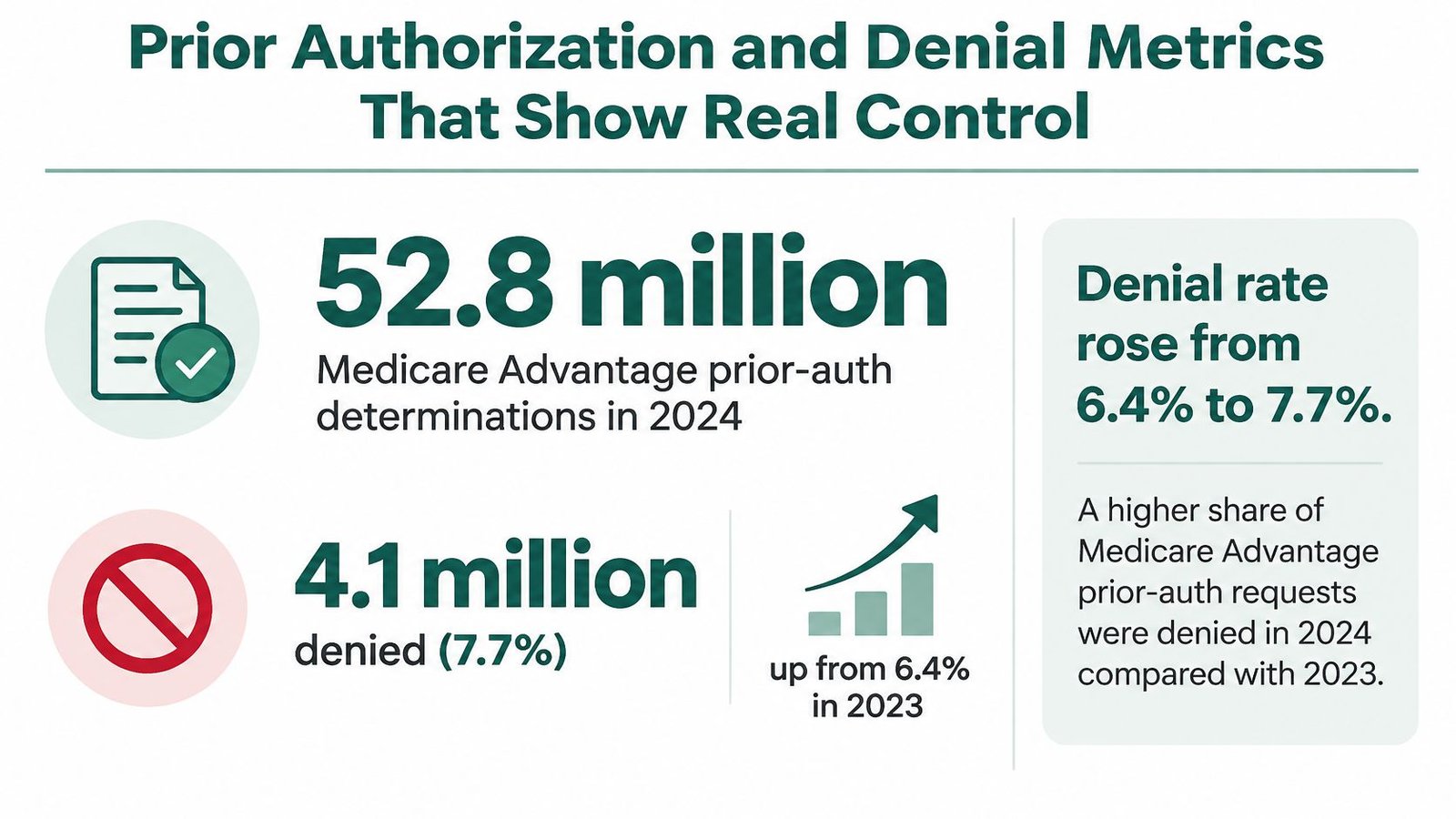
That volume hits cardiology before a claim exists. Advanced imaging, procedures, device-related care, and hospital-based treatment all depend on an approval and on notes that match it. A rising denial rate is an A/R problem first. The service was rendered, the cash isn't there, and the appeal clock is already running. If your team still treats prior authorization as a front-desk chore, the billing company is starting too late.
Split the denials before you trust any rate
Demand two buckets, not one denial percentage.
- Preventable denials: Eligibility, coding, and timely filing. These are process failures. A vendor should stop most of them before submission and show you the share of claims corrected before they went out.
- Medical-necessity denials: These need the chart and a physician. Tracking, peer-to-peer coordination, record retrieval, and appeal writing are either in the contract or they aren't. If they're "available," ask whether they're included or billed apart.
A reported 98% clean-claim rate can be real and still useless. It doesn't say whether the other 2% is cheap clerical fixes or the caths and nuclear studies that fund the month. Our lifecycle runs from credentialing and eligibility through prior authorization, coding, charge capture, submission, posting, denial work, aged A/R, and custom reporting. When a claim is unfairly denied, we contest it with clinical evidence, which is the work described in our denial management guide and in how to appeal a denied insurance claim.
Ask for overturn rate and dollars recovered by denial category, not a single clean-claim slide. If appeal writing isn't in scope, you're still staffing the expensive half yourself.
The contract should also say which payers are in the metric, and how fast an unresolved denial is escalated. That's the difference between outsourcing rework and relocating it.
Reporting Standards to Require Before You Sign
CMS's 2024 Medicare fee-for-service supplemental improper-payment data put projected improper payments on cardiology referring-provider claims at about $30.3 million, a 2.5% estimated error rate, with a confidence interval of 0.7% to 4.4%. That figure is about referring-provider payments, not a forecast of your vendor's error rate. It does show why compliance controls have to be measured. A promise of "high collections" isn't a control.
| Metric | Definition to require | Red flag |
|---|---|---|
| Clean-claim rate | Share of claims accepted by the payer on first submission, measured from payer acknowledgment | Measured at internal release |
| First-pass denial rate | Denied claims divided by claims submitted, by payer and service family | Reported only as one blended average |
| Denial overturn rate | Appeals won divided by appeals filed, with dollars recovered | No appeal volume or outcomes shown |
| A/R aging | Balances in 0-30, 31-60, 61-90 and 90-plus day buckets | Only a single days-in-A/R figure |
| Net collection rate | Payments divided by allowed amounts, net of contractual adjustments | Gross collections as the headline |
| Underpayment variance | Expected versus paid amount by CPT or HCPCS code and payer | No underpayment reporting at all |
| A/R with action in seven days | Share of open balances with documented follow-up within seven days | No action log available |
Same math, or no comparison
Give every bidder these definitions and demand the same numerator and denominator. Reject a report that averages Medicare, Medicaid, commercial, and out-of-network results. Averages hide the payer that's leaking. The billing metrics worth tracking each month only work if the definition survives a payer change.
Also require a claim-level sample: coding edits, modifier logic, a medical-necessity check, the remittance post, and the appeal file. We post ERAs and EOBs so the practice books match what the payer paid. Your bookkeeper still has to tie those deposits to the ledger. If that tie-out is behind, a firm such as Hire Bookkeepers can keep the books current while billing stays with the revenue-cycle partner.
A vendor who can't define a metric can't be compared with the next bidder. Ask who owns the data, whether you keep EHR and clearinghouse access, and how performance is scored during the handoff.
Deciding Whether to Stay, Add Help or Switch
A new biller doesn't fix a front-end failure. Separate three problems before you switch: the billing function, the workflow before the claim exists, and the payer mix. Change the vendor when the failure sits inside billing. If authorizations or charge capture are the break, the next company will repeat it.
| Situation | Better move | Verify first |
|---|---|---|
| Claims aging past 90 days with no clear owner | Switch, after exporting the full history | Aging report and open appeal list |
| Credentialing lapses or payer enrollment errors | Hybrid: add a credentialing specialist and keep the current biller | Payer enrollment status and effective dates |
| Denials rising while payment posting is clean | Fix the denial workflow first, then reassess | Denial reasons grouped by category for 12 months |
| Authorizations missed on imaging and procedures | Add front-end authorization coverage, or switch if the vendor cannot show turnaround data | Authorization turnaround by payer and service |
| Billing staff turnover with no written procedures | Full handoff with a transition plan and business associate agreement | Written procedures and a claim-level audit sample |
Pull, in writing, aging by bucket, the open-appeal list, and denial reasons for the past 12 months. If the current biller can't produce them, that is the answer. Eight signs a billing partner is costing you line up with that test. Reconcile EHR charges to submitted claims first. A charge-capture gap follows you to any new vendor.
CMS's interoperability and burden-reduction policies require impacted payers to share claims, encounters, and specified prior-authorization data through provider-access tools, and they describe APIs as links between payer data and an EHR or practice-management system. That doesn't make a vendor keep your work queues, appeals, and underpayment history in a file you can use. Credentialing is separate from billing, so the current biller can stay on the work it does well. Cost structure belongs in a written scope, which is the point of comparing what it costs to outsource medical billing without treating a headline rate as the decision. Switch only when you can name the failure, the owner of the fix, and the exit path.
Contract, Data and Exit Terms That Protect Your Cash
Say claims are aging, follow-up is spotty, and you terminate. The new biller can appeal only what it can see. If claim status, remittances, appeal files, and A/R reports stay in a system you can't export, days in A/R climb on balances that were collectible.

HHS sample business associate agreement provisions require the agreement to cover protected health information at the end of the relationship. When feasible, the business associate must return or destroy PHI it received or created for the covered entity, subcontractors must follow the same limits, and the covered entity may terminate for a material violation. A payer portal connection doesn't replace that file. Ask whether remittance and denial reason codes export, how fast records come back, and whether transition help is a contract duty.
Treat the deal the way larger buyers treat risk-based vendor tiering and SLA governance: service levels, a named owner, and a written way out.
Take this list into the negotiation
- Full export of billing history in a usable format, including status, remits, appeals, coding notes, and A/R reports.
- A return date for records after termination.
- Named transition contacts on both sides.
- Written ownership of work queues and appeal documentation.
- Cooperation duties while claims are still open.
- Confidentiality that continues after the contract ends.
We work inside eClinicalWorks, athenahealth, Epic, NextGen, ModMed, and other EHRs, so the practice system stays the system of record. Ask for this checklist in writing before the first signature.
Shortlist and Verify Your Cardiology Billing Partner
A polished demo cannot show whether a billing partner catches the revenue leaks behind a clean-claim percentage. Give yourself 30 days to verify the work.
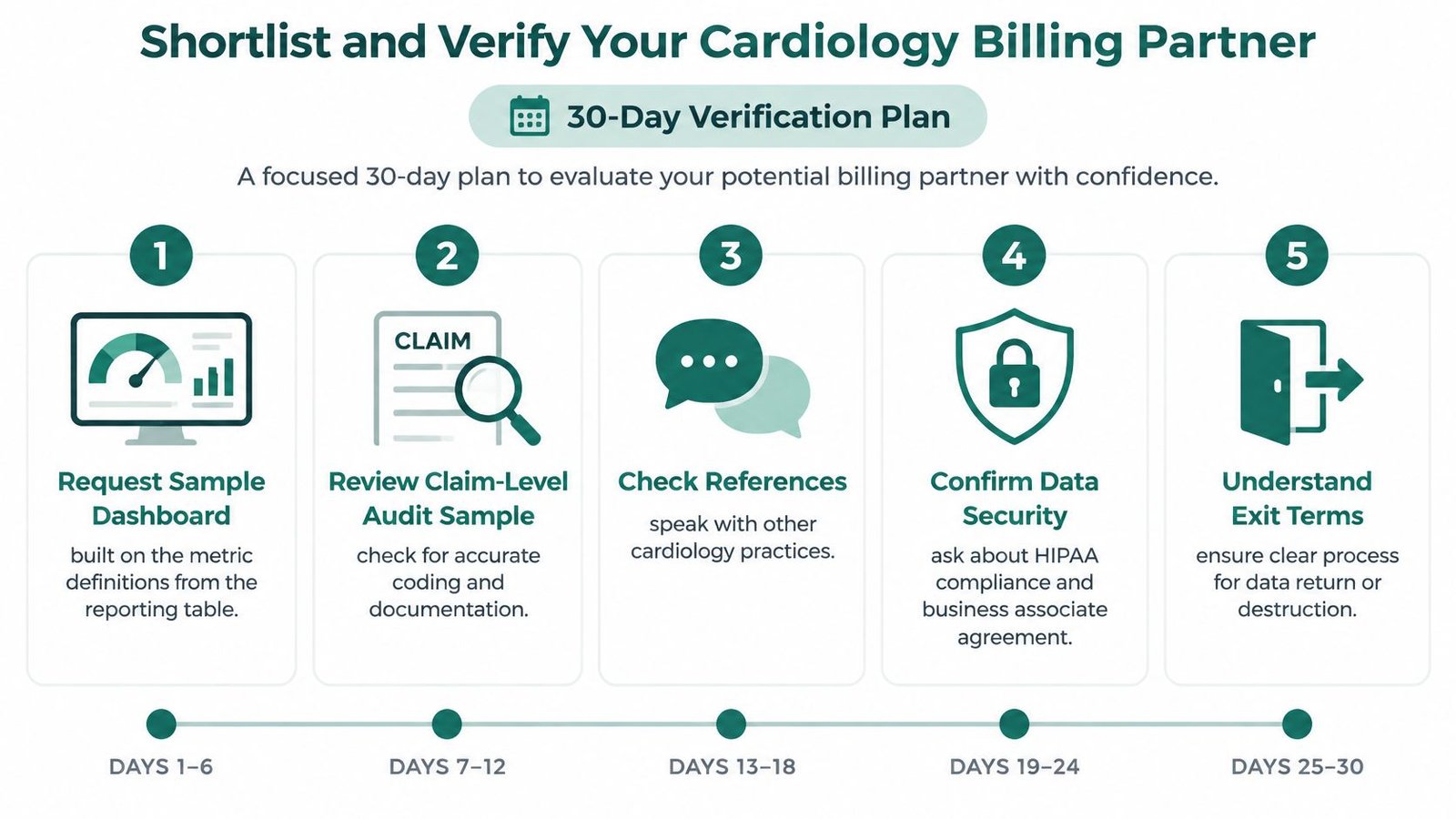
- Request a sample dashboard and ask how each metric is defined.
- Review a claim-level sample with an imaging claim and a procedure claim. Use the medical billing audit checklist for practice owners to assess the review.
- Walk through a live denial and an authorization from intake to resolution.
- Speak with a current client whose practice size and specialty mix are similar to yours.
- Confirm the exit checklist and business associate agreement in writing.
- Specify which functions the vendor will run end to end and which can remain with your current biller.
- Confirm whether credentialing and underpayment recovery are included in the proposed scope.
Happy Billing is a medical billing company headquartered in Houston, Texas. It works with independent practices across the United States and provides cardiology billing end to end or alongside a practice's existing biller. Pricing is covered on the call, not on this page.
US practices only.
Frequently Asked Questions
Should I outsource all billing or only prior authorization?
Start with the function causing the greatest delays or lost revenue, and keep work that is already performing well. Credentialing is separate from billing, so you can add it while keeping your current biller for the work you want to retain.
How long before cash improves after a switch?
Recovery of aged balances takes time. Track existing A/R separately from claims created after the handoff so you can see whether the new process is working without confusing old collection issues with current performance.
Can you handle motor vehicle accident and workers' comp cardiology claims?
Confirm this capability directly with any prospective billing partner. Ask which claim types are included in its scope and how it will report their status.
How do I compare fee structures without a published number?
Get each fee term in writing, including setup, old A/R, statements, and exit costs. Compare total cost alongside denial and A/R results, using the same metric definitions for each vendor.
Happy Billing provides cardiology billing for independent practices, including expert coding for diagnostic imaging and interventional procedures. Its revenue cycle services include eligibility verification, charge capture, claims submission, denial management, and patient collections. To discuss your practice's needs, book a free 30-minute call.
Where this fits