Podiatry Billing Company: What Independent Podiatrists Should Ask Before Hiring One

Hire a billing company only when it can prove, in writing, three things: how it screens routine foot care claims before submission, how it tracks every authorization to its expiration date, and how it reports denials by payer every month. The average initial claim-denial rate reached 11.81% in 2024, which is exactly why a verbal promise about clean claims doesn't survive contact with your first ninety days of real claims.
Every vendor leads with a clean-claim percentage. It's the most flattering number in the pitch and the least useful number in the decision, because a strong blended clean-claim rate can coexist with lapsed authorizations, postoperative visits billed inside a global period, and out-of-network claims paid at a fraction of the expected amount. That 11.81% figure comes from Kodiak Solutions data covering more than 2,100 hospitals and 300,000 physicians, as reported by Becker's Payer Issues, and it's the climate any billing partner is working in.
Judge a billing company by the money it can already see on your ledger. Pull three numbers before you take a single proposal: days in accounts receivable, first-submission denial rate by payer, and dollars parked in denials older than 90 days. Those three show where your cash is trapped, and they're the only baseline against which any vendor claim should be measured.
Who Should Run Your Podiatry Billing and When
Outside billing support makes sense when your practice has a defined job that is not getting done. That might be recurring problems with billing operations or a staff member who has no time left to handle the work assigned to them.
A billing partner should address revenue leaks before and after claims go out. Happy Billing works with independent practices across the United States and offers partial outsourcing, full revenue cycle management, or support for selected work. Its services include denial management, A/R recovery, certified coding, and provider credentialing.
Look beyond the payment total. If your reports do not show which claims remain unpaid and what follow-up they need, you cannot tell whether the billing process is recovering the money your practice has earned.
You can keep the parts of billing that already work. An outside team can handle a specific scope, such as denials or credentialing. Or you can shift more of the revenue cycle to a partner when internal capacity is no longer enough.
Set the scope before you hire. For example, ask the vendor to handle billing for one location or take on a defined backlog, then agree on how it will report results. If phone volume is also pulling staff away from billing work, an AI receptionist for allied-health clinics may help with scheduling and intake calls.
Billing Models Compared for Podiatry Practices
Five models cover almost every independent podiatry practice. Put them side by side with what each one takes off your plate, not just what it costs.
| Model | Who runs the work | Denial and underpayment ownership | Best fit |
|---|---|---|---|
| In-house billing | Your own staff, software and billing lead | Handled internally; denial and underpayment work depends on staff hours | Stable volume and a trained billing lead with time to work denials |
| Full-cycle outsourcing | Billing company runs claims end to end | Vendor owns denials, appeals and recovery under written reporting terms | Practices with high A/R days or no one who owns billing |
| Recovery-only engagement | Billing company audits and recovers money already owed | Targets aged denials and out-of-network underpayments | Practices with old unpaid claims or repeated underpayments from the same payers |
| Credentialing-only engagement | Billing company enrolls and re-enrolls providers | Not a daily claims model; determines which payers pay at all | Growing groups adding providers or entering new payer networks |
Which model fits which practice
Stable volume, a trained billing lead, no backlog. Keeping billing in-house is defensible. Buy a one-time recovery engagement to sweep aged denials and out-of-network underpayments, then get back to running the practice.
A/R days climbing and nobody owns the denials. Full-cycle outsourcing with written reporting terms is the strongest fit, because the leak isn't coding skill. It's hours nobody has.
A biller you trust, but the same payers keep paying short. Start hybrid or recovery-only. The vendor works the underpayment pattern, which is where the recoverable money sits.
Adding a provider or entering a new network. That's credentialing, and it runs on a separate track from billing. A group can enroll a new provider while claims keep flowing.
The test that matters: the decision turns on which tasks the vendor owns and reports on, not on how many staff it supplies.
We handle partial outsourcing, full revenue cycle management, or anything in between, including billing for one specialty or one location. Credentialing is separate from billing, and we run it end to end. To see how a podiatry-specific scope is built, review these podiatry billing services, then compare the quote against your real staffing cost. Before you take a proposal seriously, start with this breakdown of medical billing outsourcing costs.
Coverage Tests for Routine Care, Surgery and Wounds
Most podiatry revenue leaks before a claim is ever filed. The claim gets built by someone who didn't read the note, and the practice eats the denial six weeks later.
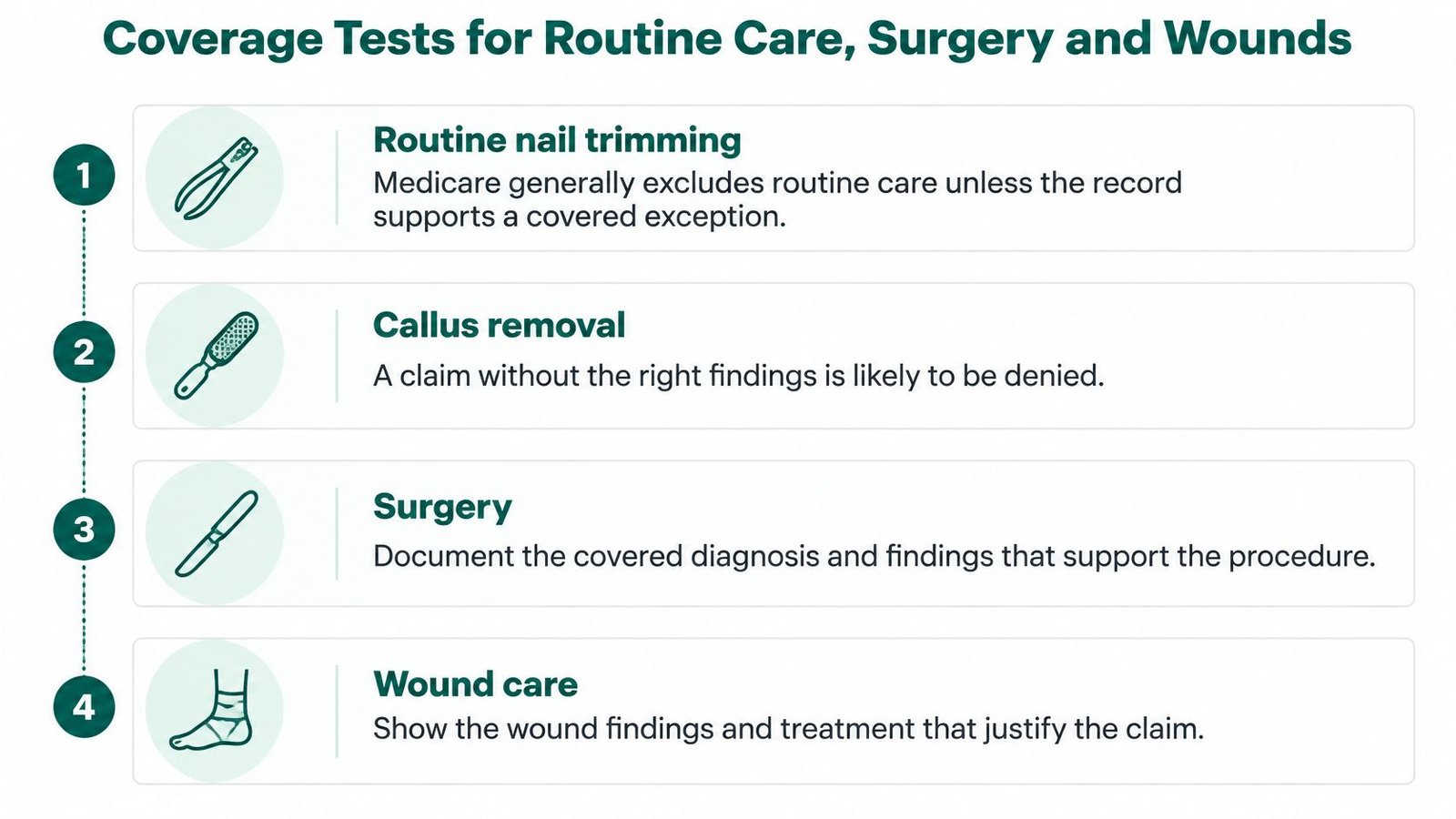
Routine foot care is a coverage test, not a coding preference
Medicare generally excludes routine foot care, including cutting or removing corns and calluses, trimming or debriding nails, and hygienic maintenance, unless the record establishes a covered medical exception, per CMS podiatry compliance guidance. Every one of those claims submitted without the exception is a visit you performed and can't collect until someone appeals it.
For claims that do qualify, the Medicare coverage article recognizes a presumption of coverage with one Class A finding under modifier Q7, two Class B findings under Q8, or one Class B plus two Class C findings under Q9, and it requires an appropriate systemic-condition diagnosis. Ask whether the vendor's edits check the modifier, the primary diagnosis and the chart support before the claim leaves the building. A mechanical miss here is a denial you pay staff to appeal.
Surgery and global periods
The CMS global surgery guidance applies global payment rules to procedures with global-surgery indicators 000, 010 and 090, and in some cases YYY. A vendor that bills a postoperative visit separately inside that window creates a recoupment. A vendor that misses legitimately separate work leaves earned money unbilled. Ask for denial and underpayment reporting by procedure, modifier, payer and global-period reason, never a single collection total.
Wound care and neuropathy documentation
Care integral to treating an ulcer or infection can be covered when the record shows measurements, the debridement performed and the reason for each visit. Our wound care billing breakdown covers what payers read first. Then there's the neuropathy claim: the applicable LCD asks for absent sensation at two or more of five tested sites on either foot using a 5.07 Semmes-Weinstein monofilament, and for patients on anticoagulation it asks the record to describe the risk nonprofessional foot care poses. A vendor that attaches a diagnosis code and calls that documentation will turn appropriate visits into nonpayable claims.
A vendor that edits modifiers or diagnosis pointers until a claim pays is handing you the compliance exposure and keeping the fee.
Six tests to require in writing, with the answer that should satisfy you:
- Routine-care screen: Can you show the edit that blocks a routine-care claim without Q7, Q8 or Q9 support and a systemic diagnosis? The answer is yes, with the edit shown.
- Global-period check: Which global-surgery indicators does your system read before a postoperative visit is billed? Accept only a specific answer.
- Wound documentation review: Who reads the wound measurement and debridement note before submission? A named role, not "the coder."
- Sensation testing: How do you confirm the monofilament findings are in the chart? The answer should describe a chart check, not a code lookup.
- In-office procedures: How do you confirm the note supports biopsies, lesion and nail-bed procedures and injections? The answer should mention a pre-submission review.
- Refusal to edit: Will you decline to change a modifier or pointer to force payment? Only a yes keeps you out of trouble.
Authorization, Denial and Underpayment Recovery
Revenue leaks start before a claim is filed and continue after a payer responds. Judge a billing company by the dollars it prevents from being lost and the money it recovers, not by a headline clean-claim percentage.
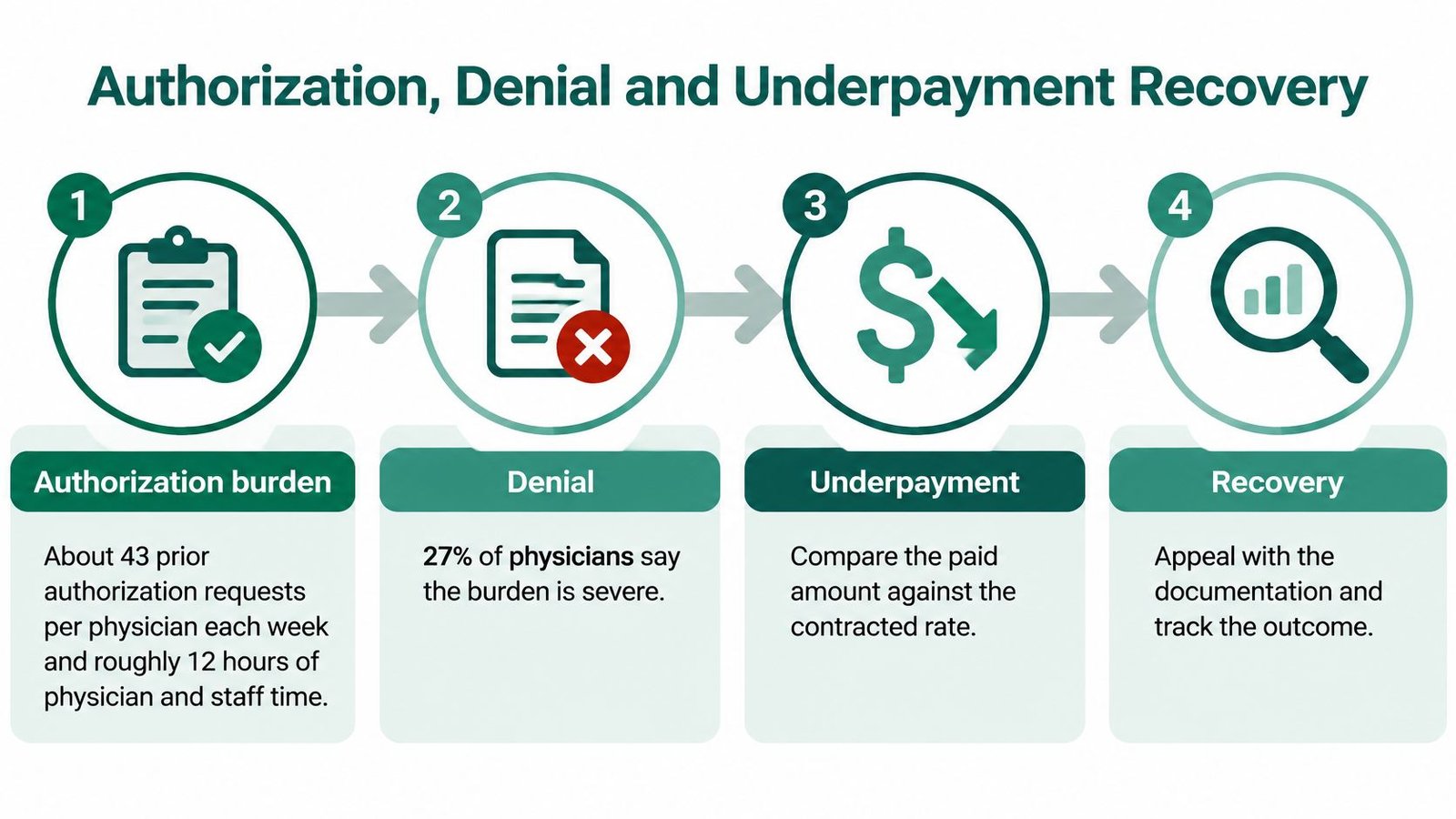
The seven steps of a working recovery workflow
- Verify eligibility before the visit. Confirm active coverage before care is delivered, so an eligibility problem does not surface after the claim is filed.
- Obtain authorization and record its number and expiration. Make the authorization details available to the person preparing the claim.
- Check the claim against the chart before submission. Catch missing information while it can still be corrected without an appeal.
- Track payer status on every open claim. Assign ownership for follow-up; an untracked claim can sit unresolved.
- Sort denials by root cause. Separate authorization, eligibility, documentation and medical-necessity issues so the practice can address the actual failure.
- Appeal with chart evidence and log the deadline. A well-supported appeal still fails if it misses the payer's filing window.
- Report overturn results by payer. Use the results to decide which denials merit further appeal work.
A clean-claim percentage can conceal failures that happen before submission. Ask for denials by cause, and require the vendor to show how authorization information is checked and carried onto the claim. A vendor offering billing automation with PMS integration should explain specifically how the system handles authorization data and what staff review before filing.
CMS's prior authorization final rule sets decision timeframes for impacted payers: 72 hours for expedited requests and seven calendar days for standard requests, with many requirements beginning in 2026. See the CMS interoperability and prior authorization final rule.
Underpayments are another source of recoverable revenue. Compare each payment with the expected amount, then document the difference and pursue claims that were paid below that amount. The guide to podiatry out-of-network underpayment recovery in New Jersey and New York explains how to build those disputes. When a claim is unfairly denied, Happy Billing fights it with clinical evidence rather than resubmitting the same line.
Ask the vendor to show how it organizes the denial queue, who owns follow-up, and how it tracks appeal deadlines and outcomes. A medical billing denial management guide can help you assess whether its process addresses the causes of denials, not just the claims already rejected.
Monthly Reports an Owner Should Demand
A clean-claim percentage cannot show what your practice lost before a claim was filed, or what remains unpaid after submission. Demand reports that separate preventable front-end errors, denials, aged A/R, and underpayments. Require the vendor to define every measure in writing so you can compare results month to month.
| Report metric | What it tells you | What to ask |
|---|---|---|
| First-submission denial rate | Share of claims denied on first pass, split by payer and procedure type | Define the denominator and explain whether corrected or resubmitted claims count |
| A/R over 120 days | Cash stuck in the oldest bucket | Below 10% is favorable; 10% to 20% is intermediate; 20% to 30% is a warning; above 30% is unfavorable, according to MGMA guidance on cost and revenue data |
| Aging buckets and days in A/R | Distribution across 0-30, 31-60, 61-90, 91-120 and 120-plus days | Use the same definitions every period and report inherited A/R separately from new A/R |
| Prior-authorization denial and overturn rate | Denials by payer, appeals filed and overturns | Break out results by payer and procedure category |
| Underpayment recovery by claim age | Dollars recovered on claims older than 90 and 120 days | Separate recoveries by age cohort and payer |
| Dollars prevented versus recovered | Denials stopped before submission compared with denials worked after | Report both figures monthly and show the trend over time |
Put the denominator in writing. Ask whether the first-submission denial rate includes corrected or resubmitted claims. Require the same definition across payers and reporting periods. A percentage without a clear denominator is not a useful performance measure.
Separate inherited A/R from new A/R. Otherwise, a vendor can make current work look better by blending it with old balances, or obscure whether the practice's existing backlog is shrinking. Review the aging distribution alongside days in A/R, using the same buckets every month.
Break results down by payer and procedure category. A blended average can hide problems in surgery, wound care or durable medical equipment. Look for recurring denial patterns within each category, then ask what changed upstream to prevent those claims from being lost before submission.
What to request with the numbers
Request a masked 12-month dashboard, a denial root-cause report based on real claims, and references from independent specialty practices. A 2025 Tebra survey found that 64% of respondents named insurance claim denials as a major medical-billing challenge and 18% reported spending more than 20 hours a month resolving billing errors, according to Tebra's medical billing survey.
Set a contract rule for high-dollar claims that pass a defined age threshold: the vendor must escalate each one to a named person every week. Track the measures consistently with this guide to medical billing KPIs to track.
Security, EHR Access and Exit Terms
Your billing company already holds access to revenue your practice has earned. Judge its security and exit terms as carefully as its claim submission rate. A vendor that cannot put its controls in writing should not handle patient data.

Set these requirements in the business associate agreement and ask how the vendor enforces them:
- Role-based access and multi-factor authentication. Limit access to the staff who need it, and require a second authentication factor.
- Encryption in transit and at rest. Ask the vendor to specify its encryption standards.
- Audit-log review. Confirm who reviews access logs and how often.
- Workforce training and breach-notification timelines. Put the notification process and timing in writing.
- Retention and secure deletion. Define what happens to your data when the contract ends.
- Controls for offshore or follow-the-sun staff. Require the same security standards for every person who can access your information.
The vendor should work in your existing EHR, not make a separate system the only place to find claim work. Happy Billing integrates with eClinicalWorks, Athena Health, EPIC, NextGen and ModMed, among other EHR systems.
Protect access to your money after the contract ends, too. Require recovery-time and recovery-point objectives, downtime procedures, backup-testing details, ownership of open work queues, and exportable claim, denial, payment and authorization histories in a usable format. Test the export before signing. If you cannot retrieve the records and open work needed to keep claims moving, a good monthly report will not protect your cash flow.
Put fees and service expectations in writing. Specify the fee basis and what it excludes. Clarify whether appeals, underpayment disputes and authorization work are included or billed separately. Name an account lead, set response times for urgent denials and payer calls, and require an onboarding plan with a go-live date. Schedule a monthly review with the owner to examine the work and money still outstanding.
Confirm the Vendor Before You Sign
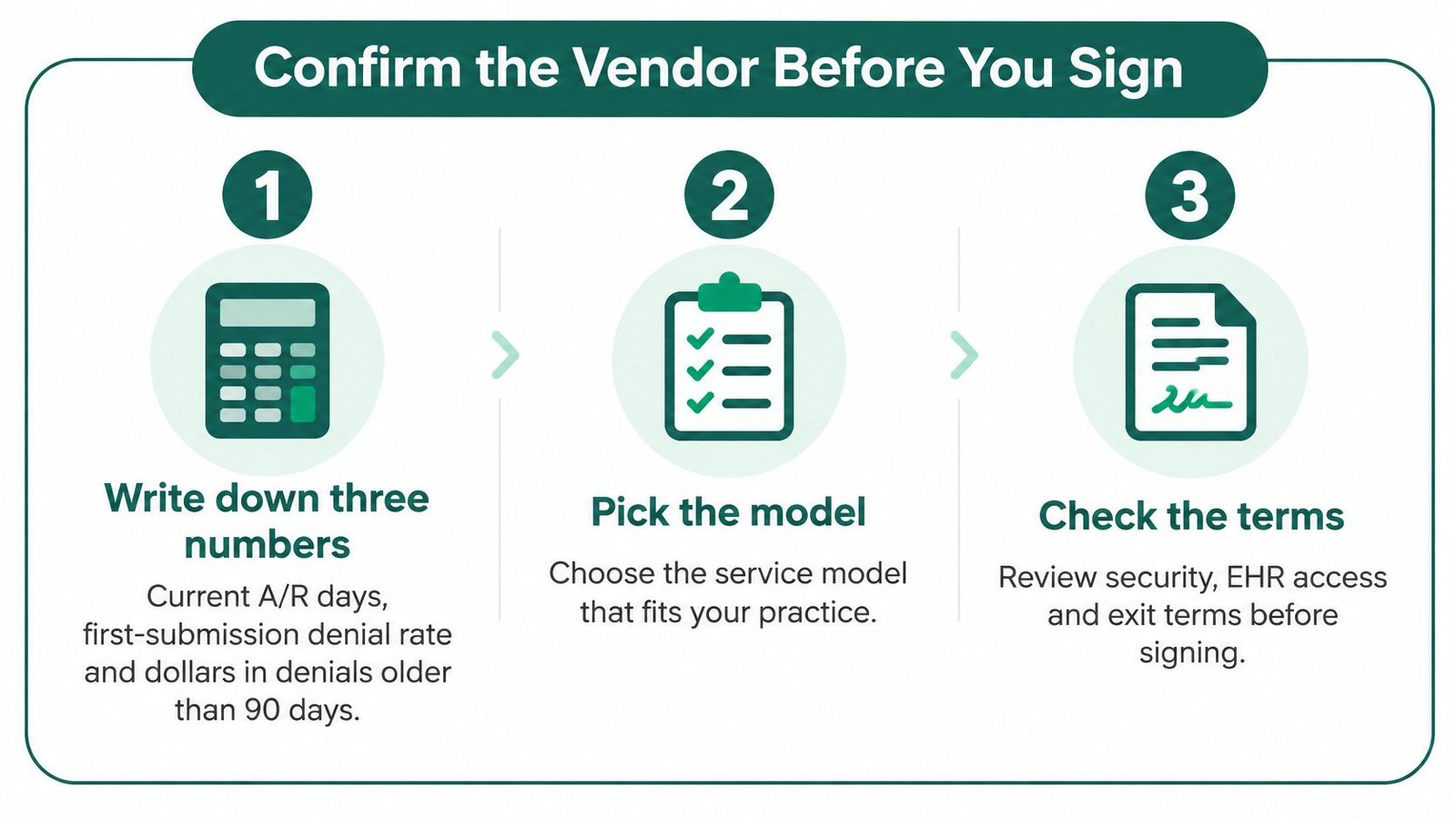
A vendor's headline clean-claim rate won't show how much money is already sitting in old denials or was lost before claims were filed. Start with your own baseline: current A/R days, first-submission denial rate, and dollars in denials older than 90 days. Ask each finalist to explain how its work will address those specific gaps, and get the scope and service expectations in writing.
Then choose the model that fits your practice: in-house, full-cycle, hybrid, recovery-only, or credentialing-only. Use the coverage questions and report table above to test how each vendor handles your work. Request a masked dashboard, a sample denial root-cause report, and references from independent specialty practices. If a vendor cannot show how it tracks unpaid claims and revenue lost before submission, keep looking.
Happy Billing manages podiatry billing end to end. Services include eligibility verification, coding, clean claim submission, denial management, A/R recovery, and credentialing, within your existing EHR. Credentialing is separate from billing, and we can run it as a standalone service. Happy Billing's costs are 30–40% below what most practices spend on in-house billing. Compare the written scope and costs before you decide, and review these medical billing company red flags before signing.
Request a free 30-minute discovery call to discuss whether the service fits your practice.
Podiatry Billing Company Questions Owners Ask
Should I fix my billing team first or outsource it
Fix it first only if your team has the hours and a denial report that shows where the leak is. If nobody has the hours and no denial report exists, compare the models in the table and start with a hybrid or recovery-only engagement so you can test the vendor on your real backlog.
What denial rate should a podiatry billing company hit
Ask for first-submission denials by payer and procedure type with the denominator in writing, then judge the vendor against the benchmark in the report table instead of a blended clean-claim figure. A single blended number hides the category that's costing you money.
Can a billing company take on one specific problem first
Yes. The vendor can take the denial backlog, the underpayments or credentialing, and that scope needs to be written down. Vague scopes are how two teams end up each assuming the other is working a claim.
How do I protect patient data and avoid being locked in
Require a business associate agreement, multi-factor access, audit logs, tested recovery objectives and an exportable claim and authorization history before you sign. Test the export yourself. Vendors rarely volunteer that their data leaves in a format nobody can use.
Do I need a vendor that understands wound care and global periods
Yes, and the interview tells you quickly. If the vendor can't explain how it reviews wound documentation or how it prevents duplicate billing inside a global period, your practice absorbs the recoupments and the appeals, and those cost more than the billing fee you were comparing.
Podiatry billing rewards a partner who reads the note before the claim goes out and then chases the money a payer already owes you. Happy Billing runs eligibility checks, certified coding, clean claim submission, denial appeals, A/R recovery and credentialing inside your existing EHR, and we take the whole revenue cycle. If you want to see whether the numbers in your ledger match what you've been told, visit Happy Billing and book a free 30-minute call with a billing specialist.