Podiatry Medical Billing Services: A Practice Owner’s Guide

Podiatry medical billing services are specialized revenue cycle systems built to keep foot and ankle claims from leaking cash. That matters because podiatric outpatient care carries a 12% denial rate, which is nearly 40% higher than the standard healthcare average according to industry reporting on podiatry billing complexity. If you're running a podiatry practice, that gap doesn't stay on paper. It shows up as slower cash flow, more staff rework, and A/R that stays open far too long.
In practical terms, generic billing teams often miss the exact payer rules that decide whether your claim gets paid, delayed, or denied. In podiatry, small details such as medical necessity support for routine foot care, the right modifier on CPT 11721, or updated HCPCS handling can change whether revenue lands this month or gets trapped in appeals. That's why the critical question isn't whether billing can be outsourced. It's whether the people touching your claims understand podiatry.
What Are Podiatry Medical Billing Services
Podiatry medical billing services are specialty-specific revenue cycle management for foot and ankle practices. They handle the full financial workflow tied to your visits and procedures, including eligibility checks, charge entry, coding review, claim submission, payment posting, denial work, and A/R recovery. The difference from generic billing is simple. Podiatry has payer rules that punish imprecision.
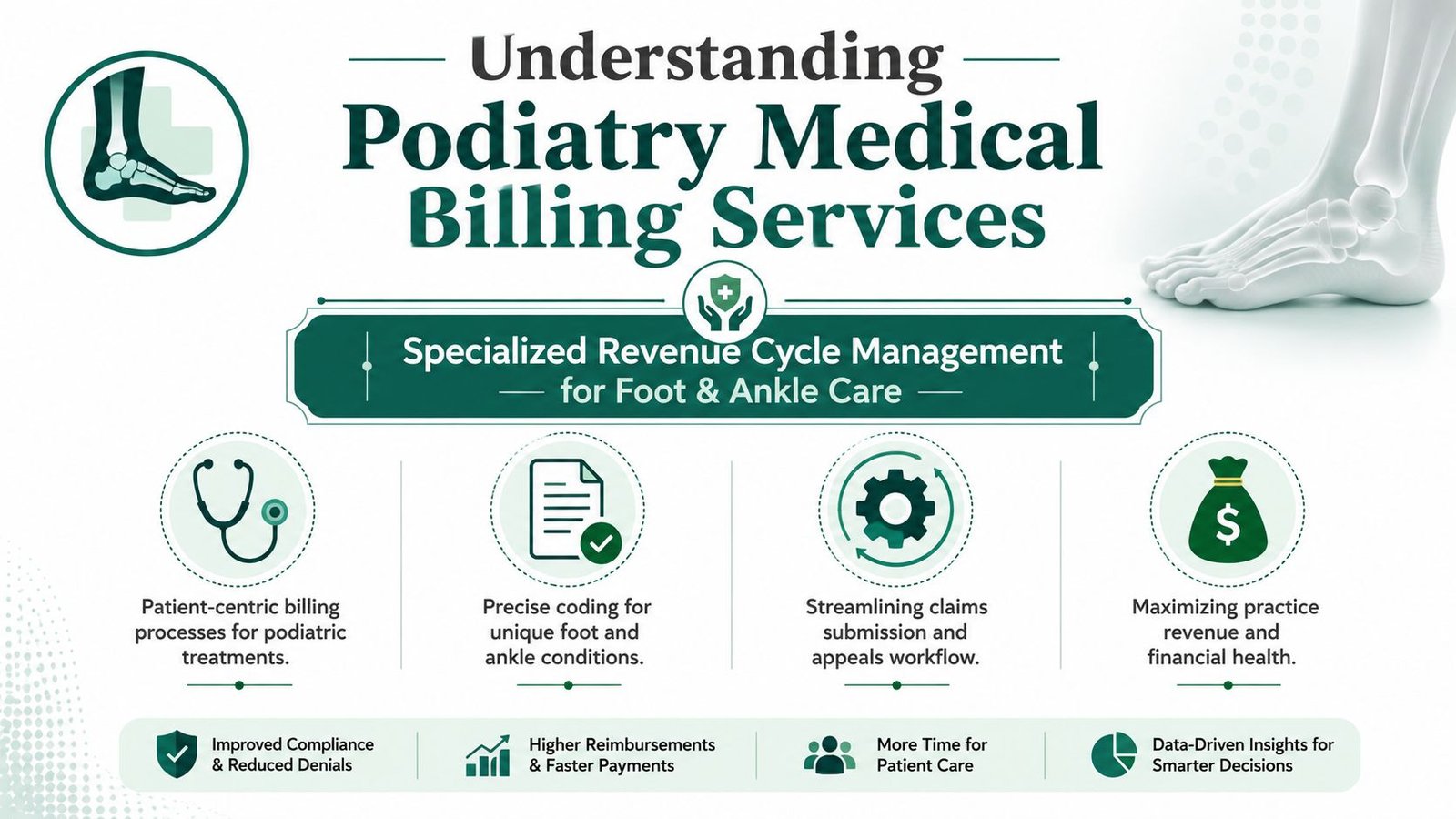
A practice owner should think of this as revenue defense, not clerical support. When outpatient podiatry claims are denied at 12%, and that rate sits nearly 40% above the broader healthcare average, the cost of “close enough” billing gets very real very fast. The reasons are familiar to anyone who has fought these claims: strict medical necessity standards, procedure-specific documentation requirements, Medicare rules around routine foot care, and modifier logic that generalist teams often mishandle.
What specialized service actually covers
A strong podiatry billing operation usually includes:
- Front-end verification: Confirming active coverage, patient responsibility, and whether the planned service meets payer requirements before the visit is billed.
- Podiatry-specific coding review: Checking whether office visit codes such as 99203 or 99204 are supported and whether procedure coding aligns with the chart.
- Modifier and policy control: Catching errors tied to routine foot care, negative procedures, and global period rules before claim submission.
- Denial management: Working rejected claims quickly instead of letting them age into write-offs.
Owner view: The point isn't just to file claims. The point is to stop preventable denials before they ever hit your aging report.
If your current process relies on a general medical biller, you're asking that person to manage the intricacies of a specialty where one missing detail can void payment. That's why many physician groups now treat specialty RCM as an operational necessity rather than an admin task. For a broader view of how specialty revenue cycle systems protect practice cash flow, see this guide on RCM for physician practices.
Why Podiatry Billing Is Uniquely Challenging
Podiatry isn't hard to bill because the volume is unusual. It's hard because the claims get scrutinized at the point where documentation, payer policy, and coding rules intersect.
A common example is routine foot care. The physician performs the service, the chart supports the clinical story, and the office assumes the claim is straightforward. Then the payer rejects it because the submitted claim doesn't tie the service to the documentation the way Medicare expects. The visit happened. The work was done. Revenue still stalls.

Where leakage usually starts
In my experience, podiatry revenue leaks in three places before a denial team ever gets involved.
First, front-desk intake misses payer-critical details. Eligibility isn't just active or inactive coverage. Staff need to confirm copays, deductibles, benefit limits, and whether the specific service is covered under the patient's plan. If that step is rushed, the practice creates downstream rework before the claim even leaves the building.
Second, documentation and charge capture fall out of alignment. That happens when the provider note supports one level of service or one diagnosis pathway, but the charge ticket or coder uses another. Payers don't care what was intended. They pay what was documented and properly linked.
Third, communication workflows break down. Referral documents, prior notes, and supporting records often still move through fax channels in medical offices, so secure transmission matters. If your staff is reviewing process risks around document exchange, this resource on data protection for healthcare faxing is worth reviewing.
Podiatry has more than one denial trigger
A practice owner usually sees denial management as a back-end problem. In podiatry, that's incomplete. The denial often starts at the front end.
Consider these real operational failure points:
- Routine foot care support is thin: The claim is billed, but the systemic condition and medical necessity elements aren't clearly documented.
- Wound-related services are entered fast: The chart may support treatment, but the billed diagnosis doesn't map cleanly to the procedure.
- Post-procedure billing ignores global rules: The practice submits work that the payer views as included, then spends time appealing something that should have been prevented.
- Code tables aren't current: A deleted or replaced HCPCS code can trigger rejection before anyone reviews medical necessity.
Strong podiatry billing starts before coding. It starts when the office confirms the patient, the benefit, and the documentation path for the exact service being performed.
Practices that also handle wound care often see this overlap clearly, because foot and ankle claims can become far more complex when debridement, chronic wounds, and supporting diagnoses need to line up across encounters. This overview of optimizing wound care billing services for 2026 is useful if that part of your case mix is growing.
Essential Podiatry Coding and Modifier Nuances
The most expensive podiatry billing mistakes don't look dramatic. They look minor. A missing modifier. A diagnosis that doesn't explicitly support the procedure. An annual code update that wasn't applied in the practice management system. Those are the errors that gradually turn earned revenue into aged A/R.
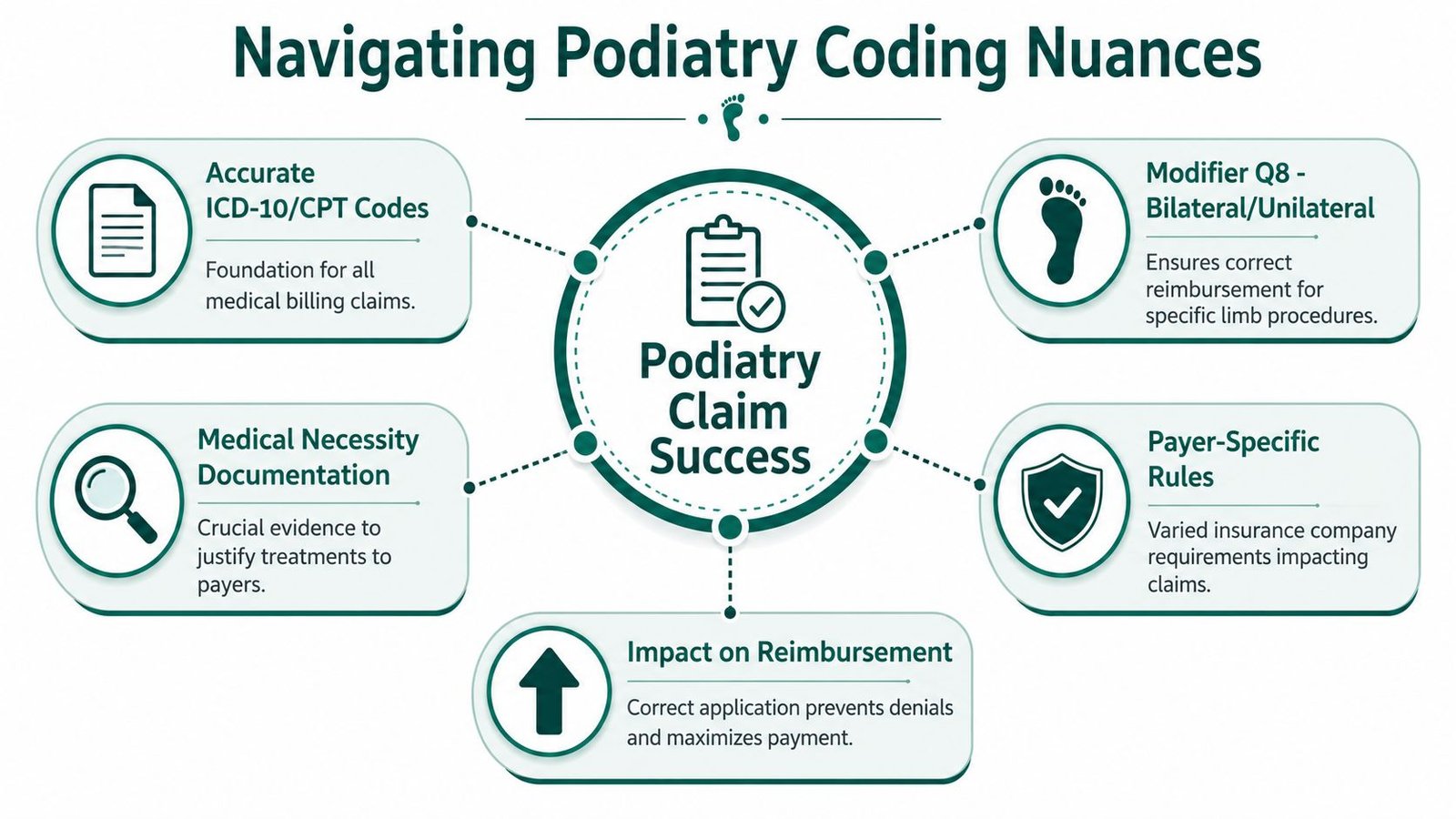
Q8 on CPT 11721 isn't optional when the payer requires it
For routine foot care, CPT 11721 is one of the clearest examples of why podiatry needs specialty billing. Medicare coverage depends on more than the procedure itself. The service must be linked to documented systemic conditions, and the Q8 modifier has to be handled correctly when required. According to podiatry billing guidance focused on modifier compliance, the broader lesson is that modifier logic directly affects reimbursement. In podiatry-specific reporting, 30% to 40% of routine foot care claims are rejected solely because of missing Q8 linkage or insufficient systemic condition documentation.
That is revenue leakage you can prevent before submission.
Diagnosis and procedure have to tell the same story
Payers don't reimburse a podiatry claim because the service code is technically valid. They reimburse when the ICD-10-CM diagnosis, CPT code, and provider note support the same medical necessity narrative.
One example is linking L60.3 appropriately to nail debridement billing when the chart supports that path. If the diagnosis on the claim doesn't precisely match the documented reason for the procedure, Medicare's medical necessity review framework can deny the claim automatically. Non-compliant practices see an average 28% routine foot care denial rate in this area, and outdated ICD-10 versions can cause 15% to 20% of claim rejections due to payer system incompatibility.
What competent podiatry billing teams check before submission
A specialist doesn't just “code the chart.” They pressure-test the claim.
- Modifier logic: Is Q8 present when needed, and is the systemic condition documented clearly enough to support it?
- Frequency rules: Does the service fall within Medicare coverage limits for that treatment category?
- Diagnosis linkage: Does the billed ICD-10 code explicitly justify the procedure that appears on the claim?
- Code currency: Has the practice updated deleted or replaced HCPCS and diagnosis codes in time?
Practical rule: If a claim needs an appeal to explain what should have been obvious from the first submission, your process failed upstream.
The upside of getting this right is material. Reporting on optimized podiatry billing shows first-pass acceptance rates of 90% to 94%, denial resolution under 7 days, and appeals success above 65% when diagnosis linkage and denial prevention are disciplined. Separate podiatry RCM benchmarks also show clean claim rates of 92% to 96% and A/R days targets of 35 to 40 when modifier logic and LCD compliance are consistently enforced. Those aren't coding trivia points. They're operating benchmarks for cash flow.
The Core Components of a Specialized Billing Service
A specialized podiatry billing service isn't one person posting charges. It's a coordinated workflow designed to keep claims clean before submission and recover them fast when payers still push back.
Front end controls revenue before the claim exists
Eligibility verification sits at the start for a reason. If the office doesn't verify coverage, patient responsibility, referral status, and plan-specific rules before the encounter is billed, every downstream step becomes slower and more expensive.
For podiatry, this matters even more when services sit near routine care exclusions or medical necessity thresholds. Front-end teams should identify likely coverage barriers before the physician's note is finalized, not after the ERA arrives with a denial code.
Mid-cycle work determines whether documentation can be monetized
Charge capture and coding review are where many practices underestimate risk. The visit happened, the note is signed, and staff assume the claim is ready. But a specialized team will compare the chart against the billed CPT, diagnosis linkage, modifier use, and payer edits before submission.
The primary work here includes:
- Documentation-to-code review: Making sure the provider's note supports the billed service, not just clinically but in payer terms.
- Claim scrubbing: Catching missing demographics, NPI issues, invalid code combinations, and policy edits before the claim hits the clearinghouse.
- Submission timing: Sending clean claims quickly enough that filing windows and cash flow don't drift.
Back-end discipline is where money is either recovered or abandoned
Denial management is not just resubmitting claims. It requires categorizing why claims failed, correcting the source error, and deciding which balances deserve immediate appeal versus rapid write-off prevention. Payment posting also matters more than many owners realize. If remits aren't posted accurately and quickly, the practice loses visibility into underpayments, open balances, and staff performance.
A complete specialized service usually includes:
| Workflow stage | What it protects |
|---|---|
| Pre-bill verification | Preventable denials tied to eligibility and benefit mismatch |
| Coding and claim review | Clean claims, compliant modifier use, accurate diagnosis mapping |
| Submission and tracking | Timely filing protection and faster claim visibility |
| Denials and appeals | Recovery of revenue that would otherwise age out |
| A/R follow-up | Consistent pressure on unpaid balances before they become write-offs |
Owners often focus on coding because it's visible. In podiatry, the stronger lever is the full system. A claim that's never denied is worth more than a claim that gets expertly appealed three months later.
Key Benefits of Outsourcing Your Podiatry RCM
Outsourcing podiatry RCM makes sense when the practice wants specialty depth without carrying the full burden of hiring, training, supervising, and replacing an in-house billing team. That isn't a fringe strategy. Over 36% of physician practices now outsource part of their billing or coding operations, according to industry reporting on outsourced billing adoption.
For a podiatry owner, the benefit isn't “less paperwork.” It's tighter control over collections.
What you gain beyond staffing relief
An internal biller may be excellent and still be stretched too thin. One person can't always manage front-end verification, payer follow-up, denial trends, coding updates, appeals, and reporting with equal quality. Outsourcing gives the practice access to a broader function, not just another set of hands.
The practical advantages usually include:
- Specialty-specific knowledge: Teams that already understand routine foot care rules, modifier issues, and diagnosis-to-procedure alignment.
- Operational continuity: Claims still move when an employee is out, leaves, or falls behind.
- Stronger pre-bill controls: Better processes for catching eligibility, demographic, and coding issues before submission.
- Less management drag: Owners and administrators spend less time supervising billing workflows and more time running the practice.
Outsourcing is often a risk decision, not just a cost decision
When owners compare in-house and outsourced billing, they often focus only on fees. That's too narrow. The more important question is what your current model is costing you in denied claims, delayed payments, staff turnover, and unrecovered A/R.
If your current billing setup can submit claims but can't reliably prevent podiatry-specific denials, you're not saving money. You're financing inefficiency.
A good overview of the benefits of outsourcing medical billing can help frame that decision. The strongest outsourced podiatry partners don't just work your old denials. They redesign the workflow so fewer claims fail in the first place.
How to Evaluate a Podiatry Medical Billing Partner
The best podiatry billing partner isn't the one with the best sales deck. It's the one that can show how it prevents revenue leakage before claims go out the door. Practices often ask about coding expertise first, but front-end controls deserve equal scrutiny. Claims are commonly denied for missing patient or provider data, inaccurate codes, and poor eligibility verification. The biggest payoff comes from fixing those pre-bill failures, not relying on back-end cleanup.
A useful starting point is this list of questions to ask a medical billing company before hiring. Then get more specific.
Questions that expose whether a vendor really knows podiatry
Ask them how they handle Q modifiers, routine foot care documentation support, office visit coding in podiatry, and post-procedure global period issues. If the answers stay generic, that's your answer.
Also ask how they deal with deleted and replaced codes, diagnosis linkage review, and whether they work inside your current EHR and clearinghouse. A podiatry partner shouldn't need you to translate the specialty for them.
Podiatry RCM Partner Evaluation Checklist
| Evaluation Category | Key Question for Vendor |
|---|---|
| Specialty expertise | What podiatry-specific claim types do you manage every day? |
| Modifier control | What is your process for reviewing Q8 and other podiatry-relevant modifiers before submission? |
| Medical necessity | How do you verify that documentation supports routine foot care and other high-scrutiny services? |
| Eligibility workflow | Who verifies coverage, copays, deductibles, and plan-specific restrictions before billing? |
| Denial prevention | What edits or scrub rules do you apply before a claim leaves the practice? |
| Denial response | How do you triage denials, and how quickly do you rework or appeal them? |
| Reporting | What KPIs do you show the practice each month for denial trends, collections, and A/R aging? |
| Technology fit | Will your team work inside our EHR and PM system, or do we need to change platforms? |
| Staffing model | Who touches our account daily, and what happens if that person is unavailable? |
| Pricing | Is your fee percentage-based, flat-fee, or hybrid, and what work is excluded? |
What to listen for in their answers
Strong vendors speak in workflows. Weak vendors speak in promises.
Look for answers that describe how they verify eligibility, review documentation before charge release, scrub claims against payer rules, and surface denial patterns back to the practice. Ask for examples of what they would audit in your current process. If a partner can't identify where your revenue is leaking before taking over, they're guessing.
The right evaluation standard is simple. Can this team stop the denial before it starts?
If you want an objective baseline before interviewing vendors, it's smart to request a free billing audit. That gives you a cleaner view of whether the problem is coding, front-desk intake, payer follow-up, or a mix of all three.
FAQs From Podiatry Practice Owners
Should I outsource full-cycle RCM or only coding?
That depends on where your revenue is leaking. If your denials start with eligibility gaps, missing demographics, or front-desk workflow issues, coding-only support won't solve the problem. Coding help is useful when documentation and intake are already disciplined. Full-cycle RCM is usually the better fit when the practice has problems across pre-bill controls, claim submission, denial follow-up, and A/R recovery.
What's the biggest warning sign that my current billing setup isn't working?
Look at behavior, not just monthly collections. If staff spends too much time correcting rejected claims, if balances sit unresolved because no one owns follow-up, or if physicians keep hearing that claims were denied for avoidable reasons, the system is underperforming. In podiatry, repeated issues around routine foot care, modifier logic, and diagnosis linkage are strong signs that the billing function lacks specialty depth.
How should I compare pricing models from billing companies?
Don't compare fees in isolation. Compare what the fee includes. Some vendors handle claim submission but exclude denial appeals, old A/R, patient statements, or payment posting support. Others offer broader coverage but need stronger oversight during onboarding. Ask what work is included, who handles front-end verification, and whether reporting is built into the engagement. The cheaper quote can become the more expensive option if denied revenue keeps piling up.
How disruptive is implementation if I switch billing partners?
Implementation doesn't have to be chaotic if the new partner can work inside your current EHR and practice management system. The cleanest transitions start with a short audit of payer mix, open A/R, denial categories, fee schedules, and workflow ownership. Then the handoff should define who verifies eligibility, who releases charges, who posts payments, and who works denials. If the vendor can't explain that transition clearly, expect friction.
Can better billing help practice growth, not just collections?
Yes, because cleaner revenue gives you better operating visibility. When claims move predictably, owners can hire more confidently, expand services more carefully, and stop making decisions based on distorted cash flow. Growth also depends on patient acquisition, so for that side of the business, this guide to Gorilla's local SEO tips for medical offices is a useful complement to stronger RCM. If you're also comparing support across service lines, you can review our expertise across various medical specialties.
If your podiatry practice is dealing with denials, slow reimbursements, or A/R that never seems to move, Happy Billing can help you find the exact leakage points and fix them inside your existing workflow. Their team specializes in high-stakes RCM, works within your current EHR, and can help you identify whether your biggest problem is front-end verification, coding accuracy, denial prevention, or old A/R recovery.