How to Choose an Oncology Billing Company

Oncology billing is where ordinary RCM vendors lose money for your practice. The wrong partner will push denials, slow A/R, and allow revenue to leak through drug unit errors, wasted-drug handling, and authorization misses that compound fast.
The market tells the same story. The U.S. revenue cycle management market for oncology and urology was USD 7.9 billion in 2022, USD 9.0 billion in 2023, and is projected to reach USD 22.3 billion by 2030 at a 13.7% CAGR from 2023 to 2030, which shows how much financial pressure sits behind this specialty (Grand View Research). If you own an oncology practice, that growth isn't abstract. It means billing specialization is becoming part of the profit model, not just back-office administration.
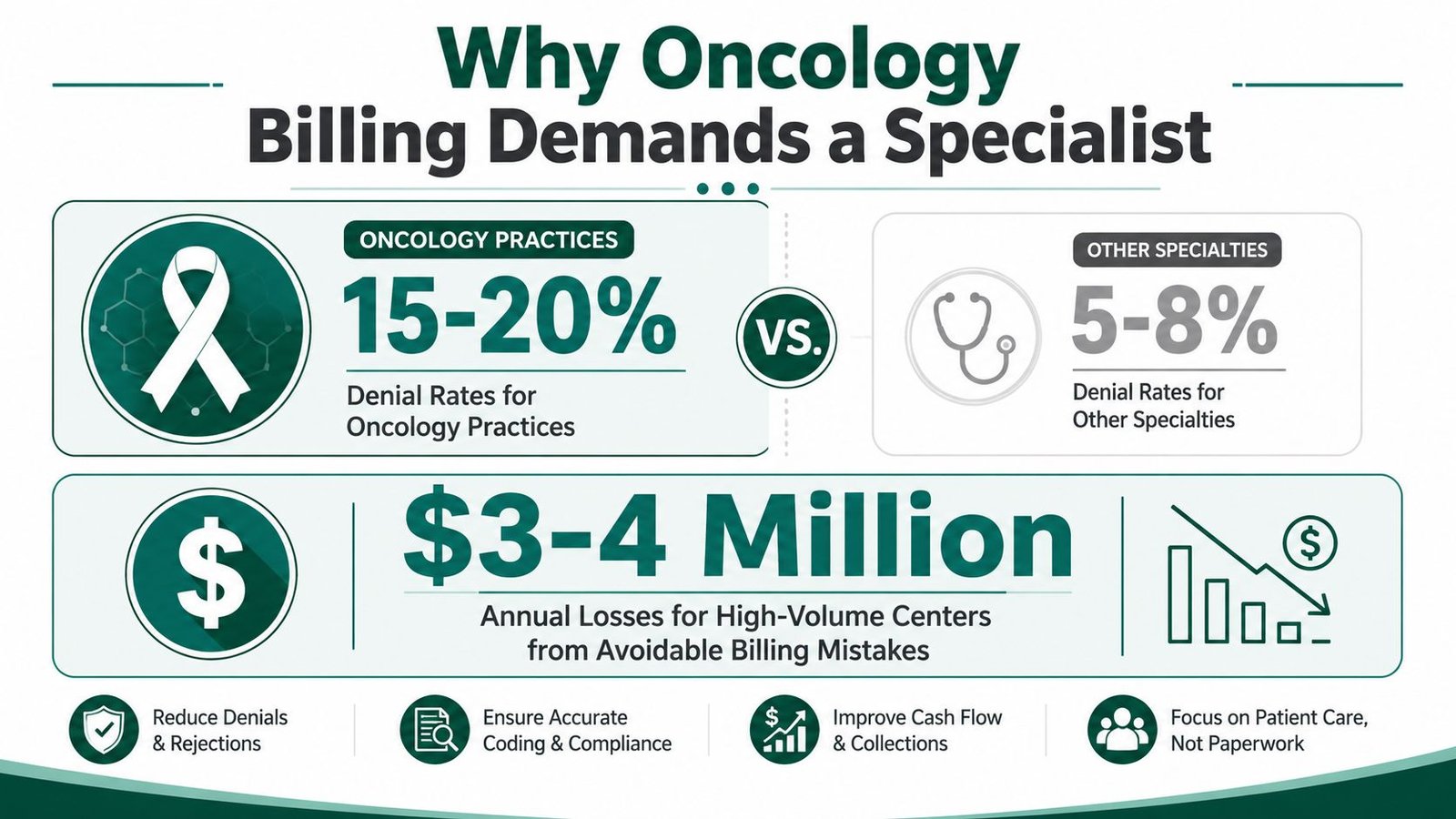
Why Oncology Billing Demands a Specialist
Oncology billing is expensive to get wrong because the denial environment is already stacked against you. One industry source places oncology denial rates at 15% to 20%, and says high-volume centers can lose $3 million to $4 million annually, with 60% of that loss being avoidable (Anexx Med). That's not a nuisance. That's a direct hit to collections, cash timing, and physician compensation.
Why the specialty is structurally harder
Oncology claims move through a maze of ICD-10, CPT, and HCPCS Level II coding, plus drug billing, infusion administration, radiation fractions, and repeated prior authorizations. The practical benchmark set in the source material is simple, keep days in A/R under 35, hold a 98% first-pass clean-claim rate, and keep denials from becoming your operating model (Anexx Med). If your current vendor can't talk in those terms, they're not managing your revenue cycle, they're processing it.
Generalist billers usually fail in predictable ways. They miss recurrence patterns in chemotherapy cycles, mishandle drug units, and treat radiation as if it were standard outpatient procedural billing. That's how a practice ends up writing off revenue it should have collected.
Practical rule: if a vendor can't explain how oncology claims create multiple denial points before submission, they're not ready for your practice.
For a practice owner, the decision isn't whether billing should be outsourced. It's whether the company touching your claims understands oncology's financial mechanics. A generalist may file cleanly enough on easy claims, but oncology doesn't live on easy claims. It lives on repeated, high-value claims where one missing detail changes the entire reimbursement outcome.
If you want a specialty-specific partner built for oncology workflows, start with Happy Billing's oncology billing services. Then compare their answers against your current process line by line.
Specialty Coding Competencies Your Vendor Must Prove
An oncology billing company has to prove it can handle the claim details that change reimbursement, not just the claims that look routine. Drug units, wastage, infusion sequencing, radiation fractions, and trial billing all affect cash. If a vendor cannot explain those mechanics clearly, revenue will leak.
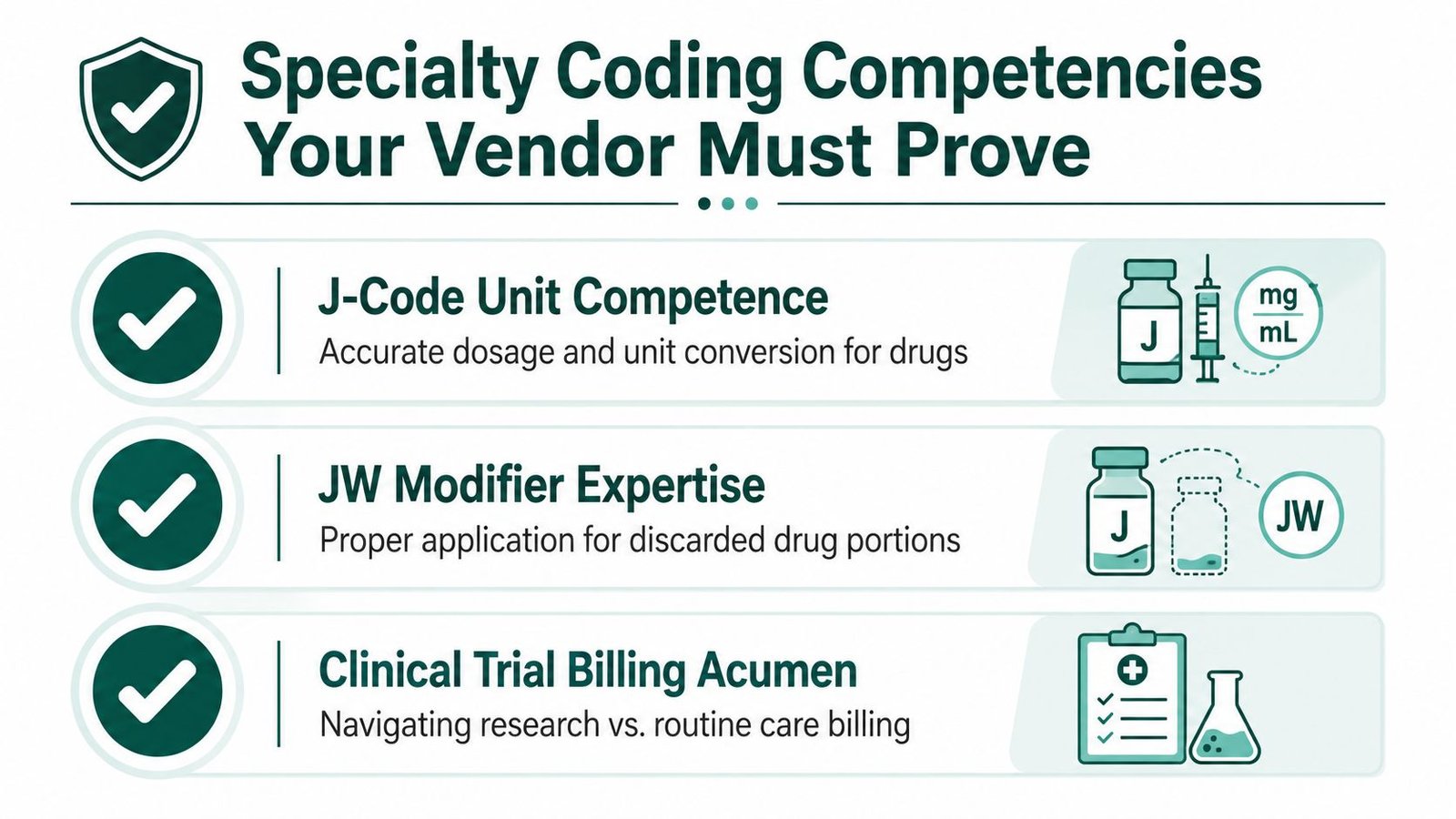
J-Codes, units, and wastage
Start with J-code unit math. Your vendor should show exactly how it validates the drug dose against billable J-code units, because a unit mismatch can trigger denial or recoupment. It should also apply JW correctly for documented wastage, since missed wastage billing leaves the practice eating drug cost that should have been reimbursed.
Ask them how they catch unit errors before a claim goes out. A specialist checks the administered dose, the billable units, and the documentation trail together, then flags the mismatch before the payer does.
Sequential dosing and modifier logic
A competent oncology billing partner also needs to handle Modifier EJ for every dose after the first when sequential medication doses are billed. It should also know there is no CPT code for concurrent administration of multiple chemotherapy drugs, so multiple drugs in the same session must be billed as sequential rather than concurrent (Medusind). That matters because the wrong interpretation turns a payable encounter into a denial.
This is one of the easiest places for generalists to miss revenue. They see multiple drugs, assume the workflow is ordinary infusion billing, and miss the sequencing rule that drives payment.
Documentation that protects reimbursement
Ask about NDCs, payer-specific edits, and NCCI awareness. A real specialist checks the therapy plan, administered units, and drug identifiers before the claim leaves the clearinghouse. It should also separate clinical-trial billable services from sponsor-funded services, because a sloppy split creates compliance risk and lost revenue at the same time.
Radiation has its own trap. The vendor should verify fraction counts before submission, or claims can stall or underpay. For infusion and biologics, it should know how gaps in units, time-based administration, or authorization status cascade into denial.
If a vendor talks about “oncology expertise” but cannot explain wasted drug, sequential dosing, and radiation fraction validation in plain English, it does not have it.
If you are comparing vendors, ask for three real claim examples where they caught a denial before submission. That tells you more than any brochure.
KPIs and Benchmarks That Separate Top Vendors From Average Ones
A serious oncology billing company should give you numbers, not slogans. If they cannot show how their work affects A/R days, denial rate, and collection performance, they are not managing the business side of care.
The scorecard you should demand
A useful benchmark set is straightforward. Strong oncology RCM should aim for a clean claim rate of 95% or higher, with 98%+ as the gold standard, days in A/R under 35, first-pass denial rate below 5 to 7%, appeal turnaround in 7 to 10 days, appeal success rate of 70% or higher, and net collection rate at or above 95% (Healix RCM, RC Billing). Those numbers are not decoration. They tell you whether cash is moving or stalling.
If you want a broader finance lens for vendor scorecards, track professional services KPIs and compare the logic to your own billing operation. The rule is simple, measure throughput, recovery, and leakage, not activity for its own sake.
| KPI | Minimum Threshold | Gold Standard | Why It Matters |
|---|---|---|---|
| Clean claim rate | 95% | 98%+ | Fewer reworks, faster cash |
| Days in A/R | Under 35 | Well below 35 | Shows whether cash is moving |
| First-pass denial rate | Below 5 to 7% | Lower is better | Measures front-end accuracy |
| Appeal turnaround | 7 to 10 days | Faster than that | Keeps denied dollars from aging |
| Appeal success rate | 70%+ | Higher is better | Proves denial management skill |
| Net collection rate | 95%+ | At or above 95% | Tells you what actually lands |
What good pre-bill control looks like
Before a claim leaves the clearinghouse, strong vendors verify demographics, insurance, diagnosis, staging, therapy plan, NDCs, units, and payer-specific edits (RC Billing). That pre-bill scrub matters because underpayments are common in complex infusion billing, and if no one reconciles them right away, they get written off by default.
A vendor that handles oncology well also watches the percent of balances over 90 days. That number shows whether the team is collecting cash or just moving work around on paper.
Bottom line: ask vendors to prove how they work old claims, not just new ones. A high-performing oncology billing partner should show you where delayed cash is sitting, why it is sitting there, and what the team did to move it.
I would ignore any vendor that reports activity without tying it back to cash. Claims submitted are not a KPI. Cash collected is.
If you want a practical benchmark checklist for your own operation, compare your current setup against these medical billing KPIs to track. The right vendor should already know how to work through them.
Pricing Models and Contract Terms That Protect Your Practice
Oncology billing fees should be judged by alignment, not just the headline rate. In a specialty with expensive drugs and repeated authorization work, the cheapest contract can be the most expensive one if it rewards volume instead of recovery.
Which pricing model usually makes sense
The three common structures are percentage of collections, percentage of charges, and flat per-claim fees. For oncology, percentage of collections is usually the cleanest fit because it pushes the vendor to fight denials, chase underpayments, and work infusion reimbursements that often get missed if no one pushes back. A flat per-claim fee can look cheap until you realize the vendor has no reason to spend time on hard denials.
A percentage of charges is usually the weakest option for this specialty. It can disconnect vendor incentives from actual reimbursement and make it too easy for the biller to focus on volume rather than value. If a vendor proposes a low-fee structure, ask what happens when a payer underpays infusion work or when a claim needs multiple appeals.
Contract language that protects revenue
Your agreement should include clear termination clauses, data ownership, transition-out support, SLA guarantees, and audit rights. Tying the SLA to the KPIs from the prior section keeps the contract anchored to outcomes, not activity. Without that, you're buying promise language, not performance.
This is also where automation matters. If the vendor leans on manual ticket chasing for every denial and authorization issue, use autonomous billing ticket resolution as a reference point for what modern workflow support can look like. The question isn't whether automation replaces judgment. It's whether it keeps the team from wasting time on predictable tasks.
Happy Billing's outsource medical billing cost guide is worth comparing against your current spend if you're trying to separate real savings from paper savings. Don't sign a contract that saves a few points on fees while handing the practice all the downside.
The contract should make the vendor accountable for revenue protection, not just claim volume.
If the vendor won't negotiate transition support or data access, walk away. That's a signal they're protecting their own lock-in, not your collections.
Evaluating Technology Integration and Security Posture
Oncology billing vendors need to fit your current EHR and claim workflow, because every extra login, queue, and handoff creates room for missed charges, slower appeals, and sloppy follow-up on infusion claims. If a vendor wants to bolt on a separate system that makes staff work twice, that cost shows up fast in labor and cash flow.
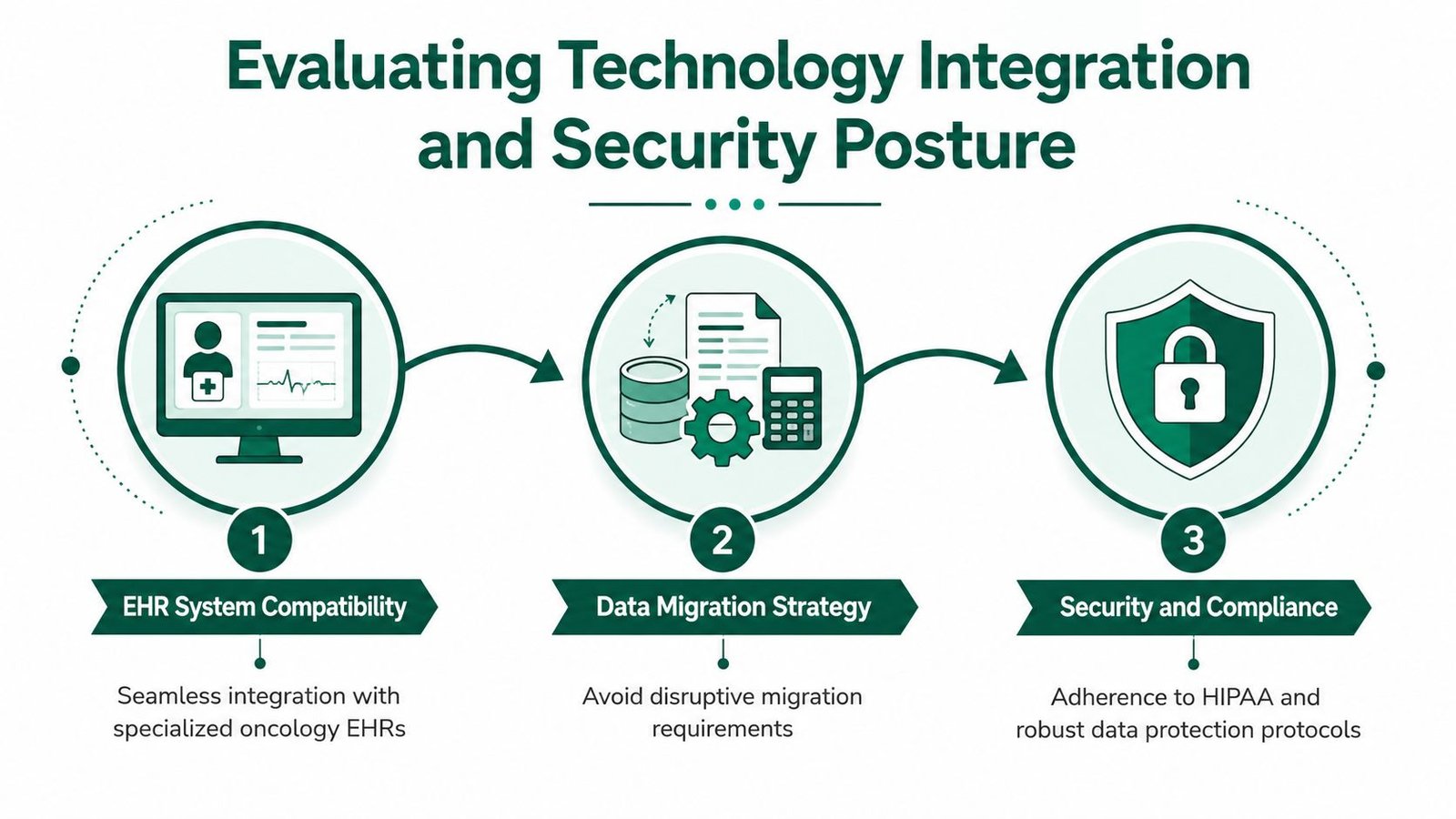
What to verify before onboarding
Ask whether the billing team works inside your existing oncology EHR or requires a separate platform. That matters because prior authorization, infusion coordination, sequential chemotherapy billing, and claim follow-up all get harder when staff has to bounce between systems. The right setup keeps billing close to the clinical record, where J-code units, waste tracking, and charge capture are easier to reconcile.
Use revenue cycle management automation as a benchmark for how much manual work the vendor should be eliminating. CMS policy context noted in the brief points to tighter prior-authorization expectations and more electronic workflow use, so a vendor that still relies on email chains and manual status checks is already behind (CMS policy context noted in the brief). For oncology, that means the team should already know how to keep infusion starts, regimen changes, and payer responses moving without derailing treatment or leaving money stuck in follow-up.
Security questions that deserve direct answers
Your due diligence should include HIPAA compliance, bank-level encryption, a signed business associate agreement, and clear privacy protocols for chemotherapy plans, drug records, and clinical-trial billing. If the vendor handles PHI but cannot explain how access is restricted, logged, and audited, that is a serious problem.
DevArmor's healthtech GRC platform is a useful example of the governance discipline healthcare vendors need when they touch sensitive billing data. Security is a revenue protection issue. One weak control can turn into a compliance event, delay cash posting, and create a denial mess that is harder to unwind than a clean billing error.
Onboarding rule: the first 90 days should prove data flow, denial workflow, and authorization handoff before anyone promises scale.
I want a written transition plan that covers EHR connection, payer setup, denial routing, and claim ownership. If the vendor avoids specifics, they are not ready for oncology's pace, and they are not protecting your margin.
Red Flags and Mistakes That Cost Practices Millions
The worst oncology billing vendors don't look broken at first. They sound polished, talk about “full-service support,” and gloss over the details that protect your margin. That's the trap.

The questions that expose a weak vendor
If they can't explain JW modifier workflows, they don't understand wasted drug recovery. If they can't describe how they reconcile drug acquisition cost against reimbursement, they're blind to buy-and-bill margin erosion. If they're vague about site-of-care payment differentials between physician office and hospital outpatient settings, they're ignoring one of oncology's biggest financial levers (MedPAC background on site-of-care and Part B drug economics).
That site-of-care issue matters because payment isn't identical across settings, and the practice owner needs to know where reimbursement pressure is coming from. Public buyer's guides rarely cover this well, but the economics are real and they shape margin decisions.
The generic-billing mistake
The biggest operational error is treating oncology as generic medical billing. Documentation gaps in units, time-based administration, or authorization status don't stay small. They cascade into denials, delays, and recoupment, especially when a practice depends on repeated infusion cycles and expensive drugs.
You should also ask how the vendor separates clinical-trial billable services from sponsor-funded services. If they can't answer cleanly, they're risking compliance and leaving money on the table at the same time. That's the kind of mistake that doesn't show up until the A/R gets old and the audit letter arrives.
Happy Billing's medical billing company red flags guide is a useful comparison point if you want a practical checklist for spotting sales talk before you sign. Don't buy a generalist dressed up in specialty language.
Red flag: if the vendor's answer to every oncology question is “our team handles that,” keep pressing. You're buying process, not confidence.
Frequently Asked Questions About Oncology Billing Partners
How long does onboarding usually take, and what should the first 90 days look like?
The first 90 days should be about control, not scale. You want clean data mapping, claim flow, denial routing, and authorization handoff settled before anyone starts bragging about volume. If a vendor can't give you a written transition plan, that's a bad sign.
Should we outsource all billing or keep some functions in-house?
Keep clinical charge capture tight in-house, but outsource the revenue cycle work that needs constant denial follow-up, payer nuance, and specialty coding discipline. For an oncology practice, the key question is whether your staff can keep up with drug billing, infusion complexity, and appeal work without creating leakage. If not, a specialist in oncology billing services is the more rational setup.
What if our current vendor is underperforming but the contract hasn't expired?
Start by measuring where the losses are happening, then push for a transition plan that protects data ownership and claim continuity. You don't need to wait for expiry to prepare. Use a focused free billing audit to understand whether the issue is staffing, workflow, or the contract itself.
How transparent should reporting be?
You should see A/R aging, denial reasons, appeal status, underpayment recovery, and net collection trends in a cadence you can use. If the vendor only sends a monthly summary with no claim-level detail, they're not giving you control. You're paying for insight, not a slideshow.
If you want an oncology billing partner that works inside your existing EHR, focuses on denial prevention, and treats A/R like a cash-flow problem instead of an admin task, talk to Happy Billing. Visit Happy Billing and ask for a review of your current oncology billing workflow before another denial cycle turns into write-off.