Master Revenue Cycle Management Automation 2026

Revenue cycle management automation is the use of AI, robotic process automation, and connected workflow tools to move claims, payments, and follow-up work faster from registration to final reimbursement. It matters now because the RCM market reached $102.16 billion in 2024 and is projected to approach $291 billion by 2033, while nearly three-quarters of hospitals had deployed RPA or AI by 2025.
For practice owners, that isn’t a technology story. It’s a cash flow story. The goal is simple: submit cleaner claims, prevent denials before they happen, shorten payment cycles, and stop losing revenue on coding details that should have been caught upstream.
In real audits, the expensive failures usually aren’t dramatic. They’re small misses repeated at scale. An anesthesia claim goes out with the wrong concurrency modifier. A cardiology procedure is billed without the documentation logic a payer expects. A behavioral health visit like CPT 90837 gets scheduled before authorization is fully aligned. An orthopedic post-op E/M slips out during a global period tied to CPT 27447. Manual teams catch some of it. Automated RCM catches more of it consistently, especially when humans review the exceptions that software can’t safely decide on alone.
What Is Revenue Cycle Management Automation
Revenue cycle management automation means using software and workflow logic to handle administrative and financial tasks across the revenue cycle, including registration, eligibility, prior authorization, charge capture, coding review, claim submission, denial routing, payment posting, and A/R follow-up. The point isn’t automation for its own sake. The point is faster cash, fewer preventable denials, and less revenue leakage.
The urgency is obvious. The global RCM market reached $102.16 billion in 2024 and is projected to grow to nearly $291 billion by 2033, with nearly three-quarters of hospitals deploying RPA or AI by 2025, according to RCM market statistics and adoption data.
What automation changes in day-to-day billing
A strong automated setup doesn’t replace billing judgment. It handles the repetitive work that slows teams down and creates avoidable errors.
- Front-end accuracy: Insurance verification, demographic checks, and eligibility validation happen before the visit.
- Mid-cycle control: Rules engines flag missing modifiers, mismatched diagnosis links, and payer-specific documentation gaps before claims leave the system.
- Back-end speed: Payment posting, denial categorization, and work-queue routing move without waiting for someone to touch every account manually.
That’s why practice leaders should think of automation as operating infrastructure, not a side tool. A useful outside reference is this comprehensive guide to AR automation, which helps frame how receivables workflows improve when repetitive handoffs are removed.
Working definition: Good RCM automation doesn’t just process claims faster. It prevents bad claims from being created in the first place.
A practice manager looking for the bigger operational picture can also review this overview of revenue cycle management. The key takeaway is that automation works best when it is tied directly to measurable financial outcomes, not when it’s deployed as a generic “digital transformation” project.
The Core Components of an Automated RCM Engine
An automated RCM engine has four parts that need to work together. If one is weak, the whole system slows down. A claim scrubber without payer logic misses denials. RPA without EHR connectivity creates duplicate work. Analytics without workflow routing gives you dashboards but not action.
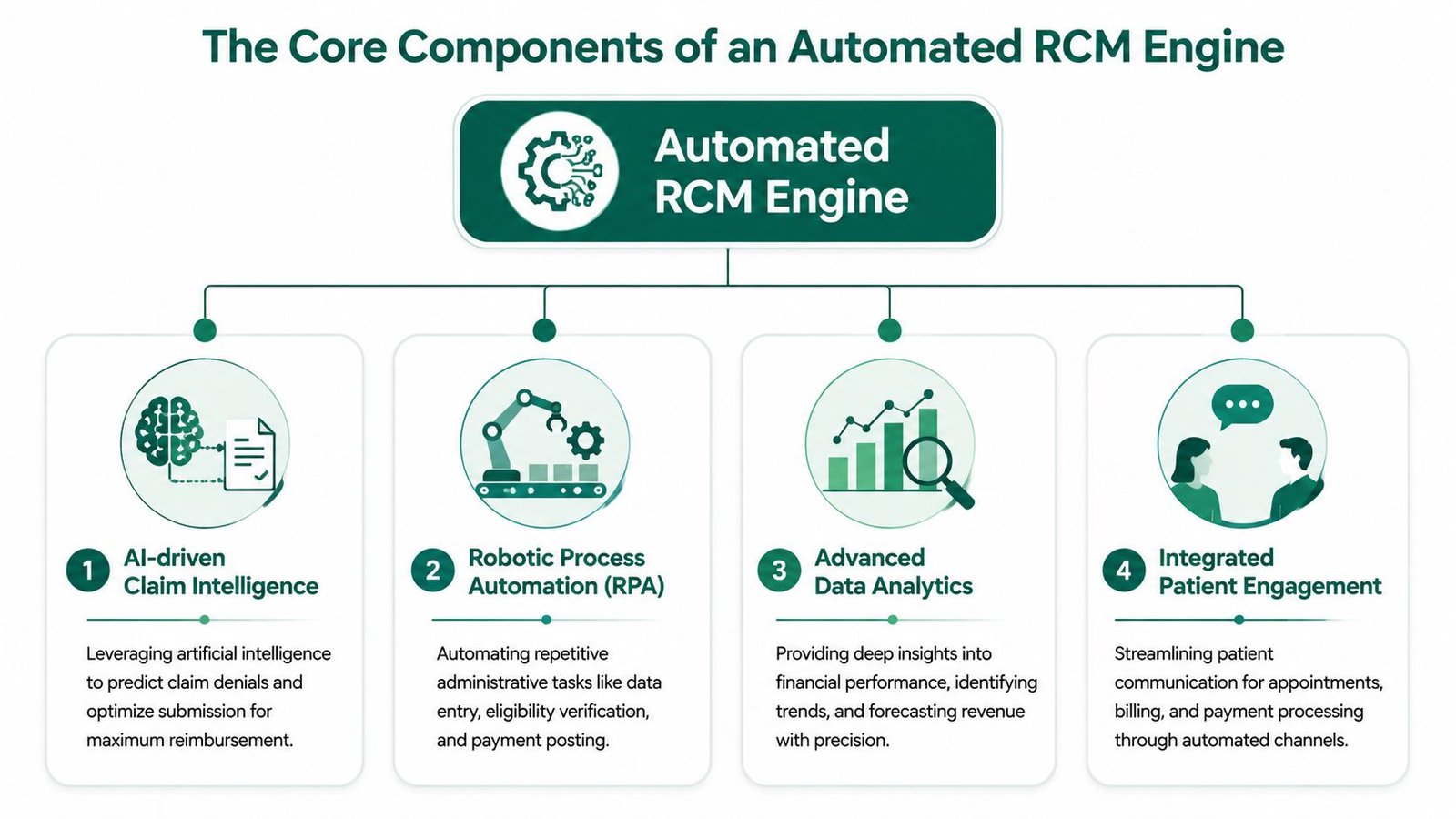
AI-driven claim intelligence
This is the pre-submission control layer. Machine learning reviews historical claim behavior, payer edits, coding patterns, and prior rejections to identify which claims are likely to fail before they are transmitted. One documented example showed overall claim error rates falling from 10.59% to 5%, a 53% improvement, in this analysis of machine learning in RCM automation.
For specialty billing, this matters at the code level.
- Anesthesiology: The system can flag a missing QK, QX, AA, or AD modifier when the staffing pattern and concurrency record don’t match the billed claim.
- Cardiology: It can identify when a cath lab report tied to CPT 93458 is likely to trigger a bundling or documentation problem.
- Orthopedics: It can stop an E/M claim when the visit appears related to a recent procedure inside the global period and needs modifier review such as 24, 25, 57, or 79 depending on the scenario.
- Behavioral health: It can block submission when CPT 90837 lacks the authorization linkage or payer-required visit documentation path.
Robotic process automation for repetitive work
RPA handles the high-volume tasks that don’t need clinical judgment but do require precision. Bots can move data between portals, verify coverage, check claim status, update account notes, and queue follow-up tasks.
This matters even outside core medical billing. Teams that also process finance paperwork often look at tools that automate invoices with PDF AI because the same principle applies: repetitive document handling should be structured, not manual.
Claims staff shouldn’t spend their day copying data from one screen to another. They should spend it fixing exceptions that put cash at risk.
Advanced data analytics
Analytics are what turn automation into management control. A useful system shows denial patterns by payer, by CPT, by modifier, by rendering provider, and by location. It should also separate front-end failures from coding failures and payer behavior.
The most useful dashboards answer practical questions:
- Which payer is rejecting prior auth-dependent services most often?
- Which CPT-modifier pairs are generating avoidable edits?
- Which providers have the highest hold rate before claim release?
- Which denial categories are worth appealing, and which need upstream correction?
A deeper look at those capabilities appears in this resource on technology for revenue cycle.
Integrated patient engagement
Patient access is part of automation whether a practice likes it or not. Registration errors, outdated insurance, unsigned consents, and uncollected balances all create downstream billing friction. Automated reminders, digital intake, benefit prompts, and pre-service financial workflows reduce the number of claims that fail for front-end reasons.
The important distinction is this: a true RCM engine connects patient-facing activity to billing outcomes. It doesn’t leave registration in one system, coding in another, and A/R in a third with no shared accountability.
Key Business Benefits Beyond Basic Cost Savings
McKinsey reports that automation can reduce the cost to collect by 15% to 30% in parts of the revenue cycle, but the stronger financial result is usually faster cash conversion and fewer preventable denials, not headcount reduction alone, as outlined in McKinsey's analysis of automation in healthcare operations.

Faster movement from claim to cash
Speed matters because every day in A/R has a financing cost. Practices feel it in payroll pressure, delayed purchasing, and rising follow-up volume.
Automation shortens the path between charge entry, claim submission, ERA posting, denial identification, and staff action. In a manual workflow, a CO-197 or CO-16 denial may sit until remits are posted and work queues are updated. In an automated workflow, the remit posts the same day, the denial reason maps instantly, and the account is routed to the correct owner with the required documents or correction steps attached.
That timing changes collections behavior. Teams stop spending mornings sorting yesterday's paper and portal downloads. They work current exceptions while the encounter is still familiar and medical records are easy to retrieve.
Leakage prevention at the code level
Revenue leakage rarely shows up as one dramatic error. It comes from repeatable misses that survive because nobody checks them at scale.
The expensive version is specialty-specific. In orthopedics, post-op E/M services tied to a 90-day global often go out without modifier 24 or 25 when documentation supports separate billing. In cardiology, claims pairing stress testing or imaging services can fail because diagnosis linkage does not support medical necessity under the payer's LCD or NCD edits. In behavioral health, session-based coding such as 90837 can fail against authorization units or place-of-service rules before the claim ever reaches adjudication.
Anesthesia is a good example of why generic edits are not enough. A claim with 00840 and modifier QK has to align with the staffing model, concurrency documentation, and time reporting. If the medical direction record supports QX instead, the variance is not a clerical issue. It changes reimbursement and raises audit risk.
Automation catches those patterns before submission. It checks CPT, modifier, diagnosis pointer, authorization status, and payer policy in the same workflow. That is where margin is protected. For a broader review of the operational and financial upside, see this breakdown of revenue cycle management benefits.
Proactive denial management
Strong automation reduces denials by preventing known failure points, then prioritizing the remaining claims by dollar value and filing deadline. That is a better operating model than treating every rejection the same.
I look for systems that separate hard stops from soft warnings. Missing eligibility on a high-dollar infusion claim should stop release. A low-risk formatting issue can route to review without holding the batch. The same logic applies to telehealth billing, where payer rules on modifier 95, POS 02, and POS 10 can change reimbursement or trigger denials if the encounter setup is wrong. Practices that rely on remote intake and virtual follow-up also need patient communication tools that fit compliance requirements, including the best HIPAA video for healthcare.
The practical outcome is simpler than the software pitch. Fewer claims enter avoidable appeals. More cash arrives on the first pass. Denial teams spend time on recoverable balances instead of preventable rework.
Specialty-Specific Automation Blueprints
Generic automation fails when billing rules become specialty-specific. That failure is expensive. A HFMA survey cited in AHIMA coverage found that 76% of healthcare leaders named denials management a top time-waster, and 51% struggled with process complexity tied to specialty variance, as discussed in this piece on revenue cycle automation and denials complexity.

Anesthesiology
Anesthesia billing punishes weak automation because the claim is built from several moving parts: base units, time units, physical status modifiers, concurrency rules, and medical direction modifiers. CMS rules and payer policies make modifier accuracy imperative.
A strong workflow should do all of the following before claim release:
- Validate anesthesia CPT selection: Cases such as 00840, 00567, or other anesthesia code families must align to the operative service and documentation.
- Check modifier logic: Modifier pairs like AA, QK, QX, QY, and AD should match the staffing model documented in the anesthesia record.
- Review concurrency timing: Overlapping start and stop times need automated comparison against provider assignment records.
- Confirm qualifying circumstances: Codes such as 99100 or physical status modifiers like P3 should be supported in the chart.
Pure automation often misses edge cases. For example, the timing may be clean, but the direction note may not support the modifier combination. That’s where a human auditor still matters.
Cardiology
Cardiology billing breaks when systems treat procedural reports like simple charge tickets. They aren’t. A claim built around CPT 93458 requires tight alignment between the procedure note, contrast, imaging interpretation, access details, and payer bundling rules.
What works:
- An AI review layer that reads the finalized report and flags likely bundling problems.
- Edits that compare diagnosis linkage to the procedure family before transmission.
- Queueing of high-risk interventional claims for coder review instead of auto-release.
What doesn’t work:
- Blindly trusting chargemaster output.
- Allowing duplicate interpretations or mismatched professional and technical billing paths.
- Running a generic scrubber with no cardiology-specific edit library.
Mental health and behavioral health
Behavioral health collections are often front-end dependent. A therapy code like 90837 may be clinically valid and still become an avoidable denial if authorization dates, rendering provider credentials, visit limits, or telehealth conditions don’t line up with payer requirements.
A practical automation setup should:
- Verify authorization status before scheduling or at least before claim creation.
- Match the rendered service date to the approved authorization window.
- Check whether payer policy requires modifiers such as 95 for telehealth.
- Hold the claim if diagnosis, place of service, or provider type creates a policy mismatch.
For virtual care operations, practices also need compliant communication tools when staff coordinate authorizations and intake. Many groups compare options such as this best HIPAA video for healthcare when telehealth and pre-service workflows intersect.
Orthopedics
Orthopedic billing usually leaks revenue through global-period confusion, procedure hierarchy mistakes, and post-op visit misclassification. A total knee arthroplasty billed as CPT 27447 is a classic example. If the follow-up visit is related and inside the global period, billing a separate E/M without proper support creates exposure. If the visit is unrelated, the modifier decision must be documented and defensible.
Automation should track:
- Procedure date and global window
- Laterality and site details
- Subsequent procedures that may need modifier review
- Post-op E/M activity that should be held for coding review
Orthopedic groups that want a deeper specialty lens can review this orthopedic revenue cycle management guide. It’s the kind of specialty-specific operating model generic RCM content usually skips.
A specialty practice doesn’t need more automation. It needs the right edits in the right order, with humans reviewing the claims software shouldn’t guess on.
Practices that span multiple service lines should also explore the specialties overview to compare workflow needs across anesthesia, cardiology, behavioral health, orthopedics, and other high-variance areas.
Implementing RCM Automation A Phased Roadmap
Most automation rollouts fail for one reason. Leadership buys software before mapping the workflow failures that software is supposed to fix.
Phase one, audit the revenue cycle before touching technology
Start with the claims that create the most rework. Look for recurring failures by payer, CPT family, modifier, and staff handoff. In anesthesia, that may be concurrency and time capture. In behavioral health, it may be authorization drift. In orthopedics, it may be post-op E/M billing. In cardiology, it may be cath or imaging documentation mismatches.
Build the baseline around operational facts you can measure internally:
- Front-end defects: registration errors, inactive coverage, missing referral or auth
- Mid-cycle defects: coding edits, modifier mismatches, missing documentation
- Back-end defects: denial posting delays, untimely follow-up, weak appeals routing
Phase two, integrate with the EHR you already have
Successful automation depends on integration with existing EHR and billing systems. RPA bots need to work across those systems for insurance verification, claims submission, and payment posting because siloed systems increase data error risk and block real-time visibility, as explained in this overview of RCM automation infrastructure.
That point matters more than most vendors admit. If the tool can’t operate inside your current workflow, staff will create side spreadsheets and manual workarounds within weeks.
A practical implementation standard is simple:
- Don’t force double entry
- Don’t create a second work queue outside the EHR unless there’s a clear reason
- Don’t automate a bad process without redesigning ownership first
Phase three, redesign staff roles
Automation should change who does what. It shouldn’t just make people click faster.
Front-desk staff move toward eligibility exception handling. Billers move from repetitive posting toward denial prevention and payer analysis. Coders review the claims that need judgment rather than scrubbing every low-risk claim by hand.
Implementation rule: If your best billers are still doing keyboard work that a bot can do, your rollout isn’t finished.
Phase four, monitor and tune continuously
RCM automation isn’t a one-time install. Payers change edits. CMS rules shift. Staff habits drift. The workflow needs active management.
Use a practical operating checklist that covers front-end, coding, claims, remits, denials, and A/R ownership. This revenue cycle management checklist is a good reference for that kind of ongoing control structure.
The strongest rollouts start narrow. Pick one high-friction process, automate it well, prove the workflow, then expand. Practices that try to automate everything at once usually end up with fragmented queues and unclear accountability.
Measuring Success and Choosing Your RCM Partner
MGMA has reported medical group median days in A/R in the low 30s for stronger performers, and HFMA has long treated cost to collect as a core revenue cycle benchmark. Those numbers matter because weak automation often looks busy while cash still arrives late, denial rework stays high, and underpayments sit untouched.
A usable scorecard starts with financial outcomes. If a vendor leads with click reduction, bot volume, or generic AI claims, press for the measures that affect cash flow, denial rate, and net collection.
The KPIs that matter
Track a small set of numbers your controller, billing manager, and physician owners can all tie back to revenue.
- First-pass resolution rate: Measure the share of claims paid without manual rework. CMS publishes national Medicare fee-for-service claims processing rates, but for practice-level automation, the useful question is simpler. How many claims leave your system clean and stay clean?
- Days in A/R: MGMA DataDive benchmarks are widely used by practices to compare payment speed across specialties and organization sizes. This is still one of the clearest indicators of whether automation is reducing touches or just shifting work between queues.
- Net collection rate: HFMA uses this metric to assess how much allowed revenue the practice collects after contractual adjustments. It exposes underpayment leakage better than gross collection numbers.
- Denial rate by category: CAQH has documented the administrative burden tied to manual revenue cycle work in its index reporting. Use denial rate at the payer, CPT, and reason-code level, not as one blended percentage.
- Cost to collect: HFMA and MGMA both treat this as a management metric worth watching over time, especially after staffing changes or a new automation rollout.
Those metrics become more useful when they are broken down by specialty-specific failure points. In orthopedics, I want to see denial rates on global-package edits after procedures like 27447. In behavioral health, I want authorization-related denials and medical necessity edits on 90837 separated from simple registration errors. In cardiology, I want edit and denial patterns on 93458 reviewed alongside modifier use and NCCI conflicts. A vendor that only reports one aggregate denial number is hiding the root cause.
RCM Automation KPIs Manual vs. Automated Benchmarks
| Metric | Typical Manual Process | Automated Benchmark | Impact |
|---|---|---|---|
| First-pass resolution rate | Higher rework volume and more staff touches before payment | Higher clean submission and fewer corrected claims | Faster reimbursement and lower avoidable denials |
| Net collection rate | Revenue leakage from missed follow-up, write-offs, and underpayment gaps | Tighter recovery of allowed revenue | Stronger cash realization |
| Cost to collect | More labor tied to repetitive verification, posting, and status checks | Lower labor intensity per dollar collected | Better margin control |
| Eligibility and authorization exception rate | Front-end errors found after claim submission | More issues caught before DOS or before claim drop | Less downstream rework |
| Days in A/R | Slower cash conversion from posting lag and inconsistent follow-up | Shorter payment cycle and cleaner aging buckets | Better cash flow stability |
The table matters only if the reporting is drilled down far enough to manage. A/R by itself is too blunt. Review aging by payer, by location, by rendering provider, and by denial reason. Review denials by CARC and RARC, not just by a vendor-defined label like "coding" or "registration."
What to look for in a partner
Start with specialty competence.
Ask direct questions. How does the platform flag medical direction versus medical supervision in anesthesia when modifiers QK, QX, and QZ affect reimbursement logic? How does it identify behavioral health authorization gaps before billing 90837? How does it handle global surgery edits on 27447, including post-op visit charge suppression and modifier review? How does it catch cardiology claim conflicts around 93458, modifier 59, and NCCI edit pairs?
Then test workflow fit inside the systems your staff already use. If billers have to live in a separate queue all day, productivity drops and ownership gets blurry. I look for tools that write back to the PM or EHR, preserve audit trails, and route exceptions to the right role without forcing duplicate work.
Require human review for judgment calls. Automation should clear routine edits, post standard remits, and route low-risk exceptions. It should not guess through documentation ambiguity, modifier disputes, or payer-specific reimbursement logic that changes by contract.
Check compliance controls next. HIPAA access rules, audit logging, role-based permissions, BAAs, and documented PHI handling procedures need to be in place before a single live claim runs through the system.
Finally, define accountability in writing. Who updates payer rules. Who owns denied claims by aging bucket. Who reviews underpayments against contracted rates. Who monitors CARC trends after a payer policy change. If those answers are vague during the sales process, the post-go-live operating model will be worse.
Choose the partner that can walk through your top denials at the CPT, modifier, and payer-rule level, then show exactly how the workflow reduces them. That is the standard that improves cash, not a polished dashboard.
Frequently Asked Questions about RCM Automation
Does RCM automation replace my billing staff
No. It should replace repetitive tasks, not experienced judgment. Staff still need to manage exceptions, review specialty-specific coding issues, escalate payer disputes, and oversee documentation alignment. The strongest setups move staff into higher-value work instead of asking them to manually post, rekey, and chase every routine account.
Which specialties benefit the most from revenue cycle management automation
The biggest gains usually show up in specialties where coding rules, modifiers, global periods, and authorization workflows are hard to manage manually. Anesthesiology, cardiology, orthopedics, pain management, and behavioral health are common examples because small billing mistakes in those areas create outsized denial risk.
Can automation work without replacing the EHR
Yes, if the platform is built to operate inside existing workflows. That’s the practical standard. Bots and workflow tools should interact with your current EHR, billing system, and payer portals without forcing a full migration just to automate eligibility, submission, posting, and follow-up.
What should a practice audit first before adopting automation
Start with denial categories, payer-specific edits, missing authorization patterns, posting delays, and claims that require repeated staff touches before payment. At the code level, audit your highest-volume and highest-value procedures first. In many groups, that quickly reveals where the bottleneck lies in front-end intake, coding logic, or back-end A/R execution.
If your practice wants tighter specialty edits, faster cash flow, and a billing team that works inside your existing systems instead of around them, Happy Billing is built for that model. The team combines AI-driven workflows with human auditors for high-stakes specialties, helping practices improve clean claims, control denials, and keep A/R moving without an EHR migration.