Oncology Billing Services: The Practice Owner’s Playbook
A typical oncology practice running sub-35 days in A/R, 95%+ net collections, and 13%+ denial rates is leaving roughly $640K of denied drug charges on the table per year, and oncology billing services exist to plug those specific leaks. In plain terms, if your infusion and radiation revenue is drifting past those marks, the problem isn't “billing overhead,” it's cash stuck in payer edits, drug-unit mismatches, and claims that never should have gone out dirty.
Most owners can feel the drag before they can name it. Checks arrive late, denials pile up around high-cost J-code drugs, and the front office starts treating prior authorization like a fire drill instead of a workflow. That's where specialty oncology billing earns its keep, by tightening the exact claim steps that decide whether your practice gets paid now or waits another month.
What Oncology Billing Services Do for Your Practice
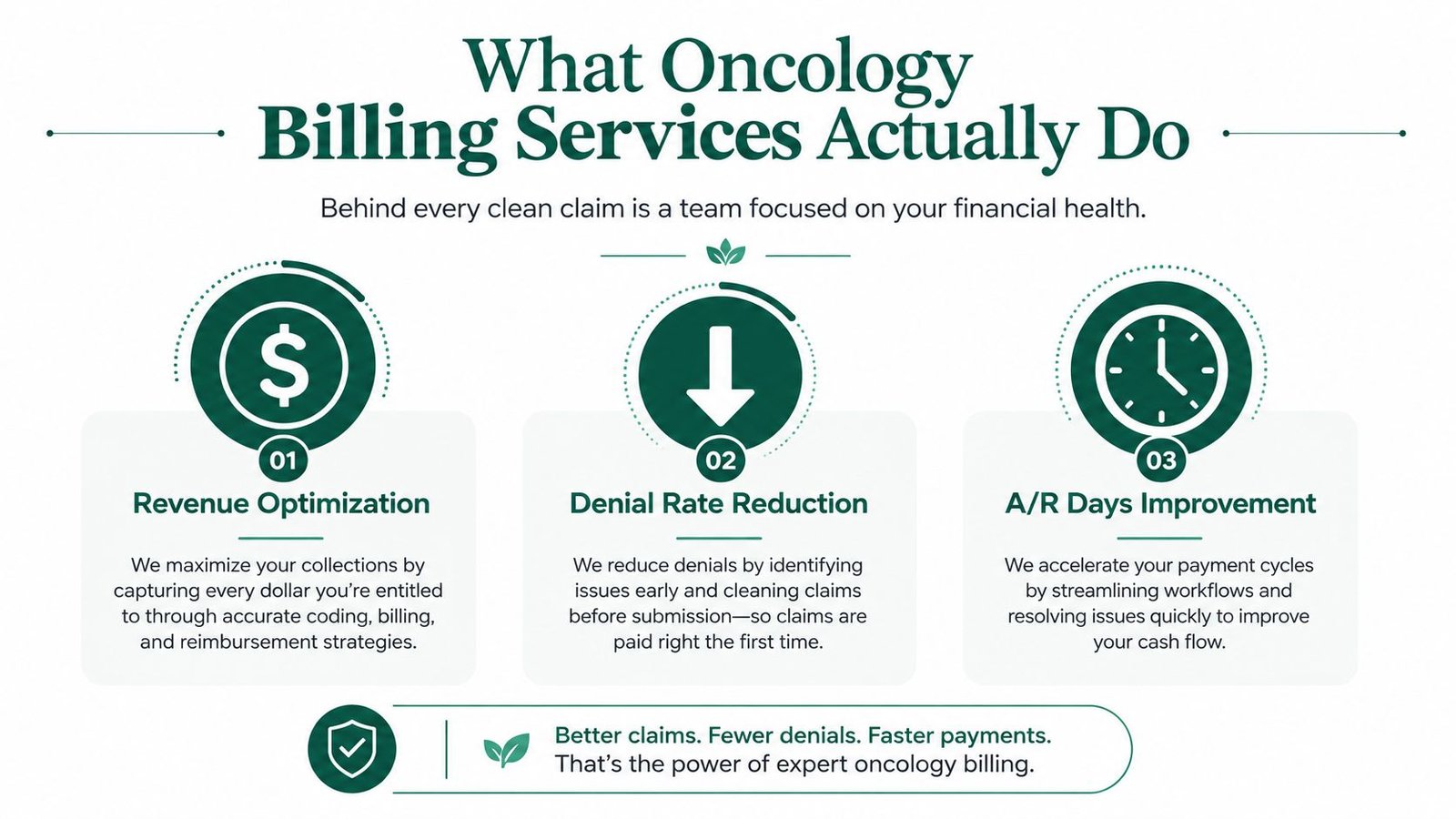
Oncology billing services keep cancer care cash from leaking out through drug denials, radiation errors, and slow claim follow-up. They are specialty RCM workflows built to protect A/R days, denial rate, and the high-value claims that move the bottom line.
The financial stakes show up in the benchmark data. A specialty report put oncology at 45.2 median AR days, 13.8% denial rate, 93.0% clean claim rate, and 87.5% net collection rate (benchmark report). That sits well above the commonly used under-35-day AR target, which means a practice with weak billing control leaves more cash stuck in accounts receivable. Every extra day in A/R is money the practice cannot use.
Practical rule: If your oncology billing team cannot explain where denials are coming from by drug, service line, and payer, they are not managing revenue. They are reporting the loss after it already happened.
The service should be judged by what it gets paid on time. It gets drug charges submitted with the right units and authorization. It keeps radiation claims from getting clipped by documentation gaps. It closes the loop on appeals, posting, and follow-up before the claim ages into bad debt.
Drugs and biologics account for most of the submitted medical oncology charge volume in the Medicare-focused benchmarking work, so a mistake there is not a small clerical miss. It is real money leaving the practice. That is why a specialty billing partner has to be fluent in the claim details that decide payment, not just in posting and remittance.
For a plain-language overview of the role behind the scenes, see this internal resource on what medical billers do.
The Five Workstreams Inside an Oncology Billing Service
The easiest way to judge an oncology billing service is to ask what it owns in production, not what it claims in a brochure. In a real practice, there are five revenue lanes that matter, and each one can either be controlled tightly or leaked. If a vendor only handles claims submission, you're still carrying the risk on the front end and the cleanup on the back end.
Drug billing and infusion charge capture
This is the biggest lane because oncology runs on high-cost infused and injected drugs. Practices lose money when chair time, wastage, and administered units are not captured cleanly at the time of service. The financial damage usually doesn't show up as one giant failure, it shows up as lots of small underpayments that never get corrected.
Keep this in mind: if the chart shows a drug was given but the claim doesn't show it with the right billable structure, the practice has already given away margin.
Radiation claims and component splits
Radiation billing needs a different level of discipline. Separate capture of simulation, treatment planning, and delivery components matters because payers expect those items to be documented and billed correctly at the line level. If your team treats radiation like a generic procedure, you'll see avoidable denials and underpayment.
Laboratory and imaging charges
These charges can look routine, which is exactly why they get missed. An oncology billing team should connect diagnostic work to the treatment episode so that supporting services aren't left off the claim or coded in a way that triggers bundling issues. The revenue impact is often less dramatic than infused drugs, but the leakage is still steady.
Program tracking and quality-based reporting
If your practice participates in value-based oncology programs, those rules need to be handled like revenue work, not admin side work. Missed reporting doesn't just create compliance friction, it can affect the money tied to participation. Owners should ask vendors what they track, who reviews it, and how exceptions get escalated.
Prior authorization and patient responsibility
This lane starts before treatment begins. If the authorization isn't in place, the treatment can still happen, but payment risk shifts onto your practice. That's why revenue cycle management basics matter here, because oncology cash flow depends on front-end control as much as claim follow-up.
The point is simple. A real oncology billing service owns more than claim submission. It owns the revenue chain from authorization to final payment, and every missing handoff costs you days in A/R.
The Codes That Make or Break Oncology Reimbursement
Oncology reimbursement lives and dies on code order, drug specificity, and modifier discipline. If your team gets the coding stack wrong, the payer does not pay “almost right.” It pays less, delays payment, or denies the claim outright. The codes that matter most are the ones that decide whether a complex infusion encounter gets recognized as payable work.

Infusion and administration codes
The core CPT codes that show up again and again are 96413 for the initial hour of chemotherapy infusion, 96415 for each additional hour, 96365 for initial therapeutic infusion, and 96360 for initial hydration infusion (code guidance). These are not just coding references. They are payment gates, and one wrong selection can turn a paid infusion into a denial or a lower allowed amount.
If a practice mis-sequences them, the payer can price the encounter incorrectly. If the administration hierarchy is wrong, the claim may get bundled or rejected. That means chemotherapy first, therapeutic infusion second, hydration last (infusion hierarchy rule). Get that order wrong, and you hand the payer an easy reason to cut the claim.
Modifiers that preserve payment
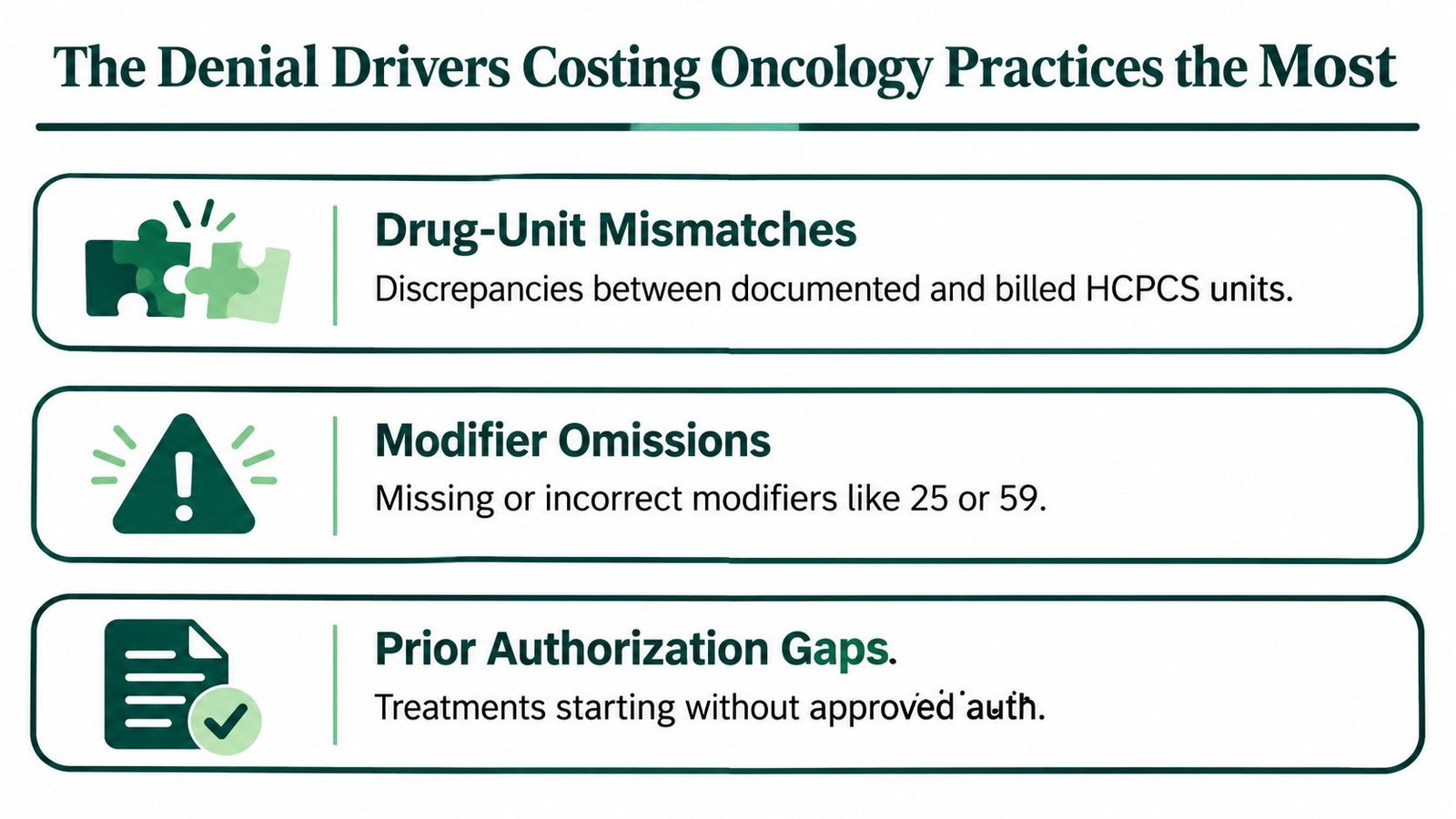
Modifier 59 is used for distinct procedural services, and modifier 25 supports a separately identifiable E/M visit when it exists (modifier guidance). If those modifiers are missing, the payer can bundle work you already performed. That is direct revenue loss, not a documentation style issue.
Your billing team also needs to know when modifier 25 belongs on the same date as infusion services, because that is where office visit dollars disappear. If the E/M is real and separately documented, the modifier keeps it payable. If it is slapped on without support, the claim gets challenged and the practice burns time on rework. The clean way to manage that risk is to follow the modifier guidance and document the visit in a way that stands on its own.
Owner takeaway: if your claims team cannot explain when 25 belongs on the same date as infusion services, you are probably giving away E/M revenue.
Drug specificity and NDC reporting
For infused and injectable drugs, payer submissions often require the National Drug Code, the unit of measure, and the quantity administered (NDC reporting guidance). That matters because oncology drugs are high-cost and payer systems are built to catch mismatches. A wrong unit or missing NDC can stall cash on the most expensive line in the claim.
The same discipline applies to the drug line itself. If the J-code is right but the NDC data is incomplete, the payer still has the power to delay or deny. Use the coding section above as the standard, then have your team audit every infusion claim against it before submission. If you want a vendor that understands this stack, ask them to walk through one infusion encounter from check-in to paid claim using real codes, not generalities. If they stumble on 96413, 96415, 96365, 96360, 59, 25, and NDC logic, they are not ready for oncology. For teams comparing systems, the EkagraHealth AI claims management guide helps show how claims tools should support this work in practice.
The Denial Drivers Costing Oncology Practices the Most
The biggest denial drivers in oncology look small on paper and get expensive fast. A few wrong units, a missing modifier, or an authorization miss can turn a clean claim into days of delay and a write-off risk on high-dollar therapy. That is why denial management in this specialty has to be tighter than generic follow-up.
Where the money slips
Drug-unit mismatches happen when the documented administered amount does not match the billed HCPCS units. In oncology, that is where real money gets lost, because many regimens run through expensive J-code drugs and the unit calculation decides how much the practice keeps. If the claim says one thing and the chart says another, the payer has a clean reason to deny or downcode.
Missing or wrong NDC data creates the same kind of damage. For practices billing infused and injected drugs, the submission has to include the correct NDC number, unit of measure, and quantity administered, as covered in the coding section above. Miss any part of that stack and reimbursement on the highest-dollar line in the claim slows down.
Prior authorization gaps are worse because they are avoidable. Oncology workflows often need authorization before treatment begins, and once the patient is in the chair, the practice is exposed if the payer decides the service was not authorized. That is cash sitting at risk, not a paper problem.
Infusion sequencing mistakes create another avoidable loss. If a payer expects chemotherapy first and the claim is built in the wrong order, reimbursement can price incorrectly. That problem shows up often enough that the billing team should audit it every week, not wait for remittance to expose it.
Radiation documentation shortfalls can be even uglier. In a radiation oncology analysis citing CMS CERT data, 36% of sampled claims were improper in 2023, extrapolating to $330 million in charges nationwide, and the article links much of that to insufficient documentation (radiation billing analysis). That is the kind of leakage owners feel in cash flow, not just on a compliance dashboard.
If you want a practical external reference on claim workflow and denial handling, the EkagraHealth AI claims management guide shows how claims tools are being positioned to reduce rework.
For a specialty-focused operational view, review this guide on medical billing denial management. That is where owner attention belongs first, because denials are the fastest way oncology practices drift past the A/R target.
Regulatory and Compliance Layers You Cannot Ignore
Oncology billing doesn't fail because one rule was missed. It fails because several rules overlap and nobody owns the intersection. CMS coverage policies, NCCI edits, LCDs/NCDs, HIPAA, and payer-specific prior authorization rules all have to line up before the claim is clean.
The practical mistake owners make is treating compliance as a back-office checkbox. It isn't. If the diagnosis code doesn't support medical necessity under the relevant coverage policy, the payer can deny the claim after treatment is already delivered. That means your clinical documentation, coding, and authorization process need to be aligned before the first unit is billed.
What this means in real operations
A generic RCM workflow won't hold up here because the same service can be covered differently by different payers. One payer may want tighter diagnosis linkage. Another may expect documentation in a different format. The team has to know the local rules, the national rules, and the payer's own edits at the same time.
HIPAA is part of that control stack too. Oncology billing teams handle sensitive diagnosis and treatment data, so security can't be an afterthought. If a vendor is casual about access control, audit trails, or PHI handling, I'd walk away.
Practical rule: if your billing partner can't explain how medical necessity, prior auth, and claim submission fit together for the same encounter, they're not reducing compliance risk. They're moving it around.
If your practice also tracks value-based oncology programs, that layer has to be watched separately. Missed reporting isn't just administrative noise. It can create avoidable exposure when the payer or program reviewer checks whether the practice met the required workflow.
Specialty-trained auditors matter here because they catch the mismatches that generic coders miss. The goal isn't perfect paperwork for its own sake. It's fewer denials, fewer audits, and faster money.
Outsourcing vs In-House: The ROI Math
The wrong question is, “What does billing cost?” The right question is, “How much revenue are we leaking while we keep this in-house?” In oncology, that difference shows up in days to payment and dollars lost on high-value claims.
An internal team has to stay current on J-codes, infusion sequencing, denial follow-up, prior authorization, modifier use, and payer-specific edits. That is a heavy labor mix to maintain inside the practice. A specialty vendor usually prices against collections, so the real test is simple. Do they tighten clean claims, cut avoidable denials, and shorten A/R enough to justify the fee?
Use the same 2026 benchmarks shown above as the comparison point, not as a trophy. If your numbers sit far from that range, the billing model is costing you cash somewhere in the workflow.
For owners comparing operating models, review in-house versus outsourced billing tradeoffs before you assume internal staffing is cheaper. The fee line can look smaller than a vendor contract, but that view ignores rework, delay, and missed follow-up. A practice that keeps denials open for weeks is paying twice, once in labor and again in lost cash flow.
That is why I do not treat outsourcing as a staffing decision. I treat it as a leakage decision. If a vendor can protect the claim on the front end, work denials fast, and keep the drug and infusion claims clean, the practice keeps more of what it earns.
If you want a simple pricing sanity check, compare AgentStack plans and look at how clearly service tiers are defined. Billing partners should be just as transparent about scope, turnaround, and ownership. One option in the market is Happy Billing, which works inside your existing EHR and focuses on claim velocity, denial prevention, and A/R recovery. That matters if you want better oncology cash flow without forcing a system migration.
How to Choose an Oncology Billing Partner Without Getting Burned
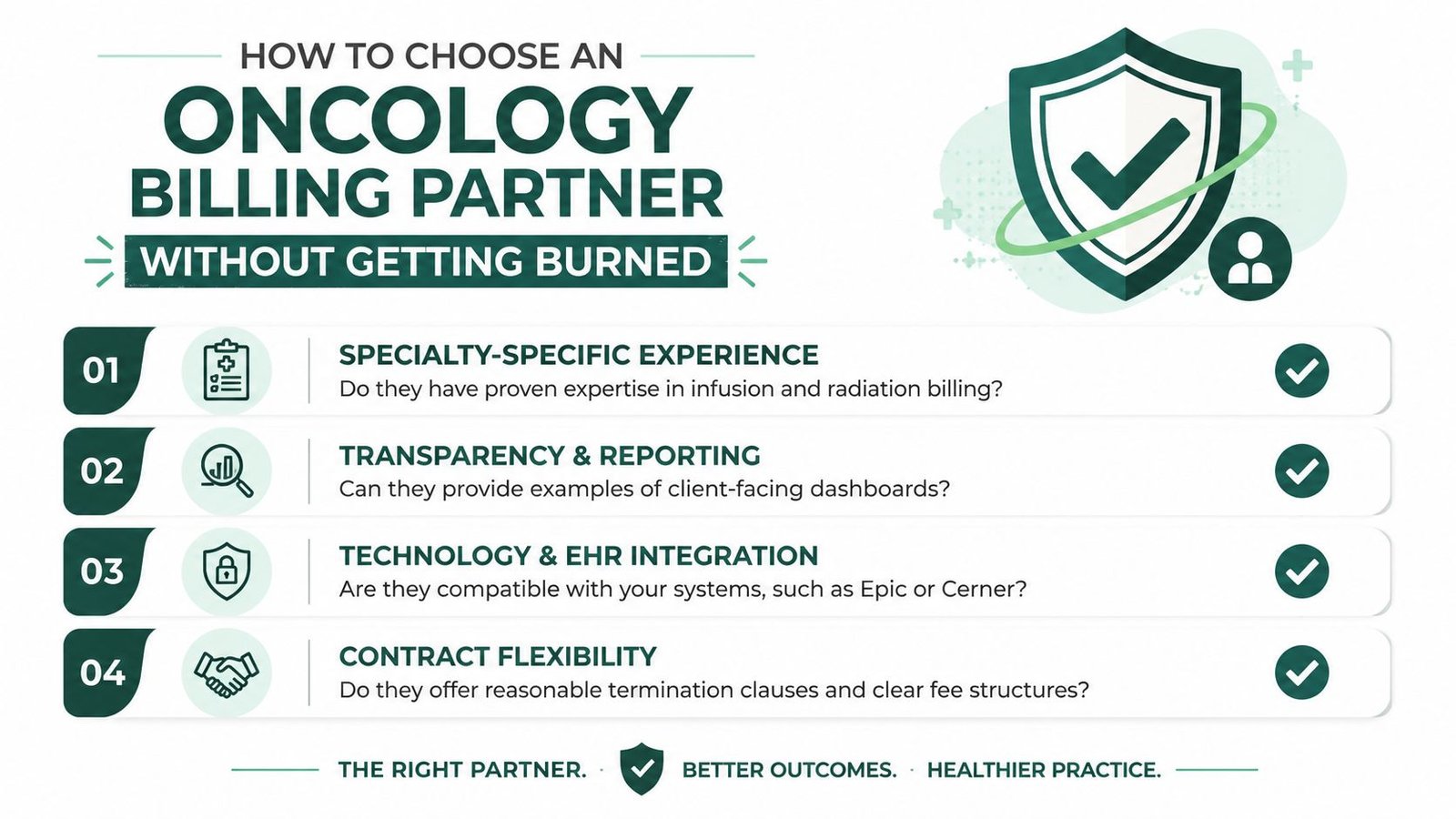
Start with one question, not ten. Ask whether the vendor has handled infusion-heavy oncology, radiation oncology, and specialty drug billing in live production, not just in a pitch deck. If the answer stays generic, keep looking.
The questions that expose real capability
How do you handle denial turnaround?
You want a direct answer on who works denials, how quickly they touch them, and whether they track root causes by payer and service line.
Who owns prior authorization?
If the vendor says your front desk or clinical staff still owns it, then they're not taking the full revenue-cycle burden off your plate.
Can you explain NDC and J-code logic on this call?
This is the simplest test I know. A serious oncology billing partner should be able to talk through drug units, modifier use, and claim sequencing without fumbling.
What does reporting look like for owners?
Ask for client-facing dashboards, not vague “monthly reports.” You should see A/R aging, denial categories, collections, and payer behavior in a format a physician-owner can read fast.
Red flags that should end the meeting
- Percentage-only pricing with no denial SLA. That structure can hide weak follow-up.
- Offshore-only teams with no U.S. clinical oversight. Oncology is too nuanced for a pure volume play.
- No clear EHR integration story. If the workflow is manual, errors will show up in claim quality.
- No security detail. HIPAA-first handling, encryption, and access controls should be part of the conversation, not an afterthought.
The cleanest vendor conversations are the ones where the rep can tie each answer back to dollars and days. If they can't show how they protect collections, reduce denials, and shorten A/R, they're selling activity, not outcomes. For a deeper specialty reference point, start with Happy Billing's oncology specialty page and compare the operating model to your current setup.
Your Next 90 Days and the Questions Owners Actually Ask
In the next 30 days, baseline your A/R days, denial rate, and net collection rate against the benchmark numbers above. In 60 days, run a denial category review and a sample audit of infusion and radiation claims. By day 90, decide whether your in-house team can close the gaps or whether a specialty vendor needs to take over the revenue leakage.
The right move is the one that gets cash moving faster. If you want a specialty review of where oncology claims are breaking, use the free oncology billing audit and compare the findings to your current numbers. That's the fastest way to find out whether you have a staffing problem or a process problem.
How fast can oncology billing services improve A/R?
Owners should expect movement only if the denials and front-end errors are being handled at the source. If the vendor is just posting payments, A/R won't change much.
What does an oncology billing audit usually uncover?
It usually exposes where claims are getting stuck, especially around drug units, authorizations, and modifier use. That's where the fastest cash wins usually live.
Will outsourcing hurt patient relationships?
No, not if the vendor handles billing professionally and your team keeps patient communication clear. What hurts relationships is surprise balances and confusing statements, not specialty billing support.
Should we fix the in-house team or bring in a partner?
If your team can't speak confidently about J-codes, NDC reporting, and denial root causes, you're probably paying for guesswork. At that point, a specialty partner is usually the faster fix.
If your oncology practice is carrying too much A/R, too many denials, or too much drug revenue risk, we should talk. Happy Billing works inside your existing EHR to tighten claim flow, reduce leakage, and protect the revenue tied to infusion, radiation, and high-cost oncology claims. Visit Happy Billing and ask for a free audit before another month of cash gets trapped in follow-up.