Podiatry Out-of-Network Underpayment Recovery in New Jersey and New York (2026)

Your podiatry claim comes back paid, and the allowed amount is a fraction of what the practice expected to collect. Before that balance hits your appeal queue, you need three answers: which dispute route the claim qualifies for, what documentation the demand requires, and whether the filing deadline has already passed. Some commercial out-of-network underpayments in New Jersey and New York are recoverable, but only when you triage eligibility first. Routing every low payment to arbitration burns staff hours on claims that were never going to pay.
The bigger leak runs quieter. Underpayments sit in aged A/R or vanish into adjustments, so your denial rate never shows the loss. Podiatry out-of-network underpayment recovery in New Jersey and New York starts with rejecting weak candidates early, then modeling net cash after patient-balance limits, IDR fees and New York award deductions rather than chasing gross billed charges. A large billed-charge gap means nothing if the recoverable margin disappears into those costs.
Happy Billing is a revenue cycle management company headquartered in Texas that recovers underpaid out-of-network claims for physician practices and specialty groups, including practices in New Jersey and New York.
Why Podiatry Underpayments in New Jersey and New York Are Worth Recovering
A payer reprices one podiatry claim below the expected allowed amount, then applies the same method across providers, locations and recurring services. A small reduction is now a repeatable revenue problem.
Start with the accounting. Ask your administrator to separate payer reductions from patient cost-sharing, coding adjustments and services the plan does not cover. Then calculate the disputed carrier balance after any patient-balance limit, filing expense, IDR cost and, for a New York claim, any award-related deduction. Gross billed charges do not show what the practice can really recover.
An underpayment should pass two tests before your team spends time on it. First, the claim needs a valid route to additional carrier reimbursement. Second, the likely net cash has to justify the work required to document, negotiate and escalate it.
Look for a repeatable payment problem
A useful recovery review groups claims by payer, service, location and adjustment reason. That lets you distinguish an isolated processing mistake from a payer methodology affecting an entire service line.
For broader operational context, CallZent's guidance on how to fix revenue cycle cash flow leaks can help owners connect payment review with front-end verification and follow-up accountability. Specialty-specific podiatry billing workflows should make those payment differences visible rather than burying them in aggregate collections.
I would prioritize complete, eligible claims with an approaching deadline over the largest balance on the aging report. A high charge does not compensate for an unavailable dispute route, weak documentation or projected recovery that disappears after filing costs.
Recovery rule: An underpayment becomes collectible money only when the practice documents the claim, supports its payment position and escalates while a valid remedy remains available.
Happy Billing offers a free New Jersey revenue audit on request for practices that want to identify repeatable underpayments and historical recovery opportunities.
Request a free New Jersey revenue audit
US practices only.
Which Recovery Pathway Each Underpaid Claim Belongs In
Before filing anything, identify the plan type, service setting and legal character of the encounter. A fully insured commercial claim, self-funded employer-plan claim, Medicare Advantage claim and Medicaid managed-care claim shouldn't enter the same escalation queue.
Facility status matters separately from surgeon status. An out-of-network podiatric surgeon working at an in-network hospital or ASC raises different questions from an elective office visit where the patient knowingly selected an out-of-network practice.
Dispute route and deadline by claim scenario
| Claim scenario | Route | Key deadline | Question to answer first |
|---|---|---|---|
| NJ commercial plan, inadvertent, emergency or urgent OON care | NJ OON arbitration, when eligible | Carrier response and negotiation clocks under the applicable state framework | Does the difference between final offers satisfy the arbitration threshold? |
| NY protected surprise or emergency bill | NY surprise-bill final-offer IDR | Document negotiation, then confirm current DFS submission requirements | What carrier payment remains disputed after protected cost-sharing? |
| NSA-covered service involving an OON podiatric provider at an in-network facility | Federal IDR, unless an applicable state process governs | Calendar the federal open-negotiation and subsequent IDR initiation windows separately | Will the likely incremental recovery justify filing expenses? |
| Ordinary network-contract underpayment | Contractual appeal or payer dispute | The participation agreement and payer appeal policy control | Does the applicable contracted rate exceed the allowed amount? |
| Medicare Advantage or Medicaid MCO claim | Plan-specific appeal | The plan's provider manual, determination notice and governing program rules control | Is this a plan appeal rather than a surprise-billing dispute? |
Ineligibility has a real cost: Healthcare Dive's reporting on federal IDR states that roughly 20% of submissions in the first half of 2025 were found ineligible, while administrative and entity fees totaled $844 million during that period.
Don't confuse starting federal open negotiation with initiating federal IDR. Treating them as the same event can produce a late or premature filing. Likewise, batching claims for payer negotiation doesn't establish that they qualify for formal IDR batching.
A practical out-of-network reimbursement review should therefore reject weak arbitration candidates early while preserving other available remedies.
Before authorizing filing expense, require answers to these questions:
- Statutory fit: Is the claim within the governing law?
- Evidence: Are the remittance, clinical record and code-level payment details complete?
- Economics: Does the expected additional payment justify fees and staff time?
Podiatry Services That Get Repriced Most and What They Cost
Repricing and coding edits can produce the same visible result, a lower allowed amount, but they require different responses. A benchmark reduction needs a reimbursement argument; a valid bundling edit needs a coding and documentation review.
Names your administrator may encounter include MultiPlan, Zelis and Data iSight. Record the actual repricer and methodology identified on the claim correspondence rather than assuming every reduction came from the payer itself. There isn't a podiatry-specific ranking in the state reports establishing which services are repriced most, so prioritize exposure using your own remittances.

Podiatry services most exposed to repricing
| Service group | Repricing trigger | What the practice loses |
|---|---|---|
| Office procedures, including nail and tissue debridement | Procedure bundled into another allowance, or distinct-service support missing | Potential separately payable procedure revenue |
| Foot and ankle surgery | Multiple-procedure, bilateral or global-period processing | Additional-procedure revenue or payment delayed by incorrect processing |
| Orthotics and DME | Device coverage limits or a schedule-based allowance | The difference between the supported device allowance and actual payment |
| Wound care | Incorrect area, tissue-depth, service or unit processing | Supported service payment and staff time spent correcting rejected lines |
| E/M with a same-day procedure | Visit bundled into the procedure | Payment for a genuinely significant, separately identifiable evaluation |
For ownership purposes, the important distinction is payment protection versus modifier chasing. Modifiers 25, 59 or XS aren't reimbursement overrides. They must describe documented services and satisfy the applicable payer's edits.
Surgical modifiers 50, 51 and 58 address different circumstances. An incorrect modifier can undermine an otherwise reasonable recovery demand, while a correct modifier doesn't eliminate a valid multiple-procedure reduction.
Separate documentation from price negotiation
Have the clinical reviewer validate the service before anyone argues about the allowance. Wound care requires particular care: don't assume every debridement service is time-based, and don't substitute therapy-unit logic for area- or depth-based reporting.
Documentation resources such as the PatientNotes podiatry specialty page can help owners evaluate whether their charting workflow captures the clinical detail needed for claim review.
Then ask how the payer calculated its allowance. Our explanation of usual and customary rates for out-of-network providers helps distinguish a charge benchmark from a payment obligation. A large billed-charge gap alone doesn't prove underpayment.
Seeing this on your own EOBs? Bring a few recent out-of-network EOBs to a call. We will tell you which claims look underpaid and which are worth appealing.
New Jersey and New York Rules That Set Your Deadlines
New Jersey deadlines and protected balances
For eligible inadvertent, emergency or urgent out-of-network care, Horizon's explanation of New Jersey's OON framework describes a carrier payment or excessive-charge notice within 20 days, followed by 30 days of negotiation; arbitration may be available when the difference between final offers exceeds $1,000.
The same explanation states that the arbitrator selects a final offer, generally issues the decision within 30 days, and requires additional awarded payment within 20 days, after which interest begins. Put each event in a dated tracker. A generic monthly follow-up task isn't sufficient.
New Jersey's process has substantial historical use, although its results aren't podiatry-specific: the NJ DOBI reporting for 2022 records 11,518 resolved cases, with providers prevailing in 5,139 award decisions, compared with 2,585 carrier wins. Those outcomes establish an operating dispute system, not an expected recovery rate for your practice.
The New Jersey OON legislation also limits patient billing for protected services to applicable in-network deductible, copayment or coinsurance. Your team must pursue the disputed carrier amount without converting it into prohibited patient responsibility.
New York protections and the federal check
The New York DFS health-insurance guidance explains protections against patient billing beyond in-network cost-sharing for a protected surprise bill. Determine whether the encounter qualifies before choosing NY IDR, another payer dispute process or a complaint.
A New York DFS complaint for out-of-network underpayment can address an appropriate regulatory issue. It isn't a substitute for preserving an IDR deadline or presenting a supported final offer.
For an out-of-network podiatric surgeon at an in-network ASC or hospital, verify the service, plan and any relevant notice-and-consent circumstances. The facility address alone doesn't establish federal IDR jurisdiction.
Identify the payer's qualifying payment amount, or QPA, separately from billed charges and market-charge benchmarks. Don't treat that payer figure as an automatic settlement ceiling, and don't assume a higher charge benchmark establishes entitlement to payment.
Documenting and Filing an Underpayment Recovery, Step by Step
How we approach it starts with the historical claim record. Happy Billing's team audits historical claims to identify and recover under-reimbursed amounts, separating correctable processing problems from disputes that need a supported payment demand.
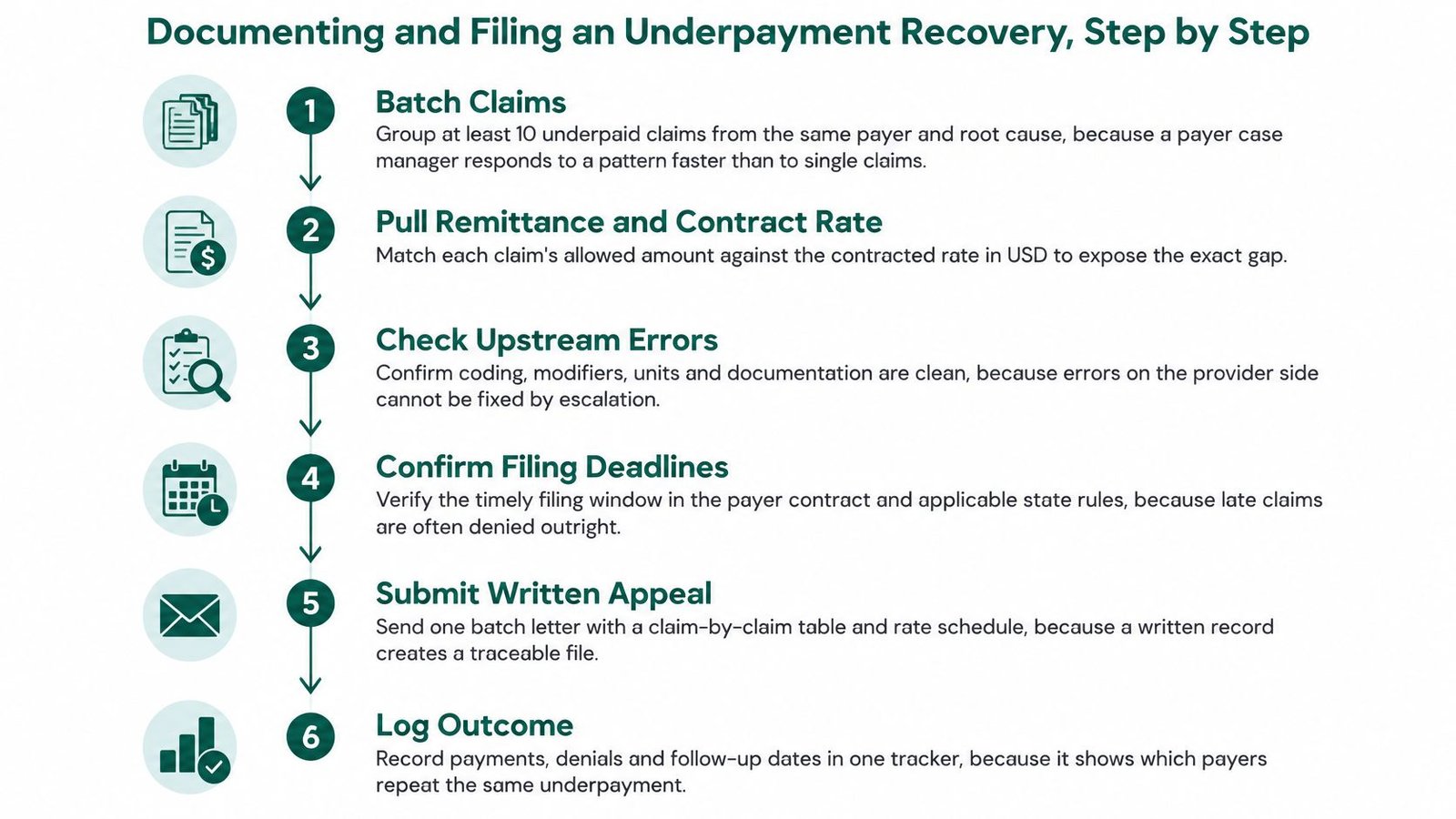
Group claims by payer and root cause. Build a negotiation batch showing a repeated payment issue, not an assortment of unrelated balances. Keep legal filing eligibility at claim level, because an operational batch may need separate formal disputes.
Reconstruct the payment variance. Capture CPT or HCPCS, modifiers, units, place of service, billed charge, allowed amount, carrier payment, patient cost-sharing and adjustment reasons. Attach remittance advice, relevant clinical records, authorization information and the governing benefit or contract language.
Choose a defensible benchmark. Use service-specific geographic comparisons, charge history and comparable reimbursement evidence. FAIR Health can inform negotiation, but a percentile isn't a universal settlement entitlement or a legal ceiling.
Send a written negotiation demand. Name the processing or valuation problem and the requested remedy. A concise claim-level paragraph is more useful than a general allegation that the payer pays too little:
For claim [claim number], date of service [date], please review the allowance of [allowed amount] for [documented procedure and supported modifier]. The enclosed remittance, clinical documentation, charge history and geographic benchmark evidence support our requested payment of [amount]. Please provide a written determination and the methodology supporting any continued reduction by [response date].
Kons Law's discussion of demand letter requirements for unpaid invoices offers useful principles for clear demands and supporting documents. Insurance disputes still require the payer-specific and statutory procedure, not merely a commercial collection letter.
Use corrected claims only when justified. Obtain a fresh EOB when the payer accepts legitimate reprocessing, but don't assume resubmission restarts an expired appeal or statutory deadline. Preserve the original determination date and obtain written confirmation of any reopened review.
Escalate through the available remedy. Use the payer's formal dispute or one-time provider-review process where available, then arbitration or IDR only when eligible. An appropriate NJ DOBI complaint for underpaid out-of-network claims should identify the regulatory failure and include the correspondence trail.
Build the New York final offer carefully
New York's final-offer process requires disciplined valuation. Brookings' analysis of New York surprise-bill arbitration describes selection between the parties' positions and reports 1,486 surprise-bill disputes submitted during 2015–2018, with 815 decisions rendered.
Confirm emergency or eligible inadvertent status, coverage, facility participation and disclosure or consent documentation. Record good-faith negotiation, then support the final offer with complexity, charge history, geographic evidence and comparable reimbursement.
Before filing, validate laterality, modifiers, global-period status and facility context. Afterward, reconcile the decision to the selected offer and actual payment.
Don't promise a universal turnaround. Payer negotiation, corrected-claim review and formal IDR follow different clocks. An AOB may support carrier-side work without routine patient contact, but confirm that the assignment and any required representative authorization are sufficient for the particular remedy.
When to Keep Recovery In-House and When to Escalate
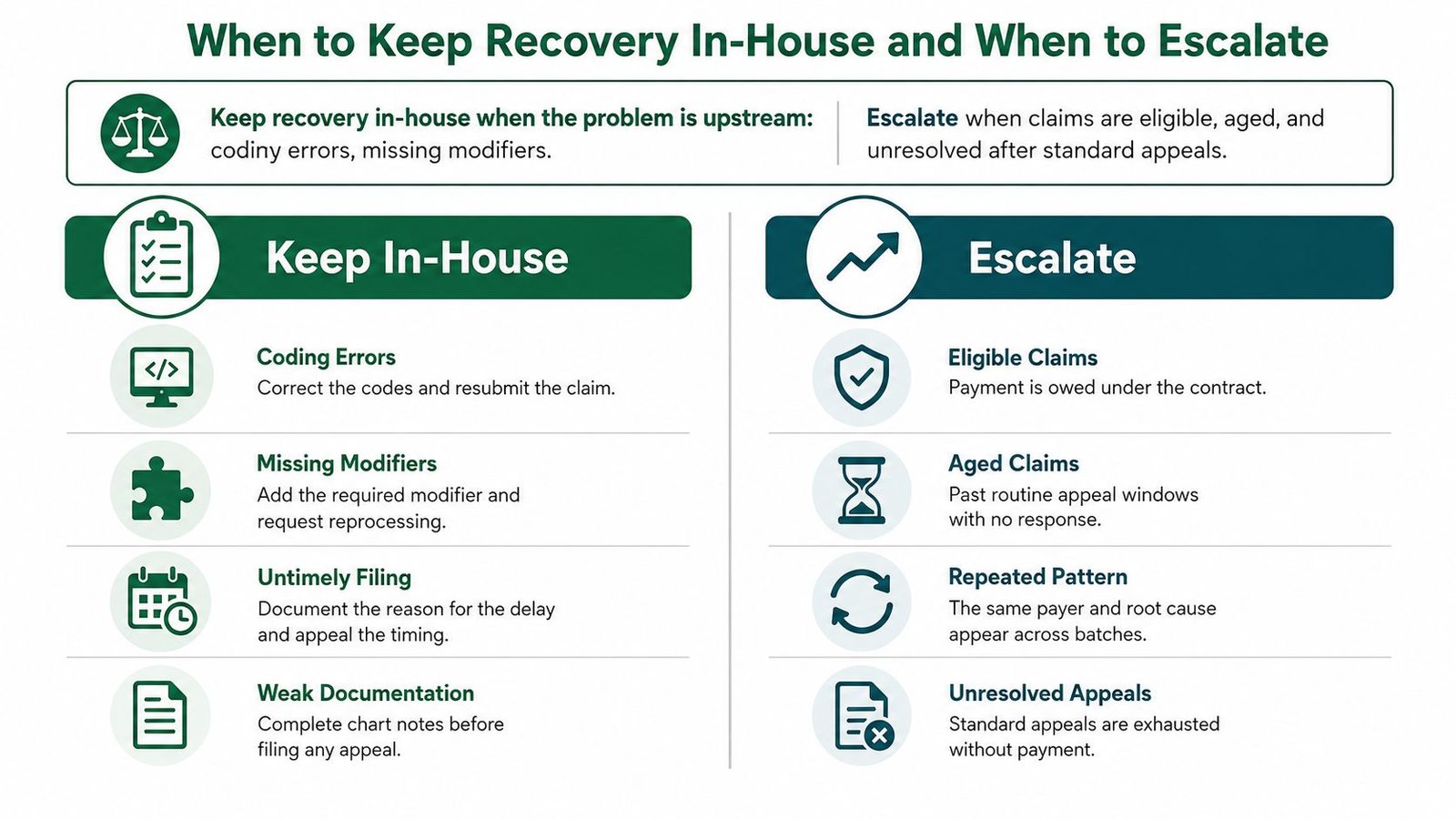
Keep upstream corrections in-house; escalate eligible payment disputes when specialist effort is economically justified. Outsourcing a missing-documentation problem doesn't make the documentation appear, and escalating an unsupported modifier won't strengthen the claim.
Review the portfolio before assigning it
Your administrator should bring an exception report, not just an A/R total:
- Claim age: Identify original determination dates and remaining review rights.
- Dollar gap: Calculate defensible additional carrier payment rather than billed balance.
- Common cause: Separate repeat payer reductions from isolated errors.
- Internal defects: Identify authorization, documentation and coding problems requiring prevention.
- Ownership: Name who will prepare, submit and reconcile each escalation.
Model the correct net recovery
Be careful with New York award deductions. New York's podiatry arbitration payment regulation, 12 NYCRR 342.9, provides that an awarded bill exceeding $100 is paid less the podiatrist's remaining 5% expense fee; under that rule, a $2,000 award produces a $1,900 payment on that component.
That is a workers' compensation podiatry arbitration rule, not a blanket deduction for commercial NY surprise-bill IDR. Apply it only to the correct claim category. The regulation also describes a minimum $5 chair expense fee for awards at or below $100 and specified A-4 settlements.
For commercial recovery, model the expenses of the actual dispute route instead of importing an unrelated fee schedule.
The practical in-house versus outsourced out-of-network recovery decision comes down to capacity and control:
- In-house advantage: Your staff retains payer knowledge and direct control, but competing work can leave deadlines unattended.
- Outside advantage: A specialist can organize historical evidence and formal filings, but you must evaluate contingency economics and reporting discipline.
Judge a recovery partner by net dollars collected after fees and patient-balance limits, not by total charges submitted.
Decide Your Next Step Before the Deadlines Run Out
A podiatry claim with nine days left on an appeal and clean support beats a larger balance that is already outside the filing window. Protect live rights first, then decide whether the expected net cash justifies the work.
Use this order for the backlog:
- Pull the portfolio: Export underpaid podiatry claims with remittances, payment dates and adjustment reasons.
- Assign jurisdiction: Separate state-protected claims, potential federal disputes, contractual appeals and government-plan appeals.
- Reject weak candidates early: Set aside claims missing eligibility, documentation, timely appeal rights or a supportable payment position before they consume specialist time.
- Price net recovery: Estimate incremental carrier payment after patient-balance limits, filing expense and preparation effort, not gross billed charges.
- Assign responsibility: Keep correctable internal errors with the operational team and route supported disputes to a named specialist.
For federal candidates, use a structured federal IDR process for providers to distinguish negotiation from formal initiation and preserve the submission record.
Happy Billing's denial and appeals team is trained on NY DFS IDR filing requirements, documentation standards and aggregation strategies. We serve physician practices and specialty groups throughout Newark, Jersey City, Trenton, Camden, Cherry Hill, Princeton and every New Jersey market, as well as New York and Pennsylvania practices.
Happy Billing offers a free New Jersey revenue audit for practices that request one, so you can see which underpaid claims merit further work.
Request a free New Jersey revenue audit
US practices only.
Do I need patient consent or contact to recover an underpayment?
An AOB can support carrier-side recovery without routine patient contact, but it doesn't automatically satisfy every appeal or representation requirement. Confirm the authorization needed for the selected process, and never transfer a protected carrier dispute to the patient.
How do I know if a claim is worth arbitration?
Confirm jurisdiction, documentation and a supportable payment position before calculating potential recovery. Then compare the expected incremental payment with the route's eligibility threshold, filing expenses and preparation cost.
How long does recovery usually take?
There isn't a reliable universal turnaround across payer negotiation, state arbitration and federal IDR. Request a claim-specific milestone schedule that separates submission, payer response, decision and payment reconciliation.
Should I stop billing if my claims are repricing?
No. Continue submitting accurate, supported claims while investigating the payer's methodology and correcting internal errors. Work the historical backlog separately so recovery activity doesn't delay current revenue.
Happy Billing can review historical podiatry claims, identify the available recovery route and organize the evidence needed for supported payer disputes. Visit Happy Billing to discuss your New Jersey and New York underpayment backlog with a billing specialist and decide which claims merit further work.
Want someone to work these claims for you? Happy Billing handles out-of-network underpayment recovery for independent practices: repricing disputes, plan appeals, state complaints, and No Surprises Act IDR where it applies.