Acupuncture Out-of-Network Underpayment Recovery in New York
You open a remittance for a full acupuncture visit, see a third of what you expected, and post it because the next patient is waiting. That habit is where acupuncture out-of-network underpayment recovery in New York is won or lost.
Is Your Acupuncture Underpayment Recoverable in New York
Yes, in most cases, when the claim is clean, batched, and routed to the right dispute path. The cases that stall fail on documentation or route, not on the payer's fee schedule.
Run the arithmetic. At 40 acupuncture visits a week with a $100 shortfall per visit, a practice leaves roughly $200,000 a year in unrecovered A/R. Underpayments post like ordinary remittances, so they age past filing and appeal windows before anyone compares the allowed amount against the verified benefit.
Before you dispute anything, split the shortfall into two piles. A cut caused by a coding error, a repricing mismatch, or a missed timely-filing detail is recoverable. A cut that matches the plan's written benefit design is applied correctly, and chasing it burns the same appeal window a genuine error would use. That is why benefit and authorization verification belongs before the first visit, not after the remit arrives.
The stakes are larger than one office's ledger. The New York State audit of UnitedHealthcare's acupuncture payments identified $7,331,458 in actual and potential overpayments, including payments for services lacking adequate provider documentation and duplicate claims. Payers miss money in both directions, and an office posting remits by hand will miss its share.
Happy Billing is a revenue cycle management company headquartered in Texas that recovers underpaid out-of-network claims for practices in New York and New Jersey, tailoring workflows to each specialty and serving New York clients entirely remotely.
Three questions start every recovery: which payer route applies, which claim errors caused the cut, and which dispute path fits. Our out-of-network underpayment recovery process builds on those three.
Book a free 30-minute call
US practices only.
Why Acupuncture Claims Get Repriced in New York
The payable amount is the payer's allowed amount, and the method behind it changes by payer type. In New York, the first split is which recovery route the claim belongs to before anyone argues about dollars.
Recovery Route by Payer Type in New York
| Payer route | Recovery path | Check first |
|---|---|---|
| Fully insured commercial plan | DFS prompt-pay complaint for delay; plan appeal for fee or benefit disputes | Plan's out-of-network benefit language and allowed-amount method |
| Self-funded ERISA plan | DFS generally cannot enforce prompt-pay; plan internal appeal, then federal external review | Summary plan description and whether the employer self-funds |
| Medicare or Medicare Advantage | Federal appeal rules; redetermination request within 120 days of the initial determination | Whether the coverage is traditional Medicare or Medicare Advantage |
| New York Medicaid managed care | Plan grievance first, then State fair hearing | MCO network status and authorization record |
| Network-only or HMO without an out-of-network benefit | Benefit may be zero without prior approval; appeal only with approval evidence | Whether prior approval was obtained before treatment |
| No-fault auto | Schedule-based reimbursement under Insurance Law 5108 and Regulation 83; arbitration for fee disputes | Schedule basis used by the carrier versus the billed charge |
Repricers such as MultiPlan, Zelis and Data iSight (Claritev) apply their own allowed-amount logic before the payer adjudicates. That is why two EOBs with the same service codes can pay differently: one was cut by repricer methodology, the other by a benefit limit, and only one of those is an appealable error. Reading about streamlining adjudication workflows with AI is useful context, but the operative document is still your remit: repricer name, allowed-amount method, adjustment reason, and whether a cap or authorization rule did the cut. Our physical therapy underpayment recovery guide for practice owners and our breakdown of usual and customary rates explained for out-of-network providers show how that number gets built.
In New York, Happy Billing works with Medicaid Managed Care, Empire BCBS, and No Surprises Act compliance, and each route carries its own grievance rules. A 2004 New York Department of Financial Services opinion contrasted a previously described prevailing regional rate of $120 per service with the possibility of a lower scheduled reimbursement. The practical read: licensure, procedure equivalency, and schedule basis have to be settled before price. A correctly applied schedule is benefit design; a missed authorization, wrong equivalency, or misapplied repricer line is recoverable work.
Pull the repricer name and allowed-amount method from the EOB first. That line decides which dispute argument can work.
Verify Benefits and Authorization Before the First Visit
Most recoverable out-of-network losses are set before the first treatment, not after the remittance. We run five checks at intake.
- Confirm the benefit exists. A network-only or HMO plan may pay zero without prior approval, so a full course of treatment can become pure write-off.
- Get the allowed-amount methodology. Ask which repricer the payer uses, record the answer and call reference, and file it with the chart.
- Confirm the visit cap and cost sharing. Model what a cap does to a typical course before you schedule it, because a correctly applied limit still leaves you short if you planned for unlimited visits.
- Obtain the authorization. File the number, approved visit count, and date range. Our overview of what prior authorization means in healthcare covers what to capture on that call.
- Record the expected payment. The later remittance gets compared against a stated number, not memory.
Say a plan allows 20 visits and your treatment plan needs 30. You can redesign the course, seek a network-gap approval, or set a patient-pay arrangement upfront. What you can't do is recover visits 21 through 30 from a payer that applied its cap correctly.
In our experience, practices that finish these five steps file fewer appeals, and the appeals they do file rest on a stated benefit instead of a billed charge.
Audit Each Acupuncture Claim Before You Appeal
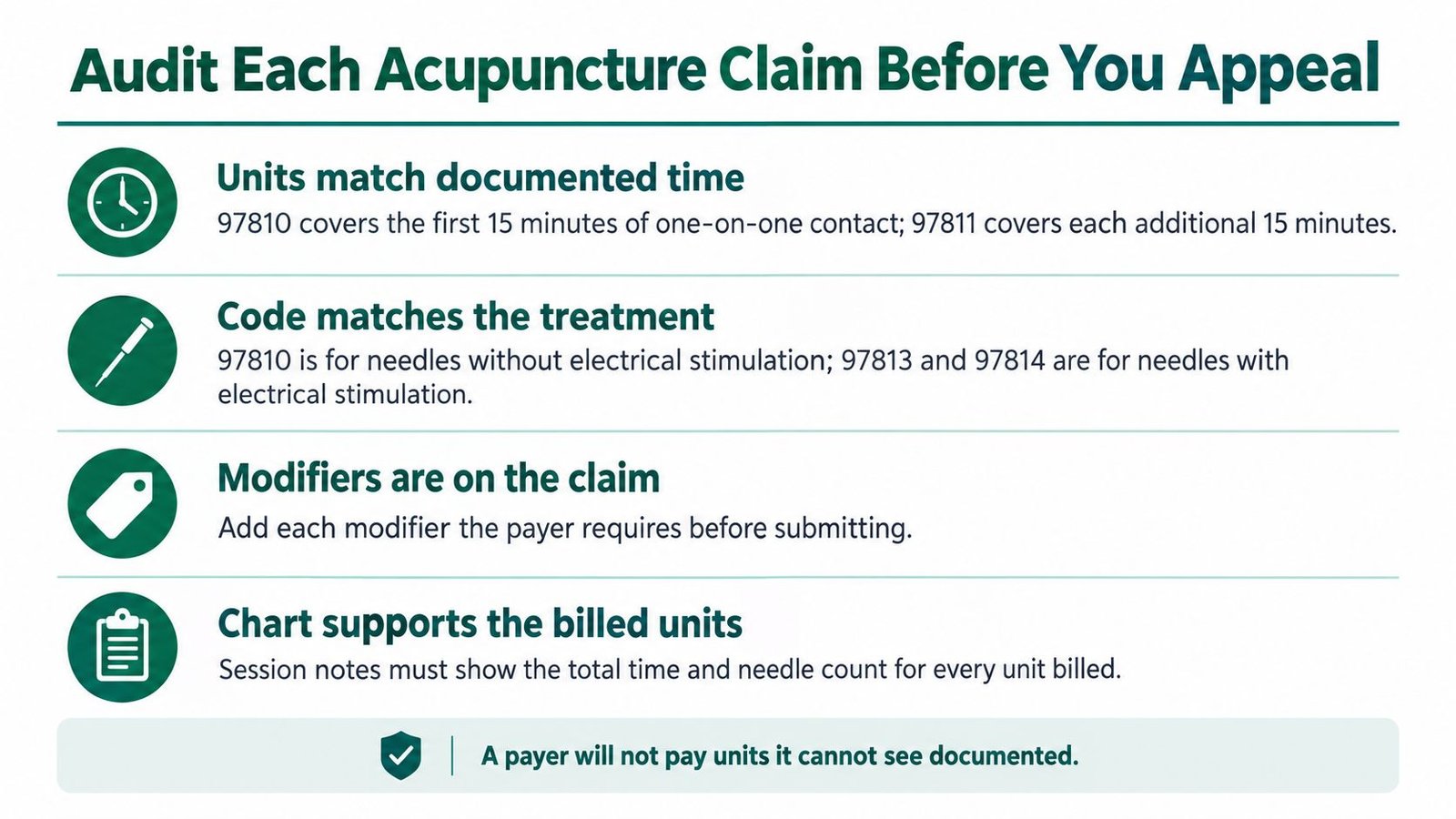
Most acupuncture cuts trace to billing inputs you control. A payer won't pay units it can't see documented.
Acupuncture Codes and Modifiers That Trigger Cuts
| Code or modifier | What it covers | Where payers cut | What the practice stands to lose |
|---|---|---|---|
| 97810 | Acupuncture without electrical stimulation, first 15 minutes | Time not documented, or session under 15 minutes | Base payment on every visit |
| 97811 | Each additional 15 minutes of the same session | Units billed without matching minutes in the note | Each extra unit that cannot be defended on appeal |
| 97813 | Acupuncture with electrical stimulation, first 15 minutes | Stimulation billed but settings not recorded | The full 97813 payment, downcoded or denied |
| 97814 | Each additional 15 minutes with electrical stimulation | Same time gap as 97811 | Per-unit premium over 97811 when documented |
| Diagnosis pointer | Links each code to medical necessity | Generic or unsupported diagnosis | Medical-necessity denial that blocks payment for the whole claim |
E/M codes billed with modifier 25 pay only when the evaluation is separately identifiable. Use it without distinct documentation and you invite recoupment across a whole batch, not just one visit.
Seeing this on your own EOBs? Bring a few recent out-of-network EOBs to a call. We will tell you which claims look underpaid and which are worth appealing.
Documentation Checklist in Review Order
- Time in and out: Per session, matching every 15-minute unit billed.
- Needle count and points: Locations recorded for the treatment performed.
- Stimulation settings: Required whenever you bill 97813 or 97814.
- Diagnosis pointers: Tied to each line so medical necessity is visible.
- Signed note: Plus a separate E/M note when an E/M is billed.
Before escalating, the New York DFS consumer guidance on health insurance rights supports confirming claim receipt, coding, units, diagnosis support, provider specialty, place of service, and whether the payer requested additional records. The same guidance notes New York requires insurers and HMOs to pay undisputed electronic claims within 30 days and paper claims within 45 days. That timing rule addresses delay, not valuation, so don't file a prompt-pay complaint for a fee dispute.
Our team audits historical claims to identify and recover under-reimbursed amounts, and AAPC-certified coders provide final oversight of our claims. Build your packet using our out-of-network appeal package checklist and template for providers so nothing essential is missing.
Separate a Surprise Bill from an Ordinary Underpayment
Most office-based, elective acupuncture is an ordinary underpayment problem. Calling every low payment a surprise-billing issue sends the appeal down the wrong path and costs you weeks.

New York protections generally apply when a patient receives nonparticipating professional services at an in-network hospital or ambulatory surgical center without a participating professional being available, or when the patient did not consent to the out-of-network professional, according to the New York State employee plan out-of-network publication. They generally do not apply when a patient deliberately selects an out-of-network practitioner despite an available in-network option.
That distinction is why benefit verification comes before the first visit, not after the denial. A patient who chose you out of network accepted the out-of-network benefit level, and a low check that matches the plan's stated out-of-network allowance is benefit design working as written. No appeal moves that number. The recoverable money sits in claims where the payer paid below the benefit it promised, and those are the claims worth your staff's hours.
Classify every claim four ways before you appeal:
- Elective office-based acupuncture: Ordinary underpayment rules; the benefit language controls.
- Facility-based care: Surprise-billing protections may apply.
- Emergency-related care: Check federal and state protections first.
- Approved network-gap referral: May be paid at the in-network benefit level.
For network-gap cases, gather provider-directory screenshots, travel-distance records, clinical rationale, the referral authorization, consent forms, and the remittance code showing the deficiency. Federal No Surprises Act IDR applies only to eligible surprise bills, so it is rarely the first move for elective acupuncture. Our guide to the No Surprises Act in New York for practice owners maps where state and federal rules diverge.
No-fault runs on its own track. Acupuncture for a motor vehicle accident patient is billed under the New York no-fault fee schedule, so the first question on a low payment is which schedule the carrier applied. Fee disputes and medical-necessity disputes are resolved through no-fault arbitration or court, and filing in the wrong forum burns time the dispute window does not give back.
How to Run the Recovery From Batch to Escalation
One underpaid claim is a rounding error to a payer. Ten claims with the same root cause are a pattern, and patterns get a case manager assigned. Before anything enters the batch, cut the lines where the remittance applied the benefit correctly: a deductible, a visit cap, or a percentage-of-allowable formula is plan design, and appealing it burns the window on the claims that were actually underpaid.
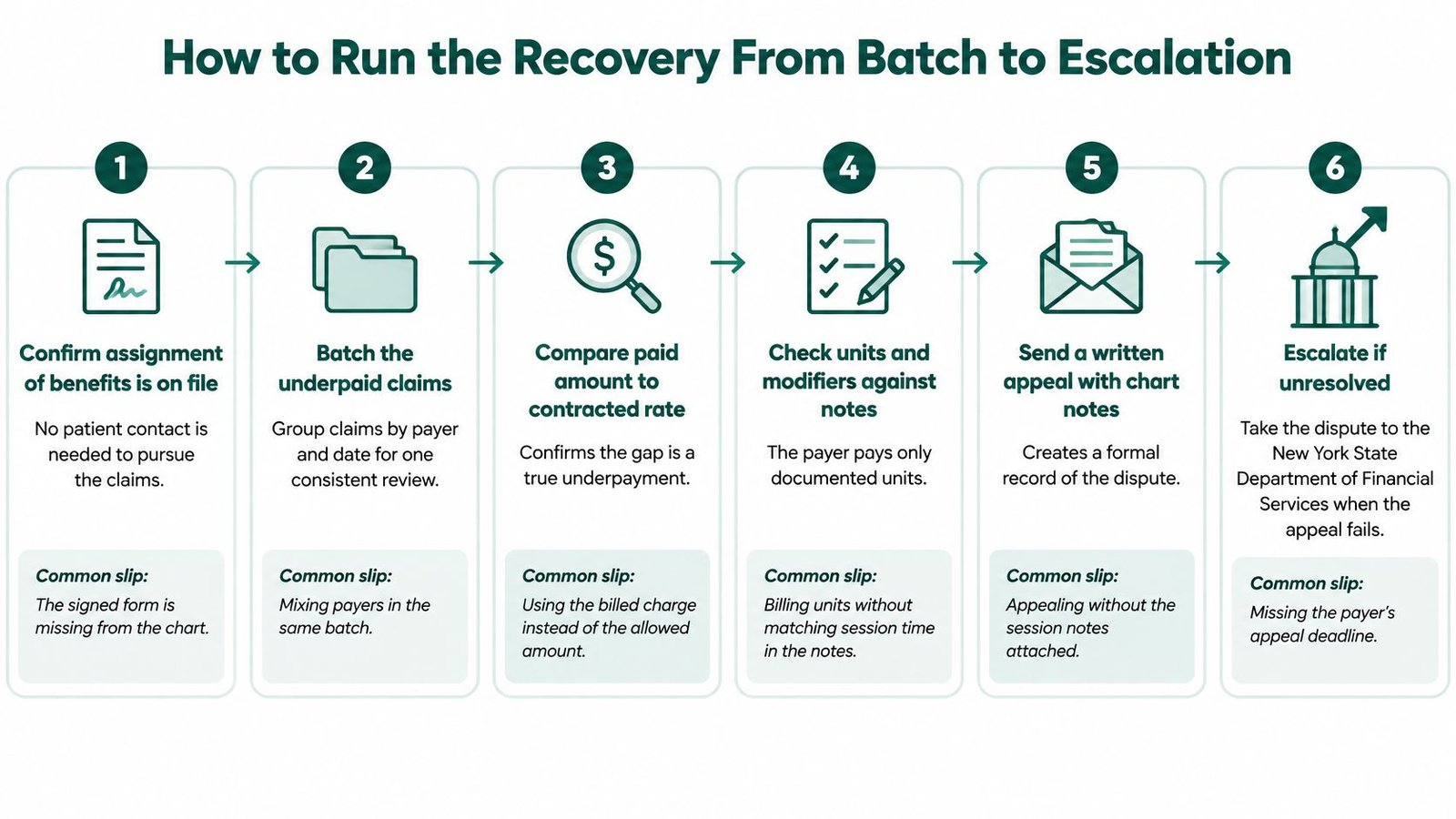
- Confirm assignment of benefits. With an AOB on file, no patient contact is needed to pursue the claims. The common slip is a signed form missing from the chart.
- Batch 10 or more claims. Group by payer, code pattern, and root cause so the dollar total earns a payer case manager's attention. This is the core of out-of-network underpayment recovery.
- Build the quantified packet. Billed charge, allowed amount, payment, expected out-of-network benefit, contractual or statutory basis, and balance due for each claim.
- Negotiate against UCR benchmarks. Anchor the request to the usual-and-customary percentile for the same code, specialty, and geographic area rather than the billed charge, and let the payer counter from there.
- Resubmit for a fresh EOB. Where the appeal window closed but timely filing still allows a corrected claim, resubmission restarts review. Keep proof of submission, the same discipline covered in guidance on how to read fax transmission reports.
- Escalate formally. File the payer's formal or one-time provider dispute, or the internal appeal within 180 days. Guidance on how to file a New York Department of Financial Services complaint for out-of-network underpayment covers the DFS route when delay is the issue.
- Use IDR only where eligible. Track the 30-business-day filing window from the initial payment or denial notice.
The strongest appeal rests on benefit language and network-adequacy evidence, not a generic demand for the billed charge. The New York DFS out-of-network law guidance states that if the final adverse determination is upheld, New York's external appeal deadline is four months, and expedited external appeals can be decided within 72 hours. That same guidance defines UCR as the 80th percentile of charges for the same service, specialty, and geographic area in a qualifying nonprofit database, which is the benchmark the negotiation step anchors to.
Appeal letter skeleton: Claim identifiers, dates of service, CPT codes and modifiers, billed versus paid, expected benefit with cited plan language, the specific action requested, and an enclosure list.
Recovery Timeline by Phase
| Phase | Days | Action | Output |
|---|---|---|---|
| Audit and batch | Days 1-14 | Pull 10 or more underpaid claims with the same payer, code pattern and root cause | Batch total and root-cause list |
| Outbound negotiation | Days 15-35 | Request reprocessing anchored to UCR benchmarks for the same code, specialty, and geographic area | Written payer response for the batch |
| Corrected or fresh claim | Days 20-45 | Resubmit where timely filing still allows, then request a fresh explanation of benefits | New remittance with corrected allowed amount |
| Formal dispute or internal appeal | Days 35-60 | File the payer's formal or one-time provider dispute, or the internal appeal within 180 days of the adverse determination | Dispute decision letter |
| IDR or external review | Days 60-90, or as deadlines require | Escalate where eligible; track the 30-business-day IDR window and the four-month external appeal deadline | Award or external determination |
A realistic timeline for a full batch is 45 to 90 days. The pitfalls we see most are appealing after the deadline, treating a correct benefit application as an underpayment, and omitting the physician's network-inadequacy statement when the appeal depends on it.
Track Four Numbers and Decide Who Runs Recovery
A recovery report should show whether the batch is paying off and where claims are getting lost. Choose four measures, then assign someone to review them.
- Recovery rate per batch: Dollars recovered compared with dollars identified as underpaid.
- Days to resolution: Time from identifying an underpayment to its resolution, compared with the expected 45-to-90-day batch timeline.
- Clean documentation share: The portion of acupuncture claims submitted with documented time, units, and diagnosis support.
- Expired write-offs: Claims that passed the filing or appeal window, pointing to an upstream process gap.
Use the measures together. A low recovery rate may reflect benefit design rather than billing errors, while a rise in expired write-offs points to missed follow-up or deadlines. For dashboard guidance, find the right performance metrics.
Keep recovery in-house when a staff member can own payer follow-up, documentation, and deadlines alongside regular claim work. Consider outside support when aged claims are sitting without an owner or the practice lacks time for repeated audits and appeals. Happy Billing provides end-to-end billing and out-of-network underpayment recovery for New York practices remotely. Its team can audit historical claims and pursue eligible aged claims. Compare billing support options in the guide to what it costs to outsource medical billing.
A free 30-minute call is a practical starting point for reviewing the batch and deciding who should run recovery.
US practices only.
Questions Practice Owners Ask About Acupuncture Underpayments
Can We Bill the Patient for the Difference?
Only if the plan contract or a signed consent permits it and New York surprise-billing protections do not apply. Check both before sending a patient statement. A balance that cannot legally be billed to the patient is not a collectible underpayment.
Is a Low Payment Worth Appealing When a Visit Cap or Coinsurance Already Applied?
Appeal only when the remittance conflicts with the benefit verified at intake. If a visit cap or coinsurance was correctly applied, that lower payment reflects the plan's benefit design, not a billing error.
What If the Claim Is Already Past Timely Filing?
Resubmit only if the payer accepts a corrected claim. If the filing window has closed, keep the denial reference, record the cause, and correct the intake or submission step to prevent the same issue in future claims.
What Does Recovery Cost and How Fast Do We Get Paid?
Recovery timing depends on the payer and the claim. A full-batch review and follow-up may take 45 to 90 days, with no guarantee of a specific outcome. A free 30-minute call with a billing specialist can help review the batch and discuss pricing.
If acupuncture remittances fall below verified benefits, Happy Billing can audit historical claims, distinguish fixable billing errors from correctly applied benefit design, and pursue underpaid out-of-network claims. Book a free 30-minute call to discuss the batch.
Want someone to work these claims for you? Happy Billing handles out-of-network underpayment recovery for independent practices: repricing disputes, plan appeals, state complaints, and No Surprises Act IDR where it applies.