Out-of-network Underpayment Recovery for Multi-site Therapy, Pain and Anesthesia Platforms
Federal IDR activity reached 288,810 cases in the first half of 2023, compared with roughly 200,000 cases initiated during all of 2022, according to the CMS supplemental IDR report. For multi-site therapy, pain, and anesthesia platforms, the first recovery deliverable should be a cross-site variance file: a view of allowed amounts by payer, repricer, TIN, and site. Underpayments can hide in differences across acquired TINs and repricers, even when claims are accepted and denial rates look controlled.
An IDR award is not cash until it posts to the correct TIN and site. Happy Billing runs end-to-end billing and recovers underpaid out-of-network claims. Headquartered in Texas, it serves major metro practices in Chicago and across Illinois for multi-specialty RCM and denial recovery.
Why Platform Underpayments Stay Off the Denial Report
Accepted claims can still be underpaid. When a payer's allowed amount falls below the applicable contract or other defensible benchmark, the difference can reduce net collections and remain invisible in denial reporting.
Clean-claim rates and denial resolution measure important parts of billing performance. They do not show whether a paid claim met its expected allowed amount. Across acquired sites, differing TINs, systems, and fee schedules can make comparable claims hard to match and recurring payment variance easy to miss.
Commercial repricing adds another layer. MultiPlan, Zelis, and Data iSight/Claritev may appear on out-of-network remittances with allowances below the practice's expectation. If paid claims close without a separate variance review, those shortfalls may not reach the team responsible for follow-up.
The first deliverable should be a cross-site variance file, organized by payer, repricer, TIN, site, and specialty. It gives the platform a consistent way to compare allowed amounts before opening disputes. An IDR award is not cash until the payment posts to the correct TIN and site.
Happy Billing has documented $32M in revenue recovery for clients. Its end-to-end billing and underpaid out-of-network claim recovery work can support a review of payment variance across sites. For more signs that paid claims may be systematically underpaid, see this guide to identifying out-of-network underpayment patterns.
US practices only.
Fees are contingency-only, depend on claim age and volume, and we give a clear number after a free 30-minute call with a billing specialist.
Where Recoverable Dollars Sit Across Sites
| Claim pool | What the remittance shows | First move | What the owner loses |
|---|---|---|---|
| Repriced commercial OON | Data iSight, MultiPlan, Zelis, or Claritev allowance far below prior allowed | Batch 10 or more similar claims and negotiate | A $540 therapy visit paid at $60 after Data iSight repricing, or a $300 claim paid at about $100 |
| NSA-eligible facility service | Initial payment near the QPA at an in-network hospital, HOPD, or ASC | Open negotiation, then IDR only if eligible | Recurring anesthesia and pain lines stuck near the QPA |
| Aged acquired-practice A/R | Mixed PM systems and fee schedules, often 90-plus days, thin appeal trail | Pull the data, then seek a fresh EOB if the window closed | Receivables that age past the point of collection |
| Coding or unit defect | Missing time unit, modifier, authorization, or concurrency | Corrected claim or first-level appeal, not IDR | The same underpayment repeats on similar cases |
| Contract or state-law dispute | Network contract or state payment rule, outside federal IDR | Payer dispute or state process | A recovery lost because the claim was filed in the wrong forum |
The first row is a payment-pattern problem, not proof that the entire difference from billed charges is owed. In an anonymized Manhattan physical therapy example, a practice billed $540 for one visit, 97140 x2 and 97110 x2. Cigna paid $60 after Data iSight repricing, compared with $300 to $400 per visit before. In a separate anonymized multi-location New Jersey sports medicine example, Cigna and Horizon repriced claims of about $300 to about $100. These examples show what a paid-but-short claim can look like; they don't establish an award or guaranteed recovery. The repricing-tools guide covers Data iSight, MultiPlan, and Zelis.
Build the variance file before opening disputes
CMS's federal IDR reports and line-item data support a line-by-line evidence approach. Normalize remittances by payer, plan, TIN, NPI, facility, place of service, CPT/HCPCS code, modifier, units, and date of service. Set expected reimbursement from the applicable contract, state rule, Medicare-relative benchmark, or QPA.
Separate a true rate shortfall from coding, documentation, authorization, or unit defects. Flag paid-to-expected amounts below 90%, unexplained unit reductions, and repeated downcoding. Rank cases by recoverable dollars multiplied by probability of success, not gross charges. Preserve line-level evidence when grouping claims so that one site's volume or rates don't obscure another's audit trail.
Finance teams building broader cash-flow controls may find cash-flow guidance for Jacksonville practices useful alongside a payer-by-code variance report. The immediate operating deliverable is simpler: one cross-site variance file before any dispute is opened.
Specialty Edits and KPIs That Change the Allowed Amount
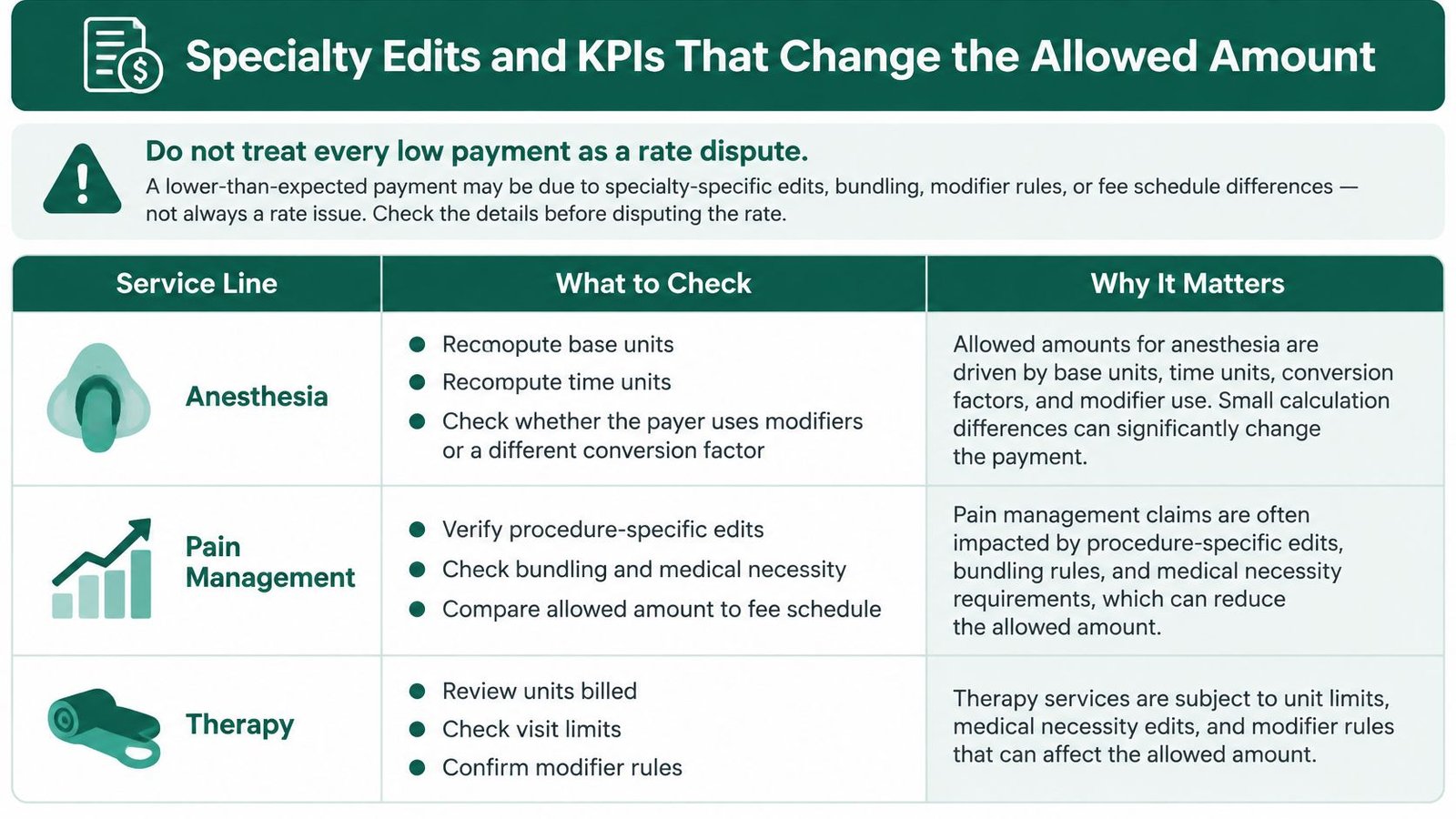
A modifier, unit, or place-of-service error can change the allowed amount before a payer-rate dispute is even considered. For a multi-site platform, compare the same specialty edits across acquired TINs and repricers, and keep each result tied to its facility and billing identifiers.
| Service line | What to recompute | Payment effect if wrong |
|---|---|---|
| Anesthesia | Base units, time units, QK, QY, QX, QZ, and concurrency | QK and QY pay the physician 50 percent of the allowed amount; an incorrect direction modifier can change the payment |
| Pain | Global period, multiple-procedure reduction, office versus ASC | Lines may be written off as adjustments instead of reviewed for underpayment |
| Therapy and rehab | 97110 and 97140 timed units, 8-minute rule, authorization date, taxonomy | A repricer reduction may be pursued as an underpayment when the actual issue is units or authorization |
Reconcile specialty-specific inputs
For anesthesia, recalculate base and time units, then confirm the payer's unit and conversion-factor assumptions. Check physical-status and qualifying-circumstance modifiers, actual anesthesia time, medical direction, and concurrency. CMS assigns QY to a physician medically directing one qualified nonphysician anesthetist and QX to the CRNA or anesthesiologist assistant. QK applies when the physician medically directs two, three, or four concurrent procedures; QZ identifies a CRNA service without physician medical direction. The CMS anesthesia modifier guidance states that QK and QY produce physician payment at 50% of the allowed amount. Reconcile provider, facility, start-stop time, and concurrent-case information before treating a payment difference as a rate cut.
For pain, check global-period edits, multiple-procedure reductions, and office versus ASC place of service. For therapy, validate timed units on 97110 and 97140, the 8-minute rule, authorization dates, and rendering-provider taxonomy. Patient-facing coverage discussions for services such as cold laser therapy may also involve insurance questions for cold laser therapy.
Track net dollars after fees, days from remittance to payment, appeal-to-payment conversion, overturn rate by root cause, and recurring leakage by site. Use confirmed patterns to correct charge capture and upstream claim edits. For a benchmark comparison, the usual-and-customary rate guide for out-of-network providers can help distinguish a rate argument from a coding correction.
Seeing this on your own EOBs? Bring a few recent out-of-network EOBs to a call. We will tell you which claims look underpaid and which are worth appealing.
A 90-Day Recovery Plan From Data Pull to Escalation
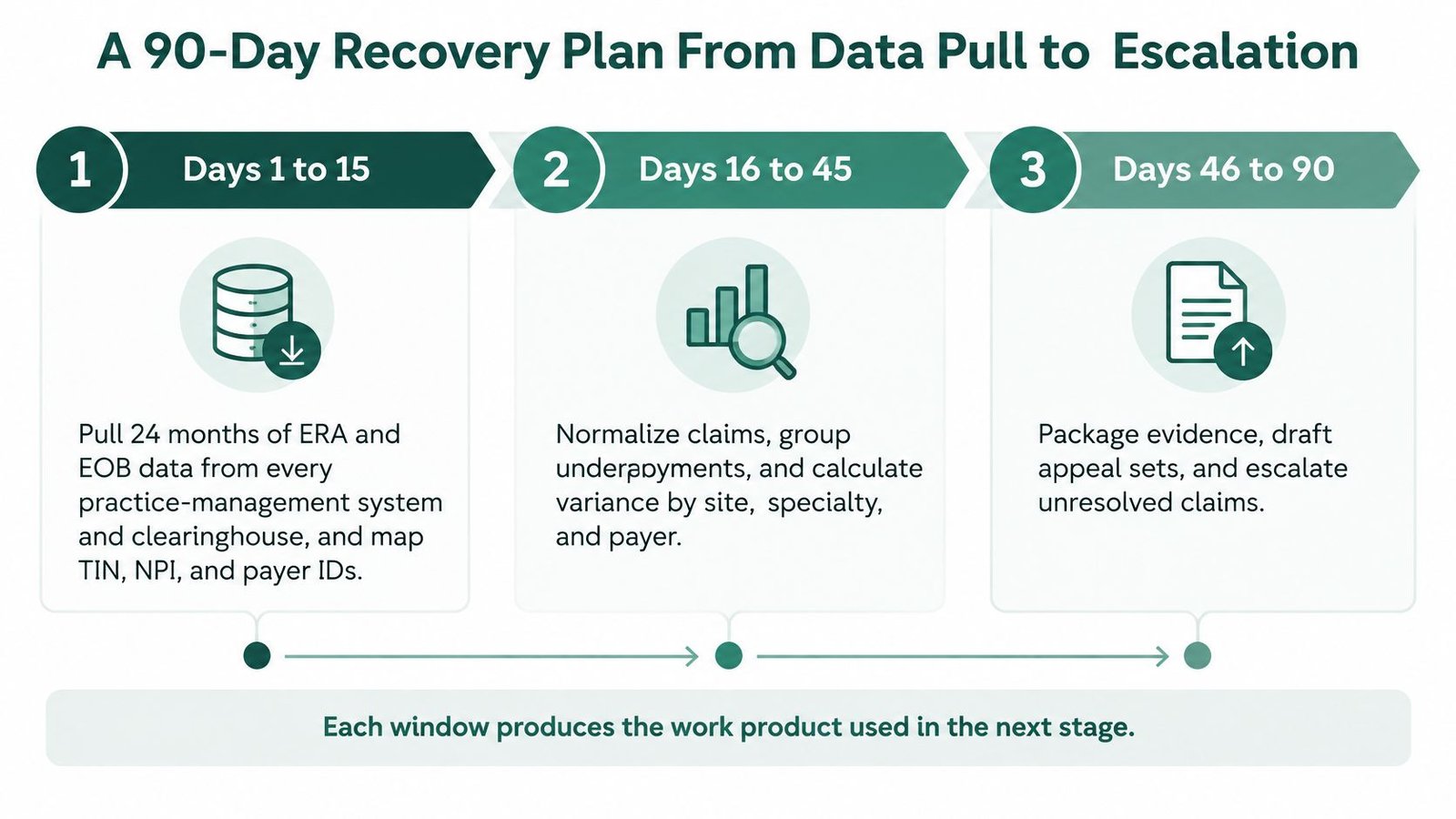
A usable recovery plan produces a work product at each checkpoint, not just a calendar of calls. Keep the original claim line, site, and payer identifiers intact throughout; blending sites into one charge total destroys the audit file.
Days 1 to 15, produce the platform data map. Pull 24 months of ERA and EOB data from each PM system and clearinghouse. Map TIN, NPI, facility, payer IDs, and fee schedules so acquired locations can be compared. Avoid: treating each system's export as a complete platform view.
Days 16 to 30, produce a routed triage list. Separate pure underpayments from coding, authorization, and timely-filing defects. Route technical defects to corrected claims or first-level appeals rather than parking them in an IDR queue. The denial-management guide is relevant to that defect path. Avoid: calling every low allowed amount a payer-rate dispute.
Days 31 to 60, produce payer-specific batches. Group 10 or more similar underpaid claims by payer so the case can be evaluated as a meaningful set. Start NSA open negotiation only for qualifying lines, and preserve each line's supporting records. Use the guide to batching underpaid out-of-network claims to keep the package auditable. Avoid: merging unrelated services or locations in a way that masks the line-level facts.
Days 61 to 90, produce an escalation and deadline file. Use a formal payer dispute or IDR when the claim qualifies and the evidence supports it. If the original window has closed, assess whether resubmission can produce a fresh EOB under the payer's rules. Avoid: assuming a new EOB automatically revives every dispute right.
A realistic cash timeline is 45 to 90 days, not a promise of payment by a particular date. No patient contact is needed when an assignment of benefits is on file. Each checkpoint should leave three controls behind: a ranked worklist, a batch log, and a deadline calendar.
How We Approach Payer Negotiation and IDR
We approach commercial negotiation by presenting a coherent batch, not arguing over an isolated visit. Group 10 or more underpaid claims with a shared payer issue so the case manager can assess the total exposure and the supporting pattern.
For the valuation, use FAIR Health benchmarks as a negotiation reference, not the practice's billed charge. Treat the 90th percentile as a ceiling and the 80th percentile as a typical settlement point, then explain why the affected services and claim details support the proposed offer. Those reference points aren't a promise that a payer will accept a particular amount.
Track the federal clock only for eligible claims
For eligible disputes, CMS sets a 30-business-day open-negotiation period after the initial payment or denial. If the parties don't agree, either may generally initiate federal IDR within 4 business days after that period ends. A certified IDR entity must select one party's final offer, not split the difference, and the selected payment must be made within 30 calendar days, as described in the CMS notices and IDR guidance.
Federal IDR applies to certain emergency services and non-emergency services furnished by out-of-network providers at in-network hospitals, hospital outpatient departments, and ambulatory surgical centers, subject to eligibility requirements. A practical starting point is the federal IDR process guide for providers, alongside the No Surprises Act compliance checklist.
An award isn't cash until it posts to the correct TIN and site.
That's why payment reconciliation belongs in the recovery workflow. Match any determination to the later remittance and the right practice ledger before finance counts it as collected revenue. For anesthesia groups, the No Surprises Act IDR recovery guide can help organize the specialty-specific dispute path.
Know when not to file
IDR isn't the route for every low payment. An unsupported high offer can lose outright, and filing costs can make a low-dollar line uneconomic. Rank cases by net expected value, considering the defensible amount, evidence strength, eligibility, and cost of pursuing the claim.
Two alternatives need clear ownership. If the original payment window has closed, evaluate a compliant resubmission for a fresh EOB without assuming it resets every deadline. If the issue is office-based, authorization-driven, or contractual, use the payer's formal or one-time provider dispute process instead of federal IDR. The purpose is to select the path that fits the claim, not to escalate every balance.
When to Keep Recovery Beside the In-House Team
Keep in-house staff focused on eligibility, coding, clean claim submission, and routine denials. Add recovery support when repriced out-of-network claims, eligible NSA claims, or aged receivables from acquisitions require focused follow-up.
A paid-to-expected amount below 90% can be a useful review trigger when the payer-and-code comparison is sound and the potential recovery justifies the work. If the gap comes from a missing modifier, authorization, or unit, correct the upstream process instead. Sending a fixable claim into a separate recovery workflow adds handoffs without addressing the cause.
Partial support may be enough. A platform can begin with one specialty or location while its current biller handles routine work in the existing PM system. Happy Billing runs end-to-end billing and recovers underpaid out-of-network claims, with options for partial outsourcing, full RCM, or a scope between them.
Keep current clean claims in-house; assign aged variance to a focused recovery team.
That division lets coders stay focused on current work while a separate team handles older claim evidence, negotiation, and follow-up. For sporadic volume, a full IDR department may not be practical. Feed confirmed payer patterns back into charge capture and claim validation to reduce repeatable sources of variance.
For owners weighing staffing boundaries, the in-house versus outsourced out-of-network recovery guide outlines the trade-offs. Happy Billing can support a single specialty or location, partial outsourcing, or full RCM.
Discuss recovery support with Happy Billing
Questions Platform Owners Ask Before They Start
What must sit in the file before we escalate a claim?
Keep the EOB, original claim, payer and service-location identifiers, and the line-level batch total. Add the relevant QPA or FAIR Health calculation and any supporting contract or clinical evidence. Don't file if the likely net recovery won't cover the work.
Does a high provider win rate mean we should dispute every low payment?
No. Providers prevailed in approximately 80% of federal IDR disputes that reached a payment decision in 2023, according to the Congressional Research Service IDR report. That figure doesn't make every claim eligible or prove that each case is economic; choose based on the evidence and net expected value.
Will this replace our billers or force a software change?
No. Overflow recovery can sit beside the existing team and practice-management system. Keep ownership clear so two groups don't submit duplicate disputes or conflicting corrections.
How should we forecast recovered cash?
Use 45 to 90 days as a planning range for a complete file, not a guarantee. No patient contact is needed when an assignment of benefits is on file, and finance should count cash only after payment posts to the correct TIN and site.
Federal IDR is only one route among corrected claims, contract disputes, state processes, and payer escalation. The Georgetown analysis of IDR costs underscores why platforms need disciplined eligibility and case selection rather than sending every low payment to arbitration.
Happy Billing recovers out-of-network underpayments and can work alongside your in-house RCM team, starting with the cross-site variance file that shows where allowed amounts diverge from defensible expectations. Visit Happy Billing to discuss a practical recovery scope for your therapy, pain, or anesthesia platform.
Want someone to work these claims for you? Happy Billing handles out-of-network underpayment recovery for independent practices: repricing disputes, plan appeals, state complaints, and No Surprises Act IDR where it applies.