Pediatric Therapy Out-of-Network Underpayment Recovery (OT, PT and Speech)
Your pediatric therapy out-of-network money is leaking in a place most owners don't inspect closely enough. A claim can pay, post, and still be badly underpaid, which means your denial rate looks stable while your revenue per visit and days in A/R drift the wrong way.
Happy Billing is a medical billing company headquartered in Houston, Texas. We recover out-of-network underpayments for physical therapy, chiropractic, sports medicine and behavioral health practices, including practices in New Jersey and New York.
A Manhattan physical therapy group thought it was getting normal out-of-network reimbursement until Cigna's repricer turned a visit built from 97140 x2 and 97110 x2 into a $60 payment on a $540 claim. The same pattern had historically produced $300 to $400 per visit, so the loss wasn't cosmetic, it was a direct hit to collected revenue on every visit that got repriced instead of negotiated. A multi-location New Jersey sports medicine practice saw the same play from Cigna and Horizon, with roughly $300 claims dropping to about $100. That's the kind of shrinkage that hides inside posting, lowers net collections, and drags your A/R longer than it should.
If you want a quick benchmark for whether your own out-of-network claims are being squeezed, use this systematic underpayment checklist for OON claims. And if you're comparing this problem to other therapy-family reimbursement disputes, verify your ABA insurance benefits can be a useful parallel for how families and practices get misled by coverage language.
Think a payer underpaid your out-of-network claims? We review your remits, find the underpaid claims, and handle the appeals. Get a free underpayment analysis.
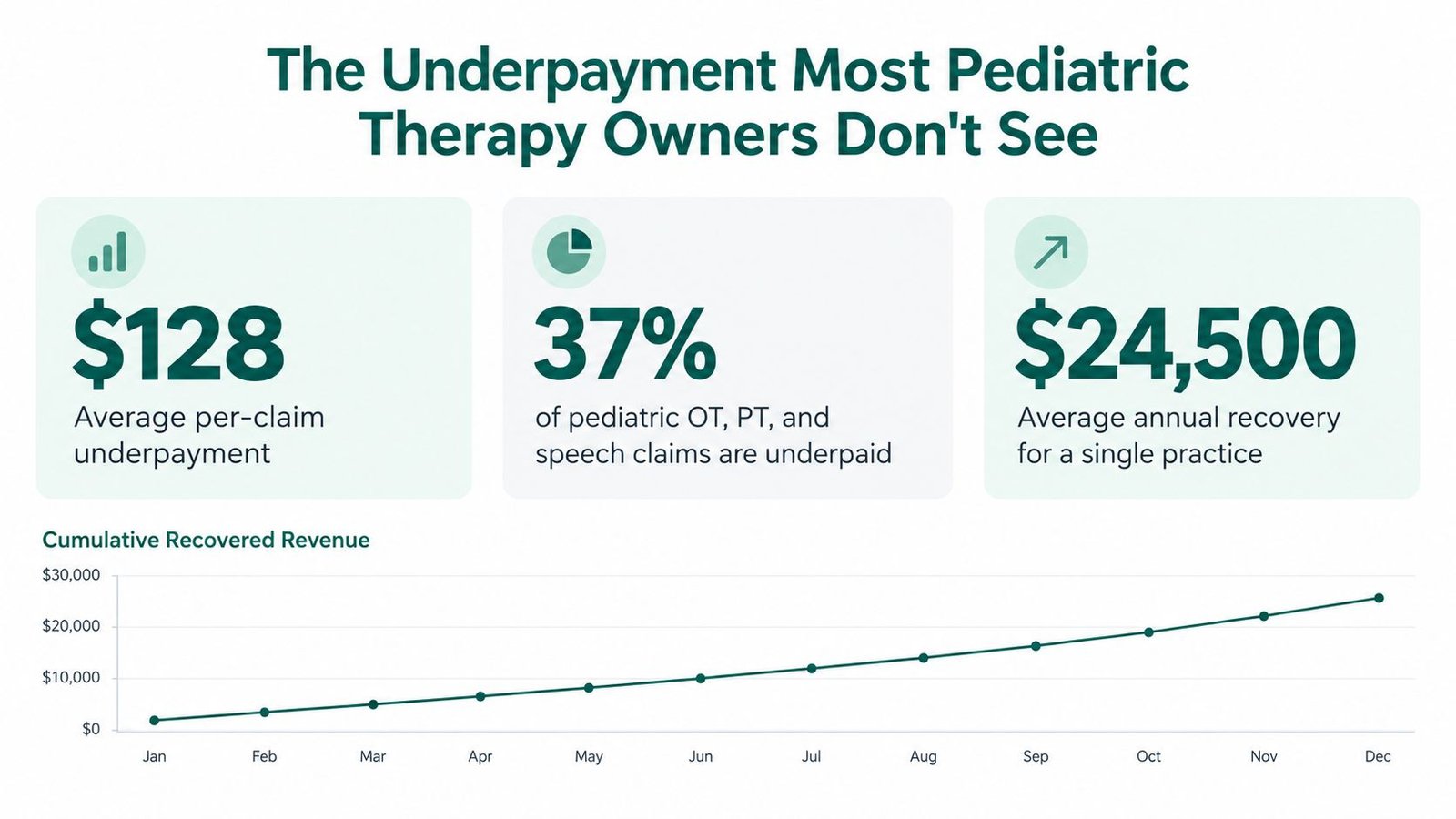
The Underpayment Most Pediatric Therapy Owners Don't See
Most owners think the problem is denial. It usually isn't. The bigger leak is a paid claim that lands far below the amount your plan language or UCR benchmark should have produced, and that money often gets posted as if it were final.
Why the loss hides so well
Underpayment is dangerous because it looks like normal adjudication. If the payer sends a check and an EOB, the front desk or billing team can treat it like a closed loop, even when the amount is materially below what the benefit design promised. That's exactly how recurring therapy visits become a slow bleed on revenue per visit and A/R days.
You see this especially in weekly OT, PT, sensory integration, feeding, and speech plans of care. One low-paid eval or treatment visit doesn't look dramatic on its own, but the math changes when the same repricer logic hits dozens or hundreds of sessions across a month.
Practical rule: A paid claim is not a correctly paid claim. If you don't compare the allowed amount to the benefit language and benchmark methodology, you're posting leakage as if it were cash.
Why owners miss it in the first place
Most pediatric therapy owners know their superbill workflow, but they don't run a true underpayment review. They check whether a check arrived, not whether the payer applied the right reimbursement basis. That's where the out-of-network underpayment guide for practice owners matters, because the process has to be built around recovery, not just claim submission.
The tell is consistency. If a payer keeps repricing the same therapy families, the same CPT families, or the same visit patterns, it's not random noise. It's systemic leakage that deserves a batch appeal, not a one-off callback.
What to compare before you call the payment final
Pull the billed code, units, modifiers, place of service, authorization, remittance reason codes, and the allowed amount. Then compare that amount to the plan's out-of-network language and benchmark method, not just the check itself. For broader context on how families are told to think about reimbursement percentages, FriendlyABA's parent financial guide is a useful reminder that family-facing explanation is usually not the same thing as provider-level reimbursement analysis.
If you want a clean decision rule, use this: if the allowed amount is wrong, the claim is underpaid, even when it paid.
What “Underpaid” Actually Means in Pediatric OON Billing
“Underpaid” means the payer paid something, but not the correct amount under the plan's own reimbursement logic. That's different from a denial, and it's different from patient cost share. Owners lose money when those buckets get mixed together, because underpayments get written off as contractual adjustments instead of being chased.
The only question that matters
What should have been paid? In practice, that means asking whether the correct reference point was the billed charge, the plan's allowed amount, a qualifying payment amount, or a UCR percentile. For many out-of-network therapy claims, that answer sits in the benefit language and benchmark methodology, not in the check amount.
That's why the usual and customary rates explainer for out-of-network providers matters. If the team doesn't know which benchmark the payer used, it can't tell whether the payment is right or just conveniently low.
Bottom line: The goal is not to collect from the family. The goal is to force the payer to pay the amount its own policy supports.
Underpayment versus denial versus patient balance
| EOB Signal | What It Means | Recovery Action |
|---|---|---|
| Payment posted below expected allowed amount | The payer paid, but likely used the wrong methodology or a reduced benchmark | Recalculate the allowed amount and appeal the gap |
| Claim denied | No payable amount was issued on the line | Appeal, correct the error, or resubmit with the missing documentation |
| Deductible or coinsurance shown | The patient owes part of the allowed amount under the plan | Collect patient balance if the plan language supports it |
| Generic “usual and customary” payment | The payer used a benchmark without transparent detail | Demand methodology, compare against plan terms, and dispute the shortfall |
The key operational point is simple. A visit that pays is not the same as a visit that pays correctly. When weekly OT, PT, and speech are running for months, a few dollars per visit becomes real annual leakage fast.
The fields that decide whether payment is final
Pull the remittance code, allowed amount, units paid, modifier pairing, authorization status, and any stated repricing method. Then compare those fields against the claim and plan excerpt line by line. If the claim was paid at the wrong unit count or the wrong benefit basis, it belongs in recovery, not in write-off.
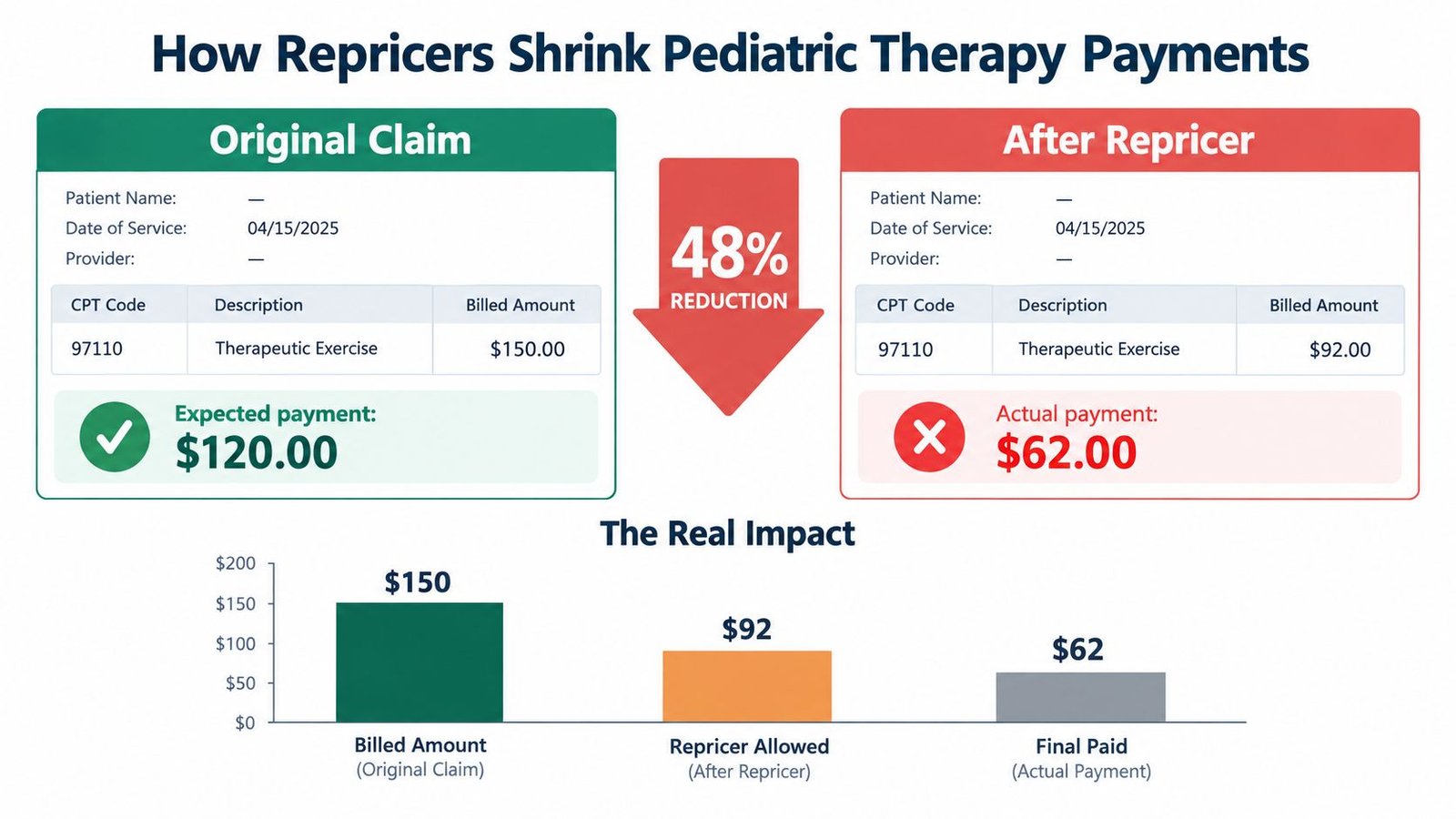
How Repricers Shrink Pediatric Therapy Payments
Repricers don't need to deny your claim to hurt you. They can keep it “paid” and still push the allowed amount down to a number that has nothing to do with the clinical service you delivered.
What the repricer is doing
MultiPlan, Zelis, and Data iSight, now rebranded as Claritev, are used by plans to set or influence the allowed amount on out-of-network claims. In plain English, they pull your claim into a benchmark system and pay against that benchmark instead of against your charge history or the family's out-of-pocket payment.
That matters because plans generally calculate reimbursement from an allowed amount, not from what the family happened to pay at the front desk. So when the repricer drives the allowed amount down, deductible and coinsurance calculations follow the lower number too. The family sees one outcome, the practice sees another, and the clinic eats the gap unless someone pushes back.
Why percentiles matter
FAIR Health's benchmark framework is the right lens here because it includes provider charges and payer-allowed reimbursement, with allowed benchmarks organized by region. In negotiation terms, the 80th percentile is a realistic settlement point, while the 90th percentile behaves like a ceiling for pushing value. The payer wants to live below that ceiling, so your case has to be built around the actual allowed amount and the benchmark support, not around hope.
Why visit limits make repricing worse
Repricing doesn't just cut the payment. It can also consume a limited authorized visit. A repriced visit still counts against the authorization or visit cap, so the practice loses twice, once on payment and again on capacity. For pediatric OT and PT, that's especially costly when the plan requires reauthorization after a limited initial set of visits.
The smart move is to treat repricing as a payment methodology problem, not a patient eligibility problem. This guide to Cigna repricing in physical therapy is a good reminder that the payment issue often sits downstream of the claim file, not in the treatment room.
What payer teams usually won't tell you
They won't volunteer the benchmark logic unless you force the issue. They'll post a low allowed amount, keep the file moving, and hope the practice is too busy to compare the remittance against the plan language and the market benchmark. That's exactly why a batch dispute works better than a single angry phone call.
If the claim is paid but the allowed amount is off, the repricer already did its job. Your job is to unwind it.
CPT Codes, Modifiers, and Unit Rules That Drive Pediatric Underpayment
Pediatric therapy underpayment often starts with code discipline, modifier pairing, or unit math. If those fields are wrong, the payer either cuts the claim down or rejects it before the underpayment even becomes visible.
The codes that show up most often
Therapy owners see 97110, 97112, 97530, and 92507 constantly, along with OT evaluation codes 97165 to 97167. CMS identifies 97110 as therapeutic exercise and 97530 as therapeutic activities, both reported in 15-minute units. That unit structure is where underpayment hides, because a four-unit visit that gets paid as two units is a recoverable shortfall, while an inflated unit count can create recoupment risk. CMS's coding guidance for therapeutic exercise and activities makes that unit logic explicit.
The modifier rules that protect revenue
CMS requires GP for physical therapy, GO for occupational therapy, and GN for speech-language pathology. Those discipline markers are not decorative, they decide whether the payer reads the claim under the right therapy plan of care. For speech claims, CMS-related guidance also ties appropriate speech services such as 92507 and 92526 to the GN modifier, while speech-language providers should not bill physical-medicine codes like 97110 and 97112 under their own discipline. ASHA's speech-language coding rules spell out that discipline boundary.
Operational rule: If the modifier is wrong, the claim may be priced as the wrong discipline or kicked back as unprocessable. That's front-end cash loss, not an innocent edit.
Assistant modifiers can stop payment before it starts
CMS also requires CQ for physical therapist assistant services and CO for occupational therapy assistant services, paired with the discipline modifiers CQ with GP and CO with GO. When that pairing is missing, the claim can be rejected or returned as unprocessable before the payer even reaches the allowed amount. CMS's PTA and OTA modifier billing examples are clear that the pairing matters.
A payer-facing audit checklist
- CPT and discipline match: Make sure 92507 isn't being processed outside the speech discipline and that 97110 or 97530 sit under the right therapy plan of care.
- Units match documentation: Reconcile timed documentation against paid units, because the underpayment lives in the unit gap.
- Assistant modifiers pair correctly: Check CQ/GP and CO/GO before posting the claim as final.
- Authorization and visit caps align: A repriced visit still burns one authorization unit or visit slot, even when it was underpaid.
If your team wants a deeper read on unit math, the 8-minute rule billing guide is the right technical companion piece. The financial point, though, is simple. Bad modifier or unit handling turns recoverable revenue into avoidable churn.
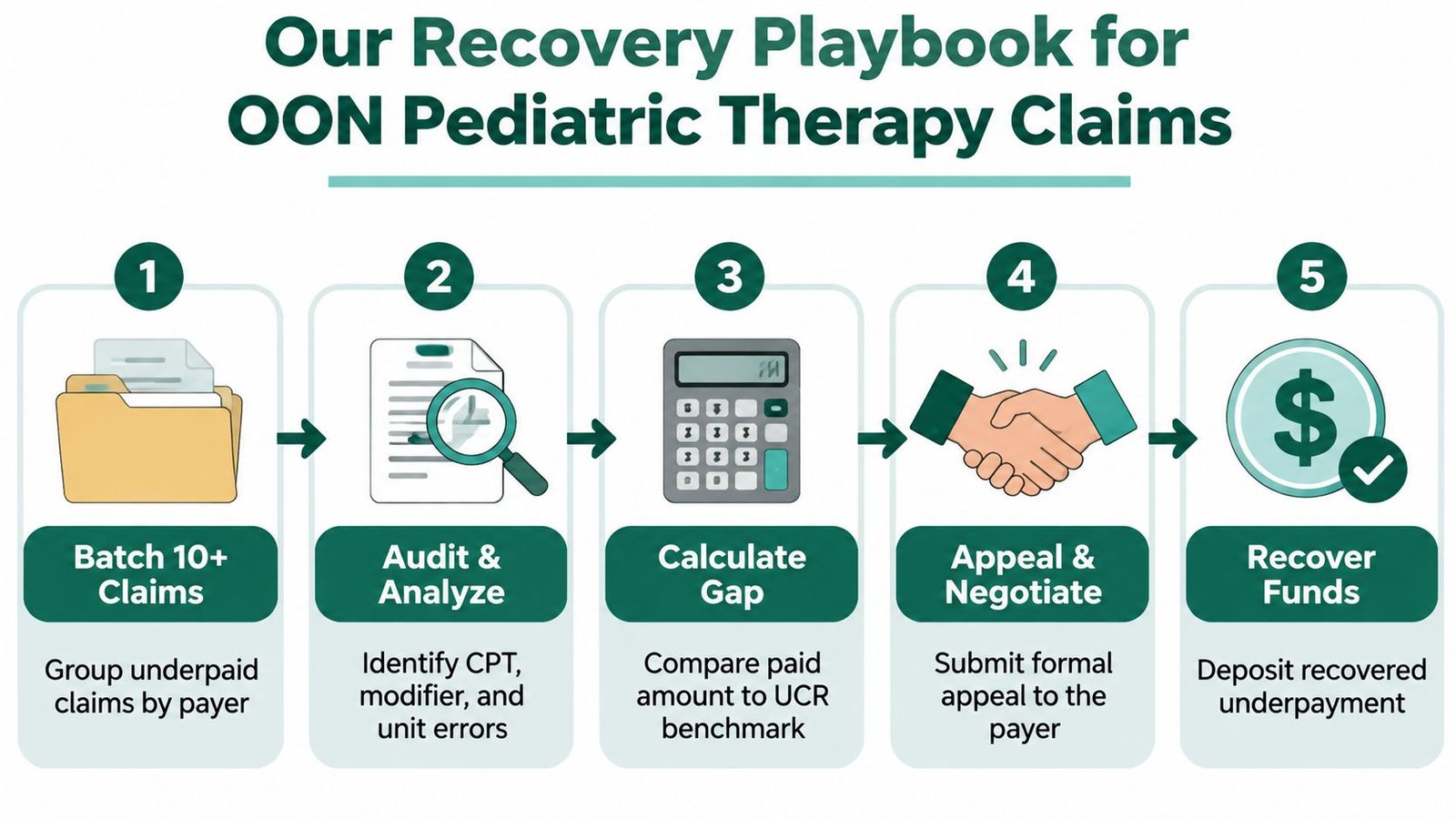
Our Recovery Playbook for OON Pediatric Therapy Claims
The fastest way to recover out-of-network therapy underpayments is to stop treating them like isolated billing errors. We batch them, document them, and push them through the payer's dispute path with enough weight that a case manager has to look at them.
Batch first, then negotiate
We start by grouping 10 or more underpaid claims by payer. That threshold matters because a single $40 or $60 discrepancy gets ignored, while a batch with real aggregate dollars gets routed to someone who can move the case. When the batch is built right, the payer stops seeing noise and starts seeing exposure.
The negotiation package should include the remittance, the superbill, the plan benefit excerpt, and a FAIR Health benchmark exhibit. We use the benchmark as the reference point for the allowed amount, then make the math obvious. The UHC out-of-network underpayment appeal guide is a useful example of how structured dispute materials change the tone of the conversation.
Resubmit while the filing window is still open
If the original filing window is still open, we resubmit for a fresh EOB instead of waiting around for the payer to “reconsider” informally. That creates a cleaner administrative trail and often gives us a second shot at the claim before we move to a formal dispute. It's not glamorous, but it shortens the path to cash.
Escalate when the payer stalls
If the payer won't correct the amount, we escalate to the formal provider dispute channel and, where eligible, the federal or state IDR path. The No Surprises Act created a major historical boundary here, and CMS's dispute framework shows why payment offers, not just denials, now have a defined challenge path. The law is most directly tied to emergency and certain facility-based services, so routine therapy claims don't automatically qualify, but the broader lesson still applies, low payment isn't the same as final payment.
Timing reality: A well-run batch usually lands in the 45 to 90 day range from intake to resolution. Faster happens when the file is clean, slower happens when the payer keeps cycling the same low offer.
No patient contact is needed when an assignment of benefits is on file. That's important, because the recovery target is the payer's underpayment, not the family's balance.
Visit Limits, Network Gaps, and the AOB Shortcut
Visit limits and network-gap exceptions are separate levers, and owners lose money when they treat them like the same thing. A therapy plan can be authorized, still underpaid, and still limited by visits, all at once.
Why authorization approval doesn't end the story
A limited number of initial OT or PT visits can look like protection on paper and still turn into a revenue trap in practice. If the payer reprices the visit and the visit also counts against the cap, the practice burns clinical capacity without receiving the market-based amount it expected. For owners, that's not a coverage issue, it's a margin issue.
A network-gap or in-network-rate exception is the right move when the local directory doesn't reflect reality. Good evidence includes directory screenshots, unanswered calls, wait times, distance, language or specialty mismatch, and continuity needs across OT, PT, and speech. If the plan advertises access but doesn't offer a clinically equivalent provider, that gap belongs in the file.
What the AOB changes
An assignment of benefits moves the recovery right to the practice. That means the practice owns the underpaid balance and the appeal path, not the parent. It also means the family should not be dragged into a provider-level reimbursement dispute when the payer's calculation is the problem.
Practical takeaway: If you're checking coverage for a therapy family, the clinic's job is to prove the gap and recover the money. The parent's job is not to chase the payer.
For a related therapy-coverage example, check pelvic floor therapy insurance coverage shows how access and reimbursement questions often overlap in ways families never see. The same logic applies here. If the network is inadequate, document it. If benefits are underpaid, pursue the balance. If AOB is in place, keep the dispute inside the practice.
Not sure what your claims should have paid? Request a free out-of-network underpayment analysis. Your current biller can stay in place while we review.
Frequently Asked Questions From Pediatric Therapy Owners
What does an underpayment recovery engagement cost
It should be contingency-only, tied to claim age and volume, with a clear number after a free out-of-network underpayment analysis. That keeps the risk aligned with net collections instead of adding fixed overhead to a problem that already hurts A/R.
Can we keep seeing families while the recovery push is happening
Yes. You should. Recovery work is a back-office revenue project, not a reason to interrupt care or slow down scheduling. The goal is lower denial rate, cleaner posting, and faster cash, not a disruption to the clinical calendar.
Which codes should we attack first
Start with your highest-volume therapy codes, especially the ones that are most often repriced, unit-reduced, or mismodified. In most pediatric groups, that means the timed PT, OT, and speech lines that show up on every weekly plan of care.
What if visit limits are eating into authorizations
Treat that as a separate control issue. Repriced visits can still count against the cap, so the fix is to challenge the allowed amount, document the access gap, and stop posting low payments as if they were correct.
If your pediatric therapy group is seeing paid claims that still feel too low, that's the right time to act. Happy Billing can help you isolate underpayments, batch the strongest claims, and pursue the payer with a recovery workflow built for OT, PT, and speech revenue, not patient balance confusion.