Out-of-Network Physical Therapy Billing in New York City
A Manhattan physical therapy practice can make a deliberate decision to stay out of network, then discover that a repricer has reduced a visit's payment to a fraction of what its team expected. Out-of-network physical therapy billing in New York City is a revenue strategy, not an administrative accident, and protecting that revenue requires accurate benefit checks, careful surprise-bill screening, and active follow-up on underpaid claims.
Happy Billing is a medical billing company headquartered in Houston, Texas. We recover out-of-network underpayments for physical therapy, chiropractic, sports medicine and behavioral health practices, including practices in New Jersey and New York.
Why NYC Physical Therapy Practices Go Out-of-Network
A Manhattan practice billed $540 for a visit that included 97140 x2 and 97110 x2. Cigna paid $60 after Data iSight repriced the claim, down from the $300–$400 per visit the practice had been receiving. That kind of payment swing puts an immediate dent in revenue and can leave an in-house team spending time on claims that appear paid but may not be fairly reimbursed.
Out-of-network billing is a deliberate choice for many independent physical therapy practices in Manhattan and across New York City. It can preserve clinical and operational flexibility, avoid restrictive payer contracts, and let a practice set its own fees. The trade-off is that the plan's allowed amount may be far below the clinic's charge, and patients may have different cost-sharing depending on their coverage and whether legal protections apply.
The revenue risk is visible when repricing changes a claim's payment substantially. The Manhattan example shows why a posted payment isn't the same as a resolved claim: the practice needs to know what the plan quoted, how it adjudicated the claim, and whether the reduction is disputable.

The New York compliance boundary
New York's Surprise Medical Bill Law took effect on March 31, 2015. It generally protects patients when an out-of-network clinician treats them at an in-network hospital or ambulatory surgical center, or when an in-network physician refers them to an out-of-network provider without adequate choice or disclosure. For covered surprise bills, the patient owes the applicable in-network cost share, not the remaining balance. The New York Attorney General's report described a physical therapy office that collected more than $5,000 after misrepresenting network status and ultimately refunded $5,175 following intervention.
The protection depends on the plan and circumstances. Fully insured plans regulated by New York are covered, but practices should verify whether a patient's plan is self-funded or otherwise exempt before applying state rules. For an elective out-of-network episode, patient liability may be different. Treat network disclosures and referral documentation as financial controls, not intake paperwork.
US practices only.
The NYC Payer Mix and Repricers That Hit Your Claims
Cigna, Aetna, UHC/Oxford, and Empire are familiar names in New York City practice revenue cycles, but an insurer's name alone doesn't tell you what the claim will pay. The benefit design, network status, authorization terms, and adjudication method all matter. Practices should read the explanation of benefits (EOB) closely and identify whether a third-party repricer affected the allowed amount.
Data iSight, MultiPlan, and Naviguard are repricers practices may encounter on out-of-network claims. A repriced claim can show a payment that looks like routine adjudication, even when the allowed amount is materially below the clinic's expectation. The Manhattan Cigna example in the previous section is one illustration. In another anonymized case, a multi-location New Jersey sports medicine practice saw Cigna and Horizon reprice claims of about $300 to about $100.
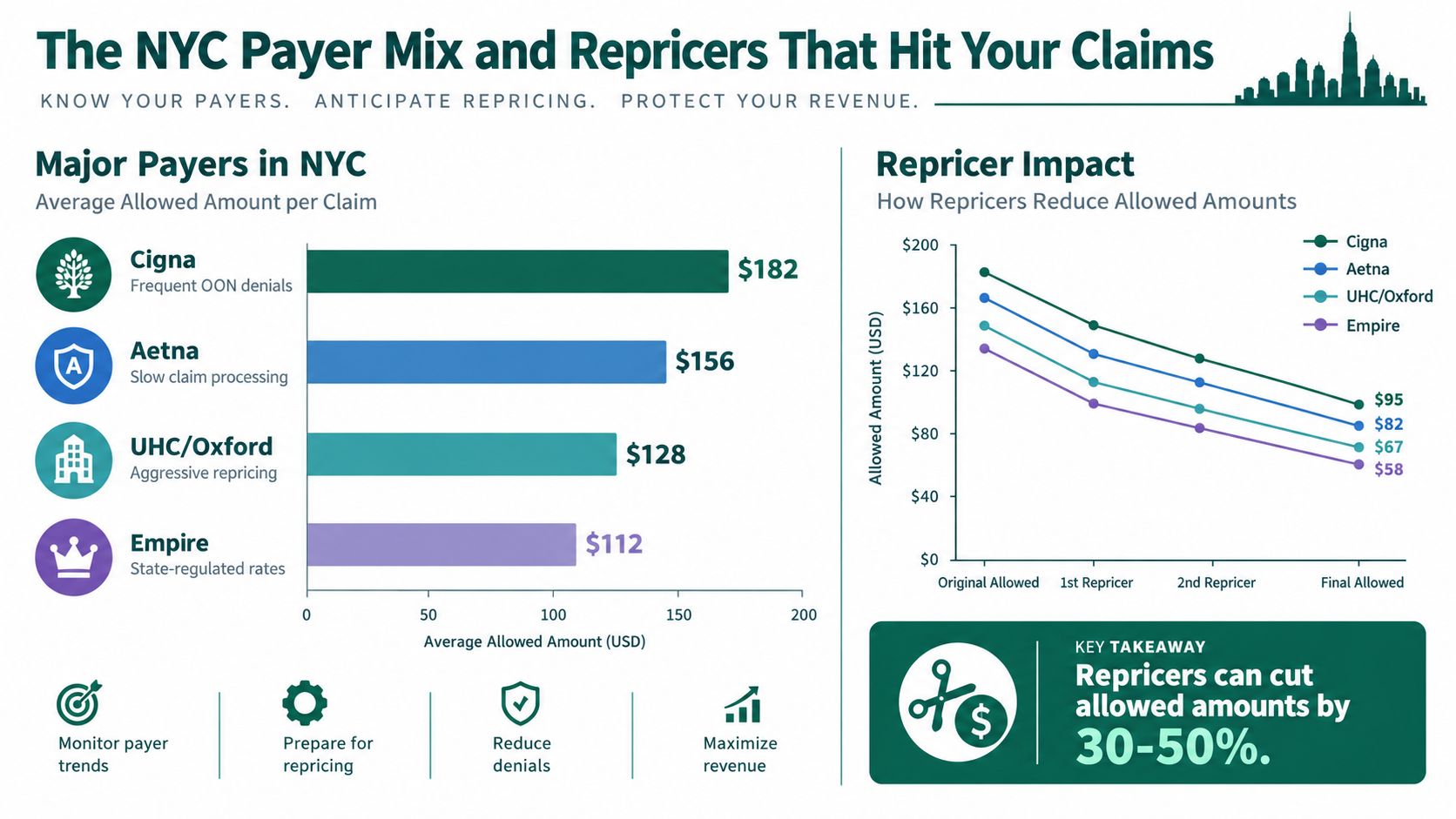
Don't assume a low payment is correct because the EOB says the claim was processed. Compare the payment and allowed amount with the plan's documented out-of-network benefit estimate, and look for repricer references or adjustment details. Cigna, Aetna, UHC/Oxford, and Empire can each have different plan-specific rules, so a payer-level generalization won't replace checking the member's actual benefits.
For a useful comparison of how treatment codes affect reimbursement expectations, review this guide to 97110 and 97140 out-of-network reimbursement. A broader benefits reference, such as this guide to verifying BCBS chiropractic benefits, can also help practices think through the questions to ask when checking plan coverage. Neither replaces direct verification with the patient's specific plan.
New York Surprise Bill Protections and Compliance Essentials
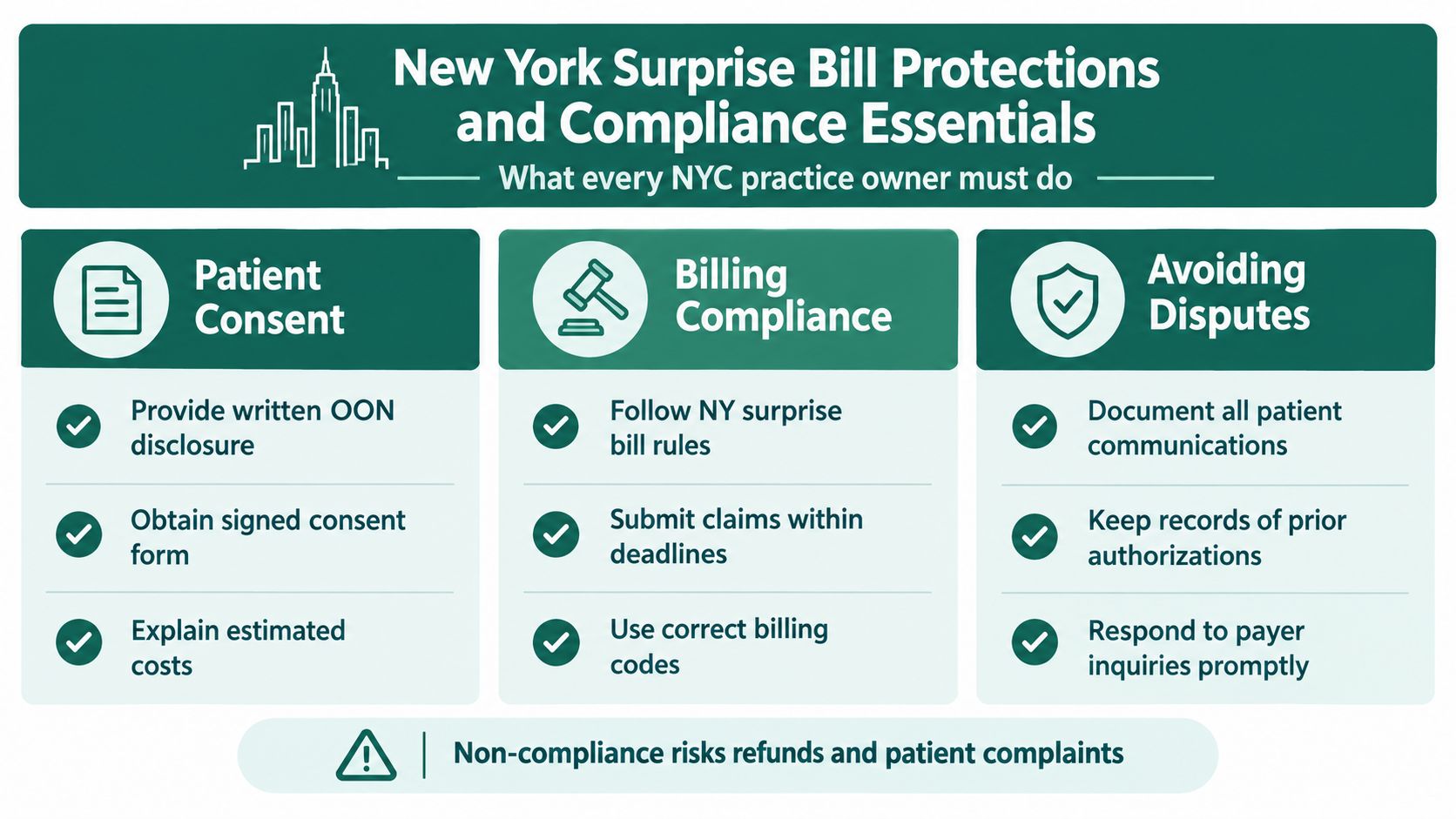
The key operational distinction is between an ordinary elective out-of-network episode and a protected surprise bill. An out-of-network provider hasn't contracted with the patient's plan; in an elective episode, the patient may face higher cost-sharing or a balance unless another protection applies. New York's protections generally apply in specified facility-based and referral situations, while federal No Surprises Act protections have operated alongside state requirements since January 1, 2022. New York's consumer guidance explains the documentation involved in disputing a protected bill, including the Surprise Medical Bill Certification Form for referral cases.
For a referred case, the patient submits the certification form to the plan and provider. The practice should retain the referral and relevant facility participation evidence, along with the form and payer correspondence. Don't issue a patient statement for a potentially protected bill until the protection status and claim adjudication are clear.
Make classification part of pre-bill review
A practical compliance sequence starts before claims go out:
- Screen the encounter: Determine whether the referral or facility setting may qualify for surprise-bill protection.
- Keep the evidence: File referral records, certification forms, network disclosures, assignments of benefits, and payer correspondence together.
- Verify the benefit: Ask the plan for its approximate reimbursement for the specific out-of-network service, and request written confirmation when available.
- Hold patient billing when status is unresolved: Don't transfer a balance until the protection question and adjudication are resolved.
- Escalate eligible disputes: Use New York's independent dispute-resolution process when the claim qualifies. New York DFS IDR information outlines the state process.
New York DFS requires plans, on request, to disclose the approximate amount they'll reimburse for a specific out-of-network service. That makes benefit verification a concrete control against unsupported patient balances. For a New York-specific overview of these rules and their operational implications, see the guide to New York surprise-bill protections for practice owners.
How Underpayment Recovery Works for NYC Practices
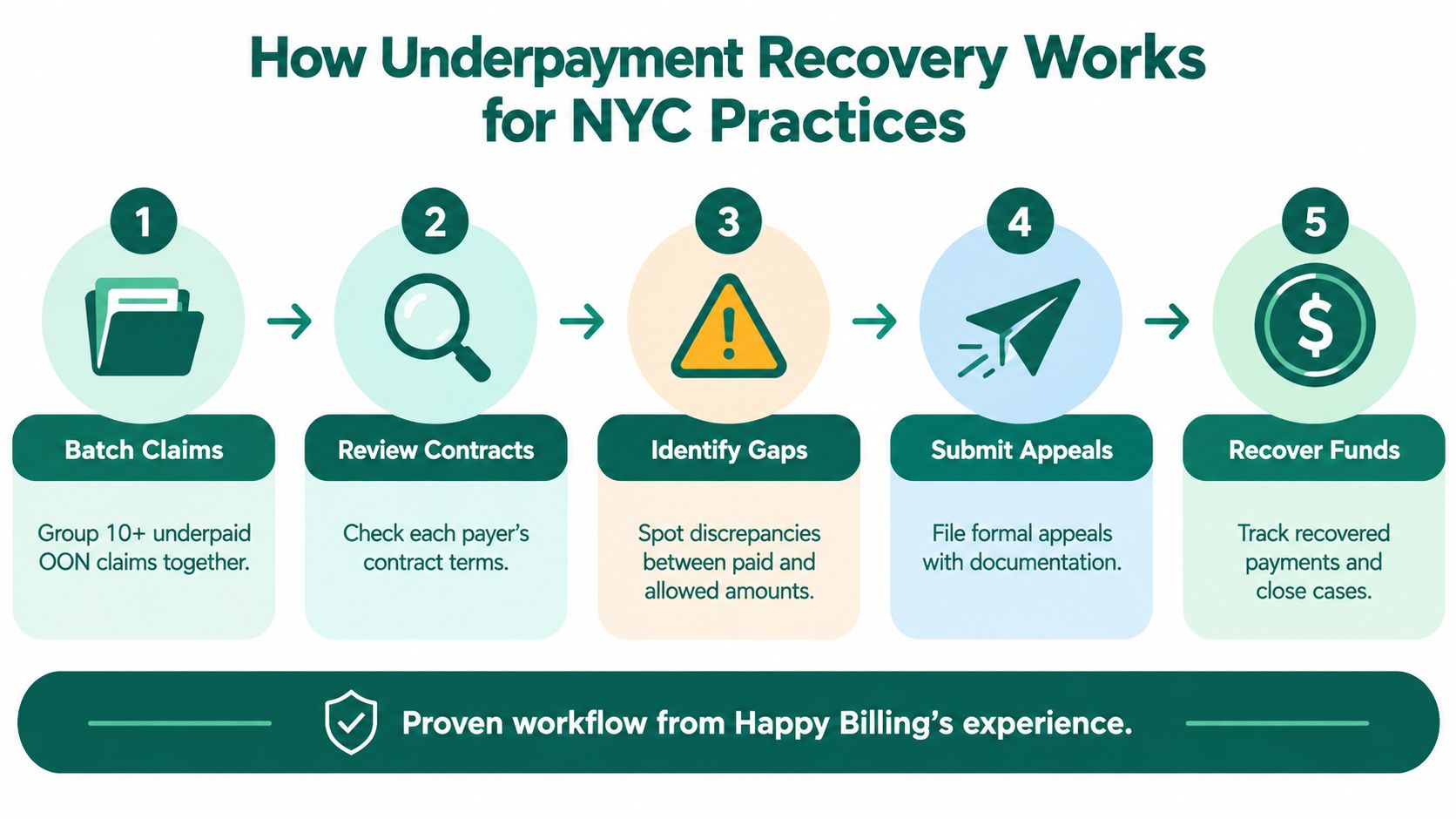
Underpayment recovery works best as a separate review after the payer has processed the claim. The practice keeps its existing billing operation; a recovery partner takes over paid claims that appear underpaid, investigates the discrepancy, and pursues the payer. When an assignment of benefits is on file, that work can proceed without contacting the patient.
How we approach it
The first move is to batch 10 or more underpaid claims. A consolidated submission can make the issue and its financial value clearer to a payer case manager than isolated requests. The review compares the payer's allowed amount with the benefit information and available FAIR Health benchmarks. In the approach described here, the 90th percentile serves as a ceiling, while the 80th percentile is a typical settlement point, not a guaranteed payment.
Next, the recovery team contacts the payer and negotiates with claim-level documentation. If a filing window has closed, resubmission may be an option to obtain a fresh EOB, depending on the payer's rules and circumstances. If direct negotiation doesn't resolve the issue, the matter can move to the payer's formal provider dispute process or to IDR when eligible.
A realistic recovery timeline is 45–90 days. The outcome depends on the claim, payer, documentation, and available dispute route; no benchmark guarantees a specific result. For the practice's next claims, use a benefit-first workflow: confirm plan type, obtain out-of-network deductible and coinsurance details, verify limits and authorization, document the call reference number, secure a signed AOB and financial policy, and submit complete coding and provider details. Then compare the remittance against the quoted benefit before billing the patient.
When a balance is ultimately patient-responsible, clear communication can help the practice handle it constructively. For an example of patient-facing options, see payment plans for medical care. For a more detailed operational framework, use this physical therapy underpayment recovery guide for practice owners.
Common Denial Reasons and How to Appeal Them
A denial and a low payment aren't the same problem, but both can damage cash flow if the team treats them as closed claims. Start with the remittance reason code, then decide whether the issue is authorization, coding, benefit application, or repricing. A dedicated recovery review adds capacity that an in-house biller may not have for older paid claims, without requiring the practice to hand over routine billing.
Match the response to the cause
Missing or incorrect authorization can leave the practice with an unpaid claim, even if the treatment was clinically appropriate. Check whether the plan required authorization and whether the submitted number and dates match the service. CPT errors, unit discrepancies, or bundling edits can also reduce payment; for codes such as 97110 and 97140, verify units, documentation, and any payer-specific edit before appealing.
A deductible or coinsurance application may explain the payment, but don't accept that explanation without comparing it to the member's verified benefits. If the EOB reflects repricing, the appeal should address the allowed amount and the basis for the reduction, not just medical necessity. That's where claim history and payer correspondence help distinguish a valid benefit calculation from a disputable reduction.
Appeal rule: Use the remittance reason code to identify the issue, attach the relevant clinical and benefit documentation, and state what correction or reconsideration you're requesting.
For protected surprise-bill cases, first classify the encounter and retain the required documentation. Suppress patient statements while the protection question remains unresolved, then appeal with the EOB and supporting records. Escalate through New York's process only when the dispute is eligible. The provider out-of-network appeal package checklist can help standardize supporting materials across claims.
Best Practices for Protecting Your OON Revenue
The strongest revenue protection comes from connecting front-end verification to back-end payment review. A benefit check without a remittance comparison leaves repricing unnoticed. A paid claim without a variance review can still be underpaid.
For each episode, keep one consistent operating record: plan type, out-of-network benefits, authorization requirements, referral details, call reference numbers, written estimates, the signed AOB, and the financial policy. New York physical therapy guidance expects written acknowledgment of the treatment plan and billing arrangements, and directs licensees to understand third-party-payer requirements. Both the clinical and administrative teams need access to that file.
Practical rule: Compare the plan's quoted benefit with the ERA before deciding a low payment belongs to the patient.
A "benefit quote versus ERA" queue makes the comparison repeatable. Flag differences for review, then check coding edits, deductible application, bundling, authorization gaps, and incorrect fee-schedule assumptions. Hold balance statements until the practice has resolved both the payment variance and any surprise-bill question.
Split the labor clearly. An in-house biller keeps claims moving and maintains payer relationships. A recovery partner works the paid-claim inventory afterward, pursuing repricing and underpayment disputes while the practice keeps its regular billing workflow. To assess the fee benchmark behind a disputed allowed amount, use this breakdown of usual and customary rates for out-of-network providers.
Book a free 30-minute call with a Happy Billing specialist to review your recent out-of-network remittances and identify underpaid claims. We work with US practices only, on a contingency basis with nothing upfront.
Frequently Asked Questions About OON Billing
Can our practice start PT without a referral and still receive out-of-network reimbursement?
New York allows a licensed physical therapist to treat without a referral for up to 10 visits or 30 days, but that doesn't guarantee insurance payment. A plan may still require a referral or authorization, and some payer contracts restrict payment to services personally rendered by a licensed PT. Verify legal access, out-of-network benefits, and claim conditions separately. New York physical therapy practice guidance addresses payer requirements.
How do we distinguish a protected surprise bill from an elective OON claim?
Review the referral and care setting, then document whether the encounter meets New York's protection criteria. If status is unresolved, hold patient billing while the practice verifies coverage and adjudication.
What if a payer confirms coverage by phone, then denies the claim?
Keep the call reference number and any written confirmation. Compare the denial reason with the verified benefits, submit a formal appeal with supporting records, and correct authorization or claim details if needed.
How long does recovery take, and what does it cost?
A realistic timeline is 45–90 days. Fees are contingency-only and depend on claim age and volume; a clear number is provided after a free 30-minute call with a billing specialist.
Happy Billing works with out-of-network physical therapy practices to review paid claims and pursue underpayments while the practice keeps its in-house billing operation. Fees are contingency-only, based on claim age and volume, with nothing upfront. To discuss your New York claims and workflow, visit Happy Billing.