97110 and 97140 Out-of-Network Reimbursement: What Payers Should Pay
There is no single mandated out-of-network rate for 97110 or 97140. On a four-unit visit billed around $540, repricers often push payment into the $60 to $150 range, which is the kind of gap that drives real A/R damage and turns “pricing” into a recovery problem.
Happy Billing is a medical billing company headquartered in Houston, Texas. We recover out-of-network underpayments for physical therapy, chiropractic, sports medicine and behavioral health practices, including practices in New Jersey and New York.
For independent PT, chiro, and sports medicine owners, that gap is not a coding nuisance. It's lost revenue sitting in underpaid EOBs, and it adds up fast when the payer is using Data iSight, MultiPlan, or Zelis to reprice the claim.
What Payers Actually Pay for 97110 and 97140 Out of Network
A four-unit visit billed near $540 can land at $60 to $150 once a repricer touches it. That is the reimbursement pattern on a lot of PT and chiro claims, and it is the gap that burns time, cash flow, and staff attention on the back end.
Practical rule: if the EOB shows a low allowed amount but the note supports the units, stop treating it like a coding problem first. Treat it as a pricing-methodology dispute.
There is no universal national out-of-network amount for 97110 or 97140. Payment usually follows the member's policy language and the plan's usual, customary, and reasonable framework, not your billed charge alone. For a plain-English explanation of how that framework gets used in out-of-network recovery, see the usual-and-customary rates guide for out-of-network providers.
The allowed amount can also change by jurisdiction and plan language. Some state policy materials use a “greatest of” standard, which changes the math fast and explains why the same claim can price differently depending on where the member is covered.
| Repricer | Typical output | % of billed charge |
|---|---|---|
| MultiPlan | Often far below billed charge on PT and chiro claims | Commonly a small fraction of charge |
| Zelis | Often repriced to a plan-defined allowed amount | Commonly a small fraction of charge |
| Data iSight / Claritev | Often repriced to a database-based figure | Commonly a small fraction of charge |
| Plan-internal schedule | Often capped by written benefit logic | Varies by plan and contract language |
The operational point is simple. A low allowed amount on 97110 and 97140 is usually a methodology issue, not a random mistake. If the payer used a repricer, your team should ask which rule set drove the number, whether the allowed amount matches that rule set, and whether the claim was priced on the actual units submitted.
That is denial-adjacent underpayment. It changes collection cost and determines how many aging claims your team has to pursue.
Defining 97110 and 97140 for OON Pricing
A payer can cut a visit from hundreds of dollars to a token payment if it misreads the code. 97110 is therapeutic exercise, used to develop strength, endurance, range of motion, or flexibility, and it is reported in 15-minute units AMA CPT 97110 code definition. 97140 is manual therapy techniques, including mobilization, manipulation, manual lymphatic drainage, or manual traction, and it is also reported in 15-minute units AMA CPT 97140 code definition. Those codes can appear on the same claim, but they are different services, and a payer that bundles them into one flat allowance is pricing the visit wrong.
That difference drives recoverable dollars. If the note supports distinct, medically necessary work, the payer should price separate timed services, not flatten the encounter into one generic PT payment. Vague documentation gives the repricer cover to default to the lowest allowed amount.
For a documentation baseline, start with the 8-minute rule billing guide before you dispute units. If your team cannot show the treated region, the functional objective, and the supported units, the payer will usually turn your documentation gap into an underpayment.
Bottom line: 97110 is active therapeutic exercise, 97140 is skilled manual therapy, and both should be priced as time-based, separately documented work, not as one blended visit.
How Out-of-Network Reimbursement Is Determined
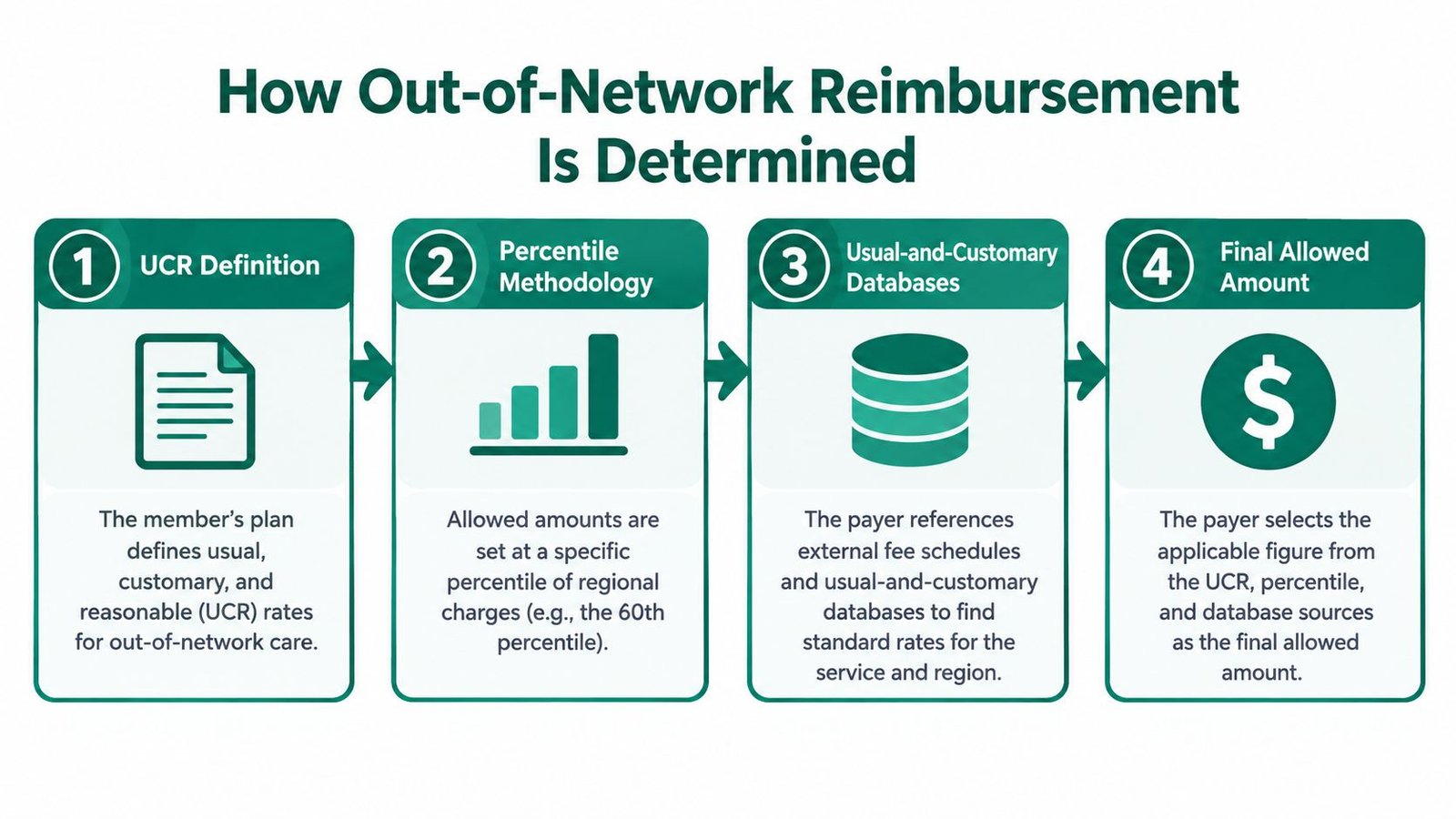
A bad repricer choice can turn a solid therapy visit into a cheap allowance fast. Out-of-network payment usually starts with one of four methods. The plan may define UCR or a reasonable-and-customary standard in the policy. It may use a percentile tied to regional charges. It may pull from an outside database. Or it may anchor the claim to the Medicare Physician Fee Schedule locality amount and then apply its own out-of-network rule.
What each method does to the number
UCR usually pushes payment toward a geographically filtered market rate, so the same code can pay very differently by city. A percentile method sets a controlled ceiling. A database method gives the repricer a number that looks objective while still landing below fair value for the visit. Medicare-based benchmarking matters because it gives you a local anchor, even when the plan is not paying Medicare rates directly.
The federal benchmark for QPA disputes under the No Surprises Act is the plan's median contracted rate in the relevant geographic area and specialty. The payer should not blend different services, different time increments, or different specialties into one median if the claim is already split by code and units.
For a plain-English breakdown of the federal benchmark rules, use the QPA and out-of-network challenge guide. Before your first appeal, require the payer to disclose in writing exactly how it priced the claim.
Repricer Patterns Practices See in the Wild
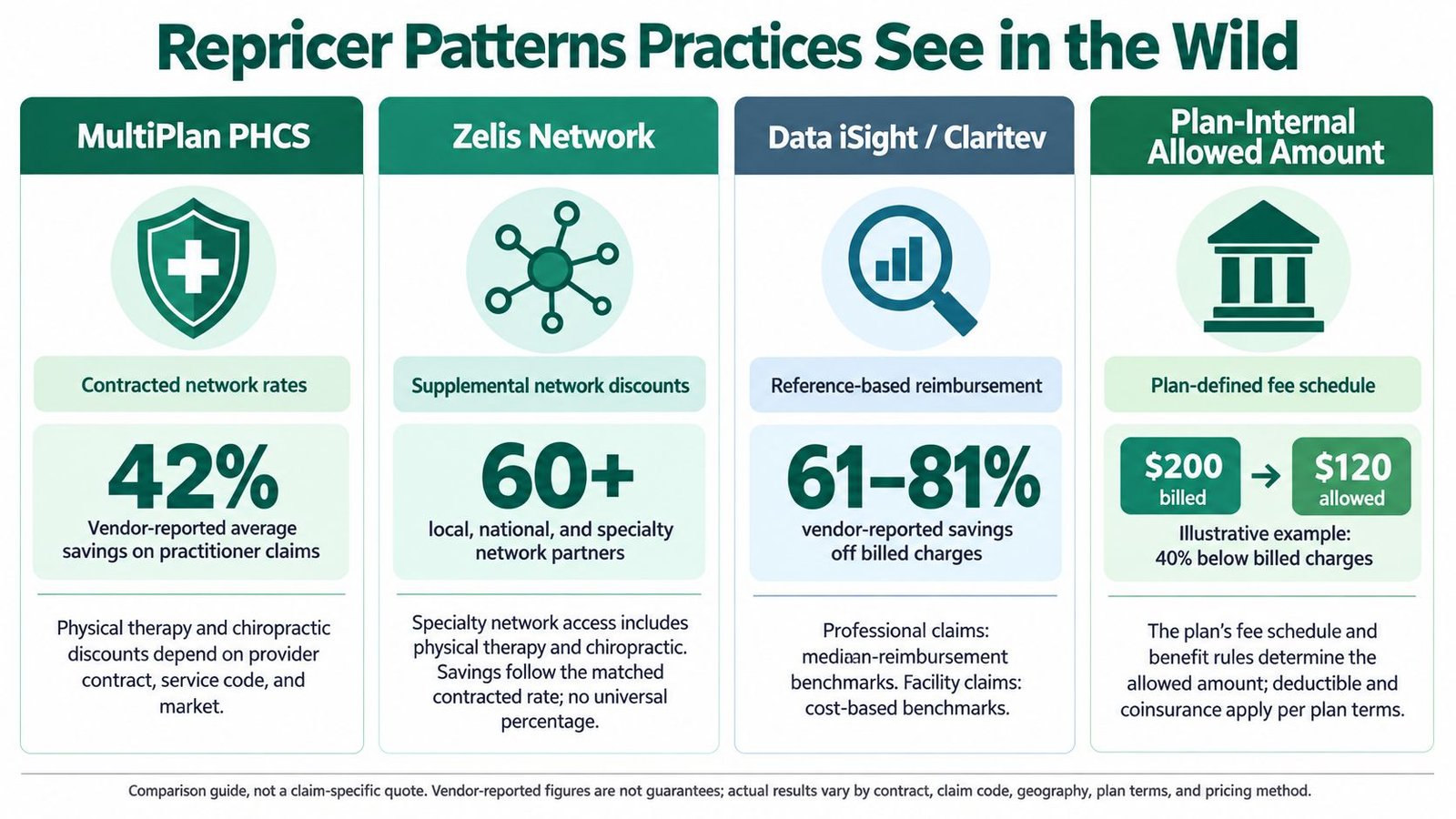
The low-payment pattern is not random. In practice, we see four common outcomes, and each one leaves a different footprint on the EOB.
The four lanes
MultiPlan PHCS claims usually show up with a sharply reduced allowed amount and a rationale tied to plan savings language. Zelis often does the same thing through its own network savings structure. Data iSight / Claritev tends to produce an external database-style repricing that looks objective until you compare it against the actual ZIP-based benchmark. Plan-internal allowed amounts are different, because the payer says its own schedule controls and the payment is only as good as the plan document.
The first counterargument is always the same, force the payer to show the written basis for the allowed amount, not just the number. If the claim is a 97110 and 97140 batch, you should be comparing the paid amount to the correct code, correct units, and correct geography, not to some flat “therapy visit” average.
For readers dealing with repeated repricing, the physical therapy underpayment recovery guide lays out the recovery mindset, and the best out-of-network medical bill repricing tools guide shows the market context. If your EOB says the allowed amount came from Data iSight, the Cigna Data iSight PT recovery page is the most relevant next read.
Commercial reality: once repricing starts, the fight shifts from “was care provided?” to “did the payer use the right pricing lane?”
State Laws NSA and Plan Requirements That Change the Number
State law can move the payout floor. New York DFS guidance says UCR should reflect usual fee patterns in the same geographic area, and other states can use different payment standards that force a higher allowed amount than a payer's internal schedule would produce. A payer cannot hide behind a low in-house figure when the governing rule points somewhere else.
Federal rules also matter, but they do not set one flat out-of-network rate for every PT claim. The No Surprises Act controls protected services, and when IDR applies, the QPA becomes the benchmark that matters No Surprises Act compliance guide. Outside those protected categories, the plan language and state law usually decide the number.
What owners should ask for in writing
- The plan's UCR definition: Ask for the exact benefit language that controlled the claim.
- The pricing methodology: Demand the formula or database basis used on the EOB.
- The QPA method, if applicable: Make the payer show the geographic and specialty inputs.
- The claim-level calculation: Units, code, place of service, and allowed amount should match.
If the claim may fall under federal dispute rules, check the plan against the No Surprises Act compliance guide first, then use the terms that apply to the case. If the claim is eligible for federal dispute resolution, the IDR workflow guide shows how the number can move when the payer's first pass is too low.
Sample Calculations and Code-Level Rules
A payer can turn a strong claim into a weak payment fast. A Manhattan physical therapy visit billed at $540 for 97140 x2 and 97110 x2 was paid at $60 after Data iSight repricing, after previously landing around $300 to $400 per visit before repricing. A $540 visit cut to $60 loses more than 88% of billed value in a single adjudication.
A multi-location New Jersey sports medicine practice saw Cigna and Horizon reprice roughly $300 claims down to about $100 each. On volume, that gap becomes a real receivable leak, not a rounding issue.
The rules that decide whether the units survive
97110 and 97140 are timed services, so the timed minutes have to support the unit count before pricing even starts. The claim needs to show the skilled intervention, the body region treated, and the documented time. If the note does not support the units, the payer has room to cut the line before it reaches the out-of-network formula 97110 billing guide.
When the codes appear together, the payer also has to clear NCCI edits and modifier rules. A distinct-service modifier, including 59 or the appropriate X modifier, only works when the services were separate and clinically identifiable APTA NCCI guidance. Place of service can change the result before pricing is even applied, so a claim that looks underpaid may be blocked on policy grounds.
The practical test is simple. Separate a true underpayment from a unit validation problem before you draft any appeal. If the units do not hold, the issue is documentation and coding. If the units hold and the allowed amount is still far below billed charges, the payer's repricing basis is the target.
Real Anonymized Cases From Our RCM Bench
The Manhattan file showed the gap clearly. A four-unit visit, 97140 x2 and 97110 x2, billed at $540, paid at $60 after Data iSight repricing. Before that cut, the same pattern was paying about $300 to $400, so the loss was not normal variation. It was repricing pressure.
The appeal did not start with a broad complaint. It started with the chart note, the timed-unit math, and the exact service mix. The submission pointed to separate skilled services, then challenged the repricer's benchmark choice line by line. That works because payer math only matters after the units survive review.
A clean recovery packet usually follows the same structure. The first page identifies the visit, the billed amount, the paid amount, and the gap. The next pages show why the units hold, then show why the pricing basis is too low for the service and the geography. That keeps the appeal focused on recoverable dollars, not argument.
The New Jersey sports medicine pattern was similar, just larger in volume. Cigna and Horizon pushed roughly $300 claims down to about $100, and once that spread repeated across locations, the annual leak became impossible to ignore.
In those cases, the strongest packet used the plan's own out-of-network logic, then added the strongest geographic benchmark available under that method. Documentation, geography, and batch size win these recoveries.
FAIR Health Benchmarks by ZIP for Negotiation
A payer can turn a $540 four-unit visit into a $60 payment and still call it “repricing.” FAIR Health gives you the counterweight: a ZIP-level benchmark that shows what the market supports where the care was delivered.
Use the local ZIP, then compare the 50th percentile, 80th percentile, and 90th percentile for the code mix you billed. For negotiation, 80th percentile is the number to anchor to, and 90th percentile is the ceiling when the repricer lands far below market.
| ZIP example | 50th %ile | 80th %ile | 90th %ile |
|---|---|---|---|
| Manhattan, illustrative 97110/97140 four-unit visit | $185 | $295 | $360 |
If that same Manhattan claim paid $60, the settlement demand starts at the gap to 80th percentile, not at the payer's lowball. On this example, that means arguing from $295 down to $60 is the underpayment to recover, with 90th percentile available if the plan's own terms and the unit math support it.
Treat anything below the 50th percentile on a skilled PT claim as a red flag unless the plan document clearly justifies it. FAIR Health belongs in the packet every time, because it gives you a ZIP-based pricing basis instead of a vague complaint about being underpaid.
Negotiation Appeals and IDR Workflow
The fastest recovery comes from a disciplined batch process. Group underpaid 97110 and 97140 claims together, push the payer on the full dollar exposure, and anchor the appeal to the 80th percentile. Keep the 90th percentile ready for escalation when the repricer sits far below market.
The sequence that gets results
Start with a corrected resubmission or refiling if the timely-filing window has passed and a fresh EOB is needed to reopen the file. Then use the payer's formal dispute path, including any one-time provider dispute process. If the claim qualifies, move it into federal IDR under the NSA framework, with the EBSA surprise billing guidance in the packet.
Send clean notes, timed-unit math, FAIR Health pulls, and a one-page underpayment summary. If an AOB is on file, patient contact usually drops out of the process, which keeps the work inside the practice and cuts wasted staff time on outreach that will not change the EOB.
Clean files settle faster. In practice, a clean batch often gets a first material response within a 45 to 90 day window. If the claim is stuck in repricer logic, force the payer to review the service itself, not just the default allowed amount.
RCM Workflow Choices That Maximize OON Reimbursement
Owners have three real choices here, and none of them are passive. You can let the payer keep repricing in silence, build an internal workflow that flags underpaid 97110 and 97140 claims at posting, or hand the recovery work to a team that lives in underpayment disputes. The wrong move is to leave these claims buried in generic AR follow-up, because a $60 payment on a $540 claim is not a normal collectible balance.
What you need operationally is a clean expected-versus-actual workflow at the claim level. That means the billing system should flag out-of-network therapy claims, compare allowed amount to the expected benchmark, and route the underpayment before timely filing, appeal deadlines, or internal write-off rules bury the opportunity.
For the practice owner thinking about outside help, Happy Billing's out-of-network recovery work is contingency-only, and the number depends on claim age and volume after a free underpayment analysis. If you want to compare that route with in-house process redesign, the outsource medical billing cost guide is useful because it frames the operating tradeoff without the sales fluff.
A good operational fix is also automation. If your staff still reconciles repriced PT claims manually, a tool like the invoice processing automation guide shows how document-driven workflows can reduce the number of items that fall through the cracks. The goal is not more software for its own sake, it's fewer low-value touches and faster recovery on the claims that matter.
For owners who want a direct read on what's recoverable, the free underpayment analysis is the right next step.
What should a practice owner do first if 97110 and 97140 are being repriced low?
Start with the EOB and the note, not the charge master. Compare the allowed amount to the units, the region, the timed minutes, and the plan's written out-of-network methodology.
How do I tell a real underpayment from a legitimate reduction?
A legitimate reduction usually traces back to a clear plan rule, unit validation issue, or documented NCCI/modifier problem. If the payer can't show its pricing basis and your note supports the service, it's usually an underpayment.
Should I appeal one claim or batch them together?
Batch them. Ten or more underpaid claims get attention faster and create enough dollar value to justify real review.
Can my team recover these without bothering the patient?
Yes, if a valid assignment of benefits is on file. That keeps the recovery work with the practice and out of patient-facing workflow.