How to Batch Underpaid Out-of-Network Claims for Payer Negotiation
A single underpaid out-of-network claim is easy for a payer to treat as a routine adjustment. Batch at least 10 claims with the same payer and plan, screen each for eligibility and deadlines, then present one organized, evidence-backed negotiation. That gives the payer a clearer view of the financial pattern and gives your practice a practical way to protect revenue, reduce avoidable write-offs, and keep disputed accounts from aging without action.
Happy Billing is a medical billing company headquartered in Houston, Texas. We recover out-of-network underpayments for physical therapy, chiropractic, sports medicine and behavioral health practices, including practices in New Jersey and New York.
Why Single-Claim Appeals Stall and Batching Works
A Manhattan physical therapy practice billed $540 for one visit, including 97140 x2 and 97110 x2. Cigna paid $60 after Data iSight repricing, down from $300–$400 per visit before. One small appeal can disappear into a payer's routine queue. A batch of related claims makes the pattern, and its financial impact on your practice, harder to overlook.
The direct answer to how to batch underpaid out-of-network claims for payer negotiation is to group 10 or more claims by payer and plan, then separate further by repricer, service type, and eligibility. A single claim may be handled as an ordinary customer-service issue. A well-documented batch can justify review by a case manager or network representative who can consider a broader payment pattern.
The strategic shift: Don't ask the payer to reconsider isolated transactions. Show a consistent, documented pattern of underpayment and request a specific resolution.
That doesn't mean that every low payment is an appeal, or that a large batch is automatically persuasive. The claims still need to be comparable, supported by remittance evidence, and on a valid negotiation path. Out-of-network charges have appeared even in in-network episodes: a Kaiser Family Foundation analysis of large employer health-plan claims found that in 2017, 18% of emergency-room visits and 16% of in-network hospital stays included at least one out-of-network charge.
For a physician owner, the practical cost of leaving these accounts untouched is not just a lower payment on one claim. It can mean recurring revenue leakage, a higher unresolved denial workload, and more time spent chasing small balances without changing the payer's behavior. Look for a repeatable pattern, such as the same plan and repricer reducing similar visits, then make that pattern the center of the negotiation. These signs of systematic out-of-network underpayment can help distinguish a recurring issue from a one-off adjudication error.
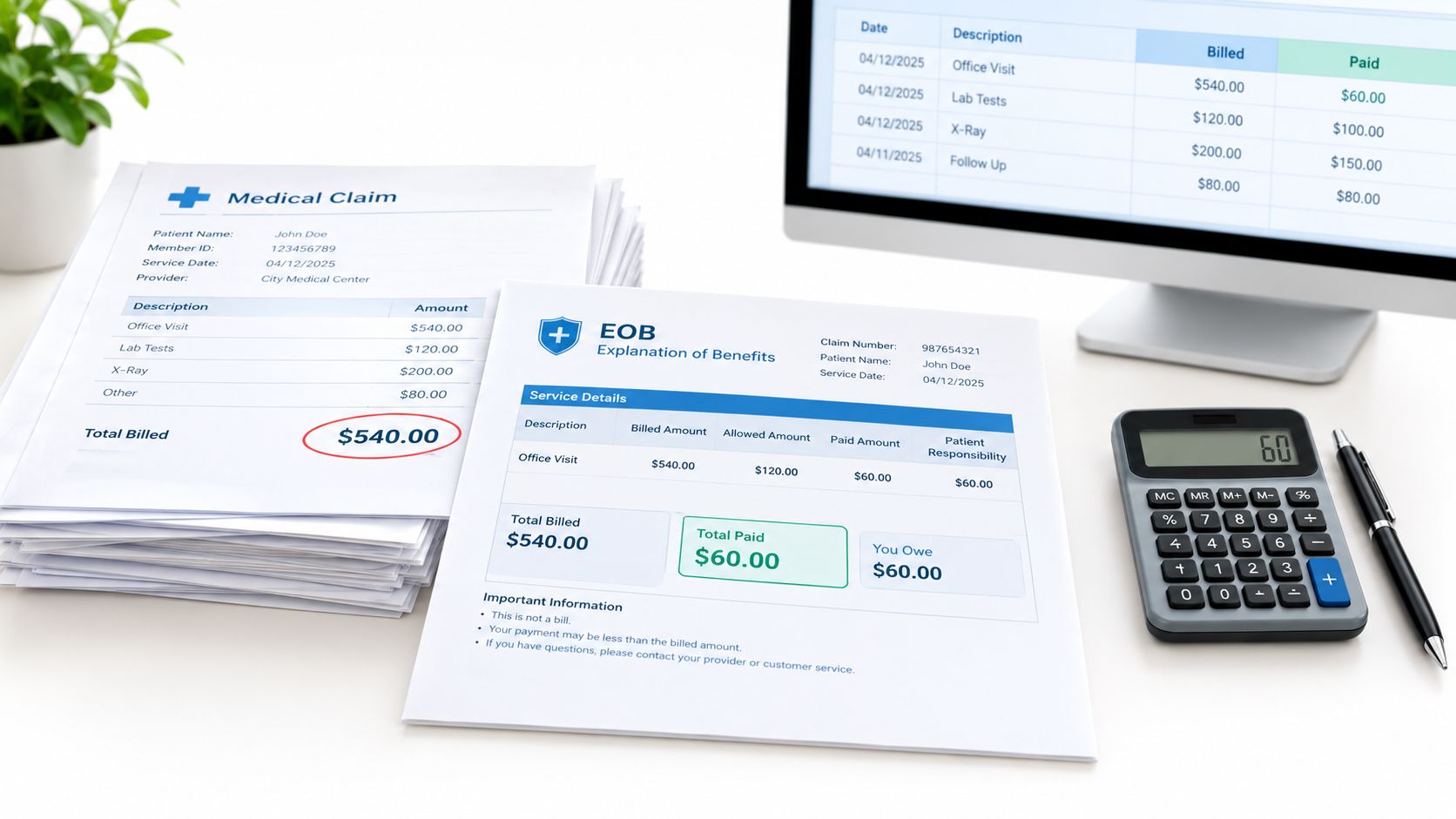
If a payer's reduction reflects repricing, not a simple claim-processing mistake, document the affected repricer and plan instead of treating each EOB as unrelated. A review of out-of-network repricing tools and allowed-amount reductions can help owners understand what to look for in the remittance trail.
Book a free 30-minute call
US practices only.
Assembling a Batch That Gets a Case Manager's Attention
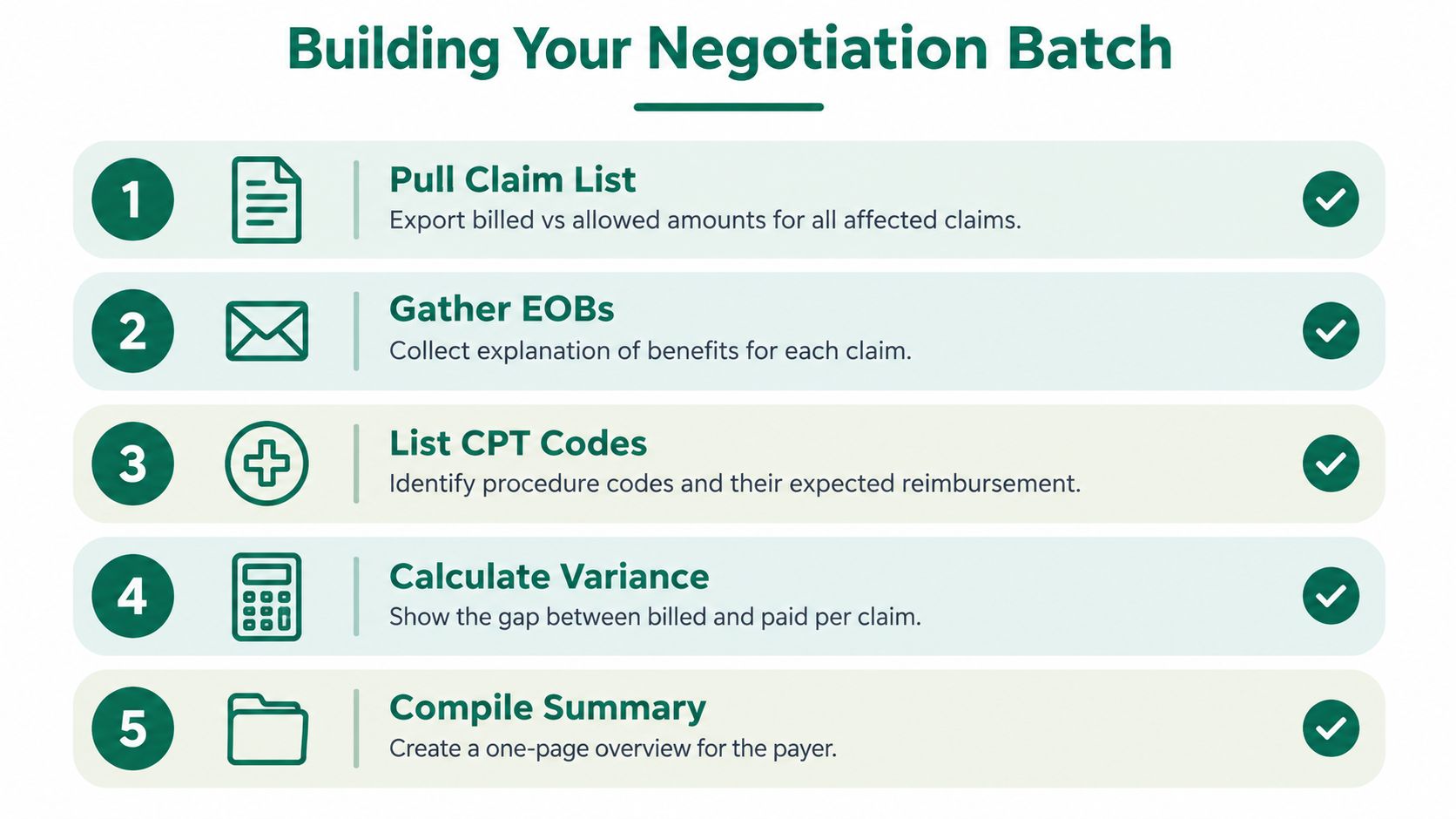
A batch should be large enough to show the payer a meaningful pattern and narrow enough that every line has a defensible reason to be together. Start by exporting the claim population, then normalize the fields before deciding which claims belong in a submission. Federal IDR claims also require careful line-level organization. The Congressional Research Service overview of the federal IDR process describes the need to distinguish disputed items or service line items, rather than treating an entire claim as one undifferentiated record.
Build the claim file
For each candidate, capture the claim ID, payer, plan product, service date, provider identifiers, place of service, CPT or HCPCS code, modifiers, units, billed charge, allowed amount, paid amount, patient responsibility, denial or adjustment code, and any relevant contract or QPA fields. Add the service ZIP so you can compare the claim with a geographically relevant benchmark. For anesthesia, preserve base units, time units, modifiers, concurrency, and qualifying circumstances as separate fields. A missing modifier or blended unit detail can undermine comparability and weaken the amount you're asking the payer to reconsider.
Attach the EOB or other remittance evidence for each line. Record billed versus allowed and paid amounts so the payer can trace the discrepancy back to its own adjudication. Collect the FAIR Health benchmark for each line, and confirm that an assignment of benefits (AOB) is on file. With an AOB in place, the practice has a documented basis to handle negotiation without requiring the patient to manage the payer dispute.
Sort, then apply an audit gate
Segment claims by payer, plan product, service year, code family, place of service, provider specialty, geographic market, authorization status, and reason for underpayment. Don't combine claims just because the CPT codes match. If the payer product, locality, service setting, coding configuration, or evidence differs materially, split the claims into separate batches.
Before submission, reject records with a mismatched plan product, missing remittance evidence, duplicate service lines, invalid modifiers, or unresolved coordination of benefits. Then rank the remaining batches by recoverable dollars, deadline, documentation completeness, and similarity. This prevents one defective record from complicating the review of otherwise well-supported claims.
A smaller, cleaner batch is better than a larger batch whose claims don't belong together.
Use a consistent evidence package for each payer, product, and service family. A practical out-of-network appeal package checklist can help keep the claim list, EOBs, benchmarks, and supporting records together.
Calculating the Underpayment Gap and Setting Your Negotiation Target
Once the batch is clean, calculate the dollar gap line by line. The basic formula is:
Underpayment gap = expected benchmark − payer payment
For this workflow, use the FAIR Health benchmark as the expected amount when it's the appropriate, supportable comparison for that service and location. The requested strategy treats the 80th percentile as a typical settlement point and the 90th percentile as a ceiling, not as an automatic entitlement. Make the offer credible by matching the benchmark to the CPT code, service ZIP, and applicable claim details. The guide to usual and customary rates for out-of-network providers provides context for thinking about those benchmarks.
Sample batch summary
The table shows the fields to present. The Manhattan visit is the supplied example; its line-level EOB allocation and FAIR Health amounts must come from the actual records. Don't fabricate a benchmark or divide a combined payment across CPT lines without documentation.
| Claim ID | CPT | Billed | Allowed | Paid | FAIR Health 80th | Gap |
|---|---|---|---|---|---|---|
| Manhattan visit, line detail required | 97140 x2 | Part of $540 visit | Per EOB | Per EOB | Per service ZIP | Benchmark minus line payment |
| Manhattan visit, line detail required | 97110 x2 | Part of $540 visit | Per EOB | Per EOB | Per service ZIP | Benchmark minus line payment |
Keep the total visit charge and payment visible in the supporting summary: the practice billed $540 and Cigna paid $60 after Data iSight repricing. Use the EOB to determine how that payment maps to each service line before calculating line-level gaps. This preserves an auditable trail instead of implying that an unknown allocation is known.
Set an offer and a decision threshold
For each homogeneous batch, establish a floor, a target, and a walk-away or IDR offer. A floor can reflect a historical contracted rate or defensible cost threshold. A target can use a comparable in-network rate or historical out-of-network median. Support the formal offer with service intensity, clinical complexity, acuity, provider specialty, training, or market scarcity where relevant.
Treat the QPA as a reference point, not an automatic settlement value. Measure negotiated settlements separately from IDR outcomes: federal reporting found that providers prevailed in roughly 80% of 2023 IDR determinations for out-of-network claims, as reported in the HHS ASPE report on the No Surprises Act. That outcome does not make every claim suitable for escalation. Compare likely recovery with filing costs, staff time, outside support, and the cost of delayed cash before deciding whether to proceed.
Channels and Escalation Tiers for Payer Negotiation
Send the batch through a channel the payer can receive and track. A case manager email works when the payer has identified a contact and accepts supporting documentation that way. Use the secure portal when the payer requires an upload or when it provides a clearer submission record. Fax can be appropriate when the payer directs the practice to a designated number, but keep the transmission confirmation with the batch file.
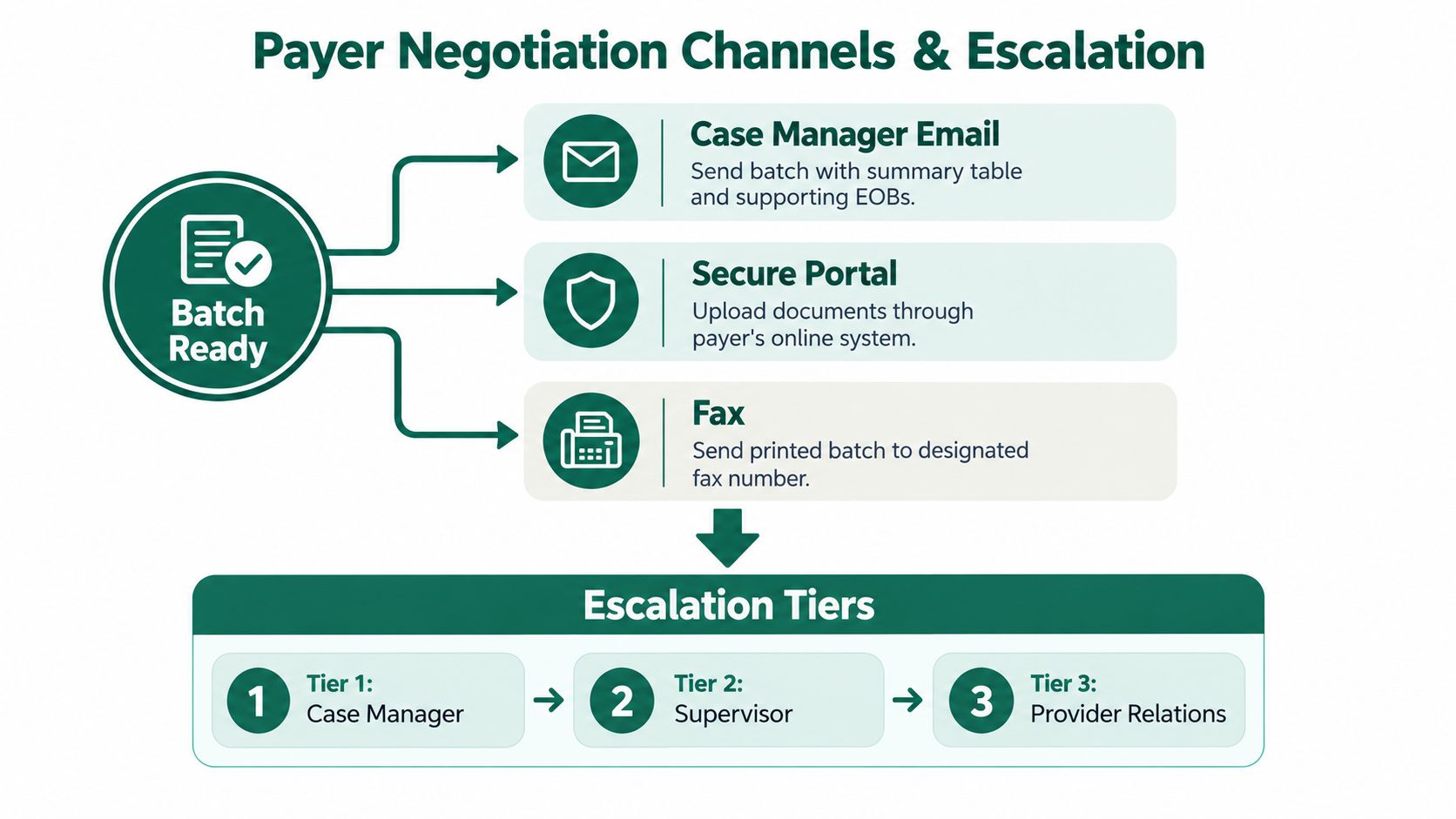
Use a staged escalation, and document the date, channel, recipient, and response at every step.
- Negotiate with evidence. Send the concise summary table, EOBs, claim-level gaps, benchmarks, and requested resolution. Ask the payer to review the batch with a case manager or network representative, not to reprocess one isolated line.
- Resubmit when the window has closed. If the payer says the appeal or negotiation period is no longer open, check whether the claim can be resubmitted appropriately to obtain a fresh EOB. Don't assume resubmission resets a deadline or creates a new right to dispute. Confirm the payer's rule and preserve the response.
- Use the formal path that applies. Escalate through the payer's formal or one-time provider dispute process when available. Use federal IDR only for eligible claims that meet its requirements.
For eligible federal No Surprises Act disputes, clock control is essential. The payer generally has 30 calendar days after receiving a claim to make an initial payment or issue a denial. The provider then has 30 business days from that payment or denial to initiate open negotiation. If negotiation fails, the provider must initiate federal IDR within four business days after the negotiation period ends. The AMA's No Surprises Act IDR toolkit outlines this sequence. A claim that misses a required window may lose access to that path.
Apply NSA batching rules before combining claims
The federal rules allow qualified claims to be batched based on defined relationships: services for one patient on the same or consecutive dates billed on the same claim form; services for one or more patients billed under the same or comparable service code; and, for anesthesiology, radiology, pathology, and laboratory services, codes within the same Category I CPT section. Same payer alone isn't enough. Screen the legal pathway, payer and plan, service category, dates, and documentation before grouping.
For disputes with an open-negotiation start date on or after November 1, 2026, CMS materials state that a batched dispute may include no more than 50 qualified line items. CMS duplicate validation uses claim number, date of service, service code, and applicable modifiers. Modifiers and anesthesia qualifying-circumstance add-on codes that function as modifiers don't count toward that limit. Check the CMS IDR notices and batching guidance before filing, and preserve the line-level audit trail.
Tracking Your Batch and Measuring Recovery Success
Plan for a working timeline of 45–90 days from initial outreach through resolution, while recognizing that payer response and the path selected affect the actual duration. Track each claim independently even when you negotiate the batch as a unit. That makes it possible to reconcile partial settlements, identify stalled lines, and keep deadlines visible.
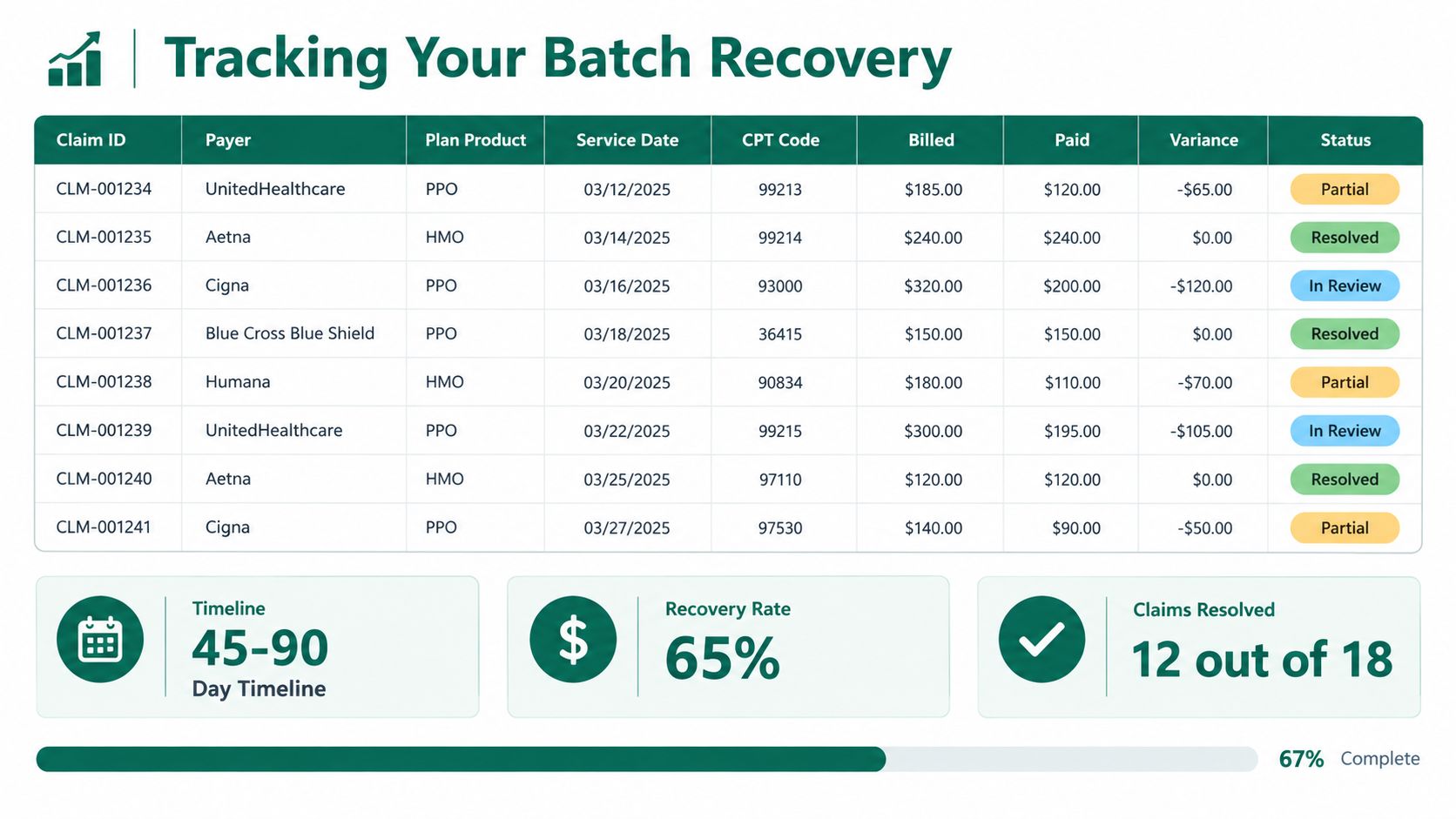
Your tracker should include claim ID, payer, plan product, service date, CPT code, billed amount, allowed amount, paid amount, FAIR Health benchmark, underpayment gap, negotiation status, escalation tier, and resolution date. Add a named owner and next-action date so an unresolved account doesn't sit unnoticed in A/R.
Measure what changes the practice's decision
Track recovery as a share of the underpayment gap, dollars recovered per line, acceptance rate, days to resolution, IDR or appeal rate, and payer-specific variance. These measures show whether a payer's offer is improving, whether the process is taking too long, and whether a particular service family repeatedly receives the same reduction. A set of medical billing KPIs to track can help owners connect recovery work to broader revenue-cycle performance.
A multi-location New Jersey sports medicine practice saw Cigna and Horizon reprice roughly $300 claims to about $100. Batching let the practice quantify the variance and present a consistent argument instead of treating each reduction as a separate billing exception. The figures describe the supplied example, not a promise of what another practice will recover.
Review the economics, not just the response
At month-end, update payer-specific benchmarks, record settlement patterns, and identify coding or documentation issues that repeatedly weaken submissions. Decide whether to accept a direct settlement, pursue a contractual appeal, or consider IDR by weighing the expected recovery against documentation strength, time, and costs. Federal IDR activity continued to expand: providers and plans initiated about 1.4 million disputes in the second half of 2025, 16% more than in the first half; providers initiated 76% of those disputes and prevailed in about 85% of determinations, according to this report on federal IDR activity. Volume alone is not a reason to file. Strong eligibility and evidence matter more than a crowded queue.
When to Outsource Your Underpayment Recovery
Batching is an operating discipline, not a one-time spreadsheet exercise. Someone must screen eligibility, preserve the claim-level evidence, calendar deadlines, communicate with the payer, and keep the practice's A/R records aligned with each resolution. If those responsibilities compete with core revenue-cycle work, the hidden cost of doing everything in-house may be missed deadlines, repeated staff effort, or a contaminated submission.
Eligibility deserves particular attention. A Conference Board policy backgrounder reports that 42% of disputes in both Q3 and Q4 2025 were challenged as ineligible. It also cites an independent analysis of roughly 200,000 disputes in 2025, finding 38% out of scope and another 31% procedurally ineligible. Those figures make the operational point clear: sort by legal pathway and deadline before grouping claims by volume.
Choose based on capacity and control
Keep the work in-house if your team can reliably verify eligibility, organize homogeneous batches, support benchmarks, and act on deadlines without pulling attention from other high-value A/R work. Consider outsourcing when the claim population is substantial, the same payer reductions recur, or your current process cannot consistently document and escalate each batch.
How we approach it is straightforward: batch 10 or more comparable claims, negotiate with FAIR Health benchmarks, request a fresh EOB through appropriate resubmission when the relevant window has closed, and escalate to a formal payer dispute or IDR only when eligible. Fees are contingency-only, depend on claim age and volume, and we give a clear number after a free 30-minute call with a billing specialist. Use this in-house versus outsourced recovery decision guide to weigh capacity, oversight, and process consistency.
Practices evaluating specialty-specific support can review physical therapy, chiropractic, sports medicine, and behavioral health billing services. For the broader build-versus-buy calculation, consider the cost factors involved in outsourcing medical billing, without treating price alone as a substitute for deadline control and sound eligibility review.
Frequently Asked Questions About Batching Underpaid Claims
How many claims should I batch before approaching a payer?
Start with 10 or more claims that share a payer and plan, then narrow the group by service family, repricer, and documentation. That's a practical negotiation threshold, not a guarantee that a payer will accept your request or settle the claims.
What if a claim isn't eligible for federal IDR?
Don't place it in an IDR batch. Check whether a state-law pathway, contractual appeal, payer provider-dispute process, or corrected-claim route applies. Keep the claim separate from eligible federal IDR lines so its different rules don't compromise the submission.
Do I need patient consent to negotiate?
Confirm that the practice has the necessary assignment of benefits and supporting records for the claims. When an AOB is on file, no patient contact is needed for the described negotiation workflow.
How long does recovery take, and what does it cost?
Use 45–90 days as a planning estimate, not a promised resolution date. Fees are contingency-only, depend on claim age and volume, and a billing specialist can provide a clear number after a free 30-minute call.
Book a free 30-minute call
US practices only.
For practices dealing with recurring out-of-network reductions, Happy Billing can organize claim batches, support payer negotiations, and escalate eligible disputes through the appropriate process. Visit Happy Billing to discuss a recovery workflow for your practice.