No Surprises Act IDR for Anesthesia Groups: Recovering Underpaid Out-of-network Claims
Anesthesia groups that are out-of-network at in-network facilities are protected by the No Surprises Act, and the remedy for underpaid claims is open negotiation followed by federal IDR when negotiation fails. That process can recover payment well above the payer's qualifying payment amount, with providers prevailing in approximately 85% of payment determinations in the second half of 2024.
Why Your Anesthesia Group Is Leaving Money on the Table
You staff the case, document the start and stop times, and then the payer sends an initial payment that barely reflects your base units, let alone the time and complexity in the room. Because you can't balance bill the patient, that near-QPA check becomes final revenue unless someone challenges it. Multiply that across a month of out-of-network cases at an in-network hospital or ASC, and A/R days climb while real money sits in an adjustment bucket.
Happy Billing works with anesthesia groups on exactly this recovery channel, from unit-level claim audits to IDR filings. What we see repeatedly: owners underestimate IDR because they treat each underpayment as an isolated denial problem. That framing is wrong. Underpayment at scale is a pricing problem, and the No Surprises Act IDR process for anesthesia groups recovering underpaid out-of-network claims exists for exactly this pattern.
The Scale Has Changed
Certified IDR entities issued 1,047,575 payment determinations during 2024, compared with 209,346 in 2023, and closed more than 1.37 million disputes that year according to the Congressional Research Service summary of CMS IDR activity. This is no longer a niche remedy. Groups that built a systematic identification and filing process used it at scale, while groups that waited for perfect claims left the channel unused.
Anesthesia math makes the stakes concrete. A case billed at base units plus time units, priced at the payer's QPA-linked conversion factor, can pay far below the same units at your group's historical contracted factor. The gap on one case may look minor on a remit line. Across a quarter of out-of-network volume, it is the difference between covering overhead and subsidizing the payer.
If your team writes off the gap between the initial payment and your historical contracted rate without a triage decision, you've made a revenue decision by default.
Your advantage is real. Anesthesia has a defensible math structure: base unit values, time units, modifying units for physical status and qualifying circumstances, documented concurrency, and medical direction records that many specialties lack. When that documentation is clean, you can present an offered rate an IDR entity can select. When it isn't, the payer's QPA-based offer wins by being the only credible number in the file.
Stop asking whether IDR is worth learning. Ask how many eligible cases your group settled at a discount last quarter because no one ran the unit math. That count is your starting inventory, and that is where recovery begins.
How the No Surprises Act Protects Anesthesia Groups
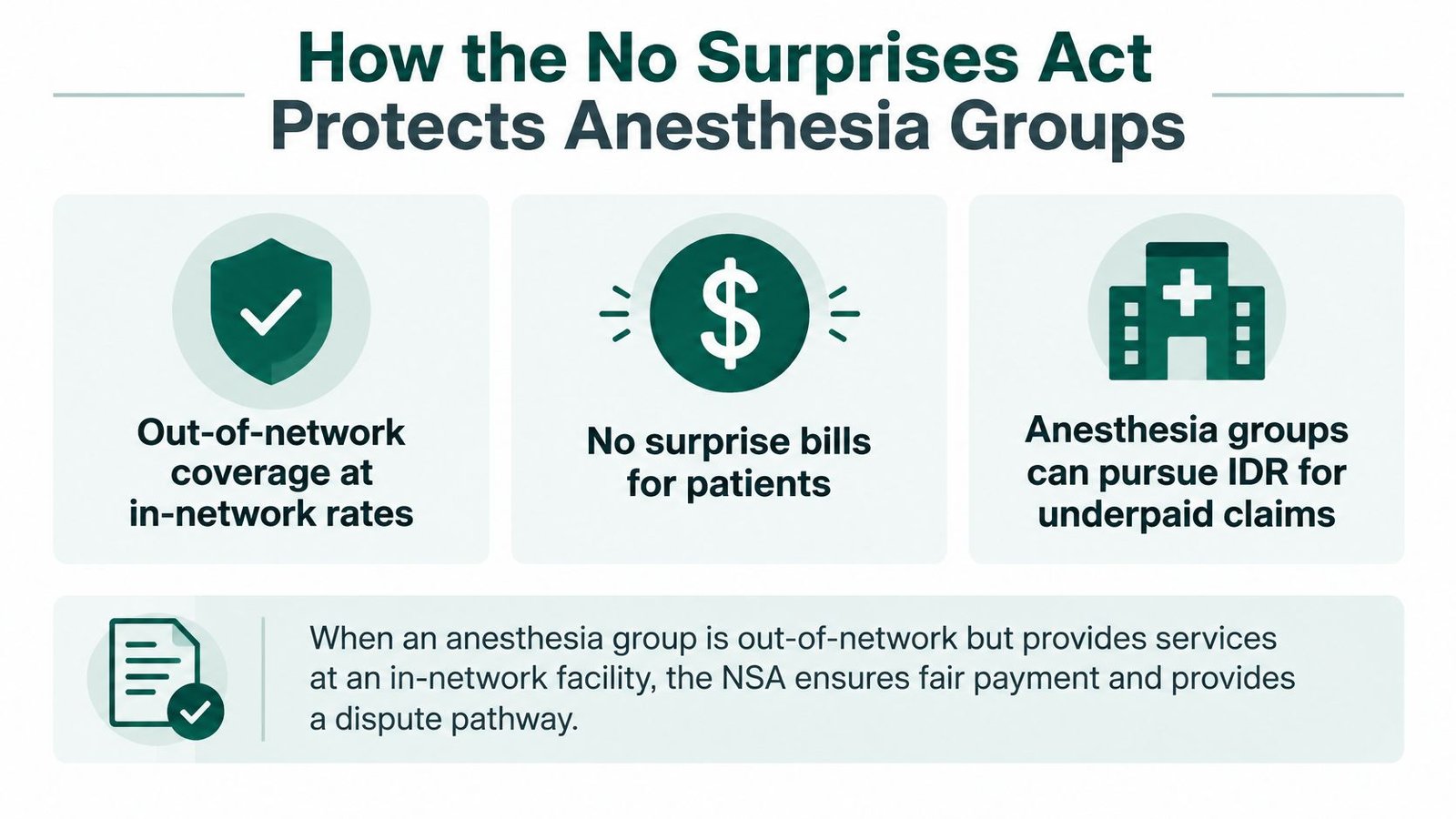
When your CRNA or anesthesiologist provides care at an in-network facility but your group is out-of-network, the patient is protected and so is your right to dispute payment. You can't send the patient a balance bill for the difference, a point covered in our guide to when balance billing is prohibited under federal law. The payer makes an initial payment or issues a denial, and that amount often tracks the qualifying payment amount, or QPA.
The QPA is generally tied to the payer's median in-network rate for the service in the geographic region. It is not your historical contracted rate, and it is not a Medicare rate. That distinction drives the whole financial case, because your group may have held contracts, case rates, or conversion factors well above what the QPA produces for the same code family.
What the Outcomes Tell Owners
In the second half of 2024, providers, facilities, and air-ambulance providers prevailed in approximately 85% of payment determinations, while health plans prevailed in about 15%, with 698,968 determinations from July through December 2024 reported in the CMS supplemental background file for late 2024 IDR activity. Broader analysis in that same verified material reported median awards for provider-winning line items at 327% of QPA in 2023 and 445% in 2024. Those figures don't guarantee an anesthesia result, but they destroy the assumption that the QPA is the ceiling.
- Baseball-style selection: The IDR entity picks one party's offer. It doesn't split the difference, so a well-supported offer matters more than a high billed charge.
- QPA is one factor: The entity considers the QPA and other legally permitted information, including factors that explain why your case costs more to deliver.
- Not Medicare math: Analysis of a common emergency professional service found the average QPA was 2.4 times Medicare payment, so owners who benchmark only against Medicare misprice the dispute.
For anesthesia, permitted supporting information should connect to the service itself. Think acuity, complexity, provider training, and the circumstances of the case, not a generic statement that your billed charge is your usual charge.
Owner lens: The QPA explains what the payer wants to pay. Your evidence has to explain why that number doesn't fit the anesthesia service you actually delivered.
Don't treat IDR as an appeal with a different form. It's an offer-selection process. Build the offer you'd want an independent reviewer to choose, then support it like a rate case.
Identifying and Triageing Eligible Underpaid Claims
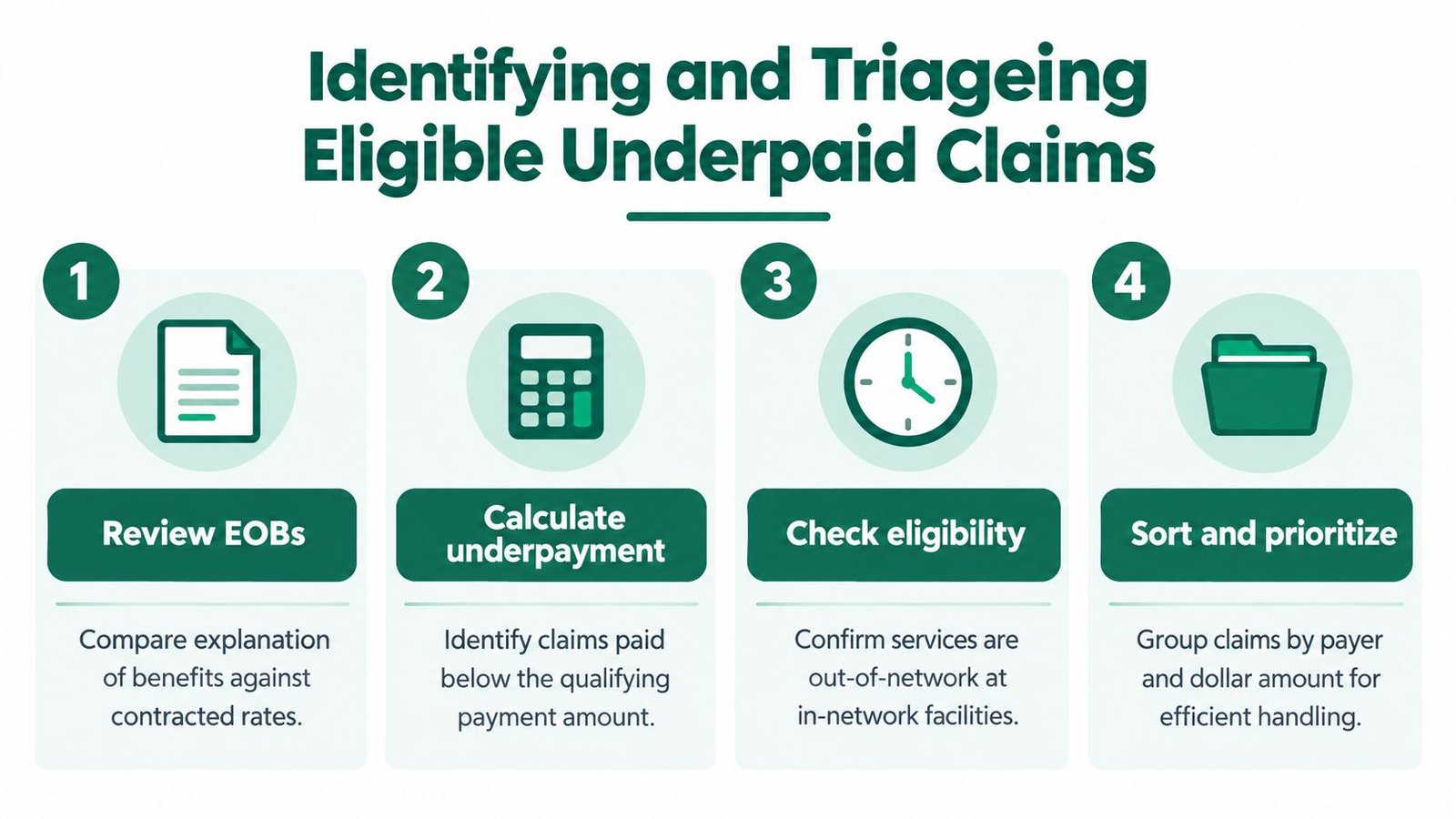
Start with your EOBs, not your billed charges. Pull out-of-network claims where the facility was in-network, the patient wasn't balance billed, and the initial payment landed near the QPA disclosure. If you recognize the patterns in our breakdown of signs your out-of-network claims are being systematically underpaid, you already have a candidate list.
Then run the anesthesia math on every candidate. Your expected payment is base units plus time units plus modifying units, multiplied by your conversion factor. Compare that expected value at your historical contracted conversion factor against what the payer paid. The gap is your dollars at stake, and that gap, not frustration, should drive triage.
A Triage System That Protects Margin
For disputes initiated on or after June 11, 2026, the federal administrative fee is $15 per party per dispute, down from the prior $115 fee, according to the CMS announcement on reduced federal IDR dispute fees. Each party also pays the certified IDR entity fee when submitting its offer, and the party whose offer isn't selected pays that entity fee if a determination is made. Model both costs before you file, especially on single low-unit cases.
- Confirm eligibility first: Verify network status, facility status, service setting, and that the claim falls under NSA protection rather than a state process or an in-network contract dispute.
- Calculate the true gap: Recalculate units from the anesthesia record. A missing physical status modifier or incorrect time can shrink the gap you're trying to recover.
- Rank by recoverable dollars: Prioritize claims and batches where the expected incremental payment comfortably exceeds fees and staff time.
- Sort for batching: Organize your inventory by payer, TIN, CPT family, service date, and negotiation period from day one.
Pay close attention to modifiers because they change both payment and credibility. AA, QK, QY, QX, and QS describe who delivered or directed care, and a mismatch with your concurrency records gives the payer an easy credibility attack. Physical status modifiers P3, P4, and P5 can support complexity, but only if the record supports them. Don't inflate the file. A defensible smaller gap beats an aggressive claim your own chart contradicts.
We recommend a weekly triage queue, not a monthly clean-up project. Deadlines run from the initial payment or denial, and a claim that sits in a workbasket loses options while it ages. Owners should see three numbers every week: eligible dollars identified, dollars in open negotiation, and dollars approaching the filing deadline.
Building the Evidence Packet That Wins Above the QPA
Your packet has one job. It must make your offered rate the more credible choice. That starts with understanding exactly what the payer disclosed, which is why owners should read our explainer on the qualifying payment amount and how providers challenge it before anyone drafts an offer.
We have seen underpayment patterns just as blunt in other specialties. A Manhattan physical therapy practice billed $540 for one visit (97140 x2, 97110 x2) and Cigna paid $60 after Data iSight repricing, down from $300 to $400 a visit before. A multi-location New Jersey sports medicine practice saw Cigna and Horizon reprice roughly $300 claims to roughly $100. Anesthesia owners face the same repricing logic, only the unit math is different and the dollars per case are larger.
What Goes in a Strong Packet
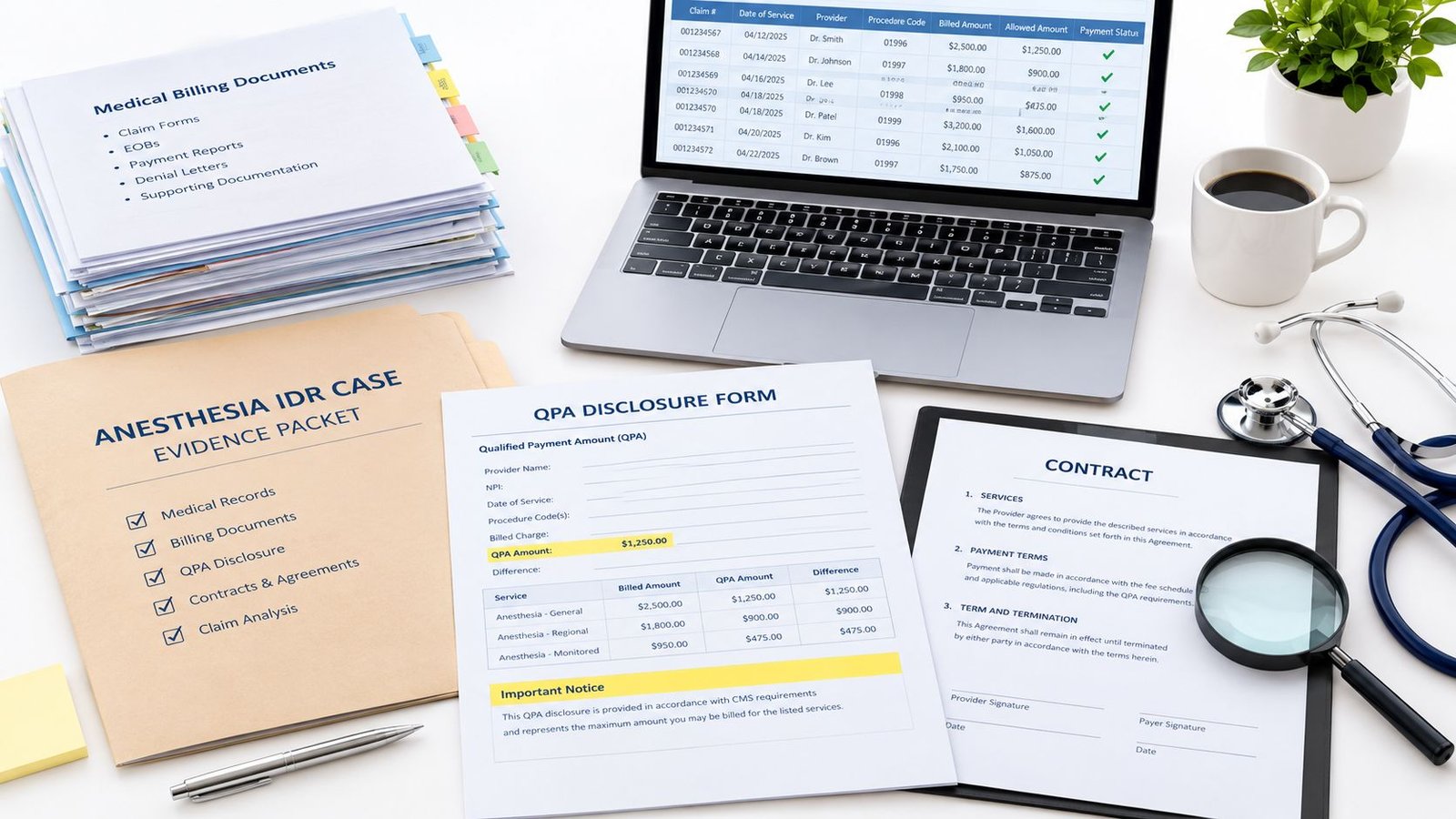
- QPA disclosure and EOB: Keep the payer's stated QPA, the initial payment, and any repricer language together. If the disclosure is late, missing, or vague, document that fact with dates.
- Anesthesia coding proof: Include the CPT code in the 00100 to 01999 anesthesia section, the surgical crosswalk where relevant, base units, start and stop times, time units, and modifiers.
- Complexity evidence: Tie physical status, emergency conditions, qualifying circumstances such as 99100, 99116, 99135, and 99140 where properly supported, and patient acuity to the chart.
- Provider and market support: Add credentials, relevant experience, prior contracted rates where permitted, and market-rate evidence that supports your conversion factor.
For market support, we use FAIR Health benchmarks as a negotiation framework, treating the 90th percentile as the ceiling and the 80th percentile as a typical settlement point. Don't anchor your IDR offer to a billed charge you can't explain. Anchor it to units delivered, a conversion factor you can defend, and comparable market data.
Handle the packet like protected health information, because it is. When your team sends charts and EOBs to a partner or counsel, use secure workflows and review how to share patient files safely so a strong recovery case doesn't create a compliance problem. Sloppy document handling also slows the entity's review and creates needless follow-up.
Documentation quality is the offer. If the entity can't follow your units, your modifiers, and your rate logic in one pass, the payer's simpler QPA story wins.
Every line item needs defensible coding, payment history, QPA evidence, and relevant non-QPA factors. Batching doesn't dilute that standard. It raises it, because one weak line can undermine confidence in the batch.
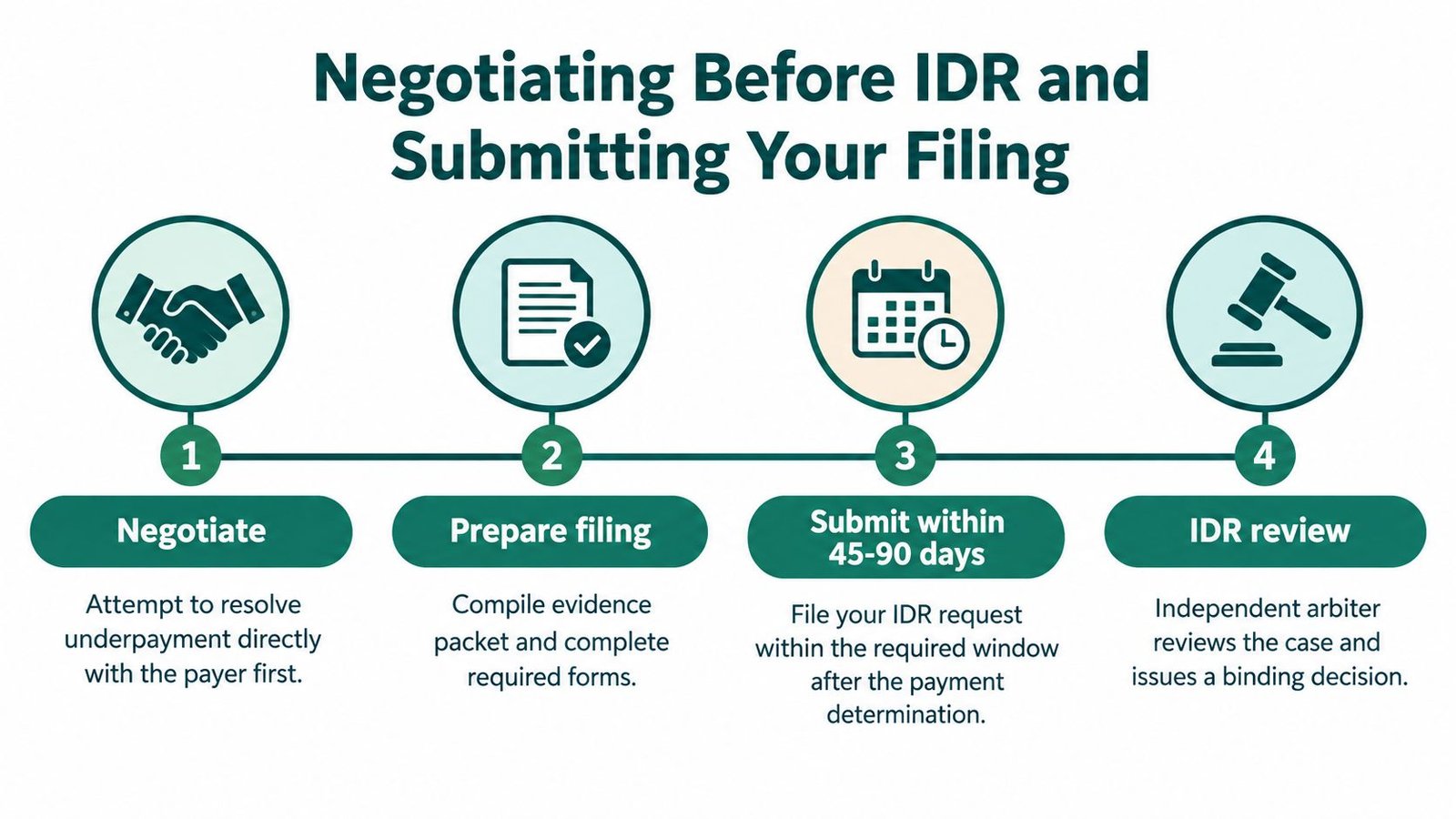
Negotiating Before IDR and Submitting Your Filing
Open negotiation sets up your filing rights, and the deadlines punish slow movers. After the initial payment or denial, the parties have a 30-business-day open-negotiation period, and either side must initiate federal IDR within 4 business days after that period ends unless the Departments grant an extension, per the CMS overview of the federal independent dispute resolution process. Once the entity decides, the payer must pay within 30 calendar days.
Before you spend those days, run the anesthesia math. Say a claim totals 14 units (base plus time): if the QPA implies a $62 conversion factor against a prior contracted $85 with that plan, the per-unit gap is $23, or roughly $322 on that one line. Multiply that gap across every claim against the same payer inside the batching window, and you know which disputes justify IDR filing fees and which ones you write off. That triage discipline is what sits behind the mechanics in our step-by-step walkthrough of the federal IDR process for providers. We batch 10 or more underpaid claims where the rules allow it, because a documented inventory with real dollars gets a payer case manager's attention. Single-claim outreach gets ignored.
Batching Rules and Payer Tactics
CMS allows multiple qualified items or services together when they're billed by the same provider or group under the same NPI or TIN, paid by the same health plan, related to treatment of a similar condition, and furnished within the same 30-business-day period, as detailed in the CMS guidance on IDR batching and bundling. Rules finalized in 2026 also permit broader grouping for anesthesiology services within the same Category I CPT section and cap a batched dispute at 50 line items, according to the CMS fact sheet on the federal IDR operations final rule. Verify implementation guidance before you file. Code grouping and modifier handling will determine whether your batch survives screening.
Put your unit math and market benchmarks on the table early in negotiation. If the window has already closed on a claim, we resubmit for a fresh EOB where appropriate, then escalate through the payer's formal dispute or straight to IDR where eligible. In the disputes we've handled, negotiation and resolution together typically run 45 to 90 days. Don't promise your partners faster cash than the process allows.
Two payer tactics show up in nearly every underpayment fight. Late or missing QPA disclosure comes first, and you counter it by timestamping every request and preserving the incomplete notice. Blanket ineligibility claims come second, and you counter those with facility network evidence, your group's network status, and the EOB itself. When an assignment of benefits is on file, no patient contact is required, so don't let staff stall a filing waiting on outreach.
Groups that treat negotiation as a documented, deadline-driven step recover more than groups that treat it as a courtesy call.
Optimizing Billing and Coding to Prevent Future Underpayments
Recovery is profitable. Prevention is better. Every clean anesthesia claim you submit with accurate units preserves revenue without fees, deadlines, or an entity's discretion, and our reference on anesthesia CPT codes and billing rules is a useful baseline for auditing your code set. Owners evaluating outside help can also review our anesthesia specialty billing support to see how specialty workflows differ from generic billing.
Audit the formula at the source. Base units must match the anesthesia CPT code and the surgical procedure performed. Time units must match documented anesthesia start and stop times, with discontinuous time handled only where the record and payer rules support it. Modifying units for physical status and qualifying circumstances must be chart-supported, because an unsupported unit doesn't just risk a denial. It damages your credibility if that claim later goes to IDR.
Fixes That Pay for Themselves
Concurrency is where anesthesia groups lose quiet money. If a medically directing anesthesiologist exceeds the permitted concurrent cases, or the modifier pattern suggests medical direction when the record shows medical supervision, the payer reduces payment and your IDR packet inherits the flaw. Align QK, QY, QX, and AD usage with the actual staffing model and the attestation in the record, every case, every day.
- Pre-bill unit audit: Recalculate total units against the record before submission, not after the EOB arrives.
- Modifier consistency check: Match provider modifiers, QS for MAC where applicable, and physical status modifiers to the chart and credentialing roster.
- Conversion factor tracking: Maintain a payer-by-payer history of contracted and paid conversion factors so underpayments are flagged automatically.
- Denial feedback loop: Route every IDR loss and payer reduction back to coding education within the month it occurs.
Broader batching for anesthesiology makes this discipline more valuable, not less. When you can group claims by code family, inconsistent documentation across providers becomes visible in a single filing. Standardize your anesthesia record prompts now, while you control the workflow, instead of explaining variations to an IDR entity later.
We recommend owners review paid conversion factors monthly by payer, facility, and code family. A sudden drop at one facility usually signals a repricing change or a QPA shift, and catching it in the first month protects both your negotiation window and your cash flow. That's how you shrink the recovery queue over time.
Frequently Asked Questions About IDR for Anesthesia
How Long Does Recovery Usually Take for Our Group
Plan on 45 to 90 days across negotiation, filing, and determination efforts, depending on payer responsiveness and batch readiness. The formal clocks are shorter and stricter, so your internal preparation speed matters more than the payer's goodwill. Groups with a ready inventory move faster.
Are Smaller Underpayments Worth Pursuing Now
often, yes, when they're batched correctly and the combined gap exceeds fees and staff time. Don't file single small claims out of principle. Triage by dollars at stake, group eligible lines where rules allow, and model the entity fee before you commit.
What If the Payer Never Sent Us a Clear QPA Disclosure
Document the missing or late disclosure, request it in writing, and preserve every timestamp. A weak disclosure doesn't automatically win your case, but it undermines the payer's position that its offer is the transparent, reliable number. Raise it during open negotiation and in the filing.
Do We Need to Contact the Patient to Start IDR
No patient contact is needed when an assignment of benefits is on file. This is a payer dispute about your reimbursement, not a patient collection effort. Keep the patient out of it and keep your documentation payer-facing.
If your anesthesia group is sitting on out-of-network cases paid near the QPA, we can help you triage the inventory, build defensible offers, and pursue recovery without upfront cost, because our out-of-network recovery fees are contingency-only, depend on claim age and volume, and we give a clear number after a free 30-minute call with a billing specialist. We only get paid when we deliver, so visit Happy Billing and book that call before your next filing window closes.