Aetna vs Cigna vs UnitedHealthcare: How Each Reprices Out-of-Network Claims
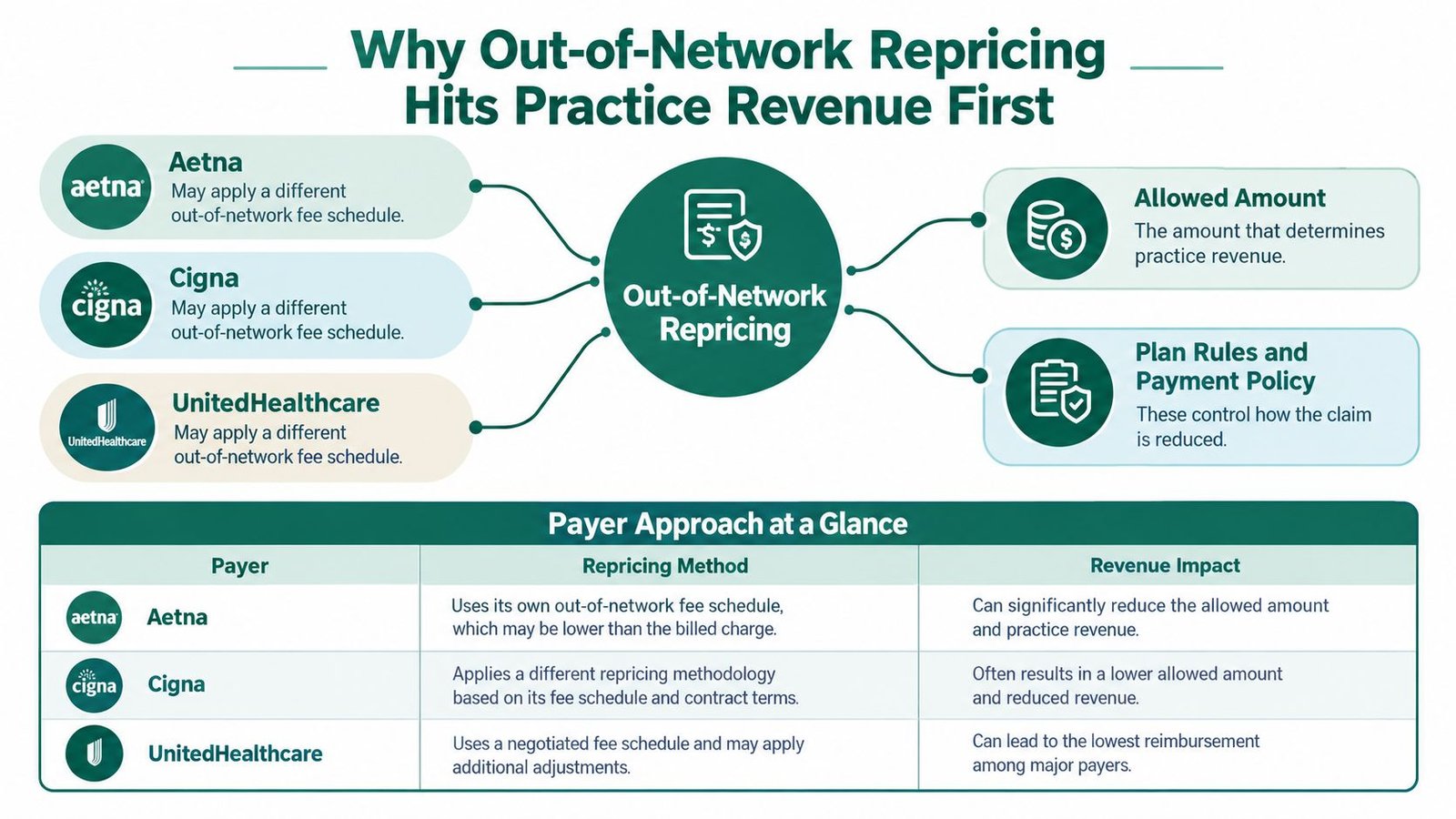
None of these payers uses a single national out-of-network fee schedule: Aetna's plan-defined recognized amount can range from 90% to 300% of Medicare in disclosed examples, Cigna can use an 80th-percentile charge benchmark, and UnitedHealthcare can use CMS, FAIR Health, Viant, or negotiated amounts. The governing plan determines the starting calculation, while the repricing vendor and applicable law determine where a practice can challenge it.
That distinction matters more than which insurer's logo appears on the card. A paid claim can still leave recoverable revenue unresolved, and a low denial rate can conceal substantial allowed-amount reductions. Posting billed charges as expected collections also inflates A/R and sends your team after variances that aren't necessarily payer errors.
Happy Billing is a medical billing company headquartered in Houston, Texas. We recover out-of-network underpayments for physical therapy, chiropractic, sports medicine and behavioral health practices, including practices in New Jersey and New York.
Why Out-of-Network Repricing Hits Practice Revenue First
Repricing is a valuation decision, not necessarily a denial. An insurer can accept the service, recognize coverage, and still assign an allowance well below what your practice expected. Your denial dashboard won't explain that gap unless management also tracks allowed-amount variances.
The financial distinction is between billed charges, allowed amounts, and collectible revenue. A practice owner needs all three, not a report that treats every unpaid dollar as insurance A/R.
Start with the governing document
The member's employer, Marketplace, Medicare Advantage, or self-funded benefit document can change the payment method. Aetna's disclosures, for example, describe multiple recognized-charge approaches rather than a universal insurer-wide schedule, including a geographic methodology for certain facility claims based on estimated provider costs plus an anticipated profit margin. See Aetna's transparency-in-coverage disclosures.
That makes a payer-level average a weak forecasting tool. Your administrator needs the plan identifier, service date, locality, procedure, place of service, and any applicable negotiated agreement before deciding what the claim should produce.
Practical rule: Don't measure an underpayment against the charge master. Measure it against the payment obligation that actually governs the claim.
Separate revenue review from patient collection
Keep distinct work queues for ordinary patient liability, surprise-billing protection screening, and payer underpayment disputes. Combining them encourages premature patient statements and unsupported insurance appeals.
The historical reason for scrutinizing benchmarks is substantial. In 2009, the Ingenix database controversy involved allegations of manipulated customary-charge data; UnitedHealthcare agreed to a $350 million AMA lawsuit settlement, while insurers collectively paid $90 million in settlements connected to the New York investigation, without admitting wrongdoing, as described in this account of the Ingenix reimbursement dispute.
The operating lesson remains straightforward: a promised share of customary charges isn't necessarily a share of your invoice.
Book a free 30-minute call with a billing specialist to review which payment methodology your disputed claims should follow. Nothing is payable upfront; we only get paid when we deliver.
US practices only.
The Four Repricing Methodologies Behind Every Allowed Amount
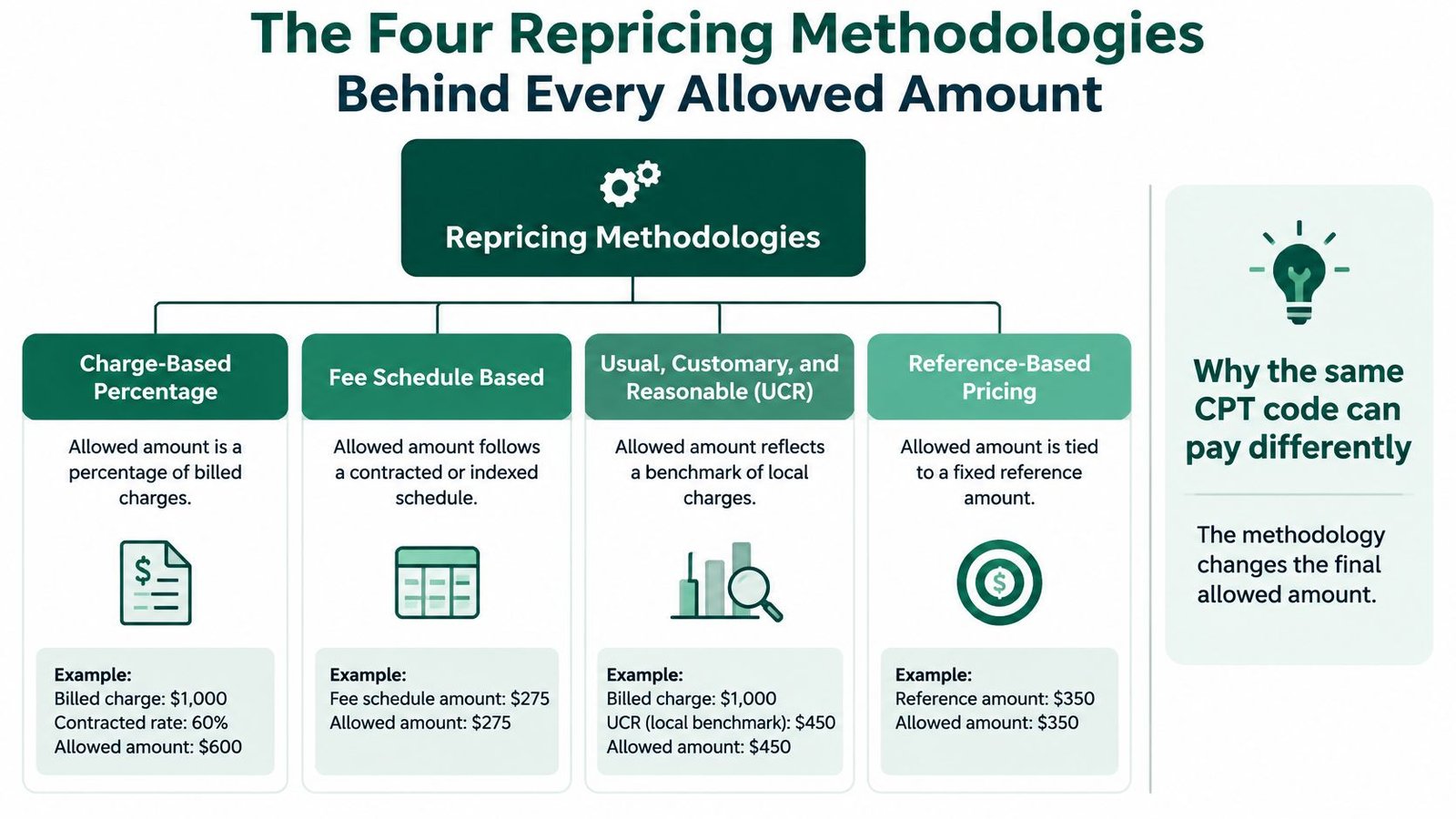
Before your practice disputes a reduction, identify the calculation family. Different methods require different evidence, and a persuasive benchmark under one method may be irrelevant under another.
Charge benchmarks and Medicare formulas
UCR and percentile-based pricing compare charges for a service within a geographic market. Cigna's disclosed methodology can select the 70th or 80th percentile; an 80th-percentile allowance means 80% of database charges fall at or below that amount, not that the insurer pays that share of your invoice. If there are fewer than nine charges for the service in a ZIP code, derived data may be used, according to Cigna's out-of-network reimbursement methodology.
A percentile dispute therefore needs the correct database, locality, service, and benchmark election. The explanation of usual and customary rates for out-of-network providers helps distinguish those inputs from a generic charge comparison.
Medicare-based formulas instead start with an applicable Medicare amount and apply the plan's multiplier. Cigna's alternative MRC2 approach uses a methodology similar to Medicare, with gap-fill provisions when no applicable Medicare amount exists.
Network allowances and vendor references
The remaining approaches depend on a rate source rather than your submitted charge alone:
- Contracted or network-access allowances use an applicable standing rate, external network arrangement, or accepted claim-specific agreement. Confirm that the arrangement applies to your practice and service.
- Reference-based or vendor-recommended amounts use a selected external benchmark or pricing recommendation. Ask which reference produced the allowance and which plan provision authorizes it.
A lesser-of rule can cap the allowance at the lower of covered billed charges or the selected benchmark. Raising the charge doesn't necessarily raise payment, and submitting a lower charge can limit the allowance even when the benchmark is higher.
The financial question isn't whether the reduction looks aggressive. It's whether the insurer applied the correct method to the correct claim inputs.
How Aetna, Cigna, and UnitedHealthcare Reprice Claims Side by Side
The useful comparison is Aetna vs Cigna vs UnitedHealthcare: how each reprices out-of-network claims, then who has authority to reconsider the result. The vendor patterns below describe routes practices may encounter, not official rules applying to every product.
Out-of-Network Repricing by Payer
| Payer | Primary repricing basis | Vendor commonly seen | Post-payment negotiability pattern |
|---|---|---|---|
| Aetna | Plan-defined recognized amount, including Medicare-based and FAIR Health approaches | Data iSight or MultiPlan on some claims | Often worth pursuing negotiation, subject to plan and vendor authority |
| Cigna | Legal payment rules, network or negotiated rates, then plan-selected MRC | Data iSight or MultiPlan on some claims | Negotiation can stall; preserve formal dispute rights |
| UnitedHealthcare | CMS, FAIR Health, Viant, or negotiated bases | Naviguard, Optum, or MultiPlan depending on the arrangement | Some disputes route to Naviguard; verify the responsible entity |
Aetna
Aetna's benefit document controls the recognized amount. Its disclosed Medicare-based examples range from 90% to 300%; using the document's $1,000 Medicare benchmark illustration produces an allowed basis of $900 or $3,000, respectively, before member cost sharing and other limits. Those examples appear in Aetna's New York commercial disclosure addendum.
For a disputed payment, request the recognized-amount provision and calculation before proposing a settlement. Where negotiation is available, confirm whether the payer or repricer can authorize additional payment; a vendor conversation doesn't automatically preserve the plan's appeal deadline.
Cigna
Cigna discloses a hierarchy: controlling law first, then applicable external pricing or standing network rates, then direct or claim-specific negotiation, followed by the sponsor-selected MRC methodology when no accepted rate results. Its reimbursement and compliance disclosures make clear why a generic percentage-of-Medicare appeal can miss the governing method.
The practical risk is extended negotiation without a substantive decision. If discussions stall, pursue the designated formal dispute route rather than repeatedly submitting the same unsupported request.
UnitedHealthcare
UnitedHealthcare's published bases include CMS, FAIR Health, Viant, and negotiated rates. Its out-of-network benefit payment policy ties the method to the benefit plan and service circumstances.
When a claim routes through Naviguard or Optum, identify who handles negotiation and who issues the formal benefit determination. A vendor referral isn't itself a resolution.
For Aetna, Cigna, UnitedHealthcare, Naviguard, Data iSight, and MultiPlan, use the out-of-network repricing tools guide as a companion to the claim-specific paperwork. Neither a vendor name nor the charge master establishes the amount owed.
Reading a Repriced Remittance and Decoding EOB Language
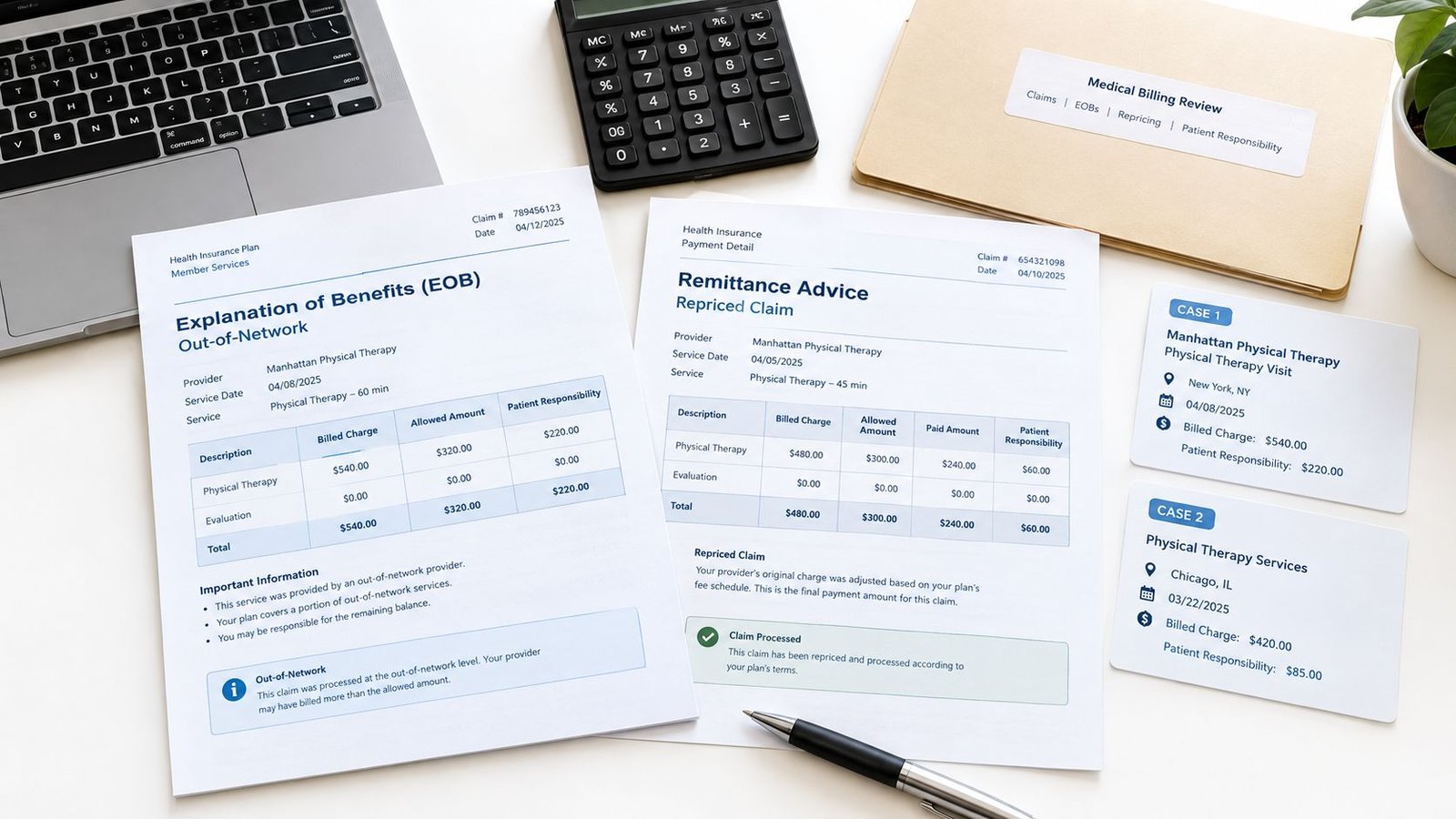
Consider an anonymized Manhattan physical therapy example: a visit billed at $540, with 97140 x2 and 97110 x2, produced a $60 Cigna payment after Data iSight repricing, compared with prior payments of $300 to $400 per visit. The management issue isn't that the payment fell. It's whether the plan, benefit method, unit treatment, or repricing route changed.
A separate anonymized multi-location New Jersey sports medicine example involved Cigna and Horizon repricing approximately $300 claims to $100. Those examples describe the payment problem, not recovered amounts or evidence that every similar reduction is erroneous.
What the document must establish
Before approving a write-off, reconcile the claim line by line:
- Allowed amount or recognized charge identifies the valuation basis, not necessarily the insurer's check.
- Maximum Reimbursable Charge signals a plan-defined Cigna benchmark that needs its underlying methodology.
- Member liability separates deductible and coinsurance from any legally permissible balance.
- Units and service classification determine whether the payer valued the services submitted.
For the physical therapy example, the owner needs confirmation that both procedure lines and their submitted units survived adjudication. A benchmark dispute won't fix a separate unit-processing problem.
Don't confuse the allowance with the check
Cigna illustrates a $100 charge, a $70 allowed amount, and a remaining $30 that may create balance-billing exposure where permitted by the plan and law in its transparency-in-coverage explanation. That difference isn't automatically additional insurer liability.
A smaller check can reflect cost sharing, a lower allowance, or a processing error. Those require different responses.
Require your current RCM provider to show the calculation, not merely label the account “paid.” The guide to reading an explanation of benefits provides a useful review framework for an administrator checking whether posted adjustments match the actual determination.
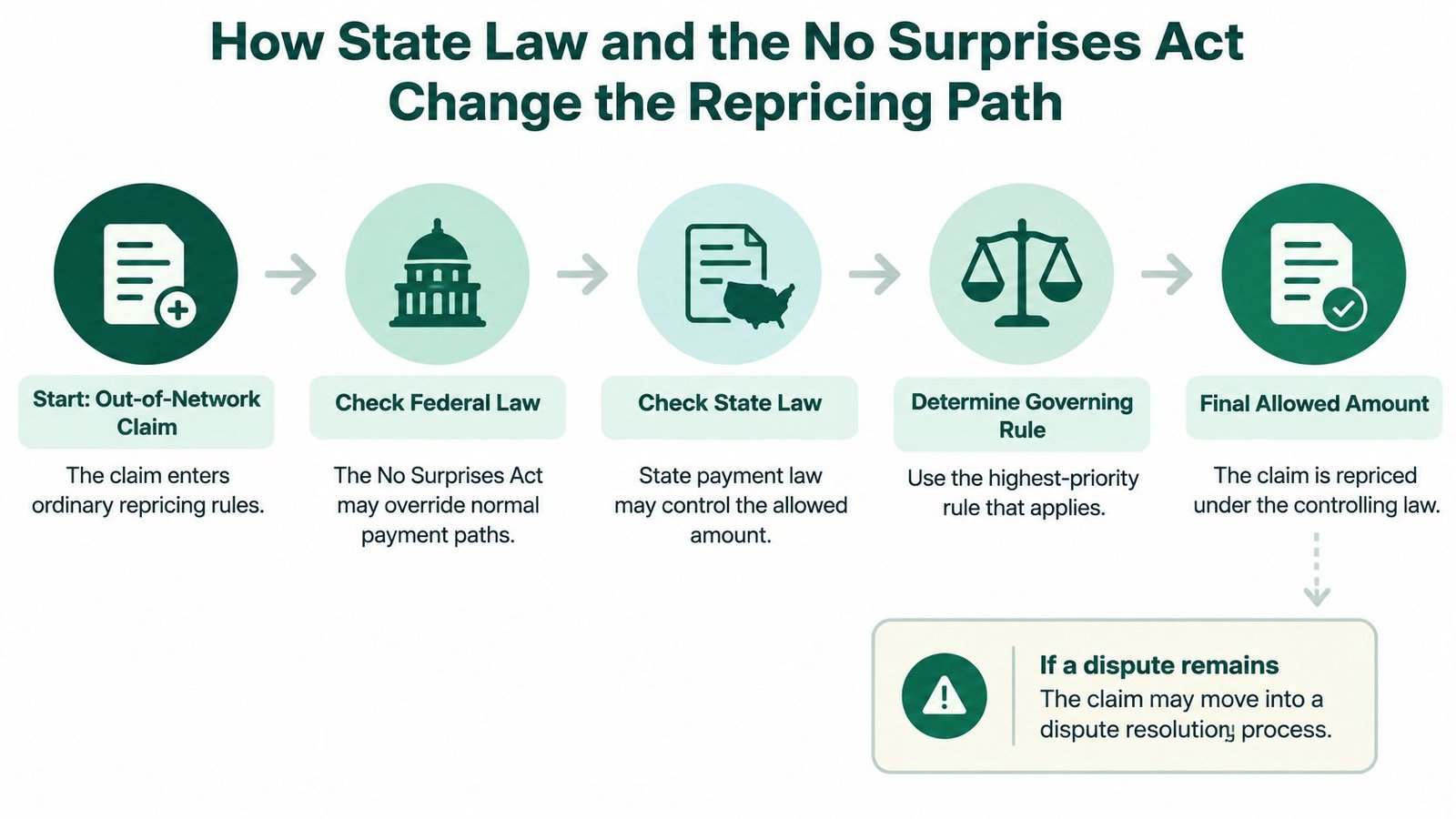
How State Law and the No Surprises Act Change the Repricing Path
Screen legal eligibility before deciding who owes the unpaid balance. Aetna, Cigna, and UnitedHealthcare claims can all require a different dispute path when federal or state protections apply. The insurer's ordinary out-of-network methodology doesn't settle that question.
For many emergency services and certain facility-based ancillary services, the No Surprises Act restricts balance billing and can place eligible payment disputes into federal independent dispute resolution. State law may instead supply the controlling payment rule or dispute mechanism, depending on the claim.
Make legal screening an upstream control
The practice needs a documented review of:
- Encounter circumstances, including emergency status and the facility setting.
- Plan and jurisdiction, so the team identifies the applicable legal regime.
- Provider role, particularly for ancillary services the patient didn't independently select.
- Dispute eligibility and deadlines, before choosing an ordinary appeal or another resolution process.
These distinctions are especially consequential for anesthesiology and hospital-based specialties. They also prevent an office-based practice from assuming that every out-of-network reduction qualifies for federal IDR.
Coverage and payment protection aren't interchangeable
Aetna explains that a provider's charge can exceed the recognized amount and that some resulting expenses don't count toward the out-of-network out-of-pocket maximum in its discussion of out-of-network care costs. That ordinary benefit explanation must still be read alongside any applicable balance-billing protection.
For surgical practices, Georgia Plastic & Reconstructive Surgery's resource on insurance coverage for reconstructive surgery provides related coverage context. Coverage review, however, doesn't replace a separate determination of the lawful out-of-network payment and collection path.
Collection safeguard: Don't transfer a disputed payer reduction to patient responsibility merely because the remittance displays a balance.
Use a documented balance-billing review before releasing statements. A correctly calculated ordinary allowance can still coexist with a legal prohibition on collecting the difference from the patient.
How We Approach Underpaid and Repriced Claims
We approach recovery as a documented payment dispute, not a request for a courtesy increase. The strongest file connects the plan obligation, the service delivered, the valuation evidence, and the authority of the person receiving the request.
Build a negotiable file
Group related claims. Where appropriate, we batch 10 or more underpaid claims sharing the same repricing issue so the payer case manager can evaluate the aggregate exposure. Combining unrelated plans or legal pathways makes the file harder to resolve, not more persuasive.
Select the right evidence. For charge-benchmark negotiations, our working approach uses the 90th percentile as an opening ceiling and the 80th percentile as a potential settlement reference. These are negotiation anchors, not universal FAIR Health rules, promised outcomes, or substitutes for a plan-required Medicare calculation.
Contact the responsible decision-maker. Outbound negotiation should identify the requested adjustment, supporting methodology, affected claims, and response deadline. Record whether the payer, vendor, or plan administrator can authorize the change.
The signs of systematic out-of-network underpayment can help owners decide whether they're looking at isolated processing errors or a recurring valuation issue.
Preserve the dispute path
When an original window has closed, first ask whether legitimate reprocessing or a permitted resubmission can produce a fresh determination. Don't submit a duplicate merely to manufacture a new appeal deadline. A fresh EOB doesn't automatically revive expired rights.
If negotiation fails, use the payer's applicable formal appeal, provider dispute, or one-time dispute process. Move to IDR only after confirming eligibility and preserving the required procedural steps.
For planning, we use a 45-to-90-day working horizon for this recovery approach, not a payer service commitment or collection guarantee. Complexity, missing documents, and the applicable dispute mechanism can change that schedule.
An assignment of benefits can support payer-facing work without routine patient outreach, but verify that it provides the required authority. Additional authorization or missing records may still be necessary.
Fees are contingency-only, depend on claim age and volume, and receive a clear quote after a free 30-minute call with a billing specialist. No recovery result is guaranteed.
Choosing Between In-House Recovery and an Outsourced RCM Partner
Keep recovery in-house when your administrator has the capacity to manage it as a distinct financial function. That means owning benchmark access, payer-specific deadlines, negotiation records, and the reconciliation of supplemental payments, not asking the existing team to “follow up harder.”
Outsourcing becomes more compelling when normal claim production consistently displaces recovery work. A practice can submit clean claims efficiently while leaving repriced accounts unresolved because nobody owns the post-payment dispute.
Test the operating model
Ask any internal team or prospective partner:
- Methodology ownership Who retrieves the governing benefit language and reconstructs the expected allowance?
- Escalation authority Who knows whether to contact the insurer, repricer, plan administrator, or dispute body?
- Financial reporting Can management distinguish open negotiations, filed disputes, final adjustments, and collected cash?
- Workflow fit Can the work occur inside the existing EHR without a migration?
Happy Billing works inside the existing EHR without migrations. Its recovery scope should be evaluated against your specialty, claim inventory, documentation, and applicable dispute routes, not a promised recovery percentage.
The in-house versus outsourced out-of-network recovery comparison offers a decision framework. Owners can also review the supported practice types through the medical billing specialty overview.
Don't let coverage work substitute for recovery
Specialty-specific benefit verification remains important. For example, the Vein and Wound Institute's insurance information for vein care is relevant context for practices considering coverage and financing communication, but it doesn't establish another practice's allowed amount or appeal rights.
The outsourcing decision should turn on execution: who can maintain a defensible claim inventory, meet deadlines, and explain each financial adjustment? Require a clear engagement scope and an account-level reporting sample before signing.
Book a free 30-minute call with a billing specialist to assess your repriced claim inventory and receive a clear contingency quote based on claim age and volume. Nothing is payable upfront; we only get paid when we deliver.
US practices only.
Frequently Asked Questions from Practice Owners
Can we negotiate a repriced claim after the insurer has paid it?
Potentially. Payment doesn't necessarily end negotiation or eliminate a valid dispute, but the available route depends on the plan, vendor arrangement, applicable law, and deadlines. Ask for written confirmation of who can reconsider the allowance and whether a settlement would release further rights.
How long should we leave a recovery account open?
Tie the account's status to a documented next action, not an indefinite follow-up date. Your recovery owner should identify whether the account is awaiting evidence, negotiation, reprocessing, or a formal decision. Management should approve closure only after the available route has been evaluated and the adjustment reason documented.
Will our practice need to contact the patient?
Not routinely when the existing assignment and records support payer-facing recovery. However, don't assume every assignment authorizes every appeal or disclosure. Verify the required authority before work begins, and keep any necessary patient communication separate from collection activity.
How can we tell a legitimate reduction from a repricing error?
Request a reproducible calculation. Your RCM team should show the governing methodology, relevant benchmark inputs, processed service details, member cost sharing, and applicable protections. If it can only explain that the payer “used an out-of-network rate,” you don't yet have enough information to approve either an appeal or a write-off.
Happy Billing offers contingency-only review and recovery work for out-of-network claims that need a defensible payment calculation and a payer-specific dispute path. Visit Happy Billing to arrange a free 30-minute call with a billing specialist and discuss your claim age, volume, and current A/R workflow. US practices only.